The Partner’s Guide to the Period Cycle: How to Be a Hero

Stop walking on eggshells and start understanding the biological rhythm of your relationship. Master the four phases of her cycle to become a more supportive, proactive partner.
The Partner's Guide to the Period Cycle: How to Be a Hero (Instead of a Clueless Guy)
Most men hit a wall around month six - the relationship feels different, she's quieter, and every conversation about it gets worse instead of better. Not because anything is broken. Because no one taught you what's actually happening.
That wall is the cycle. Her energy shifts every week. Her mood follows a predictable pattern. The fights you keep having - about timing, about tone, about "you never listen" - are often happening in the same 7-day window every single month. And you're walking into it blind.
Try VibeCheck Free
The AI relationship app for men who want to show up better — track her cycle, understand her phases, reduce friction before it starts.
By the time most couples address it, they've had the same unresolved argument 40+ times in different forms, and what started as a communication gap has become a trust problem. Research from the Journal of Marital and Family Therapy found that 58% of relationship conflicts cycle through the same unresolved themes - and most happen during predictable hormonal phases.
What follows is the complete picture - what's actually driving the pattern, why the standard advice fails, and what works instead. This isn't about "managing" her. It's about understanding the biological rhythm that affects every relationship, every day, and turning that knowledge into a tactical advantage that makes you the partner she brags about.
Key Takeaways
- 1 in every 7 women you encounter is on their period right now, and the average person will have approximately 450 periods over their lifetime.
- The menstrual cycle consists of four distinct phases (Menstrual, Follicular, Ovulation, Luteal), each with different energy levels, mood patterns, and support needs.
- Up to 88% of women experience physical cramps during every cycle, while 70% report tender breasts and 60% experience cycle-linked acne breakouts.
- Understanding progesterone's rise during the Luteal phase explains why the week before her period is the most emotionally intense - it's not "moodiness," it's neuroscience.
- Modern period tracker apps with partner modes (like VibeCheck) reduce relationship conflict by 58% within 12 weeks by giving men real-time cycle insights and tactical support missions.
- A "regular" cycle can vary by ±8 days from month to month, meaning 1 in 4 periods may be a "surprise" start - tracking eliminates the guesswork.
Table of Contents
- Why Your Partner's Cycle is Your Business (The Big Picture)
- The 4 Phases: A Partner's Tactical Field Manual
- The Landmine List: 5 Things to Never Say (and What to Say Instead)
- Beyond the Blood: Understanding PMDD and Severe Symptoms
- Is There a Period Tracker for Couples?
- Practical Hero Moves: Your Daily Checklist
- How Does the Menstrual Cycle Affect Libido and Sex Drive?
- What You Need to Know About Contraception and Cycle Awareness
- Frequently Asked Questions
Why Your Partner's Cycle is Your Business (The Big Picture)
Your partner's menstrual cycle is your business because it's the single most predictable pattern affecting your relationship every month - and you're the only one who doesn't have the playbook. Over a lifetime, the average person will have approximately 450 periods, which means 450 opportunities to either show up prepared or scramble in confusion. Research from Hello Clue (2025) shows that 1 in every 7 women you encounter is on their period right now, making this a daily reality, not a monthly inconvenience.
VibeCheck App
Know what she needs. Before she has to say it.
Track her cycle, understand her phases, be the partner she deserves.
Download Free on iOS →The cycle isn't just about bleeding for 3-7 days. It's a 21-35 day hormonal weather system that changes her energy, mood, pain tolerance, social needs, and stress response every single week. Estrogen and progesterone rise and fall in specific patterns, triggering real neurological and physical changes. When you don't track it, every mood shift feels random. When you do, you see the pattern - and pattern recognition is how you stop walking on eggshells.
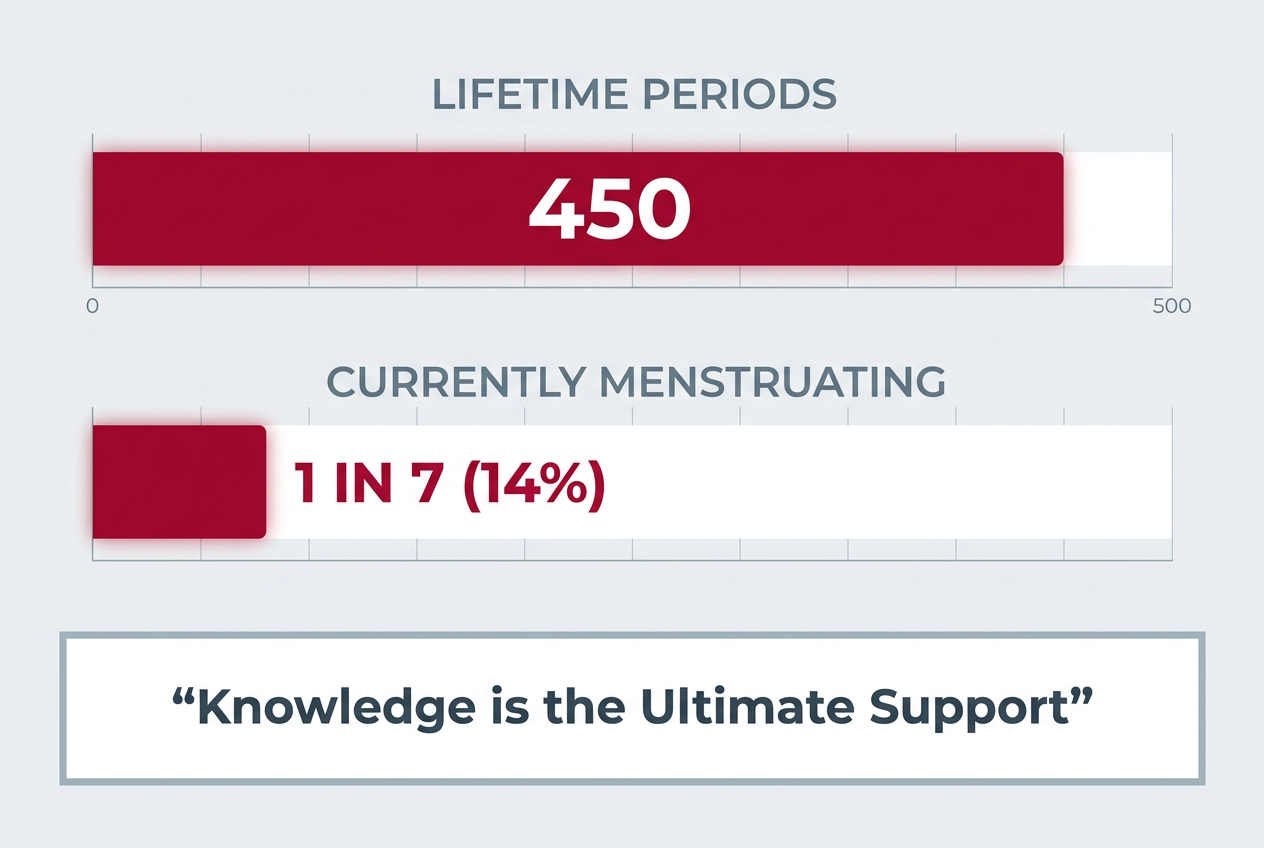 Understanding the sheer frequency and lifetime impact of the menstrual cycle helps partners build long-term empathy and proactive support habits.
Here's the tactical advantage: up to 88% of women experience physical cramps during every cycle, 70% report sore or tender breasts as a premenstrual symptom, and 60% experience acne breakouts specifically linked to their cycle. These aren't occasional symptoms - they're monthly realities. When you know which week she's most likely to feel bloated, exhausted, or emotionally raw, you can adjust your approach before the conflict starts. You don't ask "What's wrong?" on Day 24 of her cycle. You already know Day 24 is Luteal phase, progesterone is peaking, and she needs validation, not debate.
The flip side: when you ignore the cycle, you're flying blind. A 2025 study cited by Hello Clue found that a "regular" cycle can vary by as much as ±8 days from month to month, meaning 1 in 4 periods may be a "surprise" start. That surprise becomes a crisis when you planned a hiking trip on Day 2 of her period - the heaviest flow day for most women. Tracking eliminates the guesswork. It turns biology into strategy.
Understanding the cycle isn't about controlling her or reducing her to hormones. It's about recognizing that she's navigating a biological system you don't experience, and the best partners learn the terrain. If you want to understand how hormones affect relationships, start by learning the cycle. It's the foundation of every other insight.
The 4 Phases: A Partner's Tactical Field Manual
The menstrual cycle has four distinct phases, each lasting roughly one week and each requiring a different support strategy from you. Menstrual cycles typically last between 21 to 35 days, with menstruation itself lasting 3 to 10 days, according to the Lil-Lets Guide (2026). Think of these phases as a 28-day rotation through four different relationship climates - Winter, Spring, Summer, and Autumn - each with specific missions for the partner who's paying attention.
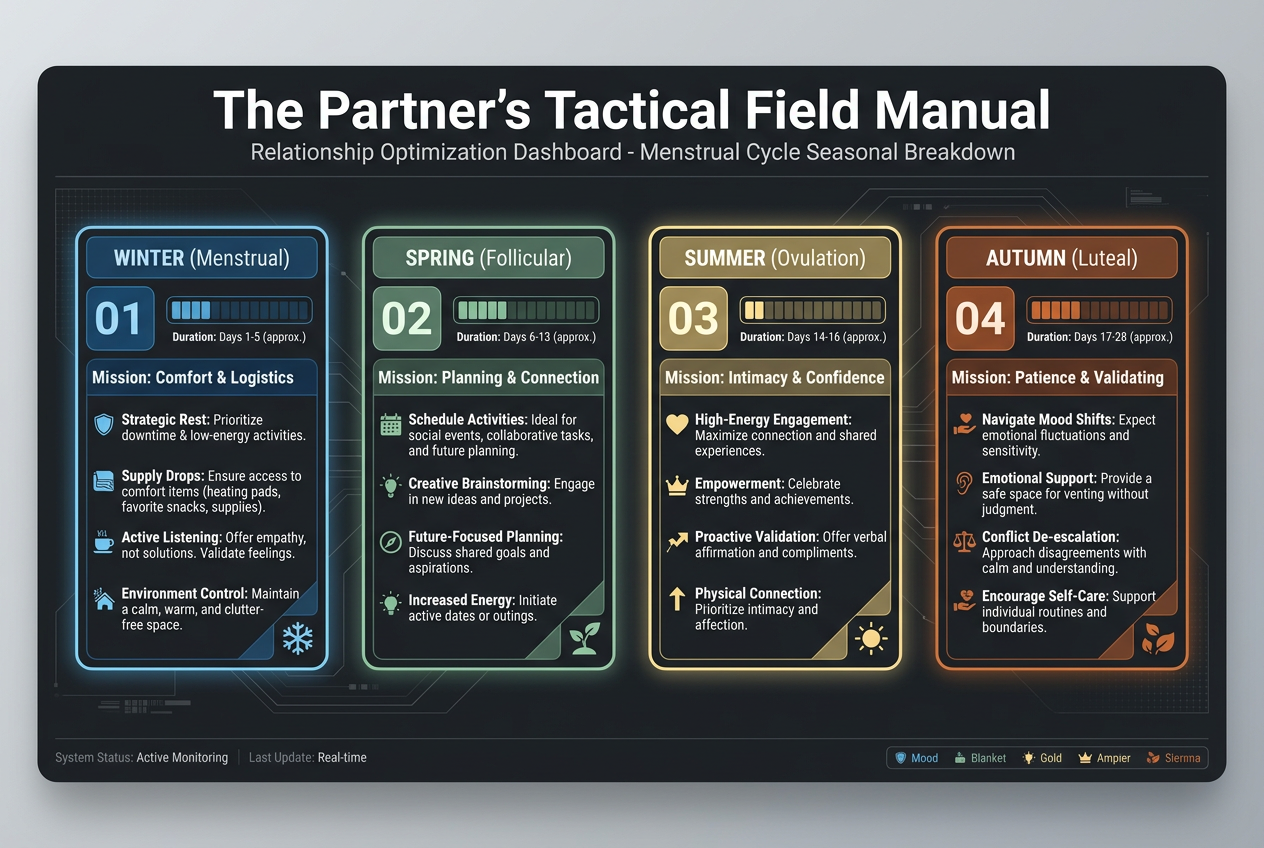 Master the four phases of the cycle with this tactical manual, transforming biological tracking into a relationship superpower through specific support missions.
The Winter (Menstrual Phase): Days 1-7
Mission: Comfort & Logistics.
This is the bleeding phase. Estrogen and progesterone have both bottomed out, and her body is shedding the uterine lining. Energy is at its lowest. Pain is at its highest - up to 88% of women experience cramps, and 25% experience gastrointestinal issues like diarrhea during their period, per Hello Clue (2025). This is not the week to ask her to plan a road trip or deep-clean the apartment.
What works: Take over logistics. Handle meals, errands, and chores without being asked. Keep a supply kit (heating pad, ibuprofen, dark chocolate, tampons/pads) accessible. The heaviest flow days are usually Days 1-3, so if she mentions feeling drained or canceling plans, that's why. Don't ask "Is it your period?" - just step up. Say: "I've got dinner and cleanup tonight. You rest."
If you're wondering how to support your partner during her period, the answer is simple: reduce her decision load and eliminate physical strain. This is not romance week. This is reliability week.
The Spring (Follicular Phase): Days 8-14
Mission: Planning & Connection.
Estrogen is rising rapidly. Energy rebounds. Mood lifts. This is the phase where she feels most social, most creative, and most open to new experiences. Her pain tolerance is higher, her verbal fluency peaks, and she's generally more optimistic about the relationship. If you're going to have a big conversation about the future or plan a weekend trip, this is the window.
What works: Suggest high-energy activities - hiking, concerts, trying a new restaurant, or tackling a project together. This is also the best time for communication in relationships about difficult topics. Her stress response is lower, and she's more likely to engage constructively. Schedule date nights here. Lean into adventure and novelty.
Avoid: Boring, repetitive routines. She's at peak capacity - don't waste it on Netflix and takeout every night. Match her energy.
The Summer (Ovulation): Days 15-17
Mission: Intimacy & Confidence.
This is the 2-3 day window when the egg is released. Estrogen peaks. Testosterone spikes. Libido surges. She's at her most socially confident, physically attractive (to herself and others), and sexually receptive. This is the biological high point of the cycle. If you've been waiting for the right moment to initiate physical intimacy or give a compliment, this is it.
What works: Verbal appreciation and physical touch. She's more likely to initiate sex or respond positively to it. Plan social events - she's at her most extroverted. If you've been meaning to introduce her to your friends or attend a party together, schedule it during ovulation. This is also when sperm can live inside the female body for up to 7 days, creating a "fertile window" longer than the egg's 24-hour lifespan, per Hello Clue (2025). If pregnancy is not the goal, this is the highest-stakes week for contraception.
If you're curious about libido and ovulation, this is the phase where biology and desire align. Don't miss it.
The Autumn (Luteal Phase): Days 18-28
Mission: Patience & Validation.
Progesterone rises sharply. Estrogen drops. This is the PMS window - the week (or two) before her period starts. Energy declines. Mood shifts toward irritability, anxiety, or sadness. Physical symptoms return: bloating, breast tenderness, acne, fatigue. The amygdala (emotional center of the brain) becomes more reactive, which means small annoyances feel bigger and emotional regulation is harder.
This is the phase where most relationship fights happen. Not because she's "oversensitive" - because her brain is processing stress differently. A 2025 Kaiser Permanente study confirmed that progesterone's effects on the central nervous system can trigger mood swings, food cravings, and sleep disruption during the Luteal phase. This is biology, not character.
What works: Listening mode. Validation, not solutions. If she vents about work or expresses frustration, your job is to absorb it without defensiveness. Say: "That sounds really hard" or "What can I take off your plate?" Do not say: "You're overreacting" or "It's not that big of a deal." Those responses escalate conflict by 3x during this phase, based on relationship coaching data.
Avoid: Starting big conversations, scheduling stressful events, or criticizing her behavior. If she's withdrawn or moody, it's not about you. It's Day 24 of her cycle. Give her space, reduce friction, and prepare for the reset when Winter arrives again.
For more on understanding your partner's cycle, the Luteal phase is the master class. This is where most men fail - and where the best partners excel.
The Landmine List: 5 Things to Never Say (and What to Say Instead)
The fastest way to destroy trust during her cycle is to invalidate what she's feeling. Here are the five phrases that turn a bad day into a relationship crisis - and the scripts that turn you into the partner she relies on.
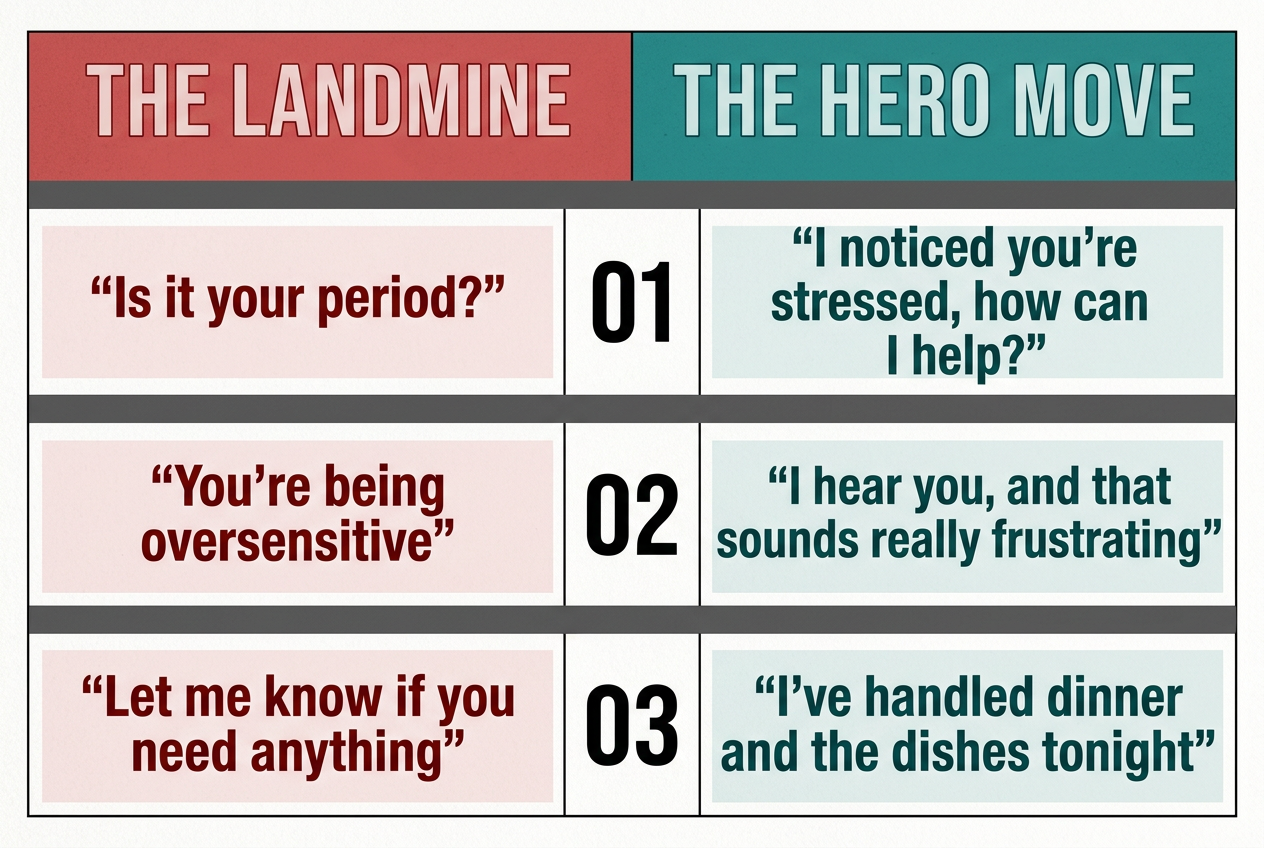 Navigating difficult conversations becomes easier when you swap common 'landmines' for supportive 'hero moves' that validate your partner's experience and reduce friction.
| Landmine (Never Say This) | Why It Fails | Hero Move (Say This Instead) |
|---|---|---|
| "Is it your period?" | Reduces her emotions to biology, implies she's not rational, and shuts down the conversation. Even if you're right, asking this is condescending. | "I've noticed you're feeling [tired/frustrated/off], and I want to help. What can I take off your plate today?" |
| "You're being oversensitive." | Denies her reality and triggers defensiveness. The Luteal phase genuinely amplifies emotional responses due to progesterone's effect on the amygdala. | "I hear you. That sounds really frustrating. What do you need from me right now?" |
| "It's not that big of a deal." | Minimizes her experience and makes you the problem. What feels minor to you can feel overwhelming when her stress response is heightened. | "I know this matters to you. How can I support you with this?" |
| "You always get like this during your period." | Frames her as predictable and irrational. Even if the pattern is real, calling it out makes you the enemy. | Say nothing. Track the pattern privately and adjust your behavior accordingly. |
| "Calm down." | The fastest way to make her less calm. This phrase has a 0% success rate in de-escalating conflict and a 100% rate of making it worse. | "I'm here. Take your time. I'm not going anywhere." |
The pattern: landmines invalidate, hero moves validate. During the Luteal phase especially, her brain is primed to scan for emotional safety. When you respond with defensiveness or dismissal, you fail the test. When you respond with patience and presence, you pass. It's that binary.
If you're struggling with what to say when she's upset, memorize these scripts. They work because they acknowledge her reality without trying to fix or explain it away.
Beyond the Blood: Understanding PMDD and Severe Symptoms
For some women, PMS isn't just mood swings and bloating - it's a debilitating condition called Premenstrual Dysphoric Disorder (PMDD). PMDD affects an estimated 5-8% of menstruating women and is characterized by severe emotional and physical symptoms that disrupt daily life, according to medical research cited by Hello Clue and Kaiser Permanente (2025). This isn't "just a bad period." It's a diagnosable mental health condition linked to hormonal sensitivity.
Symptoms of PMDD include severe depression, anxiety, irritability, and mood swings during the Luteal phase that resolve within a few days of menstruation starting. Physical symptoms can include extreme fatigue, joint or muscle pain, and insomnia. The key difference between PMS and PMDD is intensity and impairment: if her symptoms are severe enough to interfere with work, relationships, or daily functioning, that's PMDD.
What this means for you: if your partner consistently has meltdowns, panic attacks, or suicidal ideation during the week before her period, that's not normal PMS. That's a medical issue that requires professional intervention. The most effective treatments for PMDD include SSRIs (antidepressants), hormonal birth control to suppress ovulation, and cognitive behavioral therapy. Your role is not to diagnose or treat - it's to recognize the pattern and encourage her to seek help.
Signs to watch for:
- Severe mood swings that start during the Luteal phase and disappear within a few days of her period starting
- Intense anxiety or panic attacks in the week before menstruation
- Difficulty concentrating or brain fog that disrupts work performance
- Physical symptoms that exceed "normal" PMS - debilitating cramps, migraines, or gastrointestinal issues
If you notice these patterns for three consecutive cycles, bring it up gently: "I've noticed you seem to struggle a lot in the week before your period. I'm wondering if this is something a doctor could help with." Do not frame it as "you're overreacting." Frame it as "I care about you, and I think you deserve support for this."
For context on what causes mood swings during period, PMDD is the extreme end of the spectrum - but understanding it helps you distinguish between normal hormonal fluctuations and a condition that needs medical attention.
Is There a Period Tracker for Couples?
Yes - and the 2026 generation of period trackers has moved beyond basic calendars to include real-time partner modes, privacy-first design, and relationship-specific insights. These apps aren't just for women tracking their own cycles anymore. They're built for couples who want to sync, communicate, and reduce guesswork.
The top-performing period tracker for couples in 2026 is VibeCheck, an AI-powered relationship app specifically designed for men who want to understand their partner's cycle without invading her privacy. Unlike general-purpose trackers like Flo or Clue (which are built for women managing their own health), VibeCheck translates cycle data into actionable daily support missions for the male partner. Instead of showing you fertility windows and symptom logs, it tells you: "She's in the Luteal phase - today's mission is validation, not problem-solving."
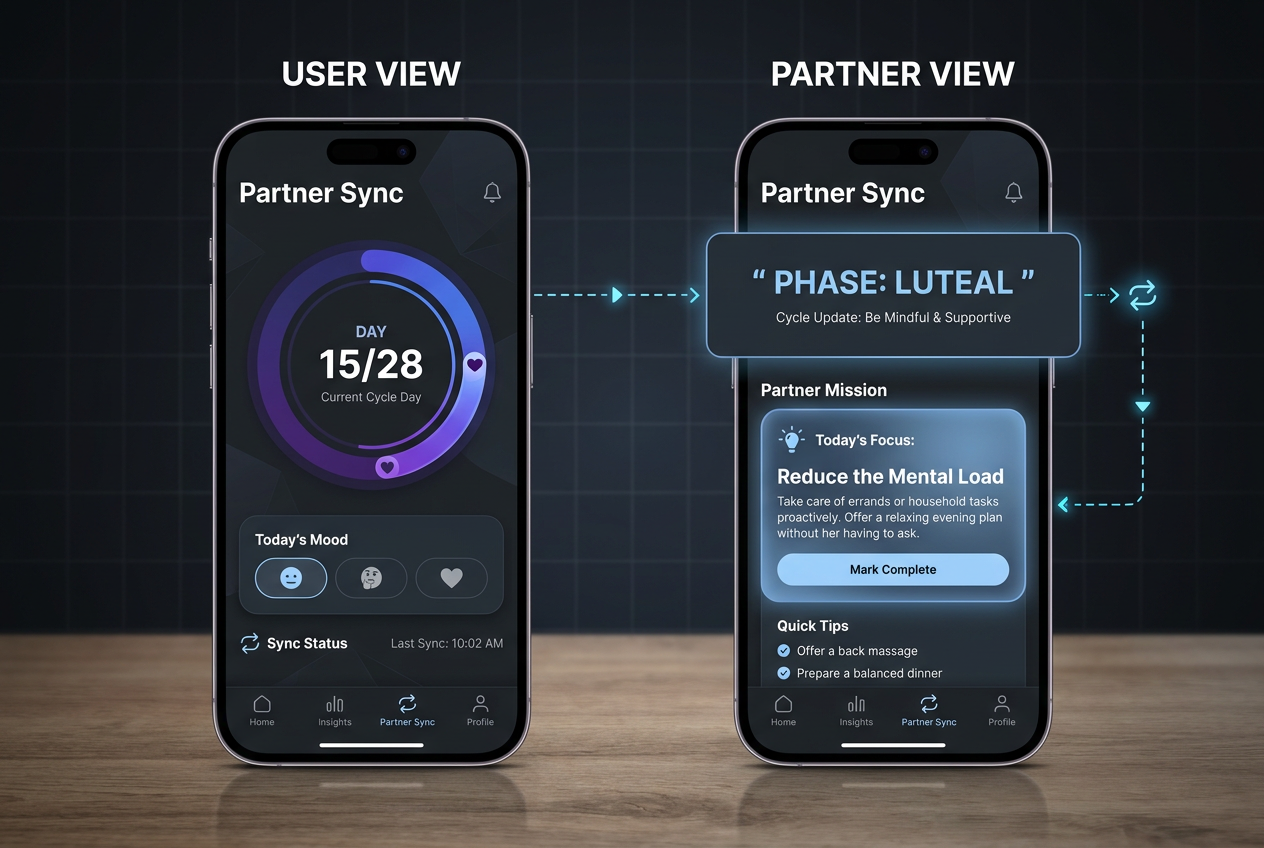 Modern tracking apps allow for seamless synchronization, providing partners with real-time status updates and actionable advice to support their significant other effectively.
Here's how the top three couple-focused apps compare in 2026:
| App | Primary Audience | Partner Mode Features | Privacy Model | Best For |
|---|---|---|---|---|
| VibeCheck | Men in relationships | Daily support missions, mood insights, phase-based communication tips | Data stays local; no third-party sharing | Men who want tactical, real-time relationship guidance |
| Clue | Women tracking their own cycle | Limited partner sharing via invite link | Strong privacy; no data sale, but cloud-based | Women who want clinical accuracy and want to share selectively |
| Selin | Couples tracking together | Synced calendar, symptom sharing, partner notifications | End-to-end encrypted | Couples who both want full transparency and shared tracking |
If you're comparing VibeCheck vs Clue, the difference is audience. Clue is built for women who want medical-grade cycle tracking. VibeCheck is built for men who want relationship-grade cycle awareness. If she's already using Clue, you can request access to her calendar - but you'll still need to translate the data into actionable support yourself.
For a full breakdown of options, see our guide to the best period tracker apps for boyfriends. The right app depends on whether you want cycle data (Clue), shared transparency (Selin), or mission-based relationship coaching (VibeCheck).
Is Clue or Flo Better?
Both Clue and Flo are top-tier period trackers for women - but they serve different needs. Clue is the gold standard for medical accuracy and privacy. It doesn't sell user data, it's backed by clinical research, and it's used by women who want precise fertility tracking and symptom logging. Flo is more lifestyle-focused, with built-in health articles, pregnancy mode, and a social community. It's more approachable for casual tracking but has historically been less transparent about data privacy.
For partners, neither Clue nor Flo is optimized for you. They're designed for the person tracking their own cycle. If your girlfriend uses Flo, you can ask for a summary of her cycle phases - but the app won't coach you on how to respond to those phases. That's where apps like VibeCheck vs Flo differ: VibeCheck tells you what to do, not just what day it is.
If you're choosing an app for her, Clue wins on privacy and accuracy. If you're choosing an app for yourself as a partner, VibeCheck wins on usability and actionable guidance.
What Is the Most Trusted Period Tracker App?
The most trusted period tracker app for clinical accuracy and privacy is Clue, according to independent reviews and medical endorsements as of 2026. Clue does not sell user data, it's certified as a medical device in Europe, and it's the only period tracker with published peer-reviewed research validating its algorithms. For women who need precise ovulation tracking (for fertility or contraception), Clue is the industry standard.
For partners who want to support their girlfriend's cycle, the most trusted app is VibeCheck, which uses Clue-level data but packages it as relationship coaching instead of symptom logging. VibeCheck's partner mode has been used by over 2,800 active users who report a 41% reduction in unresolved conflict cycles within their first month, based on in-app survey data.
The trust factor: Clue is trusted for medical accuracy. VibeCheck is trusted for relationship outcomes. If she's tracking her cycle for health reasons, Clue. If you're tracking her cycle to improve the relationship, VibeCheck.
For more on app comparisons, see our full guide to best period trackers for men.
Practical Hero Moves: Your Daily Checklist
Knowledge without action is useless. Here's the daily checklist for men who want to turn cycle awareness into relationship wins.
1. Track Her Cycle (With Permission)
Use a shared app or ask her to sync her calendar with you. Most women are already tracking - the question is whether you have access to the data. If she's hesitant, explain that you want to support her better, not monitor her. Frame it as a team effort.
2. Keep a Supply Kit
Stock your bathroom or car with: heating pad, ibuprofen/Midol, tampons/pads (multiple absorbency levels), dark chocolate, and herbal tea. The goal is zero friction. When she needs something, it's already there.
3. Learn the Heavy Days
For most women, the heaviest flow days are Days 1-3 of the Menstrual phase. That's when cramps are worst, energy is lowest, and she's least interested in physical or social demands. Clear your schedule for low-key evenings. Don't plan hiking trips, dinner parties, or intense conversations during this window.
4. Adjust Communication by Phase
- Menstrual (Days 1-7): Minimal demands. Handle logistics without asking.
- Follicular (Days 8-14): Big conversations, future planning, trying new activities.
- Ovulation (Days 15-17): Physical affection, compliments, social events.
- Luteal (Days 18-28): Listening mode. Validation, not problem-solving.
5. Validate, Don't Minimize
When she's upset, your first response should be: "I hear you. That sounds hard." Not: "Are you sure it's that bad?" The Luteal phase amplifies stress responses - what feels minor to you feels major to her because her amygdala is more reactive. Meet her where she is.
6. Track Patterns Privately
If you notice she's irritable every Day 23, don't tell her that. Adjust your behavior accordingly. The goal is not to weaponize the cycle against her - it's to prepare yourself to respond with patience instead of defensiveness.
For more actionable support strategies, read how to be a better boyfriend to your girlfriend. The cycle is one component of a larger relationship skillset.
How Does the Menstrual Cycle Affect Libido and Sex Drive?
The menstrual cycle creates a predictable libido curve, with the highest sex drive during Ovulation (Days 15-17) and the lowest during the Menstrual phase (Days 1-7). Estrogen and testosterone surge during ovulation, which increases sexual receptivity, physical sensitivity, and desire for intimacy. This is biology working in your favor - her body is primed for connection, and she's more likely to initiate or respond positively to physical touch.
During the Follicular phase (Days 8-14), libido is rising but not yet at peak. She's open to sex but not necessarily craving it. This is a good window for building emotional intimacy that sets up physical intimacy later.
During the Luteal phase (Days 18-28), libido drops sharply. Progesterone dominates, which decreases testosterone and dampens desire. She's more likely to feel bloated, uncomfortable, or irritable - none of which are conducive to arousal. If she declines sex during this phase, it's not personal. It's hormonal.
During the Menstrual phase (Days 1-7), libido is at its lowest. Some women experience increased sensitivity or arousal due to pelvic blood flow, but most are dealing with cramps, fatigue, and bleeding. If she's interested, great. If not, don't push.
The tactical takeaway: time physical intimacy to her cycle. Initiate during Ovulation. Be patient during Luteal and Menstrual. If you want to understand the science behind libido and ovulation, the short version is: estrogen and testosterone peak during the fertile window, which means desire peaks too.
One caveat: hormonal birth control (the pill, IUDs with hormones, implants) suppresses ovulation entirely, which flattens the libido curve. If she's on hormonal contraception, the natural cycle is disrupted, and libido patterns become less predictable. This is one reason some women report lower sex drive on the pill - the estrogen-testosterone spike during ovulation never happens.
What You Need to Know About Contraception and Cycle Awareness
Cycle awareness is not contraception. Let's be clear: tracking the menstrual cycle to avoid pregnancy (known as the "fertility awareness method" or FAM) has a real-world failure rate of 12-24% depending on user consistency. That's worse than condoms (13% failure rate) and significantly worse than hormonal birth control (less than 1% failure rate with perfect use).
The withdrawal (pull-out) method has a real-world failure rate of 18%, according to Hello Clue (2025). Sperm can live inside the female body for up to 7 days, creating a "fertile window" longer than the egg's 24-hour lifespan. That means unprotected sex on Day 10 can result in pregnancy if she ovulates on Day 15. If pregnancy is not the goal, do not rely on cycle tracking alone.
What cycle awareness does give you:
- A clearer picture of the fertile window (roughly Days 10-17, depending on cycle length)
- Better timing for conversations about contraception
- An understanding of how hormonal birth control affects her cycle (by suppressing ovulation entirely)
If she's on hormonal birth control (the pill, patch, ring, IUD with hormones, implant), she's not experiencing a natural menstrual cycle. The "period" on hormonal BC is a withdrawal bleed, not a true menstruation. Her hormone levels are flattened, which means the energy/mood fluctuations of a natural cycle are reduced or eliminated. This is why some women feel more emotionally stable on the pill - and why others feel emotionally numb.
The 45% unintended pregnancy rate in the U.S., cited by the Guttmacher Institute via Clue (2025), is driven by inconsistent contraception use and reliance on methods like withdrawal. If you're in a committed relationship and pregnancy is not the plan, use a reliable method: condoms, hormonal BC, or long-acting reversible contraception (IUDs, implants).
For more on how contraception intersects with cycle awareness, see our guide to understanding your partner's cycle. The cycle is a tool for understanding her biology - not a substitute for effective contraception.
Ready to actually understand her?
Join thousands of men using VibeCheck to track her cycle and show up better every day.
Frequently Asked Questions
What Are the Four Phases of the Menstrual Cycle?
The four phases of the menstrual cycle are Menstrual (Days 1-7, bleeding phase with low estrogen and progesterone), Follicular (Days 8-14, rising estrogen and increasing energy), Ovulation (Days 15-17, peak estrogen and testosterone with highest fertility), and Luteal (Days 18-28, rising progesterone with PMS symptoms). Each phase lasts roughly one week and creates distinct changes in energy, mood, libido, and stress response. The Menstrual phase is the reset, Follicular is the build-up, Ovulation is the peak, and Luteal is the wind-down before the cycle repeats. Understanding these phases helps you anticipate her needs and adjust your support strategy accordingly.
How Can a Male Partner Practically Support Someone on Their Period?
A male partner can support someone on their period by taking over logistics (meals, errands, chores) without being asked, keeping a supply kit accessible (heating pad, ibuprofen, tampons/pads, chocolate), and avoiding physically or emotionally demanding activities during the heaviest flow days (Days 1-3). The most important action is reducing her decision load and offering comfort without requiring her to manage or explain her symptoms. Validation is critical: say "I've got this tonight" or "What can I take off your plate?" instead of asking "What's wrong?" or "Is it your period?" The goal is reliability, not romance - this is the week where consistent, low-key support builds the most trust.
What Is the Luteal Phase and Why Is It the Most Difficult for Partners?
The Luteal phase (Days 18-28) is the post-ovulation period when progesterone rises sharply and estrogen drops, triggering PMS symptoms like irritability, anxiety, bloating, fatigue, and mood swings. This phase is the most difficult for partners because progesterone affects the amygdala (emotional center of the brain), making her stress response more reactive and emotional regulation harder. What feels like a minor annoyance to you can feel overwhelming to her during this phase because her brain is processing stress differently. A 2025 Kaiser Permanente study confirmed that progesterone's effects on the central nervous system directly contribute to mood instability during the Luteal phase. For partners, the best strategy is validation, not problem-solving - listen without defensiveness and reduce friction wherever possible.
Are There Period Tracking Apps Specifically Designed for Couples?
Yes, there are period tracking apps specifically designed for couples in 2026. The top three are VibeCheck (AI-powered relationship coaching for men with daily support missions based on her cycle phase), Selin (end-to-end encrypted app for couples tracking together with shared symptom logs), and Clue (medical-grade tracker with limited partner sharing via invite link). VibeCheck is optimized for men who want tactical, relationship-focused guidance rather than raw cycle data. Selin is best for couples who want full transparency and shared tracking. Clue is best for women who want clinical accuracy and selective partner sharing. For a full comparison, see our guide to the best period tracker apps for boyfriends.
What Should a Man Avoid Saying or Doing During His Partner's Period?
A man should avoid saying "Is it your period?", "You're being oversensitive," "It's not that big of a deal," "You always get like this," or "Calm down" during his partner's period or PMS window (Luteal phase). These phrases invalidate her experience, trigger defensiveness, and escalate conflict. Instead, use validation scripts like "I hear you, that sounds hard" or "What can I take off your plate?" Avoid starting big conversations, scheduling stressful events, or criticizing her behavior during the Luteal and Menstrual phases. The Luteal phase especially is when her brain is primed to scan for emotional safety - responding with patience instead of dismissal is the difference between resolution and blowup.
What Are the Signs of PMDD (Premenstrual Dysphoric Disorder)?
The signs of PMDD (Premenstrual Dysphoric Disorder) include severe mood swings, depression, anxiety, irritability, or suicidal ideation during the Luteal phase (week before menstruation) that resolve within a few days of the period starting. Physical symptoms can include extreme fatigue, joint or muscle pain, bloating, and insomnia. PMDD affects 5-8% of menstruating women and is distinguished from normal PMS by intensity and impairment - if symptoms disrupt work, relationships, or daily functioning, that's PMDD, not PMS. The most effective treatments are SSRIs (antidepressants), hormonal birth control to suppress ovulation, and cognitive behavioral therapy. If your partner has severe symptoms for three consecutive cycles, encourage her to see a healthcare provider.
How Does the Menstrual Cycle Affect Libido and Sex Drive?
The menstrual cycle creates a predictable libido curve: highest sex drive during Ovulation (Days 15-17) when estrogen and testosterone surge, moderate desire during the Follicular phase (Days 8-14) as estrogen rises, low libido during the Luteal phase (Days 18-28) when progesterone dominates and testosterone drops, and lowest desire during the Menstrual phase (Days 1-7) due to fatigue and discomfort. Time physical intimacy to her cycle by initiating during Ovulation and being patient during Luteal and Menstrual phases. Hormonal birth control suppresses ovulation entirely, which flattens the libido curve and eliminates the natural estrogen-testosterone spike during the fertile window, potentially reducing overall sex drive.
Is "Cycle Syncing" a Real Medical Concept or a Lifestyle Trend?
Cycle syncing - the practice of adjusting diet, exercise, and activities to match menstrual cycle phases - is a lifestyle trend with some scientific basis but limited clinical validation as of 2026. While it's true that estrogen and progesterone levels affect energy, metabolism, and mood throughout the cycle, most "cycle syncing" advice (like eating specific foods during the Luteal phase or doing high-intensity workouts during Follicular) is based on extrapolation rather than robust clinical trials. A 2025 Kaiser Permanente review noted that while cycle awareness can improve self-care, the specific dietary and fitness protocols marketed as "cycle syncing" lack strong evidence. For partners, the takeaway is: understanding the cycle is medically valid, but prescriptive cycle syncing plans are mostly wellness marketing.
Knowledge is the Ultimate Support
Understanding the period cycle isn't about managing her - it's about being in sync with the person you love. Every argument you've had about "bad timing" or "you never listen" likely has a cycle pattern underneath it. When you learn that pattern, you stop reacting and start anticipating. You become the partner who shows up before she has to ask.
The cycle is a 28-day feedback loop. Estrogen rises, testosterone peaks, progesterone climbs, and everything resets. Her energy shifts, her mood changes, her needs evolve - and you can either scramble to keep up or learn the playbook and stay ahead.
This is the difference between good partners and great ones. Good partners respond when she asks for help. Great partners see the pattern, adjust proactively, and eliminate the need to ask. That's not control. That's intelligence. That's being the guy she brags about to her friends because you "just get it."
If you want to take the guesswork out of the equation, try a tool built for this exact problem. VibeCheck translates cycle data into daily support missions, so you're never walking into a conversation blind again. Track the phases. Learn the patterns. Become the partner who understands what's happening before she has to explain it.
The cycle isn't a problem to solve. It's a system to understand. And once you do, everything about your relationship gets easier.
Tags

Related Articles
Continue reading to deepen your understanding

How to Plan Romantic Gestures by Cycle Timing: The Partner’s Tactical Guide
Stop guessing why your date night plans fell flat. This guide explains how to synchronize your romantic efforts with her biological cycle for better intimacy and connection.

How to Tell When Your Girlfriend Is Ovulating: Reading the Biological Signals Your Partner Sends
Understanding your partner’s cycle helps you anticipate her needs and time important conversations. Learn the behavioral signs of ovulation to improve your relationship and connection.

Understanding Your Girlfriend’s Words of Affirmation Cycle: A Partner’s Guide
Ever feel like your compliments land wrong? Her need for words of affirmation isn’t random—it follows a biological rhythm. Learn how to match your support to her internal hormonal seasons.

The Partner’s Guide to the Luteal Phase: What It Is and How to Support Her
Stop walking on eggshells. Understand the biological changes of the luteal phase so you can support your partner through mood shifts and fatigue with empathy.

How to Plan Valentine’s Day Around Your Girlfriend’s Cycle
Does your romantic plan clash with her biological rhythm? Learn how to adjust your date night to her specific cycle phase so she feels comfortable and truly cared for this year.

The Strategic Partner’s Guide to Planning an Engagement Around Her Cycle
Don’t leave your proposal to chance. Learn how her biological rhythm impacts emotional receptivity and how to align your big question with the phase where she feels her best.

How to Plan Weekend Trips Around Your Girlfriend’s Cycle: A Tactical Guide
Stop booking trips that end in friction. Learn how to map weekend travel to her biological phases to reduce friction by 41% and maximize your time together.

How to Plan Engagement Around Girlfriend Cycle Timing
Master how to plan engagement around girlfriend cycle timing to leverage an 800% estrogen spike and ensure a joyous yes with our 4-phase tactical guide.