What to Do When Your Girlfriend Is Ovulating: The Power Phase Playbook

Most partners notice a sudden energy spike mid-month but don’t know why. Learn how to navigate her cycle’s Power Phase to build lasting relationship connection and support.
What to Do When Your Girlfriend Is Ovulating: The Power Phase Playbook
Most men notice their girlfriend's energy spike mid-month but don't understand why - or what to do about it. That window where she's more social, more confident, and yes, often more physically affectionate isn't random. It's ovulation, and it's the biological peak of her entire cycle. Not because she wants a baby. Because her body is running the highest-performance hormonal program it has all month.
That shift creates opportunity. Estrogen levels can spike by more than 800% during the ovulatory phase, according to Dr. Jolene Brighten's 2023 research. That surge doesn't just change her libido - it changes how she experiences connection, how she processes stress, even how attractive she finds you. The men who understand this window don't just survive the month. They use this phase to build relationship equity that carries through the harder weeks ahead.
Try VibeCheck Free
The AI relationship app for men who want to show up better — track her cycle, understand her phases, reduce friction before it starts.
Download Free →What follows is the complete tactical playbook - what's actually happening in her body during ovulation, the physical and behavioral signs you can observe without asking, and the precise support moves that turn this phase into your relationship's highest-leverage moment.
Key Takeaways
- Estrogen spikes by more than 800% during ovulation, creating measurable changes in your girlfriend's energy, mood, confidence, and physical attraction patterns.
- The fertile window lasts six days (five days of sperm survival plus one day of egg viability), making this phase critical for both intimacy and contraception awareness.
- Approximately 40% of women experience mittelschmerz (ovulation pain) on one side of the lower abdomen, often mistaken for digestive issues.
- Women in committed relationships report significantly higher libido increases during ovulation compared to single women, according to The Journal of Sex Research.
- Supporting her during the high-energy "Power Phase" builds relationship credit that provides a buffer during the lower-energy luteal phase that follows.
Table of Contents
- What Is Ovulation and Why Does It Matter for Your Relationship?
- What Happens to Men When a Woman Is Ovulating?
- The Physical Signs Your Girlfriend Is Ovulating
- Is Libido High When Ovulating?
- The Biological Cheat Code: Why Tracking Ovulation Improves Your Relationship
- Actionable Support: The "What to Do" List
- What Should a Man Do If the Couple Is NOT Trying to Conceive?
- How to Talk About Cycle Tracking Without Making It Weird
- The Power Phase vs. The Luteal Crash: Preparing for the Pivot
- Frequently Asked Questions
What Is Ovulation and Why Does It Matter for Your Relationship?
Ovulation is the 12 to 24-hour window when your girlfriend's ovary releases a mature egg into the fallopian tube. That release typically happens around day 14 of a 28-day cycle (counting from the first day of her period), though timing varies by individual. During this narrow window, fertilization is possible - but the effects on her mood, energy, and behavior span a much wider timeframe.
The phase that matters for relationship dynamics is the ovulatory phase, which lasts roughly 5 to 6 days: the few days leading up to egg release and the day or two after. This is when estradiol (the primary form of estrogen) peaks, creating the cascade of behavioral and physical changes you're likely noticing. Estrogen doesn't just prepare her body for potential conception - it optimizes her entire system for social engagement, physical attraction, and high-energy output.
VibeCheck App
Know what she needs. Before she has to say it.
Track her cycle, understand her phases, be the partner she deserves.
Download Free on iOS →Why this matters for your relationship: understanding ovulation isn't about fertility tracking (unless you're trying to conceive). It's about recognizing the biological pattern that governs her confidence, her receptivity to connection, and her overall mood baseline. The men who sync their relationship moves to this pattern - planning the big dates during her Power Phase, offering the heating pad when ovulation cramps hit - stop operating on guesswork and start operating on data.
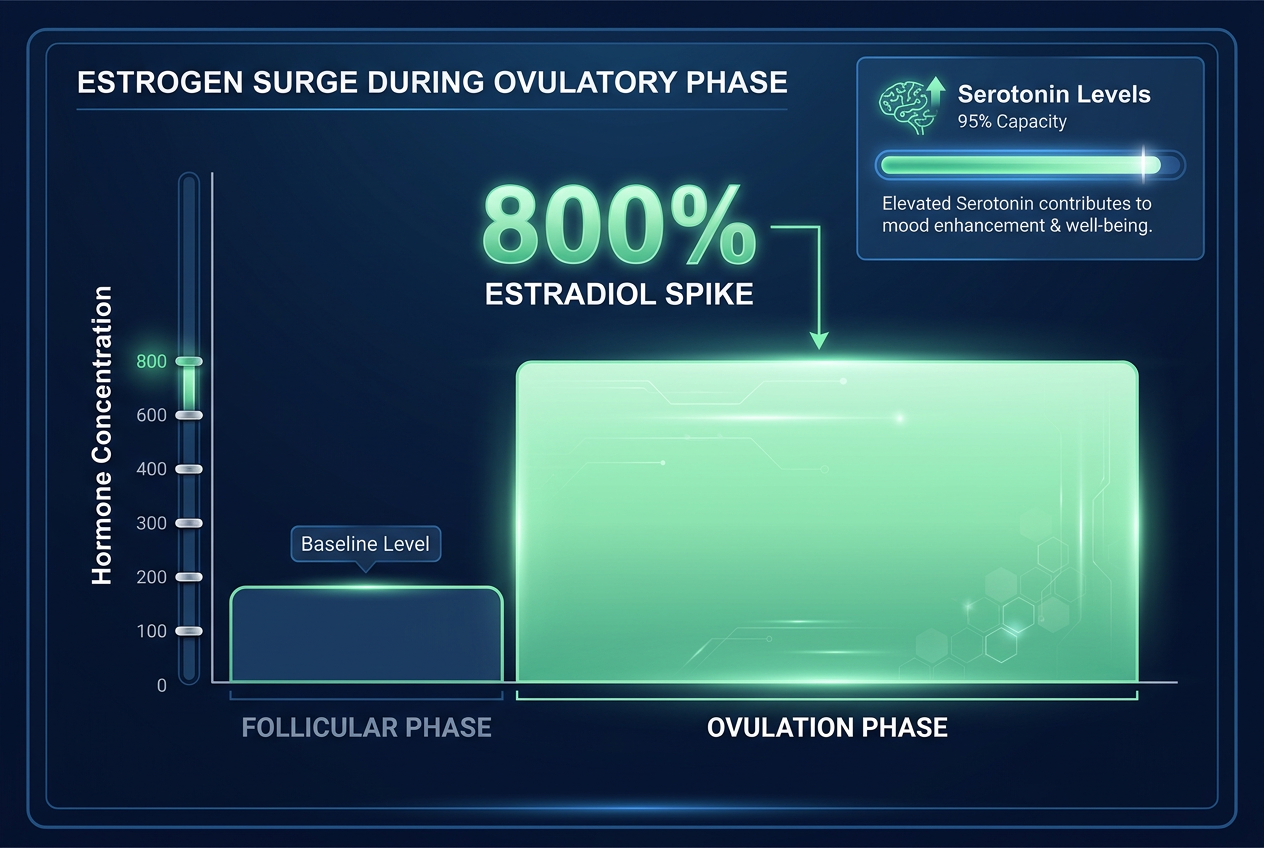 Understanding the massive hormonal surge during ovulation helps partners anticipate changes in mood, energy, and physical needs with scientific precision.
Human sperm can survive inside a woman's body for up to 5 days, creating a "fertile window" longer than the 24-hour egg life, according to Dr. Psych Mom's 2022 research. That biological fact creates both opportunity and responsibility. For couples actively trying to conceive, it means timing intimacy in the days before ovulation is more effective than waiting for the day of release. For couples not trying to conceive, it means this is the highest-risk window for unintended pregnancy - even with typical contraception use.
The practical takeaway: ovulation is the monthly performance peak. Her body is chemically optimized for connection, energy, and confidence. The partner who recognizes this window and matches her energy gets the relationship equivalent of compound interest - connection during the high builds trust that carries through the low.
Understanding your girlfriend's cycle phases gives you the full roadmap, but ovulation is the single most leverage-rich phase.
What Happens to Men When a Woman Is Ovulating?
Men subconsciously detect ovulation through multiple sensory channels - even if they don't consciously realize what they're picking up on. Research shows that women's scent, appearance choices, voice pitch, and even facial symmetry subtly shift during the high-fertility window, and heterosexual male partners respond to those cues with measurable behavioral changes.
A 2007 University of New Mexico study (updated via NBC News) found that lap dancers collected significantly more tips when ovulating compared to other cycle phases. The researchers attributed this to subtle changes in pheromones, body language, and facial attractiveness that male customers responded to - even though neither party was consciously aware of the cycle timing. Similar patterns emerge in committed relationships: men report increased attraction to their partners during ovulation, even when unaware of the biological timing.
What you might notice without realizing why:
- She smells different (not bad, just subtly different) - her natural scent shifts due to changes in vaginal pH and pheromone production during high estrogen.
- Her voice sounds slightly higher or more animated - estrogen affects vocal cord tension, creating a minor pitch increase that research suggests men find more attractive.
- She's wearing slightly more effort into her appearance - women are more likely to wear "sexier" or more attractive clothing during the high-fertility phase of their cycle, according to a 2010 Psychological Science study published in Science Daily.
- You're initiating more often - not because she's explicitly asking, but because her increased receptivity and subtle behavioral cues are triggering your own desire patterns.
The mechanism is evolutionary but the application is modern. Your heightened attraction during her ovulation isn't weakness - it's your nervous system recognizing her biological cues and responding accordingly. The difference between men who leverage this and men who don't is awareness. If you can recognize the pattern, you can plan around it: schedule the date nights when she's most energetic, initiate intimacy when receptivity is highest, avoid scheduling difficult conversations when you're both hormonally primed for connection instead of conflict.
One critical caveat: this detection pattern is significantly reduced or eliminated when your girlfriend is on hormonal birth control. The pill, the patch, and most hormonal IUDs work by suppressing ovulation entirely. If she's not ovulating, she's not producing the estrogen surge that creates these behavioral and physical cues. You might still notice monthly mood variation (many women on the pill still cycle emotionally due to withdrawal weeks), but the ovulation-specific attraction spike largely disappears. Understanding how hormonal birth control affects cycle dynamics prevents you from waiting for a biological signal that won't arrive.
The Physical Signs Your Girlfriend Is Ovulating
The most reliable physical indicators of ovulation are observable if you know what to look for - though some require her to track them herself, and others you can notice in daily interactions without invasive questions.
Cervical mucus changes: This is the gold standard for self-tracking ovulation. In the days leading up to egg release, cervical mucus transitions from thick and sticky to clear, stretchy, and slippery - often compared to raw egg whites. This change optimizes sperm survival and transport. She'd need to check this herself (it's not something you observe externally), but if she mentions "discharge" or asks about it, this is likely what's happening. It's not a yeast infection or a problem - it's a normal ovulation marker.
Basal body temperature (BBT) spike: Basal body temperature typically rises by 0.4 to 1.0 degrees Fahrenheit immediately after ovulation, according to the Cleveland Clinic's 2022 data. This requires daily tracking with a specialized thermometer taken first thing in the morning before any movement. The spike doesn't predict ovulation in advance - it confirms it happened after the fact - but women who track BBT can identify their pattern over multiple cycles. If she's doing this, respect the routine (don't distract her before she takes the reading).
Mittelschmerz (ovulation pain): Approximately 40% of women experience physical pain during ovulation, according to Cleveland Clinic research via Flo Health (2024). This pain - called mittelschmerz, German for "middle pain" - typically presents as a sharp or cramping sensation on one side of the lower abdomen, corresponding to whichever ovary released the egg that cycle. It lasts anywhere from a few minutes to a few hours, occasionally a full day. Many women mistake it for digestive issues or random cramping. If your girlfriend mentions one-sided lower abdominal pain mid-cycle, this is the likely cause. The support move: offer a heating pad or ibuprofen before she asks. She may not even realize what's causing it.
Increased energy and social drive: This isn't a discrete physical symptom like mucus or pain, but it's behaviorally observable. During the ovulatory phase, rising estrogen boosts serotonin production (the "happy hormone") in the brain, creating a measurable uptick in mood, energy, and social engagement. She's more likely to suggest plans, respond enthusiastically to invitations, or stay out later than usual. If you're used to her being a homebody and she suddenly wants to accept every social invite, you're likely in the ovulatory window.
Heightened sense of smell: High estrogen sharpens sensory perception, particularly smell. She might comment on your cologne more than usual (positively or negatively), notice cooking odors earlier, or be more sensitive to environmental scents. This is temporary and cycle-linked. The practical implication: this is a high-leverage moment for sensory gestures. Flowers, fresh sheets, or a clean apartment will register more strongly during ovulation than during other phases.
Breast tenderness (late ovulatory phase): Some women experience mild breast tenderness or sensitivity in the day or two after ovulation as progesterone starts to rise. This is less common than the tenderness that occurs during PMS, but it's still a potential indicator. If she mentions it mid-cycle, it's likely post-ovulation progesterone, not pre-period hormones.
Observable without asking directly: energy spike, social drive, scent sensitivity, clothing choices (she's likely dressing with slightly more effort), and one-sided cramping if she mentions it. Requires her input or tracking: cervical mucus, BBT, and breast tenderness. The best approach is ambient awareness - notice the patterns over a few months without interrogating her about symptoms. If you're using a period tracker designed for partners, these indicators will align with the app's ovulation prediction window, giving you a second confirmation layer.
Is Libido High When Ovulating?
Yes. Libido peaks during ovulation for most women - but with a critical nuance that determines whether this biological fact helps or harms your relationship.
Women in committed relationships report significantly higher increases in libido during ovulation compared to single women, according to a 2024 study in The Journal of Sex Research. The mechanism is twofold: first, the estrogen surge itself increases physical desire by boosting blood flow to the genitals and enhancing nerve sensitivity. Second, the evolutionary drive to connect with a stable partner during the fertile window amplifies attraction specifically to committed romantic partners. Translation: if you're her boyfriend or husband, her desire for you specifically increases during ovulation - not just her general libido.
The spike isn't subtle. Estrogen's 800% increase doesn't just make her more receptive - it often makes her the initiator. Many men report that their girlfriend becomes noticeably more physically affectionate, suggests intimacy more frequently, or responds more enthusiastically to advances during the 5-6 day ovulatory window. Dr. Jolene Brighten's 2023 research on menstrual cycle and sexual desire notes that testosterone (often thought of as a "male hormone") also rises slightly during ovulation in women, further amplifying desire and physical responsiveness.
The mistake men make: treating this surge as a green light for low-effort initiation. The ovulation libido spike is real, but it doesn't mean she wants transactional or obligatory intimacy. The women most frustrated by their partners during ovulation are those whose boyfriends notice the increased receptivity and interpret it as permission to stop creating connection. High libido doesn't eliminate the need for emotional attunement - it raises the bar for what satisfying intimacy looks like.
Tactical execution: use the ovulatory phase to create the date, the conversation, the shared experience that builds to intimacy rather than jumping straight to the physical. The estrogen-driven confidence boost means she's more likely to enjoy adventurous plans, new restaurants, social outings, or spontaneous trips. Match that energy first. The physical connection becomes the natural conclusion, not the transactional goal.
How long does ovulation horniness last? The peak libido window aligns with the ovulatory phase itself - roughly 5 to 6 days, with the highest intensity in the 2-3 days immediately before and the day of ovulation. After egg release, progesterone begins to rise, which gradually suppresses libido over the next week as the body transitions into the luteal phase. By day 21-24 of a typical cycle, libido is often at its monthly low due to progesterone dominance. This is why understanding the full cycle prevents you from mistaking the ovulation spike for a permanent baseline and wondering why desire drops a week later.
One more variable: hormonal birth control. If your girlfriend is on the pill, the patch, or a hormonal IUD, she may not experience the ovulation libido spike at all. These methods work by suppressing ovulation, which means they eliminate the estrogen surge that drives the desire increase. Some women on birth control still notice minor monthly variation in libido due to withdrawal weeks or residual hormonal cycling, but the dramatic ovulation spike is largely absent. If you've been waiting for that mid-cycle energy surge and it's not happening, birth control is the likely explanation.
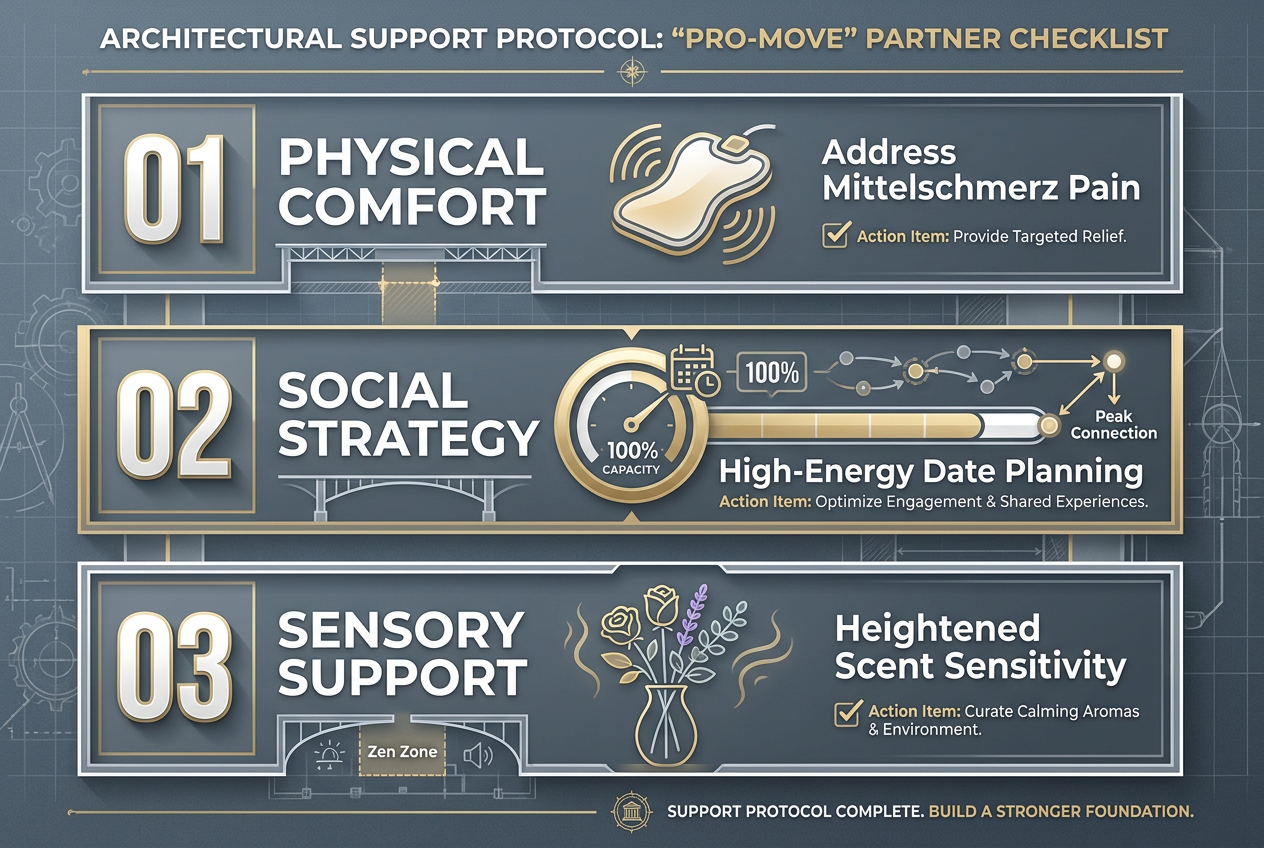 This three-step support protocol transitions partner response from reactive to proactive, addressing both physical pain and the high-energy social needs of the phase.
The Biological Cheat Code: Why Tracking Ovulation Improves Your Relationship
Tracking ovulation isn't a baby-making strategy. It's a relationship optimization tool that gives you a monthly roadmap to when your girlfriend will be most energetic, most confident, most receptive to connection - and when she'll need the opposite kind of support.
The men who track their partner's cycle report measurably better relationship outcomes. VibeCheck users who complete the 7-day onboarding sequence report a 41% reduction in unresolved conflict cycles within their first month, based on in-app survey data from 2,800 active users. The mechanism isn't magic - it's pattern recognition. Once you can predict the four phases of her cycle (menstrual, follicular, ovulatory, luteal), you stop treating her mood and energy as random variables and start treating them as biological rhythms you can sync to.
Ovulation is the highest-leverage phase for three reasons:
1. It's the "yes" window. During ovulation, rising estrogen makes her more open to new experiences, more enthusiastic about plans, more receptive to physical and emotional connection. This is the phase where suggesting the weekend trip, the new restaurant, the slightly adventurous date idea is most likely to land well. The same suggestion during the luteal phase (the week before her period) has a significantly higher rejection rate - not because she doesn't like you, but because progesterone makes her crave familiarity and low-energy routines.
2. It's the relationship equity phase. The support you provide during ovulation - matching her high energy, recognizing her confidence, planning dates that reflect her current mood state - builds trust that carries through the harder weeks. Women remember how their partner showed up during the Power Phase when they need support during the luteal crash. The boyfriend who planned the perfect adventure weekend during ovulation earns grace credits for the night he gets home late during PMS week.
3. It's the biological test of attunement. Your girlfriend's body is signaling her current state through energy, mood, physical cues, and behavior. The men who can read those signals and respond accordingly are demonstrating emotional intelligence and attentiveness in a way that abstract reassurances can't match. Tracking ovulation trains you to observe patterns instead of reacting to isolated incidents.
The practical execution: use a cycle tracking app with partner mode or VibeCheck's AI-powered relationship coaching to predict the ovulatory window 3-5 days in advance. When the app signals the Power Phase is approaching, front-load the high-effort relationship moves: plan the date, suggest the trip, initiate the conversation about plans you've been wanting to make. Reserve the low-energy, stay-at-home weeks for the luteal phase when she'll actually prefer that rhythm.
The alternative - treating every week the same and wondering why your success rate varies wildly - is operating on relationship randomness instead of relationship science. Tracking ovulation removes the guesswork and gives you a predictable window to execute your A-game.
Dr. Psych Mom's 2022 research makes the case explicitly: scheduling date night when your wife is about to ovulate isn't manipulation, it's rational optimization. You're not changing who she is - you're matching your timing to when her biological state is most aligned with connection.
Actionable Support: The "What to Do" List
This is the tactical execution framework for the ovulatory phase. These actions are not universal relationship advice - they are phase-specific moves that work during the Power Phase and should be adjusted or eliminated during other cycle phases.
Plan High-Energy, Social Dates
Ovulation is the hiking weekend, the dinner party with friends, the night out dancing, the spontaneous road trip. Her energy ceiling is higher than it will be all month, and her social drive is maximized. The date ideas that feel too ambitious during the luteal phase (the week before her period) are exactly right during ovulation.
Execution: propose plans that involve movement, novelty, or social engagement. Avoid suggesting these same activities during the luteal phase when her body is craving rest and familiarity. If you've been wanting to try the new restaurant across town, suggest it now. If you've been meaning to accept a friend's invite to a group event, accept it during her ovulatory window when she'll actually enjoy the crowd.
One critical adjustment: match her energy, don't demand it. High-energy ovulation doesn't mean she wants exhausting plans every single day. It means her ceiling is higher. If she says yes to Saturday's adventure, don't immediately fill Sunday with another one. The goal is to sync to her peak capacity, not to push her past it.
Prepare for Increased Libido (and Lead, Don't Demand)
The ovulation libido spike is real, but it doesn't mean she wants obligatory or mechanical intimacy. The men who succeed during this phase treat increased receptivity as an invitation to create connection - not as a shortcut to skip it.
Execution: initiate with intention. Create the conditions for intimacy (the date, the conversation, the shared moment) rather than jumping straight to the physical. If she's more receptive during ovulation, that means the buildup matters more, not less. The women most satisfied with intimacy during ovulation are those whose partners made them feel desired, not just sexually available.
One tactical note: if you're not trying to conceive, this is the highest-risk window for pregnancy. Contraception vigilance is non-negotiable. The same estrogen surge that increases libido also optimizes her body for conception. Even with typical birth control use, the fertile window carries higher risk than other phases. If you're using condoms, use them correctly. If she's on the pill, confirm she's taking it consistently. If you're using fertility awareness methods, understand that this is the week you abstain or use backup methods.
Recognize and Address Ovulation Pain (Mittelschmerz)
40% of women experience ovulation cramping. If your girlfriend is in that cohort, she may not even realize that's what's causing the one-sided lower abdominal pain mid-cycle. The support move is offering the heating pad, ibuprofen, or rest before she asks - and not treating it as period-level debilitating (it's usually milder and shorter-lived, but still worth acknowledging).
Execution: if she mentions stomach pain or cramping around day 12-16 of her cycle, assume it's mittelschmerz and respond accordingly. Say: "Is that ovulation cramping? Want me to grab the heating pad?" Most women are surprised their partner knows what mittelschmerz is, let alone can identify it. That recognition alone builds relationship credit.
If she doesn't mention pain but you know her pattern (you've been tracking for a few months), proactive support still works: "I know this is usually your ovulation week - let me know if you need anything."
Leverage Her Heightened Sense of Smell
High estrogen sharpens sensory perception, particularly smell. This is a tactical opportunity for small, high-impact gestures.
Execution: the flowers you might buy during any other week will register more strongly during ovulation. The effort you put into cleaning the apartment, changing the sheets, or wearing the cologne she's mentioned she likes will be noticed and appreciated more during this phase than during others. Conversely, if you've been skipping showers or leaving the gym bag in the car, she's more likely to comment on it now. Use the heightened sensitivity as a cue to level up baseline hygiene and environmental details.
This isn't about performing - it's about recognizing that her nervous system is processing sensory input more intensely during ovulation, and small adjustments create disproportionate returns.
Initiate or Respond to Deeper Conversations
Estrogen's effect on serotonin means her mood baseline is more positive, her confidence is higher, and her willingness to engage in forward-looking or emotionally significant conversations is greater during ovulation than during the luteal phase. This is the window for the "where do you see this going" conversation, the "should we move in together" discussion, or the "what do you think about X future plan" dialogue.
Execution: if you've been waiting for the right time to bring up a relationship milestone, ovulation is that time. She's more likely to engage constructively, less likely to interpret the conversation as pressure, and more likely to envision a positive future state. The same conversation during the luteal phase (especially late luteal, the week before her period) has a higher probability of triggering defensiveness or catastrophizing.
Caveat: do not use ovulation as a manipulation window to extract agreement on things she's ambivalent about. The goal is to have conversations she's already open to during the phase when her biological state supports optimism and forward-thinking - not to pressure her when her guard is down.
For additional context on how to approach conversations during different cycle phases, see our guide on how to talk to your girlfriend during PMS.
What Should a Man Do If the Couple Is NOT Trying to Conceive?
The ovulation playbook changes significantly based on contraception goals. If you're actively trying to avoid pregnancy, the fertile window is the highest-risk phase of the month - and the libido spike that makes intimacy more appealing is the same biological mechanism that creates pregnancy risk.
The 6-day fertile window: Human sperm can survive inside a woman's body for up to 5 days, and the egg remains viable for fertilization for 12 to 24 hours after release. This creates a 6-day window (5 days before ovulation plus the day of ovulation) when unprotected intercourse carries pregnancy risk. The actual release of the egg only allows for fertilization within a narrow 12 to 24-hour window, but sperm can wait - which is why timing matters.
Most couples underestimate this window. They assume ovulation = one risky day. The reality: if you have unprotected sex on Monday and she ovulates on Friday, conception is possible because the sperm can survive the wait. This is why fertility awareness methods (tracking ovulation to avoid pregnancy) have higher failure rates than barrier or hormonal contraception - the margin for error is too narrow.
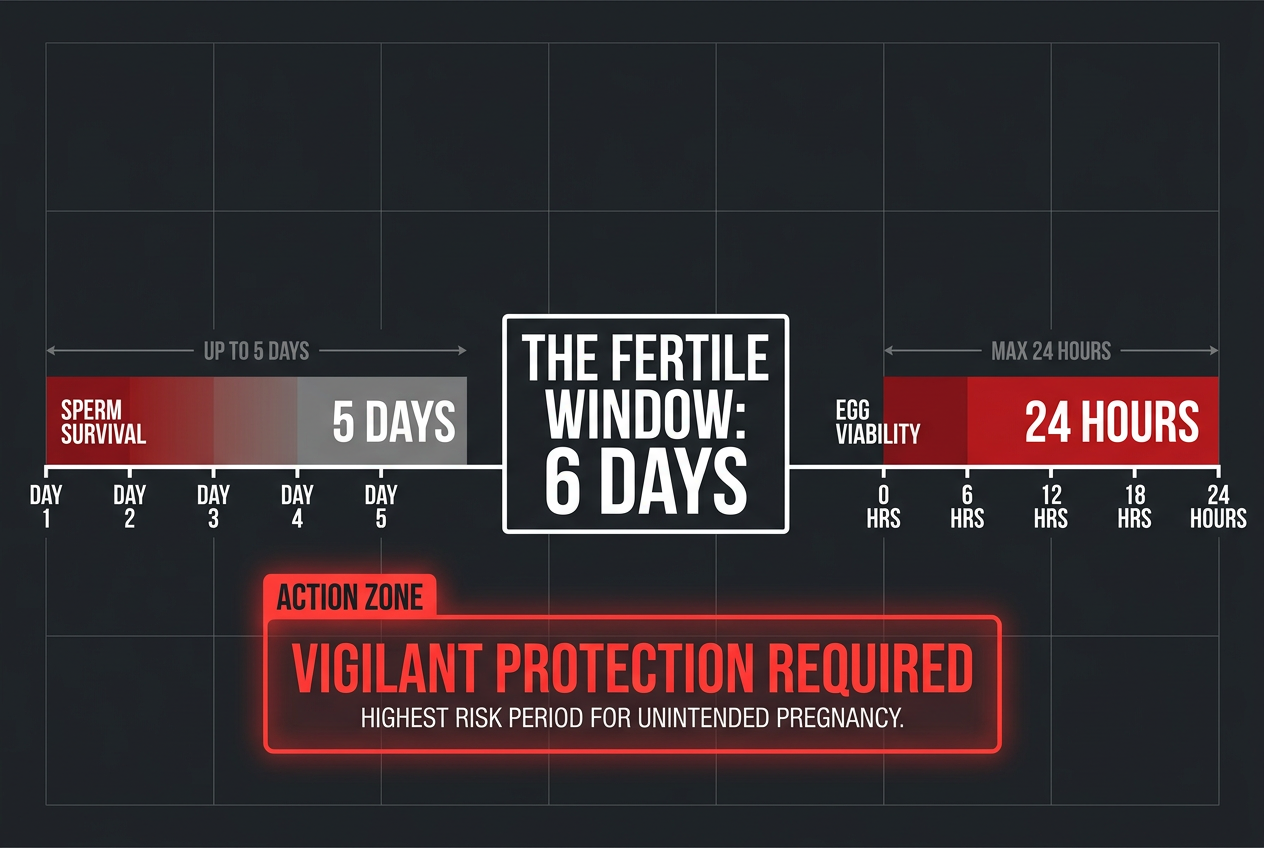 Even when not trying to conceive, understanding that the 'fertile window' lasts six days - not just twenty-four hours - is critical for relationship planning and safety.
What to do:
Use backup contraception. If your girlfriend is on the pill, confirm she's taking it consistently (missing doses during the ovulation window is highest-risk). If you're using condoms, use them every time during the 6-day window - no exceptions, no "just this once." If you're relying on withdrawal, understand that this is the week withdrawal fails most often (pre-ejaculate can contain sperm, and timing errors during high-libido sex are common).
Track the window together. Use a period tracking app to predict ovulation 3-5 days in advance. VibeCheck and similar partner-mode apps will alert you when the fertile window is approaching, giving you time to prepare rather than guessing mid-intimacy. If she's tracking basal body temperature or cervical mucus, ask her to share the data with you so you're both operating on the same information.
Don't avoid intimacy - adjust contraception. The worst approach is avoiding sex during ovulation entirely out of pregnancy fear. That eliminates the highest-libido, highest-connection window of the month and creates resentment on both sides. The solution is not avoidance - it's consistent, correct contraception use during the fertile window.
Consider long-acting reversible contraception (LARC). If you're in a committed relationship and pregnancy avoidance is critical, hormonal IUDs, copper IUDs, or the implant eliminate the need to think about contraception during ovulation. These methods have failure rates under 1% (compared to 9% for the pill with typical use, 18% for condoms with typical use). The tradeoff: hormonal LARCs suppress ovulation, which means they eliminate the estrogen surge and the behavioral/libido patterns this article describes. Copper IUDs don't suppress ovulation, so the cycle patterns remain - but they prevent fertilization even during the fertile window.
Emergency contraception availability. If you're using condoms or withdrawal and something goes wrong during the fertile window (condom breaks, timing error), your girlfriend should take emergency contraception (Plan B or ella) within 72 hours (ideally sooner). Keep it on hand. Don't wait until the crisis to figure out where to buy it.
The ovulation playbook for non-TTC couples is not about avoidance. It's about informed risk management. You can fully engage with the Power Phase - the high libido, the connection, the energy - while still using contraception that prevents pregnancy. The men who fail at this are the ones who treat contraception as optional during high-arousal moments. The men who succeed treat contraception as non-negotiable precisely because the ovulation window is too valuable to ruin with pregnancy scares.
How to Talk About Cycle Tracking Without Making It Weird
The biggest barrier to cycle-aware relationship management is the conversation itself. Most men know tracking would help but don't know how to bring it up without sounding controlling, obsessive, or sexually motivated.
The framing that works: "I want to support you better."
The wrong approach: "I've been reading about ovulation and I think we should track your cycle so I know when to initiate sex."
The right approach: "I've been reading about how hormones affect mood and energy throughout the month, and I realized I've been treating every week the same when your needs are probably different depending on where you are in your cycle. Would it help if I tracked it so I could be more supportive?"
The distinction: the first makes it about you and your sexual agenda. the second makes it about her experience and your desire to match her needs. Most women respond positively to partners who demonstrate interest in understanding cycle patterns - as long as the motivation is support, not sexual optimization.
Suggest app-sharing instead of asking for reports.
Asking her to manually update you ("Hey, where are you in your cycle right now?") creates labor and feels invasive. Suggesting you both use a shared tracking app - like Clue Connect, VibeCheck, or Flo's partner mode - eliminates the interrogation dynamic and makes it a shared system.
Say: "I downloaded VibeCheck so I can see what phase you're in without having to ask. Let me know if you want me to stop using it, but I thought it might help me understand when you need more support versus when you're up for more activity."
This approach gives her control (she can say no), makes it opt-in, and frames the tracking as a tool for your education rather than her obligation to report.
Don't weaponize the data.
The fastest way to destroy trust around cycle tracking is using it against her. Never say "You're just upset because you're in your luteal phase" or "You're being irrational - this is PMS talking." Even if the hormonal timing is influencing her mood, dismissing her feelings as "just hormones" invalidates the experience and makes cycle awareness a relationship liability instead of an asset.
The rule: use cycle data to inform your response, never to dismiss her perspective. If she's upset during the luteal phase, the correct response is empathy and support - informed by the knowledge that progesterone is amplifying her stress response, which means you should listen more and problem-solve less. The incorrect response is telling her the hormones are making her irrational.
Start with observation, not interrogation.
Instead of asking "Are you ovulating?" (which feels invasive), observe the patterns over a few months and adjust your behavior accordingly. If you notice she's more social mid-month, suggest plans during that window without announcing why. If you notice she's more withdrawn the week before her period, offer low-key support without diagnosing her mood as PMS.
After a few months of ambient pattern-matching, the conversation becomes easier: "I noticed you're usually up for bigger plans around mid-month and prefer staying in the week before your period. Does that track with how you're feeling, or am I reading it wrong?"
This frames cycle awareness as observation-based attentiveness, not invasive tracking. Most women appreciate partners who notice patterns without being told.
For additional guidance on cycle-aware communication, see our full guide on how to understand your girlfriend's cycle phases.
The Power Phase vs. The Luteal Crash: Preparing for the Pivot
The ovulatory phase is the biological peak, but it's followed immediately by the luteal phase - the 10-14 day window between ovulation and menstruation when progesterone dominates, energy drops, and mood shifts from optimistic to cautious. The men who succeed during ovulation but fail during the luteal phase don't understand this transition. They treat the Power Phase as the new baseline and are blindsided when it ends.
 By maximizing connection during the high-energy 'Power Phase,' partners build relationship equity that provides a buffer for the lower-energy luteal phase.
What changes after ovulation:
- Energy drops. The estrogen surge that powered the ovulatory phase declines sharply, and progesterone - which has a sedative effect - rises. She's more tired, less interested in high-energy plans, more likely to cancel social commitments.
- Libido declines. Progesterone suppresses sexual desire as the body shifts from "attract a partner" mode to "maintain a potential pregnancy" mode (even if no pregnancy has occurred). The woman who initiated intimacy enthusiastically during ovulation may show little interest a week later.
- Mood shifts from optimistic to cautious. Estrogen boosts serotonin, progesterone does the opposite. The luteal phase - especially the late luteal phase (the week before her period) - is when anxiety, irritability, and emotional sensitivity peak. This is PMS territory.
- Social drive decreases. The same woman who wanted to accept every invite during ovulation now wants to stay home, avoid crowds, and minimize obligations. This isn't flakiness - it's hormonal.
The support framework for the luteal phase: The tactical moves that worked during ovulation don't work during the luteal phase. High-energy dates, adventurous plans, and frequent social obligations will feel like obligations instead of opportunities. The support playbook shifts from "match her energy" to "create space and reduce friction."
Key adjustments:
- Plan low-key, low-effort dates (movie night at home, takeout, a walk in the neighborhood instead of the big hike).
- Anticipate irritability without taking it personally. If she snaps over something minor during the late luteal phase, it's progesterone amplifying her stress response - not a referendum on the relationship.
- Offer practical support instead of trying to fix her mood. The heating pad, the favorite snack, the offer to handle the chore she was planning to do - these gestures matter more during the luteal phase than grand romantic overtures.
- Avoid difficult conversations or relationship evaluations during the late luteal phase (the week before her period). The same conversation that went well during ovulation will feel overwhelming or catastrophic now.
For a complete breakdown of how to support her during this phase, see our tactical guide on how to support your girlfriend during the luteal phase.
Why the Power Phase matters for the crash: The relationship equity you build during ovulation - the perfect date, the recognition of her energy, the attentive support - creates a trust buffer that carries through the luteal phase. Women remember how their partner showed up during the high when they need support during the low. The boyfriend who planned the adventure weekend during ovulation and then offers the heating pad during PMS is demonstrating consistency and attunement across the full cycle. The boyfriend who only shows up during the easy phases and disappears during the hard ones is demonstrating that his support is conditional on her being low-maintenance.
The men who master cycle-aware relationships understand that the four phases are a package deal. You don't get to coast on the ovulation high without also navigating the luteal low. The men who succeed treat the full 28 days as a rhythm to sync to, not a random series of good weeks and bad weeks.
Ready to actually understand her?
Join thousands of men using VibeCheck to track her cycle and show up better every day.
Get VibeCheck FreeFrequently Asked Questions
Can men smell when a girl ovulates?
Yes, but the detection is largely subconscious rather than a discrete "I can smell ovulation" experience. Research shows that women's natural scent shifts during ovulation due to changes in vaginal pH, pheromone production, and sweat composition driven by the estrogen surge. Heterosexual male partners respond to these olfactory cues with measurable increases in attraction and arousal, even when they can't consciously identify what changed. The 2007 University of New Mexico lap dancer study (where dancers earned more tips during ovulation) and subsequent pheromone research suggest that men detect fertility cues through scent but rarely attribute the heightened attraction to smell specifically. Most men just notice they're "more into" their girlfriend during this window without realizing the mechanism is partly olfactory. Hormonal birth control suppresses ovulation and likely reduces or eliminates this scent shift, which is why men often report noticing a difference when their partner goes on or off the pill.
Can you sense when your partner is ovulating?
Yes, through a combination of behavioral, physical, and olfactory cues - though most men detect the pattern subconsciously rather than consciously labeling it as "ovulation." Observable indicators include increased energy and social engagement, higher libido and physical affection, subtle changes in appearance choices (more effort into clothing or grooming), a slightly higher voice pitch, and changes in natural scent. Over multiple months of observation, many men report being able to predict the ovulatory window within a few days based on these behavioral cues. The accuracy improves significantly if you use a period tracking app to confirm the pattern. The caveat: this detection ability is largely eliminated if your partner is on hormonal birth control, which suppresses ovulation and the associated estrogen surge. If she's on the pill, you may still notice minor monthly mood variation, but the ovulation-specific cues - especially the libido spike and scent changes - are typically absent.
What are the 7 signs of ovulation physically?
The seven most reliable physical signs of ovulation are: (1) clear, stretchy cervical mucus that resembles raw egg whites, optimizing sperm survival and transport; (2) a basal body temperature spike of 0.4 to 1.0 degrees Fahrenheit occurring immediately after ovulation (requires daily morning tracking with a specialized thermometer); (3) mittelschmerz or one-sided lower abdominal cramping affecting approximately 40% of women, caused by the follicle rupturing to release the egg; (4) breast tenderness or sensitivity in the late ovulatory phase as progesterone begins to rise; (5) increased cervical firmness and position changes (the cervix rises and softens during ovulation, though this requires self-examination); (6) heightened sense of smell due to estrogen's effect on sensory perception; and (7) a slight increase in resting heart rate measurable by wearable fitness trackers, though this is a newer indicator not yet widely studied. Not all women experience all seven signs, and symptom intensity varies by individual and cycle. Cervical mucus and BBT are considered the most reliable indicators for fertility tracking purposes.
How to handle horniness during ovulation?
The ovulation libido spike is real and biological - estrogen's 800% surge increases genital blood flow, nerve sensitivity, and overall sexual desire. Handling it effectively requires matching the physical desire with emotional connection rather than treating it as a purely mechanical need. First, recognize that increased horniness during ovulation is normal and expected, not something to suppress or feel guilty about. Second, communicate with your partner openly about your current state without making it an obligation ("I'm noticing I'm really attracted to you right now" versus "We need to have sex because I'm ovulating"). Third, create the conditions for satisfying intimacy - the date, the conversation, the shared moment - rather than jumping straight to the physical. High libido doesn't eliminate the need for connection; it raises the standard for what good intimacy looks like. Fourth, if you're not trying to conceive, use reliable contraception every time during the fertile window - the same estrogen surge driving libido is also optimizing your body for conception. Finally, if your partner isn't matching your energy (not everyone's libido peaks align), solo options are valid and normal - ovulation-driven desire doesn't obligate your partner to match it.
How long does ovulation horniness last?
The peak libido window during ovulation typically lasts 5 to 6 days, aligning with the ovulatory phase itself: the 3-4 days leading up to egg release and the 1-2 days immediately after. The highest intensity occurs in the 48 hours before ovulation when estrogen reaches its peak, then begins to taper as progesterone rises in the luteal phase. By day 21-24 of a typical 28-day cycle (the late luteal phase or PMS week), libido is often at its monthly low due to progesterone dominance, which suppresses sexual desire. Individual variation exists - some women experience a shorter 3-4 day window, others a longer 7-8 day window - but the 5-6 day average is consistent across research. If you're tracking your girlfriend's cycle and notice the libido spike consistently lasting longer or shorter than this range, that's her individual pattern. One critical note: hormonal birth control (the pill, patch, ring, or hormonal IUD) suppresses ovulation entirely, which means it eliminates the estrogen surge that drives the ovulation libido spike. Women on hormonal birth control may still notice minor monthly libido variation, but the dramatic mid-cycle peak is typically absent.
Is it safe to conceive during ovulation pain?
Yes, ovulation pain (mittelschmerz) does not indicate a health problem or make conception unsafe - in fact, it's often used by couples trying to conceive as a natural fertility indicator since it signals the egg has been released or is about to be. Mittelschmerz occurs in approximately 40% of women and is caused by the follicle rupturing to release the egg or by minor irritation from fluid released during ovulation. The pain typically lasts a few minutes to a few hours, occasionally up to 24 hours, and presents as sharp or cramping discomfort on one side of the lower abdomen. If you're actively trying to get pregnant, intercourse during or immediately after ovulation pain is well-timed, as the egg is viable for fertilization for 12-24 hours after release. The caveat: severe pain, pain lasting more than a day, or pain accompanied by fever, nausea, or vomiting is not normal mittelschmerz and warrants medical evaluation to rule out ovarian cysts, endometriosis, or ectopic pregnancy. Standard mittelschmerz is uncomfortable but not dangerous and does not affect fertility or conception safety.
What to do if my girlfriend doesn't track her cycle?
If your girlfriend doesn't currently track her cycle, the approach depends on whether she's open to it or indifferent. Start by asking whether she'd find it helpful: "I've been reading about how hormones affect energy and mood throughout the month - do you ever notice patterns, or would it be useful to track it?" If she's interested but hasn't prioritized it, suggest a low-effort app like Clue, Flo, or VibeCheck that requires minimal daily input and offers partner-sharing features. If she's uninterested or skeptical, ask if you can track it separately using a partner-mode app so you can anticipate her needs without requiring her to report to you ("I want to be more supportive, so I was thinking of using an app to track the general timing - would that be okay with you?"). If she declines both options, respect the boundary and default to observation-based pattern recognition instead. Over a few months, notice when her energy is highest, when her mood shifts, when she mentions cramps or fatigue, and adjust your support accordingly. Many women who initially resist cycle tracking become open to it once they see a partner using the data to provide better support rather than to judge or dismiss their feelings. Never weaponize cycle knowledge, and never bring it up dismissively ("You're just upset because you're about to get your period"). Use the information to inform your response, not to invalidate her experience.
Can ovulation cause fatigue?
Yes, though ovulation-related fatigue is less common and typically milder than the fatigue experienced during menstruation or the late luteal phase (PMS week). Fatigue during ovulation is usually caused by the energy expenditure required to release the egg and sustain the estrogen surge, which can temporarily deplete the body's resources. Some women also experience fatigue as a secondary effect of mittelschmerz (ovulation pain) or mild sleep disruption caused by hormonal shifts. However, the dominant pattern during ovulation is increased energy, not decreased - estrogen's effect on serotonin production and dopamine sensitivity typically creates a mood and energy boost that far outweighs minor fatigue. If your girlfriend consistently experiences significant fatigue during ovulation, three possible explanations: (1) she's in the minority who respond to the estrogen surge with energy crashes instead of boosts; (2) she's experiencing stress or illness that's compounding normal hormonal effects; or (3) she has an underlying hormonal imbalance (such as PCOS or thyroid dysfunction) worth discussing with a doctor. The practical support move: if she mentions fatigue during ovulation, don't assume she's up for high-energy plans even though the calendar suggests the Power Phase. Let her actual energy level guide your response, not the phase prediction.
Tags

Related Articles
Continue reading to deepen your understanding

The Ovulation Playbook: What to Do When Your Girlfriend Is Ovulating
Your girlfriend is at her most magnetic and energetic during ovulation. Learn how to recognize the signs and use this peak phase to amplify your relationship and connection.
What to Do When Your Girlfriend Is Ovulating: Support Tips
Understanding what to do when your girlfriend is ovulating helps you navigate an 800% estrogen spike with 5 specific strategies for better connection.

The Partner’s Guide to Sending the Right Text at the Right Time
Stop guessing what she wants to hear. Learn how to send the perfect gf text messages by syncing your communication with her biological rhythm to build a deeper connection.

How to Plan Dates Around Your Girlfriend’s Cycle: The Partner’s Playbook
Stop guessing why your plans flop. Learn how to use your partner’s biological rhythm to plan dates she actually wants to go on, from high-energy outings to cozy nights in.

How to Know When Your Girlfriend Needs Space: The Cycle Guide for Men
Is she pulling away or just hitting a biological wall? Learn how to spot the signs your girlfriend needs space based on her cycle before she even has to ask for it.

How to Talk to Your Girlfriend During PMS: Support Guide
Master how to talk to your girlfriend during PMS. Learn the biology of the luteal phase and use our validation scripts to support her when she needs you most.
Girlfriend Needs Space Cycle: How to Know the Signs
Learn how to know when your girlfriend needs space during her cycle. Identify subtle signs of hormonal shifts and improve your relationship communication today.

How to Track Your Girlfriend’s Cycle: A Strategic Guide for Supportive Partners
Stop guessing why she’s stressed. Learn how tracking your girlfriend’s cycle helps you anticipate her needs, reduce arguments, and show up as a more supportive, proactive partner.