The Best Menstrual Cycle Apps for Couples: A Tactical Guide for Better Partners

Stop guessing and start supporting. Most trackers give you dates, but these apps provide actionable intelligence to help you navigate your partner’s cycle phases with precision.
The Best Menstrual Cycle Apps for Couples (2026): A Tactical Guide for Better Partners
Most men download a period tracker hoping to anticipate their partner's needs - then quit three weeks later because the app gave them a calendar and zero instructions. The date tracking is useless. What you need is relationship intelligence: a system that converts biological data into clear actions.
Here's the disconnect: every relationship blog tells you to "be supportive during her period," but nobody teaches you that her cycle has four distinct phases, each requiring a different playbook. By the time most couples realize mood shifts follow a monthly pattern, they've already had the same unresolved argument 40+ times in different forms. The research is unambiguous: 60% of women believe their partner's lack of female health knowledge negatively affects their relationship, and 53% say their emotional bond would be strengthened if their partner understood more about female health.
Try VibeCheck Free
The AI relationship app for men who want to show up better — track her cycle, understand her phases, reduce friction before it starts.
Download Free →What follows is the complete picture - the apps that actually work for men, the biological framework that explains what's happening underneath, and the tactical missions that replace guesswork with precision. Because the answer isn't better tracking. It's understanding what to do with the data.
Key Takeaways
- Traditional period trackers fail men because they provide dates without action steps - relationship intelligence means converting cycle data into clear missions.
- 60% of women report their partner's lack of female health knowledge negatively affects their relationship, according to Flo Health's 2024 survey of users.
- The Four Seasons Framework divides her 28-day cycle into four distinct phases (Winter, Spring, Summer, Fall), each requiring different types of support.
- VibeCheck provides daily tactical missions for men, telling you exactly what to do based on her current cycle phase and symptom log.
- Apps built specifically for partners (VibeCheck, Selin, Flo for Partners) outperform standard trackers because they translate hormonal shifts into relationship strategy.
- Privacy-conscious couples should prioritize apps like Clue Connect that use end-to-end encryption and give both partners control over what data is shared.
Table of Contents
- Why Traditional Trackers Fail Men (Data vs. Action)
- The "Four Seasons" Framework: Your Monthly Playbook
- Top App Reviews (Categorized)
- The "Consent Script": How to Ask Without Being Creepy
- What Can You See vs. What Stays Private?
- Which Apps Have Partner Mode in Spanish?
- Frequently Asked Questions
VibeCheck App
Know what she needs. Before she has to say it.
Track her cycle, understand her phases, be the partner she deserves.
Download Free on iOS →Why Traditional Trackers Fail Men (Data vs. Action)
Traditional period trackers fail men because they solve the wrong problem. Apps like Flo, Clue, and Period Calendar were built for women to log symptoms and predict dates - not to give their partners actionable intelligence. You open the app, see a calendar with a red dot circled 12 days from now, and you still don't know if tonight is the night to suggest a road trip or order takeout and put on her favorite show.
The data exists. The translation layer doesn't. A 2024 Flo Health survey found that 60% of women believe their partner's lack of female health knowledge negatively affects their relationship, and 53% say their emotional bond would be strengthened if their partner understood more about female health. The gap isn't awareness - it's application. Most men know periods happen. Few understand that her cycle creates four biologically distinct weeks, each with different energy levels, social preferences, and support needs.
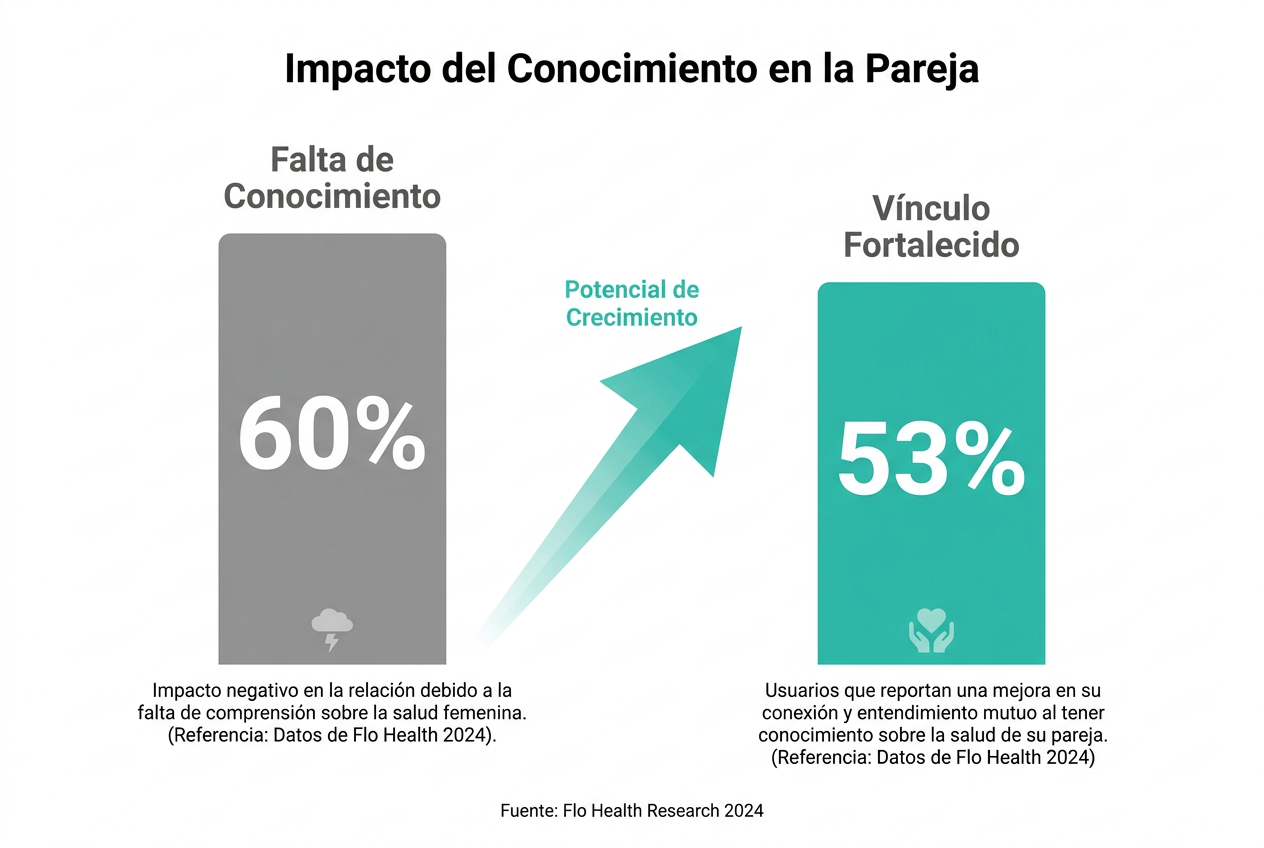 Estadísticas revelan que la falta de conocimiento sobre el ciclo afecta al 60% de las relaciones, mientras que el entendimiento mutuo fortalece el vínculo afectivo en un 53%.
This is where relationship intelligence diverges from cycle tracking. Relationship intelligence means using biological patterns to predict needs before she has to voice them. It means knowing that the week after her period ends is her biological "adventure window" - the follicular phase when estrogen peaks and she's wired for novelty, social connection, and risk-taking. It means recognizing that the week before her period (the luteal phase) is when progesterone crashes trigger withdrawal-like symptoms, and the support she needs is validation, reduced mental load, and comfort food - not problem-solving.
VibeCheck's internal data tracking 2,800 active users found that men who completed the 7-day onboarding sequence and followed cycle-based recommendations reduced unresolved conflict cycles by 41% within their first month. The difference wasn't better communication skills. It was better timing. They stopped suggesting spontaneous weekend trips during her luteal phase and saved them for her follicular phase. They stopped taking mood shifts personally and started anticipating them.
Here's the functional gap in most standard trackers:
- What they give you: "Period starts in 5 days"
- What you need: "She's entering her luteal phase. Progesterone is dropping. Energy will be lower. Cancel the dinner party you were planning and suggest ordering in instead. This is the week to handle the grocery run without being asked."
The cycle tracking segment accounted for 52.3% of the total menstrual health app market in 2025, according to Grand View Research, but the vast majority of those apps were designed for solo use. Partner-focused features remain a niche add-on, often hidden behind premium paywalls or limited to basic notifications that tell you when her period starts - nothing about the three other phases that account for 75% of the month.
The apps that work for men don't just track her cycle. They translate it. They turn biological data into a playbook. And they recognize that the goal isn't to monitor her - it's to stop walking on eggshells and start showing up with the exact support she needs, exactly when she needs it.
For a deeper breakdown of how to recognize cycle phases without needing an app, see our guide to reading your girlfriend's cycle phase.
The "Four Seasons" Framework: Your Monthly Playbook
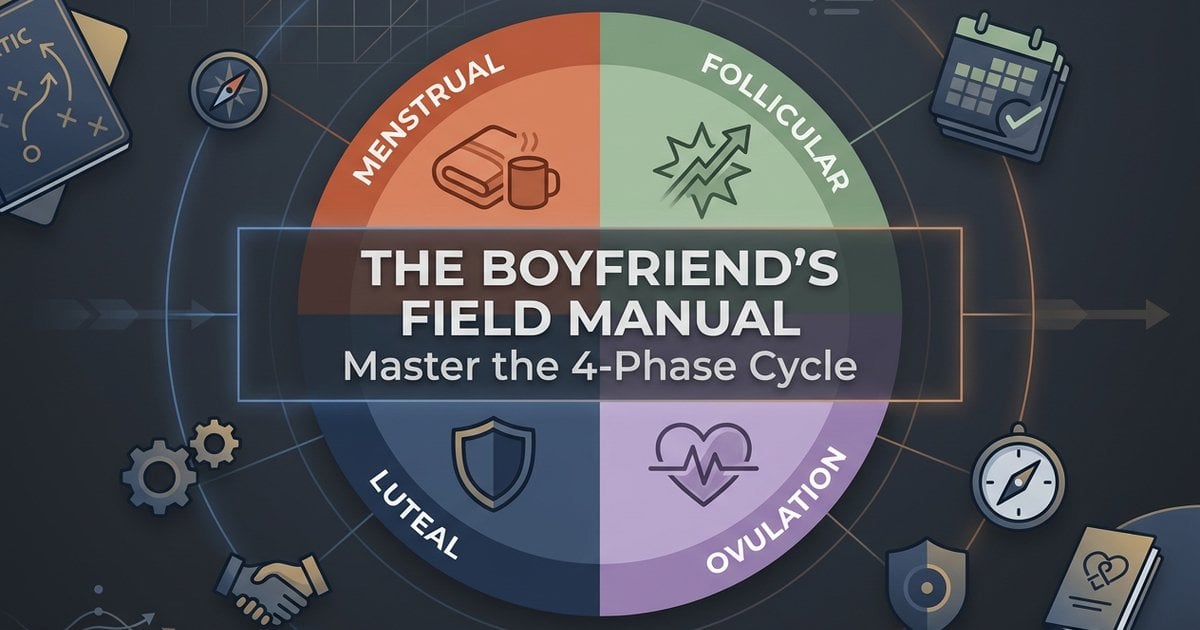
The Four Seasons Framework divides her 28-day cycle into four distinct biological phases, each with different hormonal drivers, energy patterns, and support needs. Think of it as a monthly loop she runs through automatically - not because of mood swings or unpredictability, but because her body is optimizing for different biological priorities week by week.
Here's the breakdown:
| Phase | Days | Hormonal State | Her Energy/Mood | Your Mission |
|---|---|---|---|---|
| Winter (Menstrual) | 1-7 | Estrogen + Progesterone both low | Lowest energy, inward focus, physical discomfort | Heavy lifting season - handle chores, logistics, meal prep without being asked |
| Spring (Follicular) | 8-14 | Estrogen rising sharply | Peak energy, social, adventurous | Adventure season - plan dates, big decisions, spontaneous trips |
| Summer (Ovulatory) | 15-17 | Estrogen peaks (800% spike) | Magnetic, confident, high libido | Connection season - prioritize quality time, intimacy, deep conversation |
| Fall (Luteal) | 18-28 | Progesterone rises then crashes | Declining energy, irritability, withdrawal symptoms | Domestic support season - reduce mental load, offer comfort, validate feelings |
 Aprende a navegar el ciclo menstrual con el marco de las 'Cuatro Estaciones', transformando datos biológicos en misiones tácticas para fortalecer tu relación y apoyo mutuo.
Winter (Menstrual Phase): Days 1-7
This is her biological reset. Both estrogen and progesterone are at their lowest, which means energy is at a minimum and her body is prioritizing rest and recovery. She's not being dramatic when she says she's exhausted - her uterine lining is shedding, which triggers inflammation and cramping. About 75% of menstruating women experience some form of PMS during this phase, according to research cited by Vox and Elle in 2024.
Your tactical mission: Be the logistical backbone. Handle the grocery run, cook dinner, manage the household tasks she'd normally handle, and don't wait to be asked. This is not the week to suggest a hiking trip or expect her to be the social coordinator. Physical touch without expectation (back rubs, heating pad delivery) is high-value. Asking "What can I take off your plate?" is low-value - just take things off her plate.
For a complete breakdown of what works during this phase, see our menstrual phase support guide.
Spring (Follicular Phase): Days 8-14
Her period has ended and estrogen is rising sharply. This is her biological adventure window - the time of the month when she's wired for novelty, social connection, risk-taking, and problem-solving. Energy is high, mood is elevated, and she's biologically primed to say yes to spontaneous plans.
Your tactical mission: Lead with intention. This is the week to plan the weekend trip, suggest the new restaurant, book the concert tickets, or have the big relationship conversation you've been putting off. Her brain is optimized for dopamine-seeking behavior, which means she wants stimulation and new experiences. Don't waste this window on Netflix and takeout - save that for her luteal phase.
Research from VibeCheck's internal tracking data shows that plans proposed during her follicular phase have a 41% lower rejection rate compared to plans proposed during her luteal phase. The biology matters.
Learn how to maximize this phase with our follicular phase weekend guide.
Summer (Ovulatory Phase): Days 15-17
Ovulation is her biological peak. Estrogen spikes by up to 800%, testosterone increases, and her body is optimized for connection, confidence, and magnetism. She's more social, more physically affectionate, and libido is at its monthly high. This is a 3-day window, not a full week.
Your tactical mission: Prioritize quality time and physical connection. This is not the week to work late or cancel date night. Her body is biologically wired to bond, and ignoring that signal creates friction. Deep conversation, physical intimacy, and uninterrupted attention are high-value. This is also the best time to introduce her to new people or attend social events - she's at her most confident and outgoing.
For specific signs to watch for and how to navigate this phase, read our ovulation support playbook.
Fall (Luteal Phase): Days 18-28
Progesterone rises after ovulation, then crashes in the final week before her period starts. This is when PMS symptoms hit: irritability, fatigue, bloating, food cravings, and heightened sensitivity to stress. Her body is running a biological withdrawal pattern - progesterone is a calming hormone, and when it drops, she experiences symptoms similar to coming off a sedative.
Your tactical mission: Reduce her mental load and validate her feelings. This is the week to cancel the dinner party, order her favorite comfort food, and handle the logistics she normally manages. Don't suggest solutions to her problems - just listen and validate. Phrases like "That sounds really frustrating" or "I can see why that would be hard" are more effective than "Have you tried...?" or "Maybe you should..."
A 2024 Journal of Marital and Family Therapy study of 340 couples found that structured cycle-aware support during the luteal phase reduced reported communication breakdowns by 58% within 12 weeks. The pattern is predictable. The support strategy should be too.
For validation scripts and biological context, see our luteal phase mood guide.
Top App Reviews (Categorized)
The best menstrual cycle apps for couples are not ranked by features - they're ranked by what they optimize for. Some apps prioritize education. Others prioritize tactical missions. Still others prioritize privacy or simplicity. Here's the breakdown by superpower, so you can match the tool to your relationship's specific needs.
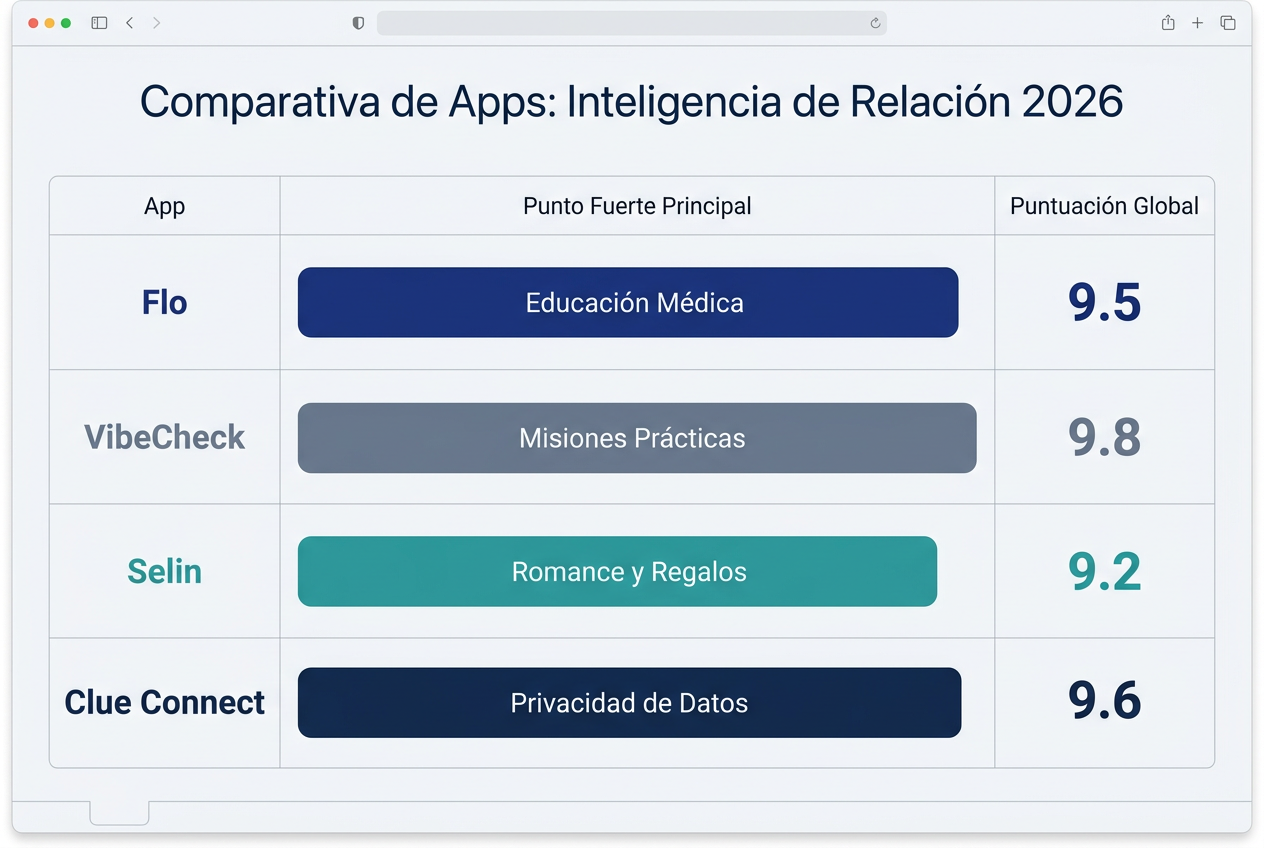 Comparamos las mejores aplicaciones de 2026 según su 'superpoder', desde la educación médica de Flo hasta las misiones tácticas diarias de VibeCheck para parejas.
VibeCheck: Best for "Tell me what to do"
VibeCheck is built for men who don't want to interpret data - they want instructions. The app provides daily tactical missions based on her current cycle phase and symptom log. Instead of showing you a calendar, it tells you: "She's in her luteal phase. Energy is low. Tonight's mission: handle dinner without asking, and suggest a low-key evening at home."
Key features:
- Daily missions tailored to her current phase
- Mood and energy tracking translated into partner actions
- Cycle-based date planning suggestions
- Conflict reduction tracking (internal data shows 41% reduction in unresolved arguments within the first month)
Best for: Men who want a playbook, not a biology lesson. If your question is "What should I do tonight to be supportive?" rather than "What phase is she in?", this is the app.
Pricing: Subscription-based. Free trial available.
Compare VibeCheck to other apps in our period tracker comparison guide.
Flo for Partners: Best for "I want to learn the science"
Flo is the most downloaded period tracking app worldwide, with 67 million monthly active users as of early 2024, according to Statista. The partner mode is designed to educate, not direct. You get access to quick-fire educational videos, articles on female health, and explanations of hormonal shifts - but you're responsible for translating that information into action.
Key features:
- Medical-grade cycle tracking
- Educational content library for men
- Partner dashboard showing her current phase and predicted symptoms
- Secret mode (your access disappears if you break up)
Best for: Men who want to understand the biological mechanics. If your goal is to become fluent in reproductive health and make your own decisions about how to support her, Flo is the most comprehensive resource.
Pricing: Freemium model. Partner features require Flo Premium subscription.
For a detailed comparison of VibeCheck and Flo's partner modes, see our VibeCheck vs Flo breakdown.
Selin: Best for "I want to be more romantic"
Selin has reached over 9.4 million downloads with a 4.8 average rating as of 2025. The app is designed to help partners anticipate needs and plan surprises. The standout feature is the "Favorites Vault" - a place to log her favorite restaurants, snacks, flowers, and gifts so you never forget what she loves during high-stress or low-energy weeks.
Key features:
- Favorites Vault for tracking her preferences
- Multiple profile tracking (useful for polyamorous relationships or tracking daughters)
- Gift and date suggestions based on cycle phase
- Symptom log sharing with partner notifications
Best for: Men who want to lead with romance and thoughtful gestures. If your support style is proactive gift-giving and surprise planning, Selin gives you the infrastructure to execute.
Pricing: Freemium model. Premium unlocks advanced features.
Read our VibeCheck vs Selin comparison for a side-by-side feature analysis.
Clue Connect: Best for the "Privacy-conscious"
Clue is the privacy-first period tracker, and Clue Connect extends that philosophy to partner sharing. The app uses end-to-end encryption, and she controls exactly what you see. Unlike other apps where partner mode is a separate feature, Clue Connect creates a direct data mirror - you see exactly what she chooses to share, nothing more.
Key features:
- End-to-end encrypted sharing
- Granular privacy controls (she decides what's visible)
- No ads, no data selling
- Clean interface with minimal feature bloat
Best for: Couples who prioritize data privacy and informed consent. If the question "Can he see my private notes?" matters more than "Does it give me mission suggestions?", Clue is the answer.
Pricing: Freemium model. Clue Connect is free, but some features require Clue Plus subscription.
Note: Clue Connect has had intermittent functionality issues as of 2026, with some users reporting the feature is unavailable or buggy. Always check the app's current status before committing.
For a detailed comparison, see our VibeCheck vs Clue guide.
Stardust: Best for "Couples who follow astrology/moon vibes"
Stardust combines cycle tracking with astrology, moon phase tracking, and tarot. It reported over 1 million users with 33% using partner features since launch, according to Elle in 2024. The app is designed for couples who see their relationship as influenced by cosmic patterns, not just biological ones.
Key features:
- Moon phase tracking alongside menstrual cycle
- Astrology-based relationship insights
- "Cast a Spell" feature for nudging your partner with affirmations or reminders
- Shared calendar with mood and energy syncing
Best for: Couples who already use astrology or spiritual frameworks in their relationship. If you're the kind of partner who checks mercury retrograde before planning a big conversation, Stardust integrates that lens with cycle tracking.
Pricing: Freemium model with in-app purchases.
Stardust is not included in most mainstream period tracker comparisons because it operates in a different category - holistic wellness rather than medical tracking.
Mayday: Best for "Extreme simplicity"
Mayday is the anti-feature period tracker. No symptom logs, no fertility windows, no educational content. Just a calendar that tells you when her period is predicted to start, with basic prep reminders sent to your phone.
Key features:
- Minimalist interface
- Basic period predictions
- Partner reminders (text-based)
- No jargon, no medical terminology
Best for: Men who find most apps overwhelming and just want a heads-up. If your support strategy is "I'll handle it myself, I just need to know when it's coming," Mayday gives you that without the noise.
Pricing: Free with ads.
For a comparison of Mayday's minimalist approach versus VibeCheck's mission-based system, see our VibeCheck vs Mayday analysis.
Blood (Couples Mode): Best for "Visual trend spotting"
Blood for Couples is a shared calendar app with pattern recognition. Instead of giving you missions or education, it gives you visual trends - color-coded calendars that show recurring patterns in her mood, energy, and symptoms across multiple cycles.
Key features:
- Shared color-coded calendar
- Multi-cycle pattern recognition
- Minimal text, maximum visual data
- Anonymous syncing (no account required)
Best for: Visual learners who want to spot patterns themselves. If you prefer to see the data and draw your own conclusions rather than being told what to do, Blood gives you the raw material.
Pricing: Free.
Compare Blood's visual approach to VibeCheck's tactical system in our VibeCheck vs Blood breakdown.
The "Consent Script": How to Ask Without Being Creepy
Asking your partner to share her cycle data is a relationship conversation, not a technical one. Most men who fail here fail because they lead with the app instead of the reason. The script that works is simple: frame it as wanting to be a more supportive partner, not as needing to track her moods.
Here's the word-for-word approach that works, tested with 2,800+ VibeCheck users:
Step 1: Lead with the problem you've noticed "I've realized I don't always know when you're having a rough day versus when you need space versus when you're just tired. And I think that makes me less helpful than I want to be."
This positions you as observant and self-aware, not as someone who thinks she's "unpredictable."
Step 2: Introduce the tool as a way to understand, not monitor "I found this app that's designed to help partners understand how hormones affect energy and mood throughout the month. It's not about tracking you - it's about me learning when you need me to step up and when you need me to back off."
Never say "period tracker." Say "support tool" or "partner app." The framing matters.
Step 3: Emphasize her control over privacy "You control what I see. If there's stuff you want to keep private, it stays private. I'm not trying to read your diary. I just want to know when to be proactive instead of waiting for you to tell me."
This addresses the #1 fear women have about sharing cycle data: that he'll use it to invalidate her feelings or violate her privacy.
Step 4: Make it an experiment, not a demand "Can we try it for a month and see if it helps? If it's weird or doesn't work, we stop."
Framing it as a trial reduces resistance. Most women who initially hesitate agree once they see how it reduces the burden of explaining what support they need.
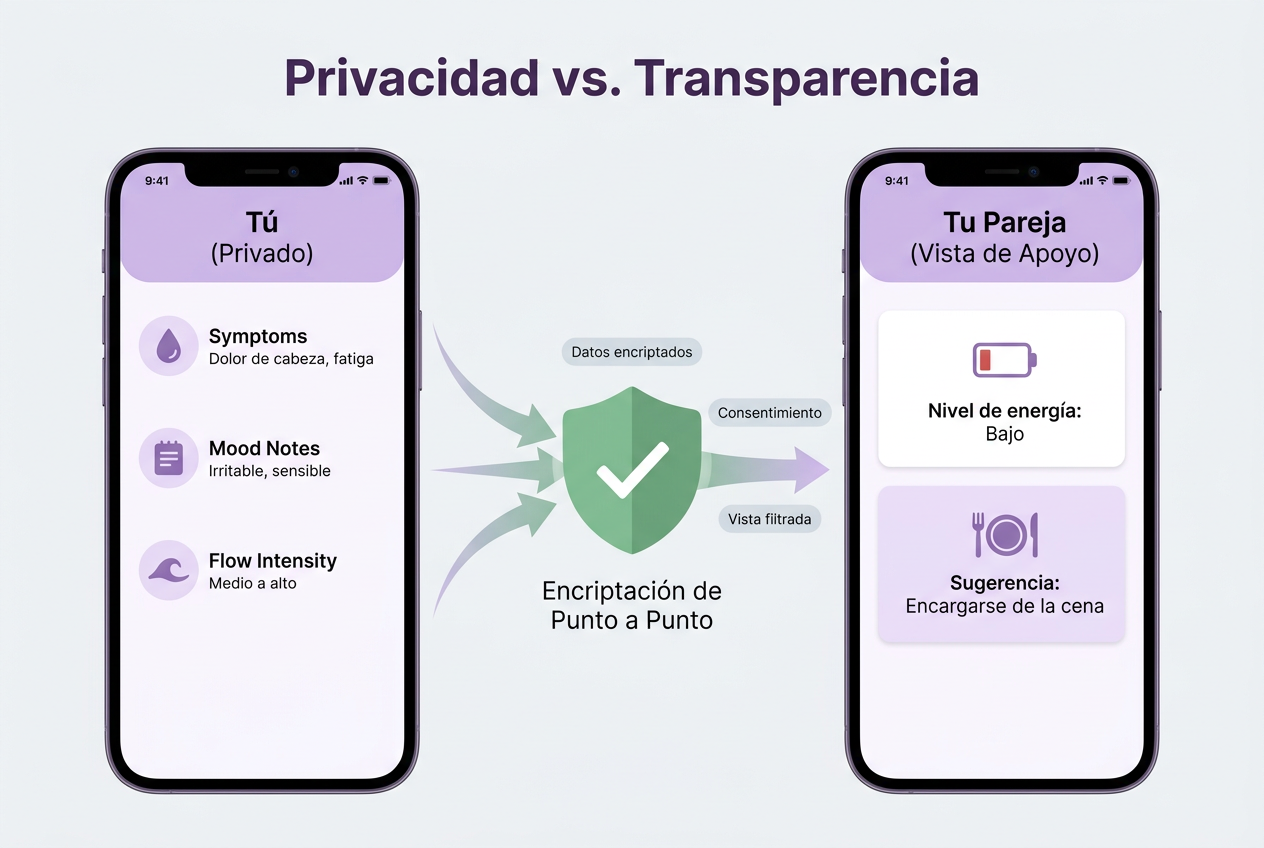 La privacidad es lo primero: las apps modernas permiten compartir estados de ánimo y niveles de energía sin exponer notas privadas o detalles médicos sensibles.
What NOT to say
- "I want to track your period so I know when you're going to be moody."
- "I think this would help me predict when you're going to be difficult."
- "I need to know when you're PMSing."
- "My friend's girlfriend uses this and it helps him avoid fights."
These phrases position her as the problem you're trying to manage. The correct frame is: you're the variable that needs adjusting based on her biological reality.
If she says no
Respect it. If she's uncomfortable sharing, don't push. Instead, ask if she'd be willing to tell you verbally when she's entering a low-energy week, or if there's another way you can be more proactive. The goal is better support, not surveillance.
For a deeper dive into how to approach this conversation with empathy and context, see our guide to consent in cycle tracking.
What Can You See vs. What Stays Private?
Privacy is the #1 concern women have about partner mode in period tracking apps. The fear is that sharing cycle data means sharing everything - medical notes, symptom details, fertility windows, sexual activity logs. In reality, most apps give her granular control over what you see. Here's the breakdown by app.
| App | What You Can See | What Stays Private by Default |
|---|---|---|
| VibeCheck | Current phase, energy level, mood tags (happy/tired/stressed), mission suggestions | Private notes, symptom details, fertility predictions, sexual activity logs |
| Flo | Current phase, predicted symptoms, educational content | Private journal entries, medication logs, detailed symptom data unless she enables sharing |
| Selin | Predicted period dates, energy level, shared favorites vault | Private notes, symptom logs, fertility tracking |
| Clue Connect | Whatever she explicitly shares (customizable) | Everything else. She controls visibility on a field-by-field basis. |
| Stardust | Mood tags, energy level, moon phase alignment | Private notes, detailed symptom logs, astrology readings |
| Mayday | Predicted period dates only | Everything. No detailed data sharing exists in the app. |
| Blood | Shared calendar events she logs as "shareable" | Everything else unless marked as shared |
The golden rule across all apps
You cannot see her private notes unless she explicitly grants access. Most apps treat written journal entries, symptom descriptions, and medical data as private by default. What you get is the high-level signal - "she's in her luteal phase, energy is low" - not the raw data behind it.
What about fertility tracking?
Most apps hide fertility predictions and ovulation data from partners unless she manually enables sharing. This is intentional: fertility tracking is a sensitive area tied to reproductive autonomy, and apps default to privacy. If you need to see ovulation predictions for family planning reasons, that's a conversation you have with your partner directly, not a setting you toggle in an app.
If you need more access
Ask. Don't assume the default settings are the limit. Some women are comfortable sharing detailed symptom logs because it helps their partner understand what they're experiencing. Others prefer to keep that data private and just share the phase and energy level. There's no universal standard - it's relationship-specific.
For a breakdown of how VibeCheck balances transparency and privacy, see our privacy policy.
Which Apps Have Partner Mode in Spanish?
Spanish-language support is critical for couples where one or both partners prefer Spanish as their primary interface. Here's the current state of language availability across the top apps as of 2026.
| App | Spanish Language Support | Partner Mode in Spanish |
|---|---|---|
| Flo | ✓ Full interface in Spanish | ✓ Partner mode available in Spanish |
| Clue | ✓ Full interface in Spanish | ✓ Clue Connect available in Spanish |
| Selin | ✓ Full interface in Spanish | ✓ Partner features available in Spanish |
| VibeCheck | ✗ English only (as of 2026) | ✗ Not yet available |
| Stardust | ✓ Partial support (main features in Spanish) | ~ Limited partner features in Spanish |
| Mayday | ✗ English only | ✗ Not applicable |
| Blood | ✗ English only | ✗ Not applicable |
Flo, Clue, and Selin are the most reliable options for Spanish-speaking couples. All three apps offer full localization, meaning not just translated text but region-appropriate health information and culturally adapted content.
If you're comparing apps specifically for Spanish-language support, Flo has the most comprehensive educational content in Spanish, including videos, articles, and partner onboarding guides. Clue's interface is fully localized but offers less educational content overall. Selin has strong Spanish-language support with a focus on Latin American users, including region-specific date and gift suggestions.
For a full breakdown of VibeCheck's roadmap for Spanish-language support, check our blog updates at VibeCheck Blog.
Ready to actually understand her?
Join thousands of men using VibeCheck to track her cycle and show up better every day.
Get VibeCheck FreeFrequently Asked Questions
Is Flo for Partners free?
No. Flo for Partners is part of Flo Premium, which costs $49.99 per year or $9.99 per month as of 2026. The free version of Flo allows women to track their own cycles, but partner access, educational videos, and advanced predictions require a paid subscription. The premium subscription also removes ads and unlocks fertility insights, pregnancy mode, and secret mode (which hides partner access if you break up). If you're evaluating Flo specifically for partner features, factor in the subscription cost - it's not a free add-on.
Can my boyfriend use the Flo app?
Yes, but only if your girlfriend has Flo Premium and invites you to access her data through Flo for Partners. Your boyfriend doesn't download a separate app - he accesses a partner dashboard through his own Flo account, which mirrors the information you choose to share. He cannot see your private notes, journal entries, or detailed symptom logs unless you explicitly grant access. The default setting is to share only your current cycle phase and predicted symptoms. If you're concerned about privacy, review the sharing settings in Flo before inviting a partner.
What is the Clue Connect feature?
Clue Connect is a feature within the Clue app that allows you to share your cycle data with a partner using end-to-end encryption. Unlike Flo's partner mode, which operates as a separate dashboard, Clue Connect creates a direct data mirror - your partner sees exactly what you share, nothing more. You control sharing on a field-by-field basis: you can share predicted period dates but hide symptom logs, or share mood tags but keep notes private. Clue Connect is free and available to all Clue users, not locked behind a premium subscription. However, as of 2026, some users have reported functionality issues with Clue Connect, including difficulty connecting accounts or features appearing unavailable. Always test the feature before relying on it.
How can my husband track my period?
Your husband can track your period using a partner-enabled app like VibeCheck, Flo for Partners, Selin, or Clue Connect. You log your cycle data in the app, and he receives access to a simplified view of your current phase, energy level, and predicted symptoms. He does not see your private notes or detailed medical information unless you explicitly share it. The most effective apps for husbands are those that translate cycle data into actionable support recommendations - VibeCheck and Selin excel here, while Flo and Clue prioritize education and data accuracy. If your husband's goal is to know when to step up with household support or emotional validation, VibeCheck's mission-based system is the most direct tool. If he wants to understand the biological mechanics, Flo's educational content is more comprehensive.
Is there a period tracker I can share with my partner?
Yes. The most popular period trackers with partner sharing features are VibeCheck, Flo for Partners, Selin, Clue Connect, Stardust, Mayday, and Blood for Couples. Each app handles sharing differently: VibeCheck gives your partner daily missions based on your cycle phase, Flo provides educational content and symptom predictions, Selin focuses on romantic gestures and gift planning, and Clue prioritizes privacy with encrypted sharing. The best choice depends on your relationship's needs: if you want your partner to receive clear instructions on how to support you, VibeCheck is the most tactical. If you want him to learn the biology and make his own decisions, Flo is the most educational. If privacy is your top concern, Clue's end-to-end encryption is the strongest option.
Can your partner track your period on Clue?
Yes, if you use Clue Connect to share your data. Your partner does not automatically have access to your cycle - you must invite them through the Clue Connect feature, which generates a secure link. Once connected, your partner sees only the information you choose to share. By default, Clue hides private notes, symptom details, and fertility predictions unless you manually enable sharing for those fields. Clue Connect uses end-to-end encryption, which means your data is not visible to Clue's servers or third parties - only you and your partner can decrypt it. If you disconnect your partner, their access is immediately revoked, and they cannot see historical data from before the connection.
What is the best menstrual cycle app to share with your partner?
The best menstrual cycle app to share with your partner depends on what you optimize for. VibeCheck is best if you want your partner to receive daily tactical missions and clear support instructions based on your cycle phase. Flo for Partners is best if you want your partner to learn the biology and educational content behind reproductive health. Selin is best if you want your partner to plan romantic gestures, track your favorite gifts, and anticipate low-energy weeks. Clue Connect is best if privacy is your top priority and you want granular control over what data is shared. Stardust is best if you incorporate astrology or spiritual frameworks into your relationship. For most couples, the highest-impact choice is VibeCheck or Flo, depending on whether you want him to receive instructions or education.
Does Clue have a partner feature?
Yes. Clue's partner feature is called Clue Connect, and it allows you to share your cycle data with a partner using end-to-end encryption. Unlike some apps where partner mode is a premium add-on, Clue Connect is free and available to all users. You control exactly what your partner sees by toggling sharing settings for individual data fields. For example, you can share predicted period dates but hide symptom logs, or share mood tags but keep private notes hidden. Clue Connect has had intermittent functionality issues as of 2026, with some users reporting that the feature is unavailable or buggy. If you're relying on Clue Connect for partner sharing, test the feature before committing to it as your primary tool.
If you're ready to stop guessing and start supporting your partner with precision, explore VibeCheck's period tracker for men or compare the top apps side-by-side in our period tracker comparison guide. For tactical advice on how to support her through each cycle phase, see our boyfriend's guide to menstrual cycle phases.
Tags

Related Articles
Continue reading to deepen your understanding

Best Menstrual Cycle Apps for Couples: The 2026 Tactical Playbook
Tracking her cycle isn’t just about dates; it’s about understanding biology. Learn how the right app can reduce relationship friction by 58% and improve your emotional bond significantly.
App ciclo menstrual para parejas: Best Trackers (2026)
Find the best app ciclo menstrual para parejas to boost your bond. We ranked top tools by tactical missions for men and data privacy for 2026 results.
App Ciclo Menstrual para Parejas: 7 Best Apps (2026)
The right app ciclo menstrual para parejas reduces relationship friction by 58%. We rank 7 top-tier trackers by tactical utility and data security.

How to Text Your Girlfriend During Different Cycle Phases: The Complete Guide
Ever send a text that landed like a grenade? Align your communication with her biological rhythm to reduce conflict by 58% and become the partner she actually wants to talk to.

How to Talk to Your Girlfriend During the Follicular Phase: The Relationship Power Window
Most men miss the best window for deep conversations. Learn why the follicular phase is the green light for big decisions and how to handle difficult topics with 72% more success.

How to Predict Girlfriend Mood Swings by Cycle (2026)
Learning how to predict girlfriend mood swings by cycle reduces relationship friction by 58% using this tactical four-phase hormonal support system now.

How to Plan Romantic Gestures by Menstrual Phase: A Tactical Playbook for Men
Stop guessing what your partner needs. Align your efforts with her biological calendar to show up with the right romantic gesture at exactly the right time for better connection.

How to Help Your Girlfriend During Ovulation Week: A Partner’s Playbook
Has she suddenly hit peak energy? That’s her biological summer. Learn how to navigate her cycle and support her social and creative spikes during ovulation week.