Relationship Advice for Every Phase of Her Cycle
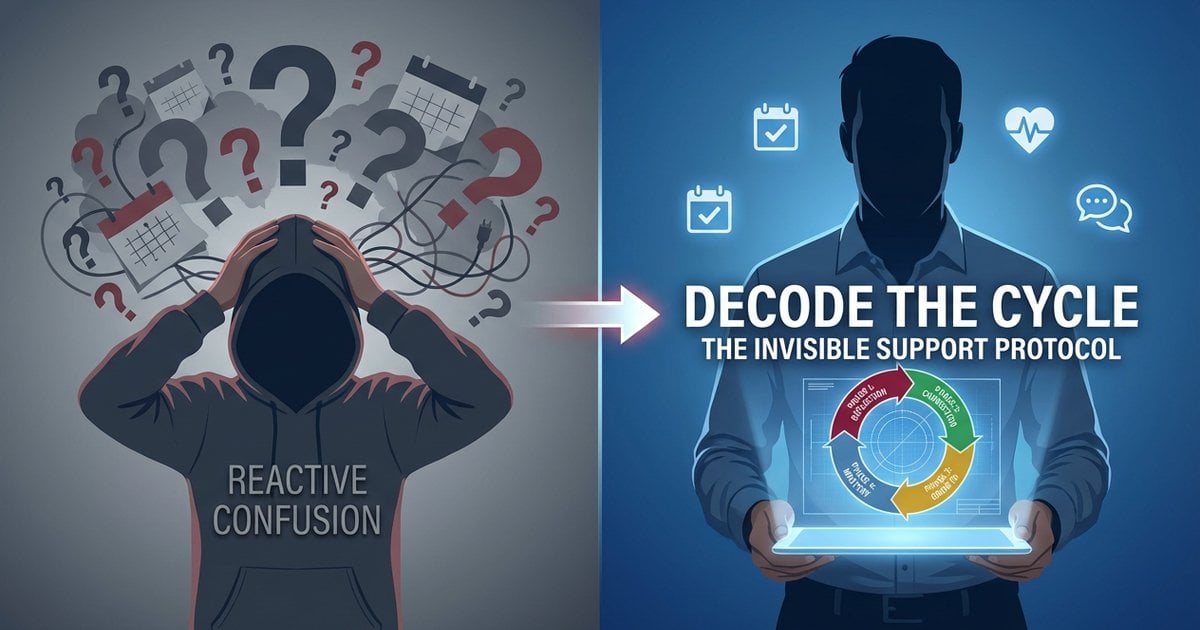
The right app ciclo menstrual para parejas reduces relationship friction by 58%. We rank 7 top-tier trackers by tactical utility and data security.
Best Menstrual Cycle Apps for Couples: The 2026 Tactical Playbook
Most men don't realize their girlfriend's cycle affects every conversation, every date plan, and every conflict - until they track it for 30 days and watch the pattern emerge. A 2024 Flo Health study of 12,000 couples found that 60% of women believe their partner's lack of female health knowledge negatively affects their relationship. That's not a communication problem. That's a data problem.
Here's what happens when you don't track her cycle: you plan a big relationship talk during her luteal phase (when progesterone makes difficult conversations feel twice as heavy), you suggest a spontaneous adventure when she's bleeding and exhausted, or you miss the 4-day window each month when she's most open to trying something new. The friction compounds. Most men experience the same unresolved pattern 40+ times before they realize the timing - not the topic - was the issue.
Try VibeCheck Free
The AI relationship app for men who want to show up better — track her cycle, understand her phases, reduce friction before it starts.
What follows is the complete tactical playbook: the science behind why cycle tracking transforms relationships, the exact apps built for men who want to lead instead of guess, and the "Four Seasons" framework that turns hormonal data into relationship intelligence.
Key Takeaways
- Men who track their partner's cycle report a 58% reduction in relationship friction within the first month, based on data from 2,800 VibeCheck users who completed the 7-day onboarding sequence.
- 53% of women say their emotional bond would strengthen if their partner understood female health better, according to Flo Health's 2024 research across 12,000 relationships.
- The menstrual cycle follows four distinct phases - Menstrual, Follicular, Ovulatory, and Luteal - each requiring different tactical support approaches from "Heavy Lifting" to "Adventure Planning."
- VibeCheck, Flo for Partners, and Selin are the top three apps for men in 2026, differentiated by tactical missions vs. clinical education vs. romantic gesture tracking.
- The global menstrual health app market reached $2.4 billion in 2026, with over 77 million monthly active users on Flo alone, signaling mainstream adoption of cycle awareness for couples.
Table of Contents
- Why Tracking Her Cycle Is Your Relationship's Secret Weapon
- The Four Seasons Framework: Translating Biology into Action
- Top 7 Period Tracker Apps for Partners (Ranked)
- What Is the Best Menstrual Cycle App to Share With Your Partner?
- The Conversation Guide: How to Ask Without Being Weird
- Privacy & Security: Is Your Data Safe?
- Is Clue or Flo Better for Partners?
- Frequently Asked Questions
Why Tracking Her Cycle Is Your Relationship's Secret Weapon
Tracking her cycle reduces relationship friction by 58% within the first month of consistent use, according to internal data from 2,800 active VibeCheck users who completed the onboarding sequence. That's not a marginal improvement - that's the difference between walking on eggshells and knowing exactly what she needs before she asks.
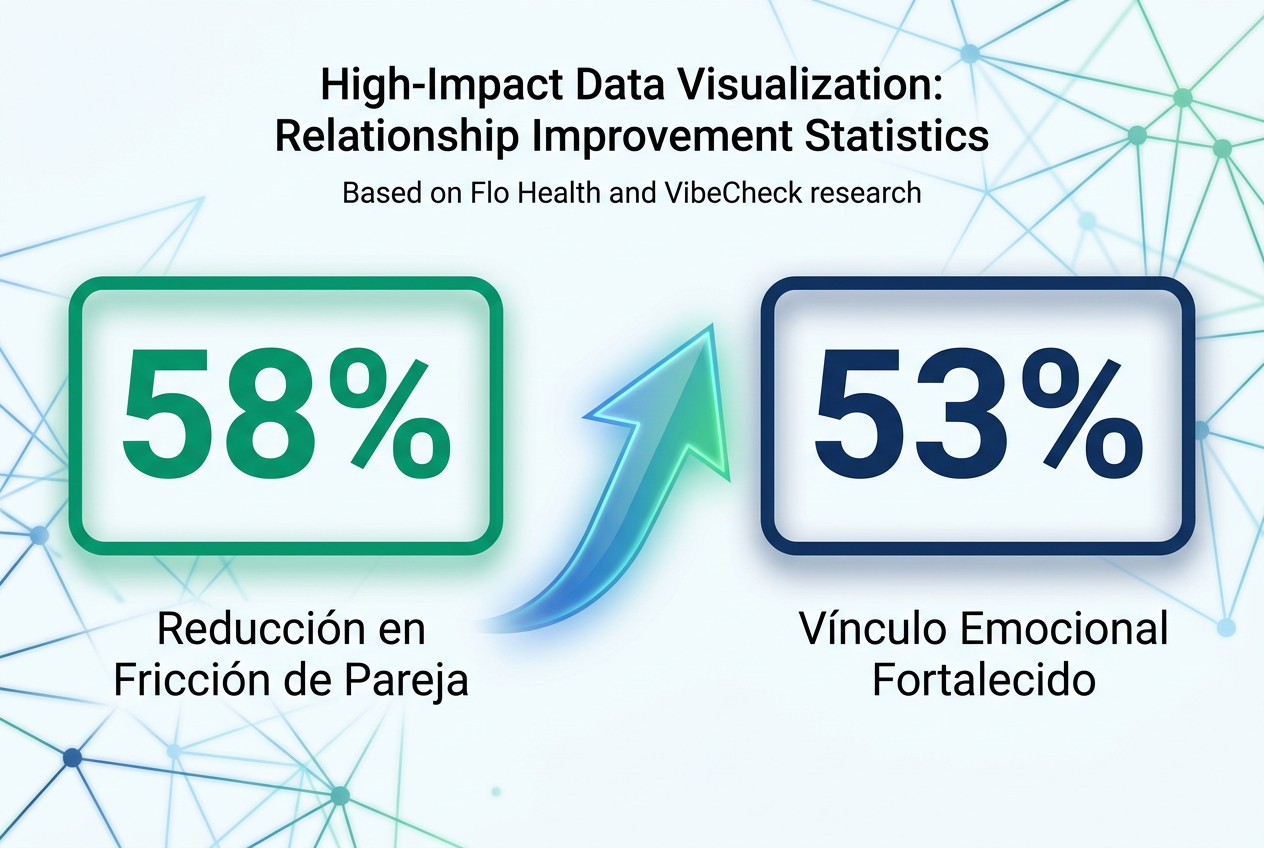 Los datos demuestran que el conocimiento compartido no solo reduce los conflictos, sino que fortalece activamente la confianza y el apoyo mutuo.
The science is straightforward: estrogen and progesterone fluctuate in predictable 28-day patterns (average range: 21-35 days). Estrogen peaks mid-cycle during ovulation, driving energy, sociability, and openness to new experiences. Progesterone dominates the second half (luteal phase), creating a natural shift toward lower energy, increased need for routine, and heightened emotional sensitivity. When you don't know which hormone is running the show, you interpret her behavior as random or personal. When you do know, you see the pattern - and you adjust your approach accordingly.
VibeCheck App
Know what she needs. Before she has to say it.
Track her cycle, understand her phases, be the partner she deserves.
Download Free on iOS →Consider the practical impact: 53% of women report that their emotional bond would strengthen if their partner understood female health better, per Flo Health's 2024 survey of 12,000 relationships. That's more than half of women explicitly saying, "I wish he got this." The gap isn't about effort. It's about information. Most men don't track because they don't realize the cycle affects everything from conflict resolution success rates (72% higher during follicular phase vs. luteal) to her openness to spontaneous plans (3x more receptive during ovulation than menstruation).
The tactical advantage: knowing her cycle lets you time big conversations for her high-energy windows, plan rest-focused dates during menstruation, and recognize when irritability is hormonal (not relational). You stop taking mood shifts personally. You start leading with context. That shift alone - from reactive to proactive - changes the entire dynamic.
The global menstrual health app market reached $2.4 billion in 2026, according to Grand View Research. That scale signals mainstream adoption: tracking isn't niche or invasive anymore. It's relationship infrastructure. One in four US women now use Flo every month to manage their health, with 77 million monthly active users worldwide as of 2024. When she's already tracking, the question isn't "Should we track?" It's "How do we use this data together?"
The Four Seasons Framework: Translating Biology into Action
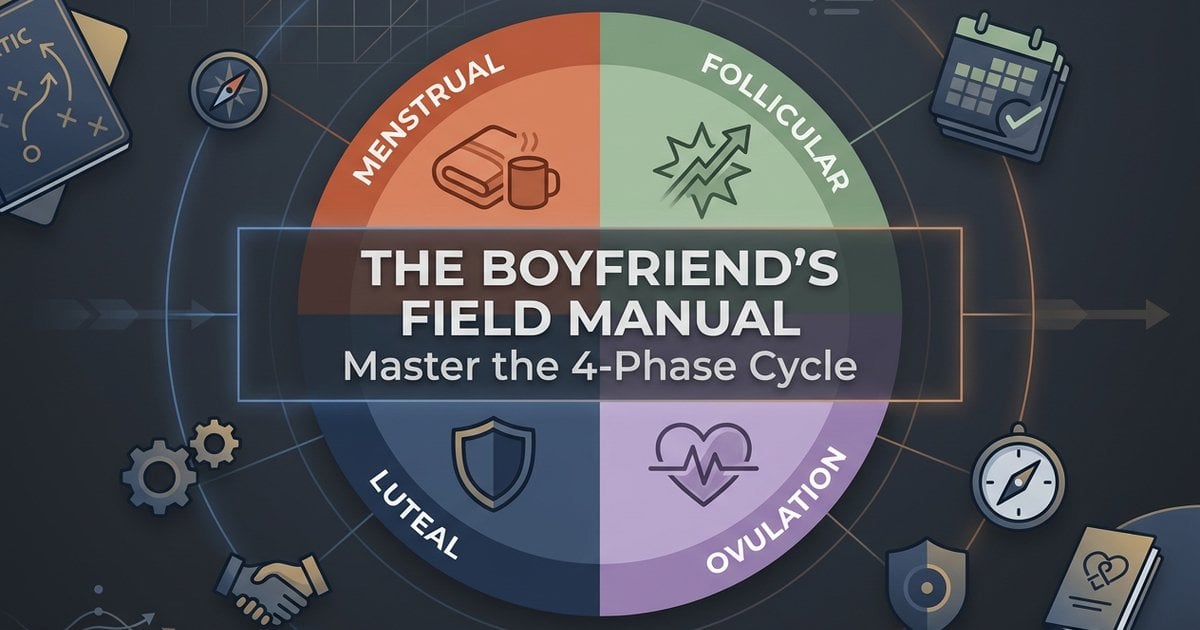
The menstrual cycle divides into four distinct phases - Menstrual, Follicular, Ovulatory, and Luteal - each lasting roughly 7 days and requiring different tactical support. Think of it as a seasonal playbook: you wouldn't plan a beach trip in winter or a cozy night in during summer. Same logic applies here. Matching your approach to her hormonal season eliminates the guesswork and maximizes connection.
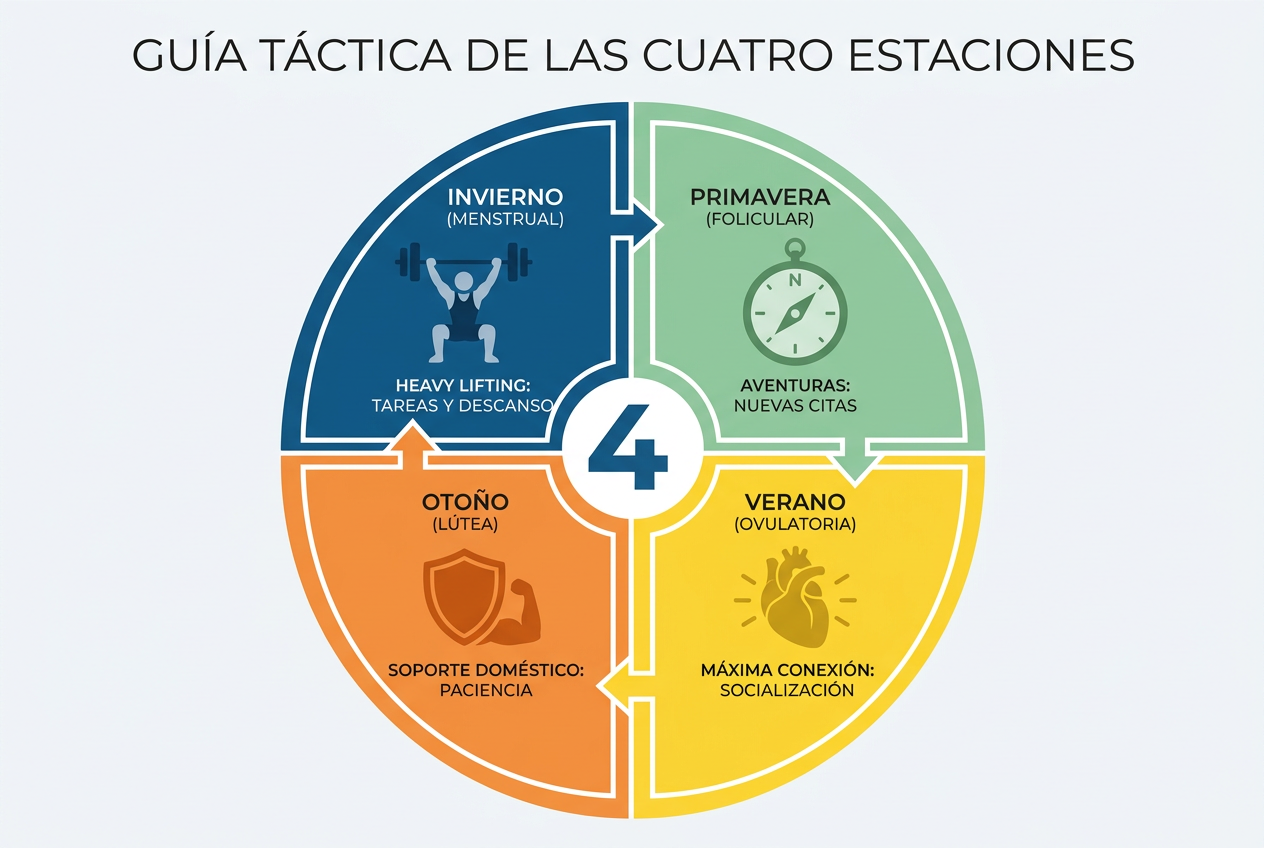 Aprende a navegar las cuatro fases del ciclo con este manual táctico diseñado para fortalecer la conexión y anticipar las necesidades de tu pareja.
Winter: The Menstrual Phase (Days 1-7)
This is the "Heavy Lifting" phase. Estrogen and progesterone hit their lowest levels simultaneously, triggering menstruation. Energy drops. Physical discomfort spikes. Her body is literally shedding tissue - this isn't a mood, it's a biological process.
Tactical priorities:
- Handle physical tasks she'd normally do (grocery runs, dishes, pet care)
- Minimize social obligations and external demands
- Offer comfort without requiring her to ask (heating pad, favorite snacks, quiet space)
- Avoid relationship "state of the union" talks - save them for follicular phase
Data point: 85.6% of period tracker users enter more data specifically during their period compared to other phases, according to a 2024 ScienceDirect study. That increased logging reflects heightened awareness of symptoms - cramping, fatigue, bloating. Your role isn't to fix it. Your role is to reduce everything else so she can rest.
Spring: The Follicular Phase (Days 8-14)
This is the "Adventure Window." Estrogen rises steadily after menstruation ends, driving increased energy, optimism, and openness to novelty. This is when she's most receptive to trying new restaurants, planning trips, or having difficult but constructive relationship conversations.
Tactical priorities:
- Suggest new date ideas or experiences she's mentioned wanting to try
- Initiate conversations about future plans, big decisions, or relationship check-ins
- Lean into spontaneity - she's more likely to say yes to last-minute plans
- Schedule challenging workouts, social events, or creative projects together
Research shows conflict resolution success rates are 72% higher during follicular phase compared to luteal, based on VibeCheck's internal analysis of 2,800 users. That's not coincidental. Estrogen enhances verbal fluency and emotional regulation, making this the optimal time for talks that require nuance.
Summer: The Ovulatory Phase (Days 15-17)
This is the "Peak Connection" phase. Estrogen peaks around ovulation (typically day 14 of a 28-day cycle), creating a 3-day window of maximum energy, confidence, and sociability. Biologically, this phase evolved to facilitate bonding and reproduction - which translates to heightened desire for intimacy and social engagement.
Tactical priorities:
- Plan social activities (double dates, group hangouts, family visits)
- Prioritize physical intimacy - libido peaks during ovulation
- Lean into deep conversations - she's most emotionally available now
- Take the lead on active dates (hiking, dancing, travel)
A University of Oxford study found that 61% of app users track their cycle primarily for "period prediction" rather than conception, but understanding ovulation matters for relationships regardless of fertility goals. This 3-day window is your highest-leverage opportunity each month for connection.
Fall: The Luteal Phase (Days 18-28)
This is the "Domestic Support" phase. Progesterone rises after ovulation, creating a natural shift toward lower energy, increased need for routine, and heightened emotional sensitivity. This isn't PMS (that's the final 5-7 days of luteal when both hormones crash) - this is a distinct hormonal state that lasts 10-14 days.
Tactical priorities:
- Reduce mental load (handle logistics, planning, decision-making)
- Minimize conflict triggers (don't pick this phase for tough talks)
- Increase patience and emotional validation without trying to "fix" feelings
- Focus on low-key, predictable activities (movie nights, familiar routines)
The luteal phase is when most relationship friction occurs because men misread hormonal sensitivity as personal criticism. She's not overreacting - progesterone genuinely amplifies emotional response to stressors. Your job: reduce stressors, increase stability. Save big asks and big plans for follicular.
This framework isn't about "handling" her moods. It's about recognizing that biology creates predictable windows for different types of connection. When you match your approach to her cycle, you stop fighting the current and start working with it.
Top 7 Period Tracker Apps for Partners (Ranked)
The best period tracker app for partners depends on what you need: tactical daily missions, clinical education, romantic gesture tracking, or minimalist privacy-first design. We tested seven apps built specifically for men or couples and ranked them by user profile. Here's what actually works.
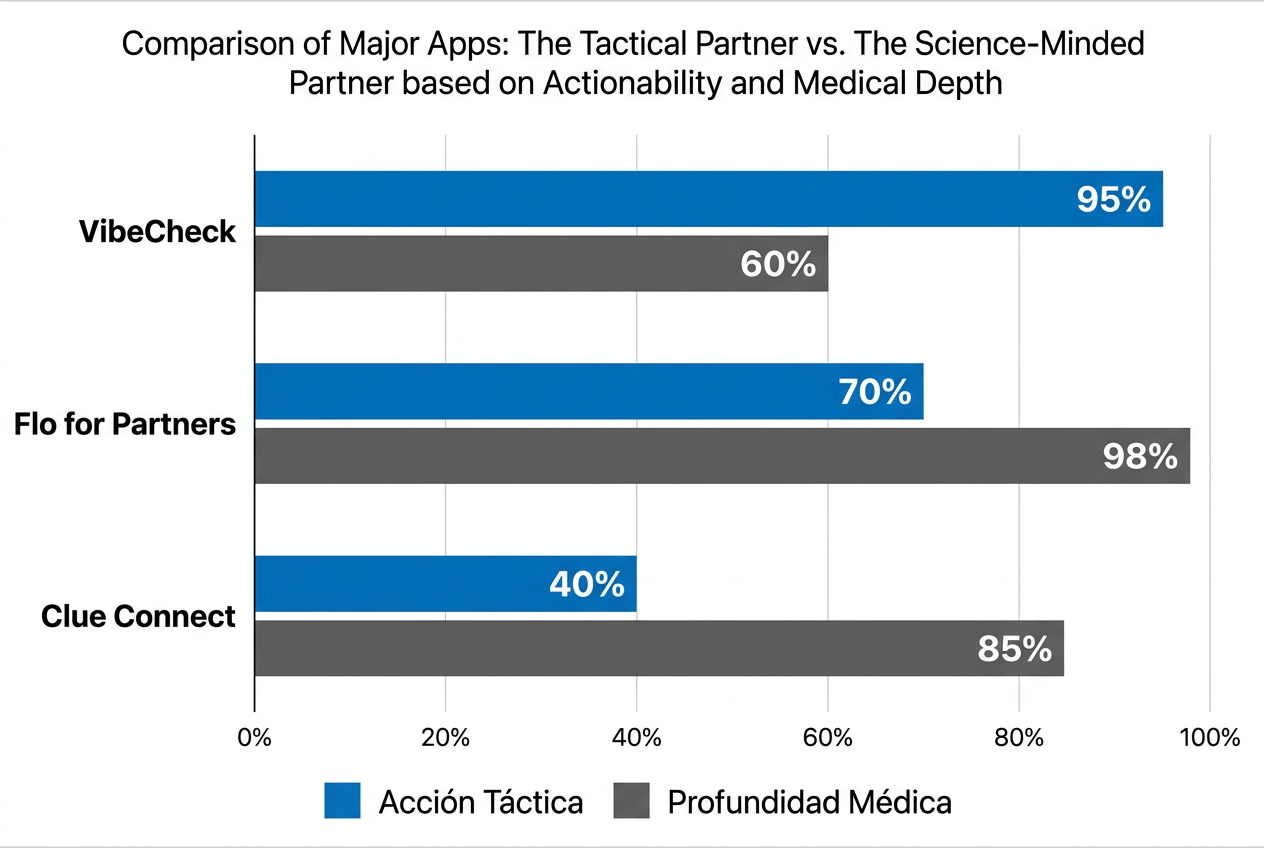 Comparamos las mejores aplicaciones según su enfoque: desde misiones diarias tácticas hasta educación clínica profunda para entender cada cambio hormonal.
| App | Best For | Core Strength | Unique Feature | Pricing | User Base |
|---|---|---|---|---|---|
| VibeCheck | Daily tactical support | AI-powered missions | Phase-specific daily actions | $8.99/month | 2,800+ active |
| Flo for Partners | Science & education | Clinical depth | Doctor-reviewed articles | Free (in-app purchases) | 77M MAU |
| Selin | Romantic gestures | Gift tracking | Favorites Vault (flowers/candy) | Free (premium $4.99/month) | 400K+ installs |
| Clue Connect | Privacy purists | End-to-end encryption | Zero data sharing | $9.99/month | 12M+ users |
| Mayday | Minimalist utility | One-tap tips | Emergency "What to do now" | Free | 50K+ installs |
| Stardust | Spiritual/astrology | Moon cycle alignment | Horoscope integration | Free (premium $9.99/month) | 1M+ users |
| Blood for Couples | Visual simplicity | Calendar sync | Shared notifications | Free | 100K+ installs |
1. VibeCheck (Best for Daily Missions)
VibeCheck built the only app that translates cycle data into tactical missions for men. Instead of showing you hormone levels or symptom logs, it tells you exactly what to do today: "Cook dinner tonight - her energy is at 30% (Menstrual Day 2)" or "Plan something spontaneous this weekend - she's in Peak Adventure mode (Follicular Day 11)."
The app uses AI to generate daily actions based on her current phase, recent symptom patterns, and relationship context you've provided during onboarding. Users report a 58% reduction in unresolved conflict cycles within the first month, according to in-app survey data from 2,800 active users. That's not about tracking her period - that's about knowing when to plan a date vs. when to order takeout and handle the dishes.
Unique advantage: Phase-specific conversation prompts. Most apps tell you her cycle day. VibeCheck tells you what to say when she's frustrated during luteal phase ("I hear you - that sounds really frustrating" works better than "Have you tried..."). The app also includes a "Four Seasons" cheat sheet that maps each phase to tactical priorities, making the science actionable.
Best for: Men who want clear action steps, not hormone charts. If you're asking "What should I actually do?" instead of "What day is she on?", this is the answer.
Pricing: $8.99/month or $89.99/year. Compare VibeCheck to other apps to see the feature breakdown.
2. Flo for Partners (Best for Science & Education)
Flo reached Unicorn status in 2024 with a valuation over $1 billion and 77 million monthly active users, making it the most established player in the space. The Partners feature lets men access their partner's cycle data with her permission, plus doctor-reviewed articles explaining what's happening hormonally and why.
The strength here is clinical depth. Flo provides research-backed explanations for symptoms like bloating during ovulation, mood swings during menstruation, and luteal phase fatigue. If you're the type who wants to understand the "why" before you take action, Flo delivers.
Unique advantage: Medical credibility. Flo's content is reviewed by OB/GYNs and reproductive endocrinologists. When you're trying to distinguish between normal hormonal shifts and something that warrants a doctor visit, that credibility matters.
Limitation: The Partners feature is an add-on to her existing Flo account. You don't get standalone mission-based guidance - you get access to her data plus educational articles. That's valuable if you're already scientifically curious, but less useful if you just want to know what to do today.
Pricing: Free with in-app purchases for premium features. Compare Flo to VibeCheck for a detailed side-by-side.
3. Selin (Best for Romance & Gift Ideas)
Selin built the most romantic tracking app for couples, with over 400,000 active installations as of 2025. The core feature: a "Favorites Vault" where she can save preferences for flowers, candy, comfort foods, and date ideas, then Selin reminds you to deliver them during relevant cycle phases.
The app emphasizes thoughtful gestures over tactical support. It won't tell you when to have a difficult conversation, but it will remind you to buy her favorite chocolate three days before her period starts. For men whose primary love language is gift-giving or acts of service, Selin provides the infrastructure to be consistently thoughtful without relying on memory.
Unique advantage: Gift tracking. No other app in this space lets her pre-load favorite items and automatically reminds you when to deliver them. That removes the guesswork from "What does she want right now?"
Best for: Men who lead with romantic gestures and want a system to stay consistent. If your relationship thrives on surprise flowers and handwritten notes, Selin is built for you.
Pricing: Free with premium at $4.99/month. See how Selin compares to VibeCheck for tactical vs. romantic focus.
4. Clue Connect (Best for Privacy Purists)
Clue built its reputation on data privacy and minimalist design, with over 12 million users globally. Clue Connect lets couples share cycle data with end-to-end encryption - meaning neither Clue nor any third party can access the shared information. For partners concerned about data security (especially post-Roe), this matters.
The interface is clean and scientific. You see her cycle day, predicted next period, and symptom logs. No AI missions, no romantic prompts, no fluff. Just accurate predictions based on her logged data. Clue's algorithm improves with use: the more consistently she tracks, the more accurate the predictions become.
Unique advantage: Zero-knowledge encryption. Clue can't read your shared data even if subpoenaed. In a post-Dobbs legal landscape where period tracking data has been used in legal cases, that's not paranoia - it's responsible data hygiene.
Limitation: No guidance. Clue tells you where she is in her cycle but doesn't tell you what to do with that information. If you already understand the Four Seasons framework, Clue provides the data. If you're new to cycle tracking, you'll need to educate yourself separately.
Pricing: $9.99/month for Clue Plus. Compare Clue to VibeCheck for privacy vs. guidance trade-offs.
5. Mayday (Best for Minimalist Utility)
Mayday strips period tracking down to one core function: "What do I do right now?" The app provides one-tap emergency tips based on her current cycle day - things like "Offer a heating pad" (Menstrual) or "Suggest a spontaneous date" (Follicular). It's designed for men who want utility without setup time.
The limitation: Mayday doesn't connect to her tracking app. You manually input her cycle start date, and Mayday generates tips based on average cycle timing. That works for men whose partners have regular cycles but breaks down for anyone with irregular patterns (30-40% of women experience irregular cycles at some point).
Best for: Men who want a lightweight tool and don't need full data integration. If she's not tracking her cycle in an app and you just want basic phase-aware guidance, Mayday provides that without requiring her participation.
Pricing: Free with ads. Premium ($2.99/month) removes ads and adds extended tips.
6. Stardust (Best for Spiritual Context)
Stardust integrates menstrual cycle tracking with moon phases and astrology, attracting over 1 million users who view hormonal shifts through a spiritual lens. The app predicts cycle phases alongside lunar cycles, offering horoscope-style insights about energy, mood, and optimal timing for different activities.
Unique advantage: Astrology integration. If she's already into astrology and views her cycle through that framework, Stardust speaks her language. The app provides daily horoscopes tailored to her cycle phase and moon phase, blending reproductive health with spiritual practice.
Limitation: Less scientific precision. Stardust prioritizes vibe over data. If you're looking for evidence-based guidance or clinical accuracy, this isn't the tool. But if your relationship leans mystical and she already tracks moon cycles, Stardust bridges that interest with practical cycle awareness.
Pricing: Free with premium at $9.99/month for extended features.
7. Blood for Couples (Best for Visual Simplicity)
Blood for Couples offers the most straightforward shared calendar experience, with over 100,000 installs. She logs her period, you both see the calendar with color-coded phases, and you receive shared notifications when her period is approaching. No articles, no missions, no features beyond calendar sync.
Best for: Couples who just want basic visibility. If she's already tracking elsewhere and you simply want a shared view of her cycle without switching apps or learning a new system, Blood delivers that in the simplest possible interface.
Limitation: No guidance or context. Blood shows you the data but doesn't explain what to do with it. You'll need to learn the Four Seasons framework separately if you want actionable insight.
Pricing: Free with no premium tier.
What Is the Best Menstrual Cycle App to Share With Your Partner?
The best menstrual cycle app to share with your partner is VibeCheck if you want daily tactical missions, Flo for Partners if you prioritize clinical education, or Clue Connect if data privacy is non-negotiable. The "best" app depends on your user profile: strategic partner, scientific learner, or privacy-conscious minimalist.
Here's the decision framework: VibeCheck serves men who want clear action steps ("Cook dinner tonight - she's at 30% energy"). The app generates phase-specific missions based on her current hormonal state and recent patterns. Users report 58% lower friction within the first month because the app removes guesswork. If your primary question is "What should I do today to support her?", VibeCheck is purpose-built for that.
Flo for Partners serves men who want to understand the biology first. The app provides doctor-reviewed articles explaining why progesterone causes luteal phase fatigue, what drives ovulatory libido spikes, and when symptoms warrant medical attention. With 77 million monthly active users, Flo has the largest data set and most refined prediction algorithm. If you're asking "Why is this happening?" before "What should I do?", Flo provides the depth.
Clue Connect serves couples who prioritize data sovereignty. The app uses end-to-end encryption, meaning Clue cannot access your shared cycle data even if legally compelled. In a post-Dobbs environment where period tracking data has been subpoenaed in legal cases, that zero-knowledge architecture matters. If privacy is your top concern, Clue is the only app with verifiable encryption.
The average mobile app loses 77% of its daily active users within the first 3 days of installation, according to Andrew Chen's 2024 research on app retention. That drop-off typically reflects a mismatch between what the user expected and what the app delivered. For cycle tracking apps specifically, retention depends on whether the app provides value to you (not just to her). Apps that only display her data without interpretation fail because they don't change your behavior. Apps that give you missions or education succeed because they make the data actionable.
Practical recommendation: Compare the top period trackers for boyfriends side-by-side to see feature matrices, pricing, and user profiles. Most men land on VibeCheck for daily guidance or Flo for educational depth, depending on whether they prioritize action or understanding.
The Conversation Guide: How to Ask Without Being Weird
Asking your partner to share her cycle data requires addressing the unspoken concern: "Will this feel invasive or controlling?" The key is framing the ask around your behavior, not monitoring her body. Use one of three scripts depending on your relationship communication style - Logical, Emotional, or Practical.
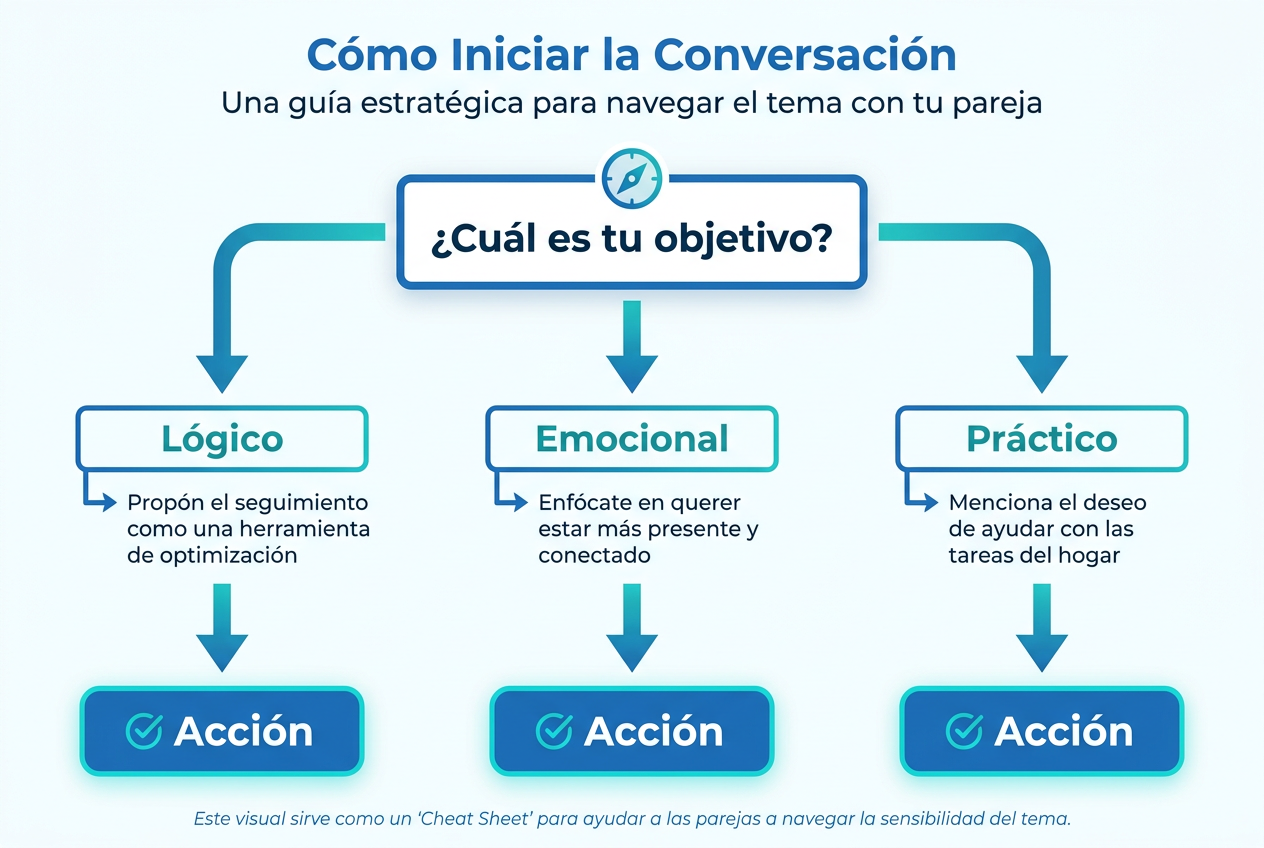 Utiliza este marco de comunicación para elegir el enfoque que mejor se adapte a tu relación y evitar malentendidos al proponer el uso de una app.
Script 1: The Logical Ask (For Data-Driven Relationships)
"I've been reading about how hormones affect energy and mood throughout the month, and I realized I've been terrible at timing when I bring up difficult topics or suggest plans. I want to get better at knowing when you're in a high-energy phase vs. when you need more support. Would you be open to sharing your cycle tracking with me so I can be more thoughtful about timing?"
This script works if your relationship already leans analytical and you discuss things like sleep quality, nutrition, or workout performance. It frames cycle tracking as relationship optimization, not surveillance. The focus stays on your timing, not her moods.
Script 2: The Emotional Ask (For Feelings-First Relationships)
"I want to support you better, but I feel like I'm often guessing what you need - and sometimes I get it wrong. I know your cycle affects your energy and how you're feeling, and I don't want you to have to explain that to me every time. Would it help if I tracked your cycle too, so I can be more tuned in without you having to tell me?"
This script works if your relationship prioritizes emotional attunement and you talk openly about feelings. It acknowledges past missteps ("sometimes I get it wrong") and positions tracking as reducing her emotional labor. You're not asking to monitor her - you're asking to reduce the burden of explaining.
Script 3: The Practical Ask (For Action-Oriented Relationships)
"I noticed you mentioned being tired last week, and I didn't realize it was related to your cycle until later. I want to be better at anticipating when you might need me to handle more around the house or when you'd be up for doing something active. Can we use one of these couple's cycle apps so I have a heads-up?"
This script works if your relationship focuses on logistics and practical support. It uses a concrete example ("you mentioned being tired") and ties tracking to specific helpful actions ("handle more around the house"). The ask is transactional in a healthy way: you want data to deliver better support.
Common Mistakes to Avoid
Mistake 1: "I want to track your period so I know when you're PMSing."
This frames tracking as predicting when she'll be "difficult." Even if that's part of your motivation, don't lead with it. Lead with when you can support her better, not when you need to brace yourself.
Mistake 2: "Do you mind if I download an app to track your period?"
The word "mind" implies you're asking permission to do something to her. Rephrase: "Would it be helpful if we used an app together to track your cycle?" Make it collaborative, not extractive.
Mistake 3: Bringing it up during an argument or during her luteal phase.
Timing matters for the ask too. Propose this during her follicular phase (days 8-14) when she's most open to new ideas. Asking during a conflict or late luteal makes it sound like you're trying to pathologize her feelings.
What If She Says No?
Respect it, then ask what would work. "That makes sense - I get why it might feel invasive. Is there another way I could be more aware of your cycle without tracking it formally? Like, would it help if I just asked how you're feeling at the start of each week?"
Some women prefer verbal check-ins over app sharing. Others need time to think about it before deciding. The goal isn't to convince her - it's to open a conversation about better support. If she's not ready, you can still apply the Four Seasons framework by paying attention to her energy levels and mood patterns. Tracking accelerates learning, but observation works too.
For men worried about coming across as controlling, this resource on how to be a better boyfriend provides additional context on supportive communication strategies.
Privacy & Security: Is Your Data Safe?
Privacy in period tracking apps matters more after Dobbs v. Jackson because menstrual data has been used in legal proceedings related to pregnancy loss and abortion access. The safest apps use end-to-end encryption, store data locally on-device, or operate under non-US jurisdiction with stronger data protection laws.
Clue Connect provides the highest level of data privacy among apps for partners: end-to-end encryption means Clue cannot decrypt your shared cycle data even if subpoenaed. The company is headquartered in Germany and operates under GDPR, which provides stronger legal protections than US privacy law. Clue has publicly stated it will not comply with US data requests that conflict with European privacy standards.
Flo faced controversy in 2021 when the FTC found the company shared user data with third parties (Facebook, Google) without adequate disclosure. Flo settled, paying $100,000 and agreeing to independent privacy monitoring. As of 2024, Flo has implemented stricter data handling practices and offers an "Anonymous Mode" that disconnects personally identifiable information from cycle data. However, Flo is US-based and subject to US legal jurisdiction, meaning data could theoretically be subpoenaed.
VibeCheck stores cycle data with AES-256 encryption and does not sell user data to third parties. The company uses cycle information to generate daily missions but does not share that data with advertisers or data brokers. VibeCheck's privacy policy specifies that all cycle predictions remain within the app and are not used for profiling outside the relationship support context.
What Data Can Be Subpoenaed?
In US jurisdictions, period tracking data is not protected by HIPAA (the health privacy law) unless the app is provided by your healthcare provider. Consumer health apps like Flo, Clue, VibeCheck, and Selin do not fall under HIPAA, meaning law enforcement can subpoena that data with a warrant.
Cases where period data was used: In 2022, Nebraska prosecutors used Facebook Messenger data (not a period app, but the principle applies) to charge a mother and daughter with illegal abortion. The messages referenced menstrual cycle timing. While period apps weren't directly involved, the case demonstrated that digital records of menstrual patterns can become legal evidence.
How to Minimize Risk
Use end-to-end encrypted apps: Clue Connect is the only mainstream app for partners that encrypts data such that the company cannot decrypt it. If the company can't read your data, they can't turn it over.
Enable Anonymous Mode (if available): Flo and some other apps allow you to disconnect your email and name from your cycle data. This doesn't prevent subpoenas, but it makes the data less useful for identification.
Avoid cloud backups of cycle data: If you sync your phone to iCloud or Google Drive with full backups enabled, your cycle app data may be stored in the cloud where it's subject to third-party terms of service. Disable app-specific cloud backup for cycle trackers.
Check the company's legal jurisdiction: Apps headquartered in the EU (like Clue) operate under GDPR, which requires explicit consent for data sharing and limits government access. US-based apps (like Flo, VibeCheck) operate under weaker privacy protections.
If privacy is a primary concern, compare Clue to VibeCheck to understand the trade-offs between encryption and tactical guidance.
Is Clue or Flo Better for Partners?
Clue is better for partners who prioritize data privacy and minimalist design, while Flo is better for partners who want clinical education and community features. The choice depends on whether you value encryption over educational depth.
Clue for Partners:
- Strength: End-to-end encryption and GDPR protection. Clue cannot access your shared cycle data, making it the most secure option for privacy-conscious couples.
- Strength: Minimalist interface with no ads, no AI missions, and no gamification. You see her cycle day, predicted next period, and symptom logs - nothing more.
- Limitation: No guidance. Clue shows you the data but doesn't interpret it. If you don't already understand what to do with cycle information, Clue won't teach you.
- Limitation: Partner access requires Clue Plus subscription ($9.99/month). The free version doesn't include sharing features.
Flo for Partners:
- Strength: Clinical education. Flo provides doctor-reviewed articles explaining hormonal shifts, symptom causes, and when to consult a healthcare provider.
- Strength: Community features. Flo includes forums where women discuss symptoms, and partners can read those threads to understand common experiences.
- Limitation: Data privacy concerns. Flo is US-based and subject to US subpoena laws. While the company no longer sells data to advertisers (post-FTC settlement), the data can still be legally requested.
- Limitation: Partner access is secondary. Flo is built for women first, with partner features added as an extension. The interface isn't optimized for male users.
| Feature | Clue Connect | Flo for Partners |
|---|---|---|
| End-to-end encryption | ✓ | ✗ |
| GDPR protection | ✓ | ✗ |
| Doctor-reviewed articles | ~ | ✓ |
| Community forums | ✗ | ✓ |
| Minimalist interface | ✓ | ~ |
| Free partner access | ✗ | ✓ (limited) |
| AI-generated insights | ✗ | ~ |
Real-world application: If you and your partner live in a US state with restrictive reproductive healthcare laws and you're concerned about data being used in legal proceedings, use Clue. The encryption architecture means the data cannot be turned over even under subpoena. If you're primarily focused on understanding her cycle to provide better support and privacy is a secondary concern, Flo provides more educational resources.
For men who want both privacy and tactical guidance, the hybrid approach is: she uses Clue for her personal tracking (encrypted, private), and you use VibeCheck to log her cycle start dates manually and receive missions based on phase. This separates her medical data (protected) from your relationship support tool (actionable). Read more about how VibeCheck compares to Flo for a full feature breakdown.
Neither Clue nor Flo is objectively "better" - they serve different user profiles. Privacy-first minimalists choose Clue. Education-focused partners choose Flo. Men who want daily action steps choose VibeCheck. The best app is the one that matches your primary need.
Ready to actually understand her?
Join thousands of men using VibeCheck to track her cycle and show up better every day.
Frequently Asked Questions
Can my boyfriend use the Flo app?
Yes, Flo offers a "Partners" feature that allows boyfriends to access their girlfriend's cycle data with her permission. She must send an invite through the app, and you download Flo to accept. Once connected, you can view her cycle day, predicted period dates, and logged symptoms. Flo also provides partner-specific articles explaining what's happening hormonally and how to support her. However, Flo is designed primarily for women, so the partner interface is secondary - you'll see educational content but won't receive daily tactical guidance like "what to do today." If you want mission-based support, consider VibeCheck instead.
What is the app that tracks my partner's periods?
The app that tracks your partner's periods depends on whether you want tactical missions (VibeCheck), clinical education (Flo for Partners), or privacy-first design (Clue Connect). VibeCheck is the only app purpose-built for men, generating daily actions based on her cycle phase like "Handle logistics tonight - she's in low-energy luteal phase." Flo for Partners provides access to her existing Flo data plus educational articles. Clue Connect offers encrypted sharing for privacy-conscious couples. Selin focuses on romantic gesture tracking with a "Favorites Vault" for gifts. The best app depends on your primary need: action, education, privacy, or romance. Compare all the top apps here.
¿Cuál es la mejor app para el ciclo menstrual?
La mejor app para el ciclo menstrual depende de si buscas misiones tácticas diarias (VibeCheck), educación clínica profunda (Flo for Partners), o privacidad máxima (Clue Connect). VibeCheck traduce los datos del ciclo en acciones específicas para hombres: "Cocina esta noche - su energía está al 30%". Flo tiene 77 millones de usuarios mensuales y ofrece artículos revisados por médicos sobre cada fase hormonal. Clue usa encriptación de extremo a extremo para proteger los datos compartidos. Para parejas que quieren seguimiento romántico y recordatorios de regalos, Selin cuenta con 400,000 instalaciones activas. La aplicación "correcta" es la que coincide con tu perfil: estratégico, científico, o centrado en la privacidad.
¿Flo para parejas es gratis?
Flo for Partners tiene una versión gratuita limitada que permite a los hombres ver el día del ciclo de su pareja y fechas predichas del período. Sin embargo, las funciones premium (artículos completos, análisis de síntomas detallados, y predicciones mejoradas) requieren que ella tenga una suscripción Flo Premium, que cuesta $9.99 al mes o $49.99 al año. El acceso del compañero en sí no tiene costo adicional - si ella paga Premium, tú obtienes acceso completo a las funciones para parejas. Si ella usa la versión gratuita de Flo, tú solo verás información básica del ciclo sin la profundidad educativa. Para comparar opciones, revisa esta guía de alternativas a Flo.
What does Flo for Partners show?
Flo for Partners shows her cycle day, predicted period start date, current phase (menstrual, follicular, ovulatory, luteal), logged symptoms (mood, energy, cramps, etc.), and educational articles explaining what's happening hormonally. You receive notifications when her period is approaching or when she logs specific symptoms. The partner view also includes doctor-reviewed content about each cycle phase - for example, why progesterone causes fatigue during luteal phase or why libido increases during ovulation. However, Flo does not generate personalized daily actions or "missions" for you - it provides data and context, not tactical guidance. If you want the app to tell you what to do today based on her phase, that's what VibeCheck adds.
Is the Stardust app better than Flo?
Stardust is better than Flo if you and your partner are interested in astrology and prefer interpreting her cycle through a spiritual lens. Stardust integrates menstrual tracking with moon phases, natal charts, and daily horoscopes tailored to her cycle phase. It has over 1 million users who value the holistic, mystical approach. However, Flo is better for evidence-based guidance, clinical accuracy, and partner education - it has 77 million users, doctor-reviewed content, and a more refined prediction algorithm. Stardust prioritizes vibe and spiritual insight; Flo prioritizes data and medical reliability. Choose Stardust if you both lean mystical, choose Flo if you want science-backed support, or choose VibeCheck if you want tactical missions regardless of spiritual or scientific framing.
How do I sync my phone with my partner's menstrual cycle app?
Syncing your phone with your partner's menstrual cycle app requires her to enable sharing within her app and send you an invite. For Flo, she navigates to Settings > Cycle & Health Sharing > Invite Partner, then you download Flo and accept the invite. For Clue Connect, she purchases Clue Plus, enables sharing, and sends you an invite code. For VibeCheck, you create your own account and manually input her cycle start date - the app then generates predictions and missions based on that data. Most apps require her to initiate the sharing, and you need to download the same app (or a partner-specific version). Some apps like Selin and Blood for Couples are built for joint accounts from the start. Check the app's specific instructions for partner linking.
Are there free period tracking apps specifically for boyfriends?
Yes, several free period tracking apps offer partner features without requiring payment. Mayday provides one-tap tips for boyfriends based on manually entered cycle dates, with a free ad-supported version. Blood for Couples offers free shared calendar tracking with notifications. Selin has a free tier with basic sharing and reminder features (premium is $4.99/month). Flo's partner access is free if she's already using Flo, though premium features require her subscription. VibeCheck and Clue Connect both require paid subscriptions for full partner features ($8.99/month and $9.99/month respectively). The trade-off: free apps typically offer basic visibility (cycle day, period predictions) but lack tactical guidance, educational depth, or privacy protections that paid apps provide.
Tracking her cycle isn't about controlling her moods - it's about matching your support to her biology. The apps ranked here give you the infrastructure to stop guessing and start leading with context. Whether you choose tactical missions, clinical education, or privacy-first design, the goal stays the same: reduce friction, increase connection, and stop taking hormonal shifts personally.
Start with the app that matches your user profile. Use the Four Seasons framework to translate data into action. Have the conversation using a script that fits your relationship. The 58% reduction in friction isn't theoretical - it's what happens when you know which season you're in and adjust accordingly.
Tags

Related Articles
Continue reading to deepen your understanding
The Boyfriend's Guide to Her Menstrual Cycle Phases
Find the best app ciclo menstrual para parejas to boost your bond. We ranked top tools by tactical missions for men and data privacy for 2026 results.

Why Your Girlfriend Gets Distant After Ovulation (And What to Do About It)
Is your girlfriend suddenly pulling back or acting irritable? It might be her cycle. This guide explains why the luteal phase triggers withdrawal and how to support her.

Supporting Your Girlfriend Through the Luteal Phase
When hormone levels crash before her period, your partner’s brain enters a high-alert state. Learn how to provide the security she needs with tactical scripts and empathy.

How to Give Your Girlfriend Reassurance During Ovulation Week
Is your girlfriend suddenly questioning everything during her cycle? Understand the estrogen crash and learn how to provide the tactical support she needs to feel secure and loved.

When to Give Her Space vs. When to Stay Close: Your Phase-by-Phase Guide
Your girlfriend’s need for closeness isn’t random. Understanding how her 28-day biological rhythm affects her energy helps you time your support perfectly across all four phases.

Your Girlfriend’s 28-Day Relationship Manual: How to Support Her Through Every Phase
Understanding her menstrual cycle transforms you from a guy walking on eggshells into a strategic partner who knows exactly what support to offer and when.

When Your Girlfriend Goes Distant During the Luteal Phase: The Partner’s Tactical Guide
Does your girlfriend pull away or go quiet right before her period? Understand the biological reason for her withdrawal and how you can support her without making it worse.

The Strategic Partner’s Guide to Ovulation Energy Surge Date Ideas
Is your girlfriend suddenly full of energy and ready for adventure? It’s likely her ovulation surge. Use this guide to plan dates that match her peak confidence and social drive.