Relationship Advice for Men: Guide to Cycle-Aware Support | VibeCheck
Stop walking on eggshells and master relationship health. Learn how to provide proactive support by understanding biological shifts and cycle phases. Read now.
How to Support Your Girlfriend During Her Period (A Week-by-Week Guide)
Your girlfriend loved your dinner suggestion last week. This week, the same idea got you the cold shoulder. What changed?
Not your suggestion. Her hormones.
Here's what most guys miss: your partner's body goes through four distinct phases every month, each with different energy levels, physical symptoms, and emotional needs. These aren't "mood swings" - they're predictable biological shifts you can actually prepare for.
This guide breaks down exactly what to do during each phase of her cycle. No more guessing. No more walking on eggshells. Just practical actions that make you the partner she needs, exactly when she needs it.
Understanding the Menstrual Cycle (The Foundation)
Before we get tactical, you need to understand the map. Your girlfriend's cycle has four phases, each lasting roughly a week. Think of them like seasons - each one brings different weather, and you dress accordingly.
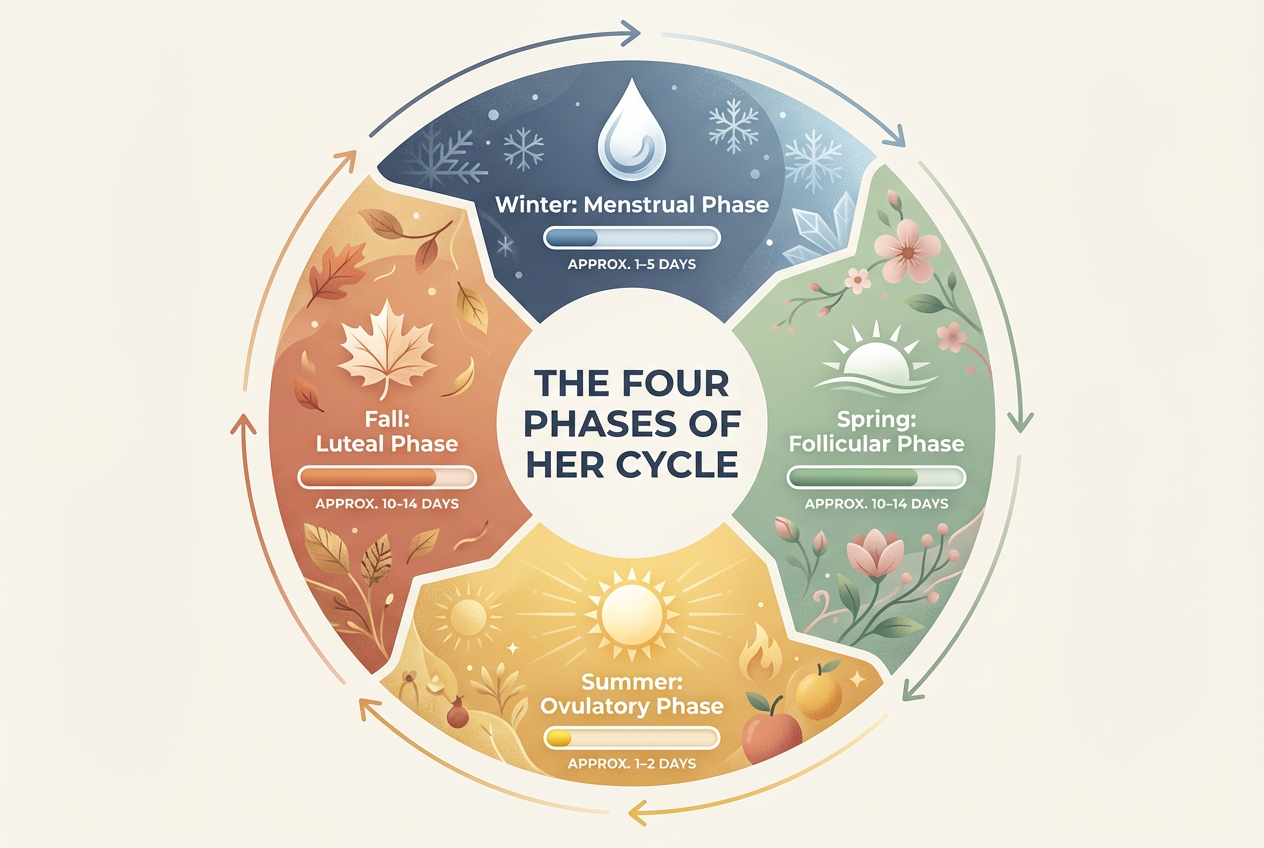
Understanding the four phases of her cycle helps you anticipate hormonal shifts and provide the right kind of support at the right time.
These phases are driven by two main hormones - estrogen and progesterone - that rise and fall in predictable patterns. When estrogen climbs, she'll feel energized and social. When both hormones crash, she'll need rest and comfort. This isn't complicated. It's just biology.
The difference between average guys and great partners? Great partners study these patterns and adjust their support accordingly.
Week 1: The Menstrual Phase (Days 1-5)
What She's Experiencing
This is the week everyone knows about but few understand. Both estrogen and progesterone hit rock bottom. Her uterus is literally shedding its lining, which often means cramping, fatigue, bloating, and genuine physical discomfort.
Think about the worst stomach bug you've had, then imagine going to work anyway. That's what many women deal with during their period.
Energy is at its lowest point. Her body is doing cleanup work. This isn't laziness - it's physiology.
What She Needs From You
She needs you to become the infrastructure. Handle the basics without making her ask. Don't say "What do you need?" and create more mental work for her. Just do the obvious stuff.
Specific Actions You Can Take
Handle the Physical Basics:
- Take over dinner (cook or order from her favorite place without asking)
- Do the dishes and any errands on her list
- Keep a heating pad charged and accessible
- Stock her preferred pain medication before she asks
- If she mentions cravings, get them. Dark chocolate, salty snacks, whatever she wants.
Provide Comfort:
- Offer a lower back massage (cramping often radiates to the lower back)
- Run a hot bath if she's into that
- Let her control the thermostat - she might run hot or cold
- Don't expect enthusiasm or high energy
Communication During This Phase:
Keep it simple. Don't ask open-ended questions that require mental work.
✅ "I'm ordering Thai - want your usual Pad Thai?"
❌ "What do you feel like eating tonight?"
✅ "Staying in tonight. I'll handle everything."
❌ "What do you want to do this weekend?"
The Physical Essentials Kit
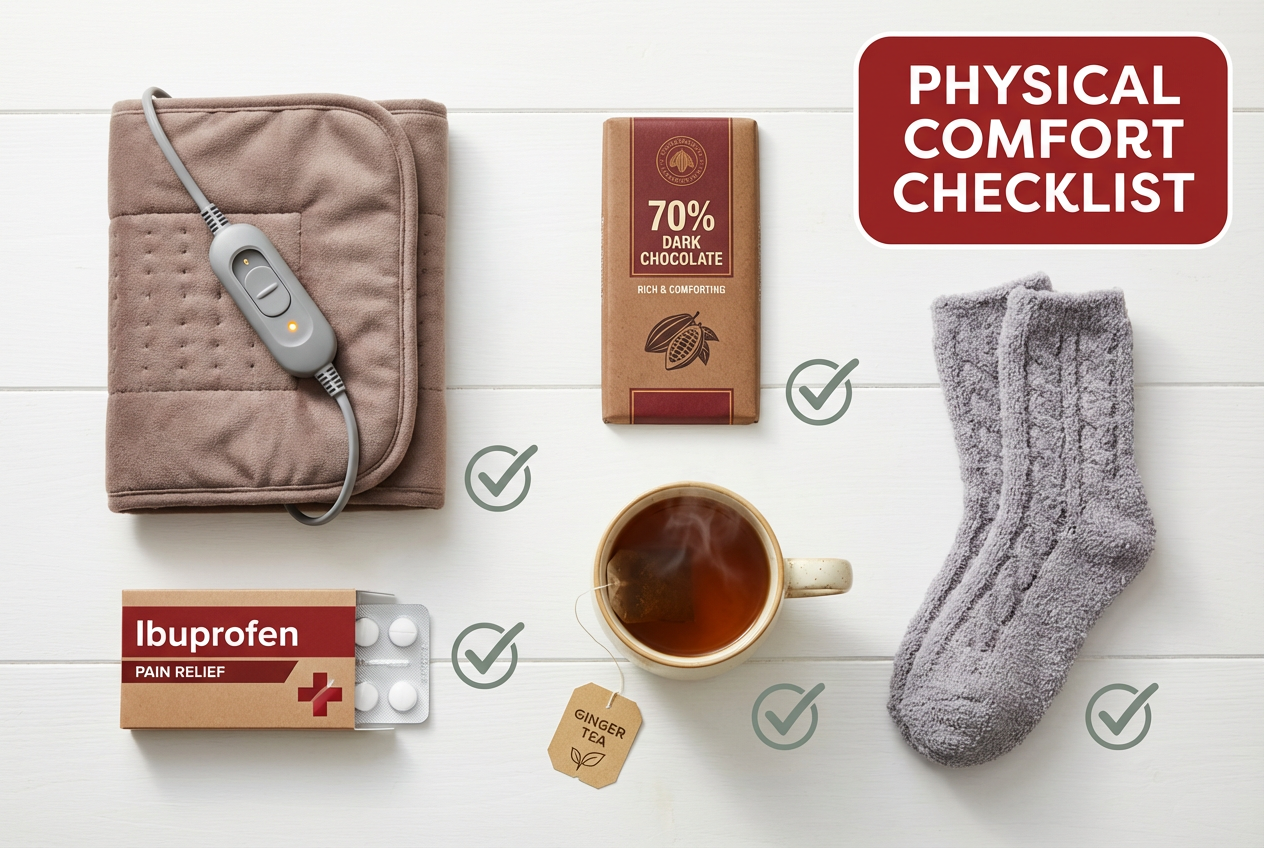
Creating a physical care kit with heat therapy, hydration, and nutrition is a proactive way to help your partner manage painful period cramps.
Stock these items before her period starts:
- Heat therapy: Electric heating pad (Sunbeam Xpress Heat heats in 30 seconds) or reusable hot water bottle
- Pain relief: Ibuprofen (Advil) for cramping or Naproxen (Aleve) for longer-lasting relief
- Hydration: Water bottle, herbal teas (raspberry leaf reduces cramping, ginger settles nausea)
- Comfort food: Dark chocolate (70%+ cacao contains magnesium that helps with cramps), her favorite snacks
- Period products: Keep extras of whatever she uses - pads, tampons, period underwear
What Never to Say:
- "Are you on your period?" (dismissive of her feelings)
- "It's just cramps - take some Advil." (minimizes real pain)
- "You're being dramatic." (invalidating)
What to Say Instead:
- "You seem uncomfortable. What would help right now?"
- "I'm handling dinner and cleanup tonight."
- "No need to respond - just wanted to say I'm thinking of you."
Week 2: The Follicular Phase (Days 6-14)
What She's Experiencing
Estrogen starts climbing. This is her body's natural energy drink. She'll feel more optimistic, social, and motivated. Physical energy rebounds. She's sleeping better and genuinely excited about plans.
This is biological spring - everything is warming up and coming back to life.
What She Needs From You
She needs a partner who matches her energy and says yes to new experiences. This is your window for adventure, deeper conversations, and making plans.
Specific Actions You Can Take
Plan and Execute:
- Suggest that weekend trip you've been thinking about
- Book a new restaurant or cooking class
- Propose a physical activity together (hiking, dancing, rock climbing)
- Bring up bigger conversations about travel or future goals
- Be spontaneous - she's more likely to say yes to last-minute plans
Social Connection:
- She'll have the energy for group hangouts or parties
- Introduce her to new friends without it feeling draining
- Plan a double date or game night
Communication During This Phase:
She's receptive to brainstorming and big-picture thinking.
✅ "What if we planned a trip to Portland next month?"
✅ "I've been thinking about our five-year plan. Want to talk through it this weekend?"
✅ "There's a new climbing gym opening. Should we try it?"
What to Watch For:
Pay attention to what lights her up during this phase. The activities and conversations that excite her right now are giving you data about what matters to her deeply. Remember these for future planning.
Week 3: The Ovulatory Phase (Days 15-17)
What She's Experiencing
This is peak everything. Estrogen hits its highest point right before ovulation. She'll feel confident, social, and energetically at her best. Communication comes easily. She'll want connection - both emotional and physical.
Think of this as biological summer. Everything is in full bloom.
What She Needs From You
She wants to feel seen, appreciated, and connected. This is the phase where genuine compliments land well, where she'll want quality time, and where physical affection feels natural.
Specific Actions You Can Take
Show Appreciation:
- Give specific compliments (not just "you look nice")
- Tell her what you appreciate about her beyond appearance
- Plan something that shows you've been paying attention to her interests
Quality Connection:
- Schedule a real date (not just Netflix)
- Have meaningful conversations - she'll want to talk about substantive things
- Physical affection is welcome and wanted
Communication During This Phase:
She's at her most receptive and communicative.
✅ "I love how you handled that situation with your coworker. You're really good at seeing both sides."
✅ "I've been thinking about what you said last week about needing more adventure. Let's make it happen."
✅ "You look amazing, but more importantly, you seem really happy lately."
What Works Now:
- Planning social events together
- Having the "where is this going" conversation if needed
- Discussing anything that requires joint decision-making
- Being spontaneous with affection
This phase only lasts a few days, so take advantage of the natural high-energy window.
Week 4: The Luteal Phase (Days 18-28)
What She's Experiencing
Progesterone surges after ovulation, then both hormones start dropping if she's not pregnant. This is PMS territory. She might feel irritable, anxious, bloated, or fatigued. Her brain is literally processing emotions differently - serotonin (the happiness chemical) drops along with estrogen.
Some women barely notice this phase. Others experience significant mood changes, physical discomfort, and lower energy. About 80% of women experience at least some PMS symptoms.
What She Needs From You
She needs you to not take things personally and to handle decision fatigue without making it a thing. She's not trying to be difficult - her brain chemistry is working against her.
Specific Actions You Can Take
Reduce Decision Fatigue:
- Pick the restaurant without asking
- Plan the weekend without needing her input
- Handle anything on the to-do list that you can
- Don't ask "what's wrong" repeatedly - if she wants to talk, she will
Provide Stability:
- Keep plans low-key (cozy night in beats loud bar)
- Stock comfort foods before she asks
- Give her space if she needs it, closeness if she wants it
- Don't schedule high-stakes events or serious conversations
Physical Support:
- She might be bloated and uncomfortable in her usual clothes
- Heating pad for lower abdomen (progesterone can cause cramping even before her period starts)
- Offer a foot rub or shoulder massage
Communication During This Phase:
Be direct and solution-oriented. Don't poke at her mood.
❌ "Why are you so irritable?"
✅ "You seem stressed. Want to vent, or should I just handle dinner?"
❌ "Are you PMSing?"
✅ "Bad day? I'm ordering pizza and queuing up your favorite show."
❌ "You're overreacting."
✅ "I hear you. That sounds really frustrating."
What Not to Do:
- Don't suggest she's being unreasonable
- Don't schedule important discussions or conflicts
- Don't take irritability as a personal attack
- Don't ignore her - silence feels like abandonment during this phase
Understanding PMDD:
Some women experience severe PMS symptoms that significantly impact daily life. This is called Premenstrual Dysphoric Disorder (PMDD). If she's dealing with intense depression, anxiety, or mood swings that interfere with work or relationships, that's beyond normal PMS and worth discussing with a doctor.
What to Say (And Never Say) During Her Period
The words you choose matter more during certain phases. Here are copy-paste scripts for common situations.
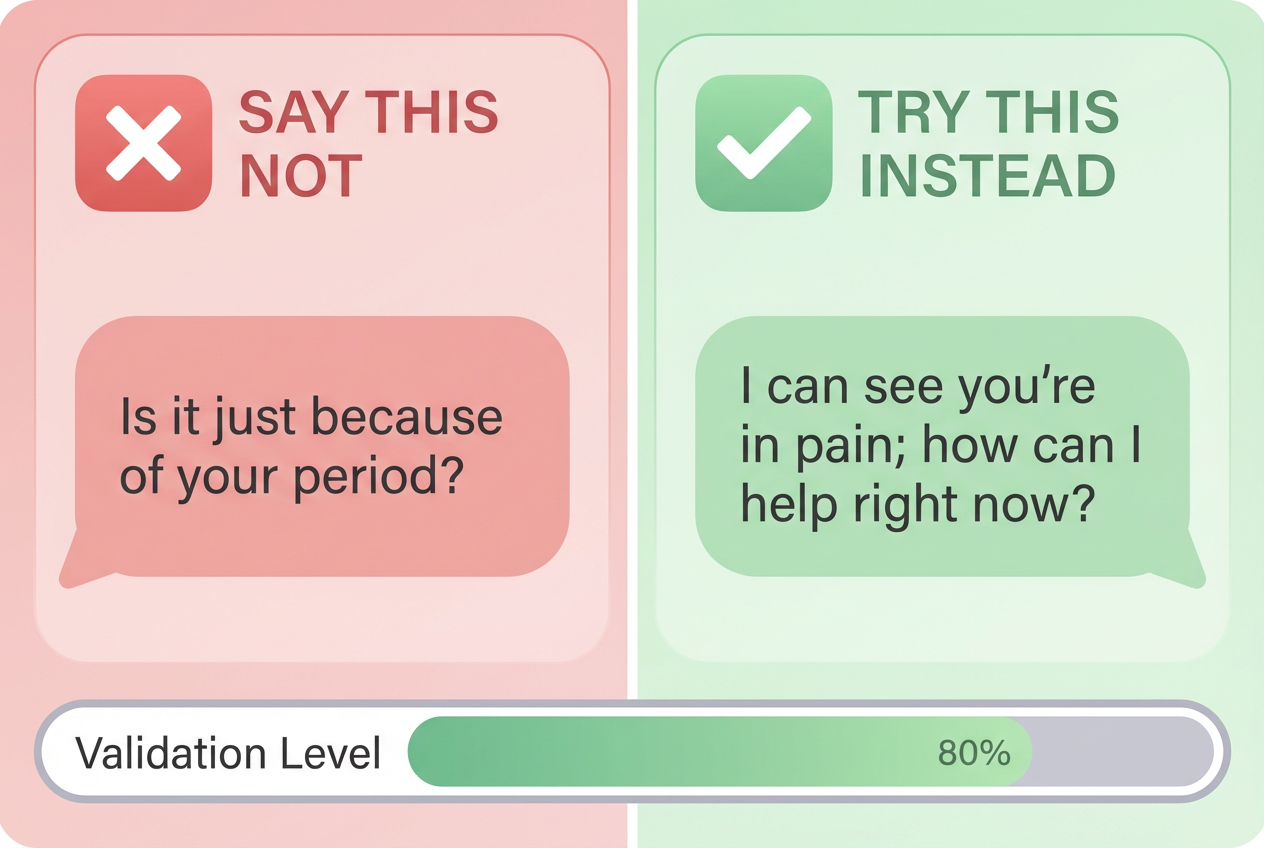
Choosing the right words can prevent conflict. Focus on validating her feelings and offering specific help rather than questioning her emotional state.
When She's in Pain
✅ "I grabbed a heating pad and your favorite ice cream. Be there in 20."
✅ "What hurts? Lower back? I can run a bath or give you a massage."
✅ "Taking over dinner and cleanup tonight. You rest."
❌ "It's just cramps."
❌ "Have you tried yoga?"
❌ "My ex never complained about her period."
When She's Emotional or Irritable
✅ "You seem frustrated. Want to talk about it, or want me to just listen?"
✅ "I can tell today's rough. What would actually help right now?"
✅ "Fair enough. I'll drop it."
❌ "You're being so sensitive."
❌ "Is this because of your period?"
❌ "You need to calm down."
When She's Tired
✅ "No need to respond. Just wanted you to know I love you."
✅ "I'm handling tonight. You do nothing."
✅ "Want company or alone time?"
❌ "You're always tired lately."
❌ "But we had plans..."
❌ "You were fine yesterday."
When You're Not Sure What She Needs
✅ "I want to help but I'm not sure how. What sounds good - space, company, or me just handling stuff?"
✅ "Scale of 1-10, how much energy do you have for [activity]?"
✅ "I'm going to [specific action]. Stop me if that's not helpful."
❌ "What's wrong?"
❌ "What do you want me to do?"
❌ "Just tell me how to fix it."
When Her Period Needs Medical Attention
Most periods are uncomfortable but manageable. Sometimes, symptoms signal a real medical issue that needs a doctor, not just a heating pad.
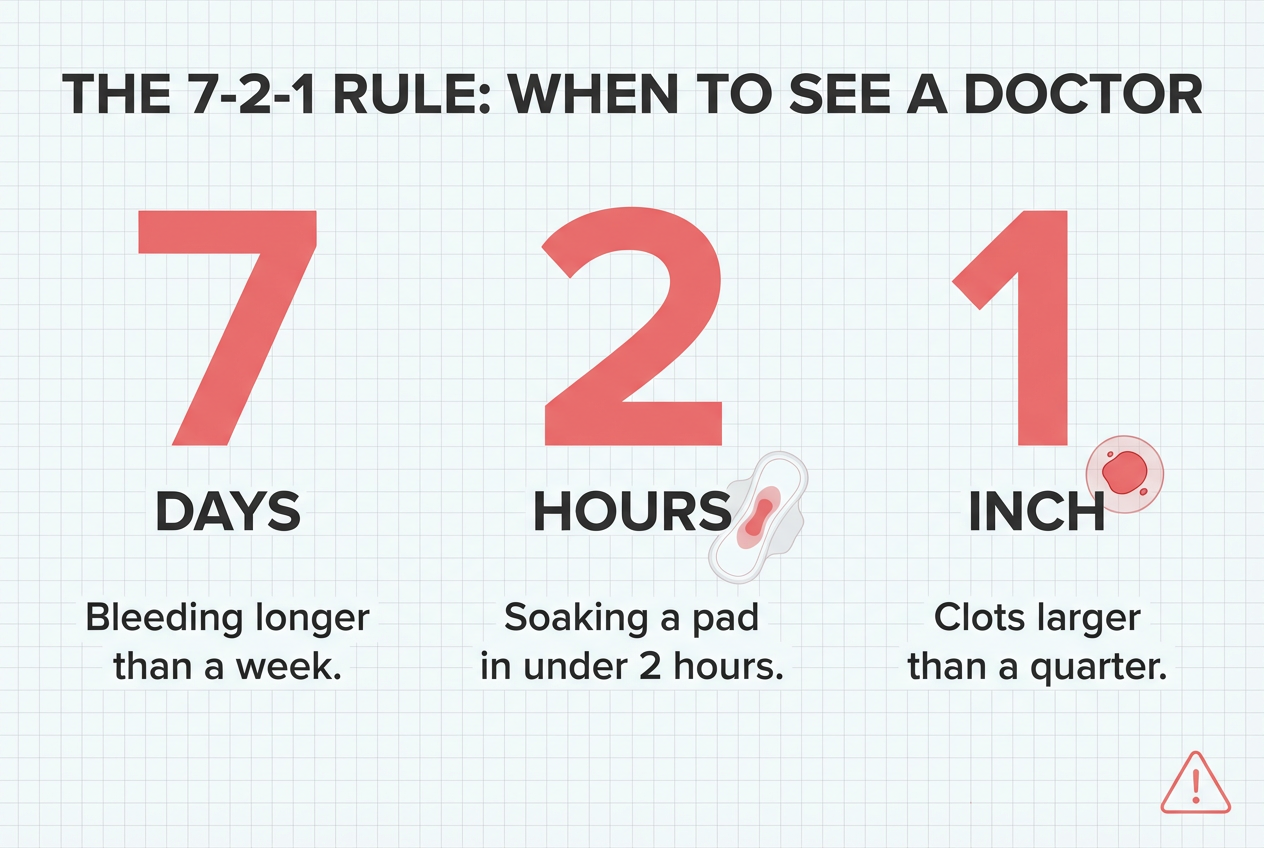
Use the 7-2-1 rule as a guide to help your girlfriend determine if her bleeding is within a healthy range or requires a medical consultation.
The 7-2-1 Rule for Heavy Bleeding
If she experiences any of these, she needs to see a doctor:
- 7+ days of bleeding (normal is 3-7 days)
- Soaking through a pad or tampon every 2 hours or less
- Passing blood clots larger than 1 inch (about the size of a quarter)
Other Red Flags
- Severe pain that doesn't respond to over-the-counter medication
- Fever during her period (could indicate infection)
- Sudden changes in cycle regularity or flow
- Debilitating symptoms that prevent her from working or functioning normally
- Extreme mood changes that feel unmanageable (possible PMDD)
Don't Google symptoms for hours. If any of these apply, book a doctor appointment. Period problems are common, but they're not something to just "tough out" if they're severe.
The Ultimate Period Care Package Checklist
Proactive support means having what she needs before she asks. Here's what to stock:
Pain Relief Category
- Electric heating pad (Sunbeam Xpress Heat is fast and reliable)
- Hot water bottle (reusable, portable option)
- Ibuprofen (Advil) - best for cramping
- Naproxen (Aleve) - longer-lasting relief
- Topical pain relief (Biofreeze for back pain)
Comfort Food Category
- Dark chocolate (70%+ cacao for magnesium)
- Herbal teas (raspberry leaf, ginger, peppermint)
- Salty snacks (if that's her craving)
- Iron-rich foods (spinach, red meat, lentils offset blood loss)
- Whatever specific comfort food she always wants
Cozy Essentials
- Fuzzy socks
- Soft blanket
- Her favorite face mask or bath bomb
- Comfortable, loose clothing
Practical Supplies
- Extra period products (pads, tampons, or period underwear)
- Wet wipes or gentle toilet paper
- Stain remover stick (accidents happen)
Optional Upgrades
- Weighted blanket (helps with anxiety and cramping)
- Meal delivery gift card (DoorDash, Uber Eats)
- Subscription to a period tracking app that helps you support her
Don't present this as some grand gesture. Just have the basics on hand. It shows you planned ahead instead of reacting when she's already uncomfortable.
Supporting Her From Afar (Long-Distance Guide)
Physical distance doesn't mean you can't provide support. You just have to be more creative.
What Works When You're Not There
Send Tangible Help:
- DoorDash her favorite comfort meal
- Amazon Prime a heating pad to her door
- Send a period care package in the mail (include a handwritten note)
Provide Emotional Connection:
- Text unprompted check-ins during her menstrual phase ("Thinking of you today")
- Schedule a low-pressure video call (not a long serious conversation)
- Send a playlist or funny videos - something that doesn't require a response
Reduce Her Mental Load:
- Handle any shared tasks remotely (bills, planning, booking things)
- Don't add to her to-do list during low-energy phases
- Remember her cycle and adjust your communication expectations accordingly
The key with long-distance support is being proactive, not reactive. Set phone reminders for her typical menstrual phase and reach out before she has to ask.
Should You Track Her Cycle?
Short answer: Only with her explicit permission.
The Right Way to Approach Tracking
Don't just download a period app and start logging her cycle like you're conducting research. That's creepy.
Instead, have a conversation:
"I've been learning about cycle phases and realized I could probably be more supportive if I knew where you were in your cycle. Would it help if I kept track so I could anticipate when you might need extra support? Totally understand if that feels weird."
If she says yes, use a tool that you both have access to. Transparency is key.
What Tracking Should Look Like
Use it for support, not control:
- Anticipating when to have low-key plans ready
- Knowing when to stock the heating pad
- Understanding when she might need more space
Never use it to:
- Dismiss her feelings ("You're just on your period")
- Predict her behavior like she's a science experiment
- Share her cycle data with anyone else
Her cycle information is protected health data. Treat it with the same privacy you'd want for your own medical information.
Tracking Tools
Most period tracking apps are designed for the person having the period, but a few work for partners:
- Flo for Partners (companion to Flo app)
- Shared calendar (she tracks, you both see)
- VibeCheck (specifically designed to help men support their partners through cycle awareness)
Pick whatever she's comfortable with. The tool matters less than your intention.
Practical Takeaways: Start Here
Feeling overwhelmed? Start with these three things this week:
Learn her average cycle length. Most women have 28-30 day cycles, but anywhere from 21-35 days is normal. Ask her when her last period started. Count forward. Put a discreet reminder in your phone.
Stock the basics before you need them. Get a heating pad, her preferred pain medication, and dark chocolate. Keep them accessible. You'll use them.
Adjust one interaction this month. During her menstrual phase (Days 1-5), take over one task without being asked. Make dinner. Do the dishes. Run an errand. Notice how it lands.
You don't have to master all four phases immediately. Start with understanding when she needs rest versus when she's ready for adventure. That alone puts you ahead of 90% of guys.
The men who build relationships that last decades share one trait: they become students of their partners. Not in a controlling way. In a deeply respectful way. They notice patterns. They ask questions. They adjust.
Your girlfriend's cycle isn't a mystery. It's a map. Learn to read it.
Tags

Related Articles
Continue reading to deepen your understanding

Your Girlfriend Is Withdrawn During Ovulation? What It Actually Means and How to Respond
Is your girlfriend suddenly distant mid-cycle? This guide covers the biological causes of ovulation withdrawal and how to support her with an invisible framework.

When Your Girlfriend Is Sensitive to Criticism During the Luteal Phase: The Partner’s Science-Based Action Guide
Does your partner react intensely to feedback right before her period? Understand the biology behind luteal phase rejection sensitivity and learn how to communicate effectively.

How to Give Your Girlfriend Reassurance During the Follicular Phase: A Partner’s Tactical Guide
Is your girlfriend feeling vulnerable after her period? Learn why the early follicular phase causes emotional lows and how you can provide the specific reassurance she needs to feel secure.

Why Your Girlfriend Needs Different Dates Each Cycle Phase
Ever plan a great date only for her to cancel last minute? Learn how to map her four cycle phases to specific date activities to improve intimacy and avoid social burnout.

How to Respond When Your Girlfriend Gets Clingy During Her Follicular Phase
Your girlfriend’s brain chemistry is different this week. Rising estrogen levels cause social drive to peak. Here is how to respond to her need for connection effectively.

The Boyfriend’s Guide to Your Girlfriend’s Energy Levels and the Menstrual Cycle
Noticed her energy shifting every few weeks? Stop guessing and start supporting. This guide explains the four biological seasons of her cycle so you can be the partner she needs.

Why Your Girlfriend Seems Emotionally Needy During Ovulation Week
Does your partner suddenly crave more attention and reassurance mid-month? It is not insecurity—it is biology. Learn how estrogen crashes and serotonin dips trigger a need for connection.

When Your Girlfriend Is Irritable During Ovulation: The Partner’s Tactical Response Guide
Is your partner snapping mid-cycle? Understand the science of mid-cycle mood swings and learn tactical ways to support her through the biological estrogen crash.