Support Your Girlfriend During Luteal Phase: A Partner Guide
Learn how to support your girlfriend during the luteal phase. Discover tactical tips for emotional validation and physical support to navigate the storm week.
How to Support Your Girlfriend During the Luteal Phase: The Ultimate Partner Playbook
Your girlfriend was laughing at your jokes last Tuesday. Today, the same joke earned you a death stare and a three-hour argument about "not taking anything seriously." What changed?
Her brain chemistry did. Specifically, she entered the luteal phase - the 10-14 day window between ovulation and menstruation when progesterone surges, then crashes, triggering a cascade of neurological and emotional shifts that can make the same person feel unrecognizable week to week.
Need a product shortlist before you apply this phase strategy? Start with our breakdown of the best period tracker for boyfriends and return here for the luteal execution playbook.
This isn’t about hormones making her "irrational." This is about a biological state that heightens sensory processing, amplifies emotional responses, and reduces her brain’s ability to regulate stress. Understanding this phase isn’t about excusing behavior - it’s about recognizing when your partner’s nervous system is under siege and adapting your support strategy accordingly.
Most men fail here because they try to logic their way through an emotional storm. This guide gives you the tactical playbook to navigate the luteal phase without creating unnecessary conflict, losing your mind, or making her feel unsupported when she needs you most.
VibeCheck App
Know what she needs. Before she has to say it.
Track her cycle, understand her phases, be the partner she deserves.
Download Free on iOS →Table of Contents
- The Luteal 101: Why Her Brain Feels Different Right Now
- The Three Pillars of Luteal Phase Support
- The Red Zone Rules: How to Avoid Relationship Damage During Storm Week
- The Partner Survival Guide: Protecting Your Own Peace
- The Tool You’re Missing: Why Every Boyfriend Needs a Cycle Tracker
- Frequently Asked Questions
The Luteal 101: Why Her Brain Feels Different Right Now
The luteal phase is the biological bridge between ovulation (when she’s statistically at her most confident and sociable) and menstruation. It lasts roughly 10-14 days and is governed by a dramatic rise and fall of progesterone - the hormone responsible for preparing her body for potential pregnancy.
Here’s what’s happening under the hood:
Week 1 of Luteal (Days 15-21): Progesterone peaks. She might feel calm, reflective, or slightly withdrawn. Her body is literally nesting, prioritizing comfort and routine over novelty.
Week 2 of Luteal (Days 22-28): Progesterone crashes. Her GABA-A receptors (the brain’s natural anxiety regulators) lose their primary fuel source. The result? Heightened sensitivity to stress, noise, light, and interpersonal friction. She’s not choosing to be irritable - her nervous system is dysregulated.
This is the week most men describe as "walking on eggshells." But here’s the critical insight: she’s not in a different mood. She’s in a different neurological state.
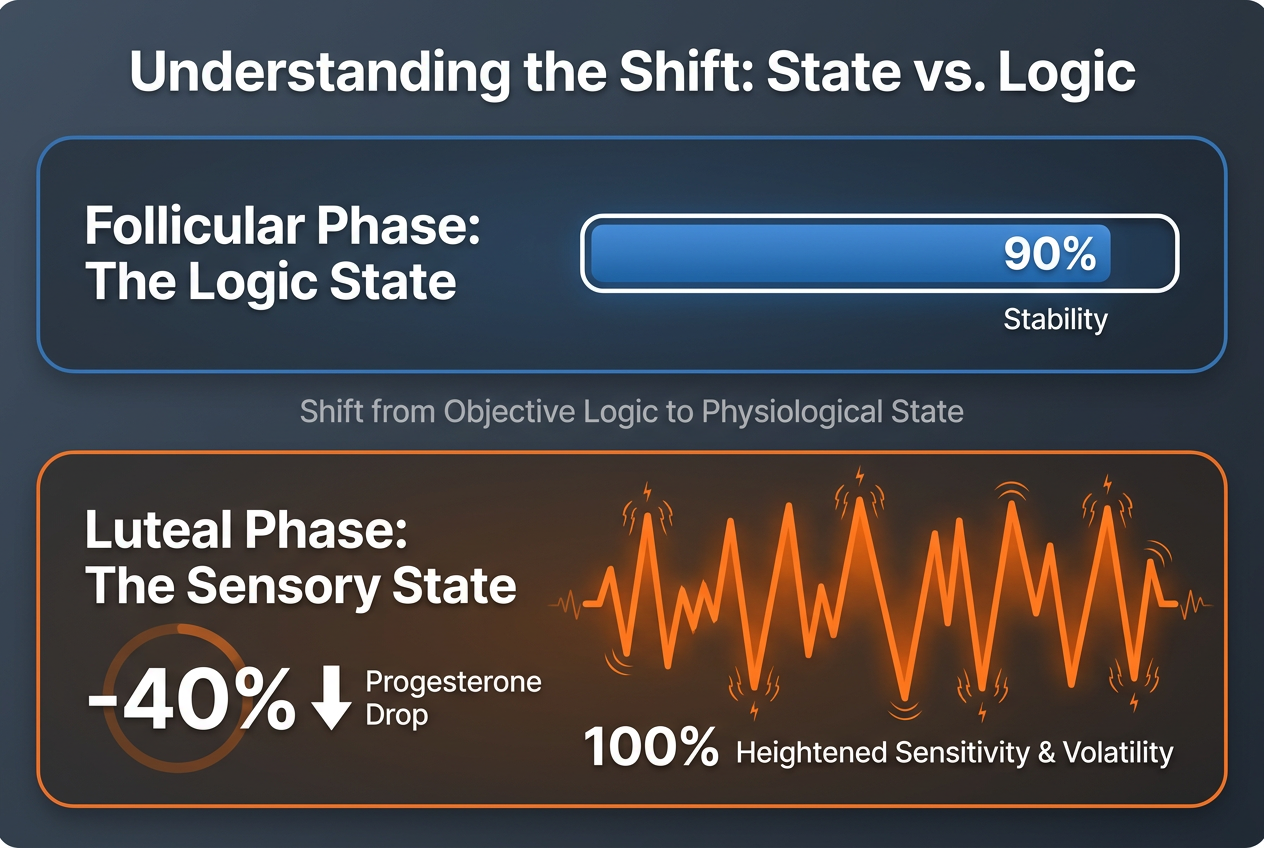 Understanding the transition from logic-driven to state-driven communication is essential for navigating the luteal phase without unnecessary conflict or personal misunderstandings between partners.
What She’s Experiencing (That She Might Not Say Out Loud)
- Sensory Overload: Sounds feel louder. Bright lights feel harsher. Your breathing across the room might genuinely feel irritating.
- Emotional Amplification: Small frustrations that wouldn’t register during her follicular phase now feel catastrophic.
- Physical Discomfort: Bloating, breast tenderness, headaches, and fatigue create a baseline level of discomfort that taxes her patience.
- The Breakup Urge: A documented phenomenon where women feel like quitting everything - jobs, diets, relationships - during late luteal. It’s not about you. It’s her brain trying to reduce stressors when its stress-regulation system is compromised.
Understanding this doesn’t mean you accept poor treatment. It means you recognize when your partner is operating with a depleted tank, and you adjust your approach to prevent unnecessary escalation.
The Three Pillars of Luteal Phase Support
Supporting your girlfriend through the luteal phase requires a three-pronged strategy: Physical, Emotional, and Environmental. Most guys focus only on the emotional piece and wonder why their efforts fall flat. Here’s the complete framework.
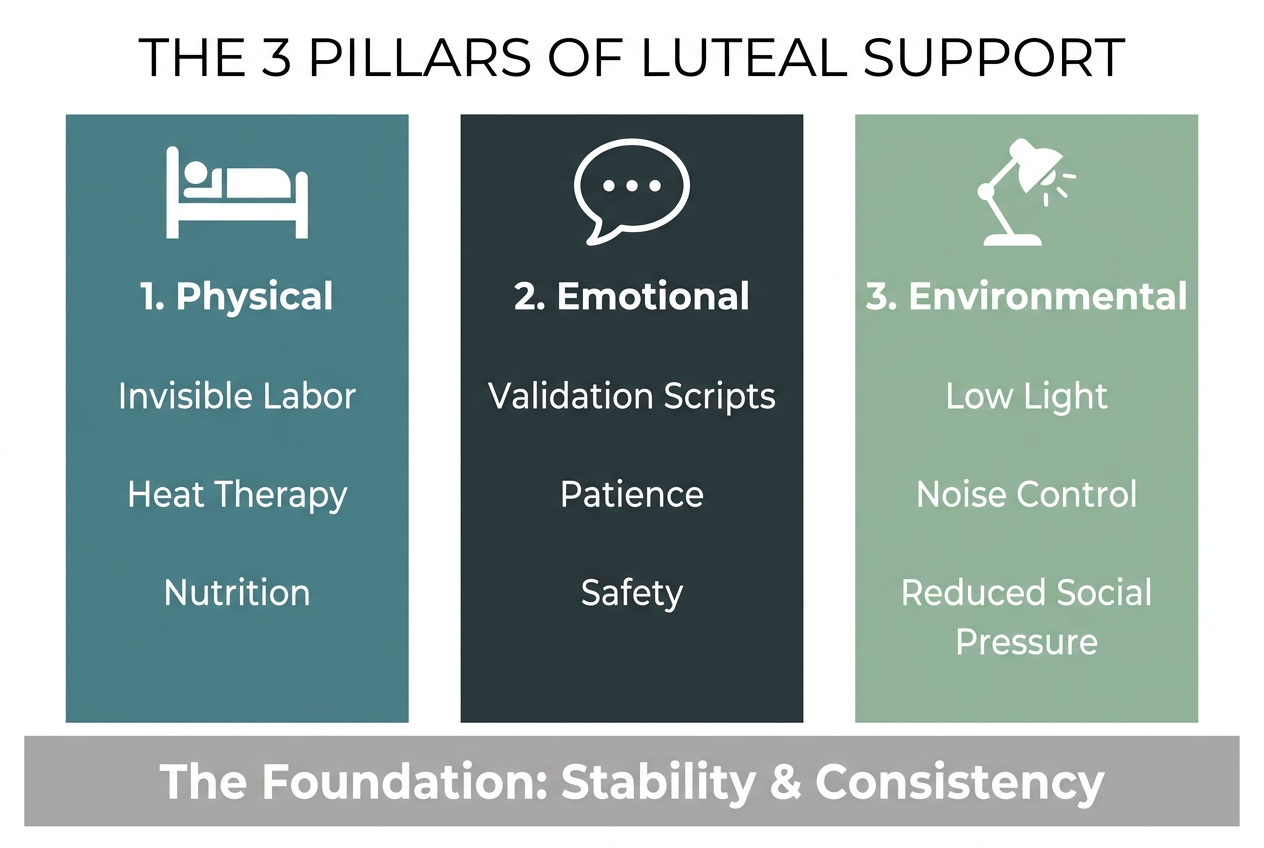 A comprehensive support strategy addresses physical comfort, emotional validation, and environmental triggers to create a safe harbor for your partner during her most sensitive monthly window.
Physical Support: The Invisible Labor Strategy
The luteal phase is physically exhausting. Progesterone causes water retention, joint pain, and digestive sluggishness. Her body is working overtime, and she’s running on fumes.
Your job isn’t to "fix" this. It’s to reduce the friction between her and basic comfort.
The Invisible Labor Checklist:
Handle the logistics before she asks. Grocery runs, meal prep, tidying shared spaces - these tasks feel 10x heavier during the luteal phase. If you notice she’s in late luteal (tracking helps here), proactively take things off her plate.
Stock the essentials. Heating pad. Ibuprofen or Midol. Her preferred comfort foods (chocolate, salty snacks, carbs). The fact that you thought ahead matters more than the actual items.
Offer heat therapy without commentary. A heating pad on her lower back or abdomen reduces cramping and signals care. Don’t say "Are you okay?" Just hand it to her and say "Thought this might help."
Adjust your energy output. If she’s fatigued, don’t suggest a high-energy activity. Match her pace. Suggest a low-key movie night instead of a social outing.
The 7-2-1 Rule (Borrowed from Reddit): In the week before her period, aim for 7 hours of sleep for yourself, 2 thoughtful gestures per day (making her coffee, running her a bath), and 1 moment where you absorb friction without reacting defensively.
Real-World Example:
You come home from work. She’s curled up on the couch, clearly drained. Instead of asking "What’s wrong?" or suggesting a solution, you say: "I’m grabbing takeout. Want your usual?" Then you clean the kitchen without being asked. That’s invisible labor. She notices, even if she doesn’t say anything.
Emotional Support: The Validation-First Framework
Here’s where most men fail. They try to solve, deflect, or debate when their girlfriend expresses frustration during the luteal phase. This backfires spectacularly because she’s not looking for logic - she’s looking for acknowledgment that her experience is real.
Your goal is de-escalation, not resolution.
The Triage Script
When she’s upset, use this exact question:
"Do you want me to listen, give you space, or help find a solution?"
This script accomplishes three things:
- It acknowledges her emotional state without dismissing it.
- It removes the guesswork for both of you.
- It empowers her to tell you exactly what she needs.
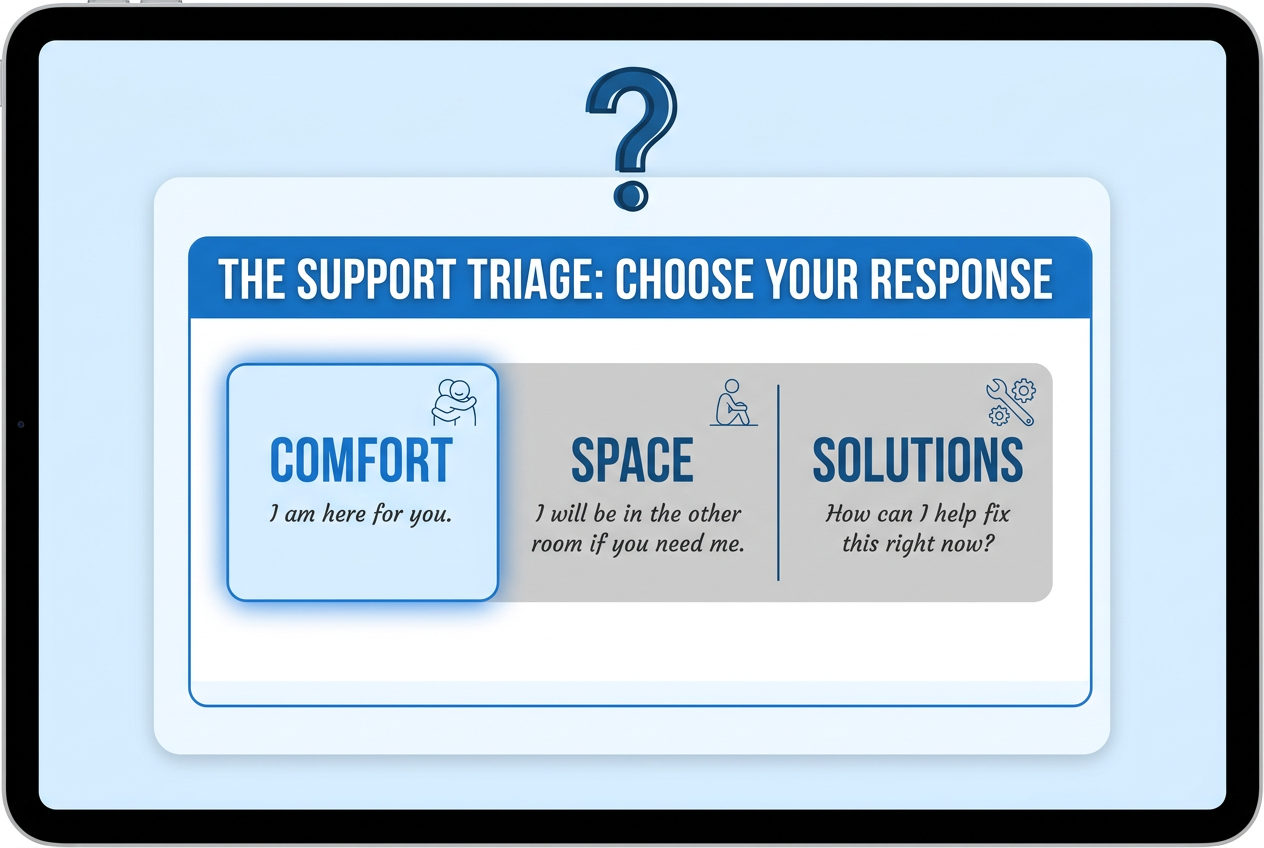 Using a simple triage script removes the guesswork from supporting your partner, allowing you to provide exactly what she needs - whether it is proximity, distance, or action.
If she says "Listen": Sit down. Make eye contact. Nod occasionally. Use phrases like "That sounds really frustrating" or "I can see why that upset you." Do NOT offer solutions. Do NOT say "But did you try..." Your job is to be a sounding board.
If she says "Space": Respect it immediately. Say "Okay, I’ll be in the other room if you need me." Check in once after 30-60 minutes with a text: "Still need space or want company?" Don’t hover. Don’t sulk. Give her the autonomy she’s asking for.
If she says "Solutions": Now - and only now - you can problem-solve. But lead with empathy: "Okay, let’s figure this out together. What feels most urgent right now?"
The Validation Templates
Use these word-for-word when she’s spiraling:
- "You’re not overreacting. This would bother me too."
- "I hear you. That sounds overwhelming."
- "You’re dealing with a lot right now. What would help you feel a little lighter?"
- "I’m here. You don’t have to manage this alone."
Notice none of these include "but," "actually," or "have you tried." That’s intentional. Validation isn’t about agreement - it’s about acknowledging her reality without editing it.
Environmental Support: The Sensory Sanctuary Protocol
During the late luteal phase, your girlfriend’s sensory threshold drops dramatically. Things that wouldn’t normally bother her - background noise, clutter, strong smells - can feel physically painful.
Your job is to create a low-friction environment that doesn’t tax her already-overloaded nervous system.
The Sensory Sanctuary Checklist:
Lower the volume. TV, music, your voice - keep it softer than usual. If she’s in the next room, don’t shout across the house.
Dim the lights. Bright overhead lights can trigger headaches and irritability. Use lamps or natural light where possible.
Reduce visual clutter. A messy living space adds cognitive load. Tidy common areas without making it a production.
Mind the smells. Strong cologne, cooking smells (especially meat or fish), or scented candles can trigger nausea. If you’re cooking, open windows and keep it simple.
Limit social obligations. If you have plans with friends or family during her late luteal phase, check in first: "Are you up for this, or would you rather I go solo?" Don’t guilt her if she opts out.
Buffer her from external stress. If her boss is riding her, her family is demanding, or she’s dealing with a crisis, your role is to be the calm anchor - not add more pressure with complaints or requests.
Real-World Example:
It’s Friday night. You were planning to have friends over for drinks. She’s in late luteal and clearly exhausted. Instead of saying "But we’ve had this planned for weeks," you text your friends: "Can we raincheck? Partner’s not feeling great." Then you order her favorite takeout, queue up a comfort show, and let her decompress. That’s environmental support.
If you want to dive deeper into understanding how to anticipate these shifts and respond proactively, check out the boyfriend’s field manual on mastering your partner’s four cycle phases.
The Red Zone Rules: How to Avoid Relationship Damage During Storm Week
The late luteal phase is relationship high-risk territory. Arguments escalate faster. Misunderstandings feel existential. Breakups get threatened over things that will seem absurd five days later.
These rules exist to prevent permanent damage during a temporary state.
Rule 1: No "Forever Language"
Avoid making or accepting permanent decisions during the luteal phase. This includes:
- Breaking up
- Moving out
- Making major financial commitments
- Having "where is this relationship going?" talks
Why? Because her brain is in threat-detection mode. Small issues feel like relationship-ending crises. If she says "I don’t think this is working," respond with: "I hear you. Can we revisit this conversation in a few days when we’re both clearer?" Then table it.
Rule 2: You Can’t Win a Logic Battle Right Now
Her prefrontal cortex (the logic center) has reduced bandwidth during late luteal. Trying to "prove your point" or "be reasonable" will only escalate things. She’s not processing information the same way she does during follicular.
If she’s upset and you disagree with her interpretation, your options are:
- Validate her feelings without conceding the facts: "I see why you’d feel that way. Can we come back to this later?"
- Remove yourself from the situation: "I don’t want to say something I’ll regret. Let’s take a break and talk when we’ve both cooled off."
Do NOT:
- Say "You’re being irrational."
- Bring up past arguments.
- Use the word "hormones" as an explanation for her behavior.
Rule 3: The 24-Hour Rule
If she’s upset about something you did, resist the urge to defend yourself immediately. Instead, say: "I want to understand what I did wrong, but I need a minute to process. Can we talk about this tomorrow?"
This gives her nervous system time to regulate and gives you time to respond thoughtfully instead of reactively. Many luteal arguments dissolve entirely with this buffer.
Rule 4: Absorb One Hit Without Retaliation
During the luteal phase, she might say something sharp or unfair. Your instinct will be to defend yourself or fire back. Don’t. Absorb one criticism without responding. Later, when she’s calmer, you can say: "Hey, when you said [X], that really hurt. Can we talk about it?"
This isn’t about being a doormat. It’s about recognizing when your partner’s filter is offline and choosing not to escalate in the moment.
For more tactical advice on navigating these high-stakes moments, learn how to reduce girlfriend PMS mood swings with communication scripts that actually work.
The Partner Survival Guide: Protecting Your Own Peace
Supporting your girlfriend through the luteal phase can be emotionally draining. If you don’t protect your own mental health, you’ll burn out and resent her - which defeats the purpose.
Your Self-Care Checklist
Maintain your routine. Don’t skip the gym, cancel plans with friends, or abandon hobbies to "be available." She needs you steady, not depleted.
Set boundaries without guilt. If she’s lashing out and you need space, take it. Say: "I want to support you, but I need a minute to reset. I’ll check in soon."
Talk to a trusted friend. Venting to someone outside the relationship helps you process frustration without dumping it on her. Just avoid friends who’ll demonize her.
Use the 80/20 rule. Give her 80% of your emotional bandwidth during the luteal phase, but reserve 20% for yourself. If you’re running on empty, you can’t be the anchor she needs.
Remember: This is temporary. The luteal phase lasts 10-14 days. The storm always passes. If you can stay grounded during this window, the rest of the month will be significantly easier.
When to Seek Outside Help
If the luteal phase symptoms are severe - debilitating pain, suicidal ideation, uncontrollable rage - she might have PMDD (Premenstrual Dysphoric Disorder), which affects 5-8% of women. This is a medical condition, not "bad PMS." Encourage her to see a doctor and offer to attend the appointment with her for support.
You’re not responsible for fixing her biology. But you can be the stable presence that makes the unbearable slightly more bearable.
The Tool You’re Missing: Why Every Boyfriend Needs a Cycle Tracker
Here’s the truth: You can’t support what you can’t see coming.
Most men are reactive during the luteal phase - waiting for the mood shift to hit, then scrambling to respond. Tracking her cycle flips the script. It gives you a 7-10 day heads-up before the storm arrives so you can prepare strategically.
What a Period Tracker Does for You
- Predicts high-risk windows. You’ll know when she’s entering late luteal and can proactively reduce friction (fewer social plans, more downtime, stocked pantry).
- Explains sudden shifts. When she’s irritable or withdrawn, you’ll understand it’s hormonal - not about you - which prevents defensive reactions.
- Improves intimacy timing. Ovulation (mid-cycle) is when her libido peaks. Late luteal is when it craters. Knowing this helps you initiate at the right times and avoid rejection.
- Tracks patterns over time. Every woman’s cycle is slightly different. Tracking for 2-3 months reveals her unique rhythm so you can customize your approach.
Apps like VibeCheck are built specifically for male partners. You input her cycle start date, and the app tells you:
- What phase she’s in right now
- What symptoms to expect
- Specific actions you can take today to support her
- When to plan dates, have tough conversations, or back off
It’s like having a relationship coach in your pocket that updates daily.
If you’re comparing options, explore the best period tracker apps for boyfriends to see which features matter most.
Ready to actually understand her?
Join thousands of men using VibeCheck to track her cycle and show up better every day.
Not sure which app actually helps with any of this? We put the best relationship advice apps for men side by side — what each one costs, and what each one is genuinely good at.
Frequently Asked Questions
Why does my girlfriend want to break up during her luteal phase?
The "breakup urge" during the luteal phase is a documented phenomenon driven by progesterone withdrawal and dysregulated GABA-A receptors. Her brain is in threat-detection mode, scanning for stressors to eliminate. Relationships require energy and emotional labor - when her nervous system is overloaded, the relationship can feel like "one more thing" she can’t handle. This isn’t a rational assessment of your partnership; it’s her brain trying to reduce cognitive load during a temporary state. The solution: Table any breakup conversations until at least three days after her period starts, when her prefrontal cortex has full bandwidth again.
How can I tell if she’s in the luteal phase without asking?
Tracking her cycle is the most reliable method, but there are behavioral cues. Early luteal: She’s calmer, more introspective, and may prefer quiet nights in over social activities. Late luteal: Increased irritability, sensitivity to noise or light, cravings for carbs or chocolate, withdrawal from physical intimacy, and shorter fuse for minor frustrations. You might also notice physical symptoms like bloating or fatigue. Using a period calculator can help you predict these shifts before they happen.
What should I absolutely not say to my girlfriend during the luteal phase?
Never say: "Are you on your period?" "You’re overreacting." "Is this because of your hormones?" "Calm down." "You were fine yesterday." These phrases dismiss her experience and imply her feelings aren’t valid. Instead, use validation-first language: "That sounds really hard." "I hear you." "What do you need from me right now?" Avoid sarcasm, defensiveness, or bringing up past arguments. If you’re tempted to debate her interpretation of events, don’t. Her brain isn’t processing logic the same way it does mid-cycle.
Is it normal for her to have zero interest in sex during the luteal phase?
Yes. Progesterone suppresses libido in many women, and physical discomfort (bloating, cramps, breast tenderness) makes intimacy feel unappealing. Couple this with emotional sensitivity and fatigue, and sex drops to the bottom of her priority list. Don’t take it personally. Her libido will return after menstruation, typically peaking again during ovulation. If you want to maintain intimacy without pressure, focus on non-sexual touch: back rubs, cuddling, holding hands. For more on timing intimacy strategically, read when to approach your partner for sex based on her cycle.
How do I support her without enabling poor behavior?
Validation doesn’t mean acceptance of mistreatment. If she’s yelling, name-calling, or being cruel, you can set boundaries while still acknowledging her state: "I understand you’re frustrated, but I can’t have a productive conversation when you’re raising your voice. Let’s take a break and talk later." Then physically remove yourself from the situation. Once she’s calmer, revisit the issue: "I want to support you, but [specific behavior] isn’t okay. Can we figure out a better way to handle this next time?" The key is addressing the behavior after the storm passes - not in the middle of it.
Does every woman experience severe luteal phase symptoms?
No. The severity varies dramatically. Some women experience mild mood changes or fatigue. Others deal with debilitating symptoms that interfere with daily life (PMDD). Tracking her symptoms over 2-3 cycles helps you understand her baseline. If her symptoms are extreme - suicidal thoughts, uncontrollable rage, inability to function - she should see a doctor. PMDD is a clinical condition that requires medical intervention, not just "better support." Your role is to encourage her to seek help and offer to attend appointments with her.
Can I use a period tracker without her knowing?
Technically yes, but it’s ethically complicated. If she’s shared her cycle start dates with you and you’re tracking them privately to be a better partner, that’s generally fine. But tracking her without her knowledge feels invasive. The better approach: Frame it as a team effort. "I want to understand your cycle so I can support you better. Would you be okay with me tracking it?" Most women appreciate a partner who’s willing to learn. If she’s hesitant, respect that boundary and ask again later. If you’re looking for a tracker built for this exact conversation, VibeCheck is designed to be transparent and collaborative.
What if tracking her cycle doesn’t seem to help?
Tracking reveals patterns, but it’s not a magic solution. If you’re tracking and still experiencing constant conflict, consider these possibilities: (1) You’re tracking incorrectly (using the wrong start date or misinterpreting phases). (2) Her cycle is irregular due to stress, hormonal birth control, or medical conditions. (3) The relationship has deeper issues unrelated to her cycle. (4) She has PMDD or another condition that requires medical treatment. If tracking for three months doesn’t improve your understanding or reduce friction, suggest a doctor’s visit and consider couples counseling to address underlying communication patterns.
The Bottom Line:
Supporting your girlfriend through the luteal phase isn’t about fixing her or walking on eggshells. It’s about recognizing when her nervous system is under biological stress and adapting your behavior to reduce unnecessary friction. Validate her feelings. Handle physical logistics without being asked. Create a low-stimulation environment. Set boundaries when necessary. And for the love of everything, track her cycle so you’re not blindsided every month.
The men who master this don’t just survive the luteal phase - they use it to build deeper trust and connection. Because when she’s at her most vulnerable and you show up with patience and consistency, she remembers.
That’s the relationship advantage no one talks about.
Tags

Related Articles
Continue reading to deepen your understanding

Your Girlfriend Is Withdrawn During Ovulation? What It Actually Means and How to Respond
Is your girlfriend suddenly distant mid-cycle? This guide covers the biological causes of ovulation withdrawal and how to support her with an invisible framework.

When Your Girlfriend Is Sensitive to Criticism During the Luteal Phase: The Partner’s Science-Based Action Guide
Does your partner react intensely to feedback right before her period? Understand the biology behind luteal phase rejection sensitivity and learn how to communicate effectively.

How to Give Your Girlfriend Reassurance During the Follicular Phase: A Partner’s Tactical Guide
Is your girlfriend feeling vulnerable after her period? Learn why the early follicular phase causes emotional lows and how you can provide the specific reassurance she needs to feel secure.

Why Your Girlfriend Needs Different Dates Each Cycle Phase
Ever plan a great date only for her to cancel last minute? Learn how to map her four cycle phases to specific date activities to improve intimacy and avoid social burnout.

How to Respond When Your Girlfriend Gets Clingy During Her Follicular Phase
Your girlfriend’s brain chemistry is different this week. Rising estrogen levels cause social drive to peak. Here is how to respond to her need for connection effectively.

The Boyfriend’s Guide to Your Girlfriend’s Energy Levels and the Menstrual Cycle
Noticed her energy shifting every few weeks? Stop guessing and start supporting. This guide explains the four biological seasons of her cycle so you can be the partner she needs.

Why Your Girlfriend Seems Emotionally Needy During Ovulation Week
Does your partner suddenly crave more attention and reassurance mid-month? It is not insecurity—it is biology. Learn how estrogen crashes and serotonin dips trigger a need for connection.

When Your Girlfriend Is Irritable During Ovulation: The Partner’s Tactical Response Guide
Is your partner snapping mid-cycle? Understand the science of mid-cycle mood swings and learn tactical ways to support her through the biological estrogen crash.