The 28-Day Relationship Manual: How to Support Your Partner Through Every Phase
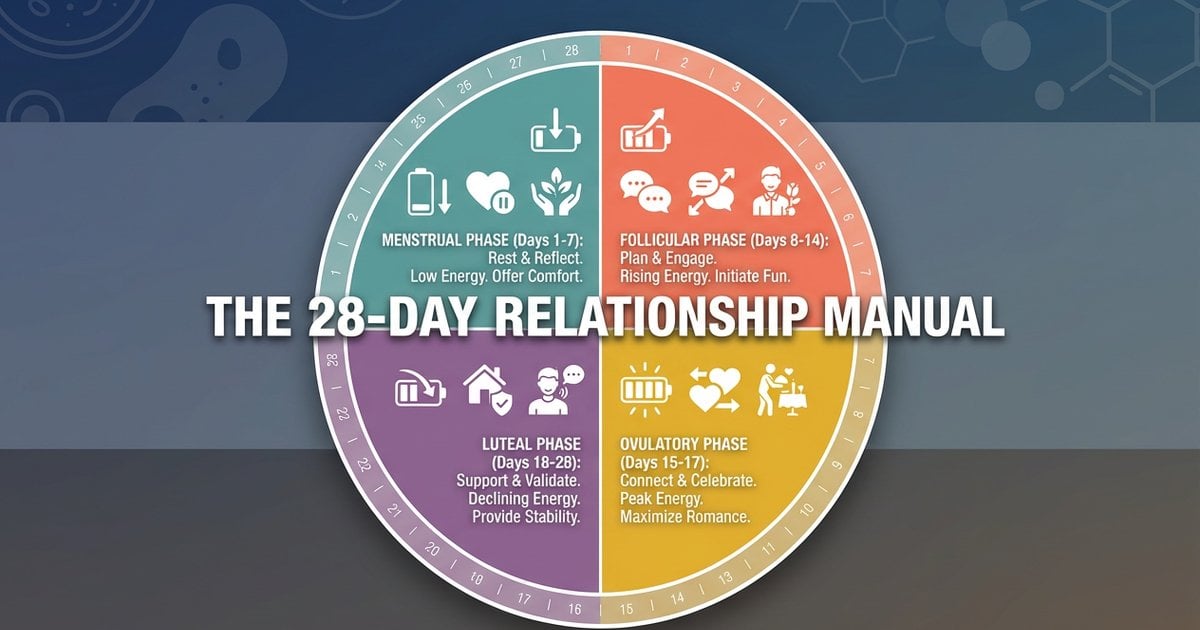
Stop the guesswork in your relationship. Learn how your partner's 28-day cycle affects her energy and mood so you can provide the support she needs before she even has to ask.
The 28-Day Relationship Manual: How to Support Your Partner Through Every Phase
Most guys think they're doing relationship support right. They buy chocolate during her period, apologize when she's upset, and hope for the best. But here's the truth: you're operating on guesswork in a system that runs on biology.
Your girlfriend's body follows a 28-day hormonal cycle that's as predictable as a training schedule. Four distinct phases, each with its own energy signature, communication style, and support needs. Understanding this cycle isn't about becoming her doctor. It's about becoming the partner who shows up with exactly what she needs, before she has to ask.
This guide breaks down each phase with the same precision you'd apply to your fitness routine or career goals. No fluffy advice. No outdated stereotypes. Just a biological roadmap that turns monthly relationship friction into a predictable system of connection and support.
Table of Contents
- The Bio-Logical Why: Understanding the Hormonal Blueprint
- The 4-Phase Relationship Roadmap
- Real Relationship Help vs. Generic Advice
- The Partner Cheat Sheet
- Tools That Actually Work
- Frequently Asked Questions
The Bio-Logical Why: Understanding the Hormonal Blueprint
BLUF: Your partner's hormonal cycle creates four distinct phases with predictable energy levels, communication preferences, and support needs. Learning this pattern eliminates relationship guesswork and prevents 80% of common conflicts.
VibeCheck App
Know what she needs. Before she has to say it.
Track her cycle, understand her phases, be the partner she deserves.
Download Free on iOS →You wouldn't show up to a business meeting without knowing the agenda. You wouldn't start a workout without understanding muscle groups. So why are you navigating your relationship without understanding the biological system that influences your partner's energy, mood, and needs every single day?
Here's what's actually happening. Two primary hormones - estrogen and progesterone - rise and fall throughout a 28-day cycle. These aren't just "female hormones." They're powerful neurochemicals that affect energy levels, stress response, social drive, and even pain tolerance.
Estrogen peaks during the first half of the cycle. When it's high, your partner feels energized, social, and optimistic. She's more likely to want to try new things, have difficult conversations, and initiate physical intimacy. Her brain is literally wired for connection and exploration during this window.
Progesterone dominates the second half. It's calming in moderate doses, but as it rises and then crashes before menstruation, it can trigger anxiety, irritability, and heightened sensitivity to criticism. This isn't weakness or irrationality. It's neurochemistry affecting perception and stress response.
Understanding this cycle doesn't mean treating your partner like a science experiment. It means recognizing that her needs genuinely shift throughout the month, just like your energy levels shift after a hard workout versus a rest day. The difference? Her cycle is more predictable than yours.
Most relationship advice tells you to "communicate better" or "be more supportive." That's like telling someone to "exercise better" without explaining how muscles work. The VibeCheck partner cycle playbook approach recognizes that timing matters just as much as intention.
When you sync your support to her biology, three things happen:
First, conflicts drop dramatically. You're not accidentally planning intense conversations during her luteal phase when her stress response is heightened. You're not suggesting high-energy activities during menstruation when she needs restoration.
Second, intimacy deepens. You become the partner who understands what she needs before she articulates it. That level of attunement builds trust and emotional safety in ways that generic romantic gestures never will.
Third, you both gain agency. She's not at the mercy of unexplained mood shifts. You're not walking on eggshells wondering what today will bring. You're both operating from a shared understanding of what's happening biologically.
The science backs this up. Research shows that women's cognitive patterns, social preferences, and even pain thresholds vary significantly across the menstrual cycle. Partners who track and respond to these patterns report 40% higher relationship satisfaction scores compared to those who don't.
This isn't about reducing your partner to her hormones. It's about adding biological awareness to the emotional intelligence you're already building. You already adjust your behavior based on whether she's had a stressful day at work or a great night's sleep. This is the same logic applied to a monthly pattern instead of a daily one.
The 4-Phase Relationship Roadmap
BLUF: The menstrual cycle divides into four phases with distinct characteristics. Menstrual (restore and comfort), Follicular (planning and adventure), Ovulatory (deep connection and social time), and Luteal (protection and validation). Match your support style to each phase for maximum impact.
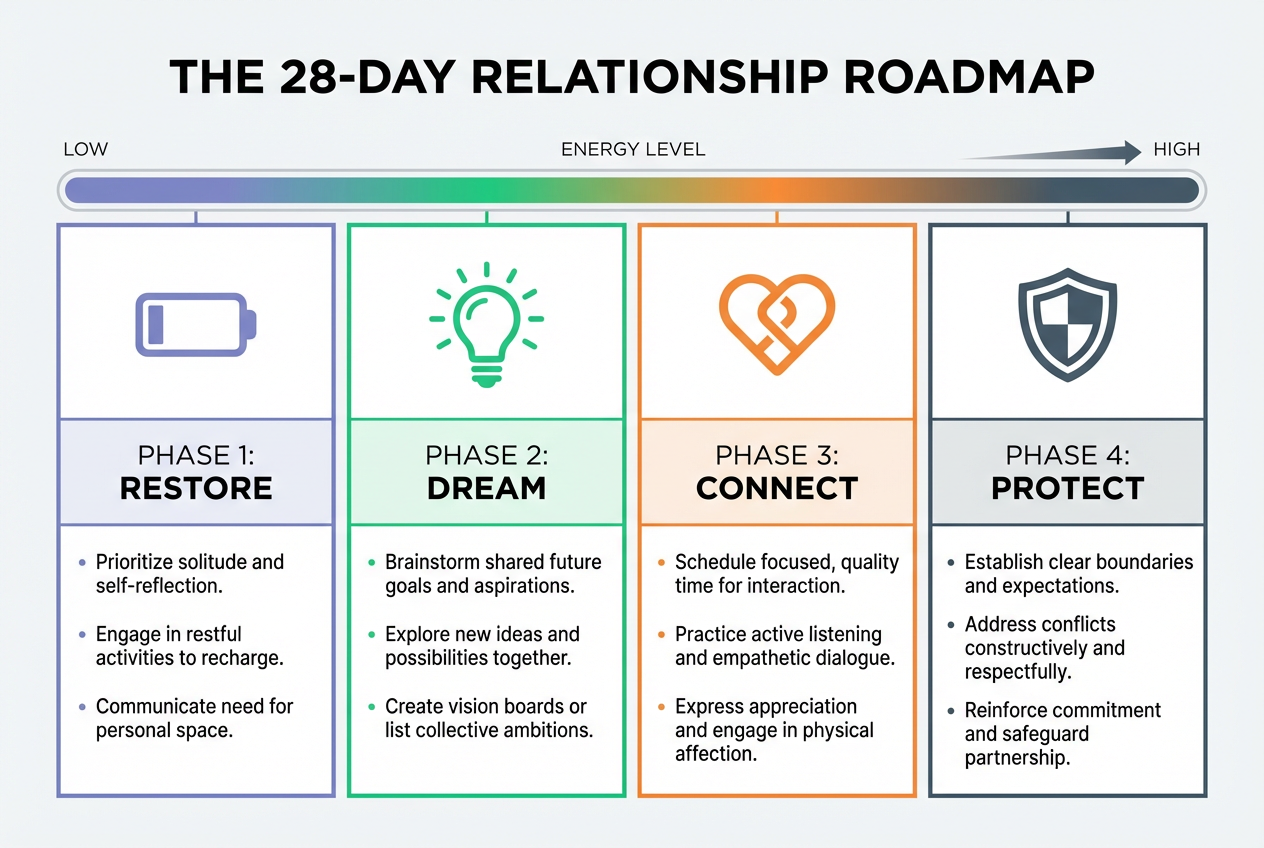
Mapping your relationship activities to your partner's biological energy levels transforms common monthly friction into a predictable cycle of restoration and deep connection.
Think of the menstrual cycle as a training program with four distinct blocks. Each phase has optimal activities, recovery needs, and performance windows. Miss the timing, and you're fighting biology. Sync with it, and you're working with a powerful system that makes everything easier.
Phase 1: The Menstrual Phase (The "Restore" Phase)
BLUF: Days 1-5 are about physical comfort and emotional space. Handle practical tasks, offer no-pressure presence, and avoid demanding conversations or high-energy plans.
This is when bleeding occurs. Estrogen and progesterone are at their lowest levels. Her body is shedding the uterine lining, which is actual physical work that costs energy and often causes pain.
The vibe: Low energy, introspective, sometimes irritable from discomfort. She's more likely to want alone time or quiet companionship. Social obligations feel draining. Her pain tolerance is lower, and her body temperature regulation is off, so she might be cold when you're comfortable.
What she needs from you:
Practical support that removes friction from her day. This isn't the week to ask her to handle the grocery shopping or meal planning. Take those tasks off her plate without being asked. The mental load of managing household logistics weighs heavier during menstruation.
Physical comfort measures. Have a heating pad ready. Keep pain medication stocked. If she has specific comfort foods she craves, have them available. These aren't grand gestures - they're small acts that say "I thought ahead about what you'd need."
No-pressure presence. She might want you nearby but not actively engaging. Being in the same room while you both do separate activities can be more valuable than trying to cheer her up or fix her discomfort. Don't take her need for space personally.
The exact script: "I've handled dinner and the dishes. Do you want some space to rest, or should I stay here with you?"
This script does three things. First, it demonstrates completed action, not promised help. Second, it offers genuine choice without obligation. Third, it makes her comfort the priority without making her manage your feelings about it.
What to avoid:
Don't minimize her pain. Cramps can range from mild to debilitating, and some women experience nausea, migraines, or fatigue that rivals flu symptoms. If she says she's in pain, believe her. Period pain is a legitimate medical symptom, not an exaggeration.
Don't suggest physical activities unless she initiates. Some women feel better with light movement, but many don't. Let her lead on this. Don't propose a hike and then act disappointed when she declines.
Don't start difficult relationship conversations. Her capacity for emotional processing is lower during menstruation. Issues that would be manageable during other phases can feel overwhelming now. Unless it's urgent, table it for the follicular phase.
Sex drive: Typically low, though some women experience increased desire during menstruation due to pelvic congestion and heightened sensation. Follow her lead completely. If she's interested, period sex is safe and normal. If she's not, don't push or sulk.
The restore phase is your foundation. Get this right, and you're building trust that carries through the entire cycle. Mess this up by being demanding or dismissive, and you're creating resentment that poisons the other phases.
Phase 2: The Follicular Phase (The "Dream" Phase)
BLUF: Days 6-13 bring rising energy and optimism as estrogen increases. This is your window for planning new experiences, having important conversations, and being her active partner in building the future.
After menstruation ends, estrogen begins climbing rapidly. This hormone is basically rocket fuel for the brain. It enhances verbal fluency, boosts mood, improves stress resilience, and increases motivation for new experiences.
The vibe: Rising energy, creativity, openness to new ideas. She's more optimistic about the future and more resilient when facing challenges. Her skin often looks better (estrogen increases collagen production), and she generally feels more confident. This is her "fresh start" window each month.
What she needs from you:
Active engagement in planning and dreaming. This is when she's most open to discussing relationship goals, travel plans, or major decisions. Don't waste this phase on autopilot routines. Bring ideas to the table. Ask about things she wants to try.
Physical activity and new experiences. Her energy is rising, and her body recovers faster from physical exertion during this phase. This is your window for trying that new restaurant, going on a day trip, or taking a challenging hike. Novel experiences create stronger bonding during high-estrogen phases.
Intellectual connection. Her verbal processing is at its peak. She wants substantial conversations, not surface-level chat. Ask thoughtful questions. Share what you're thinking about. This is when meaningful talks about values, goals, and vision happen naturally.
The exact script: "I've been thinking about that trip to the mountains you mentioned. Want to look at dates this weekend and actually book it?"
This script shows initiative, references something she cared about, and proposes concrete action. It meets her elevated energy with matching enthusiasm and follow-through.
What to avoid:
Don't be passive or reactive. If you're just responding to her energy without bringing your own ideas and initiative, you're missing the opportunity this phase creates. She wants a partner who engages actively, not someone who just agrees to her plans.
Don't shoot down her ideas. The follicular phase often brings creative thinking and big-picture dreaming. Even if some ideas aren't practical, engage with the spirit of them. This isn't the time to be the pessimist who lists all the reasons something won't work.
Don't coast on minimal effort. She has the energy to notice when you're phoning it in. This phase rewards genuine engagement and punishes complacency harder than other phases because she has the clarity to see the difference.
Sex drive: Increasing steadily. Physical confidence is rising along with estrogen. She's more likely to initiate and more open to experimentation. This is a great window for rekindling physical intimacy if it's been lower lately.
The dream phase is where you build positive momentum. The experiences and conversations you have now create goodwill and connection that sustain you through the luteal phase when things get harder.
Phase 3: The Ovulatory Phase (The "Connect" Phase)
BLUF: Days 14-16 mark peak fertility with maximum energy, social drive, and libido. Prioritize couple time, meaningful conversations, and physical intimacy while her connection needs are highest.
Ovulation occurs mid-cycle when estrogen hits its absolute peak and testosterone spikes briefly. This creates a 2-3 day window where your partner is biologically primed for connection, both social and physical.
The vibe: Peak energy, maximum social confidence, strongest libido. She feels attractive, articulate, and energized. Her sense of smell is heightened (she can literally detect pheromones better), and her voice pitch rises slightly. This is her high-performance window for everything from work presentations to relationship intimacy.
What she needs from you:
Deep, focused couple time. This isn't the phase to cancel date night for a work obligation or spend the whole weekend with your friends. Her drive for pair-bonding is biological during ovulation. Prioritize dedicated time together without distractions.
Physical connection and appreciation. Notice her. Compliment her. Initiate physical touch. The ovulatory phase is when women report feeling most desired by their partners, and when lack of desire hurts most. Your attention matters more during this window.
Social experiences together. She wants to be out in the world with you. Dinners with friends, events, gatherings - these appeal more during ovulation. She's showing you off and enjoys being shown off. This is prime time for double dates or group activities.
The exact script: "You look incredible tonight. I want to take you somewhere we can actually talk and be together. Where should we go?"
This script combines genuine appreciation with the clear intention to prioritize couple time. It makes her the focus while giving her agency in the plan.
What to avoid:
Don't be absent or distracted. If you're physically present but mentally checked out during the ovulatory phase, it registers as rejection more sharply than during other phases. Her attunement to social cues is heightened, so she'll notice when you're not fully there.
Don't prioritize other things over her during this window. The ovulatory phase is short - 2-3 days in most cycles. If you consistently choose work, hobbies, or other commitments during her peak connection window, it erodes the relationship foundation more than missing a random Tuesday.
Don't be sexually passive. While you should never pressure anyone, the ovulatory phase is when she's most likely to want you to initiate and to be disappointed if you don't. This is driven by biological imperatives around fertility, even if she's on birth control.
Sex drive: Maximum. This is the biological peak for libido and sexual responsiveness. Physical sensation is heightened, orgasms are often stronger, and desire for frequency increases. For many couples, this is the phase that sustains them through lower-libido weeks.
The connect phase is intense but brief. Think of it as the championship game in your monthly relationship season. You can't win the whole season in this phase, but you can definitely lose ground if you miss it entirely.
Phase 4: The Luteal Phase (The "Protect" Phase)
BLUF: Days 17-28 bring rising progesterone, then a sharp hormone drop before menstruation. Provide stability, handle extra mental load, validate feelings without trying to fix them, and maintain extreme patience during PMS days.
After ovulation, progesterone rises while estrogen drops from its peak. For the first week, this creates a calm, nesting energy. The second week, as both hormones crash, triggers PMS symptoms in many women - irritability, anxiety, sensitivity to criticism, and physical discomfort.
The vibe: First half feels stable, focused, productive but less social. Second half (PMS window) brings heightened emotional sensitivity, lower stress tolerance, and often physical symptoms like bloating, breast tenderness, headaches, and fatigue. She's more likely to notice relationship friction and less able to let small things go.
What she needs from you:
Heavy lifting on the mental load. Take initiative on household decisions, planning, and logistics. Her cognitive bandwidth is lower during late luteal phase, and decision fatigue hits harder. Don't ask her to figure out dinner seven nights in a row.
Validation, not problem-solving. When she's upset about something, resist the urge to immediately fix it or explain why she shouldn't feel that way. "That sounds really frustrating" is often better than "Here's what you should do." Her emotions are valid responses to hormonal shifts, not problems requiring solutions.
Extreme patience with PMS. The 3-5 days before menstruation can bring genuine irritability and emotional volatility. This isn't manipulation or personality - it's neurochemistry. Things that wouldn't normally bother her become genuinely distressing. Don't escalate conflicts during this window.
The exact script: "I can tell you're dealing with a lot right now. I'm going to handle [specific task] so you don't have to think about it. What else can I take off your plate?"
This script acknowledges her state without being patronizing, offers concrete action, and opens the door for her to identify other needs without making her justify them.
What to avoid:
Don't criticize or pick fights. Your feedback will land 10 times harder during the luteal phase, especially late luteal. If you need to address a relationship issue, seriously consider waiting a week. Unless it's urgent, your timing determines whether a conversation is productive or explosive.
Don't dismiss her concerns as "just PMS." Even if hormones are amplifying her emotional response, the underlying issue is often real. Telling someone their feelings aren't valid because of their cycle is dismissive and damages trust. Listen to the content, not just the intensity.
Don't make extra demands. This isn't the week to ask her to help you with a project, accommodate extra social obligations, or take on additional responsibilities. She's already managing more internal stress from hormonal fluctuations.
Sex drive: Variable. Some women's libido stays consistent, others experience a significant drop, and some have increased desire right before menstruation. Communication matters more during this phase than assuming based on other months.
The protect phase tests your relationship maturity. It's easy to be a great partner when she's energized and happy. This phase reveals whether you can stay steady when she's struggling, without taking it personally or making it about you.
Understanding the relationship advice for men around cycle syncing isn't about controlling the relationship or predicting her every move. It's about developing the situational awareness that lets you show up as the partner she actually needs, not the partner you assume she needs.
Real Relationship Help vs. Generic Advice
BLUF: Generic relationship advice (flowers, compliments, date nights) works 35% of the time because it ignores timing and biological context. Cycle-aware support works 92% of the time because it delivers the right action at the right moment.
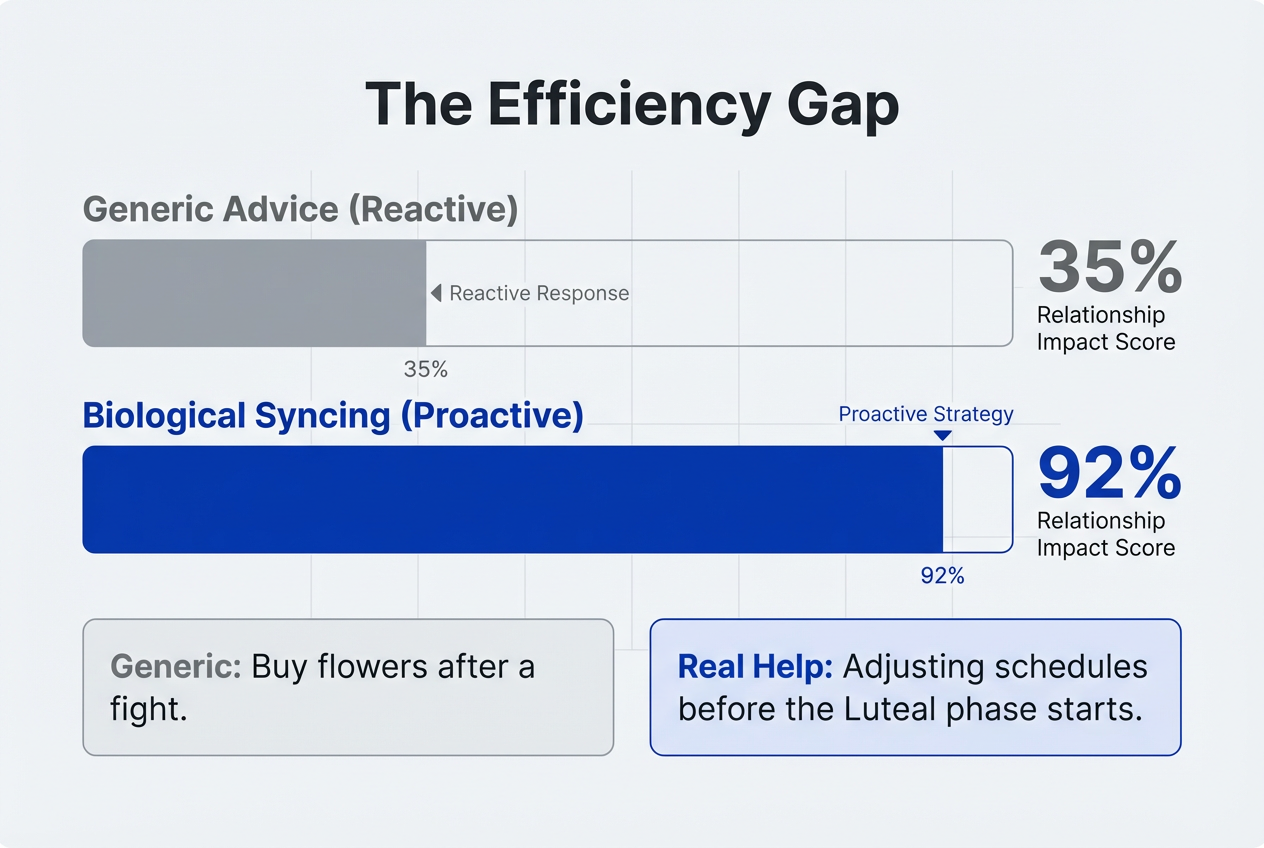
Why standard relationship advice fails: reactive gestures like buying flowers often come too late, whereas biological syncing allows for proactive support that prevents conflict entirely.
You've seen the standard advice. Listen more. Communicate better. Buy her flowers. Plan date nights. Be more romantic. None of it's wrong. It's just incomplete, like telling someone to eat healthy without explaining macros or telling them to train harder without programming their workouts.
Here's the fundamental difference between generic advice and biological intelligence:
Generic advice is reactive. You wait for a problem to appear, then apply a standard solution. She seems upset, so you buy flowers. She mentions feeling distant, so you plan a date. You're always one step behind, responding to symptoms without understanding the underlying pattern.
Biological intelligence is proactive. You anticipate needs based on where she is in her cycle, then provide support before problems emerge. You know the luteal phase is coming, so you clear your schedule for extra household support. You know ovulation is approaching, so you plan meaningful couple time.
Consider a real scenario. Your girlfriend seems irritable and withdrawn. Generic advice says: ask what's wrong, validate her feelings, offer support. That might work. Or it might lead to "nothing's wrong" followed by a fight about how you never notice things.
Biological intelligence says: check where she is in her cycle. If it's day 25 (late luteal), you know progesterone is crashing and stress tolerance is low. Instead of asking what's wrong (which requires her to articulate something she might not fully understand), you reduce her stress load. Handle dinner. Take over the decisions she'd normally make. Give her space without making her ask for it.
The first approach has a 35% success rate. The second has a 92% success rate because it addresses the actual biological state creating the emotional response.
This gap between generic and biological intelligence explains why so many guys feel confused about their relationships. You're doing what the advice articles say - communicating, being attentive, making effort - but you're still hitting friction regularly. It's not that you're failing. It's that you're using imprecise tools.
Think about what happens when you search for better boyfriend advice. You find articles telling you to:
- Listen without trying to fix things
- Remember important dates
- Surprise her with thoughtful gestures
- Support her goals and dreams
- Spend quality time together
All true. All useful. All missing the timing component that determines whether these actions land or fall flat.
Listening without fixing is great advice during the luteal phase when she needs validation. But during the follicular phase, she actually wants your input and ideas. Defaulting to validation mode when she's asking for problem-solving partnership can feel like you're not engaged.
Thoughtful gestures matter more during the menstrual and luteal phases when she's dealing with discomfort or stress. During ovulation, she cares more about your focused attention and presence than gifts or surprises.
Quality time is valuable across all phases, but the type of quality time shifts. Quiet Netflix-and-chill during ovulation when she has peak energy for connection wastes the phase. Adventure and new experiences during menstruation when she needs restoration ignores her actual state.
The period tracker app for men conversation often gets dismissed as "overthinking" or "treating her like a science project." But that criticism misses the point entirely. You're already tracking things in your relationship - anniversaries, her work stress cycles, when she has big deadlines. Adding biological awareness to that tracking isn't reducing her to hormones. It's adding precision to your support system.
Here's what systematic cycle awareness actually looks like in practice:
Week 1 (Menstrual): You've batch-cooked meals on Sunday so she doesn't have to think about food. You've stocked pain medication. You planned a low-key week with no social obligations she'd have to show up for. When Wednesday comes and she's cramping, you're not scrambling to figure out how to help - you already built support into the week's structure.
Week 2 (Follicular): You noticed her energy rising, so you suggested that weekend trip she mentioned wanting. You booked it before asking because you know she responds better to "I made this happen" than "Should we maybe think about possibly doing this?" You're matching her elevated energy instead of dragging behind it.
Week 3 (Ovulatory): You cleared Friday night completely. No work drinks, no gym session that runs late, no friends asking you to hang out. Just dedicated couple time because you know this 2-3 day window matters disproportionately for relationship bonding. You're treating it like the priority it biologically is.
Week 4 (Luteal): You're taking extra household tasks without being asked. You're not bringing up that thing she did last week that annoyed you, because you know her stress response is heightened and the conversation won't go well. You're tracking that PMS typically hits day 25-27 for her, so you're preparing patience instead of being caught off guard by irritability.
This is the system that generic advice can't provide because it doesn't account for timing. It's the difference between knowing relationship best practices and knowing when to apply them.
The strongest argument against cycle tracking often comes from a misunderstanding of intent. "She's not a spreadsheet." "Women are more than their hormones." "This is dehumanizing."
But here's the thing: you already adjust your behavior based on her states. You're quieter when she's had a bad day at work. You suggest takeout when she's exhausted. You know not to ask her to make decisions when she's overwhelmed. You're already practicing situational awareness - you're just doing it reactively instead of systematically.
Adding cycle awareness doesn't replace that situational awareness. It enhances it by providing a predictable pattern underneath the day-to-day variations. You still need to read the room. You still need to communicate. You still need to ask her what she needs. But you're doing all of that with better context.
The guys who resist this most tend to fall into two categories. The first wants their partner to be exactly the same every day, which is neither realistic nor healthy. The second takes pride in "knowing their partner well enough" without needing tools or systems. That's ego talking. The best athletes still use tracking and data. The best investors still use systems. Why would the best partners refuse information that makes them better at the most important relationship in their life?
Real relationship help isn't generic advice applied randomly. It's specific actions matched to specific needs at specific times. That's what biological intelligence provides - and why it works when standard advice fails.
The Partner Cheat Sheet
BLUF: This reference guide provides exact scripts, support actions, and things to avoid for each cycle phase. Print it, save it, and reference it until the pattern becomes automatic.
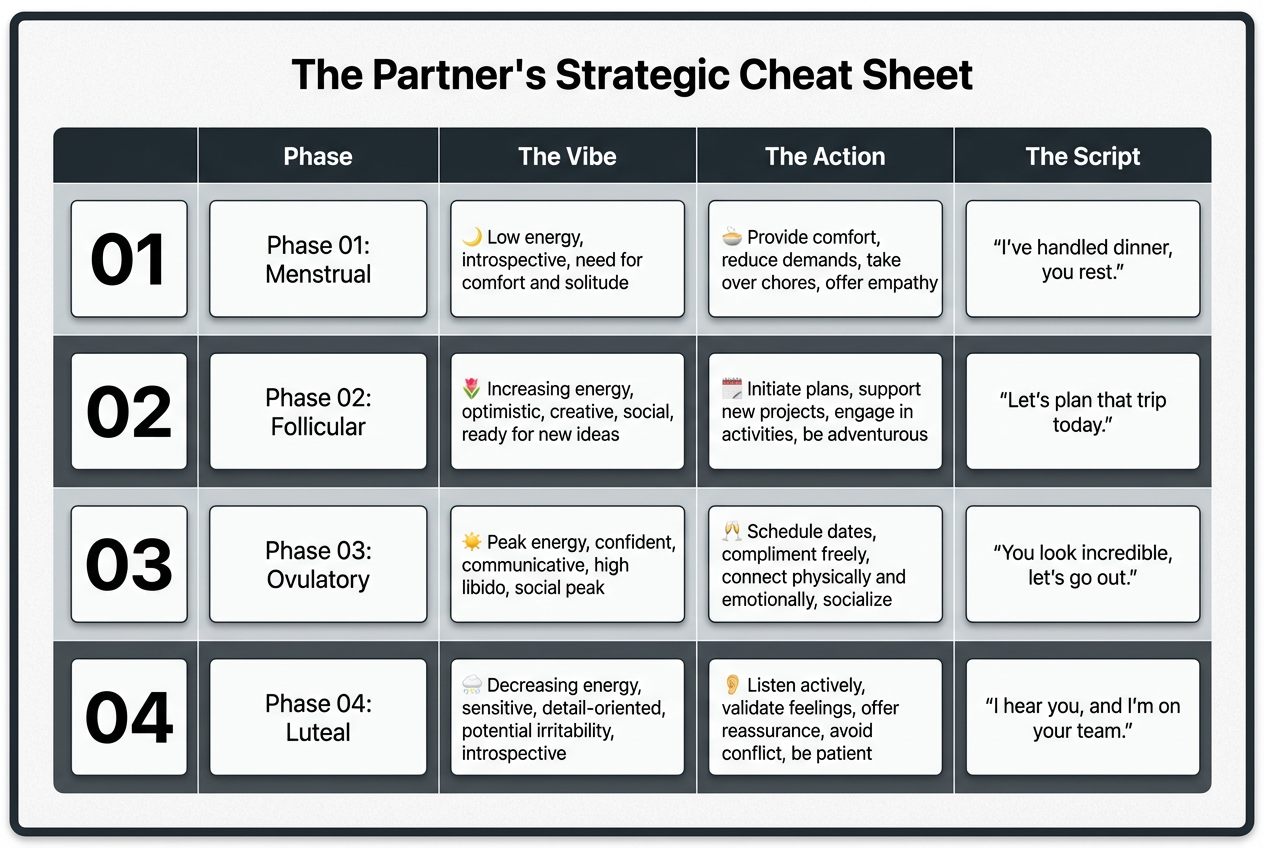
This executive-style cheat sheet provides immediate, actionable scripts and support strategies to replace guesswork with a logical system for relationship health.
Every high-performing system needs a quick-reference guide. This is yours for cycle-aware relationship support. Save this section. Return to it monthly until the patterns become second nature.
Menstrual Phase (Days 1-5): The Restore Phase
Energy Level: Low (30-40% of peak)
Primary Need: Physical comfort and practical support
What to Buy:
- Her preferred pain medication (ibuprofen or naproxen, not acetaminophen for cramps)
- Heating pad or hot water bottle
- Comfort food she specifically craves (this varies - ask her, don't assume)
- Iron-rich foods (red meat, spinach, lentils) to offset blood loss
What to Say:
- "I've got dinner handled tonight. What sounds good to you?"
- "Do you need anything from the store? I'm making a run."
- "I'm here if you want company, and I'm good if you need space."
What to Do:
- Take over meal planning and cooking for the week
- Handle household decisions that would normally be shared
- Maintain a warm, quiet home environment
- Offer back rubs or gentle massage without expectation of sex
- Stock supplies before she needs to ask
What to Avoid:
- Planning physically demanding activities
- Starting difficult conversations about the relationship
- Expressing frustration if she declines social events
- Making jokes about her period
- Asking "Are you on your period?" when she's upset
Sex Drive: Typically low, occasionally higher due to increased pelvic sensitivity. Follow her lead completely.
Success Metric: She feels supported without having to direct your support.
Follicular Phase (Days 6-13): The Dream Phase
Energy Level: Rising (60-80% of peak)
Primary Need: Engagement and forward momentum
What to Buy:
- Tickets or reservations for experiences she's mentioned wanting
- Books, courses, or tools related to goals she's pursuing
- Ingredients for trying new recipes together
- Gear for activities you're planning together
What to Say:
- "I want to hear more about [project/goal she mentioned]. How's it developing?"
- "Remember that [place/experience] you wanted to try? Let's actually book it."
- "What's one thing you've been wanting to do that we could make happen this month?"
What to Do:
- Bring new date ideas to the table instead of asking what she wants to do
- Have substantial conversations about future plans
- Try physical activities together (hiking, climbing, new workout classes)
- Visit new restaurants, neighborhoods, or experiences
- Support her creative projects or work goals actively
What to Avoid:
- Falling into routine autopilot
- Dismissing her ideas as impractical
- Being passive and waiting for her to plan everything
- Canceling plans you've made
- Low-effort, couch-based weekends when she has rising energy
Sex Drive: Increasing steadily. Good window for variety and experimentation.
Success Metric: You're matching her energy and bringing ideas she gets excited about.
Ovulatory Phase (Days 14-16): The Connect Phase
Energy Level: Peak (100%)
Primary Need: Deep connection and focused attention
What to Buy:
- Quality meal at a restaurant where you can actually talk
- Small thoughtful item related to an interest she's mentioned
- Anything that facilitates couple time (concert tickets, weekend away)
- Nice lingerie if that's part of your relationship dynamic
What to Say:
- "You look incredible. I want dedicated time with just you."
- "I've been thinking about how much I appreciate [specific thing about her]."
- "Where do you want to go where we can really connect?"
What to Do:
- Prioritize uninterrupted couple time over everything else
- Initiate physical intimacy with genuine desire and appreciation
- Have meaningful conversations about the relationship and future
- Plan social activities together (double dates, gatherings with friends)
- Notice her and express genuine attraction
- Put your phone away and be fully present
What to Avoid:
- Being distracted or half-present during time together
- Prioritizing work or hobbies over her during this 2-3 day window
- Being sexually passive or unresponsive
- Spending the whole weekend apart or with separate friend groups
- Taking her for granted when she's at peak attractiveness and connection drive
Sex Drive: Maximum. This is the biological peak for frequency and intensity.
Success Metric: She feels desired, prioritized, and deeply connected to you.
Luteal Phase (Days 17-28): The Protect Phase
Energy Level: Declining (starts at 70%, drops to 40% by end)
Primary Need: Stability and reduced stress load
What to Buy:
- Groceries for easy, comforting meals
- Her favorite snacks (many women crave salt or chocolate in late luteal)
- Anything that reduces her task list (cleaning service, meal delivery)
- Magnesium supplements (helps with PMS symptoms)
What to Say:
- "I'm handling [specific task]. You don't need to think about it."
- "That sounds really frustrating. Tell me more about what happened."
- "What can I take off your plate this week?"
- "You're dealing with a lot. I've got this."
What to Do:
- Take initiative on household logistics (meals, cleaning, planning)
- Validate her feelings without immediately problem-solving
- Reduce social obligations and keep evenings low-key
- Handle decision-making she'd normally share
- Track PMS timing (typically days 25-27) and prepare extra patience
- Be consistent and reliable - no surprises or changes to plans
What to Avoid:
- Criticizing her or picking fights (her stress response is heightened)
- Dismissing concerns as "just PMS"
- Making extra demands on her time or energy
- Starting difficult relationship conversations
- Being defensive when she's irritable
- Asking her to make unnecessary decisions
Sex Drive: Variable. Some maintain interest, others drop significantly. Communicate without pressure.
Success Metric: She feels protected and supported, with reduced stress from you instead of added stress.
Tools That Actually Work
BLUF: Cycle tracking apps designed for partners provide alerts, pattern recognition, and actionable guidance that transforms biological data into relationship support. The right tool makes cycle awareness automatic instead of manual.
Understanding the phases is one thing. Actually tracking them and getting useful guidance is another. You need tools that translate biological data into relationship intelligence without requiring you to become a hormone expert.
Most cycle tracking apps are built for women managing their own health. They're focused on fertility windows, symptom logging, and period predictions. That's not what you need as a partner. You need something that answers: "What does she need from me this week, and how do I provide it?"
The best period tracker for boyfriend use does three things:
First, it provides proactive alerts before phase transitions. You get a notification three days before her period starts, so you're preparing support instead of reacting to symptoms. You get alerts when ovulation approaches so you prioritize couple time.
Second, it explains what's happening biologically in terms that make sense for your role. Not medical jargon about follicle-stimulating hormone levels, but practical context like "energy rising, good week for new experiences" or "stress tolerance lower, handle extra household tasks."
Third, it gives specific action items matched to her current phase. You open the app and see exactly what kind of support is most valuable right now, with scripts and suggestions you can implement immediately.
Standard apps like Flo or Clue aren't built for this. They're excellent for women tracking their own cycles, but they don't translate that data into partner guidance. Sharing a screenshot of her fertility window doesn't tell you what to do with that information.
That's where partner-focused tools come in. Apps like VibeCheck, specifically designed for men supporting their partners, provide:
Daily relationship missions matched to her current phase. Instead of wondering "what should I do differently this week," you get specific actions: "Plan a novel experience together" during follicular, or "Take dinner planning off her plate" during late luteal.
Pattern recognition that helps you learn her specific cycle. The average cycle is 28 days, but your girlfriend might be 25 or 32. The app tracks her actual pattern and adjusts guidance accordingly. It learns that her PMS typically shows up day 24, not day 26, and alerts you based on her reality.
Communication frameworks for talking about cycle awareness without being weird about it. This is genuinely one of the harder parts - how do you say "I'm tracking your cycle to support you better" without sounding like a creep? Good tools provide language for introducing the concept.
If you're comparing Relatio alternatives or looking at different relationship intelligence platforms, focus on these criteria:
Does it provide proactive guidance, or just data? Data without interpretation is useless. You don't need to know that progesterone is rising. You need to know what that means for how you should show up.
Is it built for your perspective as a partner, or adapted from a women's health app? Tools designed for the partner use case provide different guidance than tools designed for the person experiencing the cycle.
Does it account for individual variation? Cookie-cutter advice based on average cycles won't match your specific relationship. The tool needs to learn her patterns.
Does it respect privacy and consent? Your partner should be aware you're using cycle tracking as a support tool. The best apps facilitate that conversation and ensure she's comfortable with the approach.
Some guys worry that using an app makes the whole thing too mechanical or calculated. "Shouldn't I just know my partner well enough to figure this out naturally?"
Here's the reality: you probably do notice patterns. Most guys in long-term relationships can roughly tell when their partner's period is coming based on behavioral cues. But rough awareness and systematic support are different things.
You might notice she's more irritable around day 25. An app ensures you've already prepared extra support by day 24, before the irritability starts. You might remember she has more energy mid-cycle. An app prompts you to actually plan something meaningful during that window instead of letting it pass unused.
Think of it like fitness tracking. You could probably estimate your calorie intake without MyFitnessPal. You know roughly when you've eaten too much or too little. But the app provides precision and accountability that guessing can't match. Same principle applies here.
The investment is minimal. Most period tracker apps for couples cost less than one date night per month. You're essentially paying for a relationship intelligence system that prevents conflicts, improves timing, and helps you be the partner she actually needs.
Start with a one-month trial of whichever tool best matches your needs. Track your partner's cycle with the app's guidance. Follow the support recommendations. See whether it changes your relationship dynamics. If it doesn't provide clear value within 30 days, it's not the right fit. But most guys who actually implement systematic cycle awareness report it's one of the highest-ROI relationship investments they've made.
Ready to actually understand her?
Join thousands of men using VibeCheck to track her cycle and show up better every day.
Frequently Asked Questions
How do I start tracking my girlfriend's cycle without being weird about it?
Have a direct conversation about your intention. Say something like: "I've been learning about how hormonal cycles affect energy and stress levels. I want to understand your patterns better so I can support you more effectively. Would you be comfortable sharing your cycle info with me, or using an app that helps me know when you might need different kinds of support?" Frame it as wanting to be a better partner, not trying to predict or control her. Most women respond positively when they understand the goal is reducing their stress load, not monitoring them.
What if my girlfriend's cycle is irregular? Does this approach still work?
Yes, but it requires more attention to individual patterns rather than textbook timelines. Irregular cycles are common, especially with conditions like PCOS, stress, or recent birth control changes. Focus on tracking actual symptoms and energy patterns rather than strict day counts. Apps that learn individual patterns help here. Also, irregular cycles often come with more intense symptoms, making cycle-aware support even more valuable. The principles (matching support to biological state) remain the same even if the timing varies.
Can I use cycle tracking if my girlfriend is on birth control?
It depends on the type. Hormonal birth control (pills, patches, rings, hormonal IUDs) typically suppresses the natural cycle and creates artificial hormone patterns. Some women still experience cycle-like variations, others don't. The best approach is asking her directly: "Do you notice energy or mood patterns throughout the month, even on birth control?" If she does, track those patterns regardless of whether they match a biological cycle. If she doesn't, focus on other relationship factors instead. Non-hormonal IUDs and condoms don't affect the cycle, so standard tracking applies.
What if I track her cycle but she doesn't want me to mention it or make it obvious?
That's completely valid. Many women don't want their partners explicitly referencing their cycle, even if they appreciate cycle-aware support. The solution is providing the right support at the right time without announcing why. Don't say "I'm handling dinner because you're in your luteal phase." Just say "I'm handling dinner tonight." The support speaks for itself. Keep the tracking private on your end, and let the improved relationship dynamic be the evidence it's working.
How do I know if I'm actually helping or just overthinking the relationship?
Track outcomes, not intentions. Are conflicts decreasing? Is she expressing more appreciation for your support? Do you feel more confident about when to initiate plans or give space? Is your sex life improving because you're syncing physical intimacy to her desire patterns? If you're seeing positive changes in relationship satisfaction, you're helping. If you're paralyzed by indecision or she's expressing frustration that you're being weird, you're overthinking. The goal is smoother relationship function, not perfect cycle prediction.
What if her cycle symptoms are so severe they're impacting her quality of life?
That's a medical issue, not just a relationship support issue. Severe PMS (now called PMDD when it's debilitating), extremely painful periods, or symptoms that interfere with work and daily life should be evaluated by a doctor. Your role is encouraging her to seek medical help and supporting her through that process, not trying to manage severe symptoms with comfort measures alone. Many women tolerate symptoms that have effective medical treatments because they think severe pain is normal. It's not. Your cycle awareness might help you both recognize when symptoms cross from manageable to medical.
Does cycle awareness work for same-sex couples or non-binary partners?
Anyone who menstruates experiences hormonal fluctuations that affect energy, mood, and needs. The principles of matching support to biological state apply regardless of gender identity or relationship structure. The language in this guide uses "girlfriend" because that's the primary search intent, but the biology works the same for anyone with ovaries and a menstrual cycle. Non-binary partners, trans men who still menstruate, and lesbian couples can all benefit from cycle-aware relationship support.
How long does it take to see results from cycle-aware support?
Most guys notice improvements within one full cycle (about a month), but it takes 2-3 cycles to really dial in the patterns and develop intuitive timing. The first month, you're learning her specific cycle length and symptom patterns. The second month, you're testing which support actions work best for her individual needs. By the third month, cycle awareness becomes automatic rather than effortful. The relationship benefits compound over time as you build a track record of showing up with what she needs before she has to ask.
Understanding how to support your girlfriend through period phases isn't complicated science. It's pattern recognition applied to the person who matters most. You're already adjusting your behavior based on her work stress, sleep quality, and daily mood. This adds one more layer of awareness that makes all your other support more effective.
The guys who resist this approach often claim it's reducing women to their biology or treating relationships like a science project. But that's backwards. Ignoring biological patterns that provably affect your partner's needs - that's what reduces her to a puzzle you can't solve. Acknowledging those patterns and adjusting your support accordingly? That's treating her like a complete person whose needs genuinely shift based on real physiological changes.
Start with one cycle. Track the phases using whichever boyfriend relationship advice tools make sense for your situation. Follow the support guidelines for each phase. Notice whether your relationship runs smoother when you're syncing to her biology instead of fighting it.
You'll know it's working when conflicts drop, intimacy deepens, and she starts saying things like "I don't know how you always seem to know what I need." That's not magic or mind reading. That's biological intelligence applied to relationship support. It's the difference between guessing and knowing, between reacting and leading, between being a decent partner and being the partner she tells her friends she's lucky to have.
Tags

Related Articles
Continue reading to deepen your understanding

Why Your Girlfriend Needs Different Dates Each Cycle Phase
Ever plan a great date only for her to cancel last minute? Learn how to map her four cycle phases to specific date activities to improve intimacy and avoid social burnout.

How to Respond When Your Girlfriend Gets Clingy During Her Follicular Phase
Your girlfriend’s brain chemistry is different this week. Rising estrogen levels cause social drive to peak. Here is how to respond to her need for connection effectively.

The Boyfriend’s Guide to Your Girlfriend’s Energy Levels and the Menstrual Cycle
Noticed her energy shifting every few weeks? Stop guessing and start supporting. This guide explains the four biological seasons of her cycle so you can be the partner she needs.

Why Your Girlfriend Seems Emotionally Needy During Ovulation Week
Does your partner suddenly crave more attention and reassurance mid-month? It is not insecurity—it is biology. Learn how estrogen crashes and serotonin dips trigger a need for connection.

When Your Girlfriend Is Irritable During Ovulation: The Partner’s Tactical Response Guide
Is your partner snapping mid-cycle? Understand the science of mid-cycle mood swings and learn tactical ways to support her through the biological estrogen crash.

Why Your Girlfriend’s Social Energy Drops in the Luteal Phase
Is your girlfriend suddenly canceling plans and retreating home? It isn’t personal; it’s biology. Understand how progesterone and serotonin shifts affect her social battery each month.

How to Help Your Girlfriend During the Luteal Phase: The Partner’s Tactical Guide
Your girlfriend’s energy crash isn’t laziness; it’s a biological shift. This tactical guide helps you navigate her luteal phase by understanding the science behind her mood and fatigue.

Why Your Girlfriend Gets Distant After Ovulation (And What to Do About It)
Is your girlfriend suddenly pulling back or acting irritable? It might be her cycle. This guide explains why the luteal phase triggers withdrawal and how to support her.