How to Know When Your Girlfriend Needs Space: The Cycle Guide for Men

Is she pulling away or just hitting a biological wall? Learn how to spot the signs your girlfriend needs space based on her cycle before she even has to ask for it.
How to Know When Your Girlfriend Needs Space: The Cycle Guide for Men
You text her. She gives you three words back. Yesterday, she wanted to plan your entire weekend together. Today, she’s acting like you’re a stranger asking for directions.
You’re not imagining the shift. And no, she’s not necessarily pulling away from the relationship.
What you’re witnessing is likely a biological pattern that happens roughly every 28 days - a hormonal shift that transforms her social battery from "Let’s talk for hours" to "Please just exist quietly in another room." Understanding this pattern is the difference between taking it personally and being the partner who actually gets it.
This guide will teach you exactly how to spot when she needs space (before she has to ask), why it happens on a predictable schedule, and what to do about it without looking clueless or clingy.
VibeCheck App
Know what she needs. Before she has to say it.
Track her cycle, understand her phases, be the partner she deserves.
Download Free on iOS →Table of Contents
- The Why Behind the Wall
- 7 Subtle Signs She Needs Space (The Checklist)
- The Green Flag Partner Playbook
- When It’s Not "The Cycle"
- How to Talk About This (Without Starting a Fight)
- Frequently Asked Questions
The Why Behind the Wall
Her need for space isn’t random. It’s tied to a biological shift called the luteal phase - the roughly 10-14 days between ovulation and her period.
Here’s what’s happening inside her body: after ovulation, progesterone levels spike, then crash. This isn’t just "feeling moody." It’s a fundamental change in how her brain processes sensory input, social demands, and emotional energy.
Think of it as bandwidth. During the first half of her cycle (the follicular phase and ovulation), she’s running on high-speed internet. She can handle your questions, your touch, your presence, and her own stress simultaneously. But during the luteal phase? Her system is throttled. Every demand - even a simple "What’s for dinner?" - consumes more processing power than it did two weeks ago.
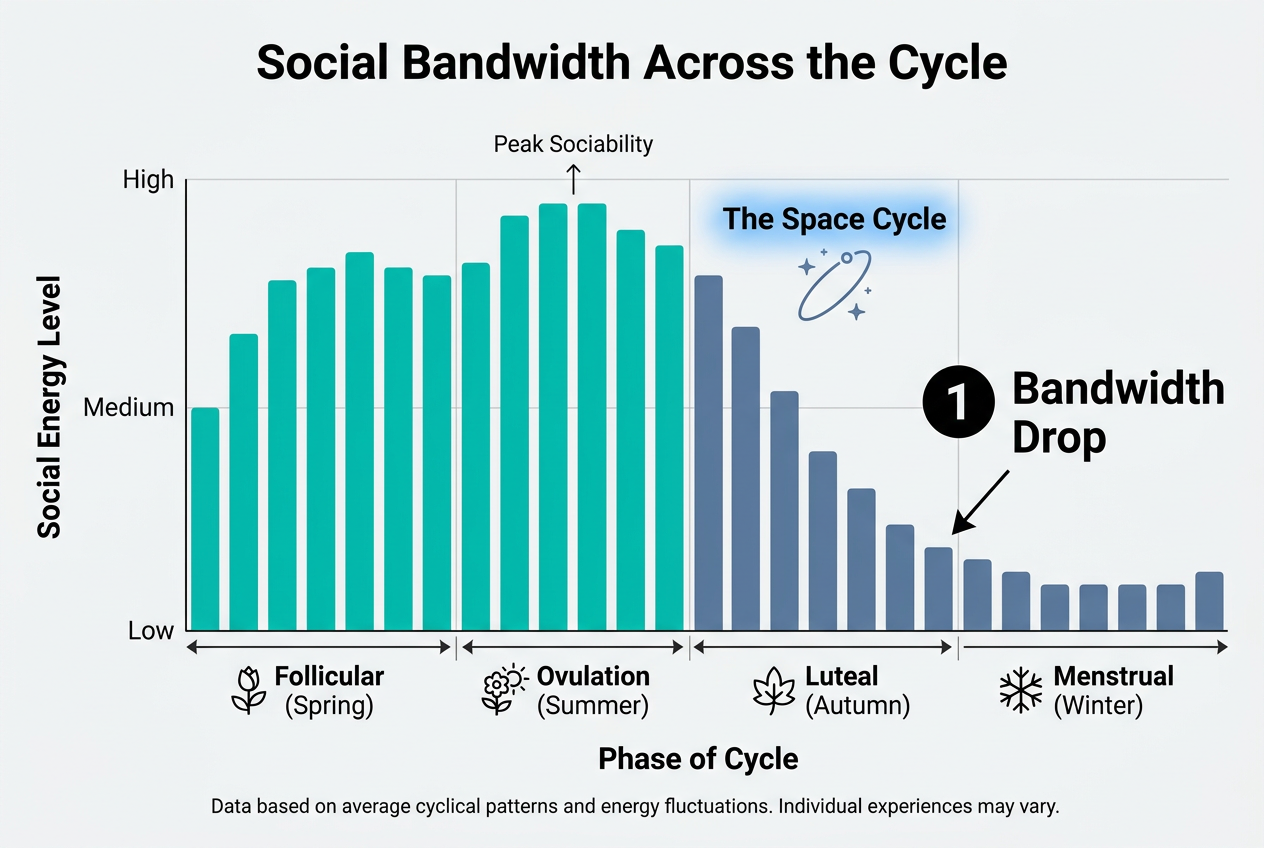 Understanding the biological ’Space Cycle’ helps partners identify when social energy naturally declines due to hormonal shifts, making the need for distance predictable and manageable.
The biological reason makes sense from an evolutionary perspective. Her body is shifting from "exploration and connection mode" (follicular/ovulation) to "protection and nesting mode" (luteal). The same hormones that prepare her uterus for potential pregnancy also trigger a withdrawal instinct - a biological drive to turn inward, reduce stimulation, and conserve energy.
This is not about you. It’s about progesterone.
The problem is that most guys interpret this shift as a relationship red flag. You start wondering if she’s losing interest, if you did something wrong, or if the relationship is headed south. Meanwhile, she’s just trying to survive a week where her brain chemistry makes everything feel louder, sharper, and more overwhelming than usual.
Learning to recognize this pattern - and respond to it correctly - is what separates the guy who panics and overcompensates from the partner who knows exactly when to step back and give her room to breathe.
For a deeper understanding of how these biological phases work, check out the boyfriend’s field manual on mastering your partner’s four cycle phases.
7 Subtle Signs She Needs Space (The Checklist)
Most guys wait for her to explicitly say "I need space" - but by that point, she’s already frustrated that you didn’t pick up on the signals. Here are the implicit signs to watch for:
1. The Texting Taper
Her messages get shorter. The emojis disappear. What used to be a full paragraph response is now "ok" or "sure." The time between her replies stretches from minutes to hours.
This isn’t ghosting. It’s a sign that text-based communication - which requires emotional energy to decode tone and craft responses - feels like work right now.
2. The Touch Ceiling
She flinches when you reach for her hand. She sits on the opposite end of the couch. Physical affection that she normally loves - the casual touch on her back, holding hands while watching TV - suddenly feels invasive.
This is progesterone reducing her sensory tolerance. Touch that felt comforting two weeks ago now registers as overstimulation.
3. The Decision Fatigue Meltdown
You ask, "What do you want for dinner?" and she either snaps at you or starts crying. Simple decisions that normally take her two seconds now feel like impossible choices.
Her brain’s executive function is already maxed out managing her own internal state. Adding one more decision to the pile triggers overwhelm.
4. The Sensory Overload
She turns down the TV volume. She asks you to stop tapping your pen. She retreats to a dark, quiet room. Sounds, lights, and movements that wouldn’t normally bother her suddenly feel like they’re amplified.
This is a direct result of the hormonal shift lowering her sensory threshold. Her nervous system is on high alert.
5. The Task Burial
She suddenly becomes obsessed with organizing the pantry, deep-cleaning the bathroom, or working late on a project. She’s using tasks as a shield to avoid emotional interaction.
This isn’t productive motivation. It’s avoidance behavior - a way to channel her energy into something that doesn’t require social performance.
6. The Past-Hoovering
She brings up an argument from six months ago. She remembers something you said in April that "really hurt her feelings." The luteal phase makes her more sensitive to past emotional wounds, and they resurface with intensity.
This isn’t her being petty. Progesterone amplifies emotional memory and makes old hurts feel fresh again.
7. The Nest Instinct
She cancels plans with friends. She wants to stay home in pajamas. Social obligations that she normally enjoys now feel exhausting. She’s in full "introvert mode" even if she’s usually extroverted.
Her body is biologically driven to create a safe, low-stimulation environment. Going out requires energy she doesn’t have.
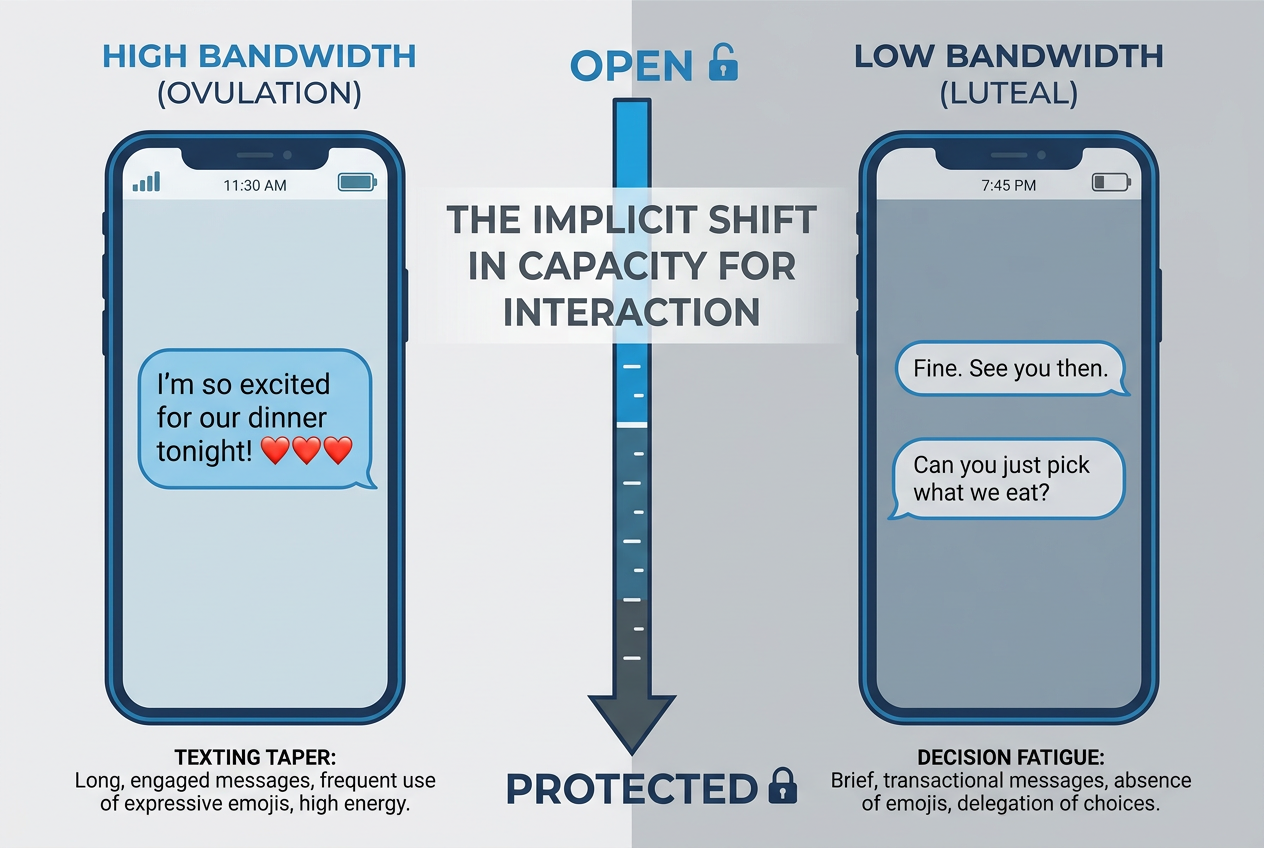 Recognizing the ’Texting Taper’ allows you to identify a shift in her social capacity before it leads to conflict, signaling a need for reduced digital demands.
When you spot three or more of these signs clustering together, she’s likely in the luteal phase and needs you to dial back your presence - not because she doesn’t love you, but because her biology is demanding reduced stimulation.
For specific guidance on what to text during these phases, see what to text your girlfriend during her period.
The Green Flag Partner Playbook
Knowing she needs space is one thing. Giving it to her without making things worse is another. Here’s your tactical guide:
The No-Ask Act of Service
Do not ask her what she needs. Asking requires her to process the question, formulate an answer, and communicate it - all of which drain the limited bandwidth she has left.
Instead, just handle tasks that you know reduce her mental load. Do the dishes. Take out the trash. Order dinner from her favorite place without asking for input. The goal is to reduce decisions, not add to them.
Parallel Play
This is the art of being near her without demanding interaction. Read a book in the same room. Watch something on your phone with headphones. Work on a hobby at the kitchen table while she’s cooking.
The key: you’re available if she wants to connect, but you’re not forcing conversation or touch. You’re proving that your presence doesn’t come with social demands attached.
The Validation Script
When she’s clearly overwhelmed, use this exact language: "I can see you’ve had a heavy day. I’m going to go [do a specific activity] to give you some quiet time, but I’m here if you want to hang later."
This script accomplishes three things:
- It validates what she’s feeling without requiring her to explain it
- It removes you from her immediate environment without making her feel abandoned
- It keeps the door open for connection on her terms
The Safety Net Check-In
Send one text mid-day during her luteal phase: "Thinking of you. No need to reply, just wanted to say I love you."
This shows you’re present and supportive without creating a communication obligation. She can read it, feel loved, and not have to generate a response.
The Physical Comfort Without Touch
If she’s visibly uncomfortable (cramps, bloating, fatigue), offer solutions that don’t require your hands on her body. Heat packs, favorite snacks, dimmed lights, a blanket. Ask once: "Would a heating pad help?" If she says no, drop it.
The Space Buffer
Give her explicit permission to retreat. "I’m going to hang out in the living room. You take the bedroom for as long as you need." Create physical separation so she doesn’t have to feel guilty about wanting it.
The Distraction Exit
If she’s spiraling (anxiety, old arguments, catastrophic thinking), don’t try to logic her out of it. Instead, offer a low-stakes distraction: "Want to watch that show you mentioned?" or "I’m going to make popcorn and put on a movie if you want to join."
You’re not dismissing her feelings. You’re offering a circuit breaker for the rumination loop her brain is stuck in.
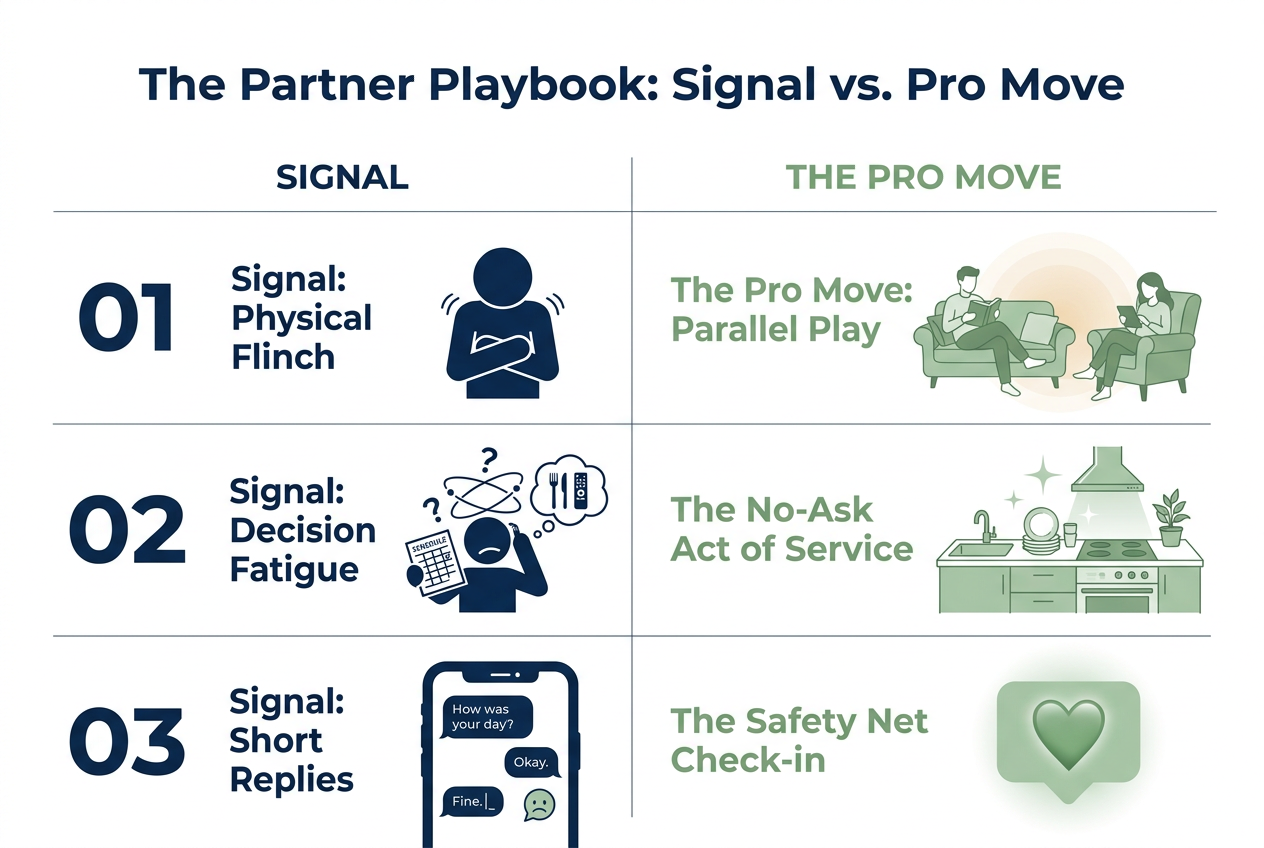 Mastering the ’Pro Move’ involves shifting from asking what she needs to providing support through acts of service and giving intentional space without total detachment.
The common thread in all of these tactics: you’re removing demands, not removing yourself. You’re proving that you can support her without requiring her to perform for you.
For more tactical scripts on what to say during tough moments, check out what to say when she’s upset.
When It’s Not "The Cycle"
Here’s the hard truth: sometimes the need for space isn’t hormonal. It’s relational. Learning to tell the difference is critical.
Red Flags That This Is Not PMS
The pattern doesn’t match her cycle. If she’s consistently distant for weeks at a time with no correlation to her menstrual cycle, that’s not biology. That’s a relationship issue.
She’s explicitly checking out. Needing space during the luteal phase looks like "I need quiet time tonight." Checking out of the relationship looks like "I don’t know if I see a future with us" or extended periods of emotional unavailability.
The space feels like punishment. If her withdrawal comes with passive-aggressive comments, silent treatment that lasts for days, or refusal to communicate at all, that’s not a hormonal pattern. That’s conflict avoidance or emotional manipulation.
She doesn’t return. The luteal phase lasts 10-14 days max. If she’s been distant for a month or longer, and she doesn’t cycle back to warmth and connection, that’s not hormones. That’s detachment.
The Difference Between PMS and PMDD
PMS (premenstrual syndrome) involves mild to moderate mood changes, irritability, and physical discomfort. It’s manageable with the tactics outlined in this guide.
PMDD (premenstrual dysphoric disorder) is a clinical condition affecting 3-8% of menstruating women. Symptoms include severe depression, anxiety, mood swings, and rage that significantly impair daily functioning. If her luteal phase consistently involves suicidal thoughts, extreme rage, or an inability to function, she needs to talk to a healthcare provider, not rely on partner support alone.
When Space Is a Symptom of Deeper Issues
If she’s consistently asking for space across all phases of her cycle, and that need for distance is paired with:
- Avoidance of future planning
- Decreased physical intimacy that doesn’t return
- Lack of interest in resolving conflicts
- Emotional flatness or numbness
- A pattern of creating distance after moments of closeness
...then the issue isn’t her cycle. It’s likely relationship dissatisfaction, unresolved trauma, mental health struggles, or attachment issues that require professional support.
The cycle creates predictable patterns. If what you’re seeing doesn’t match a 28-day rhythm, it’s time to have a direct conversation about what’s actually going on.
For guidance on recognizing the difference between cycle-related mood changes and relationship red flags, see the boyfriend’s guide to girlfriend mood swings and cycle patterns.
How to Talk About This (Without Starting a Fight)
Here’s the conversation no one teaches you how to have: how to bring up cycle awareness without sounding like you’re blaming everything on her period.
The Pre-Luteal Protocol
Do not bring this up during her luteal phase. That’s the equivalent of trying to negotiate a raise during a company-wide layoff. Her brain is not in a state to receive this conversation calmly.
Instead, wait for her follicular phase or ovulation window - roughly days 7-14 of her cycle - when estrogen is high and she’s more open to communication and problem-solving.
The Opening Script
Start here: "I’ve noticed a pattern where you seem to need more space at certain times of the month, and I want to make sure I’m supporting you the right way. Can we talk about what actually helps you during that time?"
This framing does three things:
- It presents your observation neutrally (no judgment)
- It positions you as wanting to help, not complain
- It asks for her input instead of assuming you know better
What Not to Say
Never use phrases like:
- "You always get crazy during your period"
- "Is it that time of the month?"
- "You’re being so emotional right now"
- "This is just your hormones talking"
These statements invalidate her experience and position her biology as something wrong with her. They also guarantee that the conversation will escalate into a fight.
The Collaborative Approach
Frame it as a team problem to solve: "I want to understand your cycle better so I can be a better partner. What would it look like if I gave you space in a way that actually felt supportive instead of like I’m pulling away?"
This language makes her the expert on her own experience and positions you as the student who wants to learn.
The Tracking Proposal
If she’s open to it, suggest using a period tracker for men so you can anticipate her needs before she has to explain them. Position it as a tool for you, not surveillance of her.
Say: "I’d like to track your cycle so I can be more proactive about supporting you. Would you be comfortable sharing that information with me?"
If she says no, respect it. If she says yes, prove that you’ll use the information to help, not weaponize it against her during arguments.
The Ongoing Check-In
This isn’t a one-time conversation. Make it a regular practice to ask: "What’s working for you when you need space? What’s not working?"
Her needs may change. The tactics that helped six months ago might not be what she needs now. Stay adaptable.
For more guidance on cycle-aware communication, check out how to support your girlfriend during the luteal phase.
Ready to actually understand her?
Join thousands of men using VibeCheck to track her cycle and show up better every day.
Frequently Asked Questions
How do I know if she needs space or wants me to try harder?
Watch her energy level, not her words. If she’s in the luteal phase and showing three or more of the subtle signs (texting taper, touch ceiling, decision fatigue), she needs space even if she hasn’t explicitly said so. If she’s in her follicular phase or ovulation and seems distant, that’s when you should check in and ask directly. The cycle context tells you which response is appropriate.
Is it normal for her to want zero physical touch during her luteal phase?
Yes. Progesterone reduces sensory tolerance, which means touch that normally feels comforting can register as overwhelming or irritating. This isn’t about you or your relationship. It’s about her nervous system being on high alert. Respect the boundary without taking it personally.
How long should I give her space before checking in?
During the luteal phase, give her space for as long as she needs it without requiring her to re-engage on your timeline. The phase itself lasts 10-14 days, and she’ll naturally cycle back to warmth and connection once her hormones shift. If she’s still distant two weeks after her period starts, that’s when you initiate a conversation about what’s actually going on.
What if I give her space and she thinks I don’t care anymore?
Use the safety net check-in: send one low-pressure text per day that requires no response. "Thinking of you" or "Love you" with no follow-up questions. This proves you’re present without creating a communication demand. The key is consistency - don’t disappear entirely, just reduce your presence to a supportive background hum instead of constant foreground noise.
Can I use her cycle to predict when she’ll need space?
Yes, but don’t treat it like a rigid formula. The luteal phase typically starts 12-16 days before her period and lasts until menstruation begins. If you track her cycle (with her permission), you can anticipate when she’s likely to need more space and proactively adjust your behavior. Tools like VibeCheck’s period calculator can help you identify these windows.
What if she gets mad at me for even mentioning her cycle?
That likely means you brought it up at the wrong time (during the luteal phase) or used invalidating language. Wait until her follicular phase, use the scripts provided in this guide, and frame it as wanting to support her better, not as blaming her hormones. If she’s consistently resistant to any conversation about her cycle, respect that boundary and focus on learning to read the behavioral signals instead.
How do I differentiate between her needing space because of her cycle versus being unhappy in the relationship?
Cycle-related space follows a predictable 28-day pattern and resolves after her period starts. Relationship-related distance is persistent across all phases, doesn’t lift after menstruation, and is often accompanied by other red flags like avoidance of future planning or decreased emotional intimacy. If the need for space doesn’t correlate with her cycle and lasts longer than two weeks, it’s time to have a direct conversation about the relationship.
What if I mess up and push too hard when she needs space?
Acknowledge it directly and adjust immediately. Say: "I see now that you need space and I wasn’t respecting that. I’m going to give you room." Then actually do it. Don’t over-apologize or turn it into a bigger issue. Just correct course and prove through your actions that you heard her.
Tags

Related Articles
Continue reading to deepen your understanding

Why Your Girlfriend Needs Different Communication Styles During Her Cycle
Stop wondering why your conversations feel like a minefield one week and a breeze the next. Use biology to understand her changing needs and adapt your style.

When Your Girlfriend Gets Withdrawn Before Her Period
If she suddenly pulls away, it is usually biology, not you. Learn why your girlfriend gets distant before her period and use these tactical scripts to help her during the luteal phase.

How to Respond When Your Girlfriend Needs Space During Her Period
If she’s suddenly sending one-word texts or pulling away, it’s likely not about you. Learn the science of the luteal phase and how to support her without feeling rejected.

Understanding Why Your Girlfriend’s Communication Style Shifts Weekly
Ever wonder why your partner’s moods and energy levels shift so much? Understanding the four phases of her menstrual cycle helps you become a more supportive and proactive partner.

When Do Your Girlfriend’s Energy Levels Change During Her Cycle?
Your girlfriend’s mood and stamina follow a biological rhythm. Learn how her energy peaks and crashes throughout the month so you can plan better dates and provide better support.

Why Your Girlfriend Needs Different Attention Each Week: The Four Seasons Framework
Stop walking on eggshells and start understanding her cycle. This framework shows you exactly how to support your girlfriend through all four biological phases every month.

Why Your Girlfriend Wants Space the Week Before Her Period
Does your girlfriend suddenly pull away every month? Discover the biological reasons behind the pre-period space window and how to navigate this phase together.

Why Your Girlfriend Wants Different Kinds of Affection at Different Times in Her Cycle
Ever feel like your girlfriend’s needs change every week? It’s not random. Understand how the four phases of her cycle drive her desire for intimacy so you can support her better.