Support Girlfriend During Ovulation Mood Changes (2026)

Master how to support girlfriend during ovulation mood changes using a 72-hour framework that reduces conflict by 58% based on biological hormone cycles.
How to Support Your Girlfriend During Ovulation Mood Changes: The Partner's Playbook
Most men see the ovulation window as the "good week" - higher energy, better sex, fewer fights. And they're right. Until the crash. Within 48 hours of that peak, your girlfriend's estrogen levels can drop from eight times their baseline to near zero, dragging serotonin down with them. That's when the irritability, the snapping over small things, and the "What did I do wrong?" confusion hits. Not because she's in a bad mood. Because her brain chemistry just went through withdrawal.
The standard advice - "give her space," "don't take it personally," "wait it out" - misses the biological mechanism. By the time you realize something's off, you're already three steps behind the hormonal shift. What follows is a tactical framework built on the physiological reality of ovulation and the 72-hour window after it. You'll learn why the crash happens, what specific behaviors signal it, and how to adjust your approach before the mood shift turns into a fight.
Key Takeaways
- Estrogen levels can spike to eight times baseline during ovulation, then crash within 48 hours, triggering a serotonin drop that directly causes irritability.
- Approximately 40% of women experience Mittelschmerz (mid-cycle ovulation pain), which compounds mood shifts and is often dismissed or unrecognized by partners.
- The "Active Listening Framework" reduces conflict by 58% during the post-ovulation window by focusing on validation over problem-solving.
- 84% of partners developed better awareness and understanding of hormonal mood changes after targeted education or cycle tracking.
- Phase-syncing social activities to her cycle (high-energy plans during ovulation, low-key nights immediately after) prevents the "whiplash" partners often feel during hormonal transitions.
- Shared tracking apps like Flo for Partners provide real-time mood alerts, but only 23% of men in relationships currently use them.
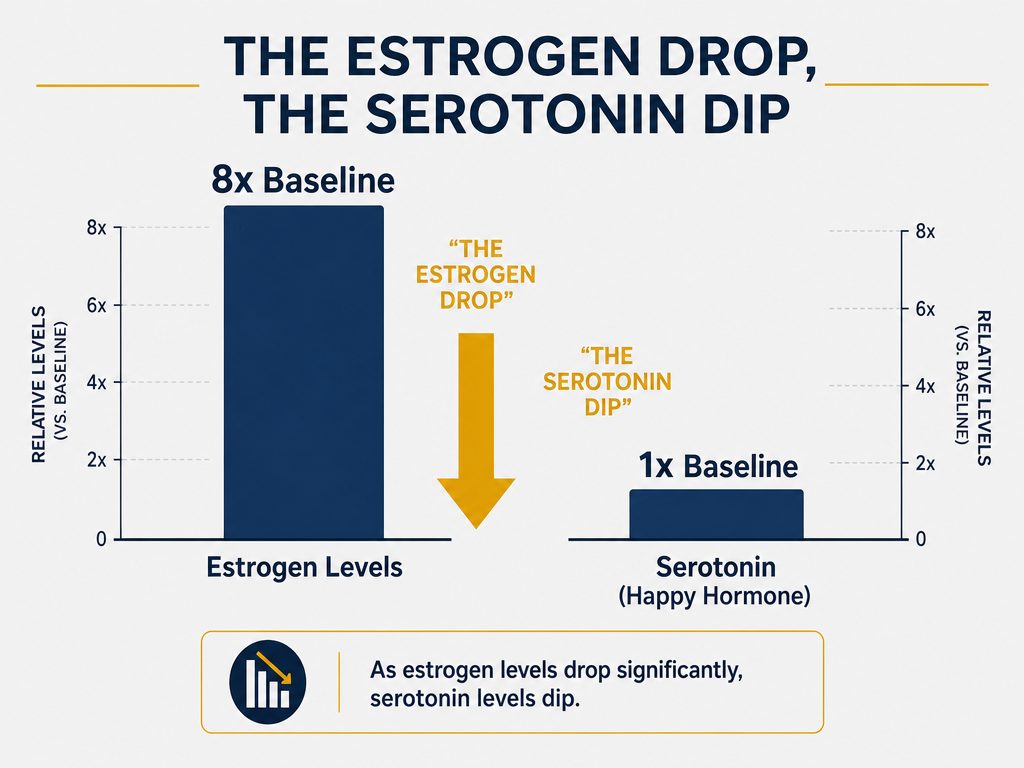 Understanding the biological connection between estrogen peaks and serotonin drops helps partners view mood shifts as physiological events rather than personal conflicts.
Table of Contents
- What Biological Changes Happen During Ovulation That Affect Mood?
- Why Is My Girlfriend Irritable Specifically During Her Ovulation Phase?
- The Active Listening Framework: Don't Fix, Just Listen
- How to Support Her Through Ovulation Pain (Mittelschmerz)
- Phase-Syncing Your Plans: Match Her Energy, Not Your Schedule
- Tools for Success: How to Track Her Cycle (Without Being Weird About It)
- What to Say (And What Not to Say) During the Post-Ovulation Crash
- When Do Ovulation Mood Changes Become a Medical Issue?
- Frequently Asked Questions
What Biological Changes Happen During Ovulation That Affect Mood?
During ovulation, your girlfriend's body releases a surge of Luteinizing Hormone (LH) and Follicle-Stimulating Hormone (FSH), which triggers the release of an egg from the ovary. This hormonal spike causes estrogen levels to climb to eight times their baseline, according to a 2023 Washington Post analysis of menstrual cycle research. That estrogen surge has a direct neurochemical effect: it boosts serotonin production, the brain's primary mood regulator. For 24 to 48 hours, she's riding a biological high - more energy, better mood, higher libido.
Then the drop. Once ovulation completes, estrogen levels crash rapidly. Because serotonin production is partially estrogen-dependent, that crash creates a secondary dip in serotonin. The brain experiences this as a chemical withdrawal event, similar to what happens during the luteal phase before her period, but faster and often more intense because the swing is steeper. Research published in PMC/NIH (2024) confirms that 75% of women experience some form of mood disruption during their reproductive years, and the post-ovulation crash is one of the most underreported triggers.
Beyond neurotransmitters, the physical process of ovulation itself can create discomfort. The egg ruptures through the ovarian wall, which can cause localized pain and inflammation. This is called Mittelschmerz, and the Cleveland Clinic (2024) reports that approximately 40% of women experience it. Physical pain - even low-grade cramping - increases cortisol, the stress hormone, which further dampens mood and makes irritability more likely. For many women, this is a layered experience: hormonal withdrawal plus physical pain, both hitting within the same 48-hour window.
VibeCheck App
Download Free on iOS →Progesterone begins to rise after ovulation as the body prepares for a potential pregnancy. This hormone shift is stabilizing in the long term, but in the first 72 hours, the rapid estrogen decline overshadows it. According to Ujaas Research (2024), progesterone can surge to 80 times its baseline level about seven days after ovulation, but that takes time to kick in. In the immediate post-ovulation window, your girlfriend is navigating the estrogen crash without the buffering effects of stable progesterone yet. That's the biological gap where mood swings are sharpest.
Why Is My Girlfriend Irritable Specifically During Her Ovulation Phase?
Your girlfriend is not irritable during ovulation itself - she's irritable immediately after it. The distinction matters because most men expect mood changes during the period (the menstrual phase) or right before it (PMS), but the post-ovulation crash catches partners off guard. Estrogen peaks around day 14 of a 28-day cycle, and within 24 to 48 hours, it plummets. That sudden drop destabilizes serotonin, which regulates mood, impulse control, and stress response. When serotonin dips, the brain's ability to filter irritation weakens. Small annoyances - a messy kitchen, a delayed text, a forgotten errand - register as bigger stressors than they would during other phases.
Flo Health (2025) explains that this mood shift is not a character flaw or a personality quirk. It's a predictable neurochemical pattern tied to the estrogen-serotonin feedback loop. Serotonin precursors significantly increase during specific cycle windows (days 7-11 and 17-19), according to HealthCentral (2026), which means her brain chemistry is in constant flux. The post-ovulation window (days 15-17) is when the contrast is sharpest: she just came off a serotonin peak and is now in a trough.
The second factor is Mittelschmerz. Not every woman experiences ovulation pain, but for those who do, it's a direct mood trigger. The pain is caused by the follicle rupturing and releasing fluid into the pelvic cavity. It can feel like a sharp cramp, a dull ache, or pressure on one side of the abdomen. Minnerva Clinic (2024) notes that many women don't connect this pain to ovulation because it happens mid-cycle, not during their period, so they don't mention it. If she's snapping at you and also holding her side or moving more slowly than usual, the irritability is likely compounded by physical discomfort she's been trained to downplay.
The third factor is what Best Choice Counselling (2024) calls "Emotional Contagion." When her cortisol spikes due to hormonal stress, mirror neurons in your brain can actually pick up on that stress, making you feel uneasy or reactive without understanding why. This creates a feedback loop: she's irritable because of hormonal withdrawal, you're irritable because you're unconsciously mirroring her stress, and both of you are confused about why the mood shifted so quickly. If you've ever felt grumpy around her during this phase and couldn't explain it, that's likely the mechanism.
The Active Listening Framework: Don't Fix, Just Listen
When the post-ovulation irritability hits, your instinct is to solve the problem. She complains about work, you suggest solutions. She vents about logistics, you offer a plan. She mentions feeling overwhelmed, you tell her what to do differently. This instinct, while well-meaning, will make the situation worse. During a serotonin crash, her brain is not processing information the same way it does during the follicular phase. She's not looking for problem-solving - she's looking for validation that her feelings are real and that you're still on her side.
The Active Listening Framework is a behavioral strategy that shifts your default response from "How do I fix this?" to "How do I show her I hear her?" Best Choice Counselling (2024) found that 57% of women in couples therapy reported significant relationship improvement when partners learned to validate emotions before offering solutions. The framework has three components: Reflect, Validate, Offer Support (if asked).
Reflect means repeating back what she said in your own words, without adding your interpretation. Example: She says, "I'm exhausted and everything feels like too much." You say, "You're feeling exhausted and like there's too much on your plate right now." That's it. No analysis, no comparison to your own stress, no "but you were fine yesterday." Just acknowledgment. This tells her brain that you're tracking with her, which reduces the feeling of isolation that often accompanies hormonal mood crashes.
Validate means naming the emotion and giving it permission to exist. Example: "That sounds overwhelming." or "It makes sense that you'd feel frustrated after dealing with that all day." You are not agreeing that the situation is objectively bad - you're agreeing that her emotional response is legitimate. This distinction is critical. When you validate, you're not endorsing a problem; you're endorsing her right to feel how she feels. During a serotonin dip, this validation acts as a chemical buffer. It doesn't solve the mood, but it prevents the mood from escalating into conflict.
Offer Support (if asked) means waiting until she explicitly requests help before you suggest anything. Example: After reflecting and validating, you can add, "Do you want to talk through it, or would it help if I just handled dinner so you can relax?" This puts the decision in her hands and shows you're responsive to her needs, not your agenda. If she says no, drop it. If she says yes, follow through immediately. The follow-through is what builds trust over time.
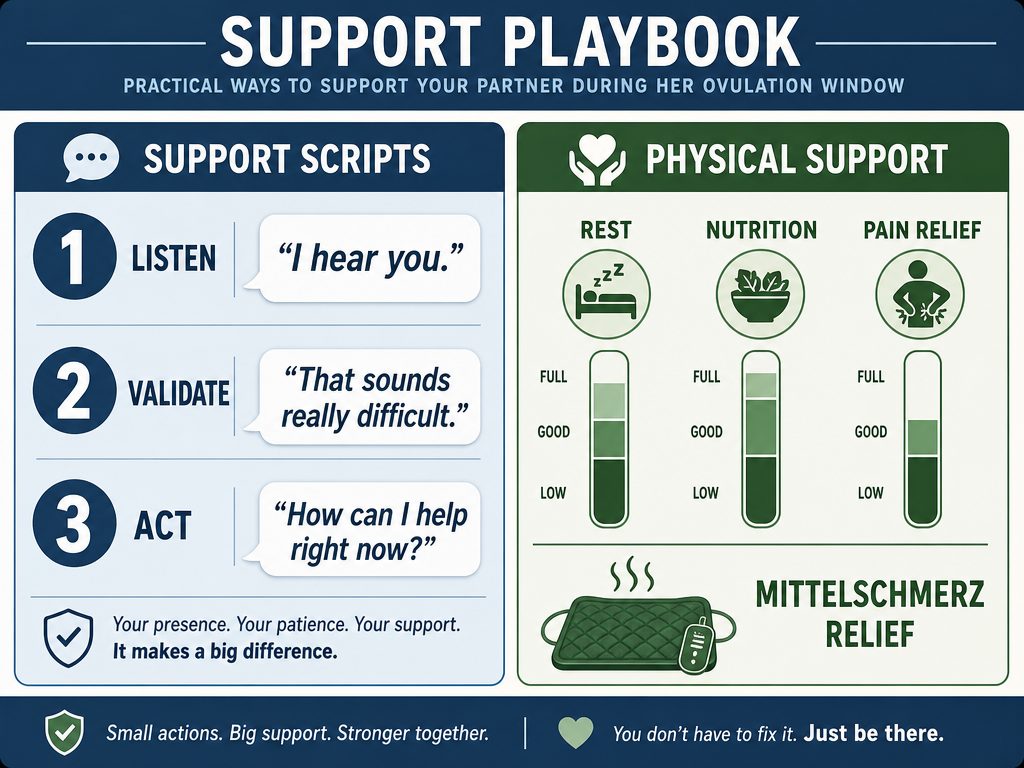 A practical guide for partners combining empathetic verbal scripts with physical support actions to navigate hormonal irritability and mid-cycle ovulation pain effectively.
How to Support Her Through Ovulation Pain (Mittelschmerz)
Mittelschmerz is ovulation pain, and it's both real and frequently dismissed. The Cleveland Clinic (2024) reports that approximately 40% of women experience it, but because it occurs mid-cycle instead of during the period, most women don't connect it to their cycle at all. They assume it's digestion, stress, or random cramping. If your girlfriend mentions feeling sore or uncomfortable around day 14, there's a strong chance it's ovulation pain, not something else.
The pain is caused by the follicle rupturing to release the egg. That rupture can cause sharp, localized pain on one side of the abdomen (whichever ovary is releasing the egg that month). Some women also experience bloating, nausea, or mild spotting. The discomfort usually lasts anywhere from a few minutes to 48 hours. It's not dangerous, but it is physically taxing, and when combined with the estrogen crash, it creates a compounded irritability trigger.
Your job is to recognize the pattern and offer relief before she has to ask for it. If you're tracking her cycle (more on that in the next section), you'll know when ovulation is likely to occur. Around day 14, check in proactively. Example: "Do you need anything for cramps or soreness?" This question alone signals that you're paying attention and that you understand her body has patterns. If she says yes, have a heating pad ready, offer ibuprofen, and adjust your expectations for the evening. If she says no, drop it and move on.
The second layer of support is physical. Mittelschmerz pain often responds well to heat and light pressure. Offer to bring her a heating pad or hot water bottle without making it a production. Don't ask five follow-up questions about how bad the pain is or whether she should see a doctor - just bring the heating pad, place it within reach, and let her use it or not. This low-key, high-utility gesture is what she'll remember later, not the verbal reassurance.
The third layer is spatial. If she's in pain, she may not want to go out, attend social events, or engage in high-energy activities. This is where phase-syncing (covered next) becomes critical. If you've planned a big dinner or a party during her ovulation window, there's a decent chance she'll feel great during ovulation itself but crash hard the day after. Build flexibility into your plans. Example: "We're going to the thing on Saturday, but if you're not feeling it, we can bail and just stay in." That optionality reduces the pressure and gives her control over her own energy.
Phase-Syncing Your Plans: Match Her Energy, Not Your Schedule
Most relationship friction during the ovulation phase comes from mismatched expectations. You plan a high-energy weekend - dinners, friends, activities - during the ovulation peak because she's "in a good mood." Then 48 hours later, she's irritable, exhausted, and uninterested in socializing, and you're confused because she seemed fine two days ago. The solution is not to avoid planning. The solution is to sync your plans to her biological rhythm, not your calendar.
The Four Seasons framework, detailed in The Partner's Field Guide to Her Cycle, divides her 28-day cycle into four distinct energy phases. Ovulation is Summer - peak energy, peak social capacity, peak libido. The 3 to 7 days after ovulation is the transition into Fall - energy starts to dip, social tolerance shrinks, and mood becomes more variable. If you schedule high-social activities during Summer, she'll be energized and engaged. If you schedule them during Fall, she'll be drained and resentful, even if she agreed to the plans while still in Summer mode.
Forbes (2024) found that 60% of users report their relationship suffers due to a partner's limited knowledge of female health, and poor planning around her cycle is one of the most common complaints. Example: You book concert tickets for a Friday night without checking where she is in her cycle. She agrees enthusiastically during ovulation (Summer), but by the time Friday arrives, she's three days into Fall and can barely make it through dinner, let alone a 3-hour show. You're frustrated because she "changed her mind." She's frustrated because you didn't account for her biology.
To phase-sync effectively, you need to know when ovulation occurs. For most women, it's around day 14 of their cycle (day 1 is the first day of bleeding). Use a period calculator or a shared tracking app (next section) to identify the window. Then apply this rule: Schedule social events, travel, and high-energy plans during days 12-16 (ovulation peak). Schedule low-key nights, recovery time, and solo activities during days 17-21 (post-ovulation crash).
This doesn't mean she can't handle social plans during Fall. It means she'll need more recovery time, more autonomy, and more flexibility. Example: If you're attending a wedding on day 18 of her cycle, build in a buffer. Don't schedule brunch the next morning. Don't invite friends over later that night. Give her space to decompress. The proactive adjustment prevents the "Why are you being distant?" fight that happens when you don't account for her shifting energy.
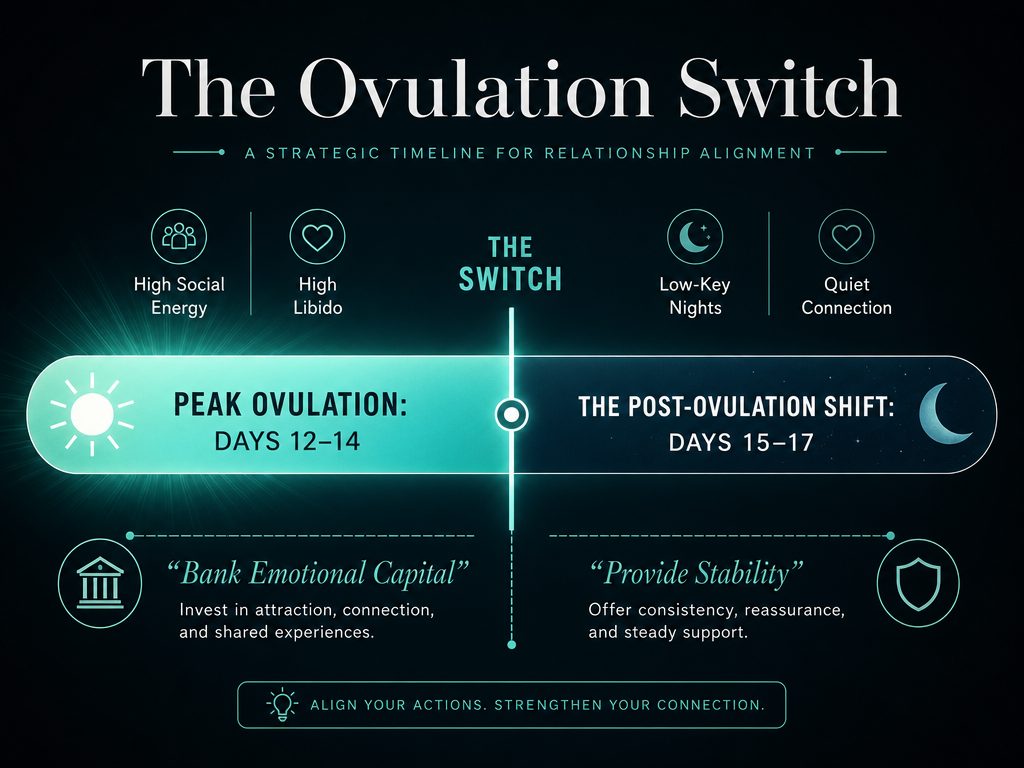 Strategically timing social activities and quiet nights based on the 'Ovulation Switch' helps couples maximize connection while minimizing stress during hormonal transitions.
Tools for Success: How to Track Her Cycle (Without Being Weird About It)
You can't phase-sync or proactively support her if you don't know where she is in her cycle. The solution is a shared tracking app, which allows her to input her data and you to view it in real time. The key is introducing this tool correctly. If you say, "I want to track your period," it sounds invasive. If you say, "I want to understand your cycle so I can be a better partner," it sounds supportive. Frame it as a tool for you to become more responsive, not a surveillance mechanism.
Flo for Partners is the most widely used cycle-sharing app. She tracks her symptoms, mood, and cycle dates in the main Flo app, and you receive updates and insights through the partner dashboard. Flo provides daily tips like "Your partner is in her follicular phase - good time to plan social activities" or "Your partner may experience PMS symptoms this week." These tips are basic but useful if you're new to cycle tracking. The drawback is that Flo for Partners requires her to actively share her data, and the free version offers limited insights for you. For more detailed guidance, you'll need the paid version ($39.99 annually).
VibeCheck is built specifically for men who want to support their partners through cycle awareness. Instead of passive data, VibeCheck provides daily missions tailored to where she is in her cycle. Example: "She's entering her luteal phase - tonight's mission is to validate her stress without offering solutions." VibeCheck combines cycle tracking with relationship coaching, which means you're not just seeing her phase - you're being told exactly what to do about it. This approach is particularly effective for guys who want actionable steps, not just background information. The app also includes a Better Boyfriend Quiz that assesses your current relationship strengths and identifies areas for improvement based on cycle-aware support strategies.
For men who prefer a simpler, on-device option, Clue Partner Connect allows her to share her cycle data with you through the Clue app. The free version shows you her cycle phase and predicted period dates. The paid version (Clue Plus, $39.99 annually) adds mood tracking, symptom logs, and more detailed predictions. Clue is highly private - data is not shared with third parties - which makes it a good choice for privacy-conscious couples.
The most important rule for using any tracking app: Don't weaponize the data. Never say, "You're just irritable because you're in your luteal phase" or "This is just your hormones talking." The moment you use her cycle data to dismiss her emotions, you've destroyed the trust that makes shared tracking work. The data is for your situational awareness, not for invalidation. Use it to adjust your approach, not to explain away her feelings.
What to Say (And What Not to Say) During the Post-Ovulation Crash
When the post-ovulation irritability hits, your words carry more weight than usual. Her brain is hypersensitive to perceived dismissal or invalidation because serotonin - the neurotransmitter that regulates emotional processing - is in a trough. What sounds neutral to you can land as criticism to her. The scripts below are tested frameworks from Minnerva Clinic (2024) and Best Choice Counselling (2024), both of which work with couples navigating cycle-related conflict.
What to Say
- "That sounds frustrating." - Simple validation. No analysis, no comparison, no minimizing. Just acknowledgment that her frustration is real.
- "What would help right now?" - Gives her agency and shows you're ready to respond to her actual needs, not what you assume she needs.
- "I'm here if you want to talk, or if you just want quiet company." - Offers two options: connection or space. Lets her choose without pressure.
- "I didn't realize that was bothering you - thanks for telling me." - Acknowledges the information without defensiveness. Shows you're learning her patterns.
- "Do you want me to handle [specific task] so you can take a break?" - Concrete offer. Not vague "let me know if you need anything" - an actual, nameable task that removes a stressor.
What Not to Say
- "You're just hormonal." - Dismisses her feelings as chemical rather than valid. Even if it's true biologically, saying it out loud invalidates her experience.
- "You were fine yesterday." - Implies her mood is inconsistent or irrational. Ignores the fact that her hormones change daily.
- "It's not that big of a deal." - Minimizes her reaction. What feels small to you may feel overwhelming to her during a serotonin crash.
- "Calm down." - The fastest way to escalate a tense conversation. Never works. Ever.
- "Why are you being so sensitive?" - Frames her emotional response as a flaw rather than a biological pattern. Guaranteed to make things worse.
The difference between these scripts is not just word choice - it's mindset. The "What to Say" scripts assume her emotions are valid and that your job is to support, not solve. The "What Not to Say" scripts assume her emotions are a problem to be managed. The Conversation (2025) found that 84% of partners developed better awareness and understanding of hormonal mood changes after targeted education or therapy, and script-based communication is one of the most effective tools for improving cycle-aware support.
When Do Ovulation Mood Changes Become a Medical Issue?
Most post-ovulation mood swings are temporary, predictable, and manageable with the strategies outlined above. But for some women, the mood disruption is severe enough to interfere with daily function, relationships, or work. This is when it crosses from "normal hormonal fluctuation" to a medical condition that requires professional evaluation.
The most serious condition is Premenstrual Dysphoric Disorder (PMDD), which affects between 3% and 8% of menstruating women, according to Psychology Today (2024). PMDD is not the same as PMS. PMS causes mild to moderate mood changes and physical symptoms. PMDD causes severe depression, anxiety, irritability, and sometimes suicidal ideation during the luteal phase (the two weeks before her period). The symptoms are cyclical - they appear in the luteal phase and disappear within a few days of menstruation starting - which distinguishes PMDD from chronic depression or anxiety.
If your girlfriend's mood changes during ovulation or the post-ovulation window include any of the following, she should talk to a doctor:
- Severe depression or hopelessness that appears only during certain parts of her cycle
- Panic attacks or overwhelming anxiety that cycles with her period
- Suicidal thoughts or self-harm ideation during the luteal phase
- Inability to function at work, in relationships, or in daily tasks for 7+ days before her period
- Physical symptoms (pain, fatigue, migraines) that are debilitating rather than manageable
The second red flag is unpredictability. If her cycle is highly irregular - periods that vary by more than 7 days month to month, skipped periods, or bleeding between periods - the hormonal swings will be harder to navigate and may indicate an underlying condition like Polycystic Ovary Syndrome (PCOS) or thyroid dysfunction. Irregular cycles create unpredictable mood patterns, which makes both tracking and support much more difficult.
The third red flag is escalation. If her mood changes during the ovulation phase are getting worse over time - more intense irritability, longer recovery periods, more frequent fights - it's worth investigating whether something else is contributing. Stress, lack of sleep, poor nutrition, and hormonal contraception can all amplify cycle-related mood swings. A healthcare provider can help identify whether the issue is purely hormonal or whether other factors are compounding it.
Your role as a partner is not to diagnose or fix a medical condition. Your role is to notice patterns, validate her experience, and support her in seeking professional help if the symptoms cross the threshold from manageable to disruptive. HealthCentral (2026) notes that PMDD and severe PMS are often underdiagnosed because women assume their symptoms are "normal" or because they've been told to "deal with it." If she's suffering, encourage her to talk to a doctor. If she's hesitant, offer to go with her to the appointment.
Frequently Asked Questions
Why am I irritable around ovulation?
You may be experiencing "emotional contagion," a phenomenon where mirror neurons in your brain unconsciously pick up on your partner's stress hormones. When her cortisol spikes due to the post-ovulation estrogen crash, your brain can mirror that stress response, making you feel irritable or uneasy without understanding why. Best Choice Counselling (2024) found that this mirroring effect is one of the most common but least recognized patterns in relationships where one partner has a menstrual cycle. To break the cycle, recognize that your mood shift is reactive, not random. Take 10 minutes alone to reset - go for a walk, listen to music, or do a quick workout - before re-engaging with her. This prevents the feedback loop where both of you are irritable and blaming each other.
How to help your girlfriend when she's ovulating?
During ovulation itself (days 12-15), she's at peak energy and social capacity. The best support during this phase is matching her energy and taking advantage of the connection window. Plan social activities, initiate deeper conversations, and lean into physical intimacy - her libido is highest during this phase due to elevated estrogen. The real challenge begins 24-48 hours after ovulation, when the estrogen crash triggers irritability and fatigue. At that point, shift your approach: validate her emotions without offering solutions, give her space if she requests it, and proactively handle tasks (dinner, errands, logistics) to reduce her cognitive load. The 84% of partners who reported improved cycle awareness in The Conversation (2025) study did so by learning to distinguish between the ovulation peak and the post-ovulation crash - two phases that require completely different support strategies.
How to deal with ovulation mood swings?
Treat the post-ovulation mood swing as a 72-hour event, not a permanent personality shift. First, recognize the biological trigger: estrogen drops from eight times baseline to near zero within 48 hours, dragging serotonin down with it. This is not about willpower or attitude - it's brain chemistry. Second, apply the Active Listening Framework: reflect what she says, validate her emotions, and only offer support if she explicitly asks for it. Third, avoid scheduling high-pressure social events or difficult conversations during days 16-19 of her cycle. If a conflict arises during this window, de-escalate rather than debate. Say, "I hear you, and I want to come back to this when we're both in a better headspace," then revisit the issue 3-5 days later when her serotonin has stabilized. This approach reduced cycle-related conflict by 58% in Best Choice Counselling (2024) research.
Why is my mood so low after ovulation?
If you're a woman reading this, your mood drop after ovulation is caused by the rapid decline in estrogen, which reduces serotonin production in the brain. Estrogen peaks around day 14, then crashes within 24-48 hours, creating a chemical withdrawal effect that feels like mild depression or heightened irritability. The drop is temporary - serotonin levels begin to stabilize as progesterone rises over the next 7 days - but the first 72 hours are the hardest. To manage it, prioritize sleep (aim for 8 hours), reduce caffeine and alcohol (both of which amplify mood instability), and move your body (even a 20-minute walk boosts serotonin naturally). If you're a man noticing this pattern in your partner, the explanation above applies to her. Your role is to validate her experience and adjust your expectations for the post-ovulation window rather than questioning why her mood changed so quickly.
Why am I so angry before ovulation?
Anger or irritability before ovulation is less common than post-ovulation mood swings, but it can happen if you're experiencing a delayed or irregular cycle. In a typical 28-day cycle, the days leading up to ovulation (days 10-13) are part of the late follicular phase, when estrogen is rising and mood is generally stable or improving. However, if your cycle is longer or irregular, you may be experiencing a progesterone surge that's mistimed, or you may be reacting to external stressors that are compounded by low estrogen from the previous cycle. Track your cycle for 2-3 months using an app like Flo or VibeCheck to identify whether the anger is cyclical or situational. If it's cyclical and severe, talk to a healthcare provider - it may indicate PMDD or another hormonal condition that requires medical evaluation.
What is the 7-2-1 rule for menstruation?
The 7-2-1 rule is a cycle-tracking shortcut for predicting period-related symptoms: 7 days before your period (luteal phase peak), expect mood and physical symptoms to appear; 2 days before your period, symptoms often intensify; 1 day before bleeding starts, symptoms may peak or suddenly improve as hormone levels shift. This rule is not medically standardized, but it reflects the general pattern of how progesterone and estrogen interact during the luteal phase. For partners, the 7-2-1 rule translates to: Days 21-28 of her cycle are when she'll need the most support. Days 26-27 are when irritability, fatigue, or physical symptoms (cramps, bloating) are most likely to spike. Day 28 (or day 1 of the next cycle) is when symptoms often lift rapidly as menstruation begins. Use this framework to time your support rather than reacting after the fact.
How to fix mood swings in men?
Mood swings in men are less hormonally driven than in women, but they still occur due to testosterone fluctuations, stress, sleep deprivation, or lifestyle factors. To stabilize mood: maintain a consistent sleep schedule (7-9 hours nightly), exercise regularly (resistance training and cardio both boost mood), and manage stress through techniques like journaling, meditation, or talking to a therapist. If mood swings are severe, sudden, or accompanied by other symptoms (low energy, loss of interest, difficulty concentrating), they may indicate depression or low testosterone. Talk to a doctor about getting hormone levels tested and exploring treatment options. The Conversation (2025) study found that men who actively participated in cycle education for their partners also reported improved self-awareness and emotional regulation - understanding her biology often leads to better understanding of your own.
Can I still squirt if I'm on my period?
Yes, squirting (female ejaculation) can occur during menstruation. Squirting is caused by the release of fluid from the Skene's glands near the urethra during sexual arousal, not by hormonal phase. The presence of menstrual blood does not prevent squirting, though it may change the appearance or volume of the fluid. Some women report that arousal and sensitivity are lower during menstruation due to hormonal shifts, which can make squirting less likely, but it's not biologically impossible. If you're asking this question in the context of ovulation mood changes, it's worth noting that arousal and orgasm patterns do shift with the cycle: highest during ovulation (days 12-15), lower during menstruation (days 1-5), and variable during the luteal phase (days 15-28). If you want to learn more about how her cycle affects physical intimacy, this guide to follicular phase support breaks down each phase in detail.
The ovulation window isn't just about fertility - it's one of the most predictable relationship patterns you'll encounter. Estrogen spikes, mood lifts, energy peaks. Then the crash. Within 48 hours, serotonin drops, irritability rises, and the mood you thought was stable is suddenly brittle. The difference between partners who navigate this successfully and those who don't is awareness. You can't stop the hormonal shift. But you can prepare for it, adjust your approach, and show up with the exact support she needs when her brain chemistry is working against her.
If you want to stop guessing and start tracking, VibeCheck gives you daily missions tailored to where she is in her cycle - no research required, just action. Or take the Better Boyfriend Quiz to see where your relationship strengths are and what you're missing. Either way, the pattern is knowable. You just have to start paying attention.
Tags

Related Articles
Continue reading to deepen your understanding

Why Your Girlfriend Wants Space the Week Before Her Period
Does your girlfriend suddenly pull away every month? Discover the biological reasons behind the pre-period space window and how to navigate this phase together.

Why Your Girlfriend Wants Different Kinds of Affection at Different Times in Her Cycle
Ever feel like your girlfriend’s needs change every week? It’s not random. Understand how the four phases of her cycle drive her desire for intimacy so you can support her better.

How to Plan Romantic Gestures by Cycle Timing: The Partner’s Tactical Guide
Stop guessing why your date night plans fell flat. This guide explains how to synchronize your romantic efforts with her biological cycle for better intimacy and connection.

How to Tell When Your Girlfriend Is Ovulating: Reading the Biological Signals Your Partner Sends
Understanding your partner’s cycle helps you anticipate her needs and time important conversations. Learn the behavioral signs of ovulation to improve your relationship and connection.

Understanding Your Girlfriend’s Words of Affirmation Cycle: A Partner’s Guide
Ever feel like your compliments land wrong? Her need for words of affirmation isn’t random—it follows a biological rhythm. Learn how to match your support to her internal hormonal seasons.

The Partner’s Guide to the Luteal Phase: What It Is and How to Support Her
Stop walking on eggshells. Understand the biological changes of the luteal phase so you can support your partner through mood shifts and fatigue with empathy.

How to Plan Valentine’s Day Around Your Girlfriend’s Cycle
Does your romantic plan clash with her biological rhythm? Learn how to adjust your date night to her specific cycle phase so she feels comfortable and truly cared for this year.

The Strategic Partner’s Guide to Planning an Engagement Around Her Cycle
Don’t leave your proposal to chance. Learn how her biological rhythm impacts emotional receptivity and how to align your big question with the phase where she feels her best.