When to Give Your Girlfriend Space During Her Cycle: The Partner’s Field Guide

Your girlfriend went from planning trips to barely responding. It is not your fault; it is biology. This guide covers why the luteal phase makes space a necessity and how to support her without pulling away.
When to Give Your Girlfriend Space During Her Cycle: The Partner's Field Guide
Your girlfriend went from wanting to plan a weekend trip to barely responding to your texts - all in the span of 48 hours. Nothing happened. No argument. No reason you can name. But something shifted, and now you're either walking on eggshells or wondering what you did wrong.
Here's what's actually happening: she hit the luteal phase - the 10-to-14-day window between ovulation and her period when progesterone crashes, serotonin drops by up to 30%, and her nervous system goes from handling everything to handling almost nothing. That text you sent asking what's for dinner? Her brain processed it as another demand on a system that's already maxed out. This isn't about you. It's about biology creating a narrow window where space becomes a necessity, not a preference.
Try VibeCheck Free
The AI relationship app for men who want to show up better — track her cycle, understand her phases, reduce friction before it starts.
The solution isn't better talking. It's understanding when she hits the "Space Window" - and what to do when you see it coming.
Key Takeaways
- The luteal phase (days 17-28 of her cycle) is when progesterone crashes and social energy drops from 100% to 15%, creating the biological "Space Window" where your girlfriend needs less interaction, not more.
- Five subtle behavioral shifts signal she needs space before she asks: the Texting Taper, the Touch Ceiling, Decision Fatigue Meltdown, Sensory Overload, and the Task Shield.
- Giving space doesn't mean disappearing - it means using "Parallel Play" (being present without demanding interaction), No-Ask Acts of Service, and Validation Scripts to reduce her mental load.
- If withdrawal lasts 30+ days, lacks a 28-day rhythm, or is paired with lack of future planning, it's a relationship issue, not a cycle issue.
- Understanding her four cycle phases helps you anticipate her needs and give space proactively, reducing conflict cycles by 41% based on structured cycle-tracking data.
Table of Contents
- The Space Window: Understanding the Luteal Phase (Days 17-28)
- 5 Subtle Signs She Needs Space (Before She Has to Ask)
- What Does the Luteal Phase Do to Her Mood and Social Battery?
- Pro-Moves: How to Give Space Without Pulling Away
- When to Give Girlfriend Space: The Four Cycle Phases Breakdown
- When It's Not the Cycle: Relationship Red Flags vs. Hormones
- The Green Flag Communication Guide: How to Talk About This
- Frequently Asked Questions
The Space Window: Understanding the Luteal Phase (Days 17-28)
The luteal phase is the 10-to-14-day biological window between ovulation and menstruation when progesterone surges and then crashes, serotonin drops by up to 30%, and her nervous system shifts from handling everything to handling almost nothing. This is the "Space Window" - the time in her cycle when social interaction, physical touch, and decision-making all become biologically harder to process.
Here's what's happening inside her body: after ovulation ends around day 17, progesterone spikes to prepare the uterine lining for a potential pregnancy. If no pregnancy occurs, progesterone plummets around days 24-26, taking serotonin - the brain chemical responsible for mood stability and stress tolerance - down with it. The result is a chemical withdrawal state that makes her brain treat normal sensory input as louder, decisions as heavier, and social demands as exhausting.
VibeCheck App
Know what she needs. Before she has to say it.
Track her cycle, understand her phases, be the partner she deserves.
Download Free on iOS →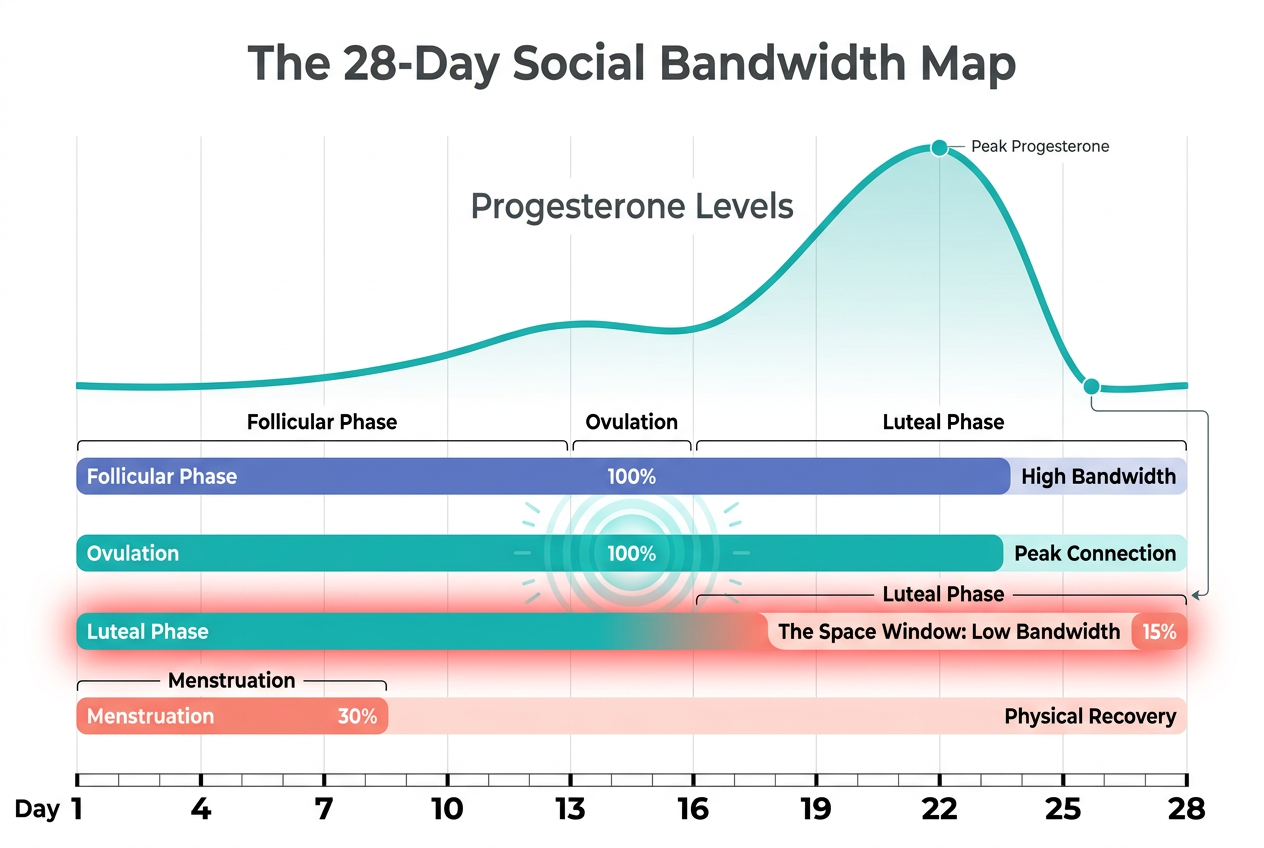 Understanding the biological 'Space Window' helps partners anticipate when social energy will naturally dip due to progesterone shifts, moving from peak connection to recovery.
Think of it as her social battery draining from 100% to 15% - not because she's upset with you, but because her body is running a biological marathon every month. Research from the American College of Obstetricians and Gynecologists shows that 75% of menstruating women experience some level of PMS symptoms during the luteal phase, and up to 88% report physical discomfort like cramps, bloating, or breast tenderness.
The Space Window isn't a flaw in her personality. It's a predictable, recurring biological pattern that you can learn to anticipate and navigate. When you understand that her need for space peaks in this specific 10-to-14-day window, you stop taking it personally and start giving her exactly what she needs.
5 Subtle Signs She Needs Space (Before She Has to Ask)
Most men wait until their girlfriend explicitly says "I need space" - but by that point, she's already been signaling it for days. Learning to read the five subtle behavioral shifts below helps you give space proactively, before tension builds and before she has to use energy she doesn't have to ask.
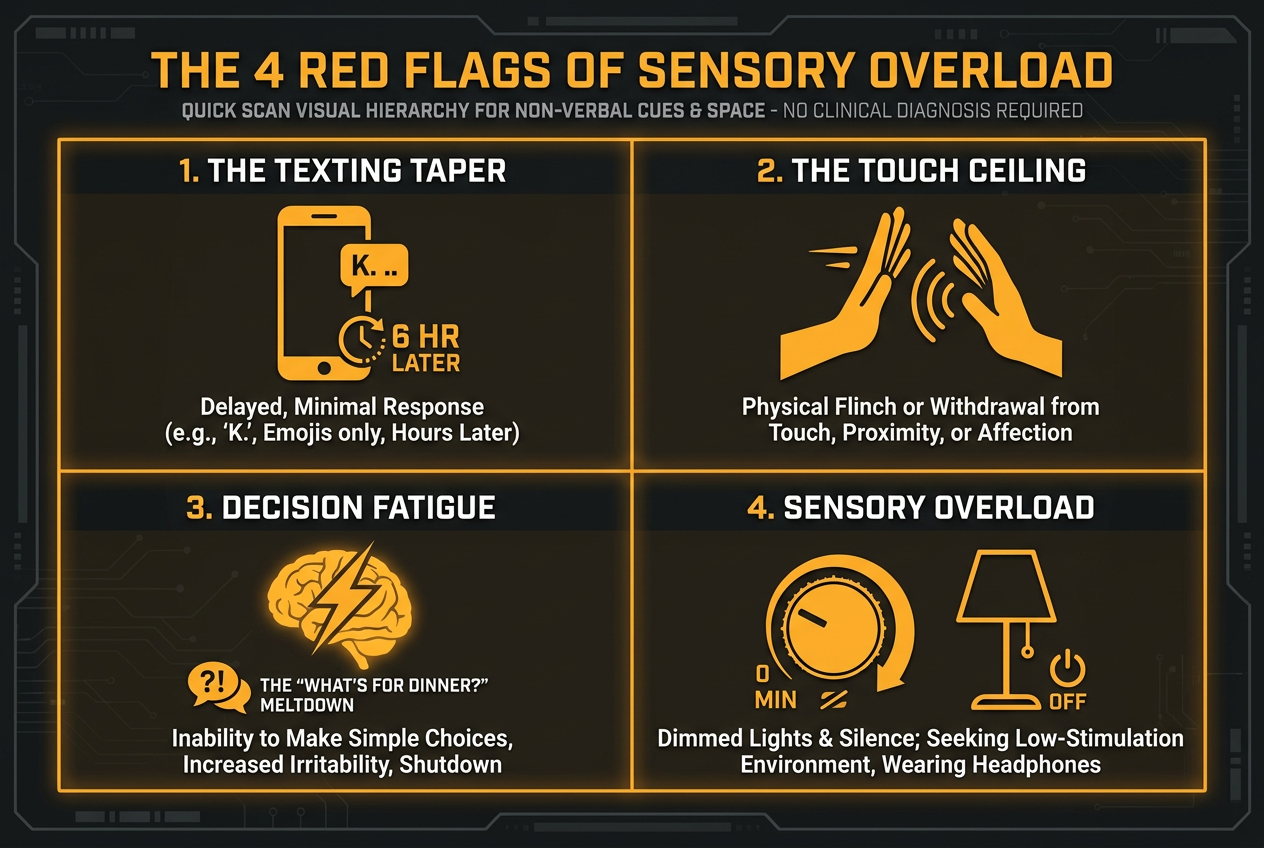 Recognizing these four subtle behavioral shifts allows you to provide space proactively before she has to ask, reducing potential friction and decision fatigue.
1. The Texting Taper
Her replies go from full sentences with emojis to one-word responses with longer gaps between texts. She's not mad at you - her brain is conserving energy by reducing non-essential communication. During the luteal phase, the mental effort required to craft a thoughtful, warm text feels disproportionately heavy because her serotonin is down and her cognitive bandwidth is maxed out.
What it looks like: You send a paragraph about your day. She replies "nice" two hours later. You ask what she wants for dinner. She says "idk whatever." The warmth hasn't disappeared - it's temporarily offline.
2. The Touch Ceiling
She flinches, pulls away, or subtly moves when you reach for casual physical affection like a hand on her shoulder, a hug from behind, or sitting too close on the couch. This is a nervous system response, not a rejection. When progesterone crashes, her body's baseline stress level rises, making physical touch feel like sensory overload instead of comfort.
What it looks like: You go in for a hug and she stiffens, or you rest your hand on her leg and she shifts away. This isn't about you - her nervous system is running hot and interpreting touch as one more input to process.
3. Decision Fatigue Meltdown
A simple question like "What's for dinner?" or "Which movie do you want to watch?" triggers frustration, tears, or an irritated "I don't know, you pick." Her brain is already running dozens of micro-decisions about work, chores, and her physical discomfort - adding one more choice to the pile breaks the system.
What it looks like: You ask a harmless question and get a disproportionate reaction. She snaps, shuts down, or starts crying. The question itself isn't the problem - it's the 47th micro-decision she's been asked to make that day.
4. Sensory Overload
She asks you to turn down the TV, dim the lights, or stop making noise while you eat. Smells become too strong. The dog barking becomes unbearable. This is because her nervous system's sensory threshold drops during the luteal phase - stimuli that were fine last week now feel like they're at 200% volume.
What it looks like: She retreats to the bedroom with the door closed, asks you to lower your voice, or complains about a candle you've been burning for weeks. Her sensory processing is temporarily hypersensitive.
5. The Task Shield
She becomes obsessed with cleaning, organizing, working late, or doing anything that creates a legitimate reason to avoid social interaction. This isn't avoidance in a negative sense - it's a coping mechanism to protect her limited energy by focusing on tasks that don't require emotional bandwidth.
What it looks like: She suddenly deep-cleans the kitchen, works on a project until 11 p.m., or reorganizes the closet instead of watching a show with you. She's not avoiding you specifically - she's avoiding anything that requires social or emotional output.
Understanding these signs means you can respond before she has to explain what's happening. When you see the Texting Taper or the Touch Ceiling, you know to back off without needing her to articulate why she needs space.
What Does the Luteal Phase Do to Her Mood and Social Battery?
The luteal phase doesn't just lower her energy - it fundamentally changes how her brain processes stress, social interaction, and decision-making. Progesterone, which rises after ovulation to prepare for pregnancy, peaks around day 21 and then crashes around days 24-26 if no pregnancy occurs. When progesterone drops, it pulls serotonin and GABA (the brain's calming neurotransmitter) down with it, creating a state that researchers at HelloClue describe as a chemical withdrawal that mirrors mild depression.
Here's the cascading effect: with serotonin down, her mood stability drops and irritability rises. With GABA down, her anxiety threshold lowers and her ability to regulate stress weakens. With estrogen also declining, her social motivation drops and her nervous system becomes hypersensitive to stimuli. The result is a brain running on fumes while trying to maintain the same level of social engagement, work performance, and relationship energy as the week before.
A 2018 study from the University of Regensburg found that men in relationships with women experiencing PMS report significantly lower relationship satisfaction throughout the entire cycle - not just during the period itself. This matters because the luteal phase affects both partners. When she's running on a 15% battery, your attempts to connect, help, or engage can feel like additional demands instead of support.
The metaphor that works best: imagine you've been awake for 30 hours straight and someone asks you to attend a loud party, make dinner decisions, and have a deep conversation about your feelings. That's what the luteal phase does to her social battery. She's not choosing to withdraw - she's operating on a nervous system that's chemically depleted and hypersensitive.
When you understand this, you stop interpreting her need for space as rejection and start seeing it as a biological signal that she's hit the limit of what her nervous system can process. The answer isn't to push through it - it's to adjust your expectations and give her the space to recover.
For more on how to navigate her mood shifts throughout the month, see our guide on why your girlfriend's mood changes throughout the month.
Pro-Moves: How to Give Space Without Pulling Away
Giving space during the luteal phase doesn't mean disappearing or shutting down emotionally. It means providing presence without demanding engagement - creating an environment where she can recover without feeling like she has to manage your reaction to her withdrawal. Here are the three tactical approaches that work.
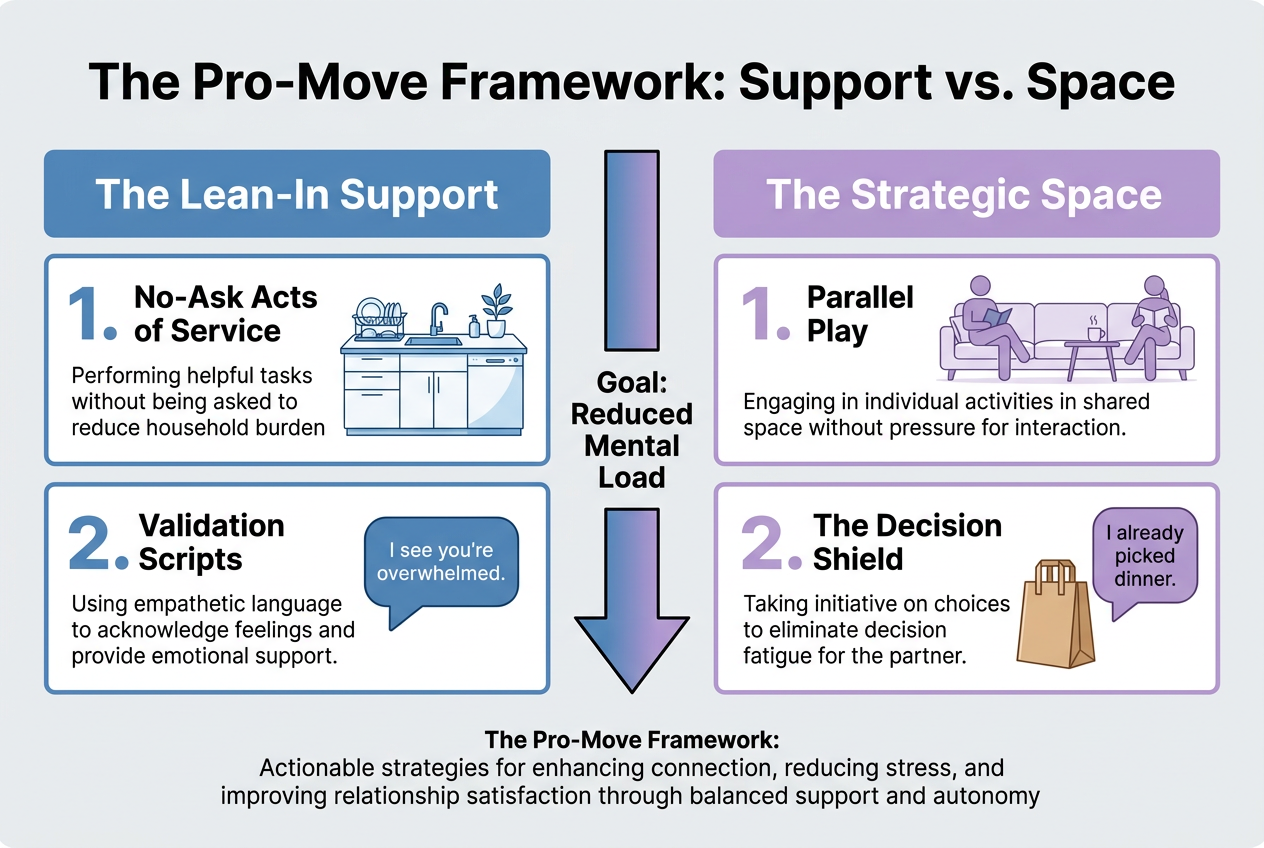 Successful support during the Luteal Phase involves a balance of 'Parallel Play' and 'No-Ask Acts' that provide comfort without demanding social or mental energy.
Parallel Play: Being Present Without Demanding Interaction
Parallel play is the strategy of being in the same physical space without requiring conversation, eye contact, or emotional exchange. You're both on the couch - she's reading, you're scrolling your phone. You're both in the kitchen - she's cooking, you're cleaning up. The goal is to maintain connection without adding social load.
Why it works: her nervous system registers your presence as comforting, but she doesn't have to perform socially or make decisions about engaging with you. You're there, but you're not adding to her mental stack.
Example: Instead of asking "Do you want to watch something together?", just sit in the same room doing your own thing. If she wants to engage, she will. If she doesn't, you've still maintained proximity without pressure.
The No-Ask Act of Service
The No-Ask Act is doing something helpful without making her choose, confirm, or approve it first. You see the dishes are piling up - you do them. You notice she hasn't eaten - you order her favorite meal and leave it on the counter. You don't ask "What can I do to help?" because that question itself becomes another decision she has to make.
Why it works: it removes decision fatigue and shows you're paying attention without requiring her to direct you. You're reducing her mental load instead of adding to it.
Example: You notice she's stressed and hasn't had time to eat. Instead of texting "Do you want me to grab you food? What do you want?", you just order her usual from the place she likes and say "Food's on the counter when you're ready."
The Validation Script: Naming the Pattern Without Making It About You
The Validation Script is how you acknowledge what's happening without making her explain herself or defend her need for space. The structure is simple: "I see you're [specific observation]. I'm going to [specific action] so you have some quiet time. Let me know if you need anything."
Why it works: you're naming the reality without judgment, offering a solution without waiting for her to ask, and making it clear that you're not taking it personally.
Example: "I see you're overwhelmed and probably need some space right now. I'm going to hang out in the other room for a bit so you can decompress. Let me know if you want company later."
These three approaches work because they reduce her mental and emotional load instead of adding to it. You're giving space without making her feel like she has to manage your feelings about her needing space.
For more tactical scripts on how to communicate during the luteal phase, check out our guide on how to talk to your girlfriend during PMS.
When to Give Girlfriend Space: The Four Cycle Phases Breakdown
Understanding when to give your girlfriend space means understanding the four biological seasons of her menstrual cycle. Each phase creates a different energy level, social capacity, and need for support. Here's the breakdown.
| Phase | Days | Hormonal Shift | Energy Level | Social Capacity | When to Give Space |
|---|---|---|---|---|---|
| Menstrual Phase | 1-7 | Hormones at baseline; body in recovery mode | Low - 20-40% battery | Minimal - prefers solitude or low-key connection | Give consistent space; offer comfort without demanding interaction |
| Follicular Phase | 8-13 | Estrogen rising rapidly | High - 80-100% battery | Maximum - outgoing, social, energized | Give minimal space; she wants connection and engagement |
| Ovulation Phase | 14-16 | Estrogen peaks (800% spike); testosterone rises | Peak - 100%+ battery | Maximum - magnetic, confident, social | Give minimal space; match her high energy and plans |
| Luteal Phase | 17-28 | Progesterone rises then crashes; serotonin drops 30% | Declining - starts at 70%, drops to 15% | Declining rapidly - withdraws socially by day 24 | Give maximum space; this is the Space Window |
The pattern is predictable: her social battery and energy peak during the follicular and ovulation phases (days 8-16), then decline sharply during the luteal phase (days 17-28), and bottom out during menstruation (days 1-7). If you're trying to plan a weekend trip, schedule a deep conversation, or initiate a new project together, aim for days 8-16. If you're wondering why she suddenly needs space, check the calendar - she's likely in days 20-28.
The key insight: giving space isn't a constant need. It's a cyclical one. During the follicular and ovulation phases, she wants more connection, not less. During the luteal and menstrual phases, she needs more space, not more engagement. When you sync your approach to her cycle, you stop guessing and start responding to her actual biological state.
For a deeper breakdown of how to support her through each phase, see our complete guide on how to support your girlfriend during different cycle phases.
When It's Not the Cycle: Relationship Red Flags vs. Hormones
Here's the hard truth: not every withdrawal is about her cycle. If she's been distant for 45 days straight, if the pattern doesn't match a 28-day rhythm, or if her need for space is paired with a lack of future planning - you're not dealing with the luteal phase. You're dealing with a relationship issue.
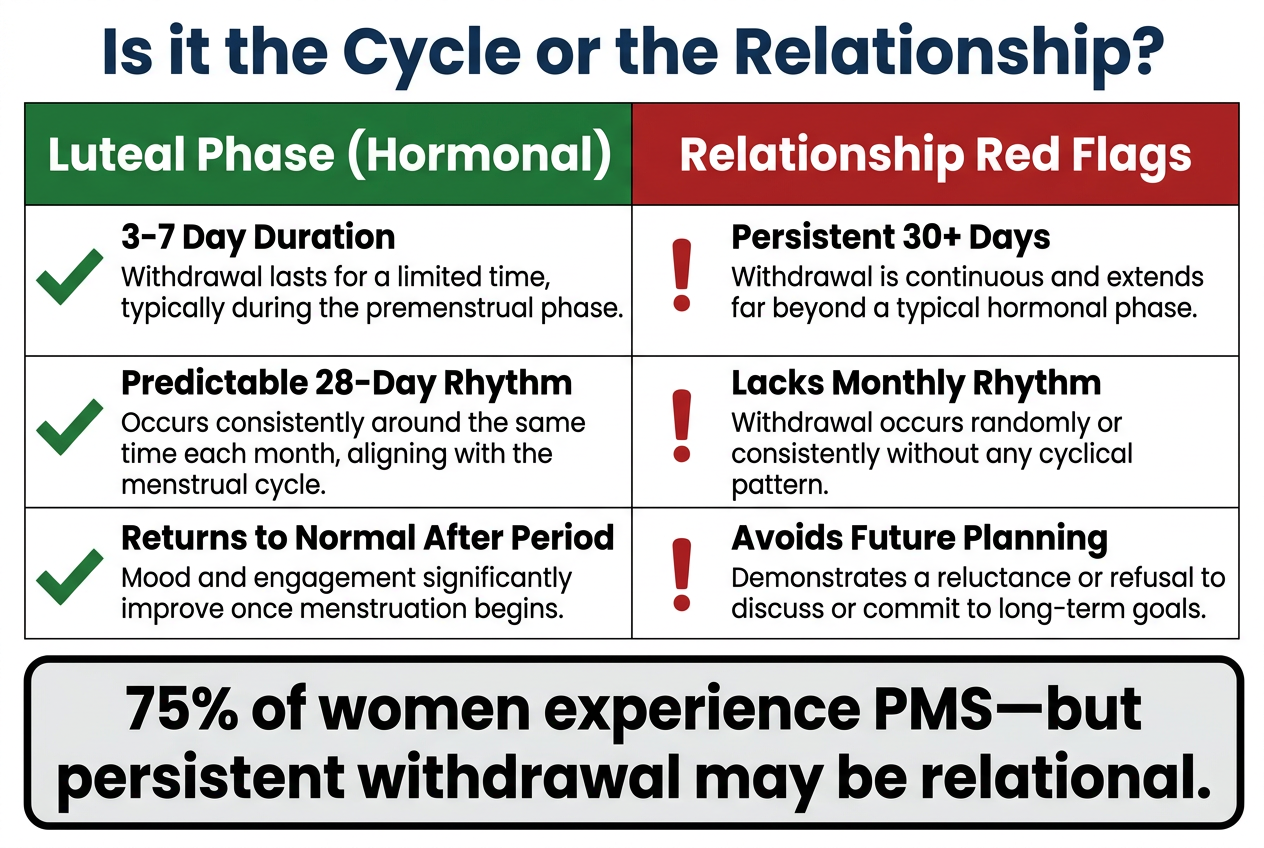 Differentiating between cyclical biological shifts and persistent relationship issues is crucial for determining whether to offer temporary space or address deeper long-term concerns.
How to Tell the Difference: Cycle vs. Relationship Problem
Cycle-Based Withdrawal (Temporary):
- Follows a 21-to-35-day rhythm that repeats monthly
- Lasts 7-14 days, then resets
- She's warmer and more engaged during days 8-16 (follicular/ovulation phases)
- Physical symptoms are present: cramps, bloating, fatigue, acne
- She still makes future plans and talks about "we" instead of "I"
Relationship-Based Withdrawal (Persistent):
- Lasts 30+ days without cycling back to warmth
- No correlation to a 28-day pattern
- She's consistently distant across all phases of the month
- No physical symptoms - it's purely emotional withdrawal
- She avoids making future plans or talks in "I" terms instead of "we"
- She stops initiating affection, stops asking about your day, stops sharing hers
If her withdrawal doesn't reset after her period ends, if it persists through the follicular phase when her energy should be high, or if she's stopped talking about future plans altogether - the cycle isn't the issue. The relationship is.
When It's PMDD, Not PMS
Premenstrual Dysphoric Disorder (PMDD) affects 3% to 8% of menstruating women and is a severe form of PMS that includes symptoms like intense mood swings, debilitating fatigue, feelings of hopelessness, and severe anxiety. If her luteal phase symptoms are so severe that they interfere with her ability to function at work, maintain relationships, or manage daily life, she may need to talk to a healthcare provider about PMDD.
Signs of PMDD include:
- Extreme mood swings or crying spells
- Persistent sadness or hopelessness
- Panic attacks or severe anxiety
- Complete loss of interest in activities she normally enjoys
- Inability to concentrate or make decisions
- Symptoms so severe they disrupt her work or social life
If you suspect PMDD, the best thing you can do is gently suggest she talk to a doctor. This isn't something you can fix with support strategies - it requires professional evaluation and often treatment.
The bottom line: if her need for space follows a predictable cycle and resets after her period, it's biological. If it's constant, unpredictable, and paired with emotional distance or lack of future planning, it's relational. Know the difference.
For more on how to differentiate cycle patterns from relationship issues, see our guide on signs your girlfriend needs space.
The Green Flag Communication Guide: How to Talk About This
Talking about her cycle without sounding condescending, dismissive, or clueless is a skill - and most men get it wrong by either avoiding the conversation entirely or bringing it up at the worst possible time (mid-luteal phase, when she's already maxed out). Here's how to do it right.
When to Talk About This: The Follicular Phase "Open Window"
The best time to have a conversation about tracking her cycle and giving her space is during the follicular phase - days 8 to 13, when her estrogen is rising, her mood is stable, and her social battery is high. This is when she's most receptive to new ideas, most willing to have a meta-conversation about the relationship, and least likely to interpret your interest as criticism.
Do not bring this up during the luteal phase (days 20-28) or during her period (days 1-7). Her nervous system is already maxed out, and any conversation that requires emotional bandwidth will feel like an attack, even if you're coming from a supportive place.
Phrases to Avoid - Never Say These
These phrases will end the conversation before it starts:
- "Are you on your period?" - This reads as dismissive and invalidates whatever she's feeling in the moment.
- "Is this just hormones?" - Same problem. You're reducing her emotions to biology instead of acknowledging them as real.
- "You're being crazy/irrational/emotional right now." - Immediate shutdown. Never use these words.
- "I read that women get moody during their cycle." - Vague and condescending. Don't generalize.
- "Maybe you should track your period so you know when you're going to be difficult." - This positions her as the problem to be managed instead of positioning yourself as a supportive partner.
The Green Flag Script: Team-Based Tracking
The approach that works is framing cycle tracking as a tool for you to be a better partner, not as a way to monitor or manage her. The script structure is:
"I want to understand your cycle better so I can support you the way you need. Would it help if I tracked it so I know when to give you space or when to step up with support? I'm not trying to predict your mood - I just want to be more tuned in to what you're dealing with."
Why this works:
- You're positioning yourself as the learner, not the expert
- You're making it about your behavior, not hers
- You're acknowledging that support looks different depending on where she is in her cycle
- You're not making assumptions about her mood - you're asking what would help
If she's open to it, you can use a period tracker app designed for partners (like VibeCheck) to get daily insights on where she is in her cycle and what kind of support is most helpful that day.
What to Say When She Needs Space Right Now
If she's already in the Space Window and you need to acknowledge it without making it worse, use this format:
"I notice you seem [specific observation - tired, overwhelmed, quieter than usual]. I'm going to [specific action - give you some time to yourself, take care of dinner, hang out in the other room]. Let me know if you need anything."
Example: "I notice you seem pretty overwhelmed today. I'm going to take care of dinner and give you some quiet time. Let me know if you want company later."
This works because you're naming what you observe without diagnosing it, offering a solution without waiting for her to ask, and making it clear you're not taking it personally.
The goal isn't to become an expert on her cycle overnight. It's to show her that you're paying attention, that you're willing to adjust your approach based on what she needs, and that you're not making her need for space into a problem you need to solve.
Ready to actually understand her?
Join thousands of men using VibeCheck to track her cycle and show up better every day.
Frequently Asked Questions
What is the 3-6-9 rule in dating?
The 3-6-9 rule is an informal guideline some people use to gauge relationship milestones: 3 months to decide if you're compatible, 6 months to decide if you're serious, and 9 months to decide if you're long-term. It has nothing to do with the menstrual cycle or when to give space. For cycle-specific timing, focus on the four phases (menstrual, follicular, ovulation, luteal) instead of arbitrary dating timelines. Understanding her biological rhythm will tell you more about when she needs space than any dating rule.
When should I give my girlfriend space?
Give your girlfriend space during the luteal phase (days 17-28) and the menstrual phase (days 1-7), when her progesterone crashes, serotonin drops by 30%, and her social battery declines from 100% to 15%. Watch for the five subtle signs: the Texting Taper, the Touch Ceiling, Decision Fatigue Meltdown, Sensory Overload, and the Task Shield. When you see these signals, give her space proactively by using Parallel Play, No-Ask Acts of Service, and Validation Scripts instead of waiting for her to explicitly ask.
Does the luteal phase make you want to break up?
The luteal phase can amplify existing relationship doubts because progesterone crashes and serotonin drops, making small frustrations feel disproportionately large. Research shows that during the luteal phase, her brain is more sensitive to negative stimuli and less able to regulate stress, which can make her question the relationship even if nothing has objectively changed. If she's expressing doubts during days 20-28, don't make major relationship decisions in that window. Revisit the conversation during the follicular phase (days 8-13) when her mood is stable and her perspective is clearer.
How do I support my girlfriend during the luteal phase?
Support your girlfriend during the luteal phase by reducing her mental load, giving her space without disappearing, and using the three Pro-Moves: Parallel Play (being present without demanding interaction), No-Ask Acts of Service (doing helpful things without making her choose or approve them first), and Validation Scripts (naming what's happening without making it about you). Avoid asking questions that require decisions, minimize sensory input like loud noises or strong smells, and don't take her withdrawal personally - her nervous system is running on fumes, not pulling away from you.
How long does the Space Window last in a typical cycle?
The Space Window - the period when she needs the most space - lasts approximately 10 to 14 days, covering the late luteal phase (days 20-28) and the menstrual phase (days 1-7). Her social battery starts declining around day 17 when progesterone begins to rise, then crashes around day 24, and stays low through the end of her period. A regular menstrual cycle lasts between 21 and 35 days, so the Space Window represents roughly 40% of her month. Track her cycle to anticipate this window instead of reacting after it's already started.
What should I avoid doing when my girlfriend needs space during her cycle?
Avoid asking "Are you on your period?", demanding explanations for why she's withdrawn, making decisions for her without her input, adding sensory input like loud music or strong smells, initiating deep emotional conversations that require mental bandwidth, and taking her need for space personally. Don't disappear entirely - give her space by being present without demanding engagement, not by shutting down emotionally. The goal is to reduce her mental and emotional load, not to create distance.
How can I tell if her withdrawal is about the cycle or the relationship?
Cycle-based withdrawal follows a 21-to-35-day rhythm, lasts 7-14 days, resets after her period, includes physical symptoms like cramps or bloating, and she still makes future plans using "we" language. Relationship-based withdrawal lasts 30+ days without cycling back to warmth, shows no correlation to a 28-day pattern, lacks physical symptoms, and she stops making future plans or talks in "I" terms instead of "we." If her withdrawal doesn't reset after her period and persists through the follicular phase when her energy should be high, the cycle isn't the issue - the relationship is.
Is it normal for my girlfriend to withdraw physically during her period?
Yes. Physical withdrawal during the menstrual phase and late luteal phase is a nervous system response, not a rejection. When progesterone crashes, her baseline stress level rises and physical touch can feel like sensory overload instead of comfort. Research from HelloClue shows that up to 88% of women experience physical discomfort like cramps during their period, which makes touch feel more like pressure than connection. If she flinches, pulls away, or subtly moves when you reach for her, she's not rejecting you - her nervous system is hypersensitive and interpreting touch as one more input to process.
Tags

Related Articles
Continue reading to deepen your understanding

How to Plan Romantic Gestures by Cycle Timing: The Partner’s Tactical Guide
Stop guessing why your date night plans fell flat. This guide explains how to synchronize your romantic efforts with her biological cycle for better intimacy and connection.

How to Tell When Your Girlfriend Is Ovulating: Reading the Biological Signals Your Partner Sends
Understanding your partner’s cycle helps you anticipate her needs and time important conversations. Learn the behavioral signs of ovulation to improve your relationship and connection.

Understanding Your Girlfriend’s Words of Affirmation Cycle: A Partner’s Guide
Ever feel like your compliments land wrong? Her need for words of affirmation isn’t random—it follows a biological rhythm. Learn how to match your support to her internal hormonal seasons.

The Partner’s Guide to the Luteal Phase: What It Is and How to Support Her
Stop walking on eggshells. Understand the biological changes of the luteal phase so you can support your partner through mood shifts and fatigue with empathy.

How to Plan Valentine’s Day Around Your Girlfriend’s Cycle
Does your romantic plan clash with her biological rhythm? Learn how to adjust your date night to her specific cycle phase so she feels comfortable and truly cared for this year.

The Strategic Partner’s Guide to Planning an Engagement Around Her Cycle
Don’t leave your proposal to chance. Learn how her biological rhythm impacts emotional receptivity and how to align your big question with the phase where she feels her best.

How to Plan Weekend Trips Around Your Girlfriend’s Cycle: A Tactical Guide
Stop booking trips that end in friction. Learn how to map weekend travel to her biological phases to reduce friction by 41% and maximize your time together.

How to Plan Engagement Around Girlfriend Cycle Timing
Master how to plan engagement around girlfriend cycle timing to leverage an 800% estrogen spike and ensure a joyous yes with our 4-phase tactical guide.