How to Support Your Girlfriend When She’s Crying Because of Hormones

Watching her cry when hormones hit can feel overwhelming. Learn the biological why behind the tears and use these proven scripts to provide the support she actually needs right now.
How to Respond When Your Girlfriend Is Crying Because of Hormones
You're sitting across from her, watching tears stream down her face, and you have no idea what just happened. Five minutes ago, everything was fine. Now she's crying over something that seems completely out of proportion - a cluttered kitchen counter, a casual comment, or nothing at all that you can identify. Your first instinct is to fix it, explain it away, or ask if it's "that time of the month." Don't. That approach will make everything worse.
When hormones lower the threshold for emotional response, the tears are real even when the trigger seems small. The kitchen counter isn't the problem - it's the final straw when her brain's emotional filter has been chemically stripped away. This guide explains the biology behind hormonal crying, gives you scripts that actually help, and shows you how to support her without walking on eggshells or making her feel dismissed.
Table of Contents
- Why Hormones Make Her Cry (And Why It's Not "Fake")
- The First 15 Minutes: What to Do When She's Actually Crying
- Why "Is It Your Period?" Is the Worst Thing You Can Say
- How to Bring Up Her Cycle Without Sounding Dismissive
- The Luteal Phase Strategy: How to Prepare Before the Storm
- When Normal Crying Becomes PMDD
- Frequently Asked Questions
Why Hormones Make Her Cry (And Why It's Not "Fake")
Hormonal crying isn't "crying for no reason." It's crying with a lowered threshold. Here's what's actually happening in her brain.
After ovulation, the luteal phase begins: progesterone rises to help prepare the uterine lining for a possible pregnancy. If pregnancy doesn't happen, both progesterone and estrogen drop sharply in the week before her period. When estrogen falls, serotonin - a neurotransmitter that stabilizes mood - follows. Estrogen peaks during the ovulatory phase and is linked to higher serotonin levels, so when it crashes, she loses the biological buffer that normally helps her shrug off minor irritations.
Progesterone acts as a mild sedative by increasing GABA production, which can lead to fatigue and "coming down" feelings in the luteal phase. When both hormones drop at once, it's like removing the shock absorbers from her emotional system. The thing she's crying about - maybe a messy room, a forgotten errand, or an offhand comment - is still "real" to her. The hormones haven't created a fake feeling; they've magnified an existing one and removed her ability to filter it.
Think of it this way: if you stubbed your toe, you'd wince and move on. If you stubbed the same toe after someone removed all the padding around it, you'd probably yell. The toe is equally stubbed in both scenarios. The pain threshold is different.
VibeCheck App
Download Free on iOS →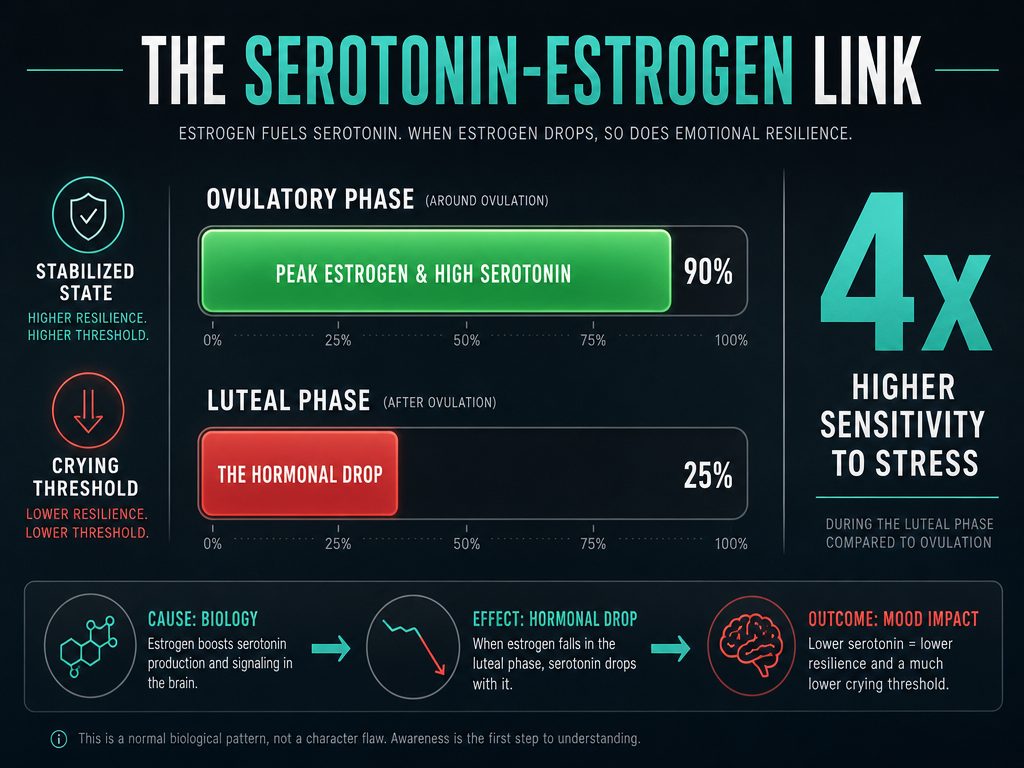 Understanding the biological 'why' behind sudden tears: When estrogen drops during the luteal phase, serotonin levels follow, significantly lowering a partner's emotional threshold.
The First 15 Minutes: What to Do When She's Actually Crying
When she's actively crying, your job is not to diagnose, explain, or solve. Your job is to be present. Here's the step-by-step approach that defuses tension instead of escalating it.
Ask Permission Before Touching
Don't assume a hug is welcome. Some women want physical comfort when they're upset; others feel smothered by it. Ask: "Would you like a hug, or do you need space right now?"
If she says space, respect it. Sit nearby, stay calm, and let her know you're available when she's ready.
Never Mention Hormones, Her Period, or PMS While She's Crying
This is the most important rule. Even if you're 100% certain her tears are hormone-related, bringing it up while she's upset will feel like you're dismissing her feelings as irrational. When a partner is struggling emotionally, responding with genuine empathy - listening without judgment, focusing on their feelings rather than debating facts, and validating that their reaction makes sense - tends to help more than trying to "fix" the problem.
Use a Script That Offers Presence Without Demanding Explanation
Try one of these:
- "I'm here. You don't have to explain it if you don't want to. I've got you."
- "I can see you're really upset. What do you need from me right now?"
- "This feels heavy. Do you want to talk about it, or just sit together?"
Notice what these scripts do: they validate her emotional state, they offer support without pressure, and they don't ask "Why?" when she might not even know the answer herself.
Don't Try to Logic Her Out of Crying
Statements like "It's not that bad" or "You'll feel better tomorrow" are well-intentioned but backfire. They communicate that you think her reaction is wrong, which makes her feel unheard. Instead, mirror her emotion: "I can see this is really bothering you" or "That sounds overwhelming."
If you're struggling with what to say when she's upset, our guide on what to say when she's upset offers seven more science-backed scripts.
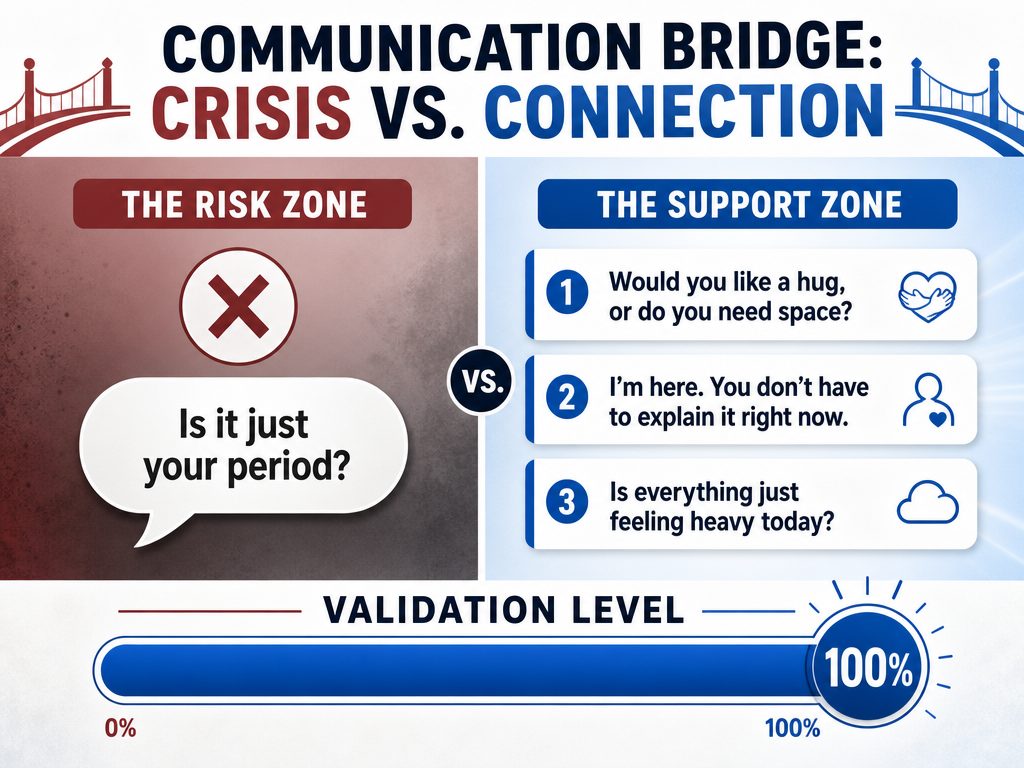 Choosing the right words: Avoid dismissive questions that feel like gaslighting. Use scripts that offer presence and validation without demanding a logical explanation for her feelings.
Why "Is It Your Period?" Is the Worst Thing You Can Say
You already suspect her tears are hormone-related. You're not wrong. But asking "Is it your period?" or "Are you PMSing?" during a crisis is the verbal equivalent of pouring gasoline on a fire. Here's why.
It Sounds Like You're Calling Her Irrational
Even if you mean it neutrally, the question implies her feelings aren't valid - they're just hormones talking. That's dismissive, and it will make her angrier or more upset. PMS (premenstrual syndrome) is very common: as many as 3 in 4 women report experiencing PMS symptoms at some point in their life, so the biology is real, but naming it while she's crying makes it sound like you're blaming her body for overreacting.
It Shifts Focus Away From the Actual Issue
Maybe the kitchen really is a mess. Maybe you did forget something important. Bringing up her cycle lets you off the hook for addressing the thing she's actually upset about, even if her emotional intensity is amplified by hormones. Don't use biology as a way to avoid accountability.
It Feels Like Gaslighting
When you tell someone their emotions are just hormones, you're implying they can't trust their own feelings. That's gaslighting territory, and it erodes trust fast. She knows her body. She doesn't need you to diagnose it for her.
How to Bring Up Her Cycle Without Sounding Dismissive
You can talk about hormones and the menstrual cycle with your partner - just not in the middle of an emotional crisis. The best time to discuss patterns is during her follicular or ovulatory phases, when her mood is stable and she has the mental bandwidth for a reflective conversation.
Pick the Right Window
During the follicular phase, estrogen rises as an egg-containing follicle develops in the ovary; this rising estrogen also thickens the uterine lining. Near the end of this phase, high estrogen triggers a surge in luteinizing hormone (LH), which sets off ovulation. She's likely to feel energized, optimistic, and open during this time - typically the week after her period ends. That's when you can bring up patterns you've noticed without it sounding like an accusation.
Use a Script That Centers Support, Not Diagnosis
Try something like this:
"I noticed you've been feeling really heavy the last few days before your period. I want to be a better support. Do you think your cycle is making things harder right now, or is there a specific issue between us I need to address?"
This script does three things: it names a pattern without labeling her as "hormonal," it offers to help rather than blame, and it gives her the option to say it's the cycle or something else entirely.
Track Together (With Her Permission)
If she's open to it, suggest using a shared period tracker or calendar to identify patterns. Tracking your own (or a partner's, with her participation) symptoms and mood changes across the cycle for a few months is a legitimate, medically endorsed way to identify real patterns and timing - rather than assuming based on stereotypes or a single cycle. Apps like VibeCheck or Flo for Partners can alert you when she's entering a higher-risk phase, so you can adjust your approach without her needing to explain herself.
For a deeper dive into how her cycle affects mood and behavior, check out our boyfriend's guide to the menstrual cycle.
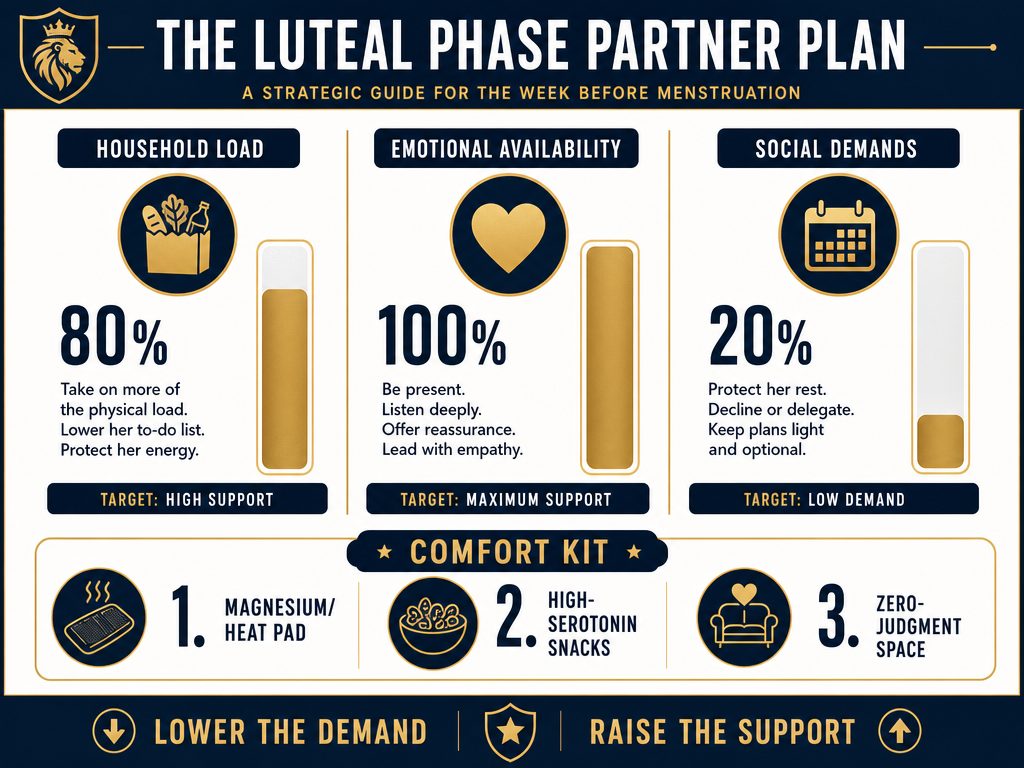 The Luteal Phase Action Plan: Proactively taking over household chores and reducing social pressure can help stabilize the environment when your partner's hormones are fluctuating.
The Luteal Phase Strategy: How to Prepare Before the Storm
If you want to reduce the frequency and intensity of hormone-related crying, you need to be proactive. Waiting until she's already in tears means you've missed the window. Here's how to prepare during the luteal phase - the roughly 10-14 days between ovulation and her next period.
Use a Tracker to Identify the High-Risk Window
You can't prepare for something if you don't know when it's coming. Around 1 in 7 women of reproductive age is menstruating at any given time, which means the luteal phase is constantly cycling through the population - but for your specific partner, it follows a predictable pattern. Use an app to mark when her period starts, then count backward 10-14 days. That's when progesterone and estrogen are both elevated but starting to drop.
Take Over 20% More Household Tasks
This isn't about treating her like she's fragile. It's about reducing the cumulative load when her brain is already working harder to regulate mood. Lifestyle approaches that can help ease PMS symptoms include regular aerobic exercise, smaller/more frequent meals, less salt/caffeine/alcohol, adequate sleep, and stress-reduction practices. A partner who understands these and is patient/supportive around them - rather than dismissive of symptoms - is aligning with medically recommended self-care.
Here's what this looks like in practice:
- Do the dishes without being asked.
- Take the lead on meal planning.
- Handle logistics (grocery runs, vet appointments, bill payments) that would normally be split.
- Don't ask her to make decisions about low-stakes things ("What do you want for dinner?"). Just make a call and move forward.
Lower Social and Emotional Demand
This is the week to cancel the dinner party, decline the invitation to your friend's birthday, or skip the family gathering that requires her to "be on." If she wants to go, great. If she wants to stay home and recharge, don't guilt her into showing up. Protecting her energy during this phase prevents the buildup of small irritations that can trigger a breakdown.
For more detailed strategies on supporting her through this phase, read our tactical guide to the luteal phase.
Keep "Comfort Kit" Supplies on Hand
Stock your space with things that address her physical symptoms:
- Magnesium supplements: Many women report that magnesium helps with cramping, bloating, and mood. Check with her before buying a specific brand.
- Heat pads: For cramps or lower back pain.
- Dark chocolate, pineapple, or other "serotonin-boosting" foods: These won't replace the hormonal serotonin drop, but they can provide a temporary mood lift.
Having these things ready before she asks shows you're paying attention and that you've thought ahead.
When Normal Crying Becomes PMDD
Not all premenstrual mood changes are typical PMS. Premenstrual Dysphoric Disorder (PMDD) affects 5-8% of women and involves "extreme" symptoms that disrupt daily function. If your partner's crying feels more severe than what you've read here - if it's accompanied by suicidal thoughts, uncontrollable rage, or an inability to work or function - she may be dealing with PMDD, not standard PMS.
The Difference Between PMS and PMDD
PMDD (premenstrual dysphoric disorder) is a real, clinically recognized condition - it's listed in the DSM-5 as a depressive disorder, not something people are "making up" or simply failing to cope with. It affects roughly 1 in 10 people who menstruate. The key difference is severity and impact: PMS is uncomfortable and frustrating; PMDD is debilitating.
Warning Signs That She Should See a Doctor
Watch for these red flags:
- Suicidal ideation or self-harm thoughts: If she mentions wanting to hurt herself or that life isn't worth living, take it seriously. PMDD increases suicide risk.
- Rage that feels out of control: Not just irritability, but explosive anger that frightens her or you.
- Inability to work or maintain relationships: If she's calling in sick every month or your relationship is on the verge of collapse because of her symptoms, that's beyond typical PMS.
- Symptoms that don't resolve after her period starts: PMS and PMDD symptoms should improve within a few days of menstruation. If they linger, something else might be going on.
How to Support Her in Seeking Help
Suggesting she see a doctor for PMDD is delicate. You don't want her to feel like you think she's "broken" or that you're pathologizing normal female biology. Here's a script that frames it as support, not criticism:
"I've noticed your symptoms the week before your period are really intense - more than what I've read is typical for PMS. I'm worried about how much this is affecting you. Would you be open to talking to a doctor to see if there are treatments that could help?"
If she's resistant, don't push. Provide information (articles, resources, or links to PMDD-specific support) and let her make the decision. Your role is to be supportive, not to diagnose or force treatment.
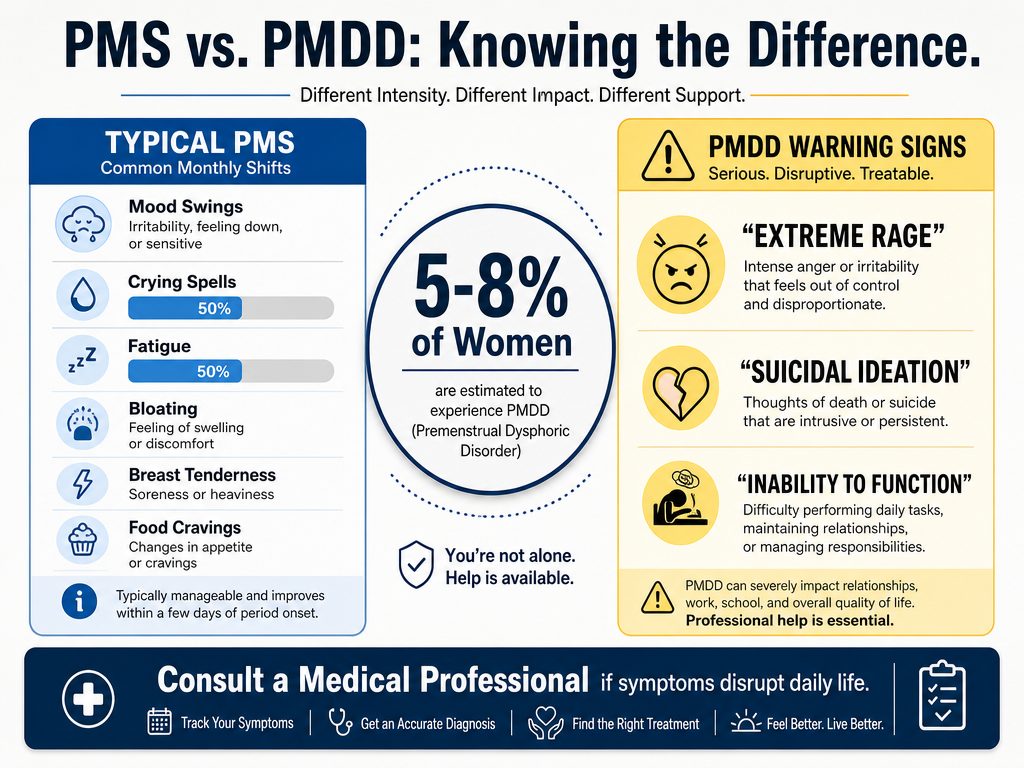 While monthly crying is often a normal biological response, extreme shifts in mood or functionality may indicate PMDD, which requires professional medical support.
For more guidance on recognizing when her mood changes require professional attention, see our article on supporting your girlfriend through PMS.
Frequently Asked Questions
Why does my girlfriend cry without any apparent reason?
She isn't crying "without reason" - the reason just isn't visible to you. When estrogen and serotonin drop during the luteal phase, her brain loses the buffer that normally helps her regulate minor stressors. Something that wouldn't bother her during other phases of her cycle - a cluttered space, a forgotten task, or even a sad song - can feel overwhelming when her emotional threshold is lowered. The tears are a real response to a real feeling, even if the trigger seems small.
How to comfort gf if she's crying?
Offer physical presence without pressure. Ask, "Would you like a hug, or do you need space?" Then use a script that validates her feelings: "I'm here. You don't have to explain it if you don't want to. I've got you." Don't try to fix the problem, debate whether she should be upset, or mention her cycle while she's crying. Your job is to make her feel heard and supported, not to diagnose or solve.
Can a woman's period affect a man's mood?
Indirectly, yes. If you're constantly walking on eggshells or navigating unpredictable mood swings without understanding the biological pattern, you'll feel stressed and reactive. But her cycle itself doesn't directly alter your hormones. The tension comes from miscommunication and unmet expectations. Learning to anticipate her phases and adjust your approach reduces friction for both of you.
What is the 7-2-1 rule for menstruation?
The "7-2-1 Rule" for heavy bleeding: Period >7 days, changing pads every 2 hours, or passing clots >1 inch. This is a health diagnostic for identifying abnormal bleeding, not a rule for managing mood or emotional symptoms. If your partner is experiencing any of these symptoms, she should see a doctor to rule out conditions like fibroids, endometriosis, or clotting disorders.
How can a husband help his wife with PMDD?
PMDD requires professional treatment - it's not something you can manage with lifestyle changes alone. Your role is to encourage her to see a doctor, support her through the treatment process (which may include medication or therapy), and provide low-demand support during her symptomatic weeks. That means taking over household tasks, reducing social obligations, and offering consistent emotional reassurance without judgment.
How does a man deal with a woman with PMDD?
You don't "deal with" her - you support her. PMDD is a medical condition, not a personality flaw. Educate yourself on the symptoms and timeline, track her cycle so you can anticipate high-risk days, and be proactive about reducing her load during those weeks. If her symptoms are severe enough to threaten your relationship, couples therapy can help you both develop coping strategies.
How to get out of a PMDD spiral?
If your partner is in the middle of a PMDD-driven emotional spiral, she likely can't think her way out of it in the moment. Remove immediate stressors (noise, obligations, decisions), offer physical comfort if she wants it, and help her get through the next 24-48 hours. Once her period starts and symptoms resolve, that's the time to discuss long-term treatment options with a doctor.
How can I explain PMDD to a man?
Share clinical resources like Cleveland Clinic's PMDD overview that explain the condition in medical terms. Frame it as a neurochemical disorder, not a mood problem: "My brain's serotonin and GABA systems become dysregulated in the luteal phase, which causes extreme anxiety, depression, or irritability. It's not me being difficult - it's a diagnosable condition, and I'm working with a doctor to manage it."
What age can a girl start coming?
This question refers to menarche - the onset of menstruation - which typically occurs between ages 10 and 15, though it can happen earlier or later. A "normal" cycle varies a lot between women - menstrual bleeding can start anywhere from every 24 to every 38 days and last up to 8 days. If you're supporting a young partner or family member through her first period, focus on normalizing the experience and providing practical supplies (pads, pain relief, heat pads) without making it embarrassing or overly clinical.
What is considered a heavy menstrual flow?
Heavy flow is defined by the 7-2-1 rule: periods lasting more than 7 days, needing to change pads or tampons every 2 hours, or passing clots larger than 1 inch. If your partner is experiencing this, she should see a doctor. Heavy bleeding can lead to anemia, fatigue, and other complications that affect her quality of life.
How to explain menstrual phases to a man?
The menstrual cycle has four phases - menstrual (bleeding, roughly day 1-5), follicular (day 1 through ovulation, estrogen rising), ovulation (around day 14 in a 28-day cycle, triggered by a surge in luteinizing hormone), and luteal (after ovulation to the next period, progesterone rising then falling). Each phase brings different energy levels, moods, and physical symptoms. If you want a comprehensive breakdown, read our partner's guide to the menstrual cycle phases.
Hormonal crying isn't irrational, and it isn't fake. It's a biological response to a chemical shift that temporarily lowers her emotional threshold. When you understand the science, you stop taking it personally. When you learn the scripts and strategies, you stop making it worse. And when you become proactive instead of reactive, you build a relationship where she feels seen, supported, and safe - even during the hardest weeks of her cycle.
If you want to stop guessing and start anticipating her needs, try VibeCheck - the relationship app that translates her cycle into daily actions you can take. It's built for men who want to be better partners without walking on eggshells.
Tags

Related Articles
Continue reading to deepen your understanding

How to Help Your Girlfriend with Hormonal Mood Swings Without Arguing
Understand her cycle and learn tactical scripts to handle tension. This guide shows you how to support her through hormonal shifts without getting into unnecessary fights.

When to Feed Your Girlfriend: Understanding Hangry Hormones
Does your girlfriend get irritable when she hasn’t eaten? It’s not just in her head. Learn why hormones cause hanger and the specific times her body needs more fuel.

The Boyfriend’s Guide to Supporting Your Partner Through PMS
If your partner is suddenly irritable and exhausted, it’s biology, not you. Learn about the luteal phase and how to provide meaningful support without walking on eggshells.

Why Your Girlfriend Wants Different Things Each Week: The Biological Roadmap
Does your partner seem like a different person every seven days? Understand how her 28-day biological cycle impacts her energy and mood so you can provide the support she actually needs.

How to Help Your Girlfriend When She’s Irritable Before Her Period: The Partner’s Playbook
Is your partner snapping at small things right before her cycle? It’s not you—it’s biology. Learn how to navigate the serotonin crash and provide the support she actually needs.

How to Tell Your Girlfriend Is Overwhelmed by Hormones
Is she snapping or withdrawing for no reason? Identify the behavioral tells of hormonal overwhelm and learn how to support her during the luteal phase without triggering a fight.

The Proactive Partner’s Guide to Supporting Your Girlfriend Through PMS
Stop guessing why her mood shifted. Understand the biological serotonin crash and learn exactly when to offer support to reduce relationship conflict during her cycle.

How to Comfort Your Girlfriend During Hormonal Irritability
Her mood swings aren’t a personality flaw—they’re a biological event. Master the invisible support framework and science-backed tactics to comfort her without adding to her stress.