The Boyfriend’s Guide to Supporting Your Partner Through PMS

If your partner is suddenly irritable and exhausted, it’s biology, not you. Learn about the luteal phase and how to provide meaningful support without walking on eggshells.
The Boyfriend's Guide to Supporting Your Partner Through PMS
You've been here before. One week, she's energetic and laughing at your jokes. The next, she's irritable over the dishes you left in the sink and exhausted by 7 PM. You're walking on eggshells, trying not to say the wrong thing, wondering what changed.
It's not you. It's biology.
Roughly 3 in 4 women experience premenstrual syndrome (PMS) at some point in their life. For many, symptoms show up one to two weeks before a period and include mood swings, irritability, fatigue, bloating, and breast tenderness. The severity varies widely, but the pattern is consistent: her body is going through a biochemical shift, and it affects everything from her stress tolerance to her social energy.
This guide explains what's happening in her body during the week before her period, why small annoyances suddenly feel overwhelming, and how you can provide meaningful support without "fixing" or tiptoeing around her. You'll learn the biology of the luteal phase, tactical communication scripts, and when symptoms cross the line into something that requires medical attention.
Table of Contents
- Why Her Mood Shifts Before Her Period: The Biology of the Luteal Phase
- PMS vs. PMDD: When Symptoms Cross Into Medical Territory
- How to Help Without Adding to Her Load
- The Communication Playbook: What to Say (and Never Say)
- Safety and Medical Advocacy: The 7-2-1 Rule for Heavy Bleeding
- Tracking Her Cycle: Partnership, Not Surveillance
- Frequently Asked Questions
Why Her Mood Shifts Before Her Period: The Biology of the Luteal Phase
After ovulation, the luteal phase begins. Progesterone rises to prepare the uterine lining for a possible pregnancy. If pregnancy doesn't happen, both progesterone and estrogen drop sharply in the days leading up to her period. This hormonal crash triggers a corresponding drop in serotonin - the neurotransmitter that regulates mood, stress tolerance, and emotional stability.
Think of it as a chemical withdrawal. Her brain is working harder to do the same emotional regulation tasks that felt effortless a week earlier.
VibeCheck App
Download Free on iOS →
Estrogen affects many body systems, including brain function. When estrogen levels drop, the brain's ability to focus and manage stress drops with it. This is not a personality flaw or a lack of willpower. It's a predictable biological event.
The "Simmering Issue" Theory
Small relationship frustrations - the dishes you left out, the plans you forgot to confirm, the emotional distance she felt last week - are often manageable for three weeks of the month. During the luteal phase, when her emotional bandwidth is low, those same issues become impossible to ignore.
This doesn't mean the issues aren't real. It means her capacity to suppress or compartmentalize them has diminished. If she's bringing up something that feels minor to you, it's probably been bothering her for a while.
How Long Does the Luteal Phase Last?
A "normal" cycle varies significantly between women. Menstrual bleeding can start anywhere from every 24 to 38 days and last up to 8 days. The luteal phase typically lasts 10 to 16 days, with PMS symptoms often appearing 7 to 10 days before menstruation begins.
There is no universal 28-day cycle. Exact day-by-day predictions for any specific woman should be treated as approximate. If you want to support her effectively, you'll need to learn her pattern - not rely on generalized timelines.
For a deeper understanding of how to support your partner during the luteal phase, read our tactical partner's guide to luteal phase support.
PMS vs. PMDD: When Symptoms Cross Into Medical Territory
Not all premenstrual symptoms are created equal. PMS (premenstrual syndrome) is very common: as many as 3 in 4 women report experiencing PMS symptoms at some point. Symptoms - which can include mood swings, irritability, bloating, breast tenderness, and fatigue - typically show up one to two weeks before a period and resolve within a few days after it starts.
But roughly half of people who menstruate report having at least one PMS symptom, and only about 1 in 5 have symptoms severe enough to disrupt their daily life. That more disruptive tier is a meaningfully different experience than "typical" PMS.
What Is PMDD?
PMDD (premenstrual dysphoric disorder) is a real, clinically recognized condition. It's listed in the DSM-5 as a depressive disorder, not something people are "making up" or simply failing to cope with. It affects roughly 1 in 10 people who menstruate.
PMDD is a more severe, sometimes disabling extension of PMS. Both happen on a similar timeline (about 7-10 days before a period) and can share physical symptoms like bloating and fatigue, but PMDD specifically involves extreme mood symptoms - such as marked irritability, anxiety, or hopelessness - intense enough to disrupt daily life and strain relationships.
Red Flags That Require Medical Intervention
If your partner experiences any of the following, she should see a healthcare provider:
- Extreme rage or anger that leads to yelling, throwing things, or breaking off relationships
- Suicidal thoughts or self-harm ideation (approximately 15% of women with PMDD will attempt suicide at least once in their lifetime)
- Total social withdrawal - canceling plans consistently, refusing to leave the house, cutting off friends
- Symptoms that do not improve after menstruation begins
- Panic attacks, severe anxiety, or depersonalization
PMDD requires medical intervention. Treatment options include selective serotonin reuptake inhibitors (SSRIs), hormonal birth control, or cognitive-behavioral therapy. Couples counseling has been shown to reduce symptoms of moderate to severe PMS and improve relationship satisfaction.
This is not something you can "support away." If you suspect PMDD, encourage her to make an appointment with her doctor. Offer to go with her if she wants the support.
If you're wondering whether her symptoms are normal or warrant medical attention, review our guide on how to tell if you have PMDD vs PMS.
How to Help Without Adding to Her Load
When she's in the luteal phase, her emotional bandwidth is limited. Asking "What do you need?" or "How can I help?" feels considerate, but it's actually another task for her to manage. She has to evaluate her own needs, articulate them clearly, and then hope you follow through. That's a lot of cognitive work when her brain is already stretched thin.
Instead, move from reactive support to proactive action. Handle things without asking, without expecting recognition, and without adding to her mental load.
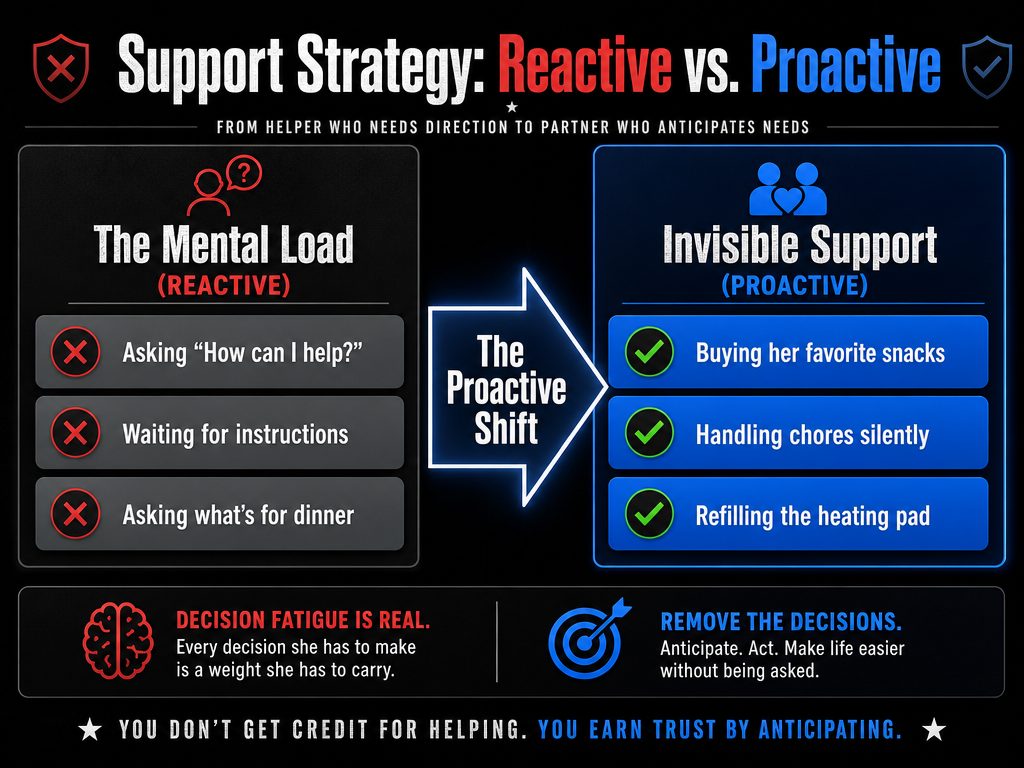
The Tactical Care Kit
Physical Support
- Heating pad: Extra-long heating pads provide relief for cramps and lower back pain. Have one ready and plugged in.
- Magnesium-rich snacks: Dark chocolate, almonds, and pumpkin seeds can help ease muscle tension and mood swings. Stock them in advance.
- Complex carbs: Oatmeal, sweet potatoes, and whole-grain bread stabilize blood sugar and reduce irritability. Cook something simple and filling.
- Hydration: Keep a water bottle filled and nearby. Dehydration worsens fatigue and headaches.
Environmental Support
- Dim the lights: Bright lights can trigger or worsen headaches. Use lamps instead of overhead lighting.
- Fresh sheets: A clean, comfortable bed makes a significant difference when she's exhausted.
- Noise reduction: If she's sensitive to sound, turn down the TV, close windows, or offer noise-canceling headphones.
- Temperature control: Progesterone raises body temperature slightly during the luteal phase. Keep the room cool and have a fan available.
Task Management
Handle the chores she usually manages without announcing it. Take out the trash, do the dishes, pick up groceries. Don't wait for her to ask. Don't expect praise. Just do it.
If you're planning to be out, leave a note: "I picked up Thai food and left it in the fridge. I've got the heating pad ready if you need it. Text me if you need anything else."
For more on how to give the right kind of support during this time, check out our guide on how to comfort your girlfriend during PMS.
The Communication Playbook: What to Say (and Never Say)
Words matter, especially when her tolerance for misunderstanding is low. When a partner is struggling emotionally, responding with genuine empathy - listening without judgment, focusing on their feelings rather than debating facts, and validating that their reaction makes sense - tends to help more than trying to "fix" the problem or offer silver linings. Feeling understood, not corrected, is what tends to defuse tension.
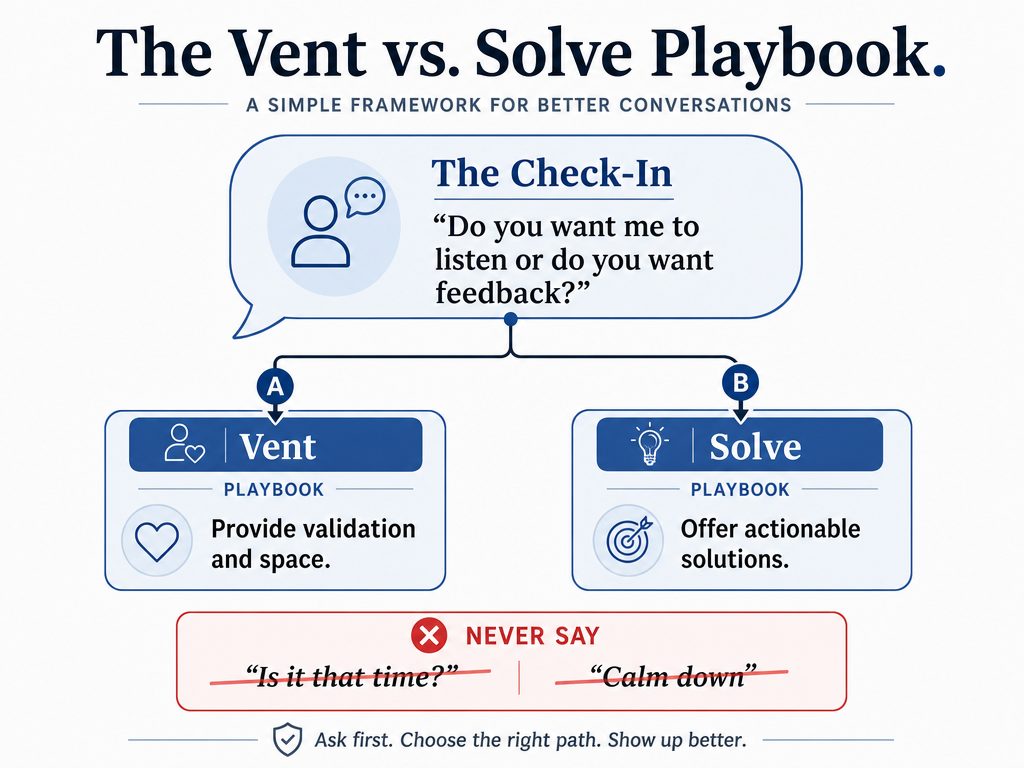
Never Say
- "Is it that time of the month?" This dismisses her feelings and reduces her to a stereotype. Even if you're right, saying this will make things worse.
- "Calm down." This implies she's overreacting and that her emotions aren't valid. It shuts down communication.
- "You're overreacting." See above. This is relationship poison.
- "It's not that big of a deal." What feels minor to you may feel overwhelming to her. Dismissing her concerns damages trust.
Say Instead
- "I can see you're carrying a lot right now. I'm here if you want to vent, or I can give you space - whatever helps." This validates her struggle without demanding she explain herself.
- "That sounds really hard." Simple acknowledgment goes a long way.
- "I hear you. What would feel most supportive right now?" If you're genuinely unsure, ask in a way that centers her needs, not your confusion.
- "I'm sorry I contributed to that." Take accountability when appropriate. Don't over-apologize or make it about your guilt.
The "Vent vs. Solve" Check
Before you offer solutions, ask: "Do you want me to listen, or do you want feedback?"
Most of the time, she just wants to be heard. Offering unsolicited solutions - "Have you tried taking magnesium?" or "Maybe you should talk to your boss about that" - can feel dismissive, even when you mean well.
If she asks for feedback, give it. If she doesn't, just listen.
For more on how to navigate high-tension moments, read our guide on what to say when your girlfriend has PMS.
Safety and Medical Advocacy: The 7-2-1 Rule for Heavy Bleeding
Most PMS symptoms - mood swings, fatigue, bloating - are uncomfortable but not dangerous. Heavy menstrual bleeding, however, can be a sign of a more serious condition like fibroids, endometriosis, or a bleeding disorder.
As her partner, you can help her recognize when bleeding crosses the line from "normal but annoying" to "time to see a doctor."
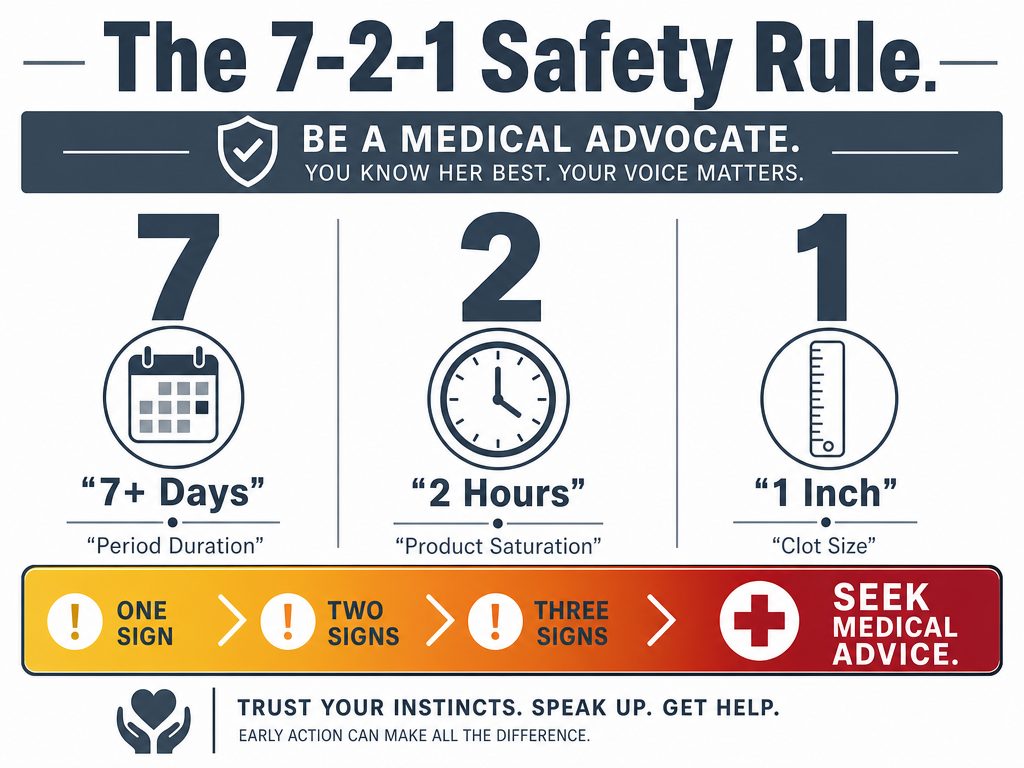
The 7-2-1 Rule for Heavy Bleeding
This is a simple framework to determine when her period requires medical attention:
- 7 days: Her period lasts longer than 7 days.
- 2 hours: She needs to change a pad or tampon every 2 hours or less.
- 1 inch: She passes blood clots larger than a quarter (roughly 1 inch in diameter).
If any of these apply, she should see a healthcare provider. Normal period duration is considered 2 to 7 days, with most commonly lasting 3 to 5 days. Bleeding that exceeds this or requires frequent product changes is not something to ignore.
When to Go to the ER
Seek emergency medical care if she experiences:
- Soaking through a pad or tampon every hour for several hours
- Passing clots larger than a golf ball
- Severe pain that doesn't respond to over-the-counter pain relievers
- Signs of anemia: extreme fatigue, dizziness, pale skin, shortness of breath
Heavy bleeding isn't always an emergency, but it's always worth a conversation with a doctor. Don't let her brush it off as "just a bad period." Medical advocacy is part of being a supportive partner.
Tracking Her Cycle: Partnership, Not Surveillance
Understanding her cycle helps you anticipate her needs and avoid mistiming important conversations or plans. But tracking without her knowledge feels invasive. The key is consent and transparency.
How to Ask for Permission
Say something like: "I want to understand your cycle better so I can be more supportive. Would you be comfortable sharing your cycle dates with me? I'm not trying to track you - I just want to know when you might need extra support or when it's a good time to plan things."
If she says yes, use a shared calendar or a period tracking app with partner access. Apps like Flo for Partners, Clue Partner Connect, or VibeCheck allow her to share cycle data with you while maintaining control over what you see.
If she says no, respect that boundary. You can still offer support by paying attention to behavioral cues - changes in energy, mood, or appetite - without formal tracking.
What to Track
- Menstrual phase: Days 1-5 (bleeding). Energy is low. She needs rest and patience.
- Follicular phase: Days 6-13 (after bleeding stops, before ovulation). Energy tends to build through this phase. This is a good time for social plans, difficult conversations, or new projects.
- Ovulation: Around day 14 in a 28-day cycle. Many women notice symptoms such as increased sex drive, mild pelvic or abdominal pain, tender breasts, bloating, and mood changes. She may feel more social and energetic.
- Luteal phase: Days 15-28 (after ovulation, before the next period). PMS-type symptoms are more likely in this phase - mood shifts, breast tenderness, bloating, acne, and appetite changes. This is when she needs the most support.
For a comprehensive breakdown of all four phases and how to support her through each one, read our boyfriend's guide to the menstrual cycle phases.
Frequently Asked Questions
Do girls get moody a week before their period?
Yes, many women experience mood changes in the week or two before their period. This is caused by hormonal fluctuations - specifically, a drop in estrogen and progesterone - that affect serotonin levels in the brain. The result is increased irritability, anxiety, or sadness. It's a biological event, not a personality flaw. Roughly 3 in 4 women experience some level of PMS, though severity varies widely.
How to explain the luteal phase to your boyfriend?
The luteal phase is the two weeks after ovulation and before your period starts. Progesterone rises to prepare the uterine lining for a possible pregnancy. If pregnancy doesn't happen, both progesterone and estrogen drop sharply, which triggers a corresponding drop in serotonin. This makes it harder to regulate stress and emotions. It's like your brain is working with less fuel. Symptoms can include mood swings, fatigue, bloating, breast tenderness, and irritability. It's not an excuse - it's a predictable biological process. Learn more about the luteal phase here.
What is the male version of PMSing?
There isn't a direct male equivalent to PMS because men don't have a menstrual cycle. However, men do experience hormonal fluctuations - testosterone levels fluctuate daily and seasonally - and these can affect mood, energy, and stress tolerance. The difference is that male hormonal changes are less predictable and less cyclical than the female menstrual cycle. If you're noticing mood swings in your own life, consider tracking sleep, stress, diet, and exercise to identify patterns.
How should men deal with PMS?
Move from reactive to proactive. Don't ask "What do you need?" - that's another task for her to manage. Instead, anticipate her needs: handle chores without being asked, keep the environment comfortable (dim lights, cool temperature, fresh sheets), and stock magnesium-rich snacks and complex carbs. Use empathetic communication: "I can see you're carrying a lot right now. I'm here if you want to vent, or I can give you space." Never say "Is it that time of the month?" or "Calm down." Validate her feelings without trying to fix them.
What can I do to support my partner who has PMDD?
PMDD (premenstrual dysphoric disorder) is a severe form of PMS that requires medical treatment. It affects between 3% and 9% of individuals who menstruate and involves extreme mood symptoms like rage, hopelessness, or suicidal thoughts. Encourage her to see a healthcare provider - treatment options include SSRIs, hormonal birth control, or therapy. Offer to go with her to appointments if she wants the support. Couples counseling has been shown to reduce symptoms and improve relationship satisfaction. Educate yourself about PMDD so you can recognize red flags and advocate for her care.
How can a husband help his wife with PMDD?
The same principles apply: validate her emotions, provide proactive support, and encourage medical treatment. PMDD is listed in the DSM-5 as a depressive disorder - it's not something she can control through willpower. Learn her symptom timeline so you can anticipate difficult days. Remove stressors when possible. If she's in treatment, support her by helping her track symptoms, manage medication side effects, or attend therapy sessions. Be patient with the process - PMDD treatment often requires trial and error to find what works.
How to tell if you have PMDD vs PMS?
PMDD is a more severe, sometimes disabling extension of PMS. Both happen on a similar timeline (about 7-10 days before a period), but PMDD specifically involves extreme mood symptoms - such as marked irritability, anxiety, or hopelessness - intense enough to disrupt daily life and strain relationships. If you're experiencing suicidal thoughts, rage that leads to yelling or breaking things, panic attacks, or total social withdrawal, see a healthcare provider. A formal diagnosis requires tracking symptoms for at least two menstrual cycles.
Can PMDD make you not like your partner?
Yes, PMDD can cause intense irritability and emotional sensitivity that make it difficult to feel connected to your partner during the luteal phase. This doesn't mean the relationship is fundamentally broken - it means your brain chemistry is temporarily disrupted. Approximately 15% of women with PMDD will attempt suicide at least once in their lifetime, which underscores the severity of the condition. Medical treatment and couples counseling can help. If you notice this pattern - feeling deeply disconnected from your partner only during certain weeks of the month - talk to your doctor about PMDD.
What is considered a heavy menstrual flow?
Heavy menstrual flow - also called menorrhagia - is defined by the 7-2-1 rule: periods lasting longer than 7 days, needing to change a pad or tampon every 2 hours or less, or passing blood clots larger than a quarter (roughly 1 inch). Normal period duration is considered 2 to 7 days, with most commonly lasting 3 to 5 days. If your partner's bleeding exceeds this, she should see a healthcare provider. Heavy bleeding can lead to anemia and may be a sign of fibroids, endometriosis, or a bleeding disorder.
How big is too big for period clots?
Blood clots smaller than a quarter are generally normal. Clots larger than a quarter (roughly 1 inch in diameter) warrant a conversation with a healthcare provider. Passing large clots regularly - especially if accompanied by heavy bleeding or severe pain - can be a sign of an underlying condition like fibroids or endometriosis. If she's passing clots larger than a golf ball, seek emergency medical care.
Supporting your partner through PMS isn't about grand gestures or perfect words. It's about understanding the biology of what she's experiencing, anticipating her needs without adding to her mental load, and validating her emotions without trying to fix them.
You can't make her hormones cooperate. But you can make sure she doesn't have to manage them alone.
If you want a tool that helps you track her cycle and provides daily, personalized guidance on how to support her, check out VibeCheck - the relationship app built for men who want to stop guessing and start understanding.
Tags

Related Articles
Continue reading to deepen your understanding

How to Understand Your Girlfriend’s Social Battery and Hormones
Does your girlfriend suddenly cancel plans or seem withdrawn? This guide explains how her cycle impacts her energy so you can support her like a pro.

How Your Girlfriend’s Emotional Needs Change During Her Cycle
Does your girlfriend’s mood seem unpredictable? Learn how her emotional needs shift on a biological loop and how to support her through every phase of her cycle.

What to Buy When Your Girlfriend Has Hormone Cravings: A Support Guide
Stop wondering what to pick up at the store. This guide explains the science behind cycle cravings and provides a specific list of foods and comfort items she needs.

Your Girlfriend’s Mood Shifts Throughout the Month, Explained
Ever wonder why her energy and moods change so drastically each week? Understand the four hormonal phases and how to be the partner she needs during every stage of her cycle.

How to Support Your Girlfriend When She’s Crying Because of Hormones
Watching her cry when hormones hit can feel overwhelming. Learn the biological why behind the tears and use these proven scripts to provide the support she actually needs right now.

How to Help Your Girlfriend with Hormonal Mood Swings Without Arguing
Understand her cycle and learn tactical scripts to handle tension. This guide shows you how to support her through hormonal shifts without getting into unnecessary fights.

When to Feed Your Girlfriend: Understanding Hangry Hormones
Does your girlfriend get irritable when she hasn’t eaten? It’s not just in her head. Learn why hormones cause hanger and the specific times her body needs more fuel.

Why Your Girlfriend Wants Different Things Each Week: The Biological Roadmap
Does your partner seem like a different person every seven days? Understand how her 28-day biological cycle impacts her energy and mood so you can provide the support she actually needs.