Why Your Girlfriend Wants Different Things Each Week: The Biological Roadmap

Does your partner seem like a different person every seven days? Understand how her 28-day biological cycle impacts her energy and mood so you can provide the support she actually needs.
Why Your Girlfriend Wants Different Things Each Week: The Biological Roadmap
One week she's energized and planning adventures. The next, she wants to stay home and do nothing. Then she's irritable over small things, and a few days later, she's affectionate again. You're not imagining the pattern - and it's not random.
Your girlfriend's changing needs follow a 28-day biological cycle driven by shifting hormone levels. Understanding this rhythm isn't about excusing behavior or walking on eggshells. It's about recognizing that her body is running on an infradian cycle - a monthly "season" that affects energy, mood, stress tolerance, and what kind of support she actually needs from you.
This guide breaks down the four phases of the menstrual cycle, explains what's happening biologically, and gives you a tactical framework for knowing when to plan the big date versus when to just handle dinner and let her rest.
Table of Contents
- The Biological Why: Understanding the Infradian Rhythm
- The Four Phases: A Season-by-Season Breakdown
- Phase-Specific Partner Actions
- When Biology Becomes a Health Issue
- Common Myths and Misunderstandings
- Frequently Asked Questions
The Biological Why: Understanding the Infradian Rhythm
Her body isn't broken or inconsistent. It's following a four-phase cycle that repeats roughly every month: menstrual, follicular, ovulatory, and luteal. Each phase is driven by different hormone levels - primarily estrogen and progesterone - that affect not just her reproductive system, but her brain, energy levels, pain tolerance, and social drive.
Think of it as four distinct "seasons" happening on a loop. Winter (menstruation) is low-energy and introspective. Spring (follicular) brings rising optimism and focus. Summer (ovulation) is peak social energy and confidence. Fall (luteal) is when sensitivity and irritability climb as hormones crash before her next period.
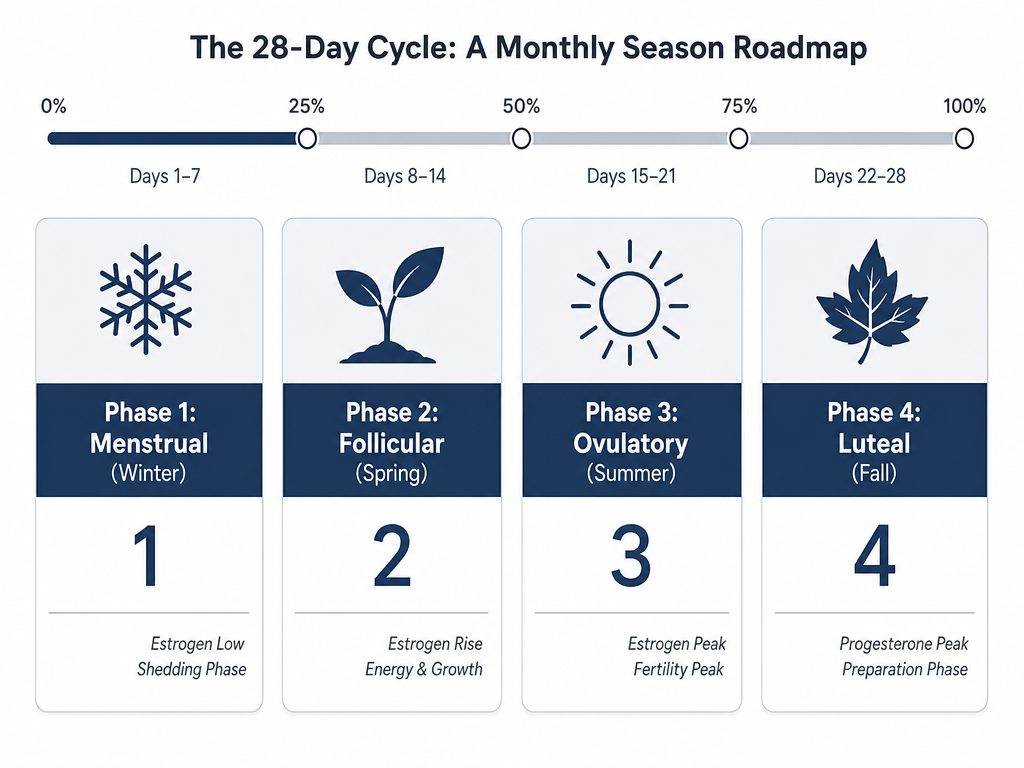
Understanding your partner's cycle as a set of four distinct 'seasons' helps you predict when she'll need more rest versus when she's ready for adventure.
VibeCheck App
Download Free on iOS →Here's the important part: a "normal" cycle can vary from every 24 to every 38 days, and even within one woman, the timing can shift by several days month to month. That means exact predictions are impossible without tracking - but the pattern of energy and mood shifts remains consistent.
The relationship impact is real. 48% of women report that PMS symptoms regularly affect their romantic relationship, and many of those conflicts stem from partners not understanding that what she needed last week isn't what she needs this week.
The Four Phases: A Season-by-Season Breakdown
Understanding each phase means you can stop reacting to her moods and start anticipating her needs.
Phase 1: Menstrual (Winter) - Days 1-5
What's happening biologically: Both estrogen and progesterone drop to their lowest levels. Bleeding begins as the uterine lining sheds. Energy is at its lowest point, and 88% of women experience menstrual cramps, which can significantly impair concentration and mood.
The vibe: Exhaustion, physical pain, introspection. She's not lazy - she's literally running on biological fumes. Her body is doing major internal work, and she has very little left over for making plans or handling stress.
What she needs: Rest, low social pressure, physical comfort. She doesn't want to make decisions about where to eat or what to do this weekend. She wants the heating pad, minimal chores, and to not be asked for anything she doesn't have the bandwidth to give.
Phase 2: Follicular (Spring) - Days 1-14
What's happening biologically: Estrogen rises steadily as an egg-containing follicle develops in the ovary. This rising estrogen thickens the uterine lining and, critically, affects brain function and the ability to focus. Energy begins to build, and mood generally lifts.
The vibe: Optimism, creativity, increasing focus and social energy. She's coming back online. This is when she starts saying yes to plans again and initiating ideas.
What she needs: This is your window to suggest new things - big conversations, weekend trips, trying that new restaurant. Her stress tolerance is climbing, and she's more open to novelty and challenge. If you've been holding back on a "we should talk about..." conversation, early-to-mid follicular phase is your best shot.
Phase 3: Ovulatory (Summer) - Around Days 13-15
What's happening biologically: A surge in luteinizing hormone (LH) triggers the release of an egg from the ovary, typically around day 14 in a 28-day cycle. Estrogen peaks just before ovulation. Many women notice increased sex drive, mild pelvic pain, tender breasts, bloating, and mood changes during this window, though symptoms vary widely.
The vibe: High libido, social confidence, peak energy. She's the version of herself you probably met when you first started dating - outgoing, engaged, up for anything. This phase is short (usually 3-5 days), so it's easy to miss if you're not paying attention.
What she needs: Connection. Prioritize quality time, plan the date night, give her your full attention. This is when emotional intimacy and physical closeness are most rewarding for both of you. Don't waste this window scheduling something stressful or low-effort.
Phase 4: Luteal (Fall) - Days 16-28
What's happening biologically: After ovulation, progesterone rises to prepare the uterine lining for a possible pregnancy. If pregnancy doesn't happen, both progesterone and estrogen crash in the final days before her period. Many women experience PMS symptoms during this phase - mood shifts, irritability, breast tenderness, bloating, acne, appetite changes - though not everyone does.
The vibe: Sensitivity, anxiety, "nesting" instinct. Small things feel bigger. Her patience for conflict or chaos drops sharply. She may withdraw or become snippy over things that wouldn't have bothered her two weeks ago.
What she needs: Stability. Be the calm, predictable presence. Don't try to fix her feelings - validate them instead. Take over decision-making (where to eat, what movie to watch) so she doesn't have to burn mental energy on trivial choices. If she says she's fine, believe the tone, not the words.
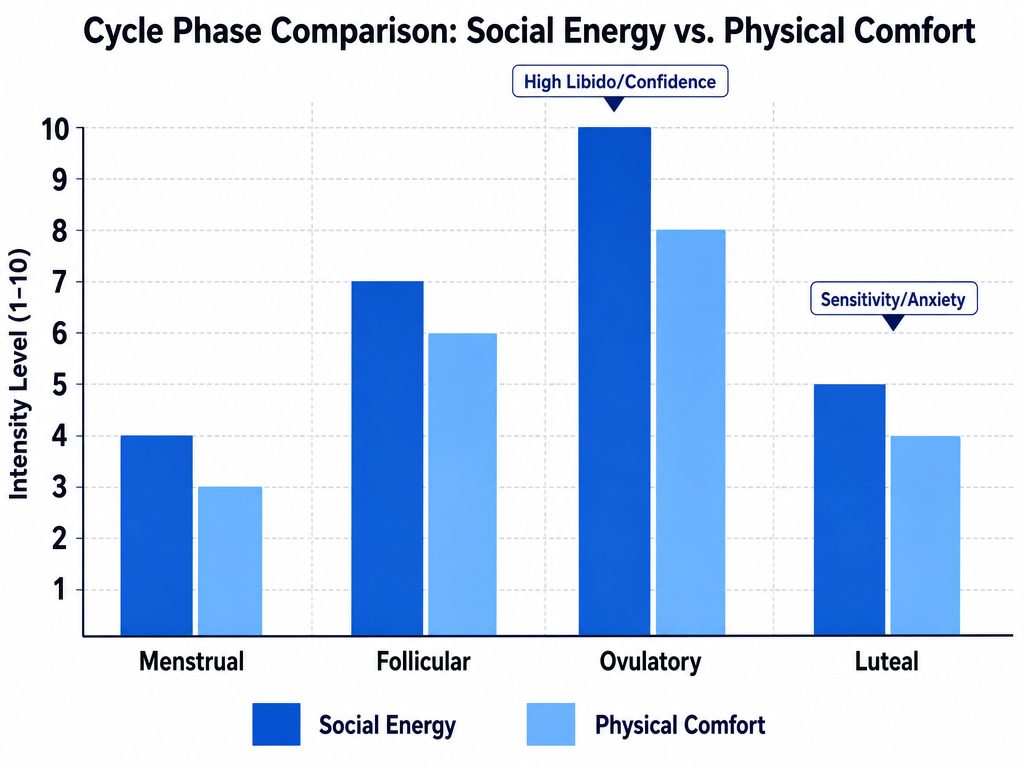
Hormonal shifts directly impact energy levels. Use this chart to understand why her desire for social activities or physical comfort changes every week.
Phase-Specific Partner Actions
Knowing the phases is useful. Knowing what to do in each one is what actually improves your relationship.
| Phase | Her Biological State | The Partner Action | What to Avoid |
|---|---|---|---|
| Menstrual (Winter) | Low estrogen/progesterone, bleeding, cramps | Handle chores without being asked. Provide heating pad, comfort food, low-pressure environment. Don't ask her to make decisions. | Suggesting plans that require energy. Asking "what's wrong?" when the answer is obviously physical pain. |
| Follicular (Spring) | Rising estrogen, building energy | Suggest new ideas, plan weekend trips, have "big" relationship conversations. This is your window for novelty. | Wasting the high-energy window on low-effort plans. Holding back on important topics until she's back in the luteal dip. |
| Ovulatory (Summer) | Peak estrogen, high libido and confidence | Prioritize date night. Give her your full, undivided attention. Plan the romantic gesture. | Scheduling something stressful or low-effort during her highest-connection window. Missing the narrow 3-5 day opportunity. |
| Luteal (Fall) | Progesterone rise then crash, PMS symptoms likely | Be the stable "rock." Validate her feelings without trying to fix them. Take over mundane decisions. | Debating whether her feelings are "logical." Adding new stressors. Being dismissive of physical symptoms. |
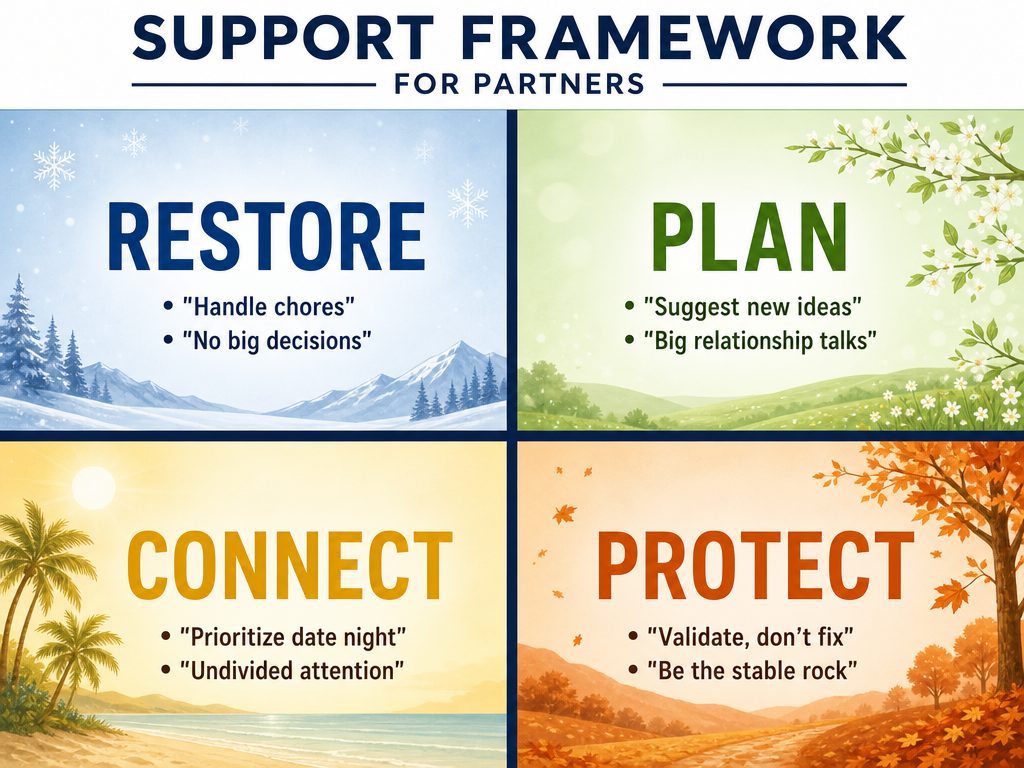
A practical framework for support: know when to take over chores (Restore) and when to suggest big ideas or romantic dates (Plan and Connect).
One more critical insight: tracking symptoms and mood changes for a few months is a medically endorsed way to identify real patterns rather than guessing based on stereotypes. If she's open to it, using a shared period tracker or just marking the calendar together can help you both see the loop more clearly. You can explore tools like our period calculator to predict her next phase and plan accordingly.
When Biology Becomes a Health Issue
Not all cycle-related experiences are "normal," even if they're common. There's a difference between manageable PMS and symptoms that genuinely disrupt her life - or yours.
Understanding PMS vs. PMDD
PMS (premenstrual syndrome) is very common: as many as 3 in 4 women report experiencing symptoms at some point, though severity varies widely. Symptoms typically show up one to two weeks before a period and resolve within a few days after it starts.
However, roughly half of people who menstruate report at least one PMS symptom, but only about 1 in 5 have symptoms severe enough to disrupt daily life. That more disruptive tier is a meaningfully different experience than "typical" PMS.
PMDD (premenstrual dysphoric disorder) is a real, clinically recognized condition listed in the DSM-5, affecting roughly 1 in 10 people who menstruate. PMDD involves extreme mood symptoms - marked irritability, anxiety, or hopelessness - intense enough to disrupt daily life and strain relationships. If her luteal phase regularly involves thoughts of self-harm, complete inability to function, or relationship-threatening behavior, she needs to talk to a doctor, not just ride it out.
The 7-2-1 Health Check
You may have seen references to a "7-2-1 rule" online. This isn't a relationship guideline - it's a medical diagnostic marker for abnormal bleeding that warrants a doctor's visit.
If her period involves any of these:
- 7 days or more of bleeding
- Changing pads or tampons every 2 hours or less
- Passing blood clots 1 inch or larger
She may have menorrhagia (abnormally heavy bleeding), which can lead to anemia and other complications. Your role here isn't to diagnose - it's to gently suggest she bring it up with her doctor and offer to help her get an appointment.
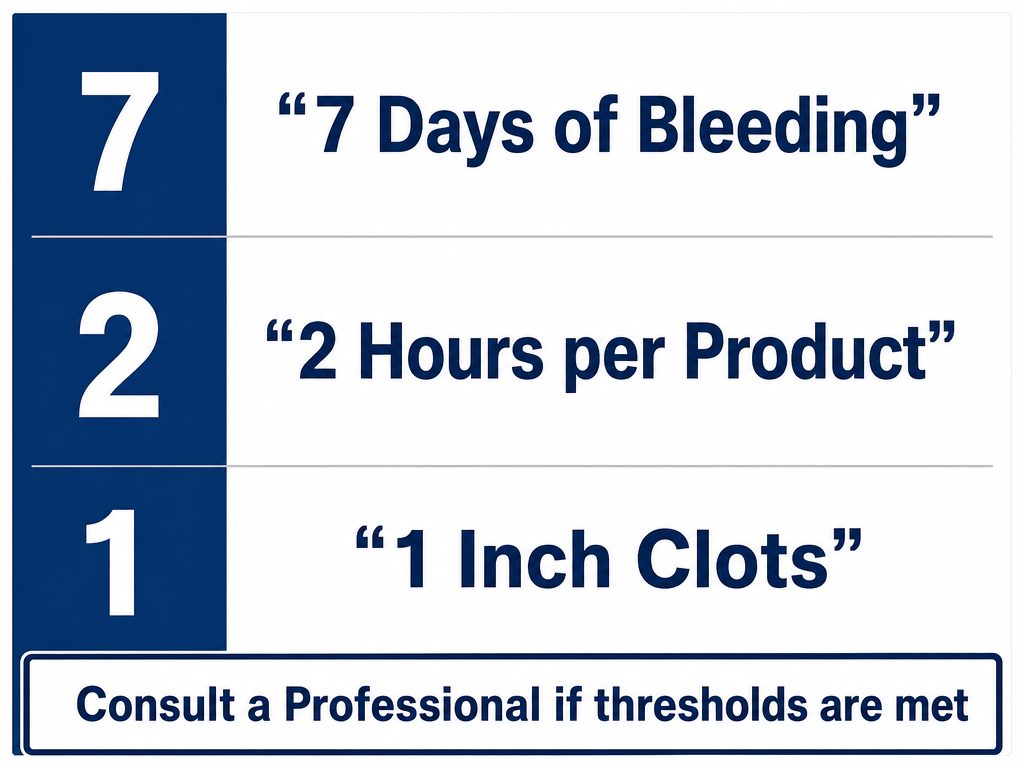
The 7-2-1 rule is a medical health check, not a relationship guideline. If your partner hits these markers, it's a sign to encourage a doctor's visit.
Mittelschmerz: Mid-Cycle Pain
Mittelschmerz is one-sided lower abdominal pain around the time of ovulation. It's real, documented, and generally harmless - usually lasting minutes to a couple of days and typically not requiring treatment. How often it happens varies: some women get it almost every cycle, others only occasionally or never.
If she mentions pain mid-cycle, it's not in her head. Offering a heating pad or ibuprofen is more useful than asking if she's sure it's real.
For more on recognizing and supporting your partner through these physical shifts, our guide on how to comfort your girlfriend during PMS offers additional tactical advice.
Common Myths and Misunderstandings
Myth: "Cycle syncing" your workouts and diet is scientifically proven
There is general research support for hormone-linked differences in mood and energy across the cycle, but specific "cycle syncing" lifestyle programs - telling you to do HIIT on day 12 and eat sweet potatoes on day 19 - have not themselves been tested in clinical research. The underlying pattern (energy lower during menstruation, higher around ovulation) is real. The prescriptive day-by-day plans go beyond what's established.
Myth: All women have a 28-day cycle
A "normal" cycle can vary by up to 8 days from month to month. Some women have 24-day cycles, others 35-day cycles, and both are medically normal. Assume nothing based on a textbook average - ask her, or better yet, track with her.
Myth: PMS is an excuse for bad behavior
Up to 90% of women experience at least one premenstrual symptom. The symptoms are real and biologically driven. That doesn't mean every conflict during the luteal phase is "just hormones," but dismissing her feelings as irrational because of where she is in her cycle is both medically inaccurate and relationally damaging.
The distinction: you can acknowledge the biology without excusing cruelty. If she's snapping at you, the hormones explain the lower stress tolerance - they don't justify personal attacks. Lifestyle approaches that help ease PMS symptoms include regular aerobic exercise, smaller/more frequent meals, less salt/caffeine/alcohol, adequate sleep, and stress-reduction practices. A partner who understands these and is supportive rather than dismissive is aligning with medically recommended self-care.
Myth: If you understand her cycle, you can predict everything
Biology sets the stage, but it doesn't script every scene. Stress at work, family issues, lack of sleep, and relationship dynamics all layer on top of the hormonal baseline. You're not trying to become a fortune teller - you're trying to stop being blindsided by a pattern that repeats every month.
For more on reading her cues beyond just the calendar, check out our guide on how to tell which cycle phase your girlfriend is in.
Frequently Asked Questions
How do the four phases of the menstrual cycle affect moods?
The menstrual cycle has four phases: menstrual, follicular, ovulatory, and luteal. Mood tends to lift during the follicular phase as estrogen rises, peak during ovulation when estrogen and testosterone are highest, then dip during the luteal phase as progesterone rises and then crashes. The menstrual phase itself is typically low-energy and introspective due to low hormone levels and physical discomfort. Individual variation is significant - not every woman experiences dramatic mood swings, and severity changes cycle to cycle.
Can the luteal phase cause feelings of sadness?
Yes. The luteal phase involves a progesterone rise followed by a crash in both progesterone and estrogen before the next period. This hormonal drop can trigger mood symptoms including sadness, irritability, and anxiety. For some women, this is mild. For others, it's severe enough to meet the criteria for PMDD. If sadness in the luteal phase regularly interferes with daily life, it's worth talking to a doctor.
How does the menstrual cycle affect relationships?
48% of women feel that PMS symptoms regularly impact their romantic relationship. The cycle affects stress tolerance, social energy, communication style, and libido - all of which show up in how she interacts with you. Partners who understand the pattern can time important conversations, adjust plans, and offer the right kind of support at the right time, which significantly reduces friction. To dive deeper into cycle-aware support strategies, read our menstrual cycle guide for boyfriends.
How do I support my partner during the luteal phase?
Validate her feelings without trying to fix them. Take over mundane decisions (what to eat, what to watch) so she doesn't burn mental energy on trivial choices. Reduce stressors where you can - handle the dishes, keep plans low-key, don't pick fights over small things. Recognize that her irritability isn't about you; it's about a serotonin crash that makes everything feel harder. Be the stable, predictable presence. For more tactical scripts and red-zone rules, see our luteal phase support guide.
What's the difference between PMS and PMDD?
Both happen on a similar timeline (about 7-10 days before a period) and can share physical symptoms like bloating and fatigue, but PMDD specifically involves extreme mood symptoms - marked irritability, anxiety, or hopelessness - intense enough to disrupt daily life and strain relationships. PMDD is a clinically recognized condition in the DSM-5, not just "bad PMS." If her symptoms regularly involve thoughts of self-harm or complete inability to function, she needs to talk to a doctor.
How can I tell when she needs space versus when she needs support?
Look at where she is in her cycle and what she's telling you with her behavior, not just her words. During menstruation and early luteal phase, many women need more alone time to recharge. During the follicular and ovulatory phases, she's more likely to want connection. If she's withdrawing and saying "I'm fine," check the calendar - if she's in the luteal phase, offer low-pressure support (handling tasks, giving her space to rest) rather than pressing for conversation. For more on reading these signals, our article on signs your girlfriend needs space breaks it down in detail.
Should I tell her I'm tracking her cycle?
Only if she's on board with it. Tracking her cycle without her knowledge feels invasive and paternalistic. Tracking it together as a team - so you both understand the pattern and can plan around it - can be a relationship strength. Frame it as "I want to understand what you're going through so I can be a better partner," not "I'm going to predict when you'll be moody."
What if her cycle is irregular?
A "normal" cycle can start anywhere from every 24 to every 38 days, and even a single woman's cycle can vary by several days month to month. Irregular cycles make exact predictions harder, but the pattern of phases still applies - you just can't rely on a fixed calendar. If her cycle is unpredictable enough to cause stress or relationship friction, she may benefit from talking to a doctor. Conditions like PCOS can cause irregular cycles and are treatable.
Your girlfriend isn't being inconsistent - she's running on a biological rhythm you probably weren't taught to recognize. Once you understand the four-phase loop, her changing needs stop feeling random and start making sense. You stop walking on eggshells and start being the partner who shows up with exactly what she needs, when she needs it.
That's not about being perfect. It's about being present, informed, and willing to adjust your plans to her biology instead of expecting her biology to adjust to your plans.
If you want a tactical, day-by-day playbook for navigating her cycle, VibeCheck is built for this. It's the relationship app that turns her cycle data into clear, actionable guidance - so you know when to plan the big date and when to just order takeout and let her rest. No guessing, no walking on eggshells, just informed support.
Tags

Related Articles
Continue reading to deepen your understanding

How to Understand Your Girlfriend’s Social Battery and Hormones
Does your girlfriend suddenly cancel plans or seem withdrawn? This guide explains how her cycle impacts her energy so you can support her like a pro.

How Your Girlfriend’s Emotional Needs Change During Her Cycle
Does your girlfriend’s mood seem unpredictable? Learn how her emotional needs shift on a biological loop and how to support her through every phase of her cycle.

What to Buy When Your Girlfriend Has Hormone Cravings: A Support Guide
Stop wondering what to pick up at the store. This guide explains the science behind cycle cravings and provides a specific list of foods and comfort items she needs.

Your Girlfriend’s Mood Shifts Throughout the Month, Explained
Ever wonder why her energy and moods change so drastically each week? Understand the four hormonal phases and how to be the partner she needs during every stage of her cycle.

How to Support Your Girlfriend When She’s Crying Because of Hormones
Watching her cry when hormones hit can feel overwhelming. Learn the biological why behind the tears and use these proven scripts to provide the support she actually needs right now.

How to Help Your Girlfriend with Hormonal Mood Swings Without Arguing
Understand her cycle and learn tactical scripts to handle tension. This guide shows you how to support her through hormonal shifts without getting into unnecessary fights.

When to Feed Your Girlfriend: Understanding Hangry Hormones
Does your girlfriend get irritable when she hasn’t eaten? It’s not just in her head. Learn why hormones cause hanger and the specific times her body needs more fuel.

The Boyfriend’s Guide to Supporting Your Partner Through PMS
If your partner is suddenly irritable and exhausted, it’s biology, not you. Learn about the luteal phase and how to provide meaningful support without walking on eggshells.