When to Feed Your Girlfriend: Understanding Hangry Hormones

Does your girlfriend get irritable when she hasn’t eaten? It’s not just in her head. Learn why hormones cause hanger and the specific times her body needs more fuel.
When to Feed Your Girlfriend: Understanding Hangry Hormones
You're sitting on the couch when she snaps at you for something minor. An hour later, after a snack, she's back to her normal self and apologizing. Sound familiar? You just witnessed "hanger" - and it's not just in her head.
When blood sugar drops, her body releases stress hormones like cortisol and adrenaline that trigger genuine irritability and aggression. Low blood sugar triggers the release of cortisol (stress) and adrenaline (fight-or-flight), which directly causes aggressive behavior. But here's what most guys miss: her menstrual cycle creates a predictable pattern where her body literally burns more fuel during certain weeks, making hanger far more likely at specific times of the month.
This guide explains the biological reality behind hormonal hunger, when it peaks, and exactly what to do about it.
Table of Contents
- What Is "Hanger" and Why Does It Happen?
- The Menstrual Cycle Phases: Your Roadmap
- When Are You Hungriest in Your Menstrual Cycle?
- The 300-Calorie Gap: Understanding Metabolic Shifts
- Why Am I So Hungry in My Luteal Phase?
- The Anti-Hanger Menu: What Actually Works
- Tactical Advice: The Two-Choice Rule
- How to Offer Food Without Being Patronizing
- What to Do When Your Girlfriend Is Hangry
- Frequently Asked Questions
What Is "Hanger" and Why Does It Happen?
Hanger is the combination of hunger and anger - a real physiological response, not just a mood. When your girlfriend hasn't eaten in several hours, her blood glucose drops. Her brain, which runs almost entirely on glucose, interprets this as a threat.
Low blood sugar triggers the release of cortisol (stress) and adrenaline (fight-or-flight), which directly causes aggressive behavior. These stress hormones don't just make her irritable - they put her nervous system into survival mode. She's not choosing to be short with you; her body is sending distress signals.
The difference between regular hunger and hormonal hanger is timing and intensity. During certain phases of her cycle, her body requires substantially more energy to function. When that fuel isn't available, the crash is harder and the irritability more pronounced.
VibeCheck App
Download Free on iOS →The Menstrual Cycle Phases: Your Roadmap
Understanding her cycle isn't about tracking dates - it's about recognizing energy patterns. The menstrual cycle has four phases: menstrual (bleeding, around day 1-5), follicular (day 1 through ovulation, estrogen rising), ovulation (around day 14 in a 28-day cycle, triggered by a surge in luteinizing hormone), and luteal (after ovulation to the next period, progesterone rising then falling).
Here's what matters for hunger:
Menstrual Phase (Days 1-5): Bleeding begins. Energy is typically lower, but hunger isn't dramatically elevated compared to baseline.
Follicular Phase (Days 1-14): During the follicular phase, estrogen rises as an egg-containing follicle develops in the ovary; this rising estrogen also thickens the uterine lining. Energy gradually builds. Hunger is moderate and manageable.
Ovulation (Around Day 14): Ovulation is when a surge in luteinizing hormone (LH) causes the ovary to release an egg, typically around day 14 of a 28-day cycle. Energy peaks. Appetite is usually normal or slightly elevated.
Luteal Phase (Days 15-28): This is the danger zone for hanger. After ovulation, the luteal phase begins: progesterone rises to help prepare the uterine lining for a possible pregnancy. If pregnancy doesn't happen, both progesterone and estrogen drop before the next period. Many women notice PMS-like symptoms in this phase - mood shifts, breast tenderness, bloating, acne, and appetite changes.
That last phase - roughly 10 to 14 days before her period - is when metabolic demand spikes and hunger becomes a relationship factor.
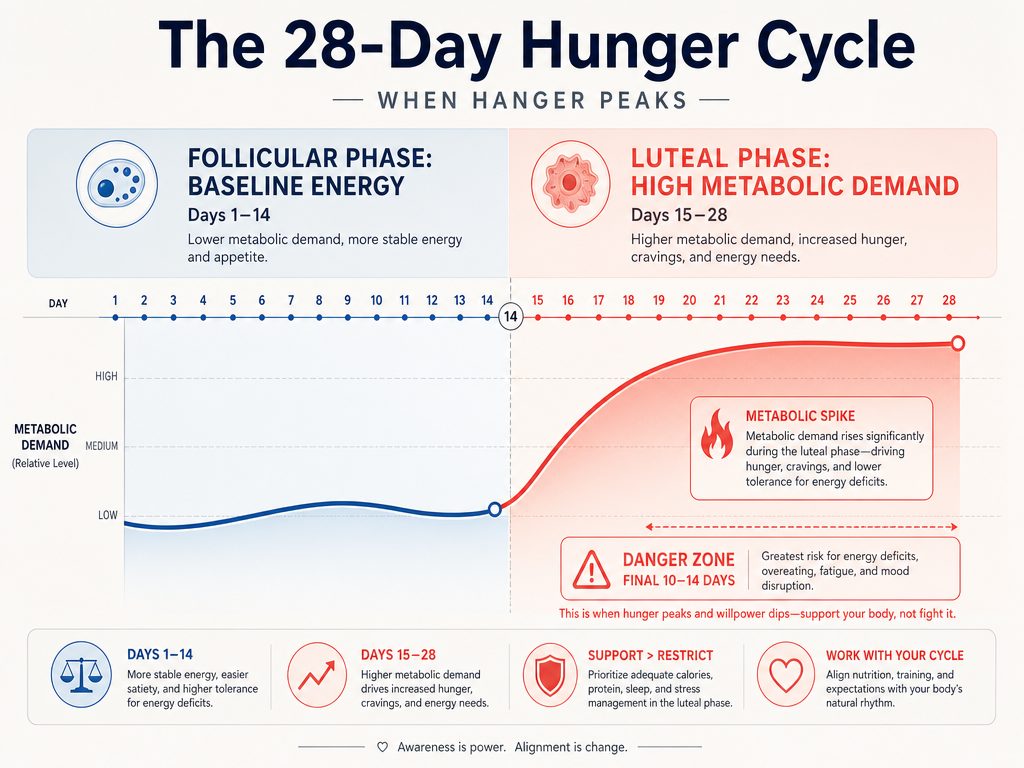 Understanding the 28-day cycle is key to predicting hanger. The Luteal Phase, occurring 10-14 days before a period, is when metabolic demands significantly increase.
When Are You Hungriest in Your Menstrual Cycle?
Most guys assume hunger peaks during the period itself. That's wrong.
Hunger is highest in the mid-luteal phase - approximately 7 to 10 days before bleeding starts. This is when progesterone levels are at their highest and the body is working hardest to sustain the uterine lining in case of pregnancy.
Energy intake was found to be significantly greater in the luteal phase compared to the follicular phase, with mean increases ranging from 90 to 500 kcal/day depending on the study. That's not a craving - that's a calorie deficit her body is trying to fill.
If you're tracking her cycle (with her consent and participation), mark days 21-25 of a typical 28-day cycle as high-risk hanger days. This is when she needs more food, not less patience.
The 300-Calorie Gap: Understanding Metabolic Shifts
Her body isn't burning the same number of calories all month. Resting metabolic rate increases by 2.5% to 11% during the luteal phase. For someone with a baseline metabolic rate of 1,400 to 1,600 calories per day, that translates to an additional 90 to 300 calories burned daily - without any extra activity.
Think of it like this: her body is running a low-grade fever for two weeks straight. She's not eating more because she's emotional. She's eating more because her engine is burning hotter.
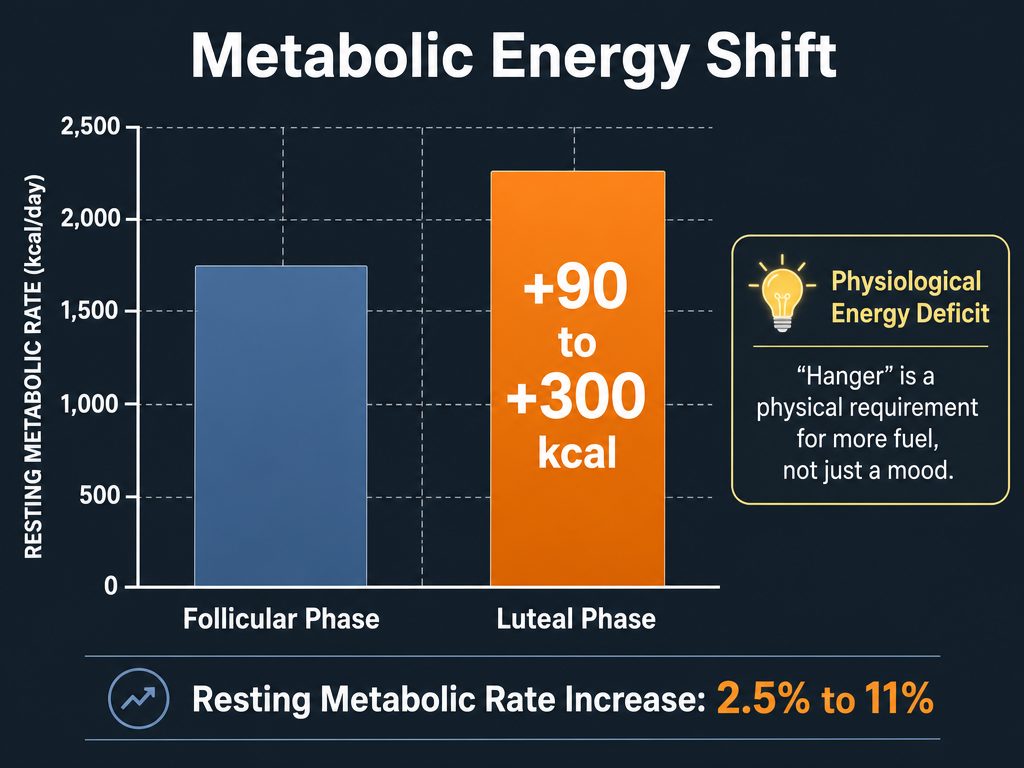 Research shows a woman's resting metabolic rate can rise by up to 11% during her luteal phase, requiring an additional 90 to 300 calories daily.
When she doesn't meet that increased demand, her blood sugar drops faster than usual, cortisol spikes harder, and hanger sets in more aggressively. You're not dealing with a mood swing - you're dealing with a biological energy deficit.
Why Am I So Hungry in My Luteal Phase?
The short answer: serotonin and progesterone.
Cravings during the luteal phase are linked to a drop in serotonin and a rise in progesterone, which has a calming/sedating effect on the central nervous system. When serotonin - the brain's mood stabilizer - drops, the body instinctively seeks foods that boost it back up, particularly carbohydrates.
Progesterone, meanwhile, has a sedating effect. It's why she might feel more tired during this phase. When fatigue and low serotonin collide with a calorie deficit, irritability becomes almost inevitable.
This isn't about willpower. It's brain chemistry demanding specific nutrients to maintain baseline function. The cravings she experiences - especially for carbs and comfort foods - are her body's attempt to self-regulate neurotransmitter levels.
The Anti-Hanger Menu: What Actually Works
Not all snacks are created equal. If you hand her a candy bar, you'll get a sugar spike followed by a crash that makes the hanger worse. What she needs are foods that stabilize blood sugar, boost serotonin, and provide sustained energy.
Magnesium-Rich Foods (To Ease Irritability):
- Dark chocolate (70% cacao or higher)
- Pumpkin seeds
- Almonds
- Spinach
Magnesium helps regulate the nervous system and can reduce the intensity of mood swings associated with the luteal phase.
Complex Carbohydrates (To Boost Serotonin):
- Sweet potatoes
- Oats
- Quinoa
- Brown rice
These provide a steady release of glucose, which helps maintain stable serotonin levels without the crash of simple sugars.
Proteins (To Prevent Blood Sugar Crashes):
- Chicken
- Eggs
- Greek yogurt
- Lentils
Protein slows digestion and keeps blood sugar levels even, preventing the rapid drops that trigger hanger.
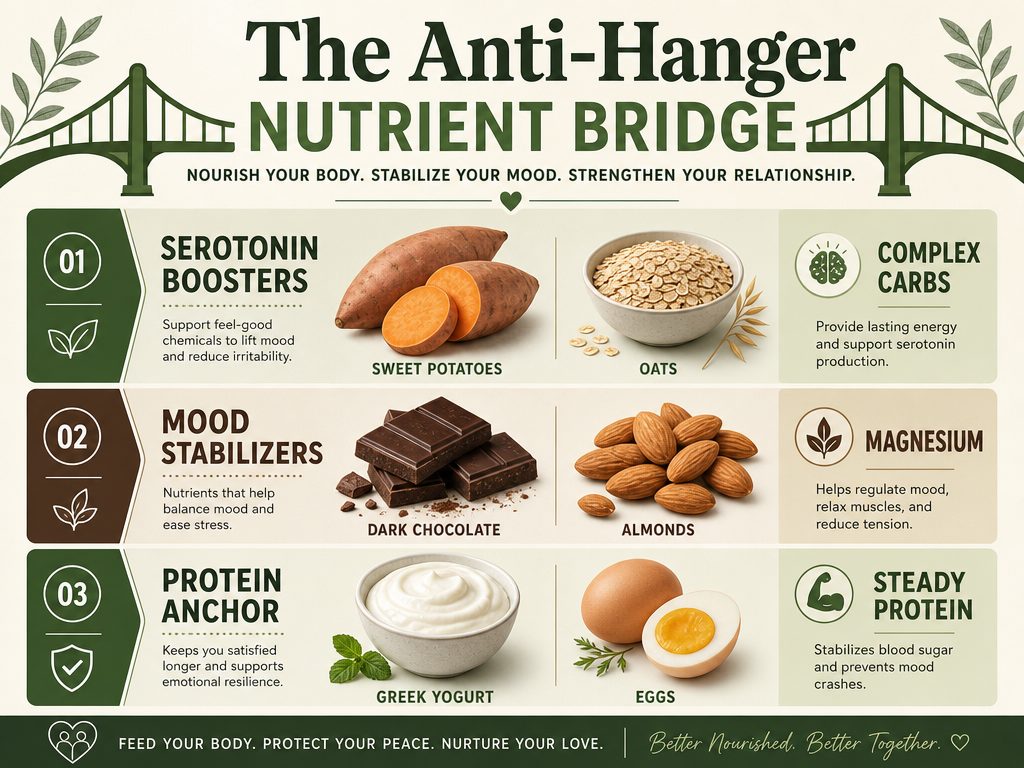 Specific nutrients like magnesium and complex carbohydrates act as a 'bridge' to stabilize blood sugar and boost serotonin during the high-demand luteal phase.
Combining these macronutrients in a snack or meal - like Greek yogurt with berries and almonds, or a sweet potato with grilled chicken - provides the most effective hanger prevention.
Tactical Advice: The Two-Choice Rule
Here's a mistake most guys make: they ask, "What do you want to eat?"
During the luteal phase, decision fatigue is real. Elevated progesterone can cause brain fog, making even simple choices feel overwhelming. An open-ended question adds stress when she's already running on fumes.
Instead, use the Two-Choice Rule: offer two specific options.
"I'm ordering food. Do you want Thai or Mexican?"
"I'm making eggs or we can do smoothies. Which sounds better?"
You're eliminating decision paralysis while still giving her autonomy. This small shift reduces friction and gets food in front of her faster - which is the actual goal.
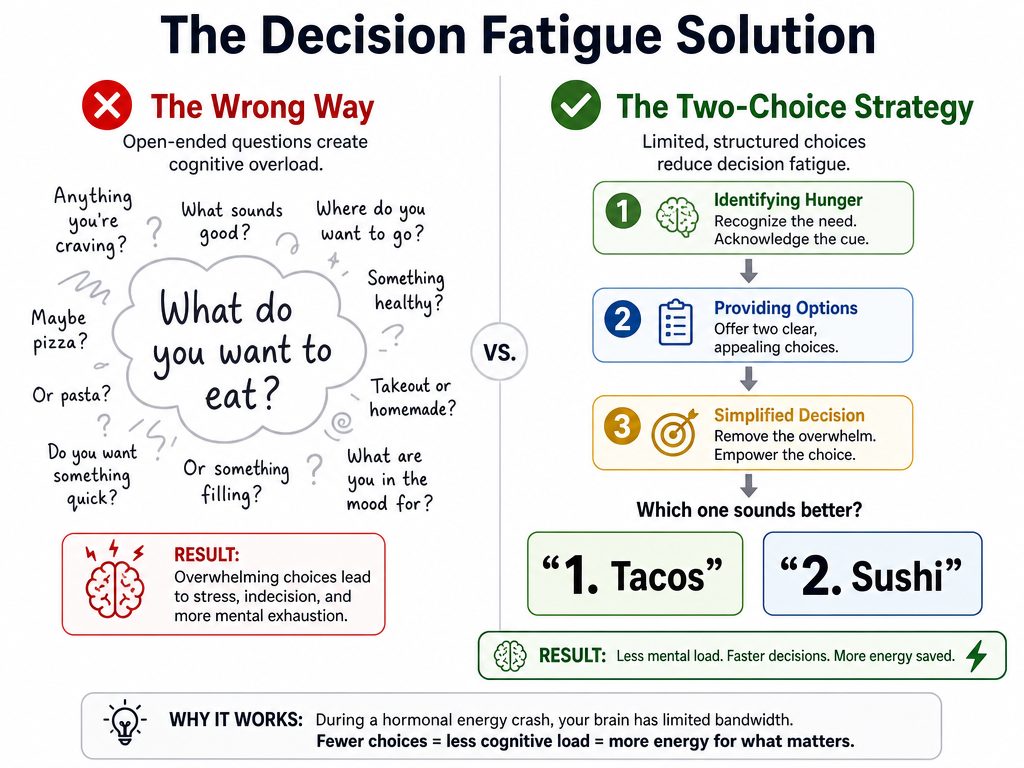 Bypass decision fatigue by offering two specific meal options. This tactical approach reduces the cognitive load on your partner when their energy is low.
Don't overthink the options. The content matters less than the structure. She's not going to care whether it's tacos or sushi if both are reasonable and you're taking the mental load off her plate.
How to Offer Food Without Being Patronizing
Never say: "Are you hangry?" or "You need to eat something."
Even if you're right, framing it as her being irrational will only make things worse. She doesn't want to feel like you're managing her emotions or treating her like a child.
What works: "I'm getting hungry and I'm about to grab a snack. What can I get you?"
This frames it as your need, not a diagnosis of her mood. You're inviting her to join you, not correcting her behavior.
Another option: "I was thinking of ordering dinner early tonight. Does [specific food] sound good, or would you rather have [other specific food]?"
You're being proactive without making it about her cycle, her mood, or hormones. You're simply taking care of logistics - and she benefits without feeling managed.
If she says she's not hungry but you know she hasn't eaten in hours, try this: "I ordered extra in case you change your mind."
Then leave it accessible and visible. Don't push. If she's genuinely not hungry, that's her call. But nine times out of ten, she'll eat it once the option is sitting in front of her.
What to Do When Your Girlfriend Is Hangry
You've already missed the prevention window. She's snapping at you, or she's withdrawn, or she's frustrated over something small. Here's the triage:
Step 1: Don't engage with the irritability. If she's picking a fight or being short, recognize that her nervous system is flooded with stress hormones. This isn't the time to debate who's right. Arguing will only escalate the cortisol response.
Step 2: Offer food immediately, without commentary. "I'm making a grilled cheese. Want one?" or "I grabbed you some fries." Keep it casual. No lectures, no "I told you so," no mention of her mood or her cycle.
Step 3: Give her space while she eats. Don't hover. Let her nervous system reset. Eating will bring her blood sugar back up, which will reduce cortisol and adrenaline. The irritability will fade on its own as her brain gets the glucose it needs.
If she apologizes after eating, accept it gracefully. Don't relitigate the interaction. Just move forward.
If you're learning how to anticipate her cycle and adjust your approach throughout the month, our guide on how to support your girlfriend during the ovulation phase covers the high-energy window that precedes the luteal crash.
Frequently Asked Questions
How to handle your girlfriend's mood swings?
Mood swings tied to her cycle are driven by hormone fluctuations, not character flaws. When a partner is struggling emotionally, responding with genuine empathy - listening without judgment, focusing on their feelings rather than debating facts, and validating that their reaction makes sense - tends to help more than trying to "fix" the problem or offer silver linings.
Your job isn't to talk her out of how she feels. It's to validate that her experience makes sense, offer practical support (like food or rest), and avoid making it worse by being dismissive. Our article on how to comfort your girlfriend during PMS provides a more detailed framework.
What causes a woman to feel hungry all the time?
During the luteal phase, her metabolic rate increases. Energy intake was found to be significantly greater in the luteal phase compared to the follicular phase, with mean increases ranging from 90 to 500 kcal/day depending on the study. Her body is working harder to maintain the uterine lining, which burns more fuel.
Outside of the cycle, persistent hunger can also signal insufficient protein, dehydration, stress, or sleep deprivation. But if the hunger is cyclical and predictable, hormones are the likely driver.
Does magnesium help with luteal phase symptoms?
Magnesium plays a role in nervous system regulation and can help ease irritability and fatigue. Lifestyle approaches that can help ease PMS symptoms include regular aerobic exercise, smaller/more frequent meals, less salt/caffeine/alcohol, adequate sleep, and stress-reduction practices like deep breathing or yoga. Magnesium-rich foods - like dark chocolate, pumpkin seeds, and almonds - are a practical, diet-based way to support her during this phase.
If she's considering magnesium supplements, that's a conversation for her healthcare provider. But adding magnesium-rich foods to her diet during the luteal phase is low-risk and widely supported.
Why do I want carbs in my luteal phase?
Cravings during the luteal phase are linked to a drop in serotonin and a rise in progesterone, which has a calming/sedating effect on the central nervous system. Carbohydrates boost serotonin production, so her body is instinctively seeking foods that will stabilize her mood.
This craving isn't weakness - it's biology. Complex carbs like oats, sweet potatoes, and whole grains provide the serotonin support without the crash that comes from refined sugars.
Is it harder to lose weight in the luteal phase?
The luteal phase increases metabolic rate, but it also increases hunger and fatigue. Resting metabolic rate increases by 2.5% to 11% during the luteal phase. While her body is burning more calories, she's also craving more food and has less energy for exercise.
Weight loss during this phase is possible, but it's harder to sustain because the body is fighting to maintain energy stores. If she's trying to lose weight, the follicular phase - when energy is higher and hunger is lower - is a more favorable window.
How can I track her cycle to be a better partner?
The key is consent and collaboration. Don't track her cycle without her knowledge - that's invasive. Instead, suggest using a shared app or calendar where she inputs her cycle data and you both benefit from the visibility. Our period tracker for men is designed specifically for this use case.
Tracking helps you anticipate the high-demand luteal phase, plan around low-energy days, and time important conversations for phases when her mood is more stable. It's not about control - it's about coordination.
Hanger isn't a character flaw, and it's not just hunger. It's a biological response to metabolic shifts that happen on a predictable schedule. When you understand the luteal phase and the 300-calorie gap it creates, you stop taking her irritability personally and start treating it like the physiological event it is.
Feed her proactively. Use the Two-Choice Rule. Avoid making it about her emotions or hormones. And when she snaps, recognize that her nervous system is flooded with stress hormones because her brain is running low on fuel.
You're not managing her moods - you're managing logistics. And when you get the logistics right, the moods take care of themselves.
Tags

Related Articles
Continue reading to deepen your understanding

How to Understand Your Girlfriend’s Social Battery and Hormones
Does your girlfriend suddenly cancel plans or seem withdrawn? This guide explains how her cycle impacts her energy so you can support her like a pro.

How Your Girlfriend’s Emotional Needs Change During Her Cycle
Does your girlfriend’s mood seem unpredictable? Learn how her emotional needs shift on a biological loop and how to support her through every phase of her cycle.

What to Buy When Your Girlfriend Has Hormone Cravings: A Support Guide
Stop wondering what to pick up at the store. This guide explains the science behind cycle cravings and provides a specific list of foods and comfort items she needs.

Your Girlfriend’s Mood Shifts Throughout the Month, Explained
Ever wonder why her energy and moods change so drastically each week? Understand the four hormonal phases and how to be the partner she needs during every stage of her cycle.

How to Support Your Girlfriend When She’s Crying Because of Hormones
Watching her cry when hormones hit can feel overwhelming. Learn the biological why behind the tears and use these proven scripts to provide the support she actually needs right now.

How to Help Your Girlfriend with Hormonal Mood Swings Without Arguing
Understand her cycle and learn tactical scripts to handle tension. This guide shows you how to support her through hormonal shifts without getting into unnecessary fights.

The Boyfriend’s Guide to Supporting Your Partner Through PMS
If your partner is suddenly irritable and exhausted, it’s biology, not you. Learn about the luteal phase and how to provide meaningful support without walking on eggshells.

Why Your Girlfriend Wants Different Things Each Week: The Biological Roadmap
Does your partner seem like a different person every seven days? Understand how her 28-day biological cycle impacts her energy and mood so you can provide the support she actually needs.