How Your Girlfriend’s Emotional Needs Change During Her Cycle

Does your girlfriend’s mood seem unpredictable? Learn how her emotional needs shift on a biological loop and how to support her through every phase of her cycle.
How Your Girlfriend's Emotional Needs Change Throughout Her Cycle (And What to Do About It)
Your girlfriend isn't unpredictable. She just runs on a different operating system than you do.
One week she's planning road trips and initiating sex. The next, she cancels plans and picks fights over dirty dishes. A week after that, she's texting paragraphs about her feelings. Then suddenly, she needs three days alone and won't tell you why.
You're not imagining the pattern. Her emotional needs genuinely shift on a biological loop - and understanding this rhythm is the difference between being a reactive boyfriend (confused, defensive, walking on eggshells) and a strategic partner (calm, confident, proactive).
This guide explains how the menstrual cycle affects her mood, energy, and what she needs from you. You'll learn the biological "why" behind the shifts, what she actually needs during each phase, and the exact support moves that reduce friction and build trust.
Table of Contents
- The Four Phases: Your Biological Roadmap
- Why Her Needs Change: The Hormonal Logic
- Phase 1: Menstrual Phase - The Reset Window
- Phase 2: Follicular Phase - The Connection Window
- Phase 3: Ovulation - The Peak Window
- Phase 4: Luteal Phase - The Support Window
- The Communication Pivot: What to Say (and What Not to Say)
- When It's More Than PMS: Understanding PMDD
- The 7-2-1 Rule: A Medical Check, Not a Relationship Guide
- Your Tactical Checklist
- Frequently Asked Questions
The Four Phases: Your Biological Roadmap
The menstrual cycle has four distinct phases: menstrual (bleeding, roughly day 1-5), follicular (day 1 through ovulation, estrogen rising), ovulation (around day 14 in a 28-day cycle, triggered by a surge in luteinizing hormone), and luteal (after ovulation to the next period, progesterone rising then falling). The follicular and menstrual phases overlap.
Here's the critical part most guys miss: a "normal" cycle varies substantially between women. Menstrual bleeding can start anywhere from every 24 to every 38 days and last up to 8 days. There is no universal 28-day blueprint, so treat any day-by-day prediction for your specific girlfriend as approximate, not absolute.
VibeCheck App
Download Free on iOS →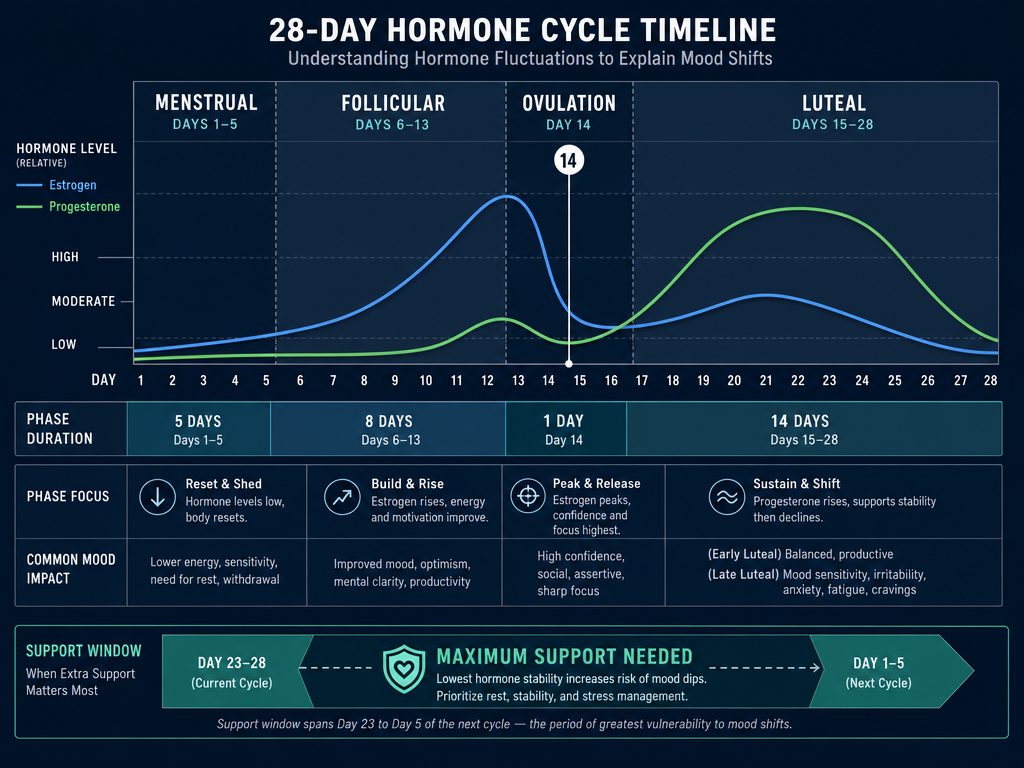
Think of the cycle as four seasons, each with its own biological weather pattern and corresponding emotional climate.
Why Her Needs Change: The Hormonal Logic
Estrogen and progesterone don't just regulate her reproductive system. They directly impact her brain chemistry, energy levels, and emotional processing.
During the follicular phase, estrogen rises as an egg-containing follicle develops in the ovary. This rising estrogen also thickens the uterine lining and, near the end of this phase, triggers a surge in luteinizing hormone (LH) that sets off ovulation. Estrogen affects many body systems, including brain function and the ability to focus, with levels highest in the days leading up to ovulation. Medical sources describe this brain effect in general terms but don't specify an exact mechanism for how estrogen affects day-to-day mood.
After ovulation, the luteal phase begins: progesterone rises to help prepare the uterine lining for a possible pregnancy. If pregnancy doesn't happen, both progesterone and estrogen drop before the next period. This hormonal crash is what drives most PMS symptoms.
The result: her emotional bandwidth, social energy, physical comfort, and need for connection genuinely fluctuate across the month. It's not drama. It's biochemistry.
Phase 1: Menstrual Phase - The Reset Window
Timeline: Day 1-5 (first day of bleeding = Day 1)
What's Happening Biologically: Estrogen and progesterone are at their lowest. Her uterine lining is shedding. Prostaglandins - the lipids that cause uterine contractions - are the biological cause of period pain.
What She's Feeling:
- Fatigue and low energy
- Physical discomfort (cramps, headaches, bloating)
- Introverted energy - she wants to nest, not socialize
- Relief that the emotional chaos of the luteal phase is over
What She Needs from You:
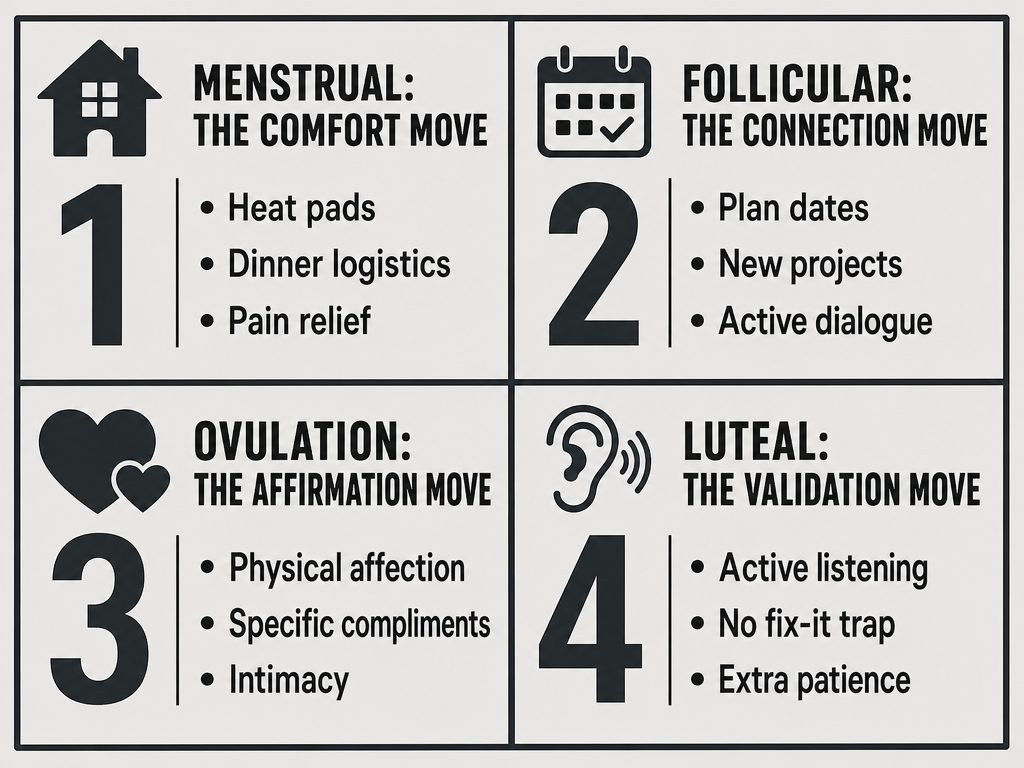
This is the "Comfort Move" phase. She doesn't need you to fix anything or cheer her up. She needs you to take things off her plate and create a low-friction environment.
Tactical Actions:
- Handle logistics without being asked: cook dinner, do the dishes, take out the trash
- Stock the basics: heating pad, ibuprofen, her favorite comfort food
- Offer physical comfort if she wants it (back rubs, cuddling), but don't take it personally if she wants space
- Cancel or postpone high-energy plans - this is not the week for a surprise hike
- Validate her discomfort instead of minimizing it ("You're tough, you'll be fine" doesn't help)
What Not to Do:
- Don't ask if she's on her period in an accusatory tone
- Don't suggest she's overreacting to pain
- Don't expect her usual energy or enthusiasm
If you want a more comprehensive breakdown of exactly what helps during this phase, read our guide on how to help your girlfriend during period mood swings.
Phase 2: Follicular Phase - The Connection Window
Timeline: Day 6-13 (overlaps with menstrual phase, continues until ovulation)
What's Happening Biologically: Estrogen and testosterone levels rise during the follicular phase, typically improving concentration, energy, and mood.
What She's Feeling:
- Energy returning and building
- Optimism and openness to new experiences
- Social and communicative
- Interested in planning and future-focused conversations
What She Needs from You:
This is the "Connection Move" phase. She's primed for quality time, deep conversation, and shared experiences. This is your window for the relationship work you've been putting off.
Tactical Actions:
- Plan dates that involve exploration or novelty (new restaurant, museum, road trip)
- Have the "big talk" conversations - goals, future plans, resolving lingering issues
- Initiate deeper emotional connection - ask thoughtful questions, share your own feelings
- Support new projects or hobbies she's starting
- Show up with energy that matches hers
What Not to Do:
- Don't waste this high-energy window on passive activities (scrolling on the couch)
- Don't be emotionally unavailable when she's reaching out for connection
- Don't dismiss her ideas or enthusiasm as unrealistic
For men who want to master timing important conversations, our menstrual cycle guide for boyfriends explains exactly when to bring up relationship topics.
Phase 3: Ovulation - The Peak Window
Timeline: Day 14-15 (in a 28-day cycle, but timing varies)
What's Happening Biologically: Ovulation is when a surge in luteinizing hormone (LH) causes the ovary to release an egg. In the days just before ovulation, cervical mucus becomes clear and slippery, which is the most fertile window of the cycle.
Around ovulation, many women notice symptoms such as increased sex drive, mild pelvic or abdominal pain, tender breasts, bloating, and mood changes - but these vary substantially person to person, and not everyone notices them.
What She's Feeling:
- Peak confidence and self-assurance
- High sex drive and physical energy
- Outgoing and socially magnetic
- Receptive to affection and compliments
What She Needs from You:
This is the "Affirmation Move" phase. She's at her biological peak and receptive to physical and emotional validation.
Tactical Actions:
- Initiate intimacy (she's more likely to be interested)
- Give genuine, specific compliments - physical and emotional
- Plan high-energy activities (workouts together, adventurous dates)
- Show physical affection - hand-holding, spontaneous kisses, touch
- Match her confidence with your own presence
What Not to Do:
- Don't be passive or low-energy when she's operating at peak capacity
- Don't take her high libido for granted or ignore her advances
- Don't criticize or nitpick when she's feeling confident
Some women experience mittelschmerz - one-sided lower abdominal pain around the time of ovulation. It's a real, documented phenomenon that's generally harmless and usually lasts minutes to a couple of days. If she mentions pain mid-cycle, this is likely what's happening.
Learn more about supporting your girlfriend during ovulation mood changes in our dedicated guide.
Phase 4: Luteal Phase - The Support Window
Timeline: Day 16-28 (from ovulation to the next period)
What's Happening Biologically: After ovulation, the luteal phase begins: progesterone rises to help prepare the uterine lining for a possible pregnancy. If pregnancy doesn't happen, both progesterone and estrogen drop before the next period. Many women notice PMS-like symptoms in this phase - mood shifts, breast tenderness, bloating, acne, and appetite changes - though not everyone does.
This is where most relationship friction happens. PMS (premenstrual syndrome) is very common: as many as 3 in 4 women report experiencing PMS symptoms at some point in their life, though severity varies widely. Symptoms - which can include mood swings, irritability, bloating, breast tenderness, and fatigue - typically show up one to two weeks before a period and resolve within a few days after it starts.
However, roughly half of people who menstruate report having at least one PMS symptom, but only about 1 in 5 have symptoms severe enough to disrupt their daily life. That more disruptive tier is a meaningfully different experience than "typical" PMS.
What She's Feeling:
- Increased anxiety and sensitivity to criticism
- Lower frustration tolerance - small things feel bigger
- Physical discomfort (bloating, breast tenderness, fatigue)
- Need for reassurance and emotional validation
- Withdrawal or desire for alone time
What She Needs from You:
This is the "Validation Move" phase. Your job is not to fix her feelings, but to create a safe space where she feels heard and supported.
Tactical Actions:
- Practice active listening without offering solutions ("I hear you" vs. "Have you tried...")
- Validate her feelings even if the trigger seems small to you ("That sounds frustrating" vs. "It's not a big deal")
- Reduce decision fatigue - make dinner plans, handle logistics, simplify choices
- Offer practical help without being asked
- Give her space if she needs it, but check in gently
- Avoid criticism or debates during this window
What Not to Do:
- Don't dismiss her feelings as "just PMS"
- Don't take irritability personally or escalate arguments
- Don't make big demands on her time or energy
- Don't be defensive when she expresses frustration
When a partner is struggling emotionally, responding with genuine empathy - listening without judgment, focusing on their feelings rather than debating facts, and validating that their reaction makes sense - tends to help more than trying to "fix" the problem or offer silver linings. Feeling understood, not corrected, is what tends to defuse tension.
For tactical scripts and deeper support strategies, see our guide on how to comfort your girlfriend during PMS.
The Communication Pivot: What to Say (and What Not to Say)
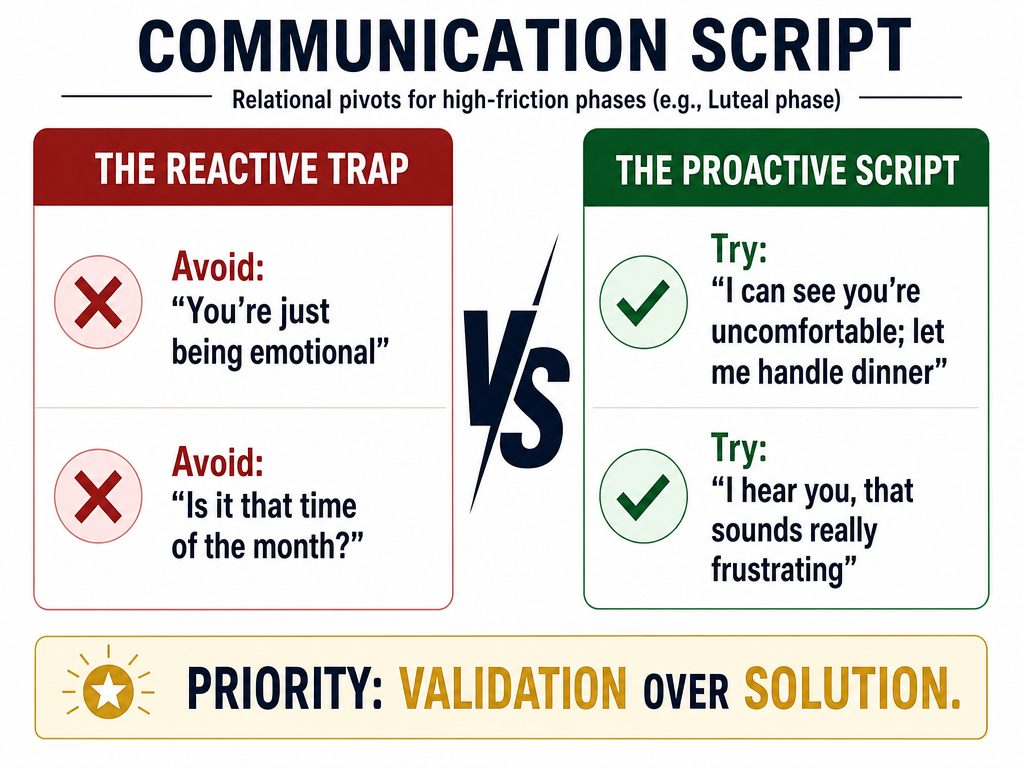
Words matter, especially during the luteal phase when her sensitivity to criticism is heightened. Here's how to pivot from dismissive language to validation-based scripts.
| What She Says | What NOT to Say | What to Say Instead |
|---|---|---|
| "I feel gross." | "You look fine." (dismissive) | "I know you're uncomfortable. Let me handle dinner so you can rest." |
| "I'm exhausted for no reason." | "You just need to sleep more." (problem-solving) | "Your body's going through a lot right now. What would help?" |
| "I'm anxious about nothing." | "You're overthinking it." (invalidating) | "That sounds hard. I'm here if you want to talk or just need quiet company." |
| "Everything's annoying me today." | "Are you on your period?" (accusatory) | "Sounds like a rough day. Want me to take [specific task] off your plate?" |
| "I need space." | "Are you mad at me?" (making it about you) | "Take all the time you need. Let me know if you want anything." |
The pattern: acknowledge her reality, offer concrete help, and resist the urge to debate or fix.
When It's More Than PMS: Understanding PMDD
PMDD (premenstrual dysphoric disorder) is a real, clinically recognized condition - it's listed in the DSM-5 as a depressive disorder, not something people are "making up" or simply failing to cope with. It affects roughly 1 in 10 people who menstruate.
PMDD is a more severe, sometimes disabling extension of PMS. Both happen on a similar timeline (about 7-10 days before a period) and can share physical symptoms like bloating and fatigue, but PMDD specifically involves extreme mood symptoms - such as marked irritability, anxiety, or hopelessness - intense enough to disrupt daily life and strain relationships.
Red Flags That Warrant a Doctor:
- Severe depressive episodes that make it hard to function
- Suicidal thoughts or self-harm ideation
- Panic attacks or uncontrollable rage
- Inability to maintain work, school, or relationships during the luteal phase
- Physical symptoms so severe they're debilitating
If she's experiencing these symptoms, she's not "bad at handling PMS." She may have a medical condition that responds to treatment - therapy, medication, or lifestyle changes under professional guidance.
Your role: don't diagnose, but do encourage her to talk to a healthcare provider if symptoms are severely affecting her quality of life.
The 7-2-1 Rule: A Medical Check, Not a Relationship Guide
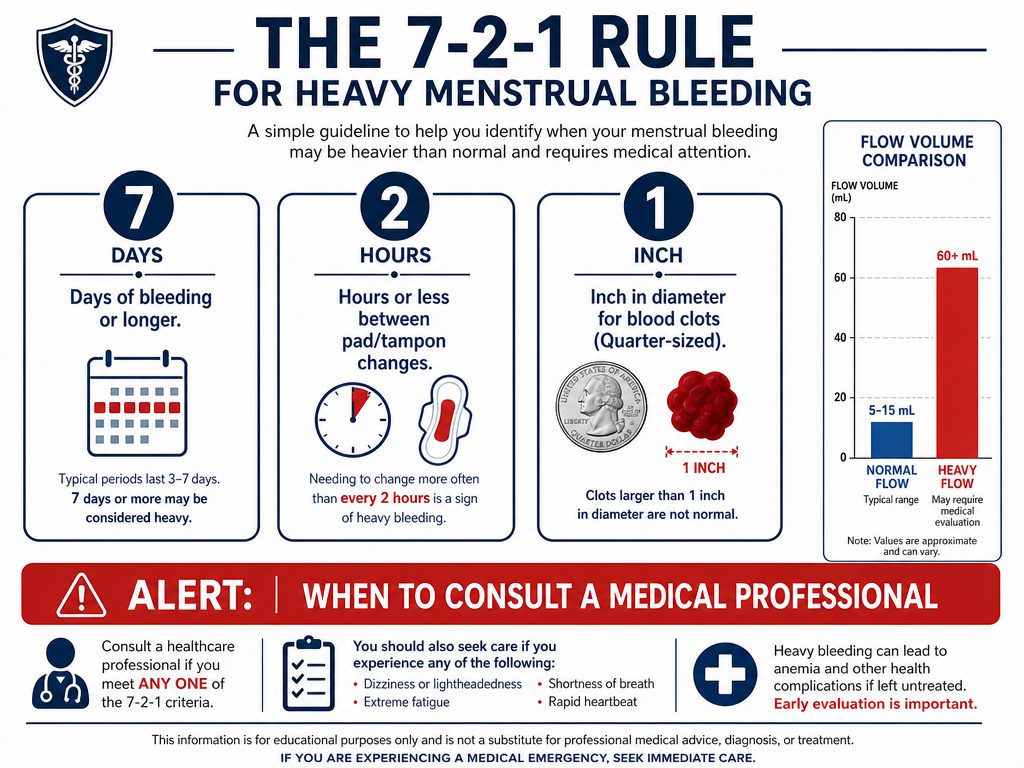
You may have seen the "7-2-1 rule" mentioned online and wondered if it's something you should know about. It's not a relationship guideline - it's a medical diagnostic tool for heavy bleeding.
If your girlfriend meets any of these criteria, it may indicate menorrhagia (abnormally heavy menstrual bleeding), which can lead to anemia and other health issues. This isn't something to ignore or normalize as "just a bad period."
What to Do:
- Gently mention that what she's describing sounds medically significant
- Offer to help her make a doctor's appointment if she's overwhelmed
- Don't frame it as "you're bleeding too much" - frame it as "this might be treatable"
The 7-2-1 rule is not about relationship dynamics. It's a health checkpoint.
Your Tactical Checklist
Here's how to move from reactive to proactive:
1. Track Her Cycle (With Her Permission)
Tracking your own (or a partner's, with her participation) symptoms and mood changes across the cycle for a few months is a legitimate, medically endorsed way to identify real patterns and timing - rather than assuming based on stereotypes or a single cycle.
Use an app like VibeCheck (built for men who want to support their partners), or ask if she'll share her cycle tracker with you. Don't track her secretly - that's creepy, not supportive.
2. Build Your Emergency Support Kit
Stock these before she needs them:
- Ibuprofen or her preferred pain reliever
- Heating pad
- Dark chocolate or her specific comfort food
- Backup tampons/pads/menstrual products
- Herbal tea (chamomile, ginger)
3. Learn Her Specific Patterns
Not every woman experiences every symptom. Ask her (during a neutral phase, not during PMS):
- Which phase is hardest for her
- What actually helps when she's struggling
- What you've done in the past that made things worse
4. Adopt Cycle-Aware Communication
Before bringing up a heavy topic, check where she is in her cycle. Save the "we need to talk about money/your mom/our future" conversations for the follicular phase, not the luteal phase.
5. Support Healthy Coping Strategies
Lifestyle approaches that can help ease PMS symptoms include regular aerobic exercise, smaller/more frequent meals, less salt/caffeine/alcohol, adequate sleep, and stress-reduction practices like deep breathing or yoga. A partner who understands these and is patient and supportive around them (rather than dismissive of symptoms) is aligning with medically recommended self-care, not indulging an excuse.
You're not her therapist or her doctor, but you can create an environment that makes healthy choices easier:
- Suggest a walk together instead of demanding she exercise
- Keep trigger foods out of the house during her luteal phase
- Respect her sleep schedule and bedtime routine
6. Know When to Step Back
Sometimes the most supportive thing you can do is give her space without taking it personally. If she says she needs alone time, believe her.
For more on navigating the luteal phase specifically, check out our tactical partner's guide to luteal phase support.
Frequently Asked Questions
How do I fulfill my partner's emotional needs throughout her cycle?
Start by understanding that her emotional needs genuinely shift based on biological phases. During her period, prioritize comfort and logistics - handle tasks, offer heating pads, create low-pressure environments. In the follicular phase, invest in quality time and deep conversations. Around ovulation, show physical affection and give compliments. During the luteal phase, validate her feelings without trying to fix them, and reduce decision fatigue by taking things off her plate. The key is matching your support style to her current biological state.
What should guys do for their girlfriend during their period?
Handle logistics without being asked. Cook meals, do the dishes, take out the trash. Stock her preferred pain reliever, heating pad, and comfort foods before she asks. Offer physical comfort like back rubs if she wants touch, but respect her need for space if she prefers it. Cancel or postpone high-energy plans - this is not the week for surprise hikes or intense social events. Most importantly, validate her discomfort instead of minimizing it. Saying "you're tough, you'll be fine" doesn't help. Saying "that sounds painful, what do you need?" does.
How do I support my partner during the luteal phase?
The luteal phase requires validation, not problem-solving. Practice active listening - say "I hear you" instead of "have you tried..." When she's frustrated about something that seems small to you, validate the feeling anyway: "that sounds frustrating" works better than "it's not a big deal." Reduce her decision fatigue by making dinner plans and handling logistics without asking. Give her space if she requests it, but check in gently. Avoid criticism, debates, or making big demands on her time during this window. She's not being difficult - progesterone and estrogen are crashing, and her serotonin is dropping with them.
How to explain menstrual phases to men?
Think of the menstrual cycle as four seasons, each with its own biological weather pattern. Week 1 (menstrual phase) is winter - low energy, need for rest and comfort. Week 2 (follicular phase) is spring - energy building, openness to new experiences and deep conversation. Week 3 (ovulation) is summer - peak confidence, high libido, social and outgoing. Week 4 (luteal phase) is fall - mood shifts, increased sensitivity, need for validation and reassurance. Her emotional needs aren't random - they're following a hormonal rhythm. Understanding this pattern helps you stop walking on eggshells and start being a proactive, strategic partner.
What does lack of emotional intimacy do to a woman?
Chronic lack of emotional intimacy can lead to withdrawal, resentment, and eventual disconnection. Women in relationships where they feel consistently unheard or invalidated often report increased anxiety, lower relationship satisfaction, and diminished interest in physical intimacy. Over time, emotional distance erodes trust and makes her less likely to reach out when she's struggling. This is particularly damaging during vulnerable phases of her cycle (like the luteal phase) when she needs validation most. The fix: practice active listening, validate her feelings even when you don't fully understand them, and show up consistently during the phases when her emotional needs are highest.
What is the 7-2-1 rule for menstruation?
The 7-2-1 rule is a medical diagnostic tool for identifying heavy menstrual bleeding (menorrhagia), not a relationship guideline. The rule states: bleeding for more than 7 days, changing pads every less than 2 hours, or passing clots larger than 1 inch. If your partner meets any of these criteria, it may indicate a medical condition that requires treatment. Heavy bleeding can lead to anemia and fatigue. If you notice these patterns, gently suggest she talk to a healthcare provider. Frame it as "this might be treatable" rather than "you're bleeding too much."
What are the signs that a relationship lacks emotional depth?
Surface-level conversations that never go beyond logistics or small talk. Avoiding vulnerability or shutting down when emotions come up. Not knowing (or caring) about each other's internal worlds - fears, dreams, what's actually bothering them. Lack of curiosity about your partner's feelings or dismissing them when they're expressed. Physical intimacy without emotional connection. If you're together but feel alone, if she's stopped sharing what's really on her mind, or if conflict always ends in defensiveness instead of resolution, your relationship likely lacks emotional depth. The fix requires intentional communication, active listening, and showing up during the phases of her cycle when she's most likely to reach out for connection.
What does the 7-2-1 period rule mean?
See "What is the 7-2-1 rule for menstruation?" above - it's a medical checkpoint for heavy bleeding, not a relationship standard. Many people search for this rule thinking it's advice for partners, but it's actually a health screening tool. If your girlfriend meets these criteria, it's worth a conversation with a doctor, not a relationship intervention.
Does my period start at 7pm count as day 1 of my cycle?
Yes. Day 1 of your menstrual cycle is the first day of full menstrual flow, regardless of what time bleeding starts. If bleeding begins at 7pm, that evening counts as Day 1. Light spotting before full flow doesn't count - wait for consistent bleeding. This matters for tracking cycle length and identifying patterns. If you're helping your partner track her cycle, use the first day of real bleeding (not just spotting) as the cycle start point.
Stop guessing and start understanding. Her cycle isn't a mystery - it's a biological rhythm you can learn to work with. When you match your support to her phase, you stop fighting invisible friction and start building the kind of partnership where she feels consistently seen, heard, and valued.
If you want a tool that tracks her cycle and tells you exactly what to do each day, try VibeCheck - the relationship app built for men who want to be better partners, not mind readers.
Tags

Related Articles
Continue reading to deepen your understanding

What to Buy When Your Girlfriend Has Hormone Cravings: A Support Guide
Stop wondering what to pick up at the store. This guide explains the science behind cycle cravings and provides a specific list of foods and comfort items she needs.

Your Girlfriend’s Mood Shifts Throughout the Month, Explained
Ever wonder why her energy and moods change so drastically each week? Understand the four hormonal phases and how to be the partner she needs during every stage of her cycle.

How to Support Your Girlfriend When She’s Crying Because of Hormones
Watching her cry when hormones hit can feel overwhelming. Learn the biological why behind the tears and use these proven scripts to provide the support she actually needs right now.

How to Help Your Girlfriend with Hormonal Mood Swings Without Arguing
Understand her cycle and learn tactical scripts to handle tension. This guide shows you how to support her through hormonal shifts without getting into unnecessary fights.

When to Feed Your Girlfriend: Understanding Hangry Hormones
Does your girlfriend get irritable when she hasn’t eaten? It’s not just in her head. Learn why hormones cause hanger and the specific times her body needs more fuel.

The Boyfriend’s Guide to Supporting Your Partner Through PMS
If your partner is suddenly irritable and exhausted, it’s biology, not you. Learn about the luteal phase and how to provide meaningful support without walking on eggshells.

Why Your Girlfriend Wants Different Things Each Week: The Biological Roadmap
Does your partner seem like a different person every seven days? Understand how her 28-day biological cycle impacts her energy and mood so you can provide the support she actually needs.

How to Help Your Girlfriend When She’s Irritable Before Her Period: The Partner’s Playbook
Is your partner snapping at small things right before her cycle? It’s not you—it’s biology. Learn how to navigate the serotonin crash and provide the support she actually needs.