Your Girlfriend’s Mood Shifts Throughout the Month, Explained

Ever wonder why her energy and moods change so drastically each week? Understand the four hormonal phases and how to be the partner she needs during every stage of her cycle.
Your Girlfriend's Mood Shifts Throughout the Month, Explained
Her energy was through the roof last week. You planned that spontaneous road trip, stayed out late, and she loved every minute. But now? She's irritable, canceled plans, and snapped at you for leaving a dish in the sink.
You didn't do anything different. So what changed?
Her biology did.
Approximately 88% of women experience measurable physical and emotional changes during their cycle. These shifts aren't random. They follow a predictable 28-day pattern driven by four distinct hormonal phases. Understanding this rhythm doesn't just reduce confusion - it gives you a biological roadmap for being the partner she needs, when she needs it.
Table of Contents
- The Four Seasons of Her Cycle
- Why Does My Girlfriend Get Irritable Exactly One Week Before Her Period?
- When in a Woman's Cycle Is She Most Moody?
- The Partner's Playbook: What to Do Each Week
- When to Suggest She Sees a Doctor: The 7-2-1 Rule
- How to Track Her Cycle Without Being Creepy
- Frequently Asked Questions
The Four Seasons of Her Cycle
Think of the menstrual cycle as a biological weather system. You don't control the weather, but you can check the forecast and pack accordingly. The same logic applies here.
A "normal" cycle varies a lot between women - menstrual bleeding can start anywhere from every 24 to every 38 days and last up to 8 days. The "28-day cycle" you've heard about is just the median - not a universal rule. That means exact day-by-day predictions for any specific woman should be treated as approximate. But the pattern of phases stays consistent.
VibeCheck App
Download Free on iOS →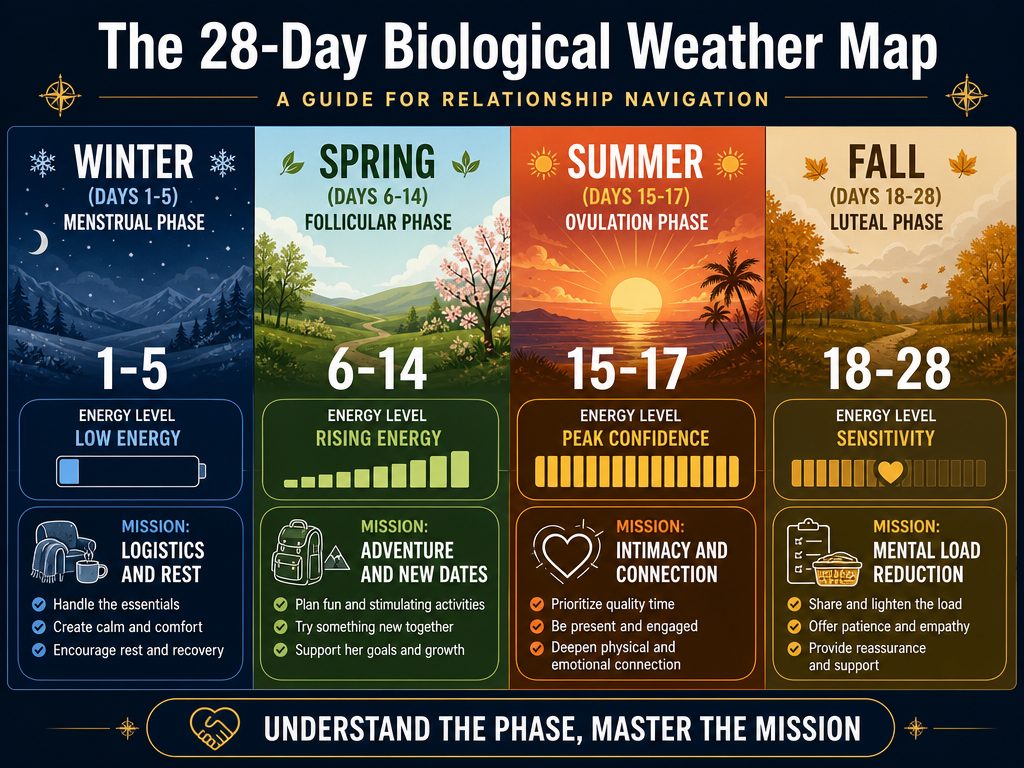 Navigating your partner's cycle is easier when you view it as a four-season weather system, each requiring a different support strategy to maintain relationship harmony.
Winter (Days 1-5): The Menstrual Phase
Winter is when bleeding starts. The menstrual phase is when the uterine lining sheds, causing cramps, fatigue, and low energy. This is the biological equivalent of a system reboot.
What you'll notice:
- She's physically uncomfortable (cramps, bloating, headaches)
- Energy is at its lowest point
- She wants to stay home, not go out
- Social plans feel overwhelming
Your mission: Logistics and rest. Handle the mental load. Pick up groceries, order dinner, do the dishes without being asked. Don't suggest a hike or a party. Offer her the heating pad, bring her water, and let her rest without guilt.
Spring (Days 6-14): The Follicular Phase
During the follicular phase, estrogen rises as an egg-containing follicle develops in the ovary. Her mood lifts, her energy climbs, and she's ready to engage with the world again. This is the biological equivalent of spring - everything is blooming.
What you'll notice:
- Her energy is building
- She's more optimistic and social
- She's open to new ideas and plans
- Conversations feel easier
Your mission: Adventure and new experiences. This is the time to suggest that weekend trip, try a new restaurant, or plan something spontaneous. She's biologically primed for novelty and connection. For more on supporting her during this phase, check out our guide on how to support your girlfriend during the follicular phase.
Summer (Days 15-17): Ovulation
Ovulation is when a surge in luteinizing hormone (LH) causes the ovary to release an egg. Estrogen peaks during the ovulatory phase, which is linked to higher serotonin and improved mood. This is her biological peak - confidence, libido, and social energy are all at their highest.
What you'll notice:
- She's at her most confident and outgoing
- Many women notice increased sex drive around ovulation
- She's more patient and emotionally steady
- Conversations about serious topics go better
Your mission: Intimacy and quality time. This is the best window for deep conversations, romantic dates, and physical closeness. Don't waste this phase scrolling on the couch. For tips on making the most of this phase, read our guide to supporting your girlfriend during ovulation mood changes.
Fall (Days 18-28): The Luteal Phase
After ovulation, the luteal phase begins: progesterone rises to help prepare the uterine lining for a possible pregnancy. If pregnancy doesn't happen, both progesterone and estrogen drop before the next period. This hormonal crash brings PMS-like symptoms - mood shifts, irritability, bloating, and fatigue.
What you'll notice:
- She's more easily irritated or overwhelmed
- Her social battery drains faster
- Small things feel bigger to her
- She needs more alone time or quiet evenings
Your mission: Mental load reduction and space. Don't add to her plate. Cancel plans if she's exhausted. Don't ask her to make decisions or plan logistics. Give her space to recharge without making her feel guilty about it. Learn more in our tactical partner's guide to the luteal phase.
Why Does My Girlfriend Get Irritable Exactly One Week Before Her Period?
The irritability you're noticing isn't a personality flaw - it's neurochemistry. During the luteal phase (Fall), both estrogen and progesterone drop sharply before her period. Estrogen affects many body systems, including brain function and the ability to focus. When estrogen crashes, so do the "happy chemicals" linked to mood regulation.
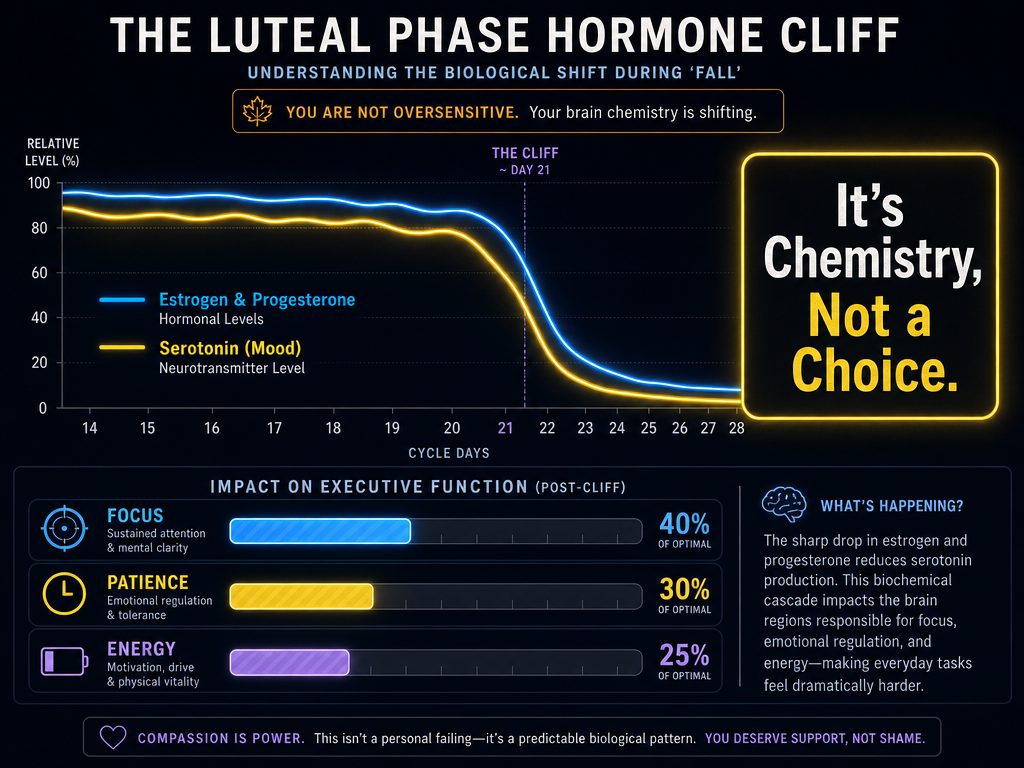 Understanding that mood shifts are driven by a significant drop in serotonin and hormones helps partners provide support rather than taking irritability personally.
Think of it this way: her brain is suddenly running on less fuel. Tasks that felt manageable last week - planning dinner, tidying the apartment, replying to texts - now feel overwhelming. It's not that she doesn't care. It's that her executive function (decision-making, planning, organizing) is biologically compromised.
PMS (premenstrual syndrome) is very common: as many as 3 in 4 women report experiencing PMS symptoms at some point in their life. But roughly half of people who menstruate report having at least one PMS symptom, and only about 1 in 5 have symptoms severe enough to disrupt their daily life.
The difference matters. Typical PMS might mean she's a bit quieter or wants to skip dinner with friends. But if she's experiencing PMDD (premenstrual dysphoric disorder) - a clinically recognized condition that affects roughly 1 in 10 people who menstruate - the symptoms are more severe. PMDD specifically involves extreme mood symptoms - such as marked irritability, anxiety, or hopelessness - intense enough to disrupt daily life and strain relationships. If her symptoms are consistently debilitating, suggest she talk to a doctor. This isn't something she needs to "tough out."
When in a Woman's Cycle Is She Most Moody?
The luteal phase (Fall, days 18-28) is when mood shifts are most noticeable. This is the week or two before her period starts, when progesterone and estrogen are both falling.
But here's the nuance: "moody" isn't the right word. She's not irrational or unpredictable. She's responding to a biological event. 70% of women report sore breasts and 60% report bloating or acne during the premenstrual phase. Add fatigue, cramps, and a serotonin drop, and you've got a recipe for irritability.
She's not moody. She's operating with less energy, more discomfort, and a brain running on fewer neurochemicals. The question isn't "Why is she moody?" It's "How do I support her when her body is going through this?"
For more on recognizing when she needs space during this phase, read our guide to signs your girlfriend needs space.
The Partner's Playbook: What to Do Each Week
Knowing the phases is step one. Step two is adjusting your behavior to match her biological reality. Here's your tactical playbook.
Winter Mission: Logistics and Rest
What to say:
- "I'm handling dinner tonight. What sounds good?"
- "I picked up your favorite chocolate on the way home."
- "You don't need to explain. Just rest."
What to do:
- Handle errands without being asked
- Bring her a heating pad, pain relievers, or comfort food
- Don't suggest social plans or high-energy activities
- Reduce decision fatigue - make the calls yourself
What not to do:
- Don't ask her to plan anything
- Don't minimize her pain ("It's just cramps")
- Don't pressure her to go out if she wants to stay in
Learn more about this phase in our guide to what to do when your girlfriend is on her period.
Spring Mission: Adventure and New Experiences
What to say:
- "Want to try that new place this weekend?"
- "I found a hiking trail we haven't done yet. You in?"
- "What's one thing you've been wanting to do?"
What to do:
- Suggest spontaneous plans
- Book that trip you've been talking about
- Introduce her to something new - a restaurant, activity, or experience
- Have deeper conversations about the future
What not to do:
- Don't default to Netflix on the couch
- Don't cancel plans last minute
- Don't waste this high-energy phase
Summer Mission: Intimacy and Quality Time
What to say:
- "Let's have a real date night. No phones."
- "I've been wanting to talk about [thing you've been avoiding]."
- "You look incredible today."
What to do:
- Plan a romantic date
- Have the big conversation you've been putting off
- Prioritize physical intimacy
- Give her genuine compliments (she's feeling confident - lean into it)
What not to do:
- Don't start a fight (this is your best communication window - don't waste it)
- Don't ignore her when she's making an effort
- Don't take her peak energy for granted
For more on this, check out how to plan romantic gestures around her cycle.
Fall Mission: Mental Load Reduction and Space
What to say:
- "I noticed you're quieter today. What can I take off your plate?"
- "You don't have to come if you're not up for it. No pressure."
- "I'm here if you need anything, but I'm giving you space."
What to do:
- Take tasks off her list without being asked
- Give her permission to cancel plans
- Create a low-stimulation environment (dim lights, quiet space)
- Be patient when she's irritable
What not to do:
- Don't take her irritability personally
- Don't add to her mental load
- Don't force conversation if she's not in the mood
- Don't suggest high-energy activities
Read our comprehensive guide on how to help your girlfriend during period mood swings for more tactical advice.
When to Suggest She Sees a Doctor: The 7-2-1 Rule
Not all period symptoms are "normal." If your girlfriend's bleeding is unusually heavy, there's a simple diagnostic tool you should know: The "7-2-1 Rule" for heavy bleeding.
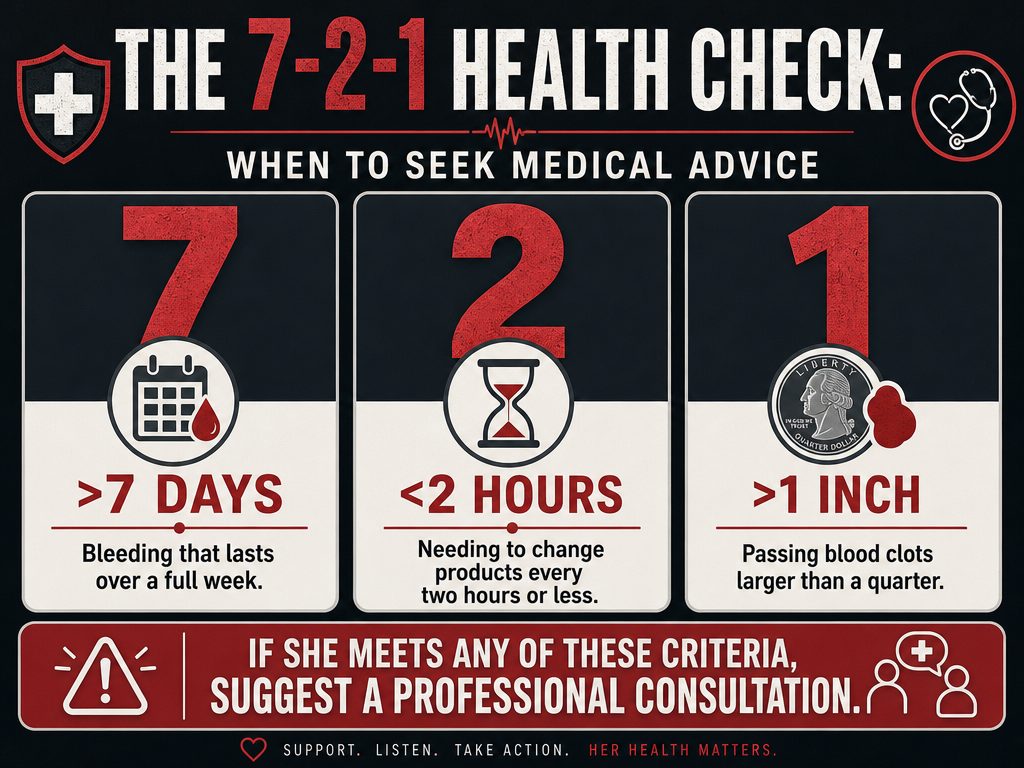 The 7-2-1 rule is a simple diagnostic tool to help you identify when your partner's period might be medically heavy, requiring professional advice.
The 7-2-1 Rule:
- 7 days: Periods lasting more than 7 days
- 2 hours: Changing pads or tampons every 2 hours or less
- 1 inch: Passing blood clots larger than 1 inch
If any of these apply, suggest she talk to a doctor. Heavy bleeding can be a sign of conditions like fibroids, endometriosis, or hormonal imbalances - all of which are treatable.
You're not diagnosing her. You're noticing a pattern and suggesting she get it checked. Frame it that way: "I've noticed your periods seem really heavy. Have you ever talked to a doctor about it?"
How to Track Her Cycle Without Being Creepy
Here's the truth: you can't support her if you don't know where she is in her cycle. But tracking her period shouldn't feel invasive.
The right approach is collaborative, not covert. Ask her if she's comfortable sharing her cycle with you. Frame it as a support tool, not surveillance: "I want to understand your energy and mood better so I can be more helpful. Would you be okay sharing your cycle with me?"
If she's on board, there are apps designed for partners:
- Clue Partner Connect lets her share cycle data with you directly from her tracking app
- VibeCheck gives you a daily "mission" based on her phase so you know exactly what to do
- Flo for Partners sends you notifications when her period is starting
For a full breakdown of the best apps, read our comparison of the best period tracker apps for boyfriends.
Frequently Asked Questions
Can my period affect my boyfriend's mood?
Not directly. Your cycle doesn't biologically change your boyfriend's hormones. But it does affect relationship dynamics. If you're irritable or withdrawn during your luteal phase, your partner might feel confused, rejected, or defensive. Clear communication helps: let him know when you're in a phase where you need more space or support. This reduces misunderstandings and prevents unnecessary conflict.
How do I tell if my period flow is heavy?
Use the 7-2-1 Rule: if your period lasts more than 7 days, you're changing pads every 2 hours, or you're passing clots larger than 1 inch, your flow is medically considered heavy. If any of these apply to you, talk to a doctor. Heavy bleeding can be a sign of fibroids, endometriosis, or hormonal imbalances - all treatable conditions.
At what point in your cycle are you most emotional?
The luteal phase (days 18-28, the week or two before your period) is when emotional symptoms are most noticeable. Progesterone and estrogen both drop during this phase, which affects mood-regulating neurochemicals. Many women feel more tearful, irritable, or anxious during this time. It's not weakness - it's biology.
How to handle mood swings of a girl during periods as a boyfriend?
Don't take her irritability personally. Recognize that she's dealing with physical discomfort and a neurochemical shift. Offer practical help without making her explain herself: handle logistics, reduce her mental load, and give her space to rest. Lifestyle approaches that can help ease PMS symptoms include regular aerobic exercise, smaller/more frequent meals, less salt/caffeine/alcohol, adequate sleep, and stress-reduction practices. A partner who understands these and is patient around them is aligning with medically recommended self-care.
Why does my girlfriend have random mood swings?
They're not random. Her mood shifts follow a predictable hormonal pattern across her cycle. If you're noticing sudden irritability, withdrawal, or tearfulness, check where she is in her cycle. The luteal phase (Fall, days 18-28) is when mood symptoms are most common. If her mood shifts seem extreme or disabling, suggest she talk to a doctor - PMDD is a real condition that is treatable.
How to tell if gf is falling out of love?
Don't confuse hormonal withdrawal with emotional distance. If your girlfriend seems distant during her luteal phase (the week or two before her period), it's likely biological, not relational. Her social battery drains faster during this phase, and she needs more alone time. Give her space without taking it personally. If the distance persists across all phases of her cycle, that's a different conversation - but don't mistake biology for falling out of love. For more on this, read our guide on signs your girlfriend needs space.
Your girlfriend isn't unpredictable. Her mood and energy shifts follow a biological rhythm you can learn to anticipate. Stop reacting to her cycle and start aligning with it. The partners who do this report fewer arguments, better timing on important conversations, and a stronger sense of connection.
Want to stop guessing and start supporting her the right way? Try VibeCheck, the relationship app that turns her cycle data into a daily action plan. Know exactly what she needs, when she needs it.
Tags

Related Articles
Continue reading to deepen your understanding

How to Support Your Girlfriend When She’s Crying Because of Hormones
Watching her cry when hormones hit can feel overwhelming. Learn the biological why behind the tears and use these proven scripts to provide the support she actually needs right now.

How to Help Your Girlfriend with Hormonal Mood Swings Without Arguing
Understand her cycle and learn tactical scripts to handle tension. This guide shows you how to support her through hormonal shifts without getting into unnecessary fights.

When to Feed Your Girlfriend: Understanding Hangry Hormones
Does your girlfriend get irritable when she hasn’t eaten? It’s not just in her head. Learn why hormones cause hanger and the specific times her body needs more fuel.

The Boyfriend’s Guide to Supporting Your Partner Through PMS
If your partner is suddenly irritable and exhausted, it’s biology, not you. Learn about the luteal phase and how to provide meaningful support without walking on eggshells.

Why Your Girlfriend Wants Different Things Each Week: The Biological Roadmap
Does your partner seem like a different person every seven days? Understand how her 28-day biological cycle impacts her energy and mood so you can provide the support she actually needs.

How to Help Your Girlfriend When She’s Irritable Before Her Period: The Partner’s Playbook
Is your partner snapping at small things right before her cycle? It’s not you—it’s biology. Learn how to navigate the serotonin crash and provide the support she actually needs.

How to Tell Your Girlfriend Is Overwhelmed by Hormones
Is she snapping or withdrawing for no reason? Identify the behavioral tells of hormonal overwhelm and learn how to support her during the luteal phase without triggering a fight.

The Proactive Partner’s Guide to Supporting Your Girlfriend Through PMS
Stop guessing why her mood shifted. Understand the biological serotonin crash and learn exactly when to offer support to reduce relationship conflict during her cycle.