How to Understand Your Girlfriend’s Social Battery and Hormones

Does your girlfriend suddenly cancel plans or seem withdrawn? This guide explains how her cycle impacts her energy so you can support her like a pro.
How to Understand Your Girlfriend's Social Battery and Hormones: A Boyfriend's Guide
Your girlfriend cancels plans she made two weeks ago. She's suddenly quiet and withdrawn. You ask what's wrong, and she says, "Nothing," but her social battery is clearly on zero.
Here's what most guys don't realize: her social energy doesn't fluctuate randomly. It follows a predictable biological pattern driven by the same hormones that control her menstrual cycle. Understanding this pattern transforms you from a reactive partner ("What's wrong?") to a proactive one who anticipates her needs before she has to explain them.
This guide decodes the connection between hormones and social energy across all four phases of her cycle, provides tactical scripts for high-friction moments, and gives you a framework for supporting her without being patronizing.
Table of Contents
- Why Her Social Battery Actually Runs on Hormones
- The Four Phases: A Biological Map
- Communication Scripts: What to Say When She's Running on Empty
- The Tracking Conversation: How to Bring It Up
- Red Flags vs. Normal Patterns
- Frequently Asked Questions
Why Her Social Battery Actually Runs on Hormones
The menstrual cycle has four distinct phases: menstrual (bleeding, roughly days 1-5), follicular (day 1 through ovulation, with estrogen rising), ovulation (around day 14 in a 28-day cycle, triggered by a surge in luteinizing hormone), and luteal (after ovulation to the next period, with progesterone rising then falling). The follicular and menstrual phases overlap.
Each phase produces different hormone levels that directly affect brain chemistry, energy, and social motivation. Rising estrogen during the follicular phase is linked to sharper cognitive function, better mood regulation, and higher sociability. Research shows a mid-cycle rise in positive mood and a drop in negative mood is statistically significant in healthy young women around ovulation.
Then comes the crash. After ovulation, progesterone levels significantly covariate with affiliation motivation but also increase sensitivity to social exclusion. Translation: she wants close connection but feels more vulnerable to criticism or perceived rejection. Women with higher progesterone levels during the luteal phase report higher levels of social feedback sensitivity and interpersonal anxiety.
VibeCheck App
Download Free on iOS →This isn't a personality flaw or "being dramatic." It's a biological event affecting neurotransmitter production. Think of it like caffeine withdrawal - when serotonin and dopamine drop before her period, her brain literally has less fuel to filter out annoying social stimuli or regulate irritability.
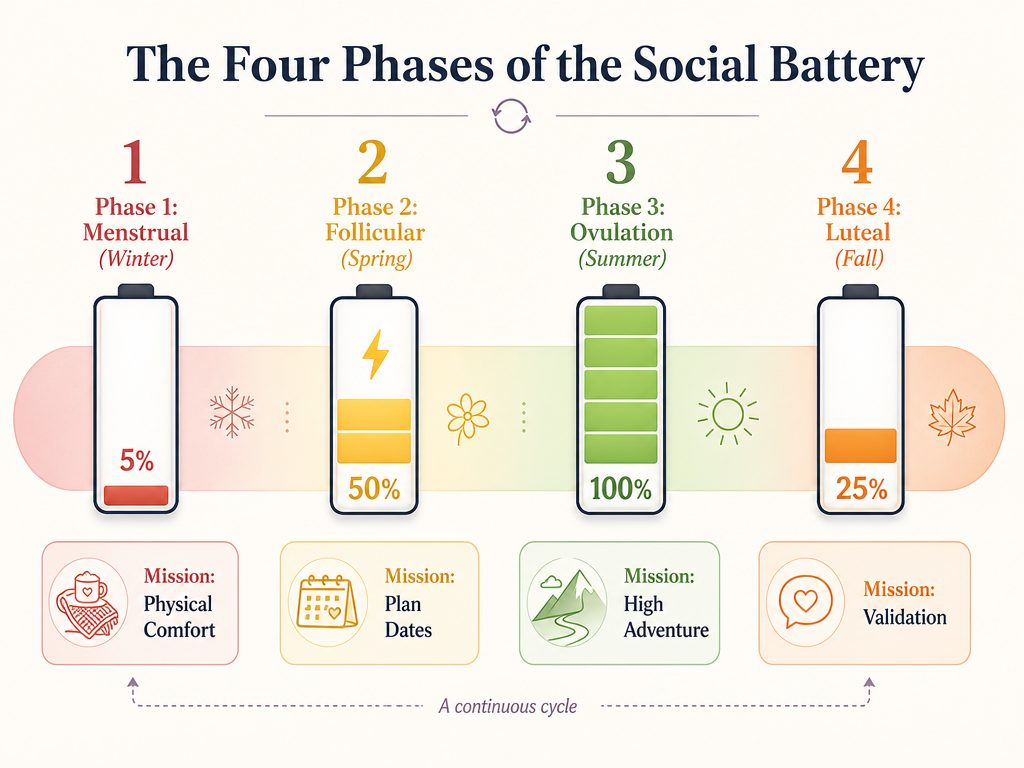 Understanding the four phases of the social battery helps partners anticipate energy shifts rather than reacting to them in the moment.
The Four Phases: A Biological Map
Think of her cycle as four seasons, each with different energy levels and support needs. A "normal" cycle varies considerably between women - menstrual bleeding can start anywhere from every 24 to every 38 days and last up to 8 days. There's no universal 28-day standard, so treat these phases as a general framework, not rigid day-by-day predictions.
Phase 1: Menstrual Phase (Roughly Days 1-5) - Battery Low
What's happening biologically: Hormone levels are at their lowest. Her body is shedding the uterine lining, often with cramps, fatigue, and physical discomfort.
Social battery status: Nearly empty. She's dealing with pain, exhaustion, or both. Group plans, loud environments, and high-energy activities feel overwhelming.
Your mission: Remove friction. This is not the week to suggest a dinner party or ask her to make decisions. Handle logistics invisibly. If she has to manage her period and figure out what's for dinner, you've already failed.
Tactical actions:
- Stock the bathroom with what she needs before she asks.
- Take dinner off her plate entirely - order in, meal prep, or cook something simple.
- Offer a heating pad, ibuprofen (not Tylenol - ibuprofen blocks prostaglandins, which cause cramps), and dark chocolate (magnesium helps with cramping).
- Don't ask, "Are you okay?" Say, "I've got this handled. Rest."
What not to do: Push for plans she made weeks ago. Don't take her low energy personally. Avoid questions like, "Are you on your period?" when she's clearly struggling.
Phase 2: Follicular Phase (Day 1 Through Ovulation) - Battery Charging
What's happening biologically: During the follicular phase, estrogen rises as an egg-containing follicle develops in the ovary. This rising estrogen also thickens the uterine lining and eventually triggers a surge in luteinizing hormone (LH), which sets off ovulation. Estrogen affects many body systems, including brain function and the ability to focus, and levels are highest in the days leading up to ovulation.
Social battery status: Recharging steadily. Energy and mood improve as estrogen climbs. She's more open to plans, conversations, and new activities.
Your mission: Say yes to her ideas. This is the phase where she's most likely to suggest a weekend trip, a new restaurant, or a social gathering. Support her momentum.
Tactical actions:
- Book that date she mentioned.
- Engage in deeper conversations - her cognitive clarity is peaking.
- Plan activities that require coordination or decision-making (she has the mental bandwidth).
- Be responsive to her initiations for connection.
What not to do: Assume this energy will last forever. Don't overcommit her to plans that fall into the luteal phase two weeks later.
For more on navigating this phase as a couple, see our Partner's Field Guide to the Attention Bandwidth Cycle.
Phase 3: Ovulation (Mid-Cycle) - Battery Full
What's happening biologically: A surge in luteinizing hormone (LH) causes the ovary to release an egg, typically around day 14 of a 28-day cycle. Around ovulation, many women notice symptoms such as increased sex drive, mild pelvic or abdominal pain, tender breasts, bloating, and mood changes - though these vary considerably person to person, and not everyone notices them.
Social battery status: Fully charged. This is her peak energy window. She's sociable, confident, and open to adventure.
Your mission: Match her energy. Plan the romantic dinner, the spontaneous road trip, or the social event. This is the week to ask for her opinion on big decisions or have important conversations.
Tactical actions:
- Initiate dates and experiences.
- Be present and engaged - she's at her most receptive.
- Use this window for relationship "state of the union" talks if needed.
- Show romantic effort - flowers, surprises, compliments.
What not to do: Waste the window. Don't spend this week on the couch scrolling your phone. She'll remember if you didn't show up when her battery was full.
Learn how to recognize and support her during this phase in our guide on Supporting Your Girlfriend During Ovulation Mood Changes.
Phase 4: Luteal Phase (After Ovulation to Next Period) - Battery Leaking
What's happening biologically: After ovulation, the luteal phase begins: progesterone rises to help prepare the uterine lining for a possible pregnancy. If pregnancy doesn't happen, both progesterone and estrogen drop before the next period. Many women notice PMS-like symptoms in this phase - mood shifts, breast tenderness, bloating, acne, and appetite changes - though not everyone does.
Social battery status: Draining fast. As hormone levels crash, so does serotonin. She's more irritable, sensitive to criticism, and likely to misinterpret neutral comments as attacks. PMS is very common: as many as 3 in 4 women report experiencing PMS symptoms at some point in their life, though severity varies widely.
Many people who menstruate report having at least one PMS symptom, but a smaller subset have symptoms severe enough to disrupt their daily life. That more disruptive tier is a meaningfully different experience than typical PMS.
Your mission: Validate and reduce friction. This is the week for invisible support - do the dishes without announcing it, pick up groceries she mentioned needing, and give her space to decompress.
Tactical actions:
- Validate her feelings without trying to fix them: "That sounds really frustrating."
- Reduce her mental load - handle chores proactively.
- Offer low-key plans: movie night at home, a walk, or nothing at all.
- Don't debate small irritations. Let minor stuff go.
What not to do: Dismiss her feelings ("You're overreacting") or joke about PMS. Don't schedule high-stress events or important arguments. Avoid tone-deaf comments like, "You're just hormonal."
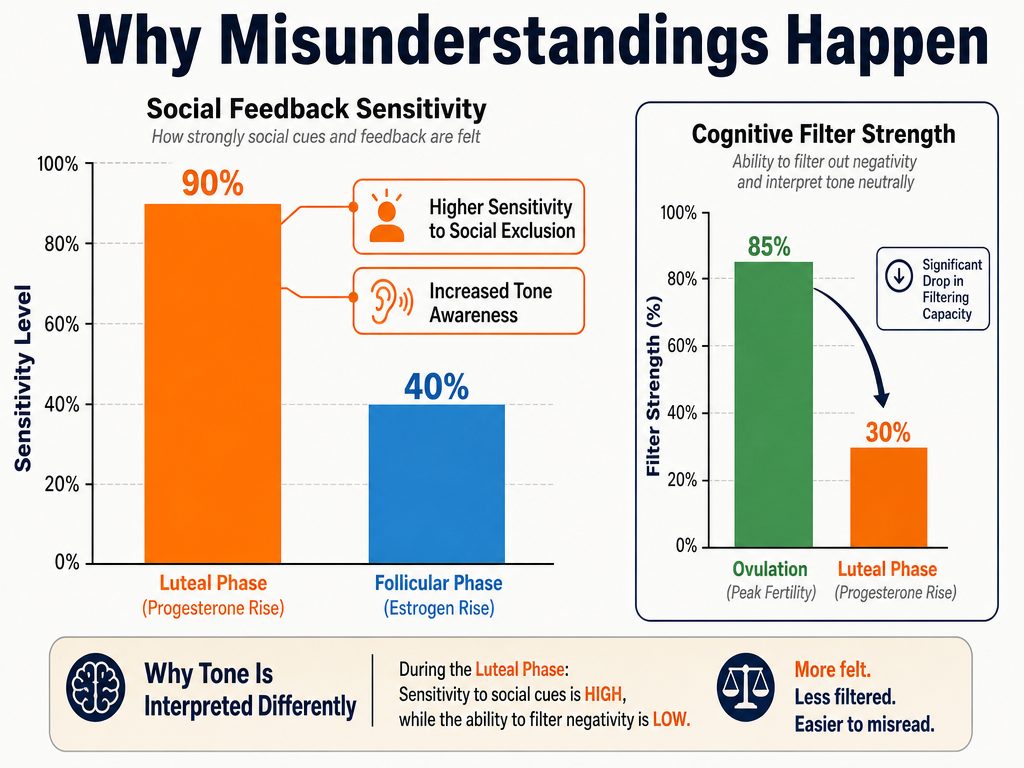 Biological data reveals that women in the luteal phase experience higher social feedback sensitivity, making proactive validation more critical than ever.
For a deeper breakdown of this phase, read Why Her Mood Changes Before Her Period.
Communication Scripts: What to Say When She's Running on Empty
The worst thing you can do when her social battery is low is ask vague questions that require her to manage your confusion. Here are scripts that work.
| Instead of this (reactive) | Say this (proactive) |
|---|---|
| "Are you on your period?" | "I noticed you're dealing with a lot today. I've got dinner handled." |
| "What's wrong?" | "You seem tired. Want me to cancel our plans so you can rest?" |
| "Why are you so moody?" | "I can tell this week has been rough. What can I take off your plate?" |
| "You're overreacting." | "That makes sense. I'd be frustrated too." |
| "Can you just tell me what you need?" | "I'm going to take care of [specific task]. Let me know if you need anything else." |
Notice the pattern: you're naming what you observe, offering a specific action, and removing the burden of explanation. When a partner is struggling emotionally, responding with genuine empathy - listening without judgment, focusing on their feelings rather than debating facts, and validating that their reaction makes sense - tends to help more than trying to "fix" the problem.
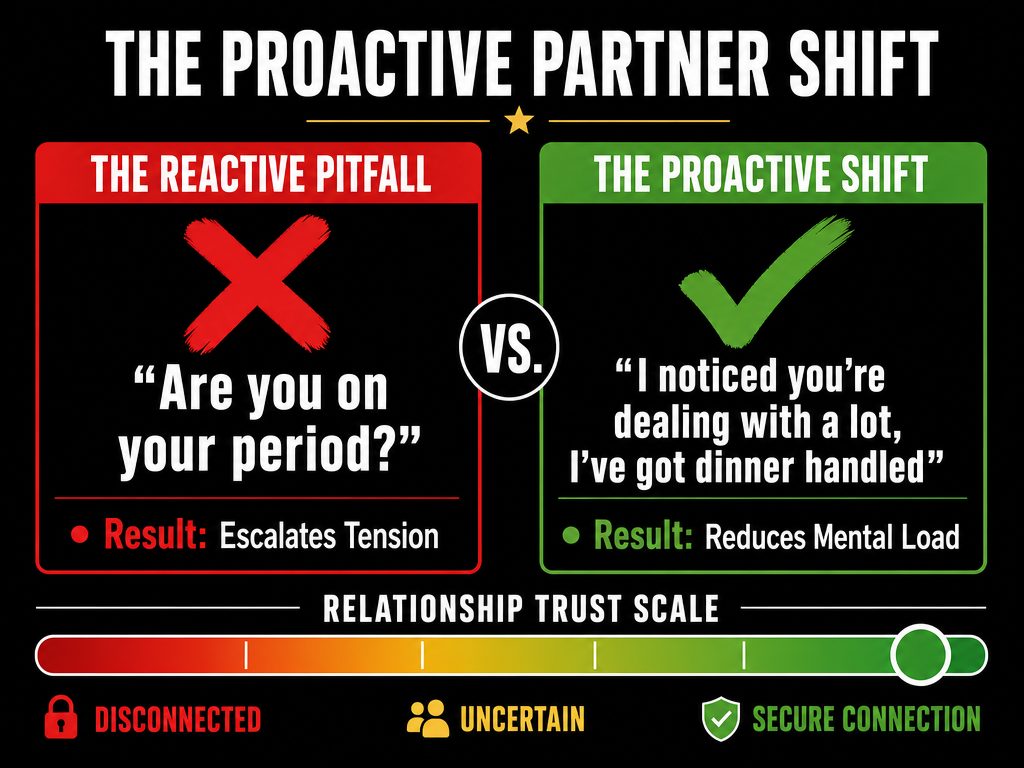 Switching from reactive questioning to proactive support reduces the mental load on your partner and strengthens your relationship during low-energy phases.
The Tracking Conversation: How to Bring It Up
Tracking her cycle without her knowledge is surveillance. Tracking it with her participation is a support tool. Here's how to have that conversation without sounding creepy or controlling.
The setup: "Hey, I've been reading about how the menstrual cycle affects energy and mood, and I realized I've been kind of clueless about how to support you during tough weeks. Would you be open to us using an app together so I can understand your patterns better and be more proactive?"
What you're communicating:
- This is about supporting her, not monitoring her.
- You're admitting you don't know everything and want to learn.
- You're asking for consent, not announcing a plan.
If she says yes: Choose an app with partner mode that respects her privacy. Options include Flo for Partners, Clue Connect, or VibeCheck (which gives you daily missions based on her phase without requiring her to share raw cycle data).
If she says no: Respect it. You can still use this guide to notice behavioral patterns and adjust your support accordingly. Just don't make a big deal of "predicting" her cycle out loud - that's patronizing.
Tracking your own (or a partner's, with her participation) symptoms and mood changes across the cycle for a few months is a legitimate, medically endorsed way to identify real patterns and timing - rather than assuming based on stereotypes or a single cycle.
For a detailed comparison of tracking tools, read Best Period Tracker for Boyfriends.
Red Flags vs. Normal Patterns
Some mood and energy shifts are normal biological responses to hormonal changes. Others signal a deeper issue that needs medical attention. Here's how to tell the difference.
Normal (even if intense):
- Irritability or mood swings that resolve within a few days after her period starts.
- Fatigue or low social energy during the menstrual or late luteal phase.
- Temporary appetite changes or cravings.
- Mild anxiety or feeling more sensitive to social feedback in the week before her period.
Possible red flag (worth discussing with a doctor):
- Symptoms so severe they prevent her from going to work, school, or maintaining relationships.
- Hopelessness, suicidal thoughts, or panic attacks tied to her cycle.
- Severe pain that isn't managed by over-the-counter medication.
- Mood symptoms that don't improve after her period starts.
PMDD (premenstrual dysphoric disorder) is a real, clinically recognized condition - it's listed in the DSM-5 as a depressive disorder, not something people are "making up" or simply failing to cope with. It affects a smaller but meaningful subset of people who menstruate.
PMDD is a more severe, sometimes disabling extension of PMS. Both happen on a similar timeline (in the days before a period) and can share physical symptoms like bloating and fatigue, but PMDD specifically involves extreme mood symptoms - such as marked irritability, anxiety, or hopelessness - intense enough to disrupt daily life and strain relationships.
If you notice any of these patterns, encourage her to talk to a healthcare provider. Frame it as, "I've noticed this is happening every month, and I want to make sure you're getting the support you need," not, "You need to get this fixed."
For more on supporting her through the toughest week, see How to Comfort Your Girlfriend During PMS.
Frequently Asked Questions
How to explain the luteal phase to a man?
The luteal phase is the window between ovulation and her next period. During this time, progesterone rises to prepare the body for a possible pregnancy. If pregnancy doesn't happen, both progesterone and estrogen drop sharply in the final days before menstruation. That hormone crash causes a corresponding drop in serotonin - the neurotransmitter that regulates mood and impulse control. Think of it like coming down from caffeine: she's not choosing to be irritable; her brain is temporarily running on less fuel. The best thing you can do is reduce friction (handle chores without being asked), validate her feelings (don't debate them), and avoid scheduling high-stakes conversations or stressful events during this window.
What should boyfriends do during the luteal phase?
Be proactive, not reactive. Handle tasks invisibly - do the dishes, pick up groceries, or take dinner off her plate without announcing it like you deserve a medal. Validate her feelings without trying to fix them: "That sounds really frustrating" works better than "Have you tried…?" Offer low-key plans or no plans at all - movie night at home beats a loud restaurant. Don't take irritability personally or joke about PMS. Most importantly, don't schedule important relationship talks, family visits, or stressful decisions during this phase if you can avoid it.
Is it normal to feel annoyed with my partner during the luteal phase?
Yes, it's extremely common. During the luteal phase, rising progesterone increases sensitivity to social feedback and interpersonal stress. Small annoyances - like how he chews or interrupts you - can feel magnified. This isn't a sign your relationship is doomed; it's a biological response to hormonal fluctuations affecting neurotransmitter levels. The key is recognizing the pattern so you don't make permanent decisions based on temporary irritability. If you're consistently questioning the relationship only during this phase, that's a sign the feelings are hormone-linked, not relationship-linked.
How can my partner support me during the luteal phase?
Tell him what specific actions help. Vague requests like "be more supportive" don't give him a playbook. Instead, try: "I need you to handle dinner this week," or "I need space to decompress after work - can you give me 30 minutes alone before we talk?" If you're tracking your cycle, consider sharing which phase you're in so he can adjust his expectations and behavior. Lifestyle approaches that can help ease PMS symptoms include regular aerobic exercise, smaller/more frequent meals, less salt/caffeine/alcohol, adequate sleep, and stress-reduction practices like deep breathing or yoga. A partner who understands these and is patient around them is aligning with medically recommended self-care.
Why do I feel annoyed with my partner during the luteal phase?
The short answer: serotonin and progesterone. As progesterone rises and then crashes before your period, it takes serotonin with it. Serotonin regulates mood, impulse control, and your ability to filter out irritating stimuli. When levels drop, things that normally wouldn't bother you - like how your partner breathes or the way he loads the dishwasher - suddenly feel unbearable. It's not that you're imagining the annoyance; your brain is literally less equipped to ignore it. Recognizing this pattern helps you separate what's a hormone-driven reaction from a real relationship issue.
How to track your partner's period cycle?
Only with her informed consent. Start by framing it as a support tool: "I want to understand your patterns better so I can be more helpful. Would you be okay with us tracking your cycle together?" If she agrees, choose an app with a partner mode that respects her privacy. Some options: Flo for Partners (free dashboard for cycle visibility), Clue Partner Connect (shows phase but not raw data), or VibeCheck (gives you daily missions based on her phase without requiring her to manage your learning curve). Never track her cycle on your own phone without telling her - that's surveillance, not support.
Is it normal to dislike your partner during the luteal phase?
Temporary irritability or feeling emotionally distant during the luteal phase is common and biologically driven. If the feeling resolves within a few days of your period starting, it's likely hormone-related. However, if you consistently feel trapped, resentful, or hopeless about the relationship only during this phase, that's worth examining. Keep a journal for two to three cycles to track when the feelings occur and how intense they are. If the negative feelings are always tied to the same week and disappear afterward, hormones are playing a major role. If they persist all month, the issue might be the relationship itself, not your cycle.
Can my period affect my boyfriend's mood?
Indirectly, yes. If you're irritable, withdrawn, or in pain, he might feel confused, helpless, or defensive - especially if he doesn't understand what's happening biologically. Some partners also experience emotional fatigue from walking on eggshells or absorbing your stress. The solution isn't for you to hide your symptoms; it's for both of you to understand the cycle so he can provide informed support instead of reacting emotionally to mood changes he doesn't understand. Clear communication ("I'm in my luteal phase, so I'm more sensitive this week") helps him contextualize your behavior and adjust his approach.
Can men sense when a woman is menstruating?
Some evolutionary psychology theories suggest men might unconsciously pick up on behavioral or scent-related cues during menstruation, but there's no scientific consensus that this is a reliable or universal phenomenon. What men can do is observe behavioral patterns - changes in energy, social withdrawal, or mood shifts - that correlate with specific cycle phases. This requires paying attention over multiple cycles, not relying on a vague "sense." The more useful skill is learning to recognize her signals (fatigue, irritability, changes in appetite) and responding with support rather than trying to "detect" her period like a parlor trick.
The bottom line: Her social battery isn't random, and you're not powerless. Understanding the biological rhythm behind her energy shifts turns you into a strategic partner who anticipates needs instead of reacting to crises. Start with the Four Seasons framework, use the communication scripts when tension rises, and track patterns with her consent. You'll reduce friction, deepen connection, and stop walking on eggshells every month.
For daily missions tailored to her cycle phase, check out VibeCheck - the relationship app built for men who want to stop guessing and start showing up.
Tags

Related Articles
Continue reading to deepen your understanding

How Your Girlfriend’s Emotional Needs Change During Her Cycle
Does your girlfriend’s mood seem unpredictable? Learn how her emotional needs shift on a biological loop and how to support her through every phase of her cycle.

What to Buy When Your Girlfriend Has Hormone Cravings: A Support Guide
Stop wondering what to pick up at the store. This guide explains the science behind cycle cravings and provides a specific list of foods and comfort items she needs.

Your Girlfriend’s Mood Shifts Throughout the Month, Explained
Ever wonder why her energy and moods change so drastically each week? Understand the four hormonal phases and how to be the partner she needs during every stage of her cycle.

How to Support Your Girlfriend When She’s Crying Because of Hormones
Watching her cry when hormones hit can feel overwhelming. Learn the biological why behind the tears and use these proven scripts to provide the support she actually needs right now.

How to Help Your Girlfriend with Hormonal Mood Swings Without Arguing
Understand her cycle and learn tactical scripts to handle tension. This guide shows you how to support her through hormonal shifts without getting into unnecessary fights.

When to Feed Your Girlfriend: Understanding Hangry Hormones
Does your girlfriend get irritable when she hasn’t eaten? It’s not just in her head. Learn why hormones cause hanger and the specific times her body needs more fuel.

The Boyfriend’s Guide to Supporting Your Partner Through PMS
If your partner is suddenly irritable and exhausted, it’s biology, not you. Learn about the luteal phase and how to provide meaningful support without walking on eggshells.

Why Your Girlfriend Wants Different Things Each Week: The Biological Roadmap
Does your partner seem like a different person every seven days? Understand how her 28-day biological cycle impacts her energy and mood so you can provide the support she actually needs.