The Proactive Partner’s Guide to Supporting Your Girlfriend Through PMS

Stop guessing why her mood shifted. Understand the biological serotonin crash and learn exactly when to offer support to reduce relationship conflict during her cycle.
The Proactive Partner's Guide to Supporting Your Girlfriend Through PMS
You've been here before: she's suddenly irritable over something small, exhausted for no clear reason, or withdrawn when everything seemed fine yesterday. You want to help, but you're not sure how - or when. Here's the reality: her mood shifts aren't random, and they're not about you. They follow a biological pattern you can learn to recognize and support.
This guide explains the science behind PMS, the timing of emotional and physical changes, and the specific actions that help without adding to her mental load. You'll learn when symptoms start, what's actually happening in her body, and how to provide support that reduces conflict rather than escalating it.
Table of Contents
- What PMS Actually Is (And Why It Happens)
- The Biological Why: The Serotonin Crash
- The Timeline: When PMS Symptoms Actually Start
- The Invisible Support Framework
- The Communication Script: What to Say (And What Never to Say)
- Clinical Red Flags: The 7-2-1 Medical Rule
- The PMS Tactical Kit
- When PMS Isn't Just PMS: Understanding PMDD
- Frequently Asked Questions
What PMS Actually Is (And Why It Happens)
PMS (premenstrual syndrome) is a set of physical and emotional symptoms that appear in the days or weeks before a period starts. As many as 3 in 4 women report experiencing PMS symptoms at some point in their life, though severity varies widely. Common symptoms include mood swings, irritability, bloating, breast tenderness, and fatigue.
Here's what matters for you: these symptoms typically show up one to two weeks before bleeding begins and usually resolve within a few days after the period starts. Roughly half of people who menstruate report having at least one PMS symptom, but only about 1 in 5 have symptoms severe enough to disrupt their daily life. That more disruptive tier is a meaningfully different experience than "typical" PMS.
The symptoms aren't invented, exaggerated, or a character flaw. They're the result of hormone changes that affect brain chemistry, energy levels, and physical comfort. Your role isn't to fix her or talk her out of how she feels - it's to understand the pattern and provide the right support at the right time.
The Biological Why: The Serotonin Crash
She isn't choosing to be upset. When you understand what's happening in her body, the emotional shifts make sense.
VibeCheck App
Download Free on iOS →The menstrual cycle has four phases: menstrual (bleeding), follicular (estrogen rising), ovulation (peak fertility), and luteal (after ovulation). The luteal phase - the roughly two weeks after ovulation and before the next period - is where PMS symptoms typically appear.
After ovulation, progesterone rises to help prepare the uterine lining for a possible pregnancy. If pregnancy doesn't happen, both progesterone and estrogen drop sharply before the next period. Many women notice PMS-like symptoms in this phase: mood shifts, breast tenderness, bloating, acne, and appetite changes.
Here's the key mechanism: serotonin levels drop significantly during the late luteal phase as progesterone falls. Serotonin is the brain's primary mood stabilizer. When it drops, irritability, anxiety, and sadness can spike - not because she's overreacting, but because her brain chemistry has shifted. Think of it as a chemical withdrawal.
Estrogen affects many body systems, including brain function and the ability to focus, and levels are highest in the days leading up to ovulation. Medical sources describe this brain effect in general terms; the exact neurochemical pathways aren't fully mapped out, but the behavioral patterns are consistent and well-documented.
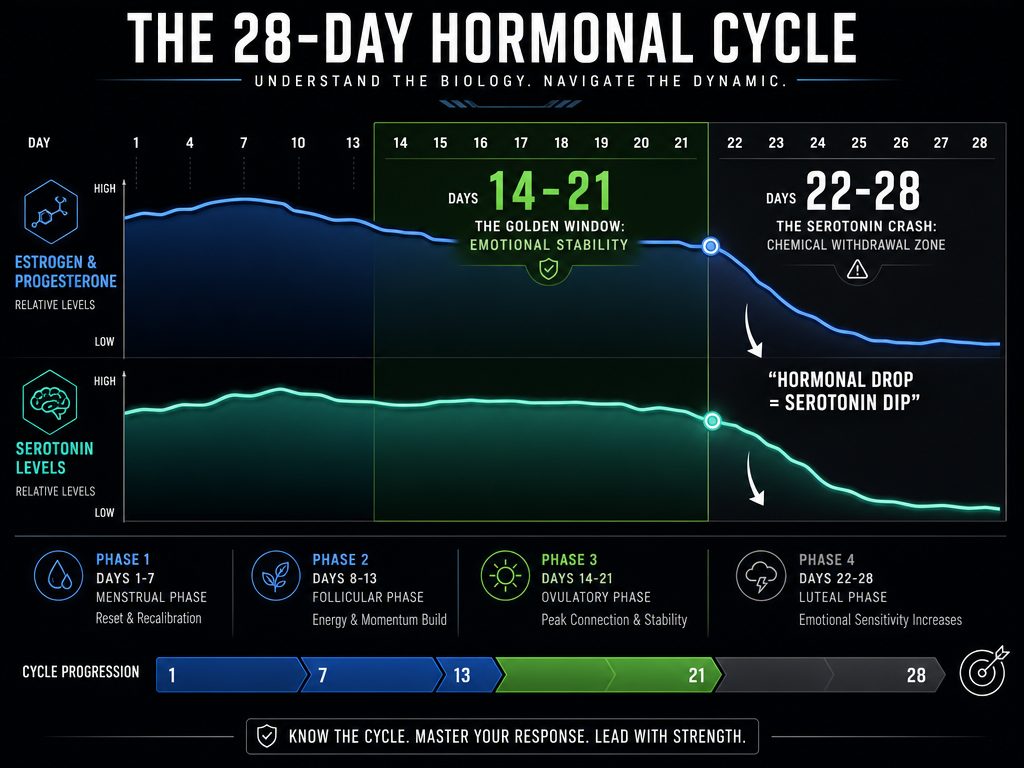
Understanding the 'Serotonin Crash' helps partners recognize that PMS irritability is a biological chemical withdrawal rather than a personal choice or emotional reaction.
The Timeline: When PMS Symptoms Actually Start
Knowing when to expect symptoms gives you a head start. Here's the breakdown:
The Luteal Phase: Days 15-28 (in a typical 28-day cycle, though menstrual bleeding can start anywhere from every 24 to every 38 days)
Days 15-21 (The Golden Window): Hormones are relatively stable after ovulation. Mood and energy are typically steady. This is not the PMS window yet.
Days 22-28 (The Luteal Dip / PMS Window): Progesterone and estrogen begin their sharp decline. This is when the serotonin crash intensifies. Symptoms usually appear 3-7 days before bleeding starts, though some women notice changes up to 14 days before.
Day 1 (Menstruation Begins): Bleeding starts. Symptoms often begin to vanish within 24-48 hours as hormone levels stabilize at their baseline.
This timing is approximate because every woman's cycle is different. Tracking symptoms and mood changes across the cycle for a few months is a legitimate, medically endorsed way to identify real patterns and timing - rather than assuming based on stereotypes or a single cycle.
If you want to track her cycle with her consent and participation, a period tracker for men can help you anticipate the luteal dip and adjust your support accordingly.
The Invisible Support Framework
Most advice tells you to ask, "How can I help?" That sounds thoughtful, but during a serotonin crash, it adds a decision to her plate. She now has to manage your help on top of everything else she's carrying.
Invisible Support means doing the task without asking. It's autonomous, proactive care that removes friction instead of creating it.
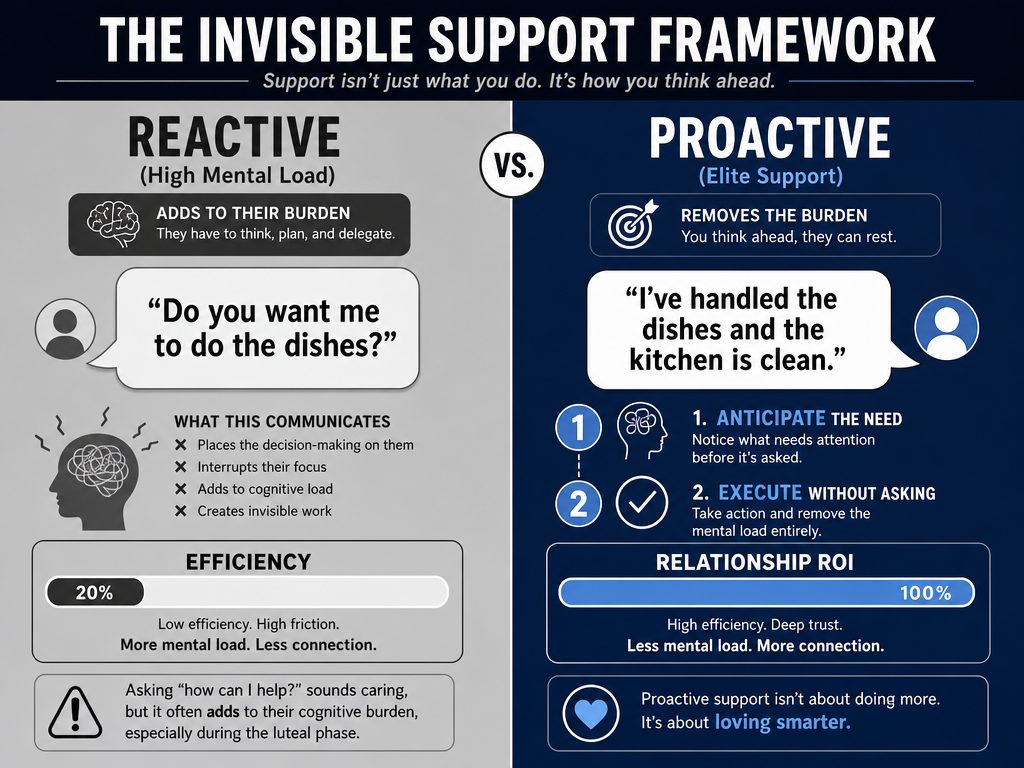
Transitioning from reactive to proactive support reduces your partner's mental load, providing 'invisible support' that maintains relationship harmony during difficult cycle phases.
Here's the contrast:
| Reactive (Weak) | Proactive (Elite) |
|---|---|
| "Do you want me to do the dishes?" | Just doing the dishes. |
| "Tell me what you need." | "I bought your favorite chocolate and the heating pad is on the bed." |
| "Are you okay?" (when she's clearly not) | "I can see you're carrying a lot right now. I'm going to handle dinner." |
| Waiting for her to ask for help | Noticing the laundry is piling up and doing it. |
When a partner is struggling emotionally, responding with genuine empathy - listening without judgment, focusing on their feelings rather than debating facts, and validating that their reaction makes sense - tends to help more than trying to "fix" the problem or offer silver linings. Feeling understood, not corrected, is what tends to defuse tension.
The goal is to reduce the number of decisions she has to make when her brain is already overloaded. That's the difference between walking on eggshells and actually helping.
The Communication Script: What to Say (And What Never to Say)
Your words matter more during the luteal phase because her stress tolerance is lower. Here's the tactical breakdown:
Never Say:
- "Is it that time of the month?" - This dismisses her feelings as hormonal rather than valid.
- "Calm down." - This escalates tension. No one has ever calmed down because someone told them to.
- "You're overreacting." - Even if the trigger seems small to you, her emotional response is real. Invalidating it makes things worse.
- "It's just PMS." - "Just" minimizes her experience. Her symptoms are real and uncomfortable.
Always Say:
- "I can see you're carrying a lot right now. I'm going to handle dinner." - Acknowledges her state without asking her to explain it. Offers concrete action.
- "You're not overreacting. This sounds hard." - Validates her feelings. Shows you're on her side.
- "What would help you feel more comfortable right now?" - Open-ended, non-judgmental. Only use this if you're genuinely ready to act on her answer.
- "I'm here." - Sometimes she doesn't need solutions. She needs to know you're not leaving.
Your tone matters as much as your words. Speak calmly, make eye contact if she's comfortable with it, and avoid defensiveness. Genuine empathy - listening without judgment and validating that her reaction makes sense - is what she needs, not debate or logic.
Clinical Red Flags: The 7-2-1 Medical Rule
PMS is common and manageable. But if her symptoms cross certain thresholds, they're no longer "just PMS" - they're medical red flags that require a doctor, not just a heating pad.
The 7-2-1 rule is a clinical guideline for recognizing heavy menstrual bleeding (menorrhagia). It's not a "how-to" for cycle length - it's a warning system. Here's what to watch for:
- 7 days: Bleeding for more than 7 days is a clinical red flag.
- 2 hours: Changing a pad or tampon every 2 hours or less because it's soaked through.
- 1 inch: Blood clots larger than a quarter (about 1 inch across).
If any of these occur, she needs to see a healthcare provider. Heavy bleeding can lead to anemia, fatigue, and other complications. Your role is to notice the pattern and encourage her to get medical attention without dismissing her symptoms as "just a bad period."
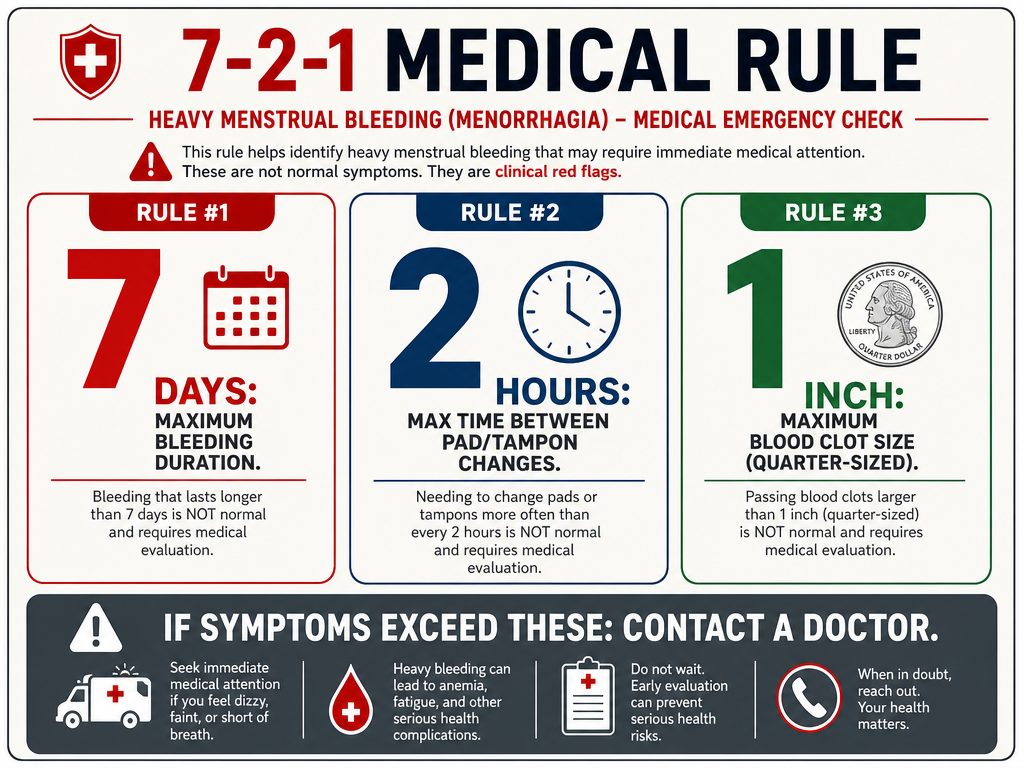
The 7-2-1 rule is a vital medical diagnostic tool. If your partner's symptoms exceed these benchmarks, it indicates a clinical issue requiring professional medical attention.
Other red flags that warrant medical evaluation:
- Symptoms so severe they interfere with work, school, or daily activities.
- Intense pain that doesn't respond to over-the-counter pain relievers.
- Sudden changes in cycle length, flow, or symptom severity.
The PMS Tactical Kit
Preparation beats reaction. Here's what to keep on hand during the luteal phase:
- Heating pad or hot water bottle: Reduces cramps and lower back pain.
- Dark chocolate (70% cacao or higher): Magnesium content can help with mood and muscle relaxation. It's not a medical treatment, but it's a comforting option many women appreciate.
- Magnesium-rich snacks: Almonds, pumpkin seeds, or bananas. Magnesium supports muscle relaxation and can ease cramps.
- Her preferred period products: Don't make her tell you which brand. Know it already.
- Ibuprofen or her preferred pain reliever: Check what she normally uses and keep it stocked.
- A clean, comfortable space: Sometimes the best support is just handling the household chaos so she can rest.
Lifestyle approaches that can help ease PMS symptoms include regular aerobic exercise, smaller/more frequent meals, less salt/caffeine/alcohol, adequate sleep, and stress-reduction practices like deep breathing or yoga. A partner who understands these and is patient and supportive around them - rather than dismissive of symptoms - is aligning with medically recommended self-care, not indulging an excuse.
When PMS Isn't Just PMS: Understanding PMDD
If her symptoms are so severe they're disabling - if she's canceling plans, calling in sick, or experiencing intense hopelessness or rage - it may not be PMS. It could be PMDD (premenstrual dysphoric disorder).
PMDD is a real, clinically recognized condition - it's listed in the DSM-5 as a depressive disorder, not something people are "making up" or simply failing to cope with. It affects roughly 1 in 10 people who menstruate.
PMDD is a more severe, sometimes disabling extension of PMS. Both happen on a similar timeline (about 7-10 days before a period) and can share physical symptoms like bloating and fatigue, but PMDD specifically involves extreme mood symptoms - such as marked irritability, anxiety, or hopelessness - intense enough to disrupt daily life and strain relationships.
PMDD symptoms include:
- Severe mood swings, depression, or hopelessness
- Intense irritability or anger
- Panic attacks or overwhelming anxiety
- Loss of interest in usual activities
- Difficulty concentrating
- Fatigue or low energy
- Changes in appetite or sleep patterns
If you recognize these patterns, encourage her to talk to a healthcare provider. PMDD is treatable with medication, therapy, and lifestyle changes. Your support matters, but this isn't something you can fix alone.
Frequently Asked Questions
How do I help my girlfriend when she's PMSing?
Provide proactive, autonomous support without asking her to manage your help. Do the dishes, handle dinner, stock her favorite comfort foods, and validate her feelings without trying to fix them. Avoid phrases like "Is it that time of the month?" or "Calm down." Instead, say things like "I can see you're carrying a lot right now" and follow through with concrete action. Understanding her cycle timing helps you anticipate her needs before she has to ask.
What is the 7-2-1 rule for menstruation?
The 7-2-1 rule is a medical guideline for recognizing heavy menstrual bleeding (menorrhagia), not a standard for normal cycle length. It flags three warning signs: bleeding for more than 7 days, needing to change a pad or tampon every 2 hours or less, or passing blood clots larger than 1 inch (about the size of a quarter). If any of these occur, she needs to see a healthcare provider, as heavy bleeding can lead to anemia and other complications.
Is it normal to feel anger at my partner during the luteal phase?
Yes, irritability and anger are common PMS symptoms during the luteal phase, typically in the 3-7 days before bleeding starts. Serotonin levels drop significantly during the late luteal phase as progesterone falls, which can trigger mood swings, anxiety, and irritability. This isn't about your relationship - it's brain chemistry. If anger is so intense it's damaging your relationship or daily life, or if it's accompanied by severe depression or hopelessness, it may be PMDD rather than typical PMS, and she should talk to a healthcare provider.
How to explain PMS to your boyfriend?
Frame it as a biological pattern, not a personality flaw. Explain that hormone changes in the week or two before your period cause physical discomfort (cramps, bloating, fatigue) and emotional shifts (irritability, sadness, anxiety) because serotonin - a mood-stabilizing brain chemical - drops when progesterone and estrogen fall. Emphasize that these symptoms are real and temporary, usually resolving within a day or two after bleeding starts. Share what helps you (rest, specific foods, space, or reassurance) and what doesn't (dismissive comments, unsolicited advice, or asking if you're on your period). If he wants to understand your cycle better, suggest he use a period tracker for men to see the pattern over time.
Can my boyfriend get my PMS symptoms?
No, men don't experience the hormonal fluctuations that cause PMS. However, your mood and physical discomfort can affect the emotional tone of the relationship, which he may feel. If he's more stressed or irritable during your luteal phase, it's likely a response to relationship tension, not a biological symptom transfer. Clear communication about your needs and his role in supporting you can reduce this friction.
How does PMS affect relationships?
PMS can increase relationship friction if symptoms aren't understood or validated. Irritability and mood swings during the luteal phase can lead to more arguments, withdrawal, or misunderstandings - especially if a partner interprets emotional shifts as personal attacks rather than temporary, biology-driven changes. When a partner responds with genuine empathy and validates feelings without trying to "fix" the situation, conflict decreases and connection deepens. Learning the timing and providing proactive support (rather than waiting to be asked) reduces tension and builds trust.
How should men deal with PMS?
Learn the biological pattern, provide autonomous support, and validate her feelings without debate. Understand that symptoms typically appear 3-7 days before her period and usually resolve within a day or two after bleeding starts. Stock her comfort items (heating pad, dark chocolate, pain reliever) without being asked, handle household tasks proactively, and avoid dismissive language like "It's just PMS" or "Calm down." Lifestyle approaches that help ease symptoms include adequate sleep, stress reduction, and smaller/more frequent meals - your role is to support these habits, not pressure her to "get over it." If her symptoms are severe or disabling, encourage her to talk to a healthcare provider about PMDD.
PMS isn't a mystery, and it's not something you have to navigate blindly. The symptoms follow a biological timeline you can learn to recognize. Your role is to provide support that reduces her mental load rather than adding to it - proactive care, clear communication, and genuine empathy.
Understanding her cycle doesn't mean you'll never have a conflict during the luteal phase. It means you'll know when to step up, what to avoid saying, and when to encourage her to seek medical care. That's the difference between walking on eggshells and being a proactive partner.
If you want daily, personalized guidance on how to support your partner through every phase of her cycle, VibeCheck gives you science-backed insights and actionable missions tailored to her specific cycle timing. Stop guessing - start understanding.
Tags

Related Articles
Continue reading to deepen your understanding

How to Understand Your Girlfriend’s Social Battery and Hormones
Does your girlfriend suddenly cancel plans or seem withdrawn? This guide explains how her cycle impacts her energy so you can support her like a pro.

How Your Girlfriend’s Emotional Needs Change During Her Cycle
Does your girlfriend’s mood seem unpredictable? Learn how her emotional needs shift on a biological loop and how to support her through every phase of her cycle.

What to Buy When Your Girlfriend Has Hormone Cravings: A Support Guide
Stop wondering what to pick up at the store. This guide explains the science behind cycle cravings and provides a specific list of foods and comfort items she needs.

Your Girlfriend’s Mood Shifts Throughout the Month, Explained
Ever wonder why her energy and moods change so drastically each week? Understand the four hormonal phases and how to be the partner she needs during every stage of her cycle.

How to Support Your Girlfriend When She’s Crying Because of Hormones
Watching her cry when hormones hit can feel overwhelming. Learn the biological why behind the tears and use these proven scripts to provide the support she actually needs right now.

How to Help Your Girlfriend with Hormonal Mood Swings Without Arguing
Understand her cycle and learn tactical scripts to handle tension. This guide shows you how to support her through hormonal shifts without getting into unnecessary fights.

When to Feed Your Girlfriend: Understanding Hangry Hormones
Does your girlfriend get irritable when she hasn’t eaten? It’s not just in her head. Learn why hormones cause hanger and the specific times her body needs more fuel.

The Boyfriend’s Guide to Supporting Your Partner Through PMS
If your partner is suddenly irritable and exhausted, it’s biology, not you. Learn about the luteal phase and how to provide meaningful support without walking on eggshells.