How to Comfort Your Girlfriend During PMS | VibeCheck

PMS affects your relationship too. Learn to navigate her mood shifts and pain with empathy, validation, and practical support that actually helps.
How to Share Your Clue Cycle with Your Partner: Complete Setup Guide
You've decided to share your cycle data with your partner. Smart move - but now you're staring at the Clue app wondering where to even start. Maybe you've heard about Clue Connect but aren't sure if it's worth the subscription. Or maybe you're worried about what your partner will actually see (spoiler: they can't access your private notes).
This guide walks you through the entire process: setting up Clue Connect, understanding exactly what data your partner can view, troubleshooting common errors, and turning raw cycle information into relationship improvements. You'll get step-by-step screenshots, privacy breakdowns, and tactical advice for making shared tracking work.
Quick Answer: Open Clue → Tap "More" (bottom right) → Select "Clue Connect" → Generate a 6-digit invite code → Send to your partner → They enter the code in their Clue app. Done. You need Clue Plus ($9.99/month), but your partner uses the free version.
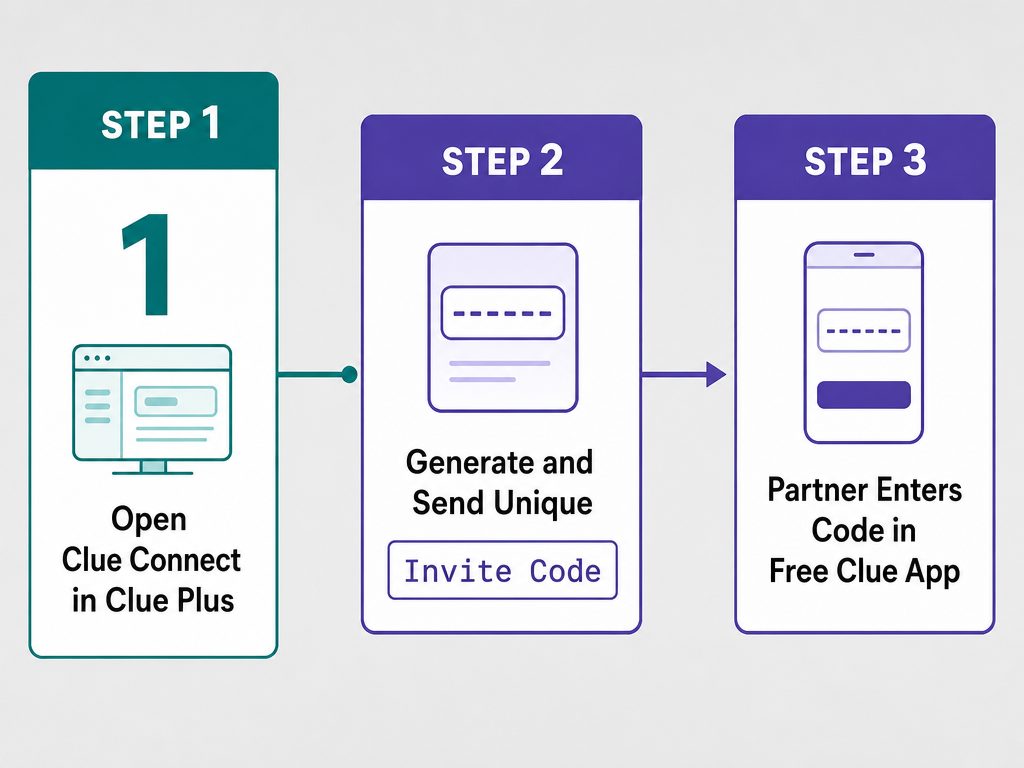
This three-step workflow simplifies the connection process, highlighting that only the person sharing their cycle needs a paid Clue Plus subscription for access.
What Is Clue Connect? (And Why It Matters)
Clue Connect is a feature within the Clue period tracking app that lets you share specific cycle data with one other person. Unlike manually texting "my period started" or awkwardly announcing "I'm PMSing," Clue Connect gives your partner real-time access to your cycle phases, predicted period dates, and fertile window - automatically synced to their device.
Here's what makes it different from other sharing methods:
Scientific Foundation: Clue uses over 60 million logged cycles to predict your patterns. When your partner sees "PMS likely in 3 days," that's not a guess - it's data-backed forecasting.
Privacy Controls: You remain the data owner. You can disconnect your partner instantly. They never see mood logs, symptom notes, or intimate details unless you explicitly choose to discuss them.
One Subscription Model: Only the person sharing their cycle needs Clue Plus ($9.99/month or $59.99/year). The partner viewing the data uses the completely free version of Clue.
This isn't about surveillance or control. It's about giving your partner the information they need to support you without requiring constant communication about where you are in your cycle.
How to Set Up Clue Connect: Step-by-Step Instructions
Setting up Clue Connect takes under three minutes. Here's the exact process:
Step 1: Subscribe to Clue Plus
Before you can use Clue Connect, you need an active Clue Plus subscription. Your partner does not need to pay - only the person sharing their cycle requires the paid plan.
To subscribe:
- Open the Clue app
- Tap "More" in the bottom right corner
- Select "Clue Plus" from the menu
- Choose monthly ($9.99) or annual ($59.99) billing
- Complete payment through your app store
Clue Plus includes additional features beyond partner sharing: Apple Watch integration, custom tracking categories, cycle analysis reports, and data export options. But if you're here specifically for Clue Connect, you're now ready for the next step.
Step 2: Generate Your Clue Connect Invite Code
Once you have Clue Plus active:
- Open Clue and tap "More" (bottom right)
- Select "Clue Connect" from the menu
- Tap "Invite a Partner"
- Clue generates a unique 6-digit code
Important details about invite codes:
- Codes expire after 24 hours for security reasons
- Each code works for one connection only
- You can only connect with one partner at a time
- If your code expires, just generate a new one - there's no limit
Step 3: Send the Code to Your Partner
Send your 6-digit code through whatever communication method you prefer:
- Text message
- Signal or WhatsApp
- In person if you're together
Make sure your partner enters the code within 24 hours. After that window, you'll need to generate a fresh code.
Step 4: Partner Enters the Code
Your partner's process is even simpler:
- Download the free Clue app (iOS or Android)
- Open Clue and complete basic setup
- Tap "More" in the bottom right
- Select "Clue Connect"
- Tap "Connect with invite code"
- Enter your 6-digit code
- Confirm the connection
Both of you will see a confirmation message once the connection succeeds. Your partner's Clue app now displays a separate "Partner Cycle" view showing your data alongside any tracking they do for themselves.
What Can Your Partner See on Clue? Privacy Breakdown
This is the question that stops most people from sharing: "What exactly can they access?"
The answer is specific and limited. Clue Connect shows cycle-related predictions and confirmed events. It does not show personal notes, mood tracking, or symptom details unless those symptoms directly relate to PMS predictions.
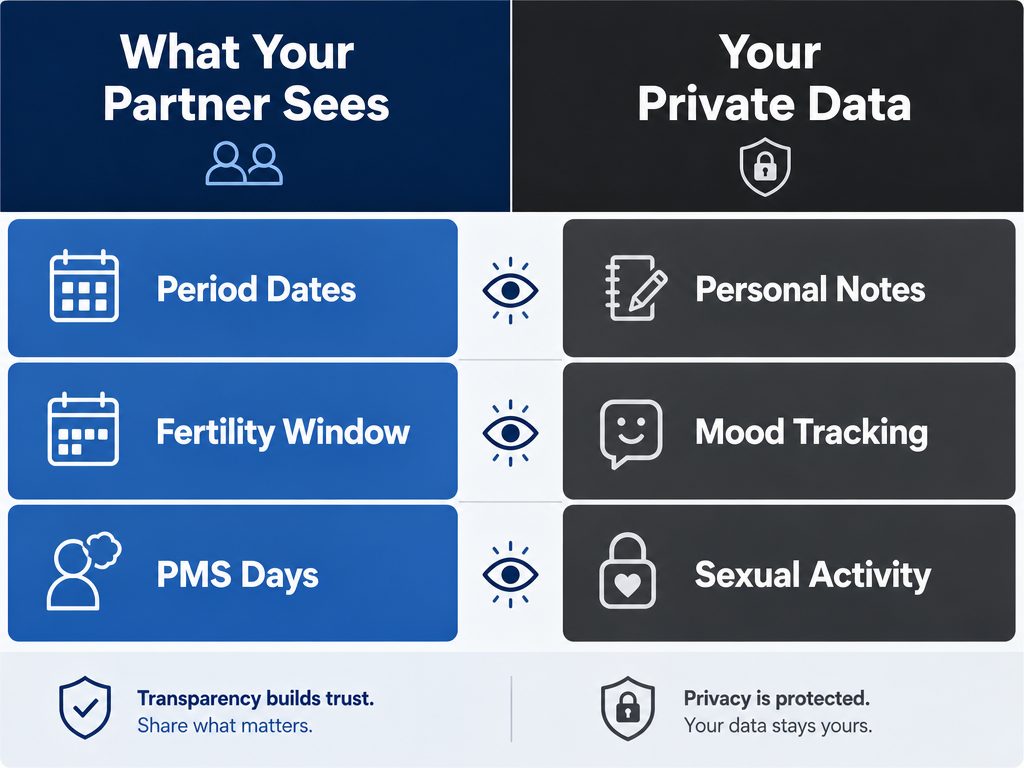
Privacy is a top priority; Clue Connect only shares essential cycle data while keeping your personal notes, moods, and intimate details completely private.
Data Your Partner CAN See
Period Days:
- Predicted start date (based on your cycle history)
- Confirmed period days once you log them
- Predicted end date
- Flow intensity if you track it (light, medium, heavy)
Fertile Window:
- Estimated ovulation day
- High fertility days (typically 5-6 days per cycle)
- Conception probability percentages
PMS Prediction:
- Expected start of premenstrual symptoms
- General intensity level (mild, moderate, severe)
- Duration estimate
Cycle Length Patterns:
- Average cycle length
- Cycle regularity (regular, irregular, very irregular)
- Historical pattern trends
Data Your Partner CANNOT See
Mood Logs: Your daily mood tracking, emotional notes, and mental health observations remain completely private. If you've logged "anxious," "depressed," or "happy," your partner sees none of it.
Symptom Details: Specific symptoms like headaches, cramps, bloating, or breast tenderness aren't visible. The only exception is if those symptoms contribute to the general PMS prediction Clue generates.
Private Notes: Any text notes you add to specific days stay hidden. This includes thoughts about your relationship, work stress, or anything else you choose to record.
Sexual Activity: Sex tracking, protected/unprotected status, orgasm logging, and related data points remain completely private.
Medication Tracking: Birth control pills, pain medication, supplements, and other medication logs aren't shared.
Custom Categories: Any custom tracking categories you've created (sleep quality, exercise, diet) stay private unless they're standard Clue categories included in cycle predictions.
Understanding the Partner's View
When your partner opens Clue Connect, they see a simplified dashboard:
- A calendar view highlighting your current cycle phase
- Today's status (e.g., "Day 14 - Ovulation likely")
- Upcoming events (e.g., "Period predicted in 6 days")
- A color-coded phase indicator (menstruation, follicular, ovulation, luteal)
That's it. Clean, simple, informative - but not invasive.
Clue Connect Troubleshooting Guide
Problems happen. Here's how to fix the most common Clue Connect errors:
"Invalid Code" Error
What causes it:
- Code expired (24-hour limit passed)
- Typo in the code entry
- Code already used for another connection
How to fix it:
- Generate a brand new code (old ones won't work even if re-entered)
- Double-check you're entering all 6 digits correctly
- Ensure no spaces before or after the code
- If you've already connected one partner, disconnect them first before sharing a new code
"No Updates Showing" or Sync Delays
What causes it:
- App needs refresh
- Poor internet connection during sync
- Clue servers experiencing delays (rare)
How to fix it:
- Both users force-close the Clue app completely
- Reopen the app and wait 30 seconds
- Check that both devices have stable internet
- Pull down on the screen to manually refresh
- If still delayed, wait 10-15 minutes - Clue uses background sync that isn't instant
"Connection Lost" Message
What causes it:
- Sharer's Clue Plus subscription expired or lapsed
- Sharer disconnected the partner through settings
- App requires update to newer version
How to fix it:
- Check if your Clue Plus subscription is still active (More > Clue Plus)
- Ensure both users have the latest Clue app version (5.0+)
- If subscription lapsed, renew it - connection restores automatically
- If you intentionally disconnected, you'll need to send a new invite code to reconnect
"Can't Find Clue Connect Option"
What causes it:
- Using an outdated version of Clue
- Haven't completed basic Clue setup yet
- Viewing partner doesn't have Clue app installed
How to fix it:
- Update Clue to the newest version through your app store
- Complete the initial cycle setup wizard (Clue requires at least 3 logged cycles for predictions)
- Ensure the partner has downloaded Clue (not just viewing through a browser)
Partner Sees Wrong Predictions
What causes it:
- Your cycle data needs more time to establish patterns
- Recent cycle irregularities affecting algorithms
- You haven't confirmed recent periods in the app
How to fix it:
- Log every period start and end consistently for 2-3 cycles
- Mark any irregular cycles (illness, stress, travel)
- Update your average cycle length if it's changed
- Remember predictions improve with more data - give it time
Is Clue Plus Worth It for Couples? Pricing Breakdown
Let's talk money. Clue Connect requires a Clue Plus subscription - but only for the person sharing their cycle.
Pricing Options:
- Monthly: $9.99/month
- Annual: $59.99/year (saves $40, equals $5/month)
Your partner pays nothing. They use the completely free version of Clue and still see all the shared cycle data.
What You Get Beyond Partner Sharing
Clue Plus includes several features outside of Clue Connect:
Apple Watch Integration: Track your period directly from your wrist without opening your phone.
Custom Tracking Categories: Create your own symptoms, moods, or activities beyond Clue's standard options.
Cycle Analysis Reports: Detailed charts showing your patterns over time, exportable for sharing with healthcare providers.
Data Export: Download your entire cycle history as a CSV file for personal records or medical appointments.
Priority Support: Faster response times from Clue's support team.
Cost-Benefit Reality Check
Compare $60/year to:
- Couples therapy sessions ($100-200 per session)
- Relationship books and courses ($30-300)
- The cost of preventable arguments (priceless)
If Clue Connect helps you avoid even one major fight per month, it's paid for itself. If it helps your partner understand why you need space on day 23 of your cycle without you having to explain it, it's worth it.
Free Alternatives If Budget Is Tight
If Clue Plus isn't financially feasible right now:
Manual Calendar Sharing: Use Google Calendar or Apple Calendar to mark period days and share the calendar with your partner. It's clunky but free.
Screenshots: Send screenshots of your Clue cycle overview as needed. Not automated, but costs nothing.
Other Apps: Flo and Eve offer different pricing models. Flo's partner mode is $49.99/year. Eve has no partner feature but costs less overall.
The trade-off is convenience and accuracy. Clue's predictions are science-backed and automatic. Manual methods require you to remember to communicate - which defeats half the purpose.
Clue Connect vs. Flo vs. Eve: Which Is Best for Partners?
If you're comparing period tracker apps specifically for partner sharing features, here's how they stack up:
| Feature | Clue Connect | Flo Partner Mode | Eve |
|---|---|---|---|
| Partner Sharing | ✅ Yes (Clue Plus) | ✅ Yes (Flo Premium) | ❌ No dedicated feature |
| Annual Cost | $59.99 | $49.99 | $19.99 (no sharing) |
| Partner Pays? | ❌ Free for viewer | ❌ Free for viewer | N/A |
| Data Visible to Partner | Period, fertile window, PMS | Period, mood summaries, tips | N/A |
| Privacy Protection | ⭐⭐⭐⭐⭐ (notes hidden) | ⭐⭐⭐⭐ (some moods visible) | N/A |
| Prediction Accuracy | Very high (60M+ cycles) | High (230M+ users) | Moderate |
| Setup Complexity | 6-digit code entry | Email-based invite | N/A |
| Apple Watch Support | ✅ Yes | ✅ Yes | ✅ Yes |
| LGBTQ+ Inclusive | ✅ Yes | ⚠️ Limited | ⚠️ Limited |
Why Clue Wins for Privacy-Conscious Couples
Clue Connect shows the least amount of personal data to partners. Flo's partner mode includes mood summaries, which some users appreciate but others find intrusive. Clue's approach - cycle mechanics only, emotions stay private - strikes the best balance.
Why You Might Choose Flo Instead
Flo's lower annual cost ($49.99 vs. $59.99) and massive user base mean more refined predictions for irregular cycles. If your cycles vary significantly month to month, Flo's AI might adapt faster.
Why Eve Isn't a Partner Tracking Option
Eve focuses on sexual health and doesn't offer cycle sharing features. It's great as a personal tracker but won't solve the "how do I share with my partner" problem.
How to Interpret Clue Data as a Partner: Phase-by-Phase Playbook
Seeing cycle data is one thing. Knowing what to do with it is another. Here's how to turn Clue Connect information into relationship improvements.
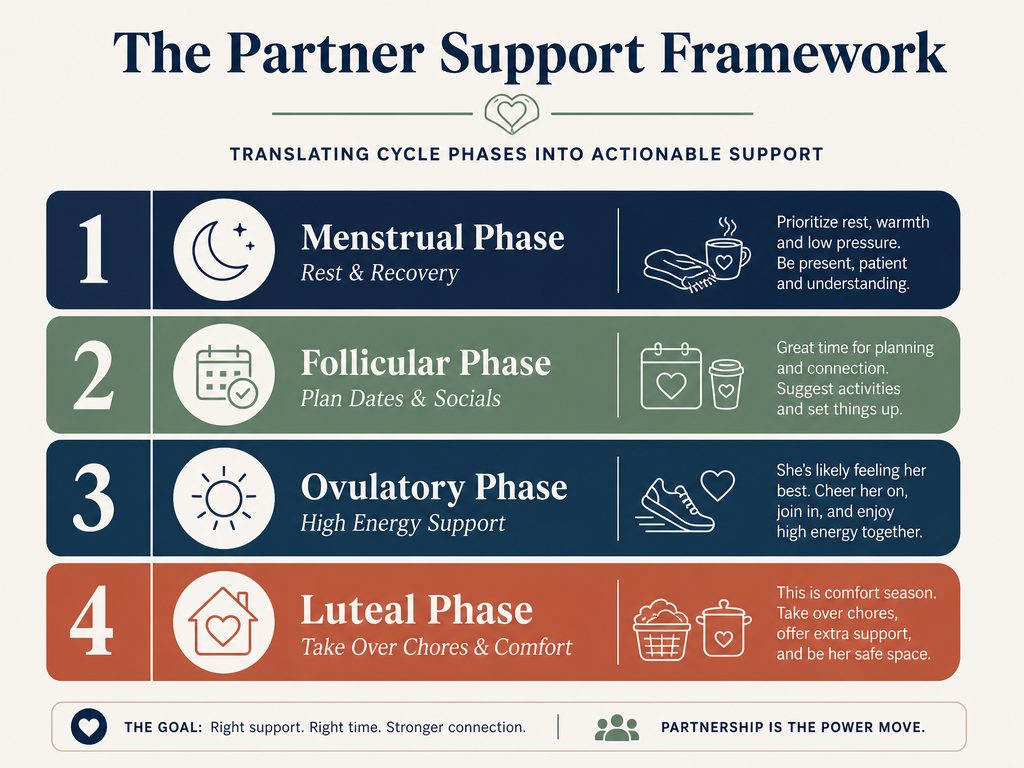
Turn data into action with this support framework, helping partners understand how to best provide comfort and assistance throughout each phase of the cycle.
Menstrual Phase (Days 1-5): Prioritize Comfort
What Clue shows: Active period days, flow intensity
What's happening biologically: Her uterine lining is shedding. Prostaglandins (chemicals that cause cramping) are at peak levels. Energy is typically low.
Your action plan:
- Take over physical tasks (groceries, cooking, cleaning)
- Stock heating pads, pain medication, and her preferred period products
- Suggest low-key activities (movie night at home, not hiking)
- Don't schedule important conversations or decisions
- Ask "What sounds good for dinner?" instead of suggesting heavy meals
Texts that work:
- "I'm picking up Thai food. Want your usual or something lighter?"
- "Taking care of the laundry tonight. You rest."
- "Need me to grab anything from the store?"
Follicular Phase (Days 6-13): Energy and Connection
What Clue shows: Post-period, pre-ovulation window
What's happening biologically: Estrogen rises. Energy rebounds. Mood stabilizes and often improves. She might feel more social and outgoing.
Your action plan:
- Schedule date nights and social activities during this window
- Plan physically active dates (hiking, dancing, sports)
- Have important relationship conversations now (they'll go better)
- Try new activities together (her openness to novelty peaks)
- Match her energy - this is connection time
Texts that work:
- "Want to try that new restaurant this weekend?"
- "Up for hiking on Saturday?"
- "I've been thinking about [future plan]. Want to talk through it?"
Ovulation Window (Days 14-16): Peak Energy and Libido
What Clue shows: Fertile window, ovulation day, high conception probability
What's happening biologically: Estrogen peaks. Testosterone rises slightly. Confidence, energy, and libido hit monthly highs.
Your action plan:
- This is the biological "sweet spot" for intimacy (if you're not trying to conceive, make sure protection is solid)
- Plan romantic dates or weekend trips
- She's likely to initiate more - follow her lead
- Compliments land especially well during this phase
- Energy is high - capitalize on productivity for shared projects
Texts that work:
- "You look amazing today."
- "Want to book that weekend away we talked about?"
- "Feeling like a night out or staying in?" (either answer works - she's feeling good)
Luteal Phase (Days 17-28): The Storm Before the Calm
What Clue shows: PMS prediction, intensity level, expected duration
What's happening biologically: Progesterone rises then crashes. Estrogen drops. Serotonin decreases. Anxiety sensitivity increases. Physical symptoms (bloating, breast tenderness, fatigue) begin.
Your action plan:
- Reduce your asks - don't add to her mental load
- Anticipate needs before she has to ask
- Give extra space if she requests it
- Don't take irritability personally (it's biochemistry, not you)
- Skip big social events unless she specifically wants to go
- Handle logistics (meal planning, scheduling, errands)
Texts that work:
- "I'm handling dinner tonight. No need to think about it."
- "Want company or want to be alone? Both are fine."
- "Anything I can take off your plate this week?"
Advanced move: Check Clue 2-3 days before PMS is predicted. Start implementing support strategies early, before symptoms hit. This prevents the "why didn't you help sooner" conversation.
How to Start the Clue Connect Conversation
You're convinced sharing cycle data helps. Now you need to suggest it without sounding like you're trying to monitor her or control her body.
The Wrong Way to Ask
"Can you share your Clue with me so I know when you're PMSing?"
This frames it as surveillance. It implies you want to predict when she'll be "difficult." Guaranteed failure.
"I read this article that says I should track your period."
This centers your research project, not her comfort. She's not a data experiment.
The Right Way to Ask
"I've noticed you deal with a lot during your cycle, and I don't always know how to help. Would it be useful if I had more context about where you are in your cycle? I saw Clue has a sharing feature - only if you're comfortable with it."
This approach:
- Acknowledges her experience
- Positions sharing as support for her, not control
- Gives her an easy out ("only if you're comfortable")
- Shows you've done basic research
If She's Hesitant
Her concern: "I don't want you judging my moods."
Your response: "The app only shows period timing and general PMS predictions - not mood logs or personal notes. I wouldn't see any of that. It's just so I can be more helpful without you having to tell me every time you're dealing with cramps or low energy."
Her concern: "This feels like you're trying to monitor me."
Your response: "The opposite, actually. Right now you have to communicate everything about your cycle to me. This way, I can anticipate what you need without you having to explain. You stay in complete control - you can disconnect me any time."
Her concern: "What if you use it against me?"
Your response: "That's fair. How about we try it for one cycle? If I ever make you feel dismissed or use the data to invalidate your feelings, you pull the plug immediately. Deal?"
Common Mistakes That Break Clue Connect
Mistake 1: Assuming You Can See Everything
Reality: Partners see period timing and PMS predictions only. You cannot see mood logs, symptom details, or personal notes.
Why it matters: If you assume you have full access, you'll be confused when she mentions symptoms you didn't see in the app. Don't say "But Clue didn't show that." Say "Tell me more about what you're experiencing."
Mistake 2: Sharing the Code via Screenshot After It Expires
Reality: Invite codes expire in 24 hours. Sending a screenshot three days later won't work.
Fix: Send the code immediately and have your partner enter it right away. If they're not ready to set up Clue yet, wait to generate the code until they are.
Mistake 3: Forgetting to Update the Clue App
Reality: Clue Connect requires app version 5.0 or higher. Outdated apps won't show the Clue Connect option.
Fix: Before starting setup, both people update Clue through their app store. Takes 30 seconds, prevents 30 minutes of frustration.
Mistake 4: Treating Predictions as Absolute Truth
Reality: Clue uses algorithmic predictions based on past cycles. They're highly accurate but not perfect.
Why it matters: Don't say "But Clue said your period wasn't supposed to start until Thursday" when it starts Tuesday. Bodies aren't machines. Predictions are guides, not guarantees.
Mistake 5: Using Cycle Data to Dismiss Her Feelings
The trap: "You're only upset because you're in your luteal phase."
Why it fails spectacularly: Even if her cycle is amplifying emotions, her concerns are still valid. Hormones don't create feelings from nothing - they amplify existing frustrations. Dismissing her emotions because of cycle phase is the fastest way to get disconnected from Clue (and possibly the relationship).
The alternative: "I know this week is harder because of where you are in your cycle. What you're feeling is real. How can I support you?"
Mistake 6: Only Checking Clue When Problems Arise
The pattern: You ignore Clue Connect until she's crying, then check the app and say "Oh, PMS week."
Why it backfires: You've turned Clue into a weapon for retroactive analysis instead of proactive support.
Better approach: Check Clue every few days as part of your routine. When you see "PMS predicted in 3 days," you start implementing support strategies before symptoms hit. She feels anticipated, not analyzed.
When It's More Than PMS: The 7-2-1 Rule and PMDD
Clue Connect helps with typical PMS. But sometimes symptoms cross into more serious territory that requires medical attention, not just cycle tracking.
The 7-2-1 Rule for Seeking Help
Use this guideline to determine if symptoms need professional evaluation:
7 days: Symptoms that last more than 7 days per cycle (beyond typical PMS window)
2 cycles: Symptoms that follow the same severe pattern for 2+ consecutive cycles
1 impact: Symptoms that significantly impact 1+ major life area (work, relationships, daily functioning)
If any of these apply, suggest she talk to a healthcare provider. Don't diagnose - that's not your role - but do encourage professional support.
PMDD: When PMS Crosses Into Clinical Territory
Premenstrual Dysphoric Disorder (PMDD) affects 5-8% of menstruating people. It's PMS on a completely different severity scale.
PMDD symptoms include:
- Severe mood swings and irritability
- Depression or hopelessness
- Extreme anxiety or tension
- Panic attacks
- Difficulty concentrating
- Fatigue that's debilitating, not just tiredness
- Physical symptoms that interfere with daily activities
The key difference: PMS is uncomfortable. PMDD is disabling.
If she consistently can't work, maintain relationships, or function normally during her luteal phase, that's not standard PMS. PMDD has treatments - SSRIs, hormonal interventions, and therapy - that significantly improve quality of life.
Your role isn't to diagnose. It's to notice patterns, suggest professional help gently, and support her through the medical process if she chooses to pursue it.
Clue Connect Alternatives: When the App Isn't Right for You
Clue Connect works well for many couples, but it's not universal. Here are alternatives if Clue doesn't fit:
Manual Calendar Sharing
How it works: Use Google Calendar or Apple Calendar to mark period days and predicted cycles. Share the calendar with your partner.
Pros: Free, works with any device, simple
Cons: No automatic predictions, requires manual updates, no PMS forecasting
Best for: Couples on tight budgets or those who prefer analog simplicity
Spreadsheet Tracking
How it works: Create a shared Google Sheet with cycle length, period dates, and PMS symptom severity ratings.
Pros: Completely customizable, free, tracks whatever metrics matter to you
Cons: Requires manual data entry, no scientific predictions, time-intensive
Best for: Data-loving couples who want full control over what's tracked
Conversation-Based Tracking
How it works: Skip apps entirely. She tells you when her period starts and when PMS symptoms begin.
Pros: No technology required, no privacy concerns, completely free
Cons: Requires constant communication, easy to forget, no proactive planning
Best for: Couples who communicate extremely well and don't want app dependence
VibeCheck App
Full disclosure: if you're reading this on VibeCheck, you already know about this option.
How it works: VibeCheck combines cycle tracking with relationship coaching specifically designed for male partners. Instead of just showing cycle data, it delivers daily prompts about what to do, what to say, and when to plan or pause.
Pros: Goes beyond raw data to give actionable advice, personalizes recommendations based on your partner's love language, remembers past feedback to improve suggestions
Cons: Requires subscription for both partners, not focused on detailed health tracking like Clue
Best for: Couples where the male partner wants explicit guidance on how to support, not just information about cycle phases
The tool doesn't matter as much as the commitment. Pick whatever system you'll actually use consistently.
FAQ: Everything Else You Need to Know
Is Clue Connect free for both partners?
No. The person sharing their cycle needs Clue Plus ($9.99/month or $59.99/year). The partner viewing the shared data uses the completely free version of Clue. Only one subscription is required per couple.
Can my partner see my private notes on Clue?
No. Partners cannot see mood logs, symptom details, personal text notes, sexual activity tracking, or custom categories. They only see period days, fertile window predictions, and general PMS timing.
What happens if I cancel Clue Plus?
Your partner loses access to your shared cycle data within 24 hours of subscription cancellation. If you resubscribe later, you'll need to send a new invite code to reconnect.
How do I disconnect a partner from Clue Connect?
Open Clue → Tap "More" (bottom right) → Select "Clue Connect" → Tap "Manage Connections" → Select your partner's name → Choose "Remove Connection." They're disconnected immediately and receive no notification.
Why isn't my Clue invite code working?
Invite codes expire after 24 hours. Generate a new code if yours has passed that window. Also check for typos - codes are case-sensitive. If problems persist, ensure both users have Clue app version 5.0 or higher.
Can I share my Clue cycle with multiple partners?
No. Clue Connect allows connection with only one person at a time. You cannot share your cycle with multiple partners simultaneously. To connect with someone new, you must first disconnect your current partner.
Can both partners share cycles with each other on Clue?
No. Clue Connect is one-directional. If both partners want to share their cycles, you'd need two separate Clue Plus subscriptions, and each person would connect to the other individually. You cannot share cycles bidirectionally within a single connection.
Does Clue Connect work with same-sex couples?
Yes. Clue Connect works for any relationship configuration. Both people in a same-sex relationship can track their own cycles and share with each other (requiring two Clue Plus subscriptions if both want to share).
How accurate are Clue's PMS predictions?
Clue's predictions improve with data. After 3 logged cycles, predictions are moderately accurate. After 6+ cycles, accuracy increases significantly. However, stress, illness, travel, and other factors can shift timing. Treat predictions as guides, not certainties.
Can I use Clue Connect for non-romantic relationships?
Absolutely. Some people share their cycles with mothers, sisters, roommates, or close friends. Clue Connect doesn't require a romantic relationship - just a trusted person who might benefit from cycle awareness.
Will my partner get notifications about my cycle?
Partners receive notifications only if they enable them in their Clue app settings. By default, notifications are off. Your partner controls whether they want alerts for period predictions, PMS timing, or fertile window.
What if my cycles are irregular?
Clue Connect still works with irregular cycles, but predictions will be less precise. The app clearly labels predictions as "low confidence" when cycle patterns vary significantly. Your partner will see this uncertainty reflected in the app.
Can Clue Connect replace conversations about my cycle?
No. Clue Connect provides data, not context. You'll still need to communicate about severity of symptoms, specific needs, and emotional state. The app reduces the need for basic "where am I in my cycle" conversations but doesn't eliminate all cycle-related communication.
Does using Clue Connect mean my partner can track my fertility without my consent?
No. You control what's shared by deciding whether to use Clue Connect at all. You can disconnect your partner at any moment. Clue Connect is a consent-based tool - your partner only has access because you actively granted it.
Sharing your Clue cycle with your partner transforms raw biological data into relationship intelligence. You stop explaining where you are in your cycle every week. Your partner stops guessing what you need. Conflicts decrease because you're both working with the same information instead of operating from assumptions.
Set up takes less than three minutes. The first cycle you track together might feel awkward. By the third cycle, it becomes routine - one of those small relationship optimizations that compounds into major relationship improvements over time.
Tags

Related Articles
Continue reading to deepen your understanding

How to Support Your Girlfriend When She’s Crying Because of Hormones
Watching her cry when hormones hit can feel overwhelming. Learn the biological why behind the tears and use these proven scripts to provide the support she actually needs right now.

How to Help Your Girlfriend with Hormonal Mood Swings Without Arguing
Understand her cycle and learn tactical scripts to handle tension. This guide shows you how to support her through hormonal shifts without getting into unnecessary fights.

When to Feed Your Girlfriend: Understanding Hangry Hormones
Does your girlfriend get irritable when she hasn’t eaten? It’s not just in her head. Learn why hormones cause hanger and the specific times her body needs more fuel.

The Boyfriend’s Guide to Supporting Your Partner Through PMS
If your partner is suddenly irritable and exhausted, it’s biology, not you. Learn about the luteal phase and how to provide meaningful support without walking on eggshells.

Why Your Girlfriend Wants Different Things Each Week: The Biological Roadmap
Does your partner seem like a different person every seven days? Understand how her 28-day biological cycle impacts her energy and mood so you can provide the support she actually needs.

How to Help Your Girlfriend When She’s Irritable Before Her Period: The Partner’s Playbook
Is your partner snapping at small things right before her cycle? It’s not you—it’s biology. Learn how to navigate the serotonin crash and provide the support she actually needs.

How to Tell Your Girlfriend Is Overwhelmed by Hormones
Is she snapping or withdrawing for no reason? Identify the behavioral tells of hormonal overwhelm and learn how to support her during the luteal phase without triggering a fight.

The Proactive Partner’s Guide to Supporting Your Girlfriend Through PMS
Stop guessing why her mood shifted. Understand the biological serotonin crash and learn exactly when to offer support to reduce relationship conflict during her cycle.