How to Comfort Your Girlfriend During Ovulation Mood Swings: The Partner’s Tactical Guide

Is your partner suddenly irritable mid-cycle? It is likely an estrogen crash. Use these tactical tips to navigate her ovulation mood swings with empathy.
How to Comfort Your Girlfriend During Ovulation Mood Swings: The Partner's Tactical Guide
You're not imagining it. Your girlfriend was energized and cheerful last week, and now she's suddenly irritable, anxious, or needs space. If it's mid-cycle, you're likely witnessing what happens when estrogen crashes after ovulation.
This isn't about you. It's biology.
Ovulation happens when a surge in luteinizing hormone (LH) causes the ovary to release an egg, typically around day 14 of a 28-day cycle. In the days leading up to this release, estrogen peaks sharply to support fertility. But immediately after the egg is released, estrogen drops suddenly - and that biochemical shift can trigger a distinct set of emotional responses that many partners mistake for PMS or "random" mood swings.
The truth? Approximately 20-30% of women notice clear mood changes (sensitivity or irritability) during ovulation, and it usually happens in the 24-48 hour window right after the egg is released. Unlike PMS, which stretches across a week or more before her period, ovulation-related mood swings are shorter, sharper, and often misunderstood.
This guide will show you how to distinguish ovulation mood swings from other cycle phases, what's happening biologically, and exactly what to say and do when she's in the post-ovulation crash.
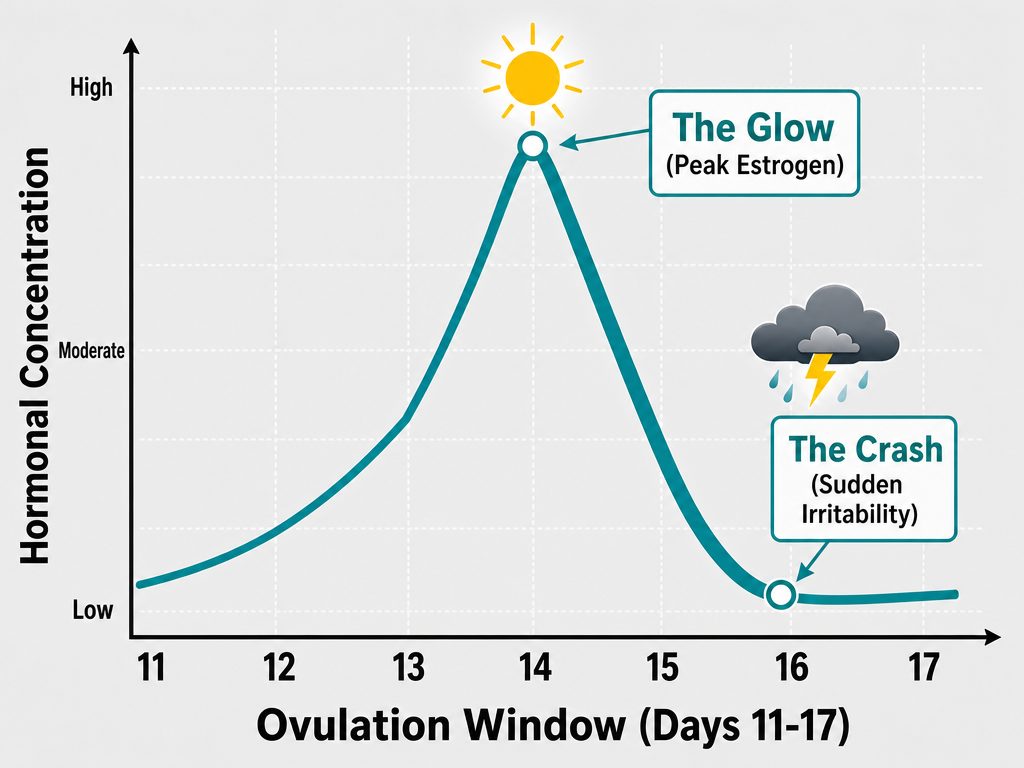 Understanding the biological 'estrogen dip' is crucial for partners, as this rapid hormonal shift is the primary trigger for sudden mid-cycle irritability and mood sensitivity.
Table of Contents
- Why Does Ovulation Cause Mood Swings?
- How to Tell the Difference Between Ovulation and PMS
- The "Validation First" Communication Rule
- Physical vs. Emotional Support: Matching Your Response to Her Phase
- Tracking as a "Silent Skill"
- What Never to Say During Ovulation Mood Swings
- When Ovulation Pain Compounds the Mood Shift
- Frequently Asked Questions
Why Does Ovulation Cause Mood Swings?
Ovulation isn't a single emotional state. It's two distinct biological moments: The Glow and The Crash.
VibeCheck App
Download Free on iOS →The Glow (Days 12-14)
During the follicular phase, estrogen rises as an egg-containing follicle develops in the ovary. Near the end of this phase, high estrogen triggers a surge in luteinizing hormone (LH), which sets off ovulation. Estrogen affects many body systems, including brain function and the ability to focus, and levels are highest in the days leading up to ovulation.
This is when she's at peak energy, confidence, and social interest. Around ovulation, many women notice symptoms such as increased sex drive, mild pelvic or abdominal pain, tender breasts, bloating, and mood changes - though these vary considerably person to person.
Research shows that naturally-cycling women show significantly higher "Positive Affect" (PA) peaks during ovulation compared to those on hormonal contraceptives. The "ovulation glow" is real.
The Crash (Hours 24-48 Post-Ovulation)
Once the egg is released, estrogen drops sharply. For many women, this sudden biochemical shift triggers irritability, anxiety, or emotional sensitivity in the day or two immediately following ovulation. It's not a full week of symptoms like PMS - it's a short, intense window.
The drop in estrogen can temporarily reduce serotonin availability in the brain, which explains the sudden shift from energized to overwhelmed. This isn't a character flaw or an overreaction. It's her nervous system recalibrating after a major hormone peak.
If you're seeing irritability or "walking on eggshells" feelings in the middle of her cycle, you're likely in the post-ovulation crash.
How to Tell the Difference Between Ovulation and PMS
Timing is everything. Here's how to distinguish the two:
| Feature | Ovulation Mood Swing | PMS |
|---|---|---|
| Timing | Mid-cycle, days 12-16 (about 14 days before her period) | Week before period starts (days 21-28) |
| Duration | 1-3 days, sharp and short | 5-7 days, sustained and building |
| Hormone Driver | Estrogen drop after peak | Progesterone drop before period |
| Mood Quality | Sudden irritability, sensitivity, or anxiety spike | Persistent sadness, fatigue, tearfulness |
| Physical Signs | About 40% of women experience physical ovulation pain, known as Mittelschmerz, one-sided lower abdominal pain | Bloating, breast tenderness, headaches, fatigue |
A "normal" cycle varies considerably between women - menstrual bleeding can start anywhere from every 24 to every 38 days. If she tracks her cycle (or you do privately with her consent), note when symptoms show up relative to the start of her next period, not just "mid-month."
If the mood shift happens around two weeks before her period and resolves quickly, it's likely the estrogen crash. If it starts a week before her period and builds into menstruation, it's PMS or possibly PMDD.
The "Validation First" Communication Rule
When she's irritable or anxious during the post-ovulation window, your instinct might be to fix the problem, ask if it's "that time," or offer reassurance. Don't.
When a partner is struggling emotionally, responding with genuine empathy - listening without judgment, focusing on their feelings rather than debating facts, and validating that their reaction makes sense - tends to help more than trying to "fix" the problem or offer silver linings. Feeling understood, not corrected, is what defuses tension.
Scripts That Work
- "I can see you're feeling overwhelmed today. Let me handle dinner."
- "You seem stressed. Do you want to talk, or would you rather have some quiet time?"
- "I notice you're not yourself right now. What do you need from me?"
These scripts validate her experience without mentioning her cycle, which is critical. Even if you're certain it's hormonal, saying "Is it your hormones?" will almost always escalate the conflict.
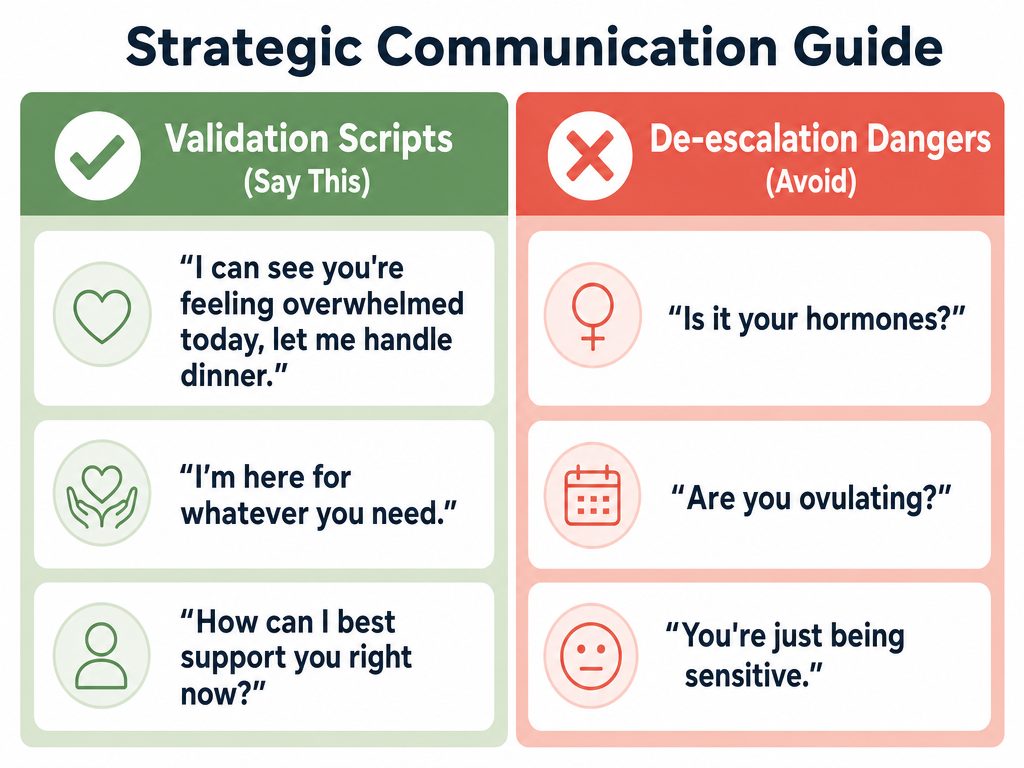 Choosing validation over biological questioning is a key de-escalation tactic. Using specific scripts allows you to provide support without making your partner feel studied or monitored.
What Not to Say
- "Are you on your period?" (She's not - ovulation is mid-cycle.)
- "You're being so moody today."
- "Is this about your hormones?"
- "You were fine yesterday, what changed?"
These questions, even when asked with good intentions, feel dismissive. She may not even realize it's cycle-related, and pointing it out won't help her regulate. Your job isn't to diagnose - it's to support.
For men wondering how to apologize to their girlfriend after a fight, timing matters here too. If she's in the post-ovulation crash, wait 20-60 minutes after the conflict before attempting repair. Immediate apologies can feel performative when her nervous system is still flooded.
Physical vs. Emotional Support: Matching Your Response to Her Phase
Your support strategy should shift based on whether she's in "The Glow" or "The Crash."
If She's in "The Glow" (Peak Ovulation, High Energy)
This is her biological summer. She's at peak confidence, social energy, and desire for novelty.
Do:
- Take the lead on planning social activities or date nights
- Suggest outings that involve movement or new experiences
- Be present for intimacy - her libido is naturally elevated
- Match her energy level without overwhelming her schedule
Don't:
- Cancel plans last-minute (she's counting on them)
- Be passive or wait for her to initiate everything
- Assume she wants "quiet nights in" - she likely doesn't
If you're looking for relationship advice based on her cycle, this is the phase to capitalize on for bonding activities, serious conversations about the future, or quality time together.
If She's in "The Crash" (Post-Ovulation, 1-3 Days After)
This is when the estrogen drop hits. She may feel irritable, anxious, or suddenly need space.
Do:
- Offer "low-stakes" companionship (watch a show together, cook dinner, run her a bath)
- Handle logistical tasks without being asked (dishes, errands, cleaning)
- Give her physical space if she requests it
- Keep your tone calm and your questions minimal
Don't:
- Push for big conversations or "state of the relationship" talks
- Plan surprise activities that require high social energy
- Take her irritability personally - it's temporary
If she's dealing with Mittelschmerz - one-sided lower abdominal pain around the time of ovulation - physical comfort becomes even more important. Offer a heating pad, suggest she rest, and avoid planning anything physically demanding.
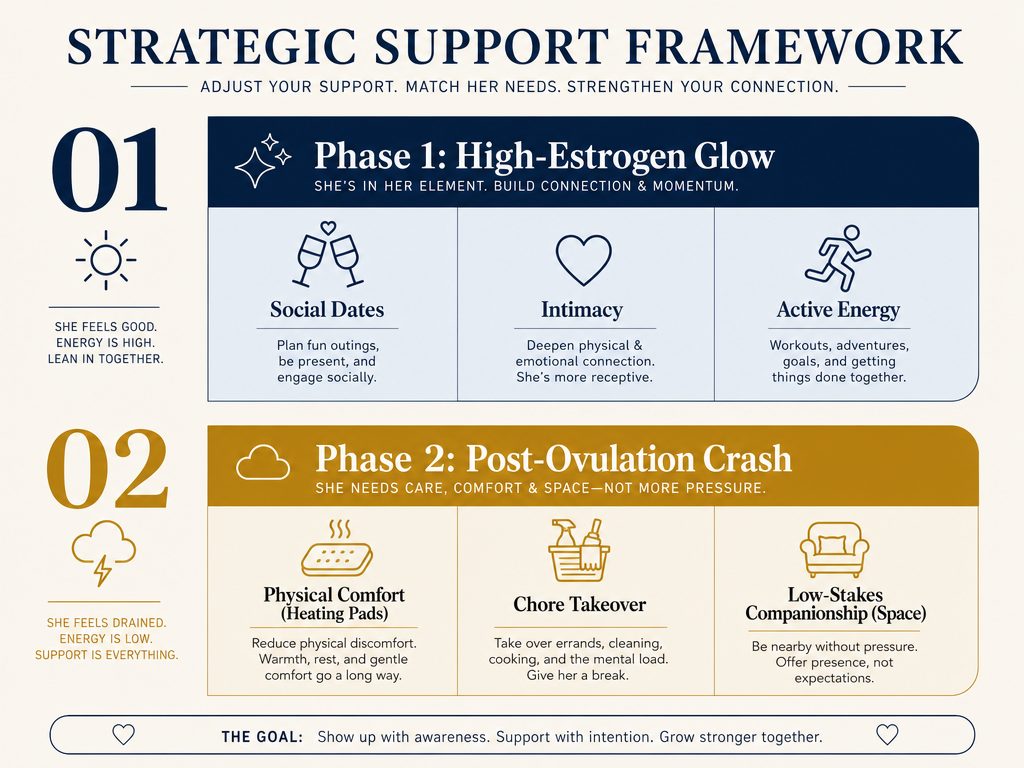 Effective support shifts based on the hormonal phase, moving from active social engagement during 'The Glow' to practical help and quiet physical comfort during 'The Crash.'
Tracking as a "Silent Skill"
The most effective partners track the cycle privately - not to "monitor" or "study" their girlfriend, but to anticipate shifts and adjust their own behavior proactively.
Tracking your own (or a partner's, with her participation) symptoms and mood changes across the cycle for a few months is a legitimate, medically endorsed way to identify real patterns and timing - rather than assuming based on stereotypes or a single cycle.
How to Track Without Being Creepy
- Ask permission. "Would it help if I kept track of your cycle so I can be more supportive? I want to know when to step up without you having to ask."
- Use a partner-focused app. Tools like VibeCheck are designed specifically for men who want to understand their partner's cycle without invading privacy.
- Never weaponize the data. Don't say "You're just irritable because you're ovulating." Use the information to adjust your behavior, not to dismiss hers.
If she's comfortable sharing her cycle data, mark ovulation (typically day 14) and note the 24-48 hour window immediately after. That's when the estrogen crash happens. Clear your schedule during that window to be more available.
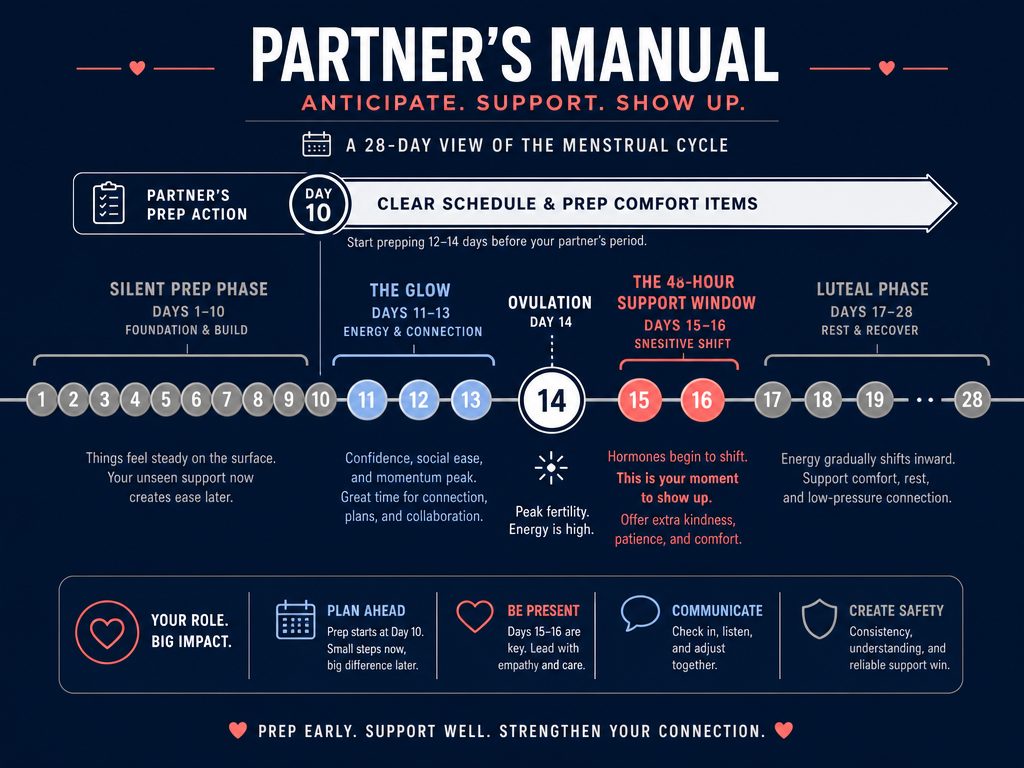 By tracking the cycle privately, partners can anticipate the 48-hour sensitivity window and proactively clear their schedules to provide maximum support without being asked.
Many men find that understanding the four phases of the menstrual cycle - menstrual, follicular, ovulation, and luteal - makes it easier to anticipate needs across the entire month, not just during ovulation.
What Never to Say During Ovulation Mood Swings
Even well-meaning comments can backfire. Here are phrases that almost always make things worse:
- "Is it that time of the month?" - Ovulation is not the period. This question shows you don't understand her cycle.
- "You're overreacting." - Dismissing her feelings will escalate the conflict.
- "Just calm down." - This has never worked in the history of relationships.
- "You were fine yesterday." - Yes, because yesterday her estrogen hadn't crashed yet.
- "Why are you so sensitive?" - Because her brain chemistry is recalibrating after a major hormone peak.
If you want to learn how to talk to your girlfriend during different phases, the post-ovulation window requires extra tact. Avoid high-stakes conversations, confrontational topics, or anything that requires her to make big decisions.
When Ovulation Pain Compounds the Mood Shift
Mittelschmerz - one-sided lower abdominal pain around the time of ovulation - is a real, documented phenomenon, not something imagined. It's generally harmless, usually lasts minutes to a couple of days, and typically doesn't require medical treatment.
But when physical pain overlaps with the emotional crash, your girlfriend is dealing with two biological stressors at once. She's not "being dramatic" - she's managing both discomfort and a serotonin dip.
How to Support Her During Ovulation Pain
- Offer a heating pad. Heat helps relax the muscles around the ovaries.
- Suggest over-the-counter pain relief. Ibuprofen or acetaminophen are typically effective.
- Handle physical tasks. If she's in pain, don't ask her to cook, clean, or run errands.
- Give her space to rest. Don't plan activities that require her to be "on."
How often mittelschmerz happens varies considerably: some women get it almost every cycle, others only occasionally or never. If she experiences it regularly, note the pattern so you can anticipate when to clear your schedule and be more present.
For more on physical symptoms during ovulation, see our guide on how to comfort your girlfriend during ovulation cramps.
Frequently Asked Questions
Why am I so angry during ovulation?
The post-ovulation estrogen drop temporarily reduces serotonin availability in your brain, which can trigger irritability, anxiety, or emotional sensitivity. It's a short-lived biochemical shift, not a character flaw. If the irritability is severe or disruptive, consider tracking symptoms for a few cycles and discussing them with a healthcare provider.
How long do ovulation mood swings last?
Typically 1-3 days, starting within 24-48 hours after ovulation. Unlike PMS, which can last a week or more, ovulation-related mood changes are shorter and sharper. If symptoms persist beyond three days, they may be related to the luteal phase (the phase after ovulation where progesterone rises) rather than the estrogen crash itself.
Can men sense when a partner is ovulating?
There's limited and inconsistent research on whether men can consciously detect ovulation through pheromones or behavioral cues. Some studies suggest women's voices may subtly shift - women's voice pitch increases by an average of 20 Hz during the high-estrogen ovulation window - but this doesn't mean men reliably "sense" it. The most effective way to know is through open communication and tracking her cycle with her consent.
How do I treat my girlfriend during ovulation?
Match your support to the phase she's in. During the high-energy peak (days 12-14), take the initiative on social plans, dates, and quality time. During the post-ovulation crash (24-48 hours after), offer practical help, validate her feelings, and give her space if she requests it. Avoid mentioning her cycle directly unless she brings it up first. For more tactical guidance, read our full partner's playbook for ovulation week.
Am I ovulating or PMSing?
Timing is the key differentiator. Ovulation happens mid-cycle, roughly 14 days before your next period. PMS symptoms typically start 7-10 days before your period and build into menstruation. If you're feeling irritable or anxious mid-cycle and it resolves within 1-3 days, it's likely the post-ovulation estrogen crash. If symptoms persist for a week or more and intensify as your period approaches, it's PMS.
What are the 7 signs of ovulation mood?
There's no universal list of "7 signs" - ovulation affects each woman differently. Common emotional and behavioral shifts include increased confidence, higher libido, more social energy, improved mood, and better focus during the high-estrogen peak. After ovulation, some women notice irritability, sensitivity, or anxiety. Physical signs include changes in cervical mucus, mild pelvic pain, breast tenderness, and bloating. The most reliable way to identify your pattern is to track symptoms for a few cycles.
Why does PMS make me want to break up with my boyfriend?
This isn't specific to ovulation - it's a luteal phase phenomenon. After ovulation, the luteal phase begins: progesterone rises to help prepare the uterine lining for a possible pregnancy. If pregnancy doesn't happen, both progesterone and estrogen drop before the next period, which can intensify relationship friction and amplify pre-existing concerns. Many women notice PMS-like symptoms in this phase - mood shifts, breast tenderness, bloating, acne, and appetite changes. If the urge to break up happens cyclically and resolves after your period, it's likely hormonally influenced. Track the pattern and consider discussing it with a partner or therapist.
Understanding ovulation mood swings isn't about excusing behavior or tiptoeing around your girlfriend. It's about recognizing a predictable biological pattern and adjusting your support accordingly. The estrogen crash is real, it's temporary, and with the right approach, you can reduce friction, deepen trust, and become the partner she relies on during her most vulnerable windows.
For more on how to support your girlfriend across all four phases of her cycle, explore our complete menstrual cycle guide for boyfriends.
Tags

Related Articles
Continue reading to deepen your understanding

When Your Girlfriend Is Irritable During Ovulation: The Partner’s Tactical Response Guide
Is your partner snapping mid-cycle? Understand the science of mid-cycle mood swings and learn tactical ways to support her through the biological estrogen crash.

Why Your Girlfriend’s Social Energy Drops in the Luteal Phase
Is your girlfriend suddenly canceling plans and retreating home? It isn’t personal; it’s biology. Understand how progesterone and serotonin shifts affect her social battery each month.

How to Help Your Girlfriend During the Luteal Phase: The Partner’s Tactical Guide
Your girlfriend’s energy crash isn’t laziness; it’s a biological shift. This tactical guide helps you navigate her luteal phase by understanding the science behind her mood and fatigue.

Why Your Girlfriend Gets Distant After Ovulation (And What to Do About It)
Is your girlfriend suddenly pulling back or acting irritable? It might be her cycle. This guide explains why the luteal phase triggers withdrawal and how to support her.

Supporting Your Girlfriend Through the Luteal Phase
When hormone levels crash before her period, your partner’s brain enters a high-alert state. Learn how to provide the security she needs with tactical scripts and empathy.

How to Give Your Girlfriend Reassurance During Ovulation Week
Is your girlfriend suddenly questioning everything during her cycle? Understand the estrogen crash and learn how to provide the tactical support she needs to feel secure and loved.

When to Give Her Space vs. When to Stay Close: Your Phase-by-Phase Guide
Your girlfriend’s need for closeness isn’t random. Understanding how her 28-day biological rhythm affects her energy helps you time your support perfectly across all four phases.

Your Girlfriend’s 28-Day Relationship Manual: How to Support Her Through Every Phase
Understanding her menstrual cycle transforms you from a guy walking on eggshells into a strategic partner who knows exactly what support to offer and when.