Why Your Girlfriend Gets Distant After Ovulation (And What to Do About It)

Is your girlfriend suddenly pulling back or acting irritable? It might be her cycle. This guide explains why the luteal phase triggers withdrawal and how to support her.
Why Your Girlfriend Gets Distant After Ovulation (And What to Do About It)
Your girlfriend was excited, affectionate, making plans - and then, without warning, she pulled back. She stopped initiating texts, canceled plans, and now seems quieter or even irritable. You're wondering: What changed? Was it something I said?
Here's the reassuring part: It's likely not you. What you're experiencing is a predictable biological shift that happens to most women every single month. After ovulation, the body enters a new phase called the luteal phase, and the hormonal changes during this time can make even the warmest partner suddenly feel distant, tired, or withdrawn.
This guide will explain the biological "why" behind her behavior, show you how to tell if it's cycle-related or something else, and give you a tactical playbook for how to support her without making things worse.
Table of Contents
- What Happens to Hormones After Ovulation
- Why Progesterone Makes Her Want to Pull Away
- The Social Exclusion Factor: Why She's More Sensitive Right Now
- How to Tell if It's the Luteal Phase or Something Else
- Your Support Playbook: What Actually Helps
- When to Be Concerned: PMDD and Red Flags
- Frequently Asked Questions
What Happens to Hormones After Ovulation
Ovulation typically happens around day 14 of a 28-day cycle, triggered by a surge in luteinizing hormone (LH) that causes the ovary to release an egg. In the days leading up to ovulation, estrogen rises sharply - and estrogen is the hormone responsible for high energy, elevated mood, increased sex drive, and social confidence.
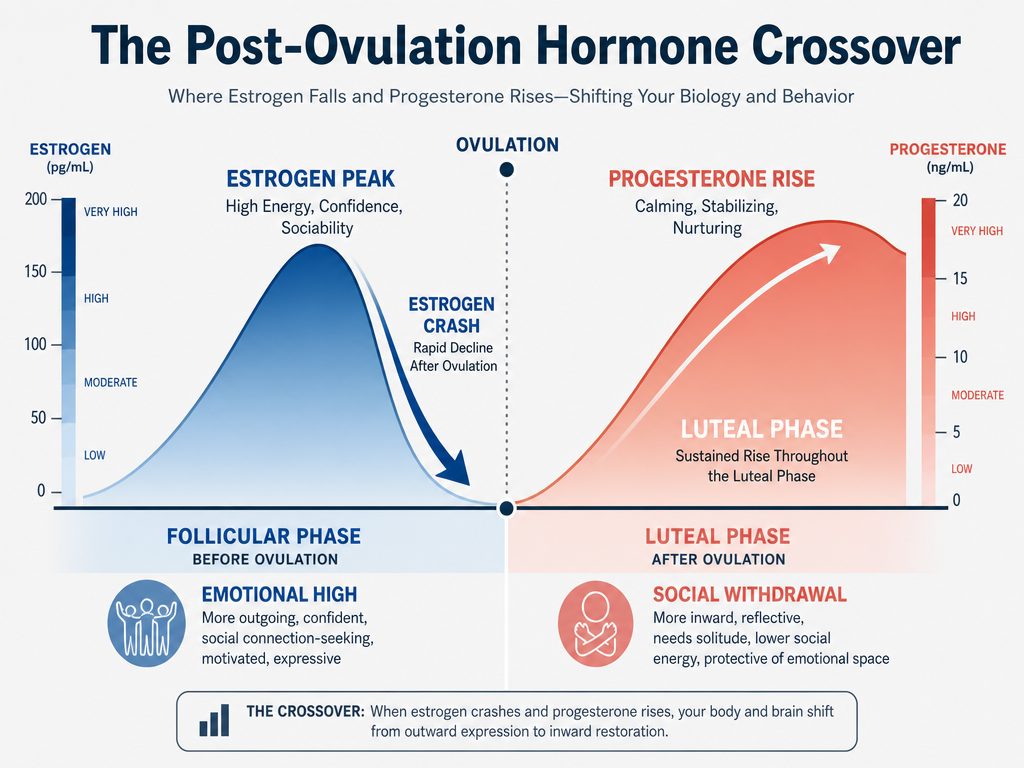 The biological 'why' behind distancing: After ovulation, a sharp drop in estrogen and a surge in progesterone naturally trigger fatigue and social withdrawal.
But once the egg is released, everything flips. Estrogen crashes, and progesterone begins to rise. Progesterone's job is to prepare the uterine lining for a possible pregnancy - it's the "nesting" hormone. While that sounds calming, progesterone can also cause fatigue, brain fog, bloating, and a noticeable drop in social energy.
This isn't a subtle shift. For many women, the drop in estrogen can feel like going from a caffeine high to a crash in the span of a few days. The result? She's not ignoring you - her body is telling her to slow down.
VibeCheck App
Download Free on iOS →Why Progesterone Makes Her Want to Pull Away
Progesterone is often misunderstood. It's not inherently negative - in fact, it helps regulate sleep and has a calming effect on the nervous system. But when it rises after ovulation, it can also make a woman feel:
- Physically exhausted, even if she hasn't done anything strenuous
- Socially drained, preferring quiet time over making plans
- More irritable, especially when she's hungry or overwhelmed
- Emotionally flat, like she's just going through the motions
After ovulation, the luteal phase begins: progesterone rises to help prepare the uterine lining for a possible pregnancy. If pregnancy doesn't happen, both progesterone and estrogen drop before the next period. Many women notice PMS-like symptoms in this phase - mood shifts, breast tenderness, bloating, acne, and appetite changes - though not everyone does.
This phase typically lasts 10-14 days, which means if your girlfriend seems distant for about a week and a half before her period, this is why. It's not a mood problem or a relationship issue - it's a biological cooldown period.
The Social Exclusion Factor: Why She's More Sensitive Right Now
Here's where things get especially interesting for partners. Research published in 2019 found that sensitivity to social exclusion increases during the luteal phase, linked to progesterone levels. In other words, during this phase, she's more likely to feel rejected, misunderstood, or left out - even when none of that is actually happening.
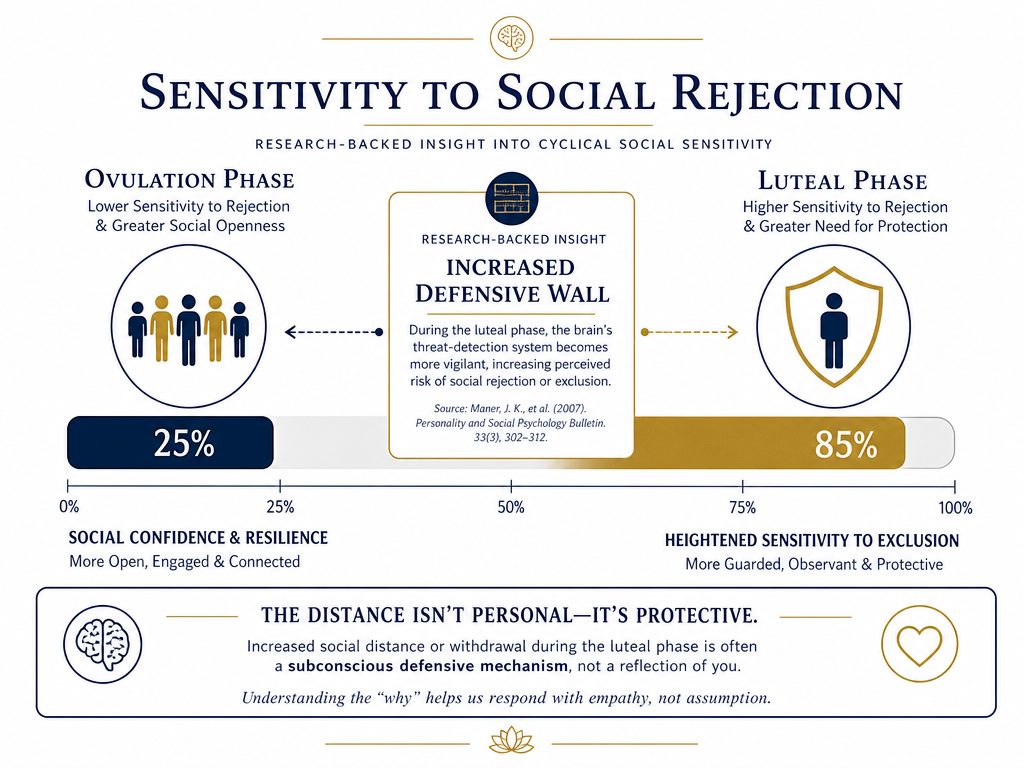 Research shows that during the luteal phase, women become more sensitive to perceived social exclusion, often leading to a 'defensive' distancing from their partners.
What does this mean for you? If you said something offhand a few days ago and she's still thinking about it, or if she's withdrawn because she thinks you're annoyed with her, it's not paranoia - it's biology. Her brain is literally more reactive to perceived rejection during this window.
People with PMDD reported frequent conflict, emotional withdrawal, and fear of abandonment during the luteal phase, a pattern that can strain even healthy relationships when partners don't understand the biological driver.
This defensive distancing is often a protective mechanism. She's not pulling away because she doesn't care - she's pulling away because she feels emotionally raw and wants to avoid being hurt. The problem? You might not even know what triggered it, because the trigger might be something her brain interpreted as rejection that you didn't intend at all.
How to Tell if It's the Luteal Phase or Something Else
Not all distancing is cycle-related. Here's how to tell the difference.
Case A: The Luteal Lean-Out (Common)
She is:
- Tired and wants to stay in
- Easily annoyed by small things
- Less interested in sex or socializing
- Craving comfort foods or snacks
- Withdrawing but not specifically from you
This is classic luteal behavior. She's not mad at you - she's just low on energy and needs space. The key tell: this pattern repeats monthly and typically starts 7-10 days before her period.
Case B: The Ovulation Shift (Less Common)
She is:
- High-energy but seems critical of you specifically
- More interested in going out - just not with you
- Making subtle comments about your relationship or future
- Comparing you to other people
This is a different phenomenon. A 2012 UCLA study found that women in relationships with "stable" partners showed a 1-point drop on a 7-point relationship closeness scale during their fertile window. In other words, some women feel less attracted to their long-term partner specifically during ovulation, when fertility is highest. This doesn't mean she wants to leave - it's a temporary hormonal blip - but it can feel confusing if you don't know what's happening.
Case C: A Real Relationship Issue
She is:
- Distant all month, not just before her period
- Avoiding specific topics or conversations
- Less engaged even when she's in a good mood
- Bringing up the same concerns repeatedly
If the distancing doesn't follow a predictable cycle, it's time to have a conversation. Understanding your partner's cycle can help you distinguish between temporary hormonal shifts and deeper relationship friction.
Your Support Playbook: What Actually Helps
Now that you understand the "why," here's what to do.
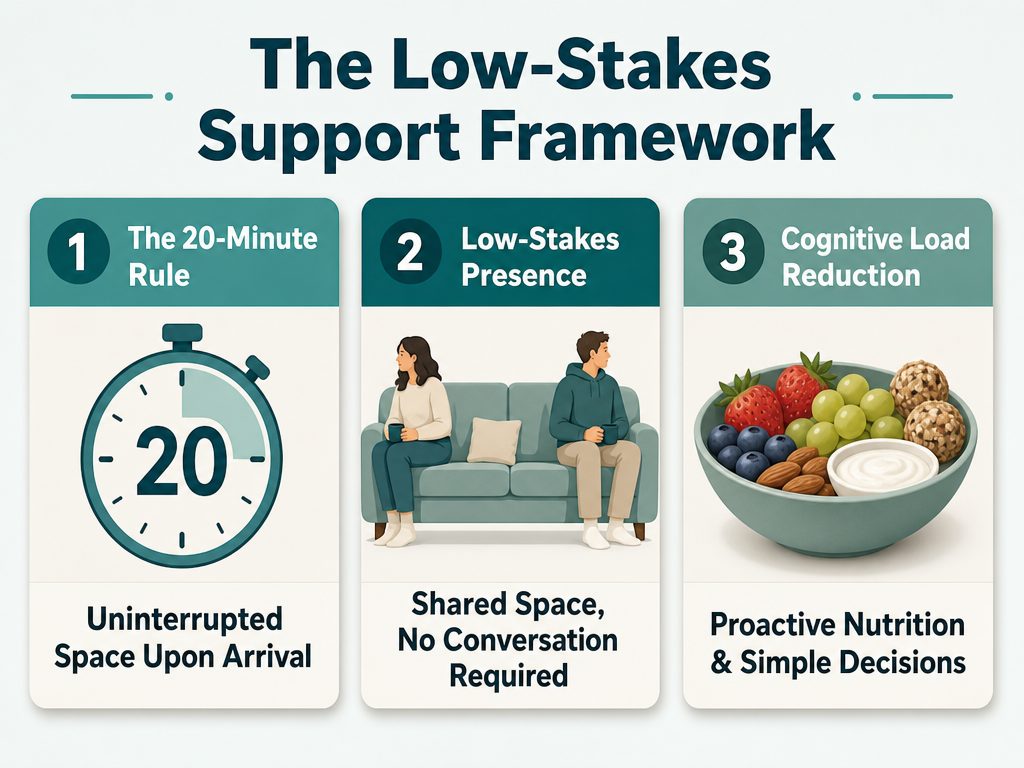 Support doesn't always mean deep conversation. Use low-stakes presence and the 20-minute rule to provide space while staying emotionally connected.
The 20-Minute Rule
When she gets home from work or wakes up in the morning during the luteal phase, give her 20 minutes of complete space before asking questions, making requests, or trying to engage. This buffer allows her nervous system to settle without the added pressure of immediate interaction.
Low-Stakes Presence
Offer to be in the same room without requiring conversation. Say something like: "I'm going to watch this show - want to sit with me?" or "I'll be on the couch if you feel like hanging out."
This gives her the option to be close to you without the social burden of performing or responding. When a partner is struggling emotionally, responding with genuine empathy - listening without judgment, focusing on their feelings rather than debating facts, and validating that their reaction makes sense - tends to help more than trying to "fix" the problem or offer silver linings.
The "Hunger Crankies" Check
Progesterone makes her more sensitive to blood sugar drops. If she seems irritable, offer a snack before trying to have a serious conversation. Say: "Can I get you something to eat? I'm grabbing food anyway."
This isn't patronizing - it's tactical. A drop in blood sugar during the luteal phase can amplify mood swings, and solving the physical problem often solves the emotional one.
Don't Take the Bait
If she snaps at you or seems annoyed by something trivial, resist the urge to defend yourself or escalate. Instead, say: "I hear you. What do you need right now?"
This acknowledges her frustration without making it about you. Lifestyle approaches that can help ease PMS symptoms include regular aerobic exercise, smaller/more frequent meals, less salt/caffeine/alcohol, adequate sleep, and stress-reduction practices like deep breathing or yoga. A partner who understands these and is patient around them - rather than dismissive of symptoms - is aligning with medically recommended self-care.
Track Patterns (With Her Permission)
If you notice the distancing happens at the same point every month, gently suggest tracking her cycle together. Say: "I've noticed you seem more tired around the same time each month. Would it help if we kept track so I know when to step up support?"
This shows you're paying attention without blaming her for her mood. Tracking symptoms and mood changes across the cycle for a few months is a legitimate, medically endorsed way to identify real patterns and timing - rather than assuming based on stereotypes or a single cycle.
For more tactical guidance, read our complete boyfriend's guide to the menstrual cycle or explore how to support your girlfriend during the luteal phase.
When to Be Concerned: PMDD and Red Flags
For most women, luteal-phase distancing is uncomfortable but manageable. But for roughly 1 in 10 people who menstruate, the symptoms are severe enough to qualify as PMDD (premenstrual dysphoric disorder), a real, clinically recognized condition - it's listed in the DSM-5 as a depressive disorder.
PMDD is a more severe, sometimes disabling extension of PMS. Both happen on a similar timeline (about 7-10 days before a period) and can share physical symptoms like bloating and fatigue, but PMDD specifically involves extreme mood symptoms - such as marked irritability, anxiety, or hopelessness - intense enough to disrupt daily life and strain relationships.
Signs She Might Have PMDD
- Extreme mood swings that feel disproportionate to the situation
- Thoughts of ending the relationship that appear suddenly and disappear after her period starts
- Severe anxiety or panic attacks in the week before her period
- Inability to function at work or socially during the luteal phase
- Suicidal thoughts or feelings of hopelessness (this is a medical emergency)
If she's experiencing any of these, encourage her to talk to a doctor. PMDD is treatable - often with SSRIs, hormonal birth control, or lifestyle changes - but it requires professional support.
For more on how to help during the most difficult phase, read how to comfort your girlfriend during PMS.
Frequently Asked Questions
Is it normal to hate my boyfriend during the luteal phase of PMS?
Yes, it's more common than you'd think. The luteal phase brings a drop in serotonin and a rise in progesterone, which can amplify feelings of irritability and make small annoyances feel massive. If she feels this way specifically before her period and it resolves within a few days after bleeding starts, it's likely hormonally driven, not a reflection of how she actually feels about you. Roughly half of people who menstruate report having at least one PMS symptom, but only about 1 in 5 have symptoms severe enough to disrupt their daily life.
Do girls get more clingy during ovulation?
Sometimes, yes. Around ovulation, many women notice symptoms such as increased sex drive, mild pelvic or abdominal pain, tender breasts, bloating, and mood changes - but these vary a lot person to person, and not everyone notices them. The estrogen surge during ovulation can increase social confidence and affection, making some women more outwardly affectionate or interested in closeness. But the opposite can also be true: women in their fertile phase accepted dance requests 60% of the time, compared to 35% during other phases, suggesting that high estrogen can make women more socially outgoing in general, not just with their partner.
Is it normal to be super emotional right after ovulation?
Yes. The drop in estrogen immediately after ovulation can feel like an emotional crash. Estrogen affects many neurotransmitters, including serotonin, so when it falls, mood often follows. This is when many women start feeling weepy, anxious, or irritable - even though PMS symptoms technically belong to the luteal phase, the emotional shift can start within a day or two of ovulation ending.
How long does the luteal phase last?
Typically 10-14 days, though this varies. For most women, the luteal phase starts the day after ovulation and ends the day before their next period begins. If you notice your girlfriend's mood or energy shifts around the same time each month, tracking her cycle can help you anticipate when the luteal phase is starting. A "normal" cycle varies a lot between women - menstrual bleeding can start anywhere from every 24 to every 38 days and last up to 8 days, so exact timing will differ.
Can stress make the luteal phase worse?
Absolutely. Stress amplifies progesterone's effects and can make PMS symptoms significantly worse. If she's dealing with work deadlines, family issues, or other stressors during the luteal phase, the combination can feel overwhelming. This is when practical support - handling errands, cooking dinner, or just giving her space - matters most.
Do men notice when a woman is ovulating?
Research shows mixed results. Some studies suggest men can detect subtle behavioral or scent changes during ovulation, but it's not a reliable or conscious detection. What you're more likely to notice is a shift in her energy, mood, or interest in socializing - but these cues vary widely between women and aren't always obvious.
Does being in luteal phase actually affect your mood?
Yes. The luteal phase involves real, measurable hormonal changes that affect neurotransmitters like serotonin and GABA. This isn't "all in her head" - it's a biological event. There is general research support for hormone-linked differences in mood and energy across the cycle - energy tends to be lower during the period and can build through the follicular phase toward ovulation, with PMS-type symptoms more likely in the luteal phase.
Your girlfriend's distancing after ovulation isn't rejection - it's her body shifting gears. When you understand the biology behind her behavior, you stop taking it personally and start responding with the kind of support that actually helps.
If you want to track her cycle and get daily insights on what she needs, explore tools like VibeCheck, a period tracker built specifically for men who want to be better partners. Or dive deeper with our guide on how to support your partner during every phase.
Tags

Related Articles
Continue reading to deepen your understanding

Supporting Your Girlfriend Through the Luteal Phase
When hormone levels crash before her period, your partner’s brain enters a high-alert state. Learn how to provide the security she needs with tactical scripts and empathy.

How to Give Your Girlfriend Reassurance During Ovulation Week
Is your girlfriend suddenly questioning everything during her cycle? Understand the estrogen crash and learn how to provide the tactical support she needs to feel secure and loved.

When to Give Her Space vs. When to Stay Close: Your Phase-by-Phase Guide
Your girlfriend’s need for closeness isn’t random. Understanding how her 28-day biological rhythm affects her energy helps you time your support perfectly across all four phases.

Your Girlfriend’s 28-Day Relationship Manual: How to Support Her Through Every Phase
Understanding her menstrual cycle transforms you from a guy walking on eggshells into a strategic partner who knows exactly what support to offer and when.

When Your Girlfriend Goes Distant During the Luteal Phase: The Partner’s Tactical Guide
Does your girlfriend pull away or go quiet right before her period? Understand the biological reason for her withdrawal and how you can support her without making it worse.

The Strategic Partner’s Guide to Ovulation Energy Surge Date Ideas
Is your girlfriend suddenly full of energy and ready for adventure? It’s likely her ovulation surge. Use this guide to plan dates that match her peak confidence and social drive.

How to Plan a Surprise for Your Girlfriend During Her Follicular Phase
Stop fighting her hormones and start working with them. Use this guide to time your surprises perfectly with her biological clock for better reactions and maximum joy.

How to Comfort Your Girlfriend During Ovulation Mood Swings: The Partner’s Tactical Guide
Is your partner suddenly irritable mid-cycle? It is likely an estrogen crash. Use these tactical tips to navigate her ovulation mood swings with empathy.