Supporting Your Girlfriend Through the Luteal Phase

When hormone levels crash before her period, your partner’s brain enters a high-alert state. Learn how to provide the security she needs with tactical scripts and empathy.
How to Give Your Girlfriend Reassurance During the Luteal Phase
Your girlfriend isn't picking a fight out of nowhere. Her brain chemistry just dropped off a cliff.
During the luteal phase, which typically lasts between 10 to 17 days after ovulation, both progesterone and estrogen crash before her period starts. This isn't a character flaw or a relationship problem - it's a biological state that makes her brain process perceived threats differently. When you understand what's happening under the hood, you can provide the exact reassurance she needs without making things worse.
This guide explains the neuroscience behind her need for reassurance, gives you tactical scripts that actually work, and shows you how to tell when you're dealing with standard PMS versus something that needs a doctor.
Table of Contents
- What the Luteal Phase Actually Does to Her Brain
- Why She Suddenly Needs More Reassurance
- The Support Setting Framework: Space, Comfort, or Solutions?
- Communication Scripts That Actually De-Escalate
- The Red Zone Rules: What Never to Say
- The Proactive Luteal Kit: Non-Verbal Reassurance
- When It's PMDD, Not PMS: The Safety Check
- Partner Self-Care: Setting Boundaries Without Guilt
- Frequently Asked Questions
What the Luteal Phase Actually Does to Her Brain
After ovulation, the luteal phase begins: progesterone rises to help prepare the uterine lining for a possible pregnancy. If pregnancy doesn't happen, both progesterone and estrogen drop before the next period. Many women notice PMS-like symptoms in this phase - mood shifts, breast tenderness, bloating, acne, and appetite changes - though not everyone does.
The drop in these hormones affects brain chemistry in a specific way. Estrogen affects many body systems, including brain function and the ability to focus, and levels are highest in the days leading up to ovulation. Medical sources describe this brain effect in general terms; they do not specify an exact mechanism for how estrogen affects day-to-day mood.
What we do know: when these hormones crash, her brain's threat-detection system becomes hyperactive. Small stressors that she'd normally brush off - a delayed text, a forgotten errand, an offhand comment - can register as bigger problems. This isn't her "overreacting." Her brain is genuinely processing these signals differently during this window.
VibeCheck App
Download Free on iOS →Think of it as her internal alarm system becoming more sensitive. The alarm works the same way it always has, but now it's triggered by things that wouldn't have set it off two weeks ago.
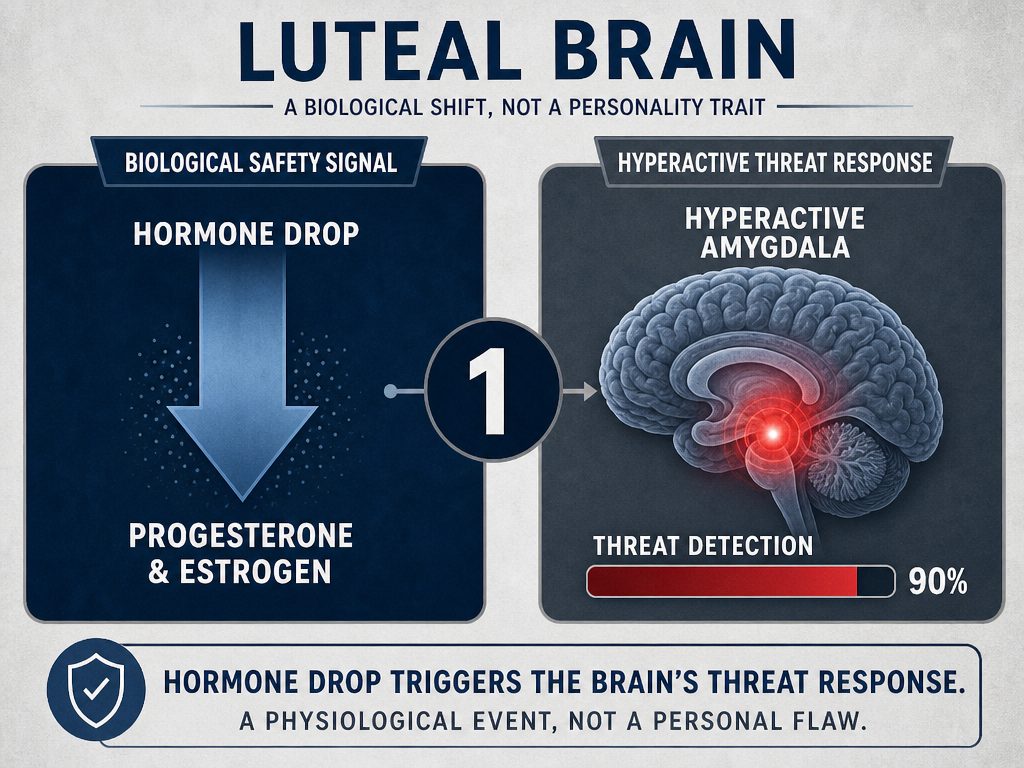 Understanding that her brain is in a hyper-aware 'threat detection' state helps you view her need for reassurance as a biological safety signal.
Why She Suddenly Needs More Reassurance
Her need for reassurance during the luteal phase is a biological safety signal, not neediness.
PMS is very common: as many as 3 in 4 women report experiencing PMS symptoms at some point in their life, though severity varies widely. Symptoms - which can include mood swings, irritability, bloating, breast tenderness, and fatigue - typically show up one to two weeks before a period and resolve within a few days after it starts.
Roughly half of people who menstruate report having at least one PMS symptom, but only about 1 in 5 have symptoms severe enough to disrupt their daily life. That more disruptive tier is a meaningfully different experience than "typical" PMS.
During this phase, she might:
- Question whether you're still interested in the relationship
- Need confirmation that you're not upset with her
- Seek validation that she's not "too much" or a burden
- Want physical closeness or, conversely, need space to process alone
These aren't random emotional requests. Her brain is running a security check, and your reassurance is what tells her system that everything is stable.
The mistake most guys make: treating these moments as irrational or trying to logic her out of them. That approach backfires because you're dismissing a signal her brain is sending for a real biological reason.
The Support Setting Framework: Space, Comfort, or Solutions?
The single best tool you can use during the luteal phase is the daily check-in. Instead of guessing what she needs, ask her directly which "support setting" works for her today.
The three settings:
- Space - She needs time alone to process or recharge
- Comfort - She wants physical presence, validation, or emotional closeness
- Solutions - She's ready to problem-solve and wants your input
This framework removes the guesswork and gives her agency over what kind of interaction feels safest. Some days she'll want you close. Other days she'll need to be alone without it meaning she's upset with you.
How to use it:
- "Hey, I know we're in your luteal window. Are you in Space, Comfort, or Solutions mode today?"
- "Just checking in - do you want company tonight, or would you rather have the place to yourself?"
The key: don't take her answer personally. If she says "Space," it's not rejection. It's her telling you the exact support she needs so her nervous system can regulate.
For more on how to identify which cycle phase she's in, check out our guide on reading behavioral cues without asking directly.
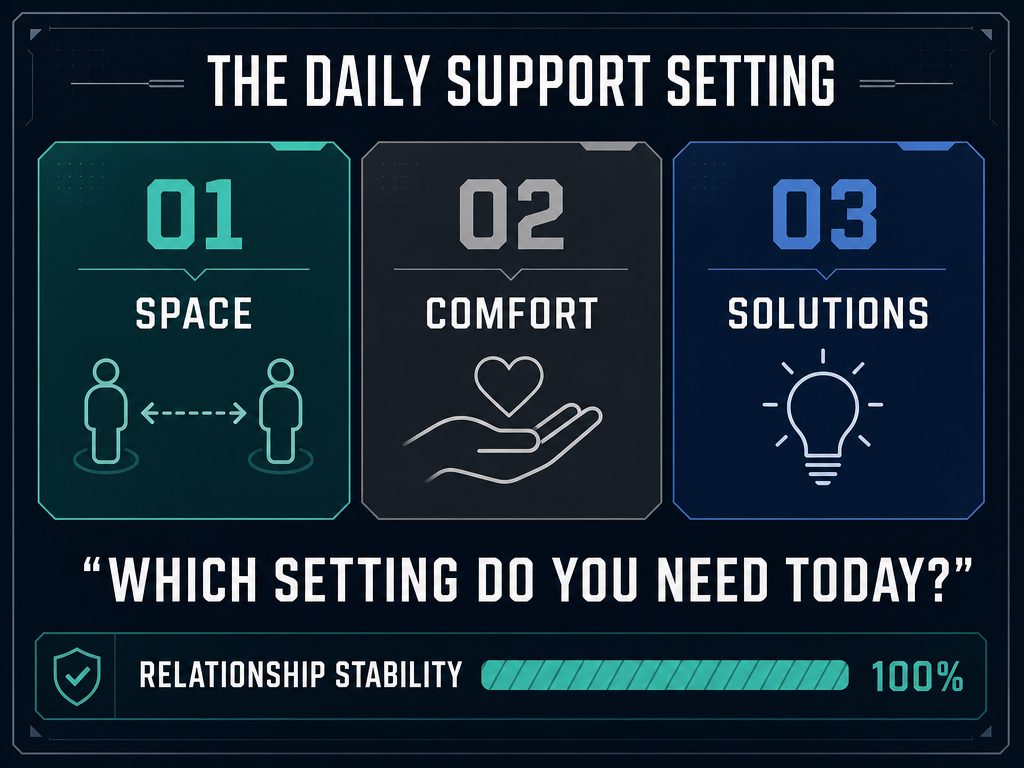 The 'Support Setting' framework removes guesswork by allowing your partner to choose the type of interaction that feels safest during the luteal phase.
Communication Scripts That Actually De-Escalate
When tensions rise during the luteal phase, your words matter more than usual. Here are the exact scripts that work when her brain is in hypervigilant mode.
The De-Escalator: "I'm on your team. This feels heavy right now. Let's talk about the [specific issue] in three days; right now, I'm just making dinner and being here."
Why it works: You're acknowledging the feeling without dismissing it, postponing the "logic" conversation to a time when her brain chemistry isn't working against you, and taking a concrete action (making food) that shows care.
The Reassurance Script: "I can see you're struggling. I'm right here, and I'm not going anywhere."
Why it works: When a partner is struggling emotionally, responding with genuine empathy - listening without judgment, focusing on their feelings rather than debating facts, and validating that their reaction makes sense - tends to help more than trying to "fix" the problem or offer silver linings. Feeling understood, not corrected, is what tends to defuse tension.
The "I Hear You" Script: "It sounds like you're feeling [overwhelmed/unappreciated/anxious]. That makes sense given what's on your plate. What would feel most helpful right now?"
Why it works: You're naming the emotion (which helps her feel seen), validating that it's a reasonable response, and then asking her what she needs instead of assuming.
The Boundary Script (when you need space too): "I want to support you, and I also need to step away for 20 minutes to recharge so I can be present. I'll be back, and we can talk then if you want."
Why it works: You're not abandoning her, you're modeling self-care and giving yourself the space to remain a stable anchor instead of burning out.
Understanding how to comfort your girlfriend during PMS requires both empathy and tactical communication - these scripts give you both.
The Red Zone Rules: What Never to Say
Some phrases are relationship landmines during the luteal phase. Here's what to avoid and why.
Never say:
- "Is it your period?" (especially during a fight)
- "You're overreacting."
- "Calm down."
- "You were fine yesterday."
- "Other women don't act like this."
Why these backfire: Each one dismisses her experience as invalid or reduces her to a stereotype. Her brain is already on high alert for signs of rejection or misunderstanding - these phrases confirm that fear.
The Red Zone Rules:
No major life decisions. Don't have "where is this relationship going?" conversations during storm week. Her brain is in threat-detection mode, not strategic planning mode.
No "logic-ing" her out of feelings. If she's upset about something that seems small to you, resist the urge to explain why it shouldn't bother her. Just validate first.
Zero tolerance for cycle-blaming during conflict. You can proactively mention you're aware of her luteal window ("I know this week is tough for you, how can I help?"), but never use it as a weapon mid-argument ("You're only upset because of your hormones").
The difference between these approaches: one is you being a teammate who understands biology. The other is you weaponizing biology to dismiss her.
For more on how to support your girlfriend during period mood swings, including the 72-hour hormone crash window, see our detailed breakdown.
The Proactive Luteal Kit: Non-Verbal Reassurance
Sometimes the best reassurance isn't verbal - it's environmental. Having a few go-to items ready can provide comfort without you having to guess what she needs in the moment.
Stock your luteal kit with:
- Magnesium-rich snacks: Dark chocolate, almonds, bananas. (Lifestyle approaches that can help ease PMS symptoms include regular aerobic exercise, smaller/more frequent meals, less salt/caffeine/alcohol, adequate sleep, and stress-reduction practices.)
- Heating pad or hot water bottle: For cramps and lower back pain
- Weighted blanket: Physical pressure can calm an overactive nervous system
- Her favorite comfort food: Whatever she gravitates toward when she's stressed
- Low-effort entertainment: Queue up a show or playlist she doesn't have to think about
How to deploy the kit: Don't make a big announcement. Just leave the heating pad on the couch, bring her chocolate without commentary, or suggest watching something easy together. The goal is to reduce the number of small decisions she has to make when her bandwidth is already low.
The environmental care strategy:
- Dim the lights if she's dealing with a headache
- Keep the space quieter than usual
- Handle logistics she'd normally manage (dinner, errands, pet care)
These actions communicate "I see you're struggling, and I'm making your environment easier" without requiring her to ask for help or explain what she needs.
For partners looking for a structured way to track these patterns and get daily guidance, tools like a period tracker for men can help you anticipate her needs before she has to voice them.
When It's PMDD, Not PMS: The Safety Check
PMDD (premenstrual dysphoric disorder) is a real, clinically recognized condition - it's listed in the DSM-5 as a depressive disorder, not something people are "making up" or simply failing to cope with. It affects roughly 1 in 10 people who menstruate.
PMDD is a more severe, sometimes disabling extension of PMS. Both happen on a similar timeline (about 7-10 days before a period) and can share physical symptoms like bloating and fatigue, but PMDD specifically involves extreme mood symptoms - such as marked irritability, anxiety, or hopelessness - intense enough to disrupt daily life and strain relationships.
According to research, PMDD affects approximately 5% of menstruating women (roughly 1 in 20), and married or cohabiting women with PMDD have a 21% increased risk of relationship disruption.
Signs it's time to talk to a doctor:
PMDD diagnosis requires 5 or more total symptoms to be present for most cycles in the past year. Watch for:
- Marked depressive mood, feelings of hopelessness
- Marked anxiety or feeling on edge
- Extreme irritability or anger
- Decreased interest in usual activities
- Difficulty concentrating
- Fatigue or low energy
- Changes in appetite (overeating or specific cravings)
- Sleeping too much or insomnia
- Feeling overwhelmed or out of control
- Physical symptoms: breast tenderness, joint or muscle pain, bloating
If she's experiencing five or more of these symptoms during most cycles, and they're severe enough to interfere with work, relationships, or daily functioning, it's not "just PMS."
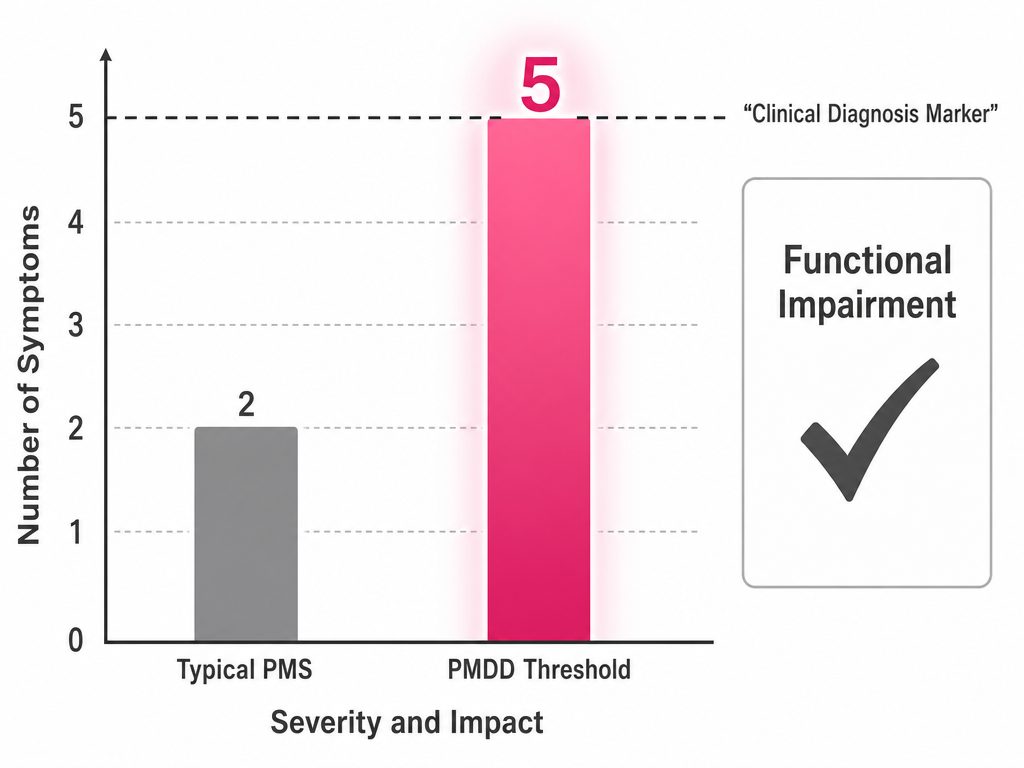 When symptoms exceed five or more and cause functional impairment, the situation moves from standard support to a team-based medical plan for PMDD.
How to bring it up: Don't ambush her mid-cycle. Wait until she's in her follicular phase (the week after her period ends, when estrogen is rising and mood is typically more stable). Then frame it as a team-based medical plan, not a criticism.
Try: "I've been noticing that the week before your period is really hard on you - way harder than I think it should be. I read that PMDD is a real medical condition that affects about 1 in 20 women, and I'm wondering if it's worth talking to a doctor to see if there are treatment options that could help. I want to support you, and I think we might be dealing with something beyond standard PMS."
The conversation should emphasize that you're not blaming her or asking her to "fix" herself. You're acknowledging that her suffering is real and suggesting there might be medical interventions (SSRIs, hormonal birth control, lifestyle changes) that could make these weeks more manageable.
In some cases, it can take 4 to 14 years for a woman to receive a formal PMDD diagnosis, so bringing it up early can be a genuine act of care.
For more context on the full menstrual cycle and how to support her through each phase, see our menstrual cycle guide for boyfriends.
Partner Self-Care: Setting Boundaries Without Guilt
Supporting someone through the luteal phase - especially if symptoms are severe - can be emotionally draining. You can't pour from an empty cup, and acknowledging your own limits isn't selfish. It's strategic.
Why partner burnout happens: When you're constantly navigating someone else's heightened emotional state, your own nervous system stays activated. You start walking on eggshells, over-monitoring her mood, or suppressing your own needs to avoid conflict. Over time, this erodes your capacity to be a stable, present partner.
How to set boundaries without abandoning her:
Name your bandwidth limit before you hit it. If you're feeling overwhelmed, say so before you snap. "I want to be here for you, and I'm also noticing I'm getting worn down. I need to take an hour to [go for a run / call a friend / sit alone] so I can come back and be present."
Don't make yourself the only source of reassurance. Encourage her to have other support systems - friends, therapist, online communities. You can be her primary support without being her only support.
Reframe "needing space" as relationship maintenance, not rejection. Taking time to recharge isn't you bailing on her. It's you ensuring you don't burn out and become resentful.
Track your own patterns. If you notice you're consistently drained or anxious during her luteal phase, that's data. It might mean you need to adjust your approach, seek outside support (therapy for yourself), or have a bigger conversation during her follicular phase about what's sustainable.
The compassion fatigue check-in: Ask yourself monthly:
- Am I sacrificing my own needs to manage her moods?
- Do I feel resentful more often than I feel connected?
- Am I avoiding bringing up my own struggles because "she has it worse"?
If you answered yes to any of these, it's time to adjust. A sustainable relationship requires both partners to have bandwidth. You can't be a good anchor if you're drowning.
For more tactical relationship advice tailored to men, explore our relationship advice for men section.
Frequently Asked Questions
How to handle luteal phase girlfriend?
Understand that her brain's threat-detection system is temporarily hyperactive due to the progesterone and estrogen crash. Use the Support Setting Framework (Space, Comfort, or Solutions) to ask her what she needs instead of guessing. Avoid cycle-blaming during arguments and offer non-verbal reassurance through environmental care (heating pads, comfort food, handling logistics). If symptoms are severe and consistent, suggest tracking patterns for a few months and consider whether PMDD might be involved.
Is it normal to not like your partner during the luteal phase?
Yes, for many women, the luteal phase can bring feelings of irritability or disconnection that feel out of character. The hormone crash affects mood regulation and can make even minor annoyances feel bigger. This doesn't mean the relationship is failing - it means her brain chemistry is temporarily different. Tracking symptoms and mood changes across the cycle for a few months is a legitimate, medically endorsed way to identify real patterns and timing rather than assuming based on stereotypes or a single cycle.
How can I best support my partner who has PMDD?
Recognize that PMDD is a clinical condition, not an exaggerated version of PMS. Work with her to identify her symptom window and what helps most (medication, therapy, lifestyle changes, or a combination). During her luteal phase, reduce environmental stressors, avoid major life conversations, and use the reassurance scripts in this guide. Encourage her to see a healthcare provider if she hasn't already - treatment options exist, and PMDD diagnosis requires 5 or more total symptoms to be present for most cycles in the past year. Your role is to be a stable, non-judgmental anchor while she navigates treatment.
What is the difference between PMS and PMDD?
PMS symptoms - mood swings, irritability, bloating, fatigue - are common and usually manageable. PMDD specifically involves extreme mood symptoms - such as marked irritability, anxiety, or hopelessness - intense enough to disrupt daily life and strain relationships. If her symptoms are severe enough that she's missing work, avoiding social activities, or experiencing thoughts of self-harm, it's PMDD, not PMS. A healthcare provider can diagnose PMDD and recommend treatment options including SSRIs, hormonal birth control, or therapy.
How long does the luteal phase last?
The luteal phase typically lasts between 10 to 17 days. It begins after ovulation (around day 14 in a 28-day cycle) and continues until the start of the next period. However, a "normal" cycle varies a lot between women - menstrual bleeding can start anywhere from every 24 to every 38 days and last up to 8 days - so exact day-by-day predictions for any specific woman should be treated as approximate. A luteal phase lasting less than 10 days is considered a "short luteal phase" and may affect fertility.
When should I suggest my girlfriend see a doctor about her cycle symptoms?
If her symptoms meet the PMDD threshold (5 or more symptoms present for most cycles in the past year, causing functional impairment), it's time for a medical evaluation. Other red flags: cycles that are extremely irregular, severe pain that isn't relieved by over-the-counter medication, or any symptom that interferes with her ability to work, maintain relationships, or function day-to-day. Frame the conversation as a team-based approach to improving her quality of life, not as criticism.
How do I give my girlfriend more reassurance without sounding patronizing?
Use direct, empathetic language that validates her feelings without explaining them away. Scripts like "I can see you're struggling. I'm right here, and I'm not going anywhere" work because they acknowledge her experience and affirm your commitment without treating her like she's irrational. Avoid phrases like "calm down" or "you're overreacting" - these dismiss her experience and confirm her brain's fear that you don't understand. Non-verbal reassurance (physical touch if she wants it, handling tasks without being asked) can also communicate care without words.
Should I track my girlfriend's cycle for her?
Only if she explicitly asks you to or gives you permission. Tracking her cycle so you can anticipate her needs is strategic and supportive - tracking it to "catch" her being emotional is manipulative. If you do track it, use a period tracker app designed for partners and treat the data as a tool for understanding, not a weapon. The goal is to time your support better, not to dismiss her feelings as "just hormones."
What are some practical ways to help during the luteal phase?
Reduce her decision fatigue by handling logistics (meal planning, errands, household tasks). Stock magnesium-rich snacks and have a heating pad ready. Create a low-stimulation environment (dim lights, quiet space) if she's dealing with headaches or sensory overload. Ask her which "support setting" she needs today (Space, Comfort, or Solutions) instead of guessing. Most importantly, don't make her symptoms about you - if she's irritable, it's not a character judgment on you, it's her brain chemistry temporarily shifting.
How can I tell if I'm being supportive or enabling unhealthy behavior?
Support means helping her manage a biological reality. Enabling means accepting treatment that crosses into abuse or letting the cycle excuse behavior that harms you. If she's lashing out verbally, blaming you for things outside your control, or refusing to acknowledge that her luteal phase affects the relationship, that's not something you have to tolerate indefinitely. Set boundaries ("I want to support you, and I also need us to talk about how we handle conflict during this window") and suggest professional help if patterns don't improve.
Understanding the luteal phase isn't about excusing bad behavior or walking on eggshells - it's about recognizing a biological reality so you can provide the right support at the right time. When you stop treating her mood shifts as random and start seeing them as part of a predictable pattern, you become a more effective partner and reduce friction in your relationship.
If you're ready to stop guessing and start understanding her cycle in real time, check out VibeCheck - the relationship app that turns her biological rhythm into daily guidance so you know exactly what she needs, when she needs it.
Tags

Related Articles
Continue reading to deepen your understanding

How to Give Your Girlfriend Reassurance During Ovulation Week
Is your girlfriend suddenly questioning everything during her cycle? Understand the estrogen crash and learn how to provide the tactical support she needs to feel secure and loved.

When to Give Her Space vs. When to Stay Close: Your Phase-by-Phase Guide
Your girlfriend’s need for closeness isn’t random. Understanding how her 28-day biological rhythm affects her energy helps you time your support perfectly across all four phases.

Your Girlfriend’s 28-Day Relationship Manual: How to Support Her Through Every Phase
Understanding her menstrual cycle transforms you from a guy walking on eggshells into a strategic partner who knows exactly what support to offer and when.

When Your Girlfriend Goes Distant During the Luteal Phase: The Partner’s Tactical Guide
Does your girlfriend pull away or go quiet right before her period? Understand the biological reason for her withdrawal and how you can support her without making it worse.

The Strategic Partner’s Guide to Ovulation Energy Surge Date Ideas
Is your girlfriend suddenly full of energy and ready for adventure? It’s likely her ovulation surge. Use this guide to plan dates that match her peak confidence and social drive.

How to Plan a Surprise for Your Girlfriend During Her Follicular Phase
Stop fighting her hormones and start working with them. Use this guide to time your surprises perfectly with her biological clock for better reactions and maximum joy.

How to Comfort Your Girlfriend During Ovulation Mood Swings: The Partner’s Tactical Guide
Is your partner suddenly irritable mid-cycle? It is likely an estrogen crash. Use these tactical tips to navigate her ovulation mood swings with empathy.

What to Expect: Understanding Your Girlfriend’s Emotional Changes During Ovulation
Ever wonder why your girlfriend’s energy shifts mid-cycle? Her mood, confidence, and social drive are driven by hormonal surges that you can track to provide better support.