When to Give Her Space vs. When to Stay Close: Your Phase-by-Phase Guide

Your girlfriend’s need for closeness isn’t random. Understanding how her 28-day biological rhythm affects her energy helps you time your support perfectly across all four phases.
When to Give Her Space vs. When to Stay Close: Your Phase-by-Phase Guide
Your girlfriend's need for closeness isn't random, and it's not about you.
One week she's planning adventures and wanting constant touch. The next, she needs quiet time alone. By week three, she's suddenly withdrawn, and by week four, even small requests feel overwhelming. You're not imagining this pattern - you're observing a 28-day biological rhythm that affects her social energy, emotional bandwidth, and need for connection.
Understanding how hormonal changes affect her mood and energy isn't about tracking her like a science experiment. It's about becoming the partner who can anticipate her needs before she has to explain them, which reduces relationship conflict by understanding her cycle phases.
This guide maps her shifting needs across all four phases so you can time your support perfectly - knowing when to lean in and when to step back.
Table of Contents
- The Biological Truth: Why Her Needs Shift Weekly
- Menstrual Phase: When She Needs Physical Comfort and Space
- Follicular Phase: When She Craves Quality Time
- Ovulation Phase: When She Wants Physical Touch and Social Connection
- Luteal Phase: When She Needs Acts of Service and Patience
- How to Track Without Being Creepy
- The Red Flags: When Biology Becomes a Health Issue
- Frequently Asked Questions
The Biological Truth: Why Her Needs Shift Weekly
Her shifting emotional needs aren't unpredictable - they follow the four distinct phases of the menstrual cycle.
Estrogen is the social hormone. When it's rising during the follicular phase, she's more verbal, socially energized, and open to new experiences. Estrogen affects many body systems, including brain function and the ability to focus, and levels are highest in the days leading up to ovulation.
Progesterone is the nesting hormone. After ovulation, progesterone rises to prepare the body for potential pregnancy. This hormone shift pulls her inward - she needs more rest, less stimulation, and more low-key connection. After ovulation, the luteal phase begins: progesterone rises to help prepare the uterine lining for a possible pregnancy. If pregnancy doesn't happen, both progesterone and estrogen drop before the next period. Many women notice PMS-like symptoms in this phase - mood shifts, breast tenderness, bloating, acne, and appetite changes - though not everyone does.
VibeCheck App
Download Free on iOS →When both hormones crash right before her period, serotonin drops with them. That's the biological mechanism behind PMS - not a personality flaw, but a neurochemical event. PMS (premenstrual syndrome) is very common: as many as 3 in 4 women report experiencing PMS symptoms at some point in their life, though severity varies widely.
The key insight: her "moving goalposts" aren't about changing her mind. They're about changing biology.
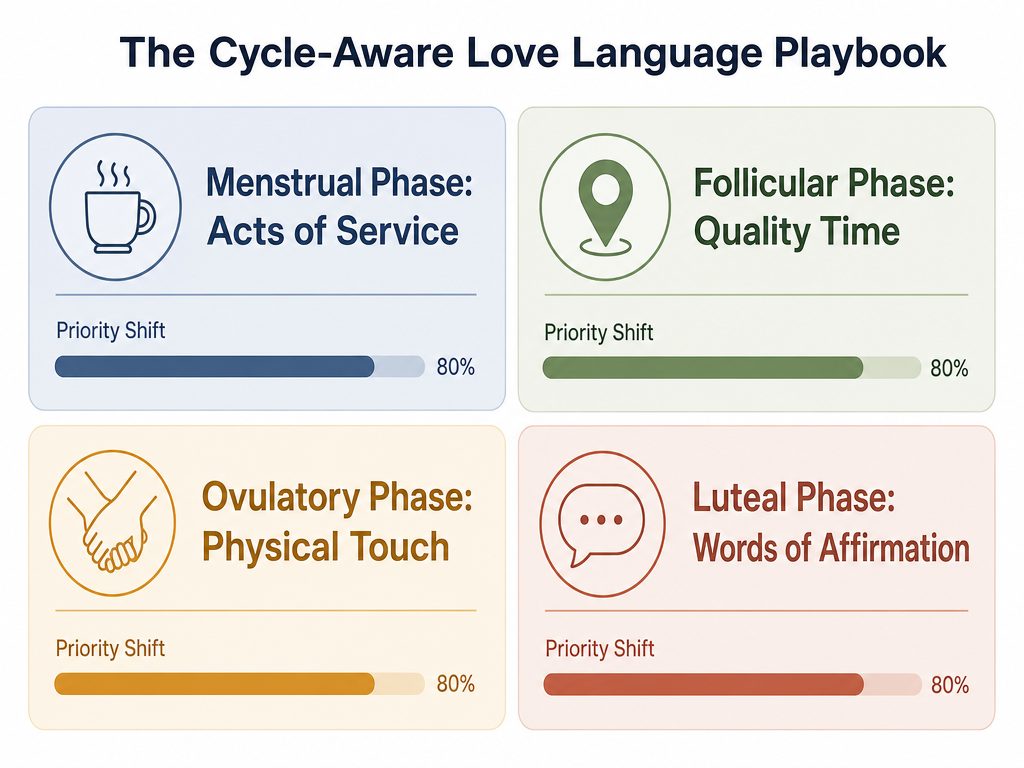 Master the moving goalposts of relationship satisfaction by aligning your primary support style with her biological phase to reduce conflict and increase intimacy.
Menstrual Phase: When She Needs Physical Comfort and Space (Days 1-5)
What's happening biologically: Both estrogen and progesterone are at their lowest. Energy drops. Up to 88% of women experience menstrual cramps every cycle, significantly impacting concentration and mood. Her body is shedding the uterine lining, which requires real metabolic energy.
What she needs from you:
- Acts of Service become critical. Don't ask "What do you want for dinner?" - just make it. The decision itself is labor right now.
- Physical comfort without demands. A heating pad, her favorite takeout, or running a bath are high-value, low-effort wins.
- Space without abandonment. She may want to be alone in the same room as you. That's not rejection - it's energy management.
The tactical script:
"I'm making dinner tonight. You want your usual or should I surprise you?" (Reduces her decision load while keeping her in the loop.)
What to avoid:
- Don't suggest high-intensity activities. A spontaneous hike will land wrong.
- Don't take her withdrawal personally. Her social battery is genuinely empty right now.
- Don't ask her to explain how she feels. She probably can't articulate it beyond "tired and crampy."
During this phase, understanding how to help your girlfriend during period mood swings means recognizing that her body is going through a real biological event, not a personality shift.
Follicular Phase: When She Craves Quality Time (Days 6-13)
What's happening biologically: Estrogen begins to rise steadily. During the follicular phase, estrogen rises as an egg-containing follicle develops in the ovary; this rising estrogen also thickens the uterine lining. Her energy rebounds, mood stabilizes, and she becomes more socially motivated.
What she needs from you:
- Quality Time with novelty. This is your window for trying new restaurants, planning weekend trips, or having the "where is this going?" conversation.
- Words of Affirmation that boost confidence. Her rising estrogen correlates with increased verbal processing. Compliments about her competence (not just looks) land well here.
- Active participation in planning. She wants to co-create experiences, not just be told what you've decided.
The tactical script:
"I found this new place I think you'd love. Want to check it out this weekend?" (Invites collaboration without dumping all the planning labor on her.)
What to avoid:
- Don't waste this high-energy window on passive Netflix nights. She'll resent the missed opportunity.
- Don't dismiss her enthusiasm for new plans as "impractical." Her optimism is hormonally driven and genuine.
This is also the phase where women in the follicular phase (rising estrogen) find kissing more important at initial stages of a relationship than women in the luteal phase. Physical affection feels more emotionally connected right now.
For more on capitalizing on this high-energy window, see our guide on how to support your girlfriend during the follicular phase.
Ovulation Phase: When She Wants Physical Touch and Social Connection (Days 13-15)
What's happening biologically: Ovulation is when a surge in luteinizing hormone (LH) causes the ovary to release an egg, typically around day 14 of a 28-day cycle. Estrogen peaks, then crashes immediately after. Around ovulation, many women notice symptoms such as increased sex drive, mild pelvic or abdominal pain, tender breasts, bloating, and mood changes - but these vary a lot person to person, and not everyone notices them.
What she needs from you:
- Physical Touch without pressure. Libido is statistically highest here, but the key word is "statistically" - not universal. Follow her lead.
- Quality Time in social settings. This is the ideal phase for double dates, parties, or meeting your family. Her social energy is at its peak.
- Big conversations land best here. Estrogen's peak correlates with higher verbal fluency and confidence. If you need to discuss something serious, this is your window.
The tactical script:
"I was thinking we could finally do that thing you mentioned last month. You free Saturday?" (Shows you've been paying attention and respects her agency.)
What to avoid:
- Don't confuse her increased energy with permanent availability. The crash is coming in 3-5 days.
- Don't plan emotionally heavy conversations for right after ovulation - that's when the estrogen crash hits and her tolerance for conflict drops.
Estrogen peaks during the Ovulatory phase (Days 13-15), typically correlating with higher social energy and verbal skills. This makes it the ideal window for relationship milestones or difficult conversations.
For a detailed breakdown of what to expect, read how to support your girlfriend during ovulation mood changes.
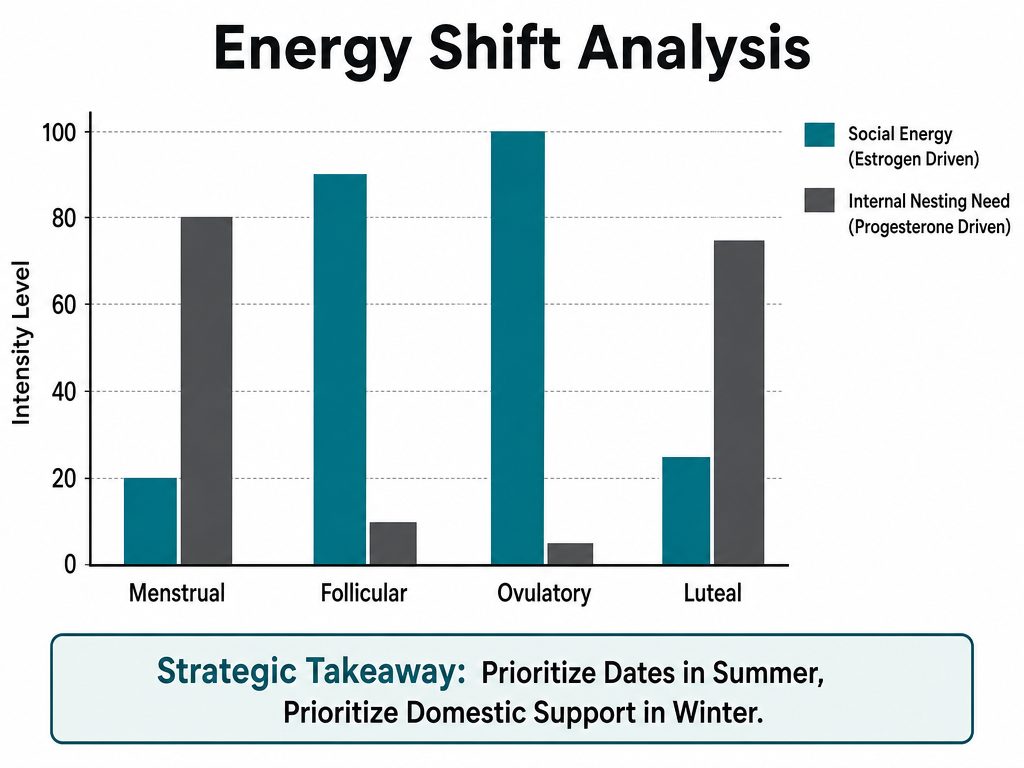 Understanding these hormonal shifts helps you transition from a 'social' partner to a 'supportive' partner at exactly the right time she needs it most.
Luteal Phase: When She Needs Acts of Service and Patience (Days 16-28)
What's happening biologically: Progesterone rises, then both progesterone and estrogen crash in the final 7-10 days before her period. Serotonin drops with them. Roughly half of people who menstruate report having at least one PMS symptom, but only about 1 in 5 have symptoms severe enough to disrupt their daily life.
What she needs from you:
- Acts of Service that reduce mental load. Take over the grocery list. Cancel plans with friends on her behalf so she doesn't have to be the "bad guy." Handle the logistics she usually manages.
- Words of Affirmation about security, not performance. "We're good" lands better than "You look great tonight."
- Space without isolation. She may want parallel time - both of you home, but doing separate things. That's not distance; it's decompression.
The tactical script:
"I'm handling dinner and dishes tonight. You just chill." (No questions, no negotiation, just execution.)
What to avoid:
- Don't plan surprise social events. Her tolerance for stimulation is genuinely lower, and you'll create resentment.
- Don't ask "Are you on your period?" when she's irritable. That dismisses her feelings as purely hormonal and implies they're not valid.
- Don't try to "fix" her mood with solutions. She doesn't need problem-solving; she needs validation.
This is the phase that tests most relationships. For a tactical breakdown of how to navigate it, see our luteal phase support guide.
 During the luteal phase, specific acts of service like making dinner decisions without being asked can significantly reduce her mental load and prevent relationship friction.
How to Track Without Being Creepy
The ethics of tracking her cycle come down to one rule: transparency wins over secrecy.
Don't download a period tracker and start logging her moods without telling her. That's surveillance, not support. Instead, frame it as a joint project:
"I've been reading about how your cycle affects energy levels, and I want to be better at giving you what you need. Would you be okay with me using an app to help keep track so I can plan better?"
Best tools for shared tracking:
- Clue Partner Connect: She logs her data, you get sanitized insights about her current phase. No raw symptom data crosses over without her permission.
- VibeCheck: Built specifically for partners. Gives you a daily "mission" based on her phase without exposing private health details.
- Shared calendar: Low-tech option. She marks approximate phase shifts, you respect the zones.
For a deeper dive into the best options, check out our comparison of period tracker apps for boyfriends.
The Red Flags: When Biology Becomes a Health Issue
Not all cycle-related mood shifts are "normal PMS." Watch for these signs that she may need medical support:
PMDD (Premenstrual Dysphoric Disorder): PMDD is a real, clinically recognized condition - it's listed in the DSM-5 as a depressive disorder, not something people are "making up" or simply failing to cope with. It affects roughly 1 in 10 people who menstruate.
When to encourage her to see a doctor:
- Suicidal thoughts or self-harm ideation during the luteal phase
- Symptoms that persist beyond day 2-3 of her period
- Missed work or social obligations multiple cycles in a row
- Physical pain severe enough to require prescription medication
Your role isn't to diagnose - it's to notice patterns and provide support. The script:
"I've noticed you've been really struggling the week before your period for the last few months. I'm worried, and I think it might be worth talking to your doctor about whether this is something treatable. I'm here for whatever you need."
For more on distinguishing between normal PMS and something more serious, read how to comfort your girlfriend during PMS.
Frequently Asked Questions
Can a relationship work if we have different love languages?
Yes, but only if both partners recognize that love languages aren't static personality traits - they're context-dependent and shift with biological and emotional states. In early relationships, companionship feelings grow by roughly 1.19 hours per week, peaking around the 2.70-year mark. What matters isn't having matching default languages; it's your willingness to adapt your expression of care to her current needs. During the menstrual phase, Acts of Service will outperform Physical Touch even if she usually prefers the latter. The partner who can flex their support style based on her cycle phases builds far more relationship capital than the one who insists "I showed love my way, so that should count."
Are love languages scientifically proven?
No. Gary Chapman's five love languages framework lacks rigorous empirical testing in peer-reviewed research. That doesn't make it useless - it's a helpful shorthand for discussing emotional needs - but it shouldn't be treated as biological fact. What is scientifically established: hormone-driven shifts in social energy, verbal processing, and touch receptivity across the menstrual cycle. There is general research support for hormone-linked differences in mood and energy across the cycle - energy tends to be lower during the period and can build through the follicular phase toward ovulation, with PMS-type symptoms more likely in the luteal phase. Use love languages as communication tools, but ground your understanding of her shifting needs in her actual biological rhythm, not a pop-psychology quiz.
When in your cycle are you most attracted to men?
Peak physical attraction tends to occur during the ovulation window, when estrogen is highest. Research shows subtle shifts in mate preference and sexual interest correlate with fertility phases. However, attraction is multifactorial - emotional connection, relationship quality, and context matter far more than any single hormonal spike. The practical takeaway for partners: don't assume that because she's ovulating, she's automatically interested in sex. Her elevated social energy may be directed toward work projects, friends, or solo activities. Read her actual signals rather than relying on a calendar prediction.
What is the 7-2-1 rule for menstruation?
There is no medically recognized "7-2-1 rule" for menstruation. This phrase occasionally appears in social media content but lacks a consistent definition or credible source. Some influencers use it to describe 7 days of flow, 2 days of peak ovulation, and 1 day of recovery - but a "normal" cycle varies a lot between women - menstrual bleeding can start anywhere from every 24 to every 38 days and last up to 8 days. Don't rely on catchy numerical frameworks. Instead, track her actual cycle for 2-3 months to identify her personal patterns.
How do I explain the luteal phase to my girlfriend?
Start by acknowledging that she is the expert on her own body - you're just trying to understand the biological context so you can support her better. A simple explanation: "The luteal phase is the two weeks after ovulation, when progesterone rises to prep the body for pregnancy. If pregnancy doesn't happen, both progesterone and estrogen crash right before your period, and serotonin drops with them. That's the biological mechanism behind PMS - it's a real neurochemical event, not something you're imagining or failing to manage." Then ask: "What do you notice changes for you during that time? And how can I help?" Frame it as curiosity, not diagnosis.
What is most men's love language?
Research on love languages doesn't consistently identify a dominant preference by gender, and claims about "most men prefer X" are usually based on anecdotal surveys rather than rigorous studies. That said, many relationship coaches report that men in heterosexual relationships frequently value Words of Affirmation (specifically about competence, not just appearance) and Physical Touch. But individual variation is enormous. The better question: What makes you feel valued in your relationship? And can you communicate that clearly so she doesn't have to guess?
Mastering your girlfriend's biological rhythm isn't about becoming a cycle-tracking robot. It's about building a mental map of her shifting needs so you can give her what she actually wants - before she has to ask for it.
The partners who do this well don't treat her hormones as a "problem to manage." They treat them as predictable seasons, each with its own weather pattern. You wouldn't wear shorts in a blizzard, and you wouldn't plan a hiking trip during the luteal phase.
Start simple: pick one phase this month and apply its tactical rules. Track what happens. Refine. In three months, you'll stop walking on eggshells and start feeling like the partner who just gets it.
For a comprehensive breakdown of all four phases, see our boyfriend's guide to the menstrual cycle. And if you want a tool that turns this knowledge into daily action, explore how VibeCheck helps partners time their support.
Tags

Related Articles
Continue reading to deepen your understanding

Your Girlfriend’s 28-Day Relationship Manual: How to Support Her Through Every Phase
Understanding her menstrual cycle transforms you from a guy walking on eggshells into a strategic partner who knows exactly what support to offer and when.

When Your Girlfriend Goes Distant During the Luteal Phase: The Partner’s Tactical Guide
Does your girlfriend pull away or go quiet right before her period? Understand the biological reason for her withdrawal and how you can support her without making it worse.

The Strategic Partner’s Guide to Ovulation Energy Surge Date Ideas
Is your girlfriend suddenly full of energy and ready for adventure? It’s likely her ovulation surge. Use this guide to plan dates that match her peak confidence and social drive.

How to Plan a Surprise for Your Girlfriend During Her Follicular Phase
Stop fighting her hormones and start working with them. Use this guide to time your surprises perfectly with her biological clock for better reactions and maximum joy.

How to Comfort Your Girlfriend During Ovulation Mood Swings: The Partner’s Tactical Guide
Is your partner suddenly irritable mid-cycle? It is likely an estrogen crash. Use these tactical tips to navigate her ovulation mood swings with empathy.

What to Expect: Understanding Your Girlfriend’s Emotional Changes During Ovulation
Ever wonder why your girlfriend’s energy shifts mid-cycle? Her mood, confidence, and social drive are driven by hormonal surges that you can track to provide better support.

How to Comfort Your Girlfriend During Ovulation Bloating Naturally
Is your partner feeling puffy mid-cycle? Help her feel better with this guide to understanding ovulation discomfort and using gentle, natural remedies to ease her physical symptoms.

How to Comfort Your Girlfriend During Ovulation Cramps
Seeing your partner in pain during the peak of her cycle can be confusing. Use this guide to provide physical relief and emotional support for mid-cycle ovulation cramps.