Your Girlfriend’s 28-Day Relationship Manual: How to Support Her Through Every Phase

Understanding her menstrual cycle transforms you from a guy walking on eggshells into a strategic partner who knows exactly what support to offer and when.
Your Girlfriend's 28-Day Relationship Manual: What She Actually Needs Each Cycle Phase
Your girlfriend's energy shifted overnight. Last week, she planned a hiking trip and talked about trying that new restaurant downtown. This week, she canceled both and barely responds to texts. You didn't do anything wrong. Her biology just moved from Summer to Autumn.
The menstrual cycle isn't a women's health issue you politely ignore - it's the operating system running your relationship. Understanding it transforms you from a guy walking on eggshells into a strategic partner who knows exactly what support to offer and when.
This guide breaks down the four biological phases of the menstrual cycle using a seasonal framework, then gives you tactical protocols for each phase so you stop guessing and start leading.
Table of Contents
- Why Her Needs Change Throughout the Month
- The Four Seasons Framework
- Phase 1: Winter (Menstrual Phase)
- Phase 2: Spring (Follicular Phase)
- Phase 3: Summer (Ovulatory Phase)
- Phase 4: Autumn (Luteal Phase)
- The Check Engine Lights
- How to Track Without Being Creepy
- Frequently Asked Questions
Why Her Needs Change Throughout the Month
The menstrual cycle has four distinct phases - menstrual (bleeding, roughly days 1-5), follicular (day 1 through ovulation, estrogen rising), ovulation (around day 14 in a 28-day cycle, triggered by a surge in luteinizing hormone), and luteal (after ovulation to the next period, progesterone rising then falling). The follicular and menstrual phases overlap.
These phases aren't subtle background noise. Estrogen affects many body systems, including brain function and the ability to focus, with levels highest in the days leading up to ovulation. After ovulation, progesterone rises to prepare the uterine lining, and when pregnancy doesn't happen, both progesterone and estrogen drop before the next period.
What does this mean for your relationship? Her energy levels, social appetite, decision-making capacity, and emotional bandwidth shift in predictable patterns. When you understand the pattern, you anticipate her needs instead of reacting to behaviors that confuse you.
VibeCheck App
Download Free on iOS →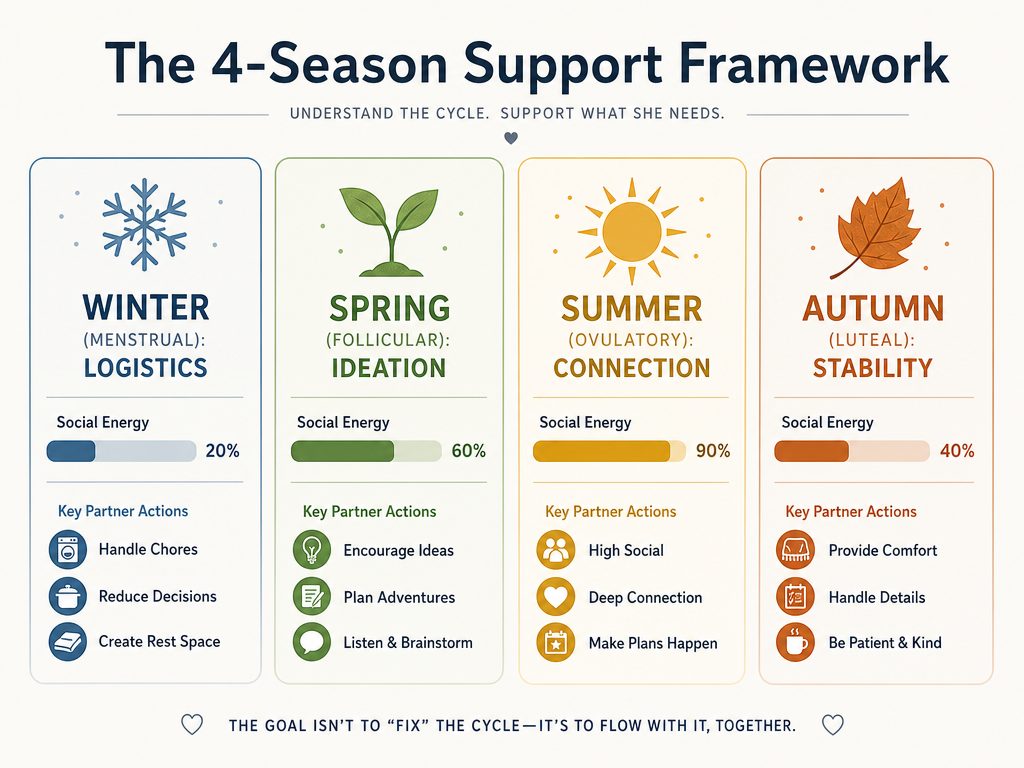 Understanding the four biological seasons allows you to anticipate your partner's needs, shifting from logistical support in 'Winter' to high-energy connection during 'Summer.'
The Four Seasons Framework
Think of the menstrual cycle as four distinct seasons, each requiring a different support strategy:
- Winter (Menstrual Phase): Days 1-5. Low energy, high need for physical comfort. Your role: Infrastructure and logistics.
- Spring (Follicular Phase): Days 6-13. Rising energy, openness to new experiences. Your role: Ideation and planning.
- Summer (Ovulatory Phase): Days 14-16. Peak energy, high social drive. Your role: Connection and adventure.
- Autumn (Luteal Phase): Days 17-28. Declining energy, rising sensitivity. Your role: Stability and defense.
One critical caveat: a "normal" cycle varies considerably between women - menstrual bleeding can start anywhere from every 24 to every 38 days and last up to 8 days. Don't treat these day counts as gospel for your specific girlfriend. Use them as a rough map, then calibrate based on what you observe.
Phase 1: Winter (Menstrual Phase)
What's Happening Biologically
Prostaglandins - hormone-like compounds - are the primary chemical cause of uterine muscle contractions, which is a clinical way of saying her body is literally cramping to shed the uterine lining. Energy is at its lowest point of the month. Blood loss, even when normal, causes fatigue.
What She Actually Needs
She needs you to handle the physical logistics without being asked. This is the Infrastructure Phase.
Do:
- Stock supplies before she asks (pain relievers, heating pad, her preferred snacks)
- Handle all meal prep and cleanup
- Take over any physically demanding chores
- Offer a heating pad, not advice
- Ask "What would make tonight easier?" not "What do you want for dinner?"
Don't:
- Suggest high-energy plans or social events
- Ask her to make decisions about anything non-urgent
- Treat her symptoms as an inconvenience to your schedule
- Use phrases like "Is it that time of the month?" or make period jokes
If she's dealing with severe symptoms that disrupt her daily life, that's not "normal PMS" - it might be a medical issue worth addressing. We'll cover red flags in The Check Engine Lights section.
For a deeper tactical breakdown of this phase, read how to support your girlfriend during her period.
Phase 2: Spring (Follicular Phase)
What's Happening Biologically
During the follicular phase, estrogen rises as an egg-containing follicle develops in the ovary. This rising estrogen also thickens the uterine lining and affects brain chemistry in ways that generally support focus and energy. Near the end of this phase, high estrogen triggers a surge in luteinizing hormone (LH), which sets off ovulation.
Her energy is building. She's more open to new ideas, planning, and future-focused conversations.
What She Actually Needs
This is the Ideation Phase. She wants to plan, create, and explore.
Do:
- Suggest new restaurants, weekend trips, or hobbies
- Have big-picture relationship conversations (moving in together, future plans)
- Plan dates that involve learning or trying something new
- Ask "What's something you've wanted to try?" and then actually book it
Don't:
- Waste this high-energy window on passive activities like another Netflix night
- Dismiss her ideas as impractical
- Be the guy who says "maybe someday" when she's biologically primed to commit to plans
This phase is also when she's most receptive to romantic surprises. Her rising energy and openness make this the ideal window for proposing a trip, planning a special date, or having a meaningful conversation about your relationship's direction.
Phase 3: Summer (Ovulatory Phase)
What's Happening Biologically
Ovulation is when a surge in luteinizing hormone (LH) causes the ovary to release an egg, typically around day 14 of a 28-day cycle. In the days just before ovulation, cervical mucus becomes clear and slippery, which is the most fertile window of the cycle.
Around ovulation, many women notice increased sex drive, mild pelvic or abdominal pain, tender breasts, bloating, and mood changes - though these vary considerably person to person, and not everyone notices them.
Energy is at its peak. Social confidence is high. She's more likely to initiate plans and seek connection.
What She Actually Needs
This is the Connection Phase. She wants high-energy social experiences and physical affection.
Do:
- Plan group dinners, parties, or events with friends
- Suggest physically active dates (hiking, dancing, rock climbing)
- Be more physically affectionate than usual
- Match her energy - this is not the week to be passive
Don't:
- Suggest staying in when she wants to go out
- Treat her increased social drive as neediness
- Miss the window - this phase is short (2-3 days at peak)
Some women experience mittelschmerz - one-sided lower abdominal pain around ovulation. It's real, documented, generally harmless, and usually lasts minutes to a couple of days. If she mentions it, acknowledge the discomfort and offer practical support like a heating pad or ibuprofen.
For more on recognizing and supporting her during this high-energy window, see our guide on supporting your girlfriend during ovulation.
Phase 4: Autumn (Luteal Phase)
What's Happening Biologically
After ovulation, progesterone rises to prepare the uterine lining for a possible pregnancy. If pregnancy doesn't happen, both progesterone and estrogen drop before the next period. Many women notice PMS-like symptoms in this phase - mood shifts, breast tenderness, bloating, acne, and appetite changes - though not everyone does.
This hormonal drop affects neurotransmitters, particularly serotonin. When serotonin drops, emotional regulation gets harder. Small annoyances feel bigger. Decision fatigue sets in faster.
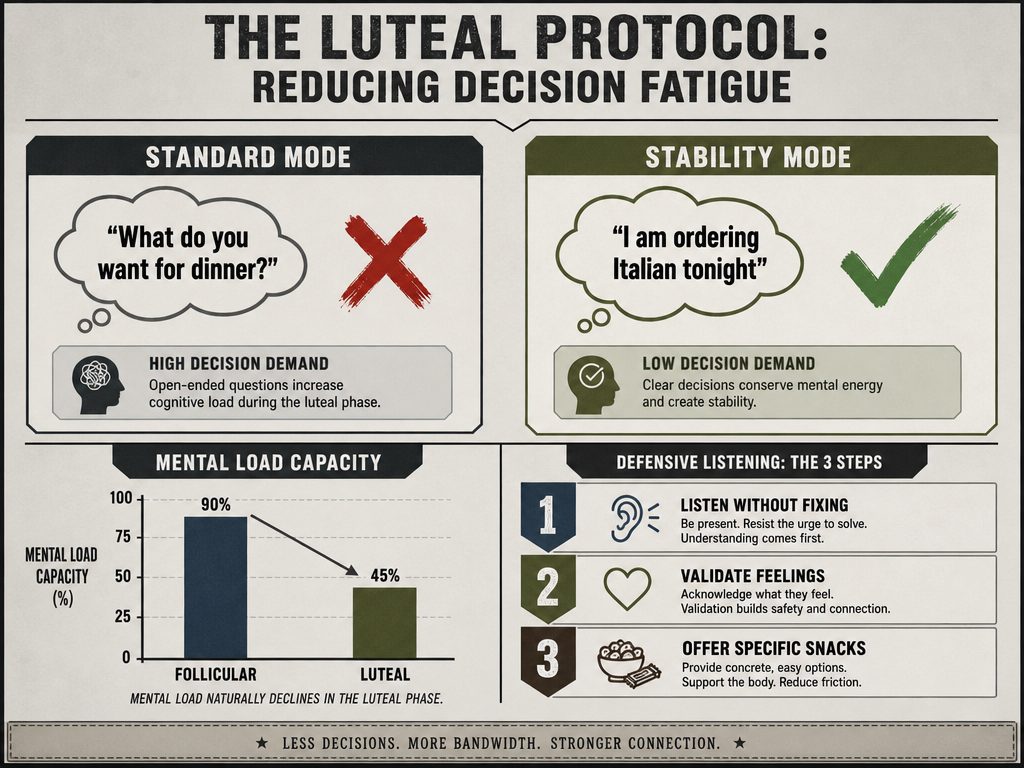 During the Luteal phase, the most effective support is removing the 'mental load' by making executive decisions rather than asking open-ended questions.
What She Actually Needs
This is the Stability Phase. She needs you to reduce decision fatigue and provide predictability.
Do:
- Make executive decisions ("I'm ordering Thai food tonight") instead of asking open-ended questions ("What do you want for dinner?")
- Stock the house with comfort foods and supplies before symptoms start
- Create a calm, predictable environment
- Practice defensive listening - validate her feelings without trying to fix or debate them
Don't:
- Pile on big decisions or emotionally heavy conversations
- Suggest high-energy social plans
- Take irritability personally
- Try to logic your way through her feelings
Approximately 3 in 4 menstruating women report experiencing PMS symptoms at some point, though severity varies widely. Symptoms typically show up one to two weeks before a period and resolve within a few days after it starts.
Here's the distinction that matters: roughly half of people who menstruate report having at least one PMS symptom, but only about 1 in 5 have symptoms severe enough to disrupt their daily life. That more disruptive tier is a meaningfully different experience than "typical" PMS.
For tactical scripts and more detailed support strategies during this challenging phase, read our luteal phase support guide.
The Check Engine Lights
Knowing when to support her versus when to suggest she see a doctor is a crucial skill. Here are the red flags that warrant a medical conversation.
The 7-2-1 Rule for Heavy Bleeding
The 7-2-1 Rule for heavy bleeding: Periods lasting more than 7 days, soaking a pad every 2 hours, or clots larger than 1 inch.
If any of these apply, she should talk to her doctor. Heavy bleeding can indicate conditions like fibroids, endometriosis, or hormonal imbalances that are treatable.
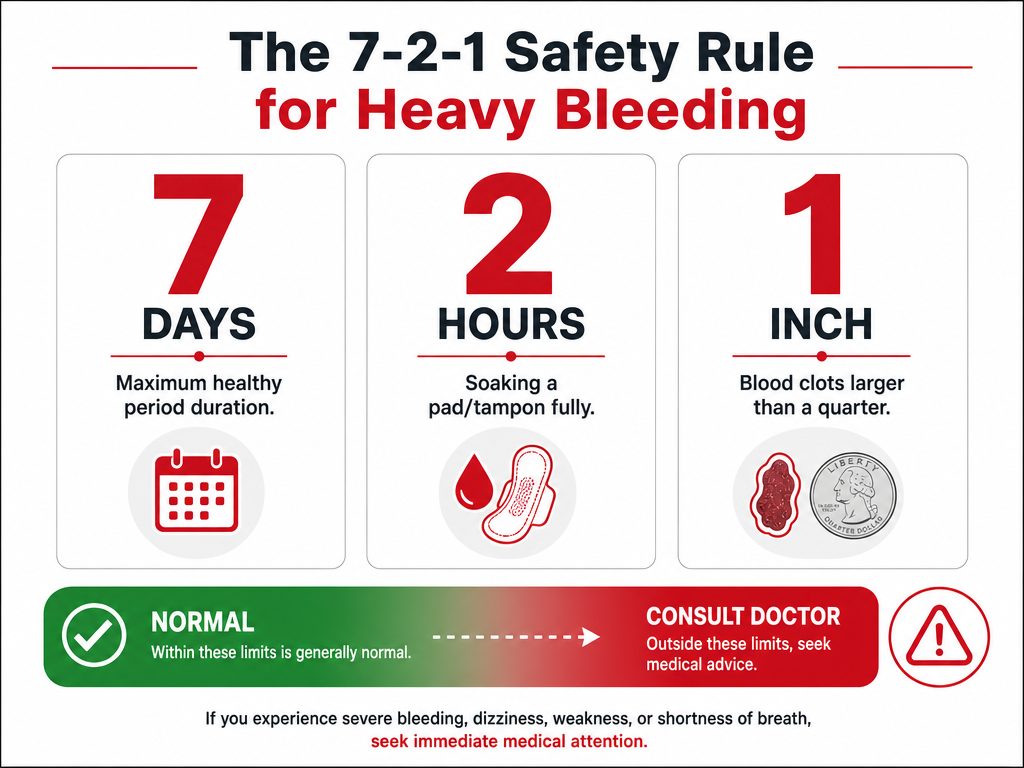 Use the CDC-validated 7-2-1 rule to identify when 'heavy bleeding' moves from a normal cycle variation to a medical concern requiring a doctor's visit.
When PMS Becomes PMDD
PMDD (premenstrual dysphoric disorder) is a real, clinically recognized condition - it's listed in the DSM-5 as a depressive disorder, not something people are "making up" or simply failing to cope with. It affects roughly 1 in 10 people who menstruate.
PMDD is a more severe, sometimes disabling extension of PMS. Both happen on a similar timeline (about 7-10 days before a period) and can share physical symptoms like bloating and fatigue, but PMDD specifically involves extreme mood symptoms - such as marked irritability, anxiety, or hopelessness - intense enough to disrupt daily life and strain relationships.
If her symptoms include:
- Intense depression or hopelessness
- Severe anxiety or panic attacks
- Sudden mood swings or crying spells
- Marked anger or interpersonal conflict
- Loss of interest in usual activities
- Difficulty concentrating
- Fatigue or lack of energy
...and these symptoms consistently appear in the week or two before her period and improve within a few days after bleeding starts, suggest she talk to her doctor. PMDD is treatable with therapy, lifestyle changes, and sometimes medication.
How to Track Without Being Creepy
The question "Should I track my girlfriend's cycle?" has a simple answer: only with her explicit knowledge and participation.
The Right Way:
- Have an open conversation: "I've been reading about how the menstrual cycle affects energy and mood. Would it help if I tracked your cycle so I can be more supportive?"
- Use a shared app or calendar she controls
- Let her update the data
- Frame it as a tool to help you be a better partner, not to monitor or predict her
The Wrong Way:
- Secretly tracking her cycle and commenting on it ("You must be about to start your period")
- Using cycle information to dismiss her feelings ("That's just PMS talking")
- Treating the data like you're managing a science experiment
Tracking symptoms and mood changes across the cycle for a few months is a legitimate, medically endorsed way to identify real patterns and timing - rather than assuming based on stereotypes or a single cycle.
For a complete guide to period tracking tools designed with men in mind, see our comparison of the best period tracker apps for men.
Why Cycle Awareness Isn't "Managing" Her
Some guys worry that understanding her cycle means treating their girlfriend like a biological experiment or reducing her to hormones. That's not what this is about.
Cycle awareness is about becoming a student of your partner, not a scientist monitoring a subject. It's recognizing that the human body runs on chemical systems that create predictable patterns, and those patterns affect everyone - including you.
When you understand these patterns, you stop taking things personally that were never about you. You anticipate needs before they become friction points. You show up with the right kind of support at the right time instead of offering solutions that miss the mark.
This isn't about control. It's about alignment.
Frequently Asked Questions
How do I explain the menstrual cycle to another guy who doesn't get it?
Use the Four Seasons framework from this guide. Most guys understand that people have different energy levels and needs at different times - they just haven't connected those shifts to a biological pattern. Explain that her cycle is a 28-day loop with four distinct phases, each requiring a different support strategy. Start with the luteal phase (Autumn) because that's where most relationship friction happens, then work backward through the other phases.
What should guys do for their girlfriend during periods?
Handle the physical logistics without being asked. Stock pain relievers, heating pads, and her preferred comfort foods before symptoms start. Take over meal prep, cleaning, and any physically demanding tasks. Ask "What would make tonight easier?" instead of open-ended questions that create decision fatigue. Offer practical comfort, not advice or attempts to fix her mood. For detailed scripts and strategies, see our guide on what to do when your girlfriend is on her period.
How to treat your girlfriend during the luteal phase?
The luteal phase requires a Stability Protocol: remove decision fatigue by making executive decisions instead of asking questions, create a calm and predictable environment, practice defensive listening (validate her feelings without trying to fix or debate them), and avoid piling on big decisions or emotionally heavy conversations. Stock comfort supplies before symptoms start. Don't take irritability personally - it's a serotonin drop, not a commentary on you. Read our tactical luteal phase guide for specific scripts.
Is it normal to not like your partner during the luteal phase?
Yes, and it's biological, not personal. When progesterone and estrogen drop in the luteal phase, serotonin drops with them, which makes emotional regulation harder. Small annoyances feel bigger. Your partner might feel more irritable or withdrawn, and you might feel like you're walking on eggshells. This is a predictable pattern, not a sign your relationship is broken. The key is recognizing the phase, adjusting your expectations, and providing stability instead of taking her mood shifts as rejection.
Are you hornier during ovulation or the luteal phase?
Around ovulation, many women notice increased sex drive, along with other symptoms like mild pelvic pain, tender breasts, and mood changes - though these vary considerably person to person. Libido tends to peak during the ovulatory phase (Summer) when estrogen is highest, then declines during the luteal phase (Autumn) as progesterone rises and both hormones eventually drop. However, individual variation is significant - some women report increased desire in other phases or no noticeable pattern at all.
What is the 7-2-1 rule for menstruation?
The 7-2-1 Rule is a screening tool for heavy menstrual bleeding: periods lasting more than 7 days, soaking a pad every 2 hours, or clots larger than 1 inch. If your girlfriend experiences any of these consistently, she should talk to her doctor. Heavy bleeding can indicate treatable conditions like fibroids, endometriosis, or hormonal imbalances. This rule helps distinguish between normal cycle variation and a medical concern requiring evaluation.
Can my period affect my boyfriend's mood?
While your menstrual cycle doesn't directly affect his hormones, your partner's mood and behavior can absolutely influence his emotional state. If you're irritable or withdrawn during your luteal phase, he might feel confused, defensive, or stressed trying to figure out what he did wrong. Open communication helps - when both partners understand that your mood shifts follow a biological pattern, it's easier for him to provide support without taking things personally, and easier for you to ask for what you need without guilt.
How do you feel in luteal vs follicular phase?
The follicular phase (Spring) typically brings rising energy, openness to new experiences, and improved focus as estrogen climbs. You might feel more social, optimistic, and ready to tackle new projects. The luteal phase (Autumn) tends to bring declining energy, increased sensitivity, and a narrower emotional bandwidth as progesterone rises and then both hormones drop. You might feel more introverted, irritable, or fatigued, with a stronger need for routine and predictability. These patterns vary person to person - tracking your own symptoms for a few months is the best way to identify your specific experience.
Your girlfriend's cycle isn't an obstacle to manage - it's a roadmap to understanding her better. When you learn the Four Seasons framework and adjust your support strategy to match each phase, you stop walking on eggshells and start leading with confidence.
The goal isn't to predict her every mood or treat her like a science experiment. It's to recognize the biological patterns that shape her energy and needs so you can show up as the partner she actually wants - not the guy who guesses wrong and wonders why she's frustrated.
Ready to turn this knowledge into daily action? VibeCheck gives you a personalized daily mission based on where she is in her cycle, so you always know what kind of support to offer. It's the difference between reading a manual and having a coach in your pocket.
Tags

Related Articles
Continue reading to deepen your understanding

When Your Girlfriend Goes Distant During the Luteal Phase: The Partner’s Tactical Guide
Does your girlfriend pull away or go quiet right before her period? Understand the biological reason for her withdrawal and how you can support her without making it worse.

The Strategic Partner’s Guide to Ovulation Energy Surge Date Ideas
Is your girlfriend suddenly full of energy and ready for adventure? It’s likely her ovulation surge. Use this guide to plan dates that match her peak confidence and social drive.

How to Plan a Surprise for Your Girlfriend During Her Follicular Phase
Stop fighting her hormones and start working with them. Use this guide to time your surprises perfectly with her biological clock for better reactions and maximum joy.

How to Comfort Your Girlfriend During Ovulation Mood Swings: The Partner’s Tactical Guide
Is your partner suddenly irritable mid-cycle? It is likely an estrogen crash. Use these tactical tips to navigate her ovulation mood swings with empathy.

What to Expect: Understanding Your Girlfriend’s Emotional Changes During Ovulation
Ever wonder why your girlfriend’s energy shifts mid-cycle? Her mood, confidence, and social drive are driven by hormonal surges that you can track to provide better support.

How to Comfort Your Girlfriend During Ovulation Bloating Naturally
Is your partner feeling puffy mid-cycle? Help her feel better with this guide to understanding ovulation discomfort and using gentle, natural remedies to ease her physical symptoms.

How to Comfort Your Girlfriend During Ovulation Cramps
Seeing your partner in pain during the peak of her cycle can be confusing. Use this guide to provide physical relief and emotional support for mid-cycle ovulation cramps.

How to Support Your Girlfriend During Ovulation Energy Changes
Notice her energy shifting from high-performance to a total crash? It’s likely ovulation. Here is how you can understand her cycle and be the supportive partner she needs right now.