How to Give Your Girlfriend Reassurance During Ovulation Week

Is your girlfriend suddenly questioning everything during her cycle? Understand the estrogen crash and learn how to provide the tactical support she needs to feel secure and loved.
How to Give Your Girlfriend Reassurance During Ovulation Week: A Partner's Tactical Guide
Your girlfriend went from planning a hiking trip to questioning whether you actually care about her career goals. Nothing changed in your relationship, but her confidence just crashed. If this sounds familiar, you're likely seeing the ovulation paradox in action.
Around 20% to 30% of women notice feeling more sensitive, energized, or emotionally reactive during ovulation. What confuses most men is that this sensitivity window includes both the high-energy peak and the sudden crash immediately after. Your girlfriend isn't being unpredictable - her biology is following a script you haven't learned to read yet.
This guide breaks down exactly when she needs reassurance, what kind of reassurance works in each phase, and how to offer support without making her feel like you're patronizing her or reducing her emotions to "just hormones."
Table of Contents
- Understanding the Ovulation Reassurance Paradox
- Phase 1: The High-Energy Peak (Days 12-14)
- Phase 2: The Estrogen Crash (Days 15-16)
- Concrete Reassurance Scripts for Each Phase
- Handling Mittelschmerz: The Physical Component
- The Invisible Tracker Code of Ethics
- When Sensitivity Becomes a Medical Concern
- Frequently Asked Questions
Understanding the Ovulation Reassurance Paradox
Ovulation isn't a single day - it's a multi-phase biological event that shifts your girlfriend's mood, energy, and social needs over about a week. Ovulation is when a surge in luteinizing hormone (LH) causes the ovary to release an egg, typically around day 14 of a 28-day cycle. But the reassurance needs you'll encounter span roughly days 12-16 of her cycle, covering both the lead-up to ovulation and the immediate aftermath.
Here's what makes this phase confusing: she might seem like two completely different people within 48 hours.
During the peak (days 12-14), estrogen levels are highest in the days leading up to ovulation, which often creates what relationship apps call "biological summer" - high energy, social confidence, and increased libido. She might initiate plans, take on new projects, or feel unusually decisive.
VibeCheck App
Download Free on iOS →Then the crash hits. Estrogen levels drop sharply right after ovulation, which can trigger a temporary decline in serotonin. Within 24-48 hours of the egg being released, she can shift from feeling invincible to suddenly questioning everything - her career, your relationship, her life choices. This isn't a personality flaw or emotional instability. It's a neurochemical event.
The reassurance mistake most men make is treating both windows the same way. Offering comfort food and a quiet night in during her high-energy peak can feel dismissive. Suggesting a spontaneous road trip during the estrogen crash can feel overwhelming. You need different playbooks for different phases.
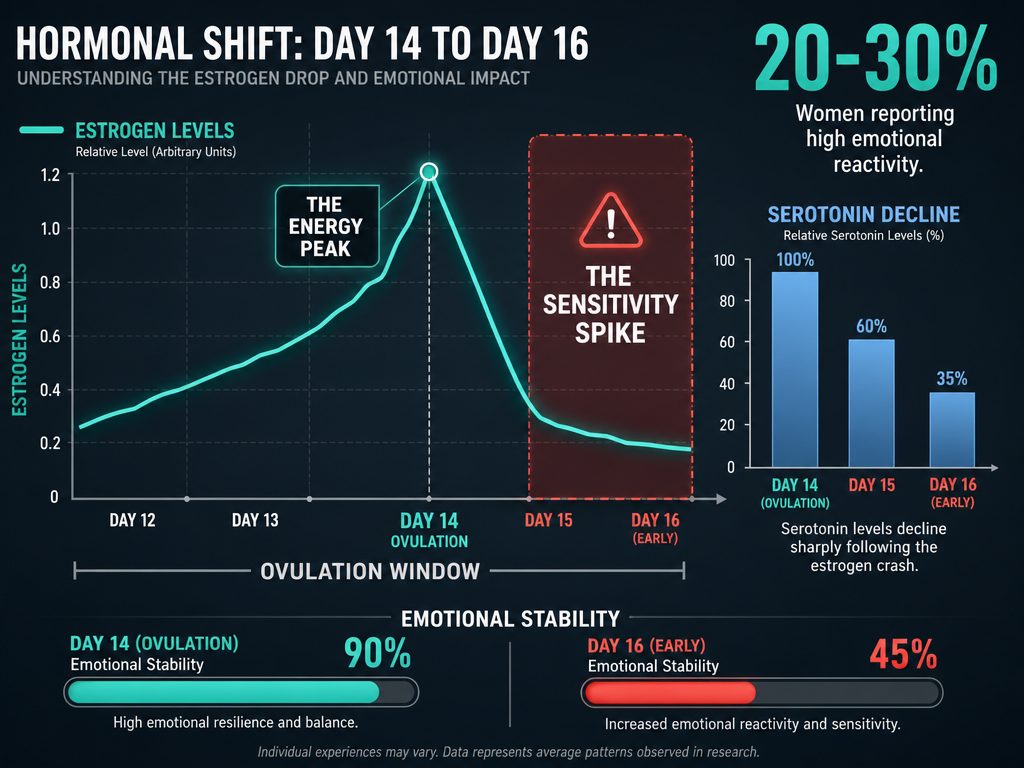 Understanding the biological 'Estrogen Crash' helps partners anticipate the sudden shift from high-energy confidence to emotional sensitivity immediately following ovulation.
Phase 1: The High-Energy Peak (Days 12-14)
What's Happening Biologically
During the follicular phase, estrogen rises as an egg-containing follicle develops in the ovary. By days 12-14, estrogen is at its monthly peak, which tends to boost cognitive clarity, social energy, and confidence. A woman's voice pitch can increase by an average of 20 Hz during ovulation, a subtle signal of this hormonal shift.
This isn't just about fertility. The energy surge affects how she engages with work, friends, and goals. She might feel more ambitious, more articulate, and more willing to take social risks.
The Reassurance Type She Needs: Validation of Competence
During this phase, reassurance isn't about making her feel safe or protected - it's about validating her capabilities and ambitions. She doesn't need you to solve problems; she needs you to recognize that she's crushing it.
The emotional need here is acknowledgment. She's operating at peak mental and physical performance, and she wants that recognized - not in a patronizing "good job, honey" way, but in a way that shows you're paying attention to her wins.
The Four Pillars of Support
Here's what works during the high-energy peak, adapted from relationship frameworks like the one used by VibeCheck:
1. Social Lead: Take initiative on plans. She has the energy for adventure, but she also has a full cognitive load right now. Offer options rather than open-ended questions. "Want to check out that new restaurant Saturday or try the farmers market?" beats "What do you want to do this weekend?"
2. Specific Validation: Generic compliments fall flat. Instead of "You're amazing," try "The way you handled that client call this morning was brilliant - you defused the tension in under two minutes." Specificity shows you're actually paying attention.
3. Creativity Soundboard: She's generating ideas right now. Your job isn't to problem-solve unless asked - it's to be an engaged listener. When she's brainstorming a career move or planning a trip, offer curiosity, not caution. "What would that look like?" beats "Are you sure that's realistic?"
4. Non-Transactional Touch: Physical affection during this phase should be offered without expectation. A spontaneous hug after she shares good news or a hand on her back during a conversation reinforces connection without pressure.
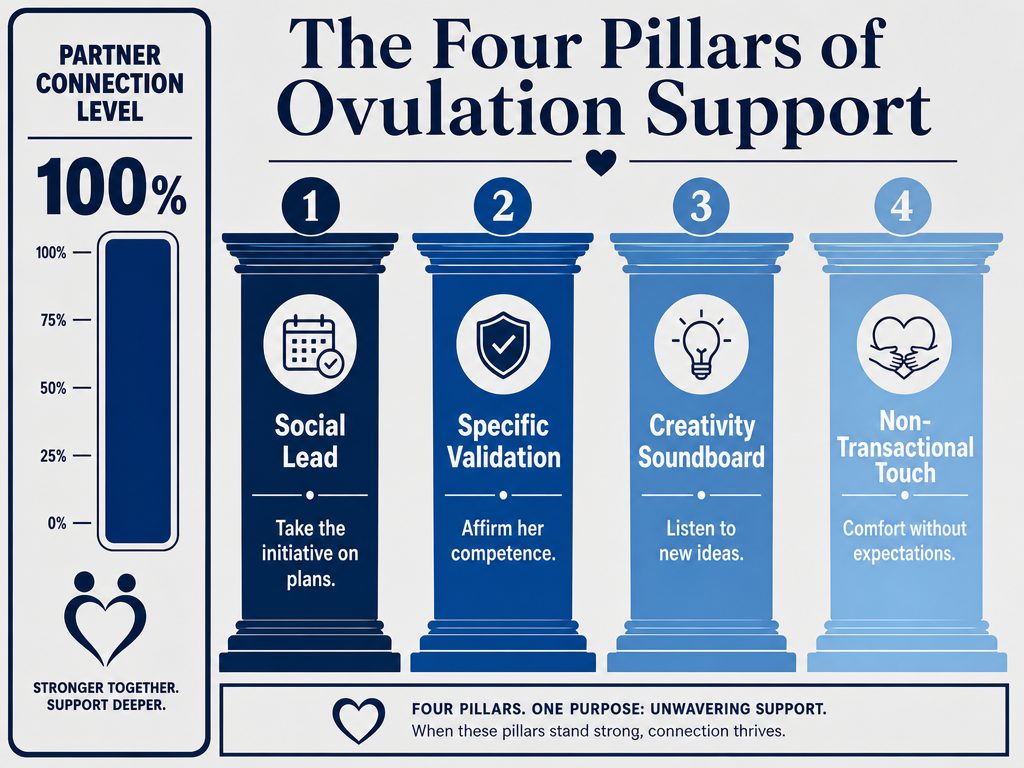 The Four Pillars of Support provide a strategic framework for men to navigate their partner's high-energy 'biological summer' with intentionality and presence.
What Not to Do
Don't dampen her energy with caution disguised as care. "Make sure you don't overcommit" or "You've been doing a lot lately, maybe slow down" can read as doubt in her judgment during a phase when she's feeling particularly capable. If she's not asking for advice, don't give it.
Also, don't assume high energy equals high libido in a simple way. Around ovulation, many women notice symptoms such as increased sex drive, but this isn't universal, and desire during this phase is often tied to emotional connection and validation - not just physical availability.
Phase 2: The Estrogen Crash (Days 15-16)
What's Happening Biologically
After the egg is released, estrogen plummets. Estrogen levels drop sharply right after ovulation, which can trigger a temporary decline in serotonin. Serotonin is the neurotransmitter that regulates mood, anxiety, and emotional stability. When it dips, even temporarily, the psychological effects can be immediate and severe.
This is the window where your girlfriend might suddenly:
- Question whether you actually care about her
- Feel inexplicably anxious about work or life decisions
- Withdraw socially or feel emotionally fragile
- Experience sudden irritability over small things
It's not a mood swing in the stereotypical sense. It's a chemical shift that feels, to her, like the ground just disappeared.
The Reassurance Type She Needs: Security and Stability
During the crash, reassurance shifts from validating her competence to reinforcing stability and emotional safety. She needs to know that even though she feels like she's falling apart, the relationship is solid, your feelings haven't changed, and you're not going anywhere.
This is the phase where actions speak louder than words. Grand romantic gestures can feel hollow if the day-to-day reassurance isn't there.
Tactical Support Scripts
Here's what to say and do when you notice the shift:
"I've got the chores tonight. You've been going hard all week - let's just have a quiet night in. I love having you close."
This script does three things: it removes a task from her mental load, it acknowledges her recent effort (callback to the high-energy phase), and it offers closeness without demanding emotional labor.
"That project at work has been stressing you out. Want to talk through it, or would you rather watch something mindless and order takeout?"
You're naming the stressor (which shows you've been paying attention) and offering two options that respect her current bandwidth. Don't force problem-solving mode if she's not in it.
Physical presence over words: Sit next to her on the couch instead of across the room. Offer a shoulder massage without expectation. When a partner is struggling emotionally, responding with genuine empathy - listening without judgment, focusing on their feelings rather than debating facts, and validating that their reaction makes sense - tends to help more than trying to "fix" the problem.
What Not to Do
Never, ever say "Are you sure you're not just hormonal?" Even if you're trying to help her connect the dots, it reads as dismissal. If she brings up biology herself, you can acknowledge it - but don't lead with it.
Don't try to logic her out of anxiety. "There's no reason to worry about that" or "You're overthinking this" invalidates her experience. The anxiety is chemically driven, not rationally grounded, and telling her it doesn't make sense only makes her feel worse.
Don't take irritability personally. If she snaps over something small, it's probably not about the thing she's snapping about. Hold your boundary if needed ("Hey, I want to help, but I need you to talk to me without yelling"), but don't escalate.
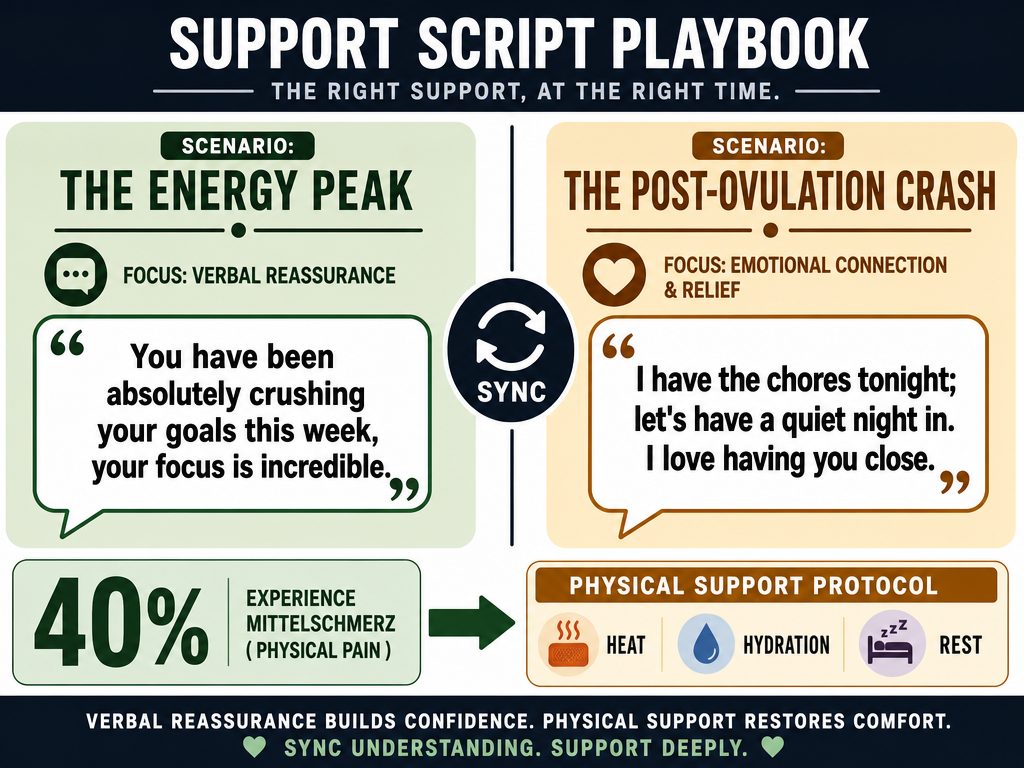 Using specific scripts tailored to her hormonal phase allows for targeted reassurance that addresses either her need for ambition-validation or safety-stability.
Concrete Reassurance Scripts for Each Phase
Here are side-by-side scripts you can adapt based on which phase she's in.
High-Energy Peak Scripts (Days 12-14)
Career/Ambition:
"You've been absolutely crushing [specific project or goal] this week. Your focus is incredible. What's next on your list?"
Social Plans:
"I was thinking we could [specific plan] this weekend, but I'm also down for [backup plan]. What sounds better to you?"
Everyday Validation:
"I noticed you [specific observation]. That was smart/thoughtful/well-handled."
Estrogen Crash Scripts (Days 15-16)
Anxiety/Worry:
"I can tell something's weighing on you. I'm here if you want to talk, or I can just sit with you. What would help right now?"
Relationship Reassurance:
"I know things have felt off today, but nothing's changed for me. I'm not going anywhere."
Physical Comfort:
(No words necessary - offer a hug, make her tea, sit close, dim the lights if she's overwhelmed.)
The key difference: during the peak, your reassurance should amplify her energy and confidence. During the crash, it should create a stable, low-pressure container where she can feel vulnerable without having to perform.
For more on cycle-aware communication strategies, see How to Support Your Girlfriend During Ovulation Mood Changes.
Handling Mittelschmerz: The Physical Component
Approximately 40% of people experience ovulation pain, known as Mittelschmerz. This is one-sided lower abdominal pain that happens around the time of ovulation. Mittelschmerz - one-sided lower abdominal pain around the time of ovulation - is a real, documented phenomenon, not something imagined. It usually lasts minutes to a couple of days and is generally harmless.
If your girlfriend mentions pain or you notice her holding her side or moving more carefully, here's how to help:
Physical Support Protocols
Heat: A heating pad or hot water bottle on her lower abdomen can relieve cramping. Offer to set this up without her having to ask.
Hydration: Dehydration can make cramping worse. If she's in pain, bring her water. Simple, but effective.
The Invisible Lead: Don't make her manage you while she's uncomfortable. If you're out and she needs to go home, just start heading toward the car - don't make her justify it or negotiate timing. "Let's get you home" beats "Do you want to leave?"
Rest Space: If she needs to lie down, create a low-stimulus environment. Dim lights, quiet, and your presence nearby (but not hovering) can help more than trying to distract her with conversation.
How often mittelschmerz happens varies a lot: some women get it almost every cycle, others only occasionally or never. If she's experiencing this regularly, she already knows what helps - your job is to remove obstacles to her getting that relief.
The Invisible Tracker Code of Ethics
If you're tracking her cycle to anticipate her needs, there's a right way and a wrong way to use that information.
Never Say "I Know You're Ovulating"
Even if you're right, this lands as reductive and invasive. It positions you as an outside observer of her body rather than a supportive partner. If she brings up her cycle, you can engage - but don't lead with your tracking data.
Frame Support as Observation, Not Prediction
Instead of "You're probably going to need space this week because you're entering your luteal phase," try "I noticed you've been quieter the last couple of days - want me to give you some space, or would it help to talk?"
You're responding to what you're observing in the moment, not telling her how she's going to feel based on a calendar.
Avoid Transactional Intimacy Expectations
Don't use cycle tracking to optimize when to initiate sex. Yes, libido patterns correlate with hormonal phases, but treating her cycle as a sexual availability forecast is dehumanizing. Desire is influenced by biology, but it's also influenced by emotional connection, stress, sleep, and whether you've been pulling your weight on household responsibilities.
Respect Privacy
If you're using a period tracking app with a partner mode (like Clue Partner Connect or VibeCheck), make sure she's opted in and knows what data you're seeing. Don't secretly track her cycle and then act on it without her knowledge. That's surveillance, not support.
For more on ethical cycle tracking, see The Partner's Guide to the Period Cycle.
When Sensitivity Becomes a Medical Concern
The line between normal hormonal sensitivity and a clinical condition isn't always obvious, but there are clear markers that signal when she should talk to a healthcare provider.
Normal Ovulation Sensitivity vs. PMDD
About 20% to 30% of women notice feeling more sensitive, energized, or emotionally reactive during ovulation. This is within the range of typical hormonal shifts. However, PMDD (premenstrual dysphoric disorder) is a real, clinically recognized condition - it's listed in the DSM-5 as a depressive disorder, not something people are "making up" or simply failing to cope with. It affects roughly 1 in 10 people who menstruate.
Red Flags That Warrant Medical Attention
If your girlfriend experiences any of these patterns regularly, encourage her to see a doctor:
- Mood symptoms that interfere with work, school, or relationships every cycle
- Suicidal thoughts or self-harm urges during any phase of her cycle
- Severe pain that isn't relieved by over-the-counter medication
- Bleeding between periods or cycles that are consistently irregular
- Anxiety or depression that feels unmanageable, even with support
How to Bring It Up
"I've noticed the week before your period has been really rough on you for the last few months. Have you thought about talking to your doctor? I'm not saying something's wrong - I just want to make sure you're getting support if this is harder than it needs to be."
Frame it as care, not diagnosis. You're not a medical professional, and even if you've read every article on menstrual health, you can't diagnose PMDD or endometriosis from behavioral observation. What you can do is notice patterns and gently suggest that professional support might help.
For more on supporting a partner with severe symptoms, see How to Comfort Your Girlfriend During PMS.
Frequently Asked Questions
Do women get clingy when ovulating?
Not exactly. Around ovulation, many women notice symptoms such as increased sex drive, mild pelvic or abdominal pain, tender breasts, bloating, and mood changes - but these vary a lot person to person. Some women feel more socially energized and seek connection during the high-energy peak (days 12-14), while others might feel more emotionally vulnerable during the estrogen crash (days 15-16) and need reassurance. "Clingy" is reductive - what you're seeing is a shift in social and emotional needs driven by hormonal changes.
Is it normal to feel super emotional during ovulation?
Yes, particularly during the post-ovulation estrogen crash. Estrogen levels drop sharply right after ovulation, which can trigger a temporary decline in serotonin. This can cause sudden mood swings, anxiety, or tearfulness that feel disproportionate to the situation. About 20% to 30% of women notice feeling more sensitive, energized, or emotionally reactive during ovulation. It's a real, biologically driven experience - not overreacting.
How do I give my girlfriend reassurance without making it about her hormones?
Focus on what you observe, not what you've tracked on a calendar. Instead of "You're probably just ovulating," try "I can tell something's bothering you - want to talk about it?" or "You seem stressed. What would help right now?" Reassurance should respond to her emotional state in the moment, not to your prediction of what her hormones are doing. When a partner is struggling emotionally, responding with genuine empathy - listening without judgment, focusing on their feelings rather than debating facts, and validating that their reaction makes sense - tends to help more than trying to "fix" the problem.
What to do if your partner constantly seeks reassurance?
If reassurance-seeking is constant and doesn't align with her cycle, it might signal an underlying anxiety issue or attachment insecurity that goes beyond hormonal fluctuations. Roughly half of people who menstruate report having at least one PMS symptom, but only about 1 in 5 have symptoms severe enough to disrupt their daily life. If her need for reassurance is chronic and distressing for both of you, suggesting therapy (individual or couples) is reasonable. Frame it as wanting to support her in feeling more secure, not as a criticism of her behavior.
How can I best support my partner who has PMDD?
PMDD requires medical intervention - it's listed in the DSM-5 as a depressive disorder, not something that can be managed through partner support alone. Encourage her to see a healthcare provider who specializes in menstrual health. In the meantime, lifestyle approaches that can help ease symptoms include regular aerobic exercise, smaller/more frequent meals, less salt/caffeine/alcohol, adequate sleep, and stress-reduction practices like deep breathing or yoga. Your role is to reduce her mental load during severe symptom windows and validate that what she's experiencing is real and serious.
Why am I angry around ovulation?
If you're the one feeling angry, it might be a response to her mood shifts, or it could be unrelated to her cycle entirely. Men can also experience hormonal fluctuations, though the pattern differs from the menstrual cycle. If you're consistently feeling reactive during a specific time each month, tracking your own (or a partner's, with her participation) symptoms and mood changes across the cycle for a few months is a legitimate, medically endorsed way to identify real patterns and timing. But if anger is frequent and unpredictable, consider whether stress, sleep, or relationship dynamics are the real drivers.
How to reassure your girlfriend over text during ovulation?
Keep it specific and emotionally attuned. During the high-energy peak (days 12-14), text validation of her competence: "Just saw your presentation went well - you killed it." During the estrogen crash (days 15-16), text stability and presence: "Thinking about you. Let me know if you need anything tonight, or if you just want to decompress when I get home." Avoid generic "thinking of you" messages - specificity shows you're actually paying attention. For more text strategies, see GF Text Messages: Supporting Her Through Cycle Phases.
Giving reassurance during ovulation week isn't about learning a script - it's about understanding that her emotional needs shift on a biological timeline and adapting your support to match. The high-energy peak requires validation of her competence and initiative. The estrogen crash requires emotional stability and low-pressure presence. Both are predictable if you're paying attention.
Around 75-80% of women experience some physical or emotional symptoms during their cycle. Your girlfriend isn't an outlier or unusually sensitive. She's experiencing a normal hormonal event that most men don't have a biological reference point for. Your advantage is that you can learn the pattern and stop walking on eggshells.
If you want to go deeper into cycle-aware support strategies, VibeCheck offers daily missions tailored to her current phase, so you always know what to say and when to say it. But even without an app, tracking her cycle for a few months and matching your reassurance style to her phase will reduce friction and make you the kind of partner who shows up at the right time with the right kind of support.
Tags

Related Articles
Continue reading to deepen your understanding

When to Give Her Space vs. When to Stay Close: Your Phase-by-Phase Guide
Your girlfriend’s need for closeness isn’t random. Understanding how her 28-day biological rhythm affects her energy helps you time your support perfectly across all four phases.

Your Girlfriend’s 28-Day Relationship Manual: How to Support Her Through Every Phase
Understanding her menstrual cycle transforms you from a guy walking on eggshells into a strategic partner who knows exactly what support to offer and when.

When Your Girlfriend Goes Distant During the Luteal Phase: The Partner’s Tactical Guide
Does your girlfriend pull away or go quiet right before her period? Understand the biological reason for her withdrawal and how you can support her without making it worse.

The Strategic Partner’s Guide to Ovulation Energy Surge Date Ideas
Is your girlfriend suddenly full of energy and ready for adventure? It’s likely her ovulation surge. Use this guide to plan dates that match her peak confidence and social drive.

How to Plan a Surprise for Your Girlfriend During Her Follicular Phase
Stop fighting her hormones and start working with them. Use this guide to time your surprises perfectly with her biological clock for better reactions and maximum joy.

How to Comfort Your Girlfriend During Ovulation Mood Swings: The Partner’s Tactical Guide
Is your partner suddenly irritable mid-cycle? It is likely an estrogen crash. Use these tactical tips to navigate her ovulation mood swings with empathy.

What to Expect: Understanding Your Girlfriend’s Emotional Changes During Ovulation
Ever wonder why your girlfriend’s energy shifts mid-cycle? Her mood, confidence, and social drive are driven by hormonal surges that you can track to provide better support.

How to Comfort Your Girlfriend During Ovulation Bloating Naturally
Is your partner feeling puffy mid-cycle? Help her feel better with this guide to understanding ovulation discomfort and using gentle, natural remedies to ease her physical symptoms.