When Your Girlfriend Is Sensitive to Criticism During the Luteal Phase: The Partner’s Science-Based Action Guide

Does your partner react intensely to feedback right before her period? Understand the biology behind luteal phase rejection sensitivity and learn how to communicate effectively.
When Your Girlfriend Is Sensitive to Criticism During the Luteal Phase: The Partner's Science-Based Action Guide
You're standing in the kitchen. You mention the dishes. Suddenly, she's crying or defending herself like you just accused her of a felony. Last week, the same comment got a laugh. This week? A meltdown.
If this happens like clockwork in the 7-10 days before her period, you're not dealing with a personality issue. You're dealing with a biological event called rejection sensitivity, and it's a documented symptom of the luteal phase.
This guide explains why her nervous system reacts this way, how to communicate during the "red zone," and when to suggest she talk to a doctor about PMDD (premenstrual dysphoric disorder).
Table of Contents
- What Is Rejection Sensitivity During the Luteal Phase?
- The Biology of the "Hijack": Why Her Brain Reads Criticism Differently
- The Baseline Test: Is This a Relationship Problem or a Hormonal Pattern?
- The Luteal Phase Protocol: Pre-Agreed Rules for Communication
- Practical Dos and Don'ts When She's in the Red Zone
- When to Suggest Professional Help: PMS vs. PMDD
- Frequently Asked Questions
What Is Rejection Sensitivity During the Luteal Phase?
Rejection sensitivity is when your partner perceives neutral or mildly critical feedback as a personal attack. It's not melodrama. It's a documented neurological shift.
After ovulation, the luteal phase begins: progesterone rises to help prepare the uterine lining for a possible pregnancy. If pregnancy doesn't happen, both progesterone and estrogen drop before the next period. Many women notice PMS-like symptoms in this phase - mood shifts, breast tenderness, bloating, acne, and appetite changes - though not everyone does.
But some women experience something more intense. Typical affective symptoms of PMDD include irritability/anger and significant rejection sensitivity. When this happens, a comment like "Can you grab milk on the way home?" can register as "You never think ahead" or "I don't trust you."
VibeCheck App
Download Free on iOS →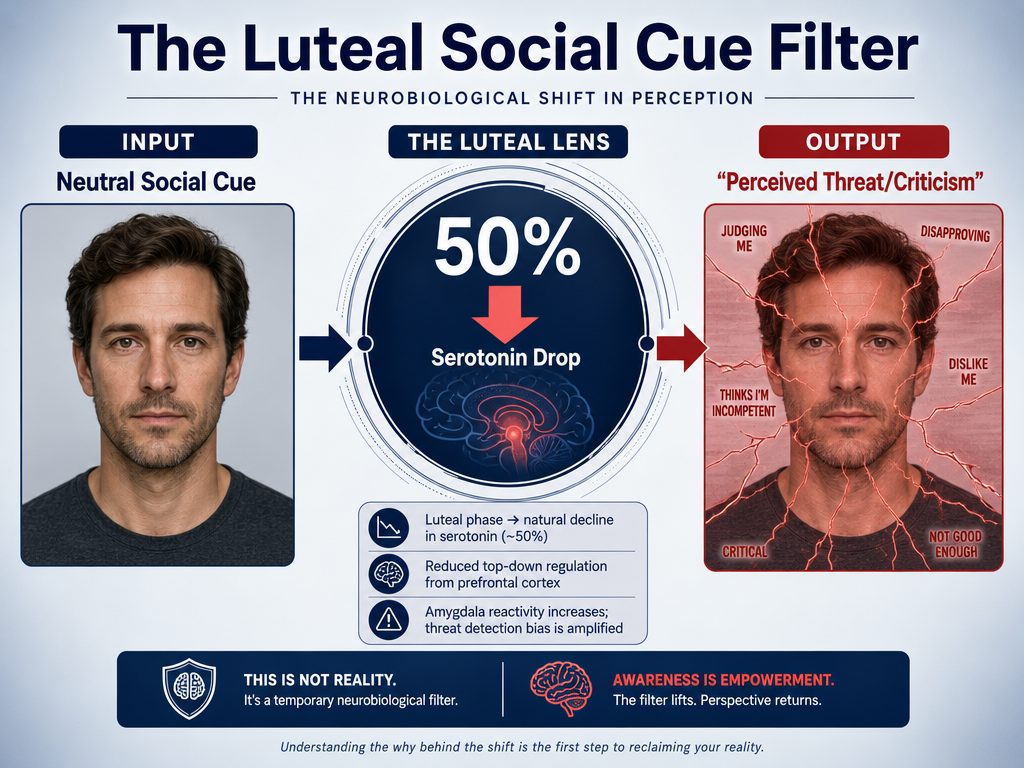 During the luteal phase, a drop in serotonin can physically impair the brain's ability to read social cues, turning neutral comments into perceived attacks.
The key insight: serotonin levels drop in the luteal phase, which specifically regulates the processing of social cues. Low serotonin literally impairs the brain's ability to read facial expressions and tone. A neutral face looks "angry" to her. A factual statement sounds accusatory.
This isn't about her being "too sensitive." Her brain is processing your words through a different neurochemical filter.
The Biology of the "Hijack": Why Her Brain Reads Criticism Differently
Think of the luteal phase as a biological alarm system on high alert. Two neurochemical shifts cause this:
1. Serotonin Drop
Serotonin regulates mood and social perception. Serotonin levels drop in the luteal phase, which means her ability to read your tone, facial expressions, and intent is compromised. You say "We need to talk about finances." She hears "You think I'm irresponsible with money."
2. GABA-A Receptor Dysfunction
During the luteal phase, GABA-A receptors respond abnormally to fluctuating Allopregnanolone (ALLO) levels in PMDD, leading to emotional lability. GABA usually calms the nervous system. When it malfunctions, emotional responses become exaggerated. Small feedback feels existential.
Research shows PMDD patients have significantly lower estrogen levels in both early and late luteal phases compared to controls. Lower estrogen means lower serotonin. Lower serotonin means heightened threat perception.
This isn't a character flaw. It's a nervous system hijack.
The Baseline Test: Is This a Relationship Problem or a Hormonal Pattern?
Before you assume her sensitivity is a "her problem" or a "relationship problem," run the Baseline Test.
The Baseline Test Rule: Evaluate the health of your relationship only during days 5-10 of her cycle (the follicular phase). During the follicular phase, estrogen rises as an egg-containing follicle develops in the ovary; this rising estrogen also thickens the uterine lining. This is when her serotonin is highest and her nervous system is most stable.
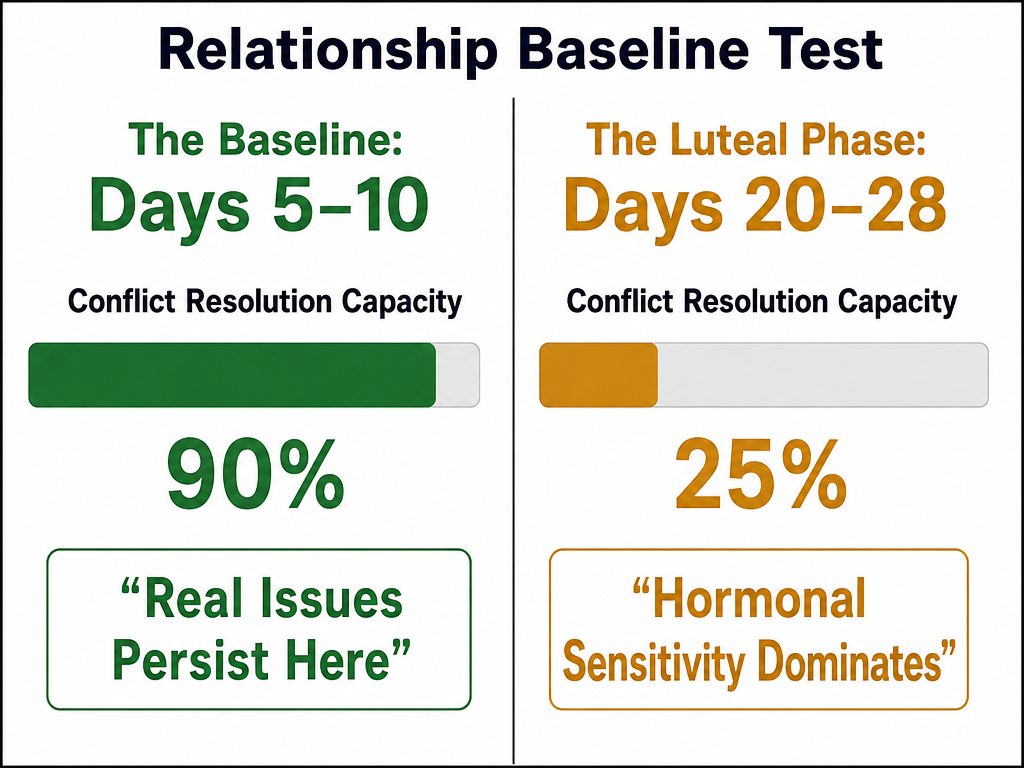 Use the 'Baseline Test' to evaluate your relationship: issues that only exist during the luteal phase are often biological, not foundational relationship flaws.
Ask yourself:
- Does she react defensively to feedback all month, or just the week before her period?
- Are her complaints consistent, or do they disappear after menstruation starts?
- Can you have productive conversations about the relationship during the first half of her cycle?
If the answer to the first question is "just the week before," you're dealing with a biological pattern, not a personality issue.
If the sensitivity is constant across all phases, that's a different conversation - possibly about communication patterns or deeper relationship dynamics.
The Luteal Phase Protocol: Pre-Agreed Rules for Communication
The best time to create a Luteal Phase Protocol is during the follicular phase, when both of you can think clearly. This is a set of pre-agreed rules for how to handle communication when her nervous system is on high alert.
Here are three non-negotiable elements:
1. The Announcement
She needs a phrase to signal she's entered the red zone. Examples:
- "I'm in my window."
- "My bandwidth is low this week."
- "I'm in luteal mode."
This isn't an excuse. It's a biological heads-up that lets you adjust your communication style.
2. The Safe Word
Pre-agree on a word or phrase that pauses a heated argument. Examples:
- "Timeout."
- "Let's circle back."
- "I need a reset."
When a partner is struggling emotionally, responding with genuine empathy - listening without judgment, focusing on their feelings rather than debating facts, and validating that their reaction makes sense - tends to help more than trying to "fix" the problem or offer silver linings. The safe word gives both of you permission to step back before the conversation escalates.
3. The "Wait and See" Rule
If you need to deliver feedback about something that's not urgent (chores, plans, a minor issue), delay it to the follicular phase. The traditional "feedback sandwich" fails during the luteal phase because any criticism is perceived as an existential threat.
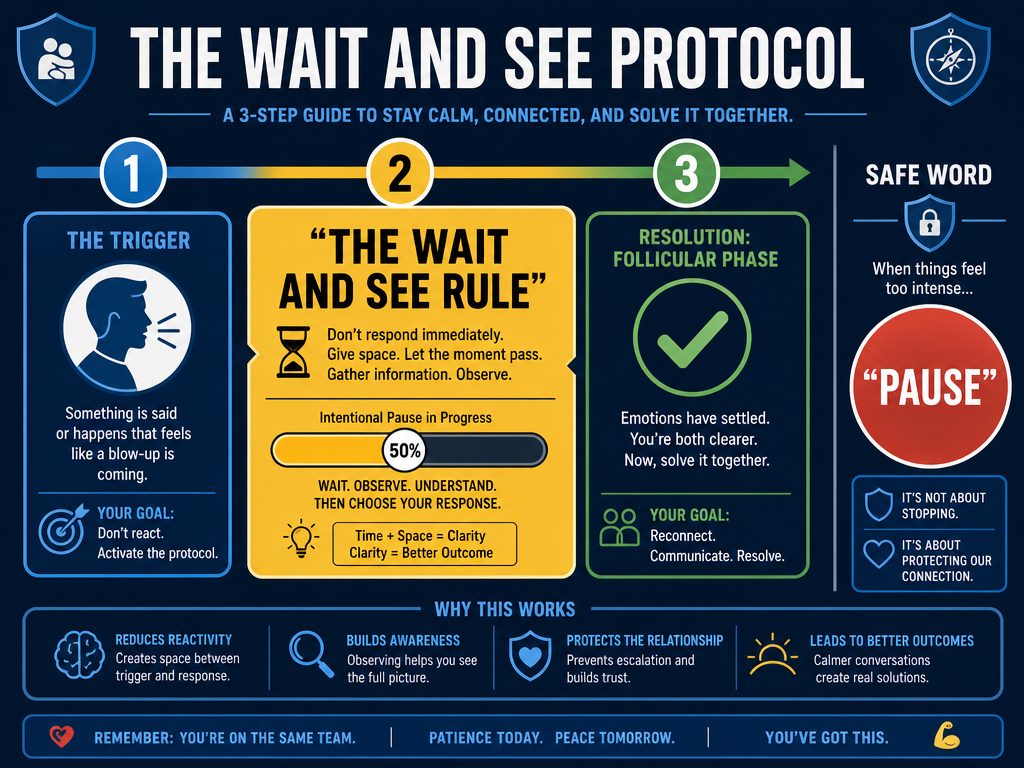 Implementing the 'Wait and See' rule allows you to postpone difficult conversations until her nervous system is no longer in a state of high alert.
Ask yourself: "Does this need to be said right now, or can it wait five days?" If it can wait, wait.
Practical Dos and Don'ts When She's in the Red Zone
DO: Take Over Domestic Labor
Reduce her sensory and cognitive load. Lifestyle approaches that can help ease PMS symptoms include regular aerobic exercise, smaller/more frequent meals, less salt/caffeine/alcohol, adequate sleep, and stress-reduction practices like deep breathing or yoga. A partner who understands these and is patient/supportive around them - rather than dismissive of symptoms - is aligning with medically recommended self-care.
During the luteal phase, her brain has less capacity for decision-making and multitasking. Silently handle:
- Cooking
- Cleaning
- Grocery shopping
- Scheduling
You're not "babying" her. You're managing the environment so her nervous system can recover.
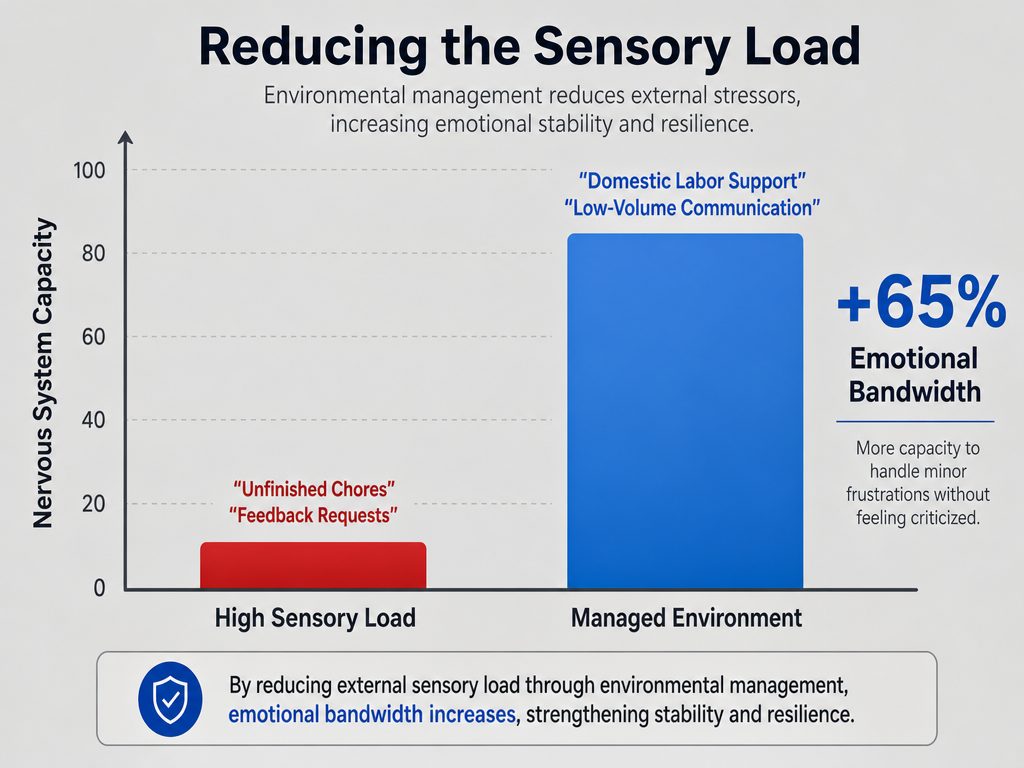 Shifting your role to 'Environment Manager' by reducing domestic labor can significantly lower her overall stress levels and reduce instances of rejection sensitivity.
DO: Validate the Feeling, Not the Reaction
When she says "You never listen to me," your instinct is to defend yourself or cite evidence. Don't.
Instead, say:
- "I can see you're feeling really hurt right now."
- "It sounds like you're feeling unheard. That sucks."
- "I'm sorry you're feeling that way. What do you need from me?"
You're not agreeing with the accusation. You're validating that the emotion is real.
DON'T: Use Dismissive Language
Never say:
- "Is it that time of the month?"
- "You're being irrational."
- "Why are you overreacting?"
- "Calm down."
These phrases trigger rejection sensitivity. To her brain, you're saying "Your feelings don't matter."
DON'T: Debate Facts During a Meltdown
If she's crying or yelling, her prefrontal cortex (the logic center) is offline. Trying to reason with her is like arguing with someone who's intoxicated. It won't work.
Say: "I hear you. Let's talk about this when we've both had some time to cool off."
When to Suggest Professional Help: PMS vs. PMDD
Not all luteal-phase sensitivity is PMDD. Here's how to tell the difference:
PMS
PMS is very common: as many as 3 in 4 women report experiencing PMS symptoms at some point in their life, though severity varies widely. Symptoms - which can include mood swings, irritability, bloating, breast tenderness, and fatigue - typically show up one to two weeks before a period and resolve within a few days after it starts.
PMDD
PMDD is a real, clinically recognized condition - it's listed in the DSM-5 as a depressive disorder, not something people are "making up" or simply failing to cope with. It affects roughly 1 in 10 people who menstruate.
PMDD is a more severe, sometimes disabling extension of PMS. Both happen on a similar timeline (about 7-10 days before a period) and can share physical symptoms like bloating and fatigue, but PMDD specifically involves extreme mood symptoms - such as marked irritability, anxiety, or hopelessness - intense enough to disrupt daily life and strain relationships.
Red Flags That Suggest PMDD
Suggest she talk to a doctor if:
- She cancels work or social plans consistently during the luteal phase.
- She has suicidal thoughts or feels hopeless.
- Her sensitivity escalates to verbal or physical aggression.
- You're walking on eggshells for 10+ days every cycle.
1 in 3 people with PMDD and/or PME (Premenstrual Exacerbation) report receiving no mental health support. If she's struggling, the International Association for Premenstrual Disorders (IAPMD) offers clinical screening tools and resources.
Frequently Asked Questions
Why am I so emotional in my luteal phase?
During the luteal phase, both estrogen and progesterone drop before your period. This decline causes serotonin (the brain chemical that regulates mood and social perception) to drop as well. Lower serotonin means your brain processes neutral social cues as negative. A partner's neutral face looks angry. A factual statement sounds critical. It's not a personality flaw - it's a neurochemical shift.
Is it normal to feel anger at my partner during the luteal phase?
Yes. Typical affective symptoms of PMDD include irritability/anger and significant rejection sensitivity. Even in women without PMDD, the luteal phase can trigger irritability because of the serotonin drop. If your anger is disruptive to daily life or relationships, that's a sign to talk to a doctor about PMDD.
Can PMDD make you not like your partner?
PMDD can make you feel like you don't like your partner during the luteal phase, but those feelings usually resolve after menstruation starts. This is why the Baseline Test is so important: evaluate your relationship only during the follicular phase (days 5-10 of your cycle), when serotonin is highest and your nervous system is stable. If your concerns disappear after your period, they're likely biological, not relational.
How to react to girlfriend's period?
If your girlfriend is in the luteal phase (the 7-10 days before her period), reduce her sensory and cognitive load. Take over domestic tasks like cooking, cleaning, and scheduling. Validate her feelings without debating facts. Delay non-urgent feedback until after her period starts. If she's in pain or visibly struggling, ask "What do you need from me?" and follow her lead. For more tactical guidance, read how to help your girlfriend during period mood swings.
Is the luteal phase the worst for PMDD?
Yes. The luteal phase is when PMDD symptoms peak because estrogen and progesterone drop sharply, which causes serotonin to drop. This creates a "nervous system hijack" where rejection sensitivity, irritability, anxiety, and hopelessness are most intense. Symptoms typically resolve within a few days after menstruation starts. For a phase-by-phase breakdown, see the boyfriend's guide to menstrual cycle phases.
The Bottom Line: If your girlfriend becomes sensitive to criticism in the 7-10 days before her period, you're not dealing with a character flaw. You're dealing with a serotonin crash that physically changes how her brain processes your words. Use the Baseline Test to separate hormonal patterns from relationship issues. Implement a Luteal Phase Protocol to communicate safely. And if her symptoms are disabling, suggest she talk to a doctor about PMDD.
Tracking your own (or a partner's, with her participation) symptoms and mood changes across the cycle for a few months is a legitimate, medically endorsed way to identify real patterns and timing - rather than assuming based on stereotypes or a single cycle. Tools like VibeCheck help partners understand her cycle so you can stop walking on eggshells and start supporting her proactively.
Tags

Related Articles
Continue reading to deepen your understanding

Your Girlfriend Is Withdrawn During Ovulation? What It Actually Means and How to Respond
Is your girlfriend suddenly distant mid-cycle? This guide covers the biological causes of ovulation withdrawal and how to support her with an invisible framework.

How to Give Your Girlfriend Reassurance During the Follicular Phase: A Partner’s Tactical Guide
Is your girlfriend feeling vulnerable after her period? Learn why the early follicular phase causes emotional lows and how you can provide the specific reassurance she needs to feel secure.

Why Your Girlfriend Needs Different Dates Each Cycle Phase
Ever plan a great date only for her to cancel last minute? Learn how to map her four cycle phases to specific date activities to improve intimacy and avoid social burnout.

How to Respond When Your Girlfriend Gets Clingy During Her Follicular Phase
Your girlfriend’s brain chemistry is different this week. Rising estrogen levels cause social drive to peak. Here is how to respond to her need for connection effectively.

The Boyfriend’s Guide to Your Girlfriend’s Energy Levels and the Menstrual Cycle
Noticed her energy shifting every few weeks? Stop guessing and start supporting. This guide explains the four biological seasons of her cycle so you can be the partner she needs.

Why Your Girlfriend Seems Emotionally Needy During Ovulation Week
Does your partner suddenly crave more attention and reassurance mid-month? It is not insecurity—it is biology. Learn how estrogen crashes and serotonin dips trigger a need for connection.

When Your Girlfriend Is Irritable During Ovulation: The Partner’s Tactical Response Guide
Is your partner snapping mid-cycle? Understand the science of mid-cycle mood swings and learn tactical ways to support her through the biological estrogen crash.

Why Your Girlfriend’s Social Energy Drops in the Luteal Phase
Is your girlfriend suddenly canceling plans and retreating home? It isn’t personal; it’s biology. Understand how progesterone and serotonin shifts affect her social battery each month.