Why Your Girlfriend Seems Emotionally Needy During Ovulation Week

Does your partner suddenly crave more attention and reassurance mid-month? It is not insecurity—it is biology. Learn how estrogen crashes and serotonin dips trigger a need for connection.
Why Your Girlfriend Seems Emotionally Needy During Ovulation Week
You've noticed a pattern. Mid-cycle, your girlfriend suddenly wants more attention, asks for reassurance about things she never questioned before, or seems to crave physical closeness in a way that feels different from the rest of the month. You're not imagining it. What looks like "neediness" is actually a biological drive for connection that peaks during a very specific window: ovulation week.
This isn't about her being insecure or difficult. It's about understanding how estrogen peaks just before ovulation and then dips immediately after, affecting serotonin production. When you know what's happening in her body, you stop taking it personally and start providing the exact support she needs.
Table of Contents
- What Actually Happens During Ovulation Week
- The Hormone Timeline: Understanding the 72-Hour Window
- Why She Seeks More Connection During Ovulation
- Reframe "Needy" as "Bonding-Ready"
- Physical Signs You Can Actually Observe
- The Partner Playbook: Four Pillars of Ovulation Support
- The Tracker Trap: What Never to Say
- Frequently Asked Questions
What Actually Happens During Ovulation Week
Ovulation is when a surge in luteinizing hormone (LH) causes the ovary to release an egg, typically around day 14 of a 28-day cycle. But the emotional and behavioral shifts don't happen on a single day. The entire ovulation window spans roughly three to five days, with distinct phases that affect her mood, energy, and need for connection.
During the follicular phase, estrogen rises as an egg-containing follicle develops in the ovary. This rising estrogen also thickens the uterine lining and, critically, affects brain function. Estrogen affects many body systems, including brain function and the ability to focus, and levels are highest in the days leading up to ovulation.
Here's what most men miss: the "needy" behavior doesn't happen when estrogen is climbing. It happens when it crashes.
Estrogen peaks just before ovulation and then dips immediately after, affecting serotonin production. Serotonin is your brain's mood stabilizer. When estrogen drops suddenly, serotonin drops with it. That's when she starts seeking reassurance, questioning things, or wanting more physical touch. Her brain is literally experiencing a chemical shift that makes her more sensitive to rejection and more alert to signs of disconnection.
VibeCheck App
Download Free on iOS →About 20 to 30 percent of women notice feeling more sensitive, energized, or emotionally reactive during ovulation. If your girlfriend is in that group, the shifts will be noticeable. If she's not, she might still experience subtle changes in her social drive or need for validation that you can learn to recognize.
The Hormone Timeline: Understanding the 72-Hour Window
Understanding her ovulation window requires breaking it into three distinct days. This isn't about tracking every hour; it's about recognizing which phase she's in so you can match your response to her actual needs.
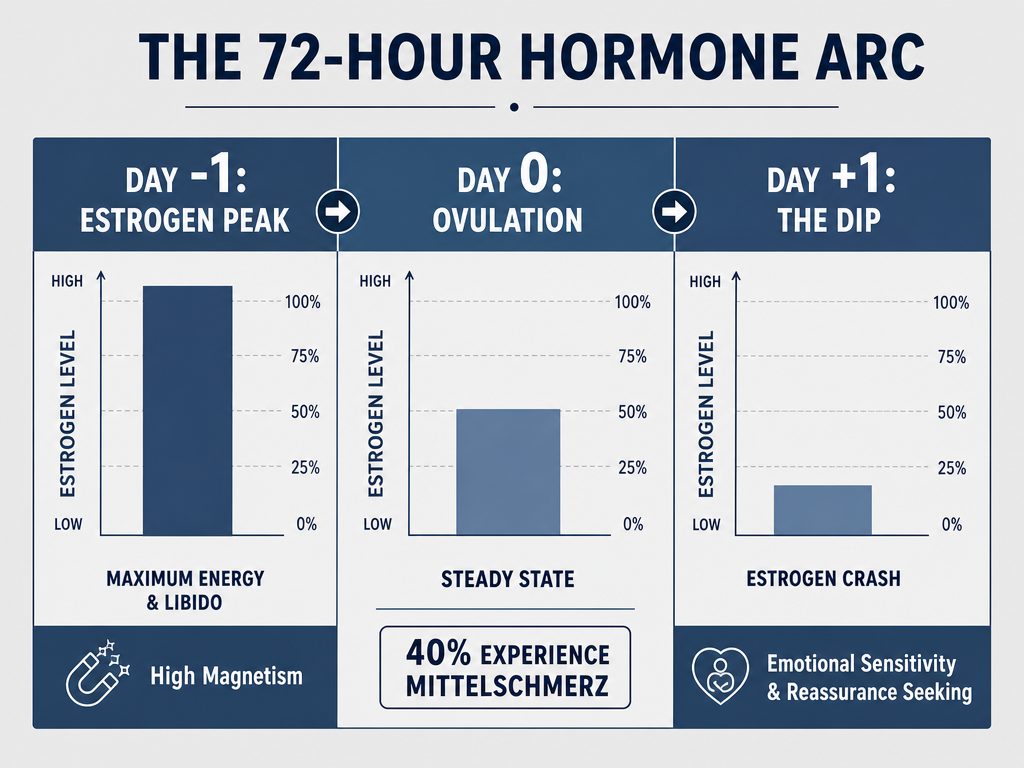 The rapid rise and sudden drop of estrogen during the ovulation window explains the transition from high social energy to a sudden need for emotional reassurance.
Day -1: The Peak
This is the day before ovulation, when estrogen is at its absolute highest. She's likely in her best mood of the month. High energy, high libido, socially magnetic. She wants to go out, see people, try new things. Her voice might sound slightly higher. A woman's voice pitch rises by an average of 15.6 Hz during the most fertile phase of her cycle, which you won't consciously notice but will subconsciously register as more animated or engaged.
This is the day she's most likely to initiate plans, suggest spontaneous activities, or push back if you want to stay in. She's not being demanding; her brain is flooded with the energy to execute ideas that have been sitting in the back of her mind all month.
Day 0: Ovulation
The egg is released. Around ovulation, many women notice symptoms such as increased sex drive, mild pelvic or abdominal pain, tender breasts, bloating, and mood changes. Some women experience mittelschmerz, which is one-sided lower abdominal pain around the time of ovulation. Approximately 40% of people experience ovulation pain, known as mittelschmerz.
If she has mittelschmerz, she might suddenly be quieter, hold her abdomen, or mention feeling bloated or uncomfortable. The pain is usually harmless and lasts anywhere from a few minutes to a couple of days. Your job isn't to fix it; it's to acknowledge it and adjust plans if needed.
Day +1: The Crash
This is the day that confuses most men. Estrogen drops sharply. Serotonin follows. She might seem suddenly sensitive, withdrawn, or in need of reassurance about things that didn't bother her yesterday. This isn't PMS; it's the post-ovulation dip. It's also when you're most likely to perceive her as "needy."
She's not insecure. Her brain is adjusting to a rapid hormonal shift, and she's seeking stability signals from you to compensate for the internal instability she's feeling. This is the day when a generic "you look nice" falls flat, but a specific "I noticed you solved that problem at work this week" lands like she needed to hear it.
Why She Seeks More Connection During Ovulation
The biological drive during ovulation isn't random. It's a fertility window, and her body is primed for bonding behaviors that historically increased the chances of securing a committed partner. You're already in a relationship, so she's not "shopping around." But her brain is still wired to seek high-quality interaction, oxytocin release, and reassurance that her partner is invested.
Ovulating women increase visual attention to attractive men, but this does not translate into better memory of them. This study shows that women are more visually alert during ovulation, but it doesn't mean they're evaluating other options. What it does mean is that her brain is in a heightened state of social awareness, which also makes her more sensitive to how you are showing up.
She's not comparing you to other men. She's unconsciously evaluating whether you're present, decisive, and reliable. This is why she might suddenly ask if you're still attracted to her, whether you're happy in the relationship, or why you didn't text her back as quickly as usual. These aren't signs of clinginess; they're her brain checking in on the stability of the bond.
If you've been tracking her cycle or paying attention to patterns, you'll notice this window happens on a regular schedule. A "normal" cycle varies a lot between women - menstrual bleeding can start anywhere from every 24 to every 38 days and last up to 8 days. Use that variability as permission to track her specific rhythm rather than assuming a textbook 28-day cycle applies.
Reframe "Needy" as "Bonding-Ready"
The term "needy" implies something is wrong. It suggests she's being unreasonable or high-maintenance. But what if you reframed it as "bonding-ready"? During ovulation, her brain is optimized for connection. She wants quality time, physical touch, and verbal reassurance because those behaviors release oxytocin, which strengthens pair bonding.
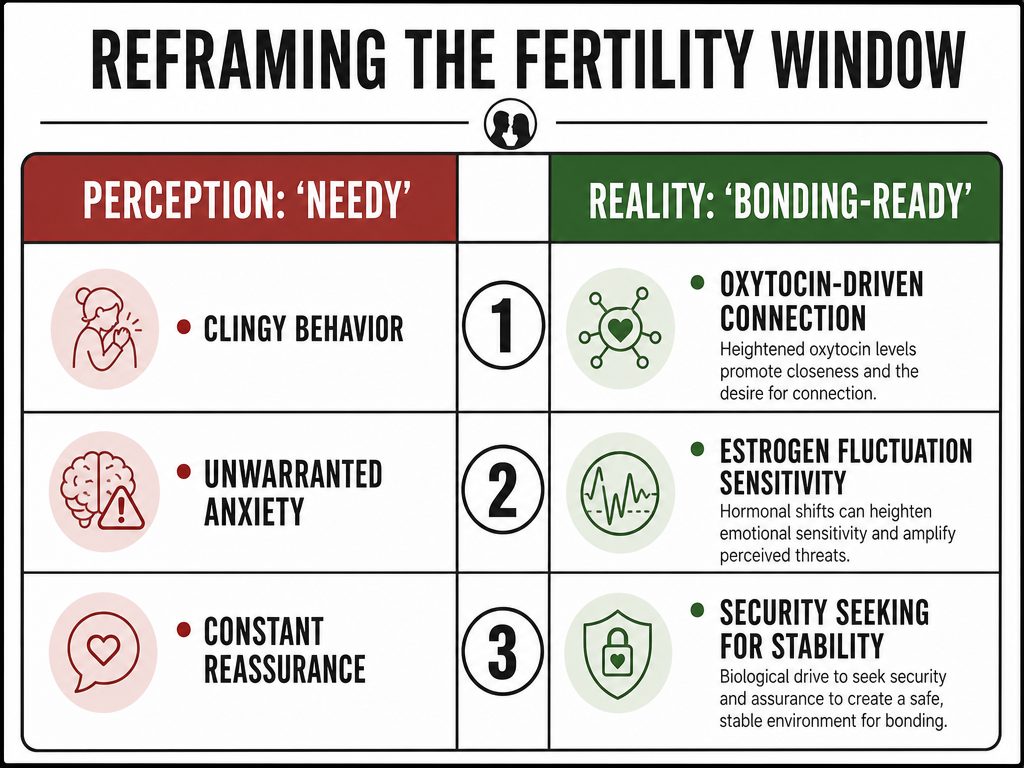 By reframing perceived "neediness" as a biological drive for bonding, partners can move from frustration to providing the specific security their significant other requires.
This reframe helps you stop seeing her behavior as a demand and start seeing it as an invitation. She's not asking you to fix anything. She's asking you to be present, engaged, and specific in your affection.
Here's what that looks like in practice. Instead of:
- "You're being clingy." Reframe to:
- "She's asking for connection during her high-bonding window."
Instead of:
- "Why does she need so much reassurance?" Reframe to:
- "Her brain is processing a serotonin drop and looking for stability signals."
Instead of:
- "She was fine yesterday; why is she upset now?" Reframe to:
- "Estrogen crashed overnight. She needs validation today, not problem-solving."
This shift in perspective doesn't mean you have to be "on" 24/7 or ignore your own needs. It means you understand the pattern so you can give the right support at the right time. If you're interested in learning more about how to support your partner through every phase, check out our guide on how to support your girlfriend during ovulation mood changes.
Physical Signs You Can Actually Observe
You don't need to ask her where she is in her cycle. There are observable behavioral and physical markers that signal ovulation is happening or just finished. Use these as silent data points to inform your approach, not as conversation starters.
The Glow Checklist
These signs appear in the 24-48 hours before ovulation:
- Clearer skin: Estrogen improves skin texture and oil production.
- Higher social battery: She's more likely to suggest plans, text friends, or say yes to social events she might usually decline.
- More animated voice: You'll notice her tone is brighter, her laugh is quicker, and she's more verbally expressive.
- Increased initiative: She's planning, organizing, or suggesting activities without you prompting her.
- More physical touch: She initiates hand-holding, sits closer, or asks for a hug more often.
The Post-Ovulation Shift
These signs appear 12-36 hours after ovulation:
- Sudden quietness: She goes from chatty to withdrawn without an obvious trigger.
- Reassurance questions: "Do you still think I'm attractive?" "Are you happy with me?" "Why didn't you text me back?"
- Mild physical discomfort: She mentions bloating, tenderness, or low-level pain.
- Preference for staying in: Plans she was excited about yesterday now feel like too much effort.
- Sensitivity to tone: A comment that would have made her laugh two days ago now feels like criticism.
If you notice these shifts, you're likely in the post-ovulation window. This is when you switch from "match her energy" mode to "provide reassurance" mode. For more on how to navigate different phases of her cycle, read our article on understanding your partner's cycle.
The Partner Playbook: Four Pillars of Ovulation Support
This framework gives you four concrete strategies to use during ovulation week. You don't need to execute all of them every day. Pick the one that fits the moment and her specific need.
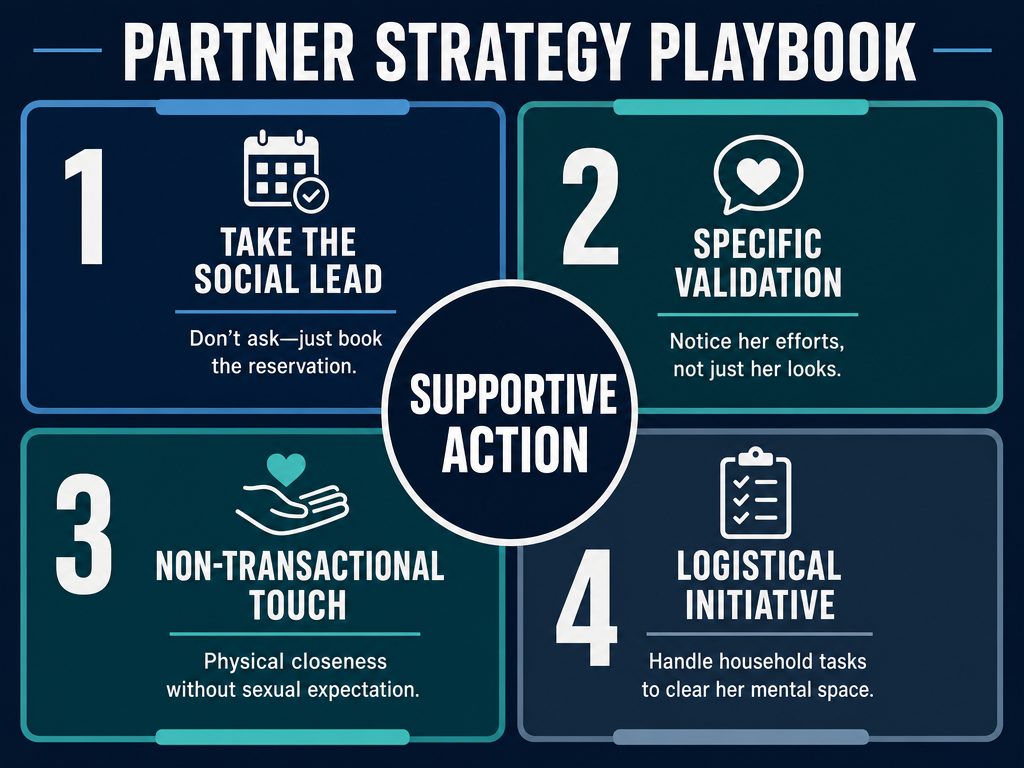 This four-pillar strategy provides a practical roadmap for men to support their partners during ovulation by focusing on initiative, validation, and physical connection.
1. Social Lead
During the high-energy window (Day -1 and Day 0), don't ask her what she wants to do. Make a decision and invite her into it. Her brain is wired for decisiveness right now, and indecisiveness from you reads as low confidence.
Instead of: "What do you want to do this weekend?" Try: "I made a reservation at that place you mentioned. We're going Saturday at 7."
Instead of: "Do you want to go out or stay in?" Try: "I'm thinking we grab dinner, then walk around downtown. Sound good?"
This doesn't mean you ignore her preferences. It means you take the mental load of planning off her plate so she can enjoy her high-energy state without having to organize everything herself.
2. Specific Validation
Generic compliments don't work during ovulation week. Her brain is seeking evidence of your investment, and "you look nice" is too vague to register as meaningful. Be specific about what you noticed.
Instead of: "You're pretty." Try: "I noticed you finished that project early. That's impressive."
Instead of: "I love you." Try: "I love how you handled that situation with your friend. You were really thoughtful."
Instead of: "You look good." Try: "That color makes your eyes stand out. I noticed when you walked in."
Specificity signals that you're paying attention. Attention signals investment. Investment is what her brain is checking for during this window. For more strategies on giving meaningful support, see our guide on supportive text ideas.
3. Non-Transactional Touch
Physical touch during ovulation should not be a prelude to sex. Offer a backrub, hold her hand while watching TV, or pull her into a hug without expecting it to go anywhere. She's seeking oxytocin release, not foreplay.
The rule: initiate touch that has no agenda. If she escalates it, great. If she doesn't, you've still given her what she needed in that moment.
Examples:
- Offer to rub her shoulders while she's working.
- Hold her hand during a walk without making it a "romantic moment."
- Sit close on the couch and rest your hand on her leg without checking your phone.
This type of touch reassures her that you want connection for its own sake, not because you're trying to get something from her. It's the difference between feeling valued and feeling like a transaction.
4. Initiative
During ovulation week, take care of logistical tasks without being asked. Handle the grocery list, book the weekend plans, or take care of something she mentioned needing to do. Her mental bandwidth is high, but she doesn't want to use it on logistics. Free her up to enjoy her energy instead of managing the household calendar.
Examples:
- "I ordered dinner. It'll be here in 30 minutes."
- "I saw we were low on [thing she mentioned]. I grabbed it."
- "I booked the tickets for [thing she wanted to do]. We're going Friday."
This isn't about "fixing" her or taking over her responsibilities. It's about proactive partnership that matches her biological state. When you handle logistics, you signal competence and reliability, which are exactly the traits her brain is checking for during this window.
If you want a deeper understanding of how to time your support efforts across her entire cycle, check out our menstrual cycle guide for boyfriends.
The Tracker Trap: What Never to Say
You're reading this article because you want to be a better partner. You're tracking patterns, learning biology, and trying to anticipate her needs. That's valuable. But there's a line you must never cross: using your knowledge as a weapon or a joke.
Never say:
- "I know you're ovulating."
- "Is this because of your hormones?"
- "You're only upset because it's ovulation week."
- "I checked your cycle. This makes sense now."
The moment you verbalize that you're tracking her, you make her feel like a science experiment instead of a partner. Your knowledge should be a silent tool that informs your behavior, not a conversation topic that reduces her emotions to hormones.
Even if you're right, even if she's exhibiting every sign on the checklist, even if you know with certainty that the estrogen crash is happening right now - keep it to yourself. Use what you know to adjust your approach, not to explain her feelings to her.
The goal is invisible support. She should feel understood and cared for without ever knowing you're running a playbook in the background. If you're interested in tools that help you track patterns without making it obvious, explore our period tracker for couples options.
Frequently Asked Questions
Is it normal to cry emotionally during ovulation?
Yes. About 20 to 30 percent of women notice feeling more sensitive, energized, or emotionally reactive during ovulation. Crying during ovulation is often tied to the post-ovulation estrogen crash, which affects serotonin levels. If she's suddenly tearful without an obvious trigger, it's likely the hormone dip, not a relationship problem.
Do girls get clingy when ovulating?
The word "clingy" is loaded, but yes, many women seek more connection during ovulation. This isn't clinginess; it's a biological drive for bonding. Her brain is wired to seek high-quality interaction, physical touch, and reassurance during her fertile window. Reframe it as "bonding-ready" instead of "clingy" to shift your perspective from frustration to partnership.
Can ovulation cause anxiety?
Yes. The rapid shift in estrogen after ovulation affects serotonin production, which can trigger anxiety-like symptoms. She might feel more worried about the relationship, question decisions she was confident about days earlier, or feel uneasy without a clear reason. This anxiety is temporary and linked to the hormonal transition, not an underlying mental health issue.
Why am I irritable during ovulation?
If you're asking this on behalf of your partner, irritability during ovulation is less common than irritability during the luteal phase, but it does happen. Some women experience mid-cycle irritability due to the hormone fluctuations or physical discomfort from mittelschmerz. Approximately 40% of people experience ovulation pain, known as mittelschmerz, which can make anyone irritable.
Does ovulation make your partner want you more?
During ovulation, many women experience increased sex drive as one of the common symptoms. But "wanting you more" isn't just about physical attraction. It's about seeking connection, validation, and presence. Her libido might increase, but what she's really looking for is evidence that you're invested in the relationship. If you want to understand how to support her during different phases, read our guide on how to support your girlfriend during the follicular phase.
How long does ovulation anxiety last?
The post-ovulation anxiety window is typically 24-72 hours, depending on how quickly her body adjusts to the estrogen drop. If anxiety persists beyond that, it might be shifting into the luteal phase, where progesterone rises to help prepare the uterine lining for a possible pregnancy. For more on navigating the luteal phase, see our article on why her mood changes before her period.
Understanding why your girlfriend seems emotionally needy during ovulation week isn't about making excuses for her behavior. It's about recognizing the biological patterns that drive connection-seeking during her fertility window. When you stop labeling it as "neediness" and start seeing it as a bonding opportunity, you shift from reactive frustration to proactive support.
Use the four-pillar framework - social lead, specific validation, non-transactional touch, and logistical initiative - to match her needs during the 72-hour ovulation window. Track the patterns silently, adjust your approach based on what phase she's in, and never verbalize that you're using her cycle as a guide. Your knowledge should make her feel understood, not analyzed.
If you're ready to stop guessing and start understanding, tools like VibeCheck turn her cycle data into daily insights on her mood, energy, and needs so you can be a more attuned partner. Stop walking on eggshells and start working with her biology instead of against it.
Tags

Related Articles
Continue reading to deepen your understanding

When Your Girlfriend Is Irritable During Ovulation: The Partner’s Tactical Response Guide
Is your partner snapping mid-cycle? Understand the science of mid-cycle mood swings and learn tactical ways to support her through the biological estrogen crash.

Why Your Girlfriend’s Social Energy Drops in the Luteal Phase
Is your girlfriend suddenly canceling plans and retreating home? It isn’t personal; it’s biology. Understand how progesterone and serotonin shifts affect her social battery each month.

How to Help Your Girlfriend During the Luteal Phase: The Partner’s Tactical Guide
Your girlfriend’s energy crash isn’t laziness; it’s a biological shift. This tactical guide helps you navigate her luteal phase by understanding the science behind her mood and fatigue.

Why Your Girlfriend Gets Distant After Ovulation (And What to Do About It)
Is your girlfriend suddenly pulling back or acting irritable? It might be her cycle. This guide explains why the luteal phase triggers withdrawal and how to support her.

Supporting Your Girlfriend Through the Luteal Phase
When hormone levels crash before her period, your partner’s brain enters a high-alert state. Learn how to provide the security she needs with tactical scripts and empathy.

How to Give Your Girlfriend Reassurance During Ovulation Week
Is your girlfriend suddenly questioning everything during her cycle? Understand the estrogen crash and learn how to provide the tactical support she needs to feel secure and loved.

When to Give Her Space vs. When to Stay Close: Your Phase-by-Phase Guide
Your girlfriend’s need for closeness isn’t random. Understanding how her 28-day biological rhythm affects her energy helps you time your support perfectly across all four phases.

Your Girlfriend’s 28-Day Relationship Manual: How to Support Her Through Every Phase
Understanding her menstrual cycle transforms you from a guy walking on eggshells into a strategic partner who knows exactly what support to offer and when.