Why Your Girlfriend Needs Different Dates Each Cycle Phase

Ever plan a great date only for her to cancel last minute? Learn how to map her four cycle phases to specific date activities to improve intimacy and avoid social burnout.
When Your Girlfriend Needs Different Dates Each Cycle Phase
Ever plan the perfect date - reservations at her favorite restaurant, tickets to something she mentioned weeks ago - and she cancels an hour before? Or worse, she shows up physically but seems mentally a thousand miles away?
You're not imagining it. And it's not about you.
60% of women say their partner's limited understanding of reproductive health affects their relationship dynamics, according to research from Flo Health. The disconnect isn't about effort; it's about timing. Your girlfriend's energy, social appetite, and desire for different activities shift on a predictable 28-day loop. When you plan without accounting for this biological rhythm, even the best intentions can land flat.
This guide explains why her needs change throughout the month and gives you a tactical framework to plan dates she'll actually want to be on.
Table of Contents
- The Four Seasons Framework
- Understanding the Social Battery Metric
- Phase 1: Menstrual (Winter) - The Comfort Phase
- Phase 2: Follicular (Spring) - The Adventure Window
- Phase 3: Ovulatory (Summer) - The Social Peak
- Phase 4: Luteal (Autumn) - The Low-Stakes Buffer
- How to Start the Conversation
- When It's More Than PMS
- Frequently Asked Questions
The Four Seasons Framework
The menstrual cycle has four distinct phases: menstrual, follicular, ovulatory, and luteal. Each phase brings different hormone levels, energy patterns, and social preferences. Think of it like planning outdoor activities around actual seasons - you wouldn't schedule a beach day in January or a ski trip in July.
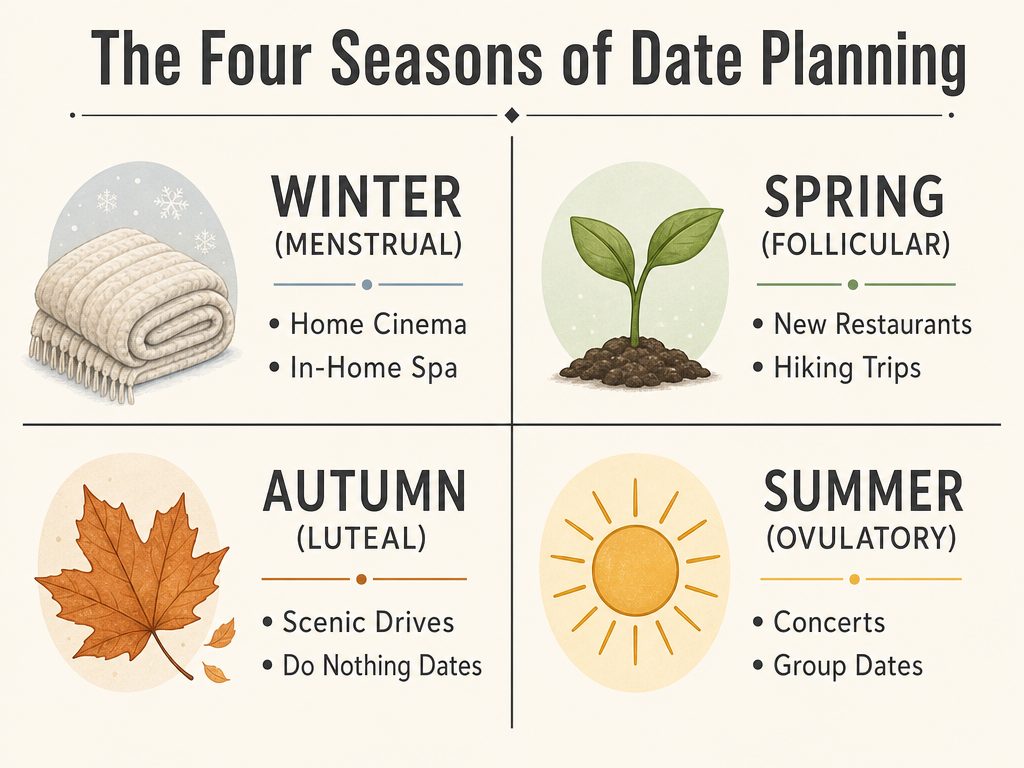 The 'Four Seasons' framework helps partners transition from a one-size-fits-all approach to a strategic planning method that aligns with her biological rhythm.
Here's the high-level map:
VibeCheck App
Download Free on iOS →| Phase | Season | Hormone State | Energy Level | The Goal |
|---|---|---|---|---|
| Menstrual | Winter | Low estrogen, low progesterone | Lowest | Provide comfort and reduce demands |
| Follicular | Spring | Rising estrogen | Building | Create opportunities for adventure |
| Ovulatory | Summer | Peak estrogen, LH surge | Highest | Plan social, high-visibility activities |
| Luteal | Autumn | Rising then falling progesterone | Declining | Offer low-stakes, familiar experiences |
The menstrual cycle's four phases create predictable windows for different types of connection. Understanding this pattern isn't about "managing" her - it's about reading the field conditions so you're not constantly fighting uphill.
Understanding the Social Battery Metric
Here's what most advice gets wrong: they talk about "energy" as if it's one thing. Your girlfriend might have the physical stamina for a workout during the luteal phase but zero capacity for a loud dinner party. The distinction that matters is her social battery.
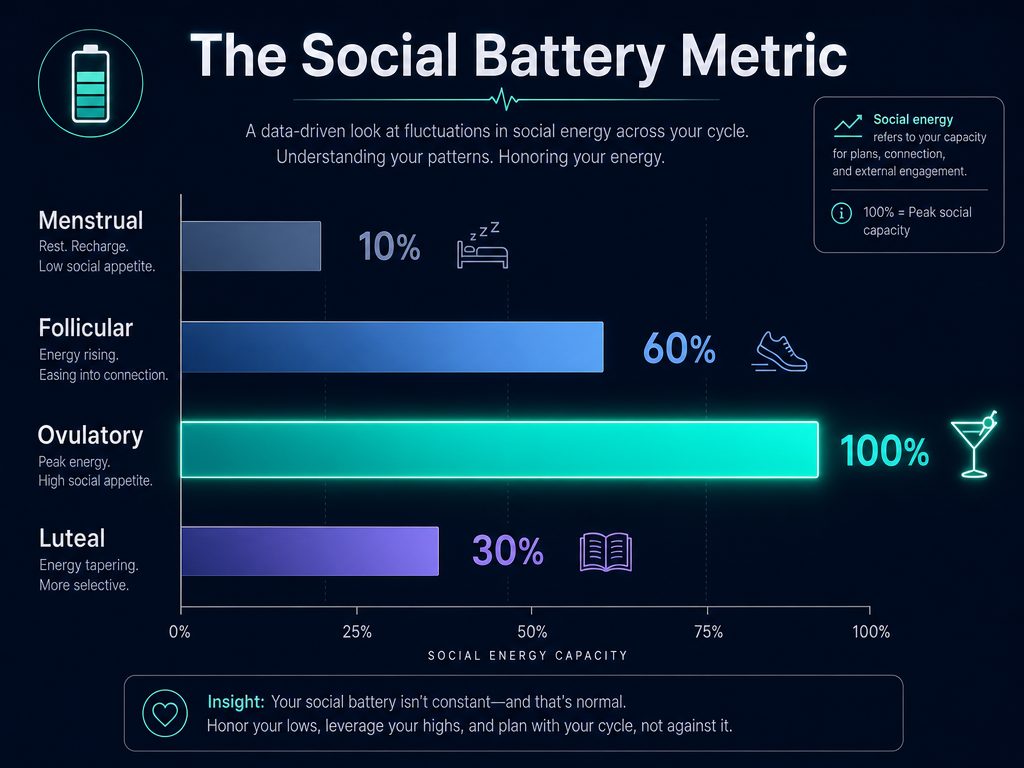 Visualizing her 'Social Battery' helps you gauge whether to plan a high-energy group outing or a low-stakes night at home to avoid burnout.
Research shows that rising estrogen during the follicular phase (days 6-14) is linked to a 20-30% increase in social energy and optimism. Conversely, serotonin levels can drop by approximately 40% during the luteal phase as progesterone peaks, making her nervous system more sensitive to stimulation.
Translation: A high-energy hike might work in the luteal phase if she's up for it. A high-energy party almost never will.
The social battery framework helps you match date intensity to her current capacity. Stop planning based on what sounds fun to you and start planning based on what her biology will support.
Phase 1: Menstrual (Winter) - The Comfort Phase
Days: 1-5 (approximately)
Vibe: Low energy, high need for physical comfort and emotional intimacy
The menstrual phase is when bleeding occurs. Hormone levels are at their lowest. Her body is shedding the uterine lining, and many women experience cramping, fatigue, bloating, and headaches.
This is not the week to plan an escape room or a concert. Her social battery is at roughly 10%. She needs low-demand activities that don't require her to perform or be "on."
What to plan:
- Movie night at home with her favorite comfort food
- Soup delivery and a heating pad (doing the setup for her, not making her ask)
- A quiet walk if she wants fresh air, with zero pressure to go far
- Taking over her household tasks so she can rest without guilt
What to avoid:
- Anything with a fixed start time that requires her to rally
- Group hangouts or loud environments
- Activities that require physical exertion
- Making her explain why she's tired
The script:
"I know you're feeling low-energy this week. I'm handling dinner - do you want a movie night or just some quiet time?"
If you're unsure whether she wants company or solitude, learning how to support your partner during her period can give you clarity on when to step in and when to step back.
Phase 2: Follicular (Spring) - The Adventure Window
Days: 6-14 (approximately)
Vibe: Rising energy, increasing optimism, openness to novelty
During the follicular phase, estrogen rises as an egg-containing follicle develops in the ovary. This rising estrogen also thickens the uterine lining and affects brain function, supporting focus and mood. Her social battery is rebuilding - somewhere between 60% and climbing toward 100%.
This is your planning window for anything new, challenging, or outside her routine. She's more likely to say yes to spontaneous ideas and less likely to feel overwhelmed by logistics.
What to plan:
- Trying a new restaurant or cuisine she's mentioned
- Outdoor activities like hiking, kayaking, or biking
- Creative date ideas: pottery class, painting night, cooking together
- A surprise mini-trip or day adventure
What to avoid:
- Repeating the same date you always do (she's craving novelty right now)
- Over-scheduling or packing the day too tight
- Assuming she wants the same intensity every follicular phase
The script:
"You've got great energy this week! Want to finally try that new spot downtown?"
If you're interested in understanding how her cycle affects her mood and energy, this is the phase where those shifts become most obvious in a positive direction.
Phase 3: Ovulatory (Summer) - The Social Peak
Days: 12-16 (approximately)
Vibe: Peak confidence, extroverted energy, high libido
Ovulation is when a surge in luteinizing hormone (LH) causes the ovary to release an egg, typically around day 14 of a 28-day cycle. Estrogen levels are at their highest. Many women notice increased sex drive, higher social confidence, and a desire for visibility during this window.
Her social battery is at 100%. This is the time for high-energy, high-visibility dates. She's more likely to want to dress up, be seen, and engage with larger groups.
What to plan:
- Group dates with other couples
- Concerts, live music, or events with a social element
- A nice dinner where she can dress up and feel seen
- Dancing, rooftop bars, or anything with a "we're celebrating" vibe
What to avoid:
- Low-key Netflix nights (she'll feel like you're wasting the window)
- Anything that keeps her isolated from social interaction
- Passive activities when she's craving engagement
The script:
"You look incredible today. Let's go somewhere we can show off a little."
For more on supporting your girlfriend during ovulation mood changes, remember that this phase also includes a post-ovulation dip where her mood can shift quickly.
Phase 4: Luteal (Autumn) - The Low-Stakes Buffer
Days: 17-28 (approximately)
Vibe: Declining energy, increasing sensitivity, need for predictability
After ovulation, the luteal phase begins: progesterone rises to prepare the uterine lining for a possible pregnancy. If pregnancy doesn't happen, both progesterone and estrogen drop before the next period. Many women notice PMS-like symptoms during this phase - mood shifts, breast tenderness, bloating, acne, appetite changes, and fatigue.
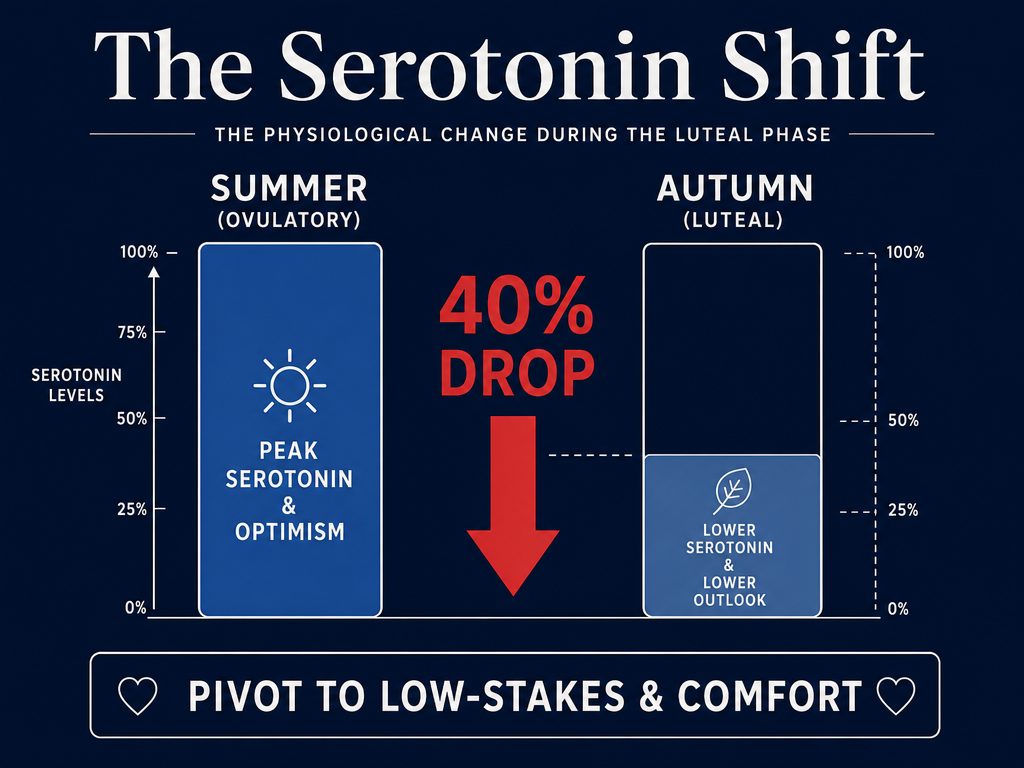 A 40% drop in serotonin during the luteal phase often makes the nervous system more sensitive, making familiar, low-stakes dates the superior choice.
Her social battery drops to roughly 30% and continues declining. The last thing she wants is a surprise adventure or a high-pressure social situation. What she needs is low-stakes familiarity.
What to plan:
- Scenic drives with no fixed destination
- Her favorite "comfort" restaurant (not a new one)
- "Do nothing" dates: being together in silence, watching a show, reading side by side
- Offering to take tasks off her plate so she can decompress
What to avoid:
- Anything requiring her to meet new people
- High-stimulation environments (loud bars, crowded events)
- Plans that demand enthusiasm she doesn't have
- Acting like her withdrawal is a referendum on the relationship
The script:
"What can I take off your plate today so we can just relax tonight?"
Understanding the luteal phase helps you recognize when her irritability or fatigue isn't about you - it's about the 40% serotonin drop happening in her brain.
How to Start the Conversation
Most men worry that tracking her cycle will come across as creepy or controlling. The key is framing it correctly: you're not tracking her to predict her behavior; you're tracking to be a better partner.
Here's a three-step approach:
Step 1: Lead with your goal, not the method
Don't say: "I want to start tracking your period."
Do say: "I've been thinking about how I can be more supportive. I know your energy shifts throughout the month, and I want to make sure I'm planning things when you'll actually enjoy them."
Step 2: Ask for her input
"Would it be helpful if I knew when those shifts were happening? I'm not trying to predict your mood - I just don't want to plan a big night out when you need rest."
Step 3: Offer a trial period
"What if we try it for a month and see if it actually helps? If it feels weird or intrusive, we stop."
When a partner is struggling emotionally, responding with genuine empathy tends to help more than trying to "fix" the problem. The same principle applies here: you're not solving her cycle; you're learning to work with it.
If you're looking for tools to help, check out our guide to the best period tracker apps for men to find one that gives you actionable insights without being invasive.
When It's More Than PMS
PMS (premenstrual syndrome) is very common: as many as 3 in 4 women report experiencing PMS symptoms at some point in their life, though severity varies widely. Roughly half of people who menstruate report having at least one PMS symptom, but only about 1 in 5 have symptoms severe enough to disrupt their daily life.
For some women, it's more severe. PMDD (premenstrual dysphoric disorder) is a real, clinically recognized condition - it's listed in the DSM-5 as a depressive disorder. PMDD affects between 3% and 8% of menstruating women.
PMDD is a more severe, sometimes disabling extension of PMS. Both happen on a similar timeline (about 7-10 days before a period) and can share physical symptoms like bloating and fatigue, but PMDD specifically involves extreme mood symptoms - such as marked irritability, anxiety, or hopelessness - intense enough to disrupt daily life and strain relationships.
If your girlfriend's symptoms are consistently severe - if she's missing work, expressing hopelessness, or having panic attacks - this is not something you can support through better date planning. Encourage her to talk to a healthcare provider. PMDD is treatable, often with a combination of lifestyle changes, therapy, and medication.
In those cases, your role shifts from "tactical date planner" to "crisis support partner." The goal is not to optimize her cycle; it's to help her get the medical care she needs.
Frequently Asked Questions
Is there a period app for couples?
Yes. Several period tracking apps now include partner modes or couple-sharing features. Apps like Flo for Partners, Clue Partner Connect, and VibeCheck are designed to help men understand and support their partners through cycle awareness. These apps translate her cycle data into actionable insights - like when to plan a date night or when to expect lower energy.
What to do for your girlfriend on the menstrual phase?
During the menstrual phase, her energy is at its lowest. Focus on comfort and reducing demands. Good options include bringing her favorite comfort food, setting up a heating pad, handling household chores so she can rest, or offering a quiet movie night at home. Avoid planning anything that requires her to rally or perform socially. The goal is to create a low-pressure environment where she can recover.
How do I support my girlfriend in her luteal phase?
The luteal phase is when progesterone rises and then drops, often bringing PMS symptoms like mood swings, fatigue, and irritability. Support her by offering low-stakes, familiar activities instead of high-energy plans. Take tasks off her plate, validate her feelings without trying to fix them, and avoid taking her mood shifts personally. If you want more detail, read our full guide on how to support your girlfriend during the luteal phase.
How to support gf during periods?
Supporting your girlfriend during her period means recognizing that she's dealing with physical discomfort (cramping, bloating, fatigue) and often low mood. Practical support includes bringing pain relief if she asks, preparing or ordering food, and handling chores without being asked. Emotional support means validating her experience, not dismissing symptoms as "just PMS," and giving her space if she needs it. For a deeper breakdown, check out how to comfort your girlfriend during PMS.
What time in your cycle are men most attracted to you?
Research suggests men may be slightly more attracted to women around ovulation, when estrogen is at its peak. Around ovulation, many women notice symptoms such as increased sex drive, and some studies indicate subtle changes in scent, skin, and behavior that men subconsciously respond to. However, this is a generalized finding and varies widely between individuals. Attraction in a relationship is far more influenced by emotional connection, communication, and mutual effort than by cycle phase.
Being the "Partner Who Just Gets It"
Understanding her cycle isn't about predicting her behavior or gaining control. It's about emotional intelligence. It's about recognizing that her needs shift on a biological loop and adjusting your approach accordingly.
You wouldn't expect the same output from yourself after a sleepless night as you would after a full night's rest. The same logic applies here. Her 28-day cycle creates predictable windows of high energy, social appetite, and need for rest. When you stop planning dates as if every week is the same, you reduce friction, increase connection, and become the partner who just gets it.
Empathetic acknowledgment can reduce defensiveness in conflict by 60% compared to problem-solving responses. The same principle applies to cycle-aware planning: when you show her that you understand her rhythm, she doesn't have to defend her needs or explain why she's tired. You've already adjusted.
Tracking your own (or a partner's, with her participation) symptoms and mood changes across the cycle for a few months is a legitimate, medically endorsed way to identify real patterns and timing - rather than assuming based on stereotypes or a single cycle.
Start with observation. Notice when she has the most energy. Notice when she cancels plans. Notice when she's irritable or withdrawn. Then check those patterns against the calendar. You'll see the loop.
And once you see it, you can't unsee it. You'll stop taking her mood shifts personally. You'll start planning with her biology, not against it. And she'll notice.
For more on how to apply this knowledge, explore our guide on how to plan dates around her cycle or learn when to give your girlfriend space based on her hormonal cues.
Tags

Related Articles
Continue reading to deepen your understanding

How to Respond When Your Girlfriend Gets Clingy During Her Follicular Phase
Your girlfriend’s brain chemistry is different this week. Rising estrogen levels cause social drive to peak. Here is how to respond to her need for connection effectively.

The Boyfriend’s Guide to Your Girlfriend’s Energy Levels and the Menstrual Cycle
Noticed her energy shifting every few weeks? Stop guessing and start supporting. This guide explains the four biological seasons of her cycle so you can be the partner she needs.

Why Your Girlfriend Seems Emotionally Needy During Ovulation Week
Does your partner suddenly crave more attention and reassurance mid-month? It is not insecurity—it is biology. Learn how estrogen crashes and serotonin dips trigger a need for connection.

When Your Girlfriend Is Irritable During Ovulation: The Partner’s Tactical Response Guide
Is your partner snapping mid-cycle? Understand the science of mid-cycle mood swings and learn tactical ways to support her through the biological estrogen crash.

Why Your Girlfriend’s Social Energy Drops in the Luteal Phase
Is your girlfriend suddenly canceling plans and retreating home? It isn’t personal; it’s biology. Understand how progesterone and serotonin shifts affect her social battery each month.

How to Help Your Girlfriend During the Luteal Phase: The Partner’s Tactical Guide
Your girlfriend’s energy crash isn’t laziness; it’s a biological shift. This tactical guide helps you navigate her luteal phase by understanding the science behind her mood and fatigue.

Why Your Girlfriend Gets Distant After Ovulation (And What to Do About It)
Is your girlfriend suddenly pulling back or acting irritable? It might be her cycle. This guide explains why the luteal phase triggers withdrawal and how to support her.

Supporting Your Girlfriend Through the Luteal Phase
When hormone levels crash before her period, your partner’s brain enters a high-alert state. Learn how to provide the security she needs with tactical scripts and empathy.