Your Girlfriend Is Withdrawn During Ovulation? What It Actually Means and How to Respond

Is your girlfriend suddenly distant mid-cycle? This guide covers the biological causes of ovulation withdrawal and how to support her with an invisible framework.
When Your Girlfriend Withdraws During Ovulation: What It Actually Means and How to Respond
You've probably heard that ovulation is when women feel their best - confident, social, full of energy. So when your girlfriend suddenly goes quiet, cancels plans, or seems distant right around mid-cycle, it's confusing. You might even wonder if she's losing interest.
Here's what's actually happening: roughly 40% of women experience physical pain or discomfort during ovulation (Jordan News), and many more deal with a sharp hormonal shift that can trigger temporary fatigue, irritability, or a genuine need for space. It's not about you. It's biology.
This guide will help you understand why some women withdraw during ovulation, how to tell if that's what's happening, and exactly how to respond in a way that supports her without making things worse.
Table of Contents
- Is She Actually Ovulating? (Or Is This PMS?)
- Why Do Some Women Withdraw During Ovulation?
- What About the "She Wants an Alpha Male" Myth?
- How to Tell What She Actually Needs
- The "Invisible Support" Framework: Your Response Strategy
- When to Worry: Hormonal Withdrawal vs. Relationship Withdrawal
- Frequently Asked Questions
Is She Actually Ovulating? (Or Is This PMS?)
First, verify the phase. Most guys (and many women) confuse mid-cycle changes with pre-period symptoms because both can involve mood shifts and physical discomfort.
Ovulation typically happens around day 14 of a 28-day cycle, but cycle length varies a lot person to person - anywhere from 24 to 38 days is normal (Mayo Clinic). Here's how to tell the difference:
If she's ovulating, you might notice:
- Sharp, one-sided lower abdominal pain (called Mittelschmerz)
- Pain or discomfort that lasts a few hours to a couple of days
- Clear, slippery cervical mucus (she might mention this)
- Mild bloating or breast tenderness
- Fatigue that seems to come out of nowhere
VibeCheck App
Download Free on iOS →If she's in the luteal phase (pre-period), you'll see:
- Bloating and breast tenderness that persists for days
- Irritability, sadness, or anxiety that builds over a week
- Food cravings, especially for salty or sweet foods
- Symptoms that show up consistently one to two weeks before her period
PMS symptoms typically appear one to two weeks before menstruation and resolve within a few days after the period starts. If she's in that window, you're dealing with the luteal phase, not ovulation. Understanding the boyfriend's guide to the luteal phase can help you navigate that time more effectively.
Why Do Some Women Withdraw During Ovulation?
Most of the popular advice out there assumes ovulation equals peak energy and sex drive. That's true for many women - but not all. Here are the three biological reasons why some women pull back during this phase.
Physical Pain: Mittelschmerz
Mittelschmerz is one-sided lower abdominal pain that happens when the ovary releases an egg. It's a real, documented phenomenon, not something imagined. The pain is generally harmless and usually lasts minutes to a couple of days.
How often it happens varies a lot: some women get it almost every cycle, others only occasionally or never. It may be somewhat more common in women in their teens through mid-20s (Cleveland Clinic).
When your partner is experiencing sharp pelvic pain, social plans or physical intimacy can be the last thing she wants. It's not rejection - it's discomfort.
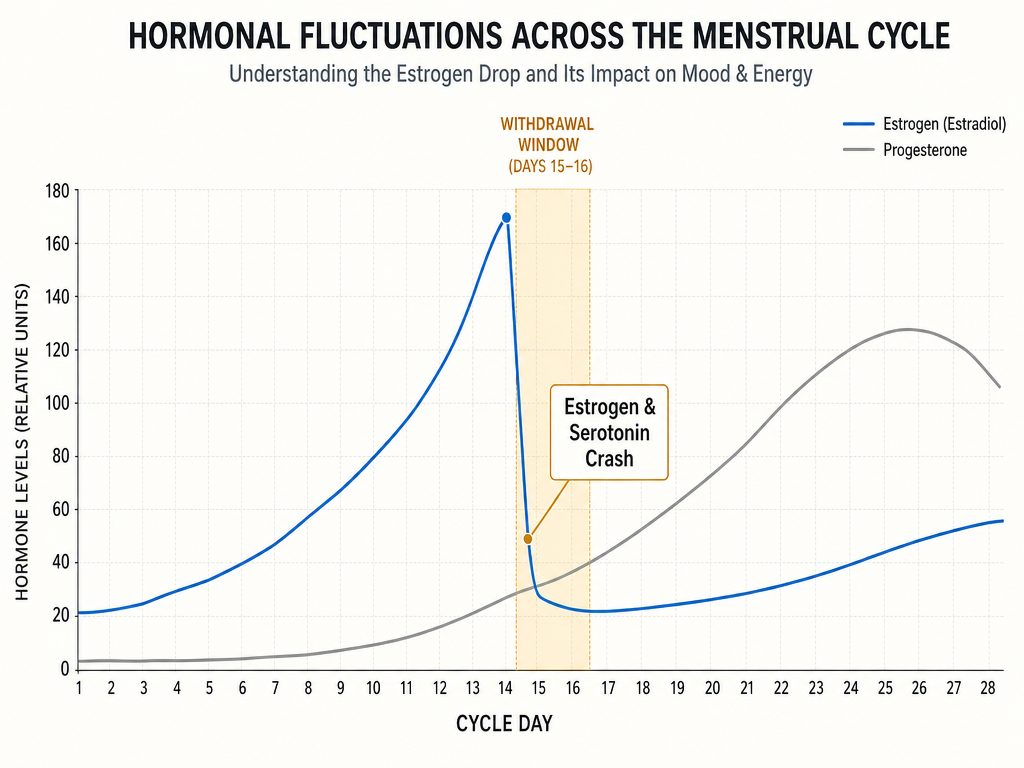 Understanding the biological 'mini-crash': When estrogen drops sharply post-ovulation, serotonin levels can dip, leading to temporary fatigue and a natural desire for space.
The Estrogen Peak and Post-Ovulation Crash
Estrogen rises sharply in the days before ovulation, triggering a surge in luteinizing hormone (LH) that sets off the release of the egg. Estrogen affects many body systems, including brain function and the ability to focus, and levels are highest in the days leading up to ovulation (Cleveland Clinic).
But here's what most people miss: estrogen doesn't stay high. Right after the egg is released, estrogen levels drop. For some women, this creates a noticeable "mini-crash" that can last 24 to 48 hours. Since estrogen helps regulate mood-related neurotransmitters, this drop can cause temporary grumpiness, fatigue, or social withdrawal.
If you're seeing her pull back mid-cycle, it's often this post-ovulation dip, not the ovulation surge itself.
The Progesterone Rise
After ovulation, the luteal phase begins: progesterone rises to help prepare the uterine lining for a possible pregnancy. Progesterone has a calming, sedating effect. If you're expecting ovulation to mean high energy and sociability, the sudden shift to "quiet and inward" can feel like withdrawal.
It's not. It's just a different hormonal state. For a deeper understanding of how this phase affects mood, check out our guide on progesterone effects on mood.
What About the "She Wants an Alpha Male" Myth?
You've probably seen the online claims: women lose attraction to their stable, caring partners during ovulation and start craving "alpha" traits instead. This is called the "Ovulatory Shift Hypothesis," and it's been debunked.
A study analyzing 26,000 diary entries found no evidence that women's partner preference shifts during ovulation (Max Planck Institute). The idea that she's suddenly not into you because of her cycle is not supported by modern research.
If she's withdrawn, it's far more likely she's dealing with physical pain, fatigue, or a hormonal crash - not a change in how she feels about you.
How to Tell What She Actually Needs
Before you try to fix anything, figure out which scenario you're in. This matters because the right response in one situation can make things worse in another.
Ask yourself:
- Is she in pain? Sharp, localized discomfort suggests Mittelschmerz. She needs physical comfort, not conversation.
- Is she tired but otherwise fine? Post-ovulation fatigue or the early luteal phase means she needs low-key support, not high-energy plans.
- Is she irritable or withdrawing emotionally? This could be the estrogen crash or early PMS. She needs space and patience, not problem-solving.
If you're not sure, don't guess. A simple, non-intrusive check-in works: "You seem a bit drained today. Want me to handle dinner so you can rest?"
That script does three things:
- Acknowledges what you're observing without diagnosing her
- Offers concrete help instead of asking her to decide what she needs
- Gives her an out if she just wants to be left alone
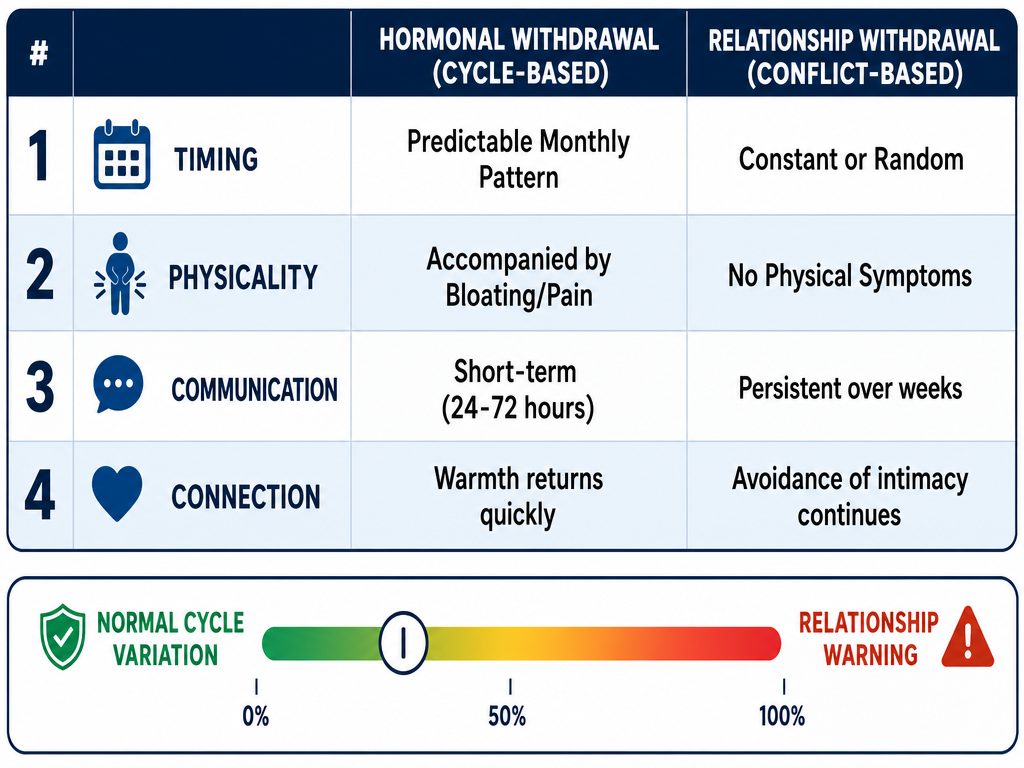 Is it the cycle or the relationship? Use this comparison to identify if her withdrawal follows a predictable monthly pattern tied to physical symptoms.
The "Invisible Support" Framework: Your Response Strategy
When she's withdrawn, your instinct might be to ask what's wrong or try to talk it out. Don't. Decision fatigue is real, and asking her to articulate her needs when she's already overwhelmed just adds to her mental load.
Instead, use "invisible support" - actions that reduce her cognitive and physical burden without requiring her input.
Invisible Support Actions:
- Handle the dishes, laundry, or grocery run without announcing it
- Turn down the lights, reduce noise, and create a calm sensory environment
- Prep easy meals or order her favorite takeout
- Walk the dog, handle errands, or take care of anything on her to-do list
- Offer physical comfort (heating pad, back rub) if she's in pain - but only if she's receptive
What NOT to do:
- Don't ask "What's wrong?" or "What do you need?" repeatedly
- Don't take her withdrawal personally or make it about you
- Don't try to cheer her up with jokes or force her to socialize
- Don't dismiss her discomfort as "just hormones"
Validating her feelings without trying to fix them is what tends to defuse tension. Feeling understood, not corrected, is what she needs.
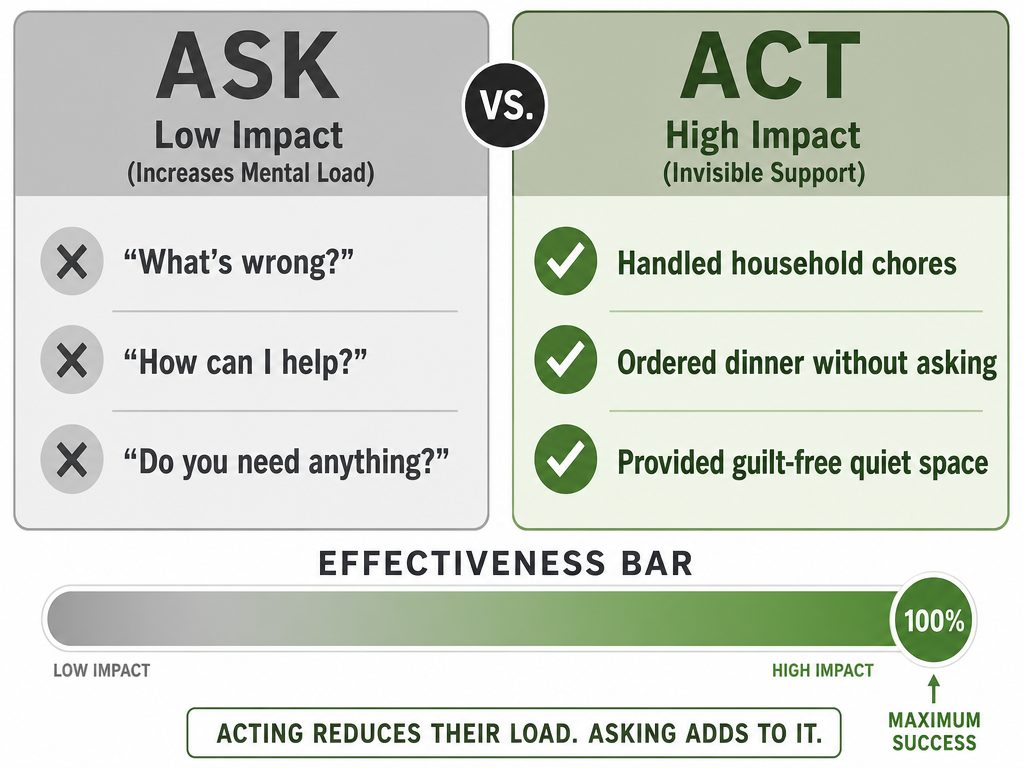 Move from asking to acting: Reducing her mental load by taking over household tasks is often the most effective way to support a withdrawn partner.
The script when you need to say something: "I noticed you seem a bit drained today. I'm going to take care of [specific task], and I'm here if you want to vent or just want some quiet time."
This acknowledges her state, removes a decision from her plate, and gives her control over how much interaction she wants.
When to Worry: Hormonal Withdrawal vs. Relationship Withdrawal
Not every instance of distance is hormonal. Here's how to tell the difference between a predictable cycle-based pattern and a deeper relationship issue.
Hormonal withdrawal:
- Happens on a predictable schedule (mid-cycle or pre-period)
- Accompanied by physical symptoms (pain, fatigue, bloating)
- Resolves within a few days
- She returns to her baseline mood and energy once the phase passes
- Happens whether things are going well or not
Relationship withdrawal:
- No clear pattern or timing
- Persists for weeks regardless of cycle phase
- Accompanied by emotional distance, lack of interest in you specifically
- No physical symptoms to explain the shift
- She seems fine with friends or family but distant with you
If you're genuinely unsure, track the pattern for three months before making major relationship decisions. Tracking symptoms and mood changes across the cycle for a few months is a legitimate, medically endorsed way to identify real patterns and timing.
Pre-menstrual disorders are associated with a 1.21 incidence risk ratio for relationship disruption (ScienceDirect), which means cycle-related symptoms can strain relationships - but they can also be managed when both partners understand what's happening.
If you notice your girlfriend consistently pulling away during certain phases, learning more about how to support your girlfriend during ovulation mood changes can help you navigate those windows more effectively.
Frequently Asked Questions
How do you feel emotionally when you ovulate?
Many women report feeling confident, social, and energetic during the days leading up to ovulation due to rising estrogen levels. However, immediately after ovulation, some women experience a brief dip in mood or energy as estrogen drops and progesterone rises. Physical symptoms like ovulation pain can also affect emotional state during this time.
Why do I feel so grumpy during ovulation?
Grumpiness during or right after ovulation is often linked to the sharp drop in estrogen that happens post-ovulation. Since estrogen helps regulate mood, this "mini-crash" can cause irritability or fatigue for 24 to 48 hours. Physical discomfort from Mittelschmerz can also contribute to a bad mood.
What is Mittelschmerz?
Mittelschmerz is one-sided lower abdominal pain that occurs when the ovary releases an egg during ovulation (Mayo Clinic). It's generally harmless and usually lasts minutes to a couple of days. The pain can range from a dull ache to a sharp twinge.
Can ovulation cause fatigue?
Yes, some women experience fatigue during or right after ovulation. This can be due to the hormonal shift as estrogen drops and progesterone rises, or from the physical stress of ovulation itself. For more on this topic, see our guide on whether ovulation can cause fatigue.
How severe can ovulation pain get?
Most ovulation pain is mild to moderate and resolves on its own. However, some women experience sharp, intense pain that can last for hours or even a couple of days. If the pain is severe, persistent, or accompanied by other symptoms like heavy bleeding or fever, it's worth seeing a doctor to rule out other conditions.
What should I do if my girlfriend is on her period?
The period (menstrual phase) is different from ovulation, but the support principles are similar: reduce her mental and physical load, offer comfort without being asked, and don't take her mood shifts personally. For a detailed guide, check out what to do when your girlfriend is on her period.
How to tell if my girlfriend is falling out of love?
If her withdrawal is persistent, has no cycle-based pattern, and is accompanied by emotional distance specifically toward you (but not others), that's a different issue. Track the pattern for three months. If her distance always coincides with a specific cycle phase and resolves after a few days, it's biological. If it doesn't follow a pattern and persists, it's worth having a conversation about the relationship.
When are you most irritable in your cycle?
Most women report increased irritability during the luteal phase - the week or two before their period starts. This is when progesterone rises and then drops, which can cause mood swings, fatigue, and heightened sensitivity. However, some women also experience a brief irritability window right after ovulation due to the estrogen crash.
Understanding her cycle isn't about walking on eggshells. It's about recognizing when biology is driving behavior so you can respond with empathy instead of confusion. When she withdraws during ovulation, it's usually physical discomfort, hormonal shifts, or genuine fatigue - not a referendum on your relationship.
Offer invisible support, give her space when she needs it, and track the pattern over a few months. If the withdrawal is predictable and short-lived, you're dealing with hormones. If it's persistent and unrelated to her cycle, it's time for a deeper conversation.
For more tools and insights on supporting your partner through every phase, explore our period tracker for partners guide or try VibeCheck to get personalized daily guidance based on where she is in her cycle.
Tags

Related Articles
Continue reading to deepen your understanding

When Your Girlfriend Is Sensitive to Criticism During the Luteal Phase: The Partner’s Science-Based Action Guide
Does your partner react intensely to feedback right before her period? Understand the biology behind luteal phase rejection sensitivity and learn how to communicate effectively.

How to Give Your Girlfriend Reassurance During the Follicular Phase: A Partner’s Tactical Guide
Is your girlfriend feeling vulnerable after her period? Learn why the early follicular phase causes emotional lows and how you can provide the specific reassurance she needs to feel secure.

Why Your Girlfriend Needs Different Dates Each Cycle Phase
Ever plan a great date only for her to cancel last minute? Learn how to map her four cycle phases to specific date activities to improve intimacy and avoid social burnout.

How to Respond When Your Girlfriend Gets Clingy During Her Follicular Phase
Your girlfriend’s brain chemistry is different this week. Rising estrogen levels cause social drive to peak. Here is how to respond to her need for connection effectively.

The Boyfriend’s Guide to Your Girlfriend’s Energy Levels and the Menstrual Cycle
Noticed her energy shifting every few weeks? Stop guessing and start supporting. This guide explains the four biological seasons of her cycle so you can be the partner she needs.

Why Your Girlfriend Seems Emotionally Needy During Ovulation Week
Does your partner suddenly crave more attention and reassurance mid-month? It is not insecurity—it is biology. Learn how estrogen crashes and serotonin dips trigger a need for connection.

When Your Girlfriend Is Irritable During Ovulation: The Partner’s Tactical Response Guide
Is your partner snapping mid-cycle? Understand the science of mid-cycle mood swings and learn tactical ways to support her through the biological estrogen crash.

Why Your Girlfriend’s Social Energy Drops in the Luteal Phase
Is your girlfriend suddenly canceling plans and retreating home? It isn’t personal; it’s biology. Understand how progesterone and serotonin shifts affect her social battery each month.