How to Give Your Girlfriend Reassurance During the Follicular Phase: A Partner’s Tactical Guide

Is your girlfriend feeling vulnerable after her period? Learn why the early follicular phase causes emotional lows and how you can provide the specific reassurance she needs to feel secure.
How to Give Your Girlfriend Reassurance During the Follicular Phase: A Partner's Tactical Guide
Your girlfriend just finished her period. You thought the hard part was over. But instead of the carefree, energetic partner you expected, she's asking if you're happy with the relationship, second-guessing plans, and checking in more than usual.
You're not imagining it. And no, you didn't do anything wrong.
The follicular phase - the stretch from day 1 of her period through ovulation - is often portrayed as the "spring season" of the menstrual cycle, full of energy and optimism. That's true for the later days. But what most guides ignore is the hidden low at the start: the biological vulnerability window when she needs reassurance most, not least.
This guide explains why that happens, what you can do about it, and how to support her through each stage of the follicular phase without guessing.
Table of Contents
- What Is the Follicular Phase (And Why It's Misunderstood)
- Why She Needs Extra Reassurance Right Now
- The Hidden Low: Early Follicular (Days 1-5)
- Three Pillars of Reassurance
- The Repair & Reconnect Framework
- How to Support Her Through Each Stage
- When to Step Back (And When to Step Up)
- What to Say (And What Not to Say)
- Frequently Asked Questions
What Is the Follicular Phase (And Why It's Misunderstood)
The follicular phase starts on day 1 of your period and ends when you ovulation. That means it includes menstruation - the bleeding days - not just the energy-filled stretch afterward.
During the follicular phase, estrogen rises as an egg-containing follicle develops in the ovary; this rising estrogen also thickens the uterine lining. Near the end of this phase, high estrogen triggers a surge in luteinizing hormone (LH), which sets off ovulation.
VibeCheck App
Download Free on iOS →Most relationship guides treat the follicular phase like a single block of high energy and good mood. They're wrong. The phase has three distinct windows:
- Early Follicular (Days 1-5): Low estrogen, physical discomfort, iron depletion. This is the reassurance zone.
- Mid Follicular (Days 6-10): Rising energy, repair mode, reconnection needs.
- Late Follicular (Days 11-14): Peak energy, confidence, social drive.
Your partner's need for reassurance is highest at the start, not because she's insecure, but because her body is recovering from a biological crash.
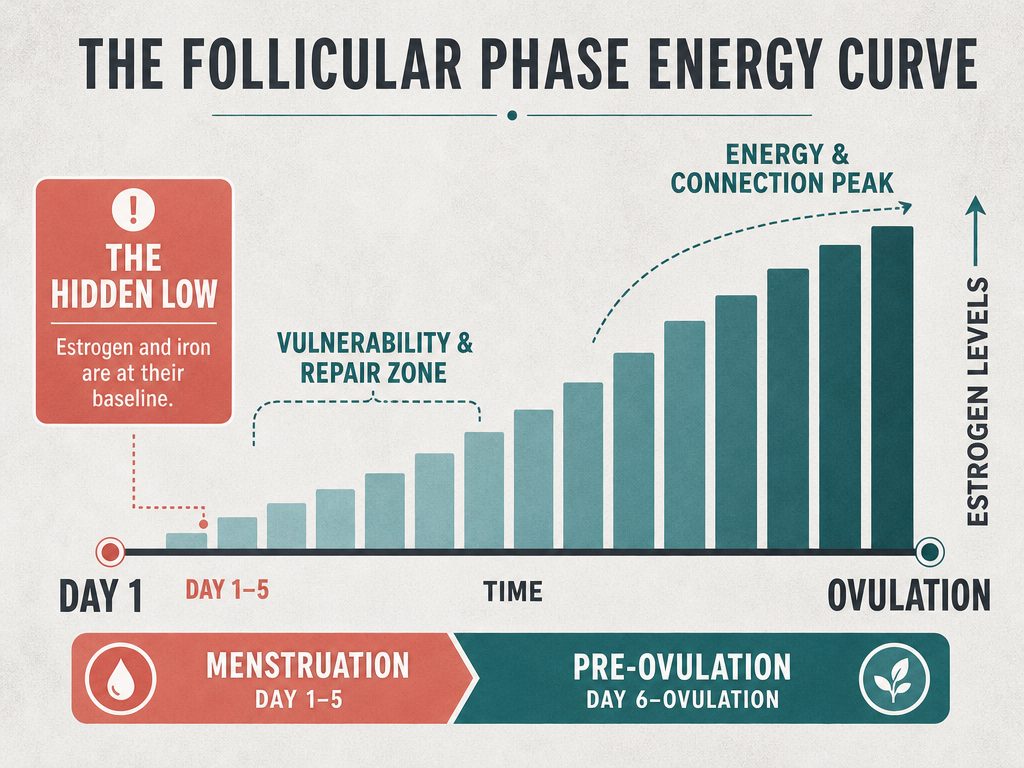 Understand the hormonal trajectory of the follicular phase, which begins at a biological low point, requiring extra reassurance before the energy peak.
Why She Needs Extra Reassurance Right Now
Her need for reassurance isn't random. It's driven by three biological factors converging at once.
The Estrogen Floor
Estrogen levels are at their lowest on the first day of the follicular phase. Estrogen affects many body systems, including brain function and the ability to focus, and levels are highest in the days leading up to ovulation.
When estrogen drops, so does her brain's natural buffer against stress and doubt. Small worries feel bigger. Neutral conversations feel loaded. Her mind is scanning for threats to emotional safety - including threats to the relationship.
The Iron Deficit
Iron deficiency is common in menstruating women; approximately 35% of women of reproductive age in the U.S. have low iron stores. During her period, she loses blood. That means she loses iron. Low iron doesn't just cause fatigue - it affects mood stability.
Correcting iron deficiency can significantly reduce symptoms of anxiety and depression in women with low ferritin. When her body is working harder just to maintain baseline energy, emotional regulation becomes harder too.
The Luteal Hangover
The luteal phase - the two weeks before her period - is when many women notice PMS-like symptoms in this phase: mood shifts, breast tenderness, bloating, acne, and appetite changes.
If the last two weeks involved tension, misunderstandings, or small conflicts, those emotional loose ends don't disappear when her period starts. They linger. Now, with her defenses down and her brain chemistry shifting, she needs proof that the relationship survived the storm.
That's why she's asking if you're okay, if you're still happy, if she said something wrong last week. She's not being needy. She's recalibrating emotional safety.
If you want to understand the biological shifts happening right before her period, read our guide on why her mood changes before her period.
The Hidden Low: Early Follicular (Days 1-5)
The first five days of the follicular phase are a paradox: the "spring" phase starts with winter.
She's bleeding. She's cramping. Her energy is at its lowest. And yet, most cycle-syncing guides gloss over this window entirely, jumping straight to the "high energy" narrative that applies later.
Here's what's actually happening in her body:
- Her uterus is shedding its lining (physical discomfort, fatigue)
- Estrogen is still near its monthly low (reduced resilience to stress)
- Her body is prioritizing physical recovery (less bandwidth for social or emotional demands)
- She's losing iron with every day of bleeding (increased anxiety, brain fog)
This is not the time to plan a surprise party, book a spontaneous road trip, or have a serious relationship talk. This is the time to create space, offer steady reassurance, and handle logistics she doesn't have the energy for.
Think of it as storm cleanup. The luteal phase was the hurricane. Early follicular is the repair crew arriving.
For more on what she's experiencing during this window, check out how to help your girlfriend during her period.
Three Pillars of Reassurance
Reassurance isn't a single gesture. It's a system. Use all three pillars to provide the kind of support that actually lands.
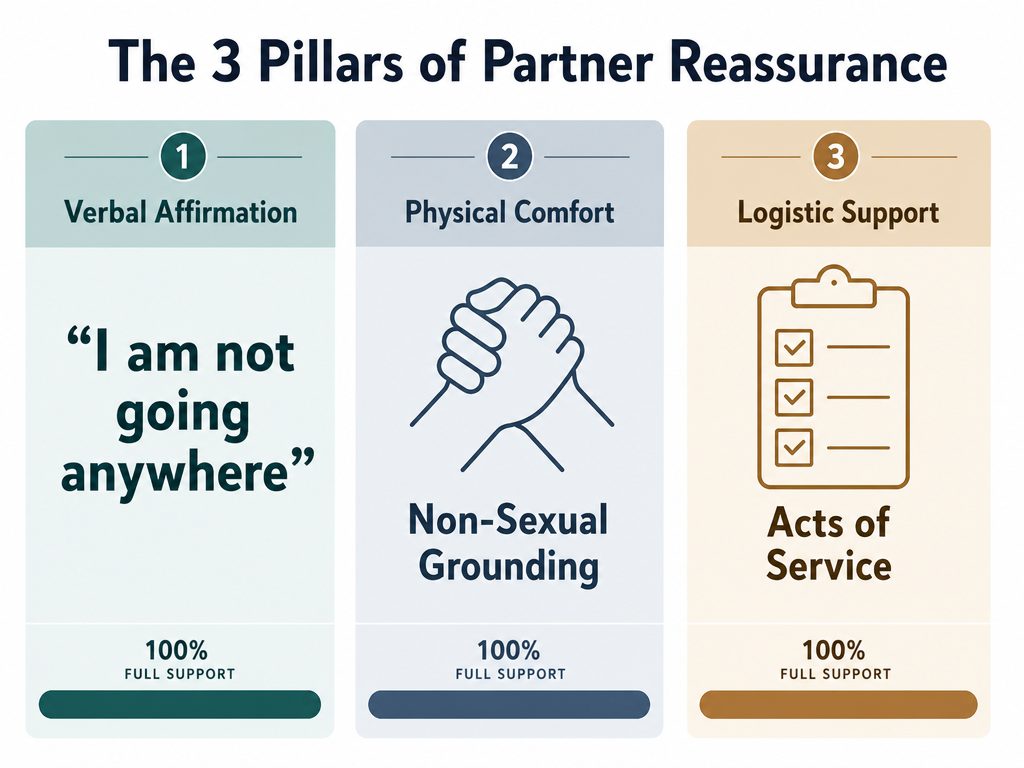 Consistent reassurance requires a multi-faceted approach, combining verbal safety, physical grounding, and practical acts of service to support her recovery.
Pillar 1: Verbal Reassurance
Words matter most when her brain is scanning for threats. Use specific, unprompted affirmations that address her underlying fear: that the relationship is unstable.
What to say:
- "I love you even when things are stressful."
- "I'm not going anywhere."
- "You didn't do anything wrong. I'm here."
- "I know last week was rough. We're good."
Why it works: These statements provide certainty. They don't require her to ask for reassurance (which feels vulnerable). They don't dismiss her feelings (which backfires). They simply affirm what she needs to hear: the relationship is safe.
For more scripts and timing strategies, read what to say when your girlfriend has PMS.
Pillar 2: Physical Reassurance
Non-sexual touch grounds her nervous system. When her brain is flooded with low-grade anxiety, physical comfort sends a signal: you're safe, I'm here, everything is stable.
What to do:
- Hold her hand while watching TV
- Rub her back or shoulders without being asked
- Sit close on the couch
- Offer a heating pad and stay nearby
Why it works: Touch activates the parasympathetic nervous system, which counteracts stress. It doesn't require her to articulate what's wrong. It just provides a steady, non-verbal reminder that she's not alone.
If you're looking for more ways to provide physical support during her cycle, check out how to support your partner during her period.
Pillar 3: Logistic Reassurance
Acts of service during her low-energy window show that you understand what she's going through. You're not waiting for her to ask for help. You're removing friction before it builds.
What to do:
- Make dinner or order her favorite takeout
- Handle a chore she usually does
- Pick up groceries or tampons without being asked
- Cancel or reschedule plans so she can rest
Why it works: Lifestyle approaches that can help ease PMS symptoms include regular aerobic exercise, smaller/more frequent meals, less salt/caffeine/alcohol, adequate sleep, and stress-reduction practices. When you reduce her decision fatigue and energy drain, you free up bandwidth for emotional recovery.
The Repair & Reconnect Framework
The follicular phase is your relationship's repair window. Use it.
If the luteal phase involved conflict - snapping, withdrawal, miscommunication - her brain is still processing it. Even if you've moved on, she might not have. This is when you actively rebuild trust.
Step 1: Acknowledge the Storm
Don't pretend the last two weeks didn't happen. Acknowledge that things were hard without blame.
Script: "I know last week was rough for both of us. I'm glad we're through it."
This validates her experience and signals that you're not holding onto resentment.
Step 2: Rebuild Safety
She needs to know the relationship is still solid. Use unprompted affirmations (Pillar 1) consistently, not just once.
Script: "I love you. We're good. I'm not upset."
Repeat variations of this throughout the early follicular phase. Repetition builds certainty.
Step 3: Plan Reconnection
In mid-follicular (days 6-10), when her energy starts to rise, propose low-pressure quality time. Don't plan anything demanding. Just reconnect.
Ideas:
- A walk together
- Cooking dinner at home
- Watching a show she's been wanting to see
- A coffee date with no agenda
The goal is simply to be together without stress. This reestablishes emotional safety and primes the relationship for late follicular (days 11-14), when her energy and social drive peak.
For more on how to plan dates that match her energy, read how to plan dates around your girlfriend's hormone cycle.
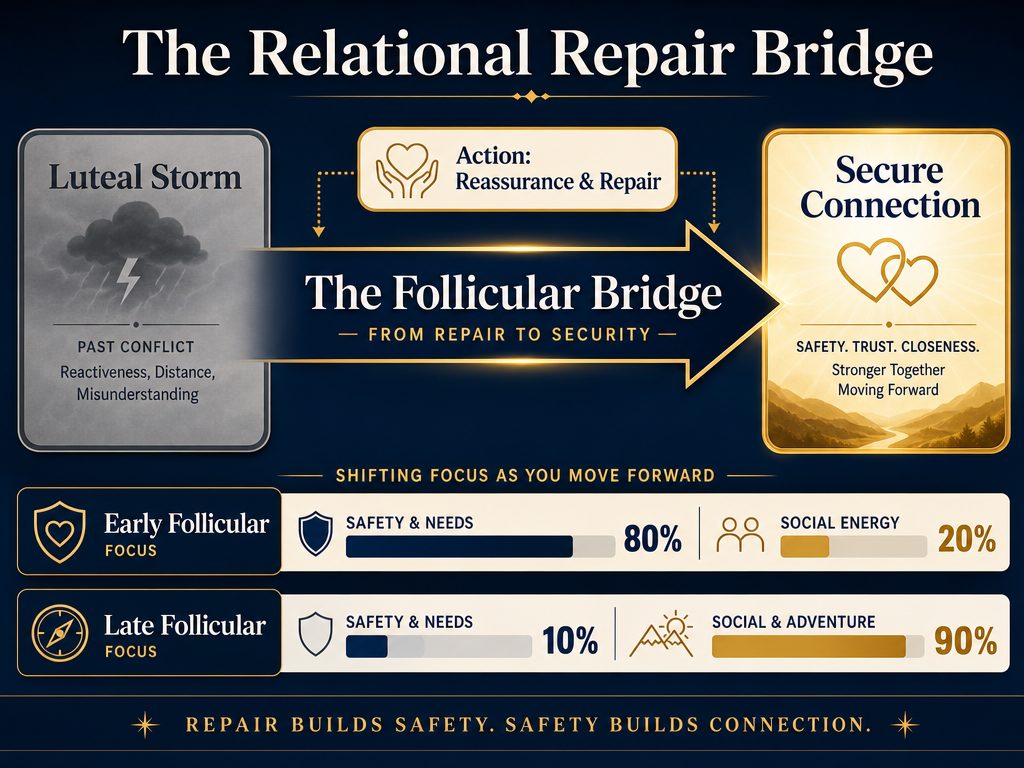 The follicular phase is your primary window for relational repair, allowing you to move from the 'luteal storm' back into a secure, connected state.
How to Support Her Through Each Stage
The follicular phase isn't one thing. It's three distinct windows. Here's how to navigate each one.
| Phase Stage | Biological State | Her Potential Need | Partner Action |
|---|---|---|---|
| Early Follicular (Day 1-5) | Low estrogen, low iron, menstrual discomfort | Vulnerability, physical comfort, proof of stability | Words of affirmation, meals, warmth, low-demand presence |
| Mid Follicular (Day 6-10) | Rising estrogen, energy returning | Reconnection, quality time, repair of any tension | Plan low-pressure time together, validate feelings, rebuild trust |
| Late Follicular (Day 11-14) | High estrogen, peak energy and confidence | Social activity, adventure, physical intimacy | Compliments, physical touch, plan outings or dates |
Early Follicular (Days 1-5): The Vulnerability Window
What she needs: Safety, rest, and proof that you're not going anywhere.
What to do:
- Offer verbal reassurance daily ("I love you, we're good")
- Handle chores without being asked
- Bring her favorite comfort food
- Don't plan anything demanding
- Offer a heating pad or pain relief
- Stay physically close but respect her need for space
What not to do:
- Start a serious conversation
- Criticize or nitpick
- Plan social events that require energy
- Ask if she's okay repeatedly (once is enough)
If she's still experiencing significant discomfort, read how to help your girlfriend during period mood swings for more targeted support strategies.
Mid Follicular (Days 6-10): The Reconnection Window
What she needs: Quality time, emotional repair, proof that the relationship is back on solid ground.
What to do:
- Propose a low-key date or shared activity
- Validate any lingering feelings from the luteal phase ("I know that was hard")
- Ask about her week without making it an interrogation
- Compliment her (appearance, effort, thoughtfulness)
- Re-initiate affection if you've been cautious
What not to do:
- Assume she's "back to normal" without checking in
- Skip reconnection time because she seems fine
- Bring up unresolved conflict without context
To understand the broader cycle pattern, read the boyfriend's guide to menstrual cycle phases.
Late Follicular (Days 11-14): The High-Energy Window
What she needs: Adventure, social activity, physical intimacy, and affirmation that you see her as capable and attractive.
What to do:
- Plan something fun (hike, concert, new restaurant)
- Initiate physical touch and intimacy
- Give specific compliments about her energy and confidence
- Support her social plans without competing for her time
- Match her enthusiasm for plans or ideas
What not to do:
- Assume she'll always have this much energy
- Take her high mood for granted
- Miss the chance to connect physically
For a full breakdown of how to support her during this peak-energy window, check out how to support your girlfriend during ovulation.
When to Step Back (And When to Step Up)
Not every moment of reassurance looks the same. Sometimes she needs you close. Sometimes she needs space to process.
When to step back:
- She explicitly asks for alone time
- She's processing emotions and doesn't want to talk yet
- She's dealing with physical discomfort and just needs rest
- You've offered support and she said she's okay
What to do: Respect her boundary, but stay available. Text once to check in later. Don't disappear completely.
When to step up:
- She's asking indirect questions ("Are you happy?" "Did I do something wrong?")
- She's withdrawing more than usual
- She mentions feeling anxious or sad
- She's not initiating plans or conversation
What to do: Offer specific reassurance without waiting for her to ask. Use the three pillars. Don't make her work for the support she needs.
If you're struggling to read her signals, how to tell which cycle phase your girlfriend is in can help you decode her behavior.
What to Say (And What Not to Say)
Words matter more during the follicular phase than you think. Here's what works and what backfires.
What to say:
Direct reassurance:
- "I love you."
- "I'm not upset."
- "You didn't do anything wrong."
- "I'm happy with us."
Validation:
- "I know you're tired. That's normal."
- "It makes sense that you're feeling that way."
- "Last week was hard for both of us. I'm glad we're through it."
Support:
- "What do you need right now?"
- "I'm here if you want to talk."
- "Let me handle dinner tonight."
What not to say:
Dismissive:
- "You're overreacting."
- "It's just hormones."
- "You were fine yesterday."
Demanding:
- "Why are you being like this?"
- "Can you just snap out of it?"
- "When are you going to feel better?"
Minimizing:
- "It's not a big deal."
- "You always do this."
- "Other people have it worse."
These phrases invalidate her experience and make reassurance impossible. If you've said something like this, apologize quickly and offer what she actually needs: steady, patient presence.
For more on how to repair after saying the wrong thing, read how to apologize to your girlfriend after a fight.
Frequently Asked Questions
Why does she need reassurance if the follicular phase is supposed to be the "good" phase?
The follicular phase is often described as high-energy, but that applies to the later days (11-14). The early follicular phase (days 1-5) is still a low point. She's bleeding, her estrogen is at its monthly floor, and she's recovering from the physical and emotional strain of the luteal phase. Reassurance is highest during this window because her brain has less natural resilience to stress.
How do I know if she needs reassurance or just wants space?
If she's asking indirect questions ("Are we okay?" "Are you happy?"), withdrawing without explanation, or second-guessing herself, she needs reassurance. If she explicitly asks for alone time or says she's fine when you check in, respect that. You can still send one text later ("Thinking of you, let me know if you need anything") without crowding her.
What if we fought during her luteal phase and she's still upset?
Use the Repair & Reconnect Framework. Acknowledge the conflict without rehashing it ("I know last week was rough"), offer steady reassurance that the relationship is safe ("I'm not upset, we're good"), and propose low-pressure reconnection time in mid-follicular. Don't wait for her to bring it up. Take the lead on repair.
Can I track her cycle to anticipate when she'll need reassurance?
Yes, and it's one of the most proactive things you can do. Tracking your own (or a partner's, with her participation) symptoms and mood changes across the cycle for a few months is a legitimate, medically endorsed way to identify real patterns. Use a period tracker for men to log her cycle start date and set reminders for the early follicular window (days 1-5) when she's most vulnerable.
What if I give reassurance and she still seems anxious?
Don't take it personally. Her anxiety isn't about you - it's about her brain chemistry operating with less estrogen than usual. Keep offering steady, patient support. If her anxiety persists beyond the follicular phase or disrupts her daily life, it may be worth gently suggesting she talk to a healthcare provider about PMDD or other conditions.
Should I mention her cycle when offering reassurance?
Only if she's already comfortable discussing it. If she's tracking her cycle and talking about it openly, you can acknowledge it ("I know you're in the early part of your cycle, so I wanted to check in"). If she's not, stick to offering reassurance without labeling the cause. The goal is to provide support, not make her feel analyzed.
How long should I give reassurance before it's "too much"?
Reassurance during early follicular (days 1-5) should be consistent but not smothering. Offer verbal affirmation once a day, handle logistics proactively, and be physically present when she wants closeness. If she starts pulling back or seems annoyed, scale down. The goal is steady support, not hovering.
What if she says she doesn't need reassurance but her behavior suggests otherwise?
Trust behavior over words. If she's asking indirect questions, withdrawing, or showing signs of emotional overwhelm, offer reassurance anyway. Use low-pressure language: "I just want to make sure you know I love you and we're good." You're not accusing her of needing help - you're providing it proactively.
Why does she seem fine one day and anxious the next during the follicular phase?
Because the follicular phase isn't one continuous state. Early follicular (days 1-5) is a low point. Mid follicular (days 6-10) is a transition. Late follicular (days 11-14) is peak energy. Her mood and needs shift as estrogen rises. Use the phase-by-phase table above to match your support to her current state.
The follicular phase isn't the easy stretch you were told it would be. It's a repair window. Your girlfriend isn't being needy when she asks for reassurance - she's recalibrating emotional safety after a biological crash. When you understand that, you stop taking it personally. You start showing up proactively. And the relationship gets stronger because of it.
If you want to stop guessing and start supporting her at the right time every time, try VibeCheck, the relationship app built for men who want to understand their partner's cycle and become better partners.
Tags

Related Articles
Continue reading to deepen your understanding

Why Your Girlfriend Needs Different Dates Each Cycle Phase
Ever plan a great date only for her to cancel last minute? Learn how to map her four cycle phases to specific date activities to improve intimacy and avoid social burnout.

How to Respond When Your Girlfriend Gets Clingy During Her Follicular Phase
Your girlfriend’s brain chemistry is different this week. Rising estrogen levels cause social drive to peak. Here is how to respond to her need for connection effectively.

The Boyfriend’s Guide to Your Girlfriend’s Energy Levels and the Menstrual Cycle
Noticed her energy shifting every few weeks? Stop guessing and start supporting. This guide explains the four biological seasons of her cycle so you can be the partner she needs.

Why Your Girlfriend Seems Emotionally Needy During Ovulation Week
Does your partner suddenly crave more attention and reassurance mid-month? It is not insecurity—it is biology. Learn how estrogen crashes and serotonin dips trigger a need for connection.

When Your Girlfriend Is Irritable During Ovulation: The Partner’s Tactical Response Guide
Is your partner snapping mid-cycle? Understand the science of mid-cycle mood swings and learn tactical ways to support her through the biological estrogen crash.

Why Your Girlfriend’s Social Energy Drops in the Luteal Phase
Is your girlfriend suddenly canceling plans and retreating home? It isn’t personal; it’s biology. Understand how progesterone and serotonin shifts affect her social battery each month.

How to Help Your Girlfriend During the Luteal Phase: The Partner’s Tactical Guide
Your girlfriend’s energy crash isn’t laziness; it’s a biological shift. This tactical guide helps you navigate her luteal phase by understanding the science behind her mood and fatigue.

Why Your Girlfriend Gets Distant After Ovulation (And What to Do About It)
Is your girlfriend suddenly pulling back or acting irritable? It might be her cycle. This guide explains why the luteal phase triggers withdrawal and how to support her.