VibeCheck App for Better Relationship Timing and Support
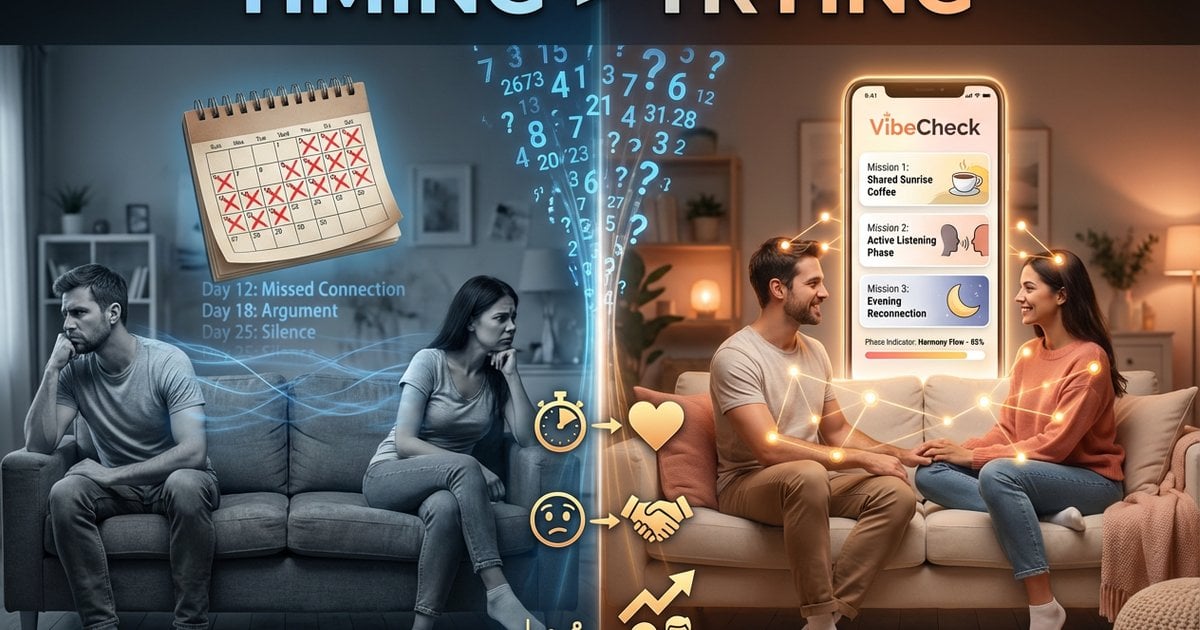
Stop guessing and start supporting. VibeCheck App turns biological data into actionable missions for better relationship timing. Become a supportive partner now.
Beyond the Calendar: Why VibeCheck is the 'Secret Weapon' for Modern Partners
You've been in this situation before: your partner snaps at something small, and you're left wondering what you did wrong. Or maybe you planned a big conversation about moving apartments, only to realize afterward it was the absolute worst timing possible. These aren't relationship failures - they're timing failures. And they're preventable.
The VibeCheck app represents a fundamental shift in how men approach relationship dynamics. While traditional period trackers simply mark dates on a calendar, VibeCheck acts as your personal relationship timing coach, translating biological data into actionable missions that help you become a better partner without the guesswork.
Table of Contents
- What Makes VibeCheck Different from Regular Period Trackers
- The Science: Four Seasons of Your Relationship
- VibeCheck vs. The Competition: Finding Your Best Fit
- Feature Deep-Dive: The Tools That Actually Matter
- Setting Up VibeCheck the Right Way
- Real-World Wins: What Success Looks Like
- Frequently Asked Questions
What Makes VibeCheck Different from Regular Period Trackers
Bottom Line: VibeCheck translates raw biological data into specific daily actions, turning you from a passive observer into a proactive partner who prevents relationship friction before it starts.
Most period tracking apps were built for women to monitor their own health. When companies added "partner features," they basically gave men read-only access to the same calendar view. You could see when her period was coming, but you still had to figure out what that information meant for your relationship.
VibeCheck was built from the ground up for men. Instead of showing you a calendar full of medical terminology, it tells you what to do today. Think of it as the difference between getting a weather report ("There's a 40% chance of rain") and getting actual advice ("Bring an umbrella").
The app's core innovation is its translation layer. It takes the four hormonal phases women experience every month and converts them into a tactical playbook for your specific relationship. During the follicular phase, when energy is naturally higher, it might suggest planning that weekend trip you've been talking about. During the luteal phase, when stress sensitivity peaks, it reminds you to handle dinner and avoid bringing up contentious topics.
This isn't about manipulating anyone or walking on eggshells. It's about timing your support to match her biology rather than fighting against it. The same conversation that causes an argument on Day 25 of her cycle might go perfectly on Day 10. The difference isn't what you're saying - it's when you're saying it.
What separates VibeCheck from every other option on the market is its AI learning engine. The app doesn't just give you generic advice. It watches which gestures work for your relationship and which don't. After a few months, it builds a custom playbook based on your partner's unique patterns and your past successes. If bringing home Thai food worked during her last period, the app remembers that. If she prefers space rather than hovering, it learns that too.
This is where VibeCheck leaves competitors like Flo for Partners in the dust. Those apps have more users and more medical data, but they lack the fundamental insight that makes VibeCheck powerful: relationships aren't won with data - they're won with the right action at the right time.
The Science: Four Seasons of Your Relationship
Bottom Line: Women's hormones create four distinct phases each month, and each phase affects energy, stress tolerance, and social needs differently. Understanding this pattern lets you align your support instead of working against biology.
Here's what actually happens during a typical 28-day cycle (though cycles can range from 21 to 35 days):
Phase 1: Menstrual (Days 1-5) - The Reset
This is when her period actually happens. Estrogen and progesterone are at their lowest point, which often means lower energy and a need for comfort. Think of this as winter in your relationship calendar.
Your Mission: Create a low-pressure environment. Handle routine tasks without being asked. Stock comfort items (heating pad, favorite snacks, pain relievers). This isn't the time for ambitious plans or difficult conversations.
Phase 2: Follicular (Days 6-13) - The Green Light
Estrogen starts rising, bringing increased energy, optimism, and social drive. This is spring - everything feels possible, and mood is generally positive. This phase often gets overlooked because there's no drama, but it's actually your biggest opportunity window.
Your Mission: This is when to plan adventures, start new projects together, or have important conversations about the future. Her natural energy is high, so match it. Suggest that weekend road trip or finally book that cooking class you've talked about.
Phase 3: Ovulatory (Days 14-16) - Peak Connection
This is the shortest phase but the most powerful. Estrogen peaks, testosterone rises slightly, and everything from communication to confidence hits its high point. Think of this as summer.
Your Mission: This is your relationship's natural peak. Plan date nights, be spontaneous, suggest social activities with friends. The physical and emotional connection is naturally strongest here, so lean into quality time together.
Phase 4: Luteal (Days 17-28) - The Sensitivity Window
Progesterone rises while estrogen drops, creating the combination most men associate with "PMS." Energy decreases, stress sensitivity increases, and small annoyances feel bigger. This is fall - not bad, just different, and requiring a different approach.
Your Mission: Reduce friction proactively. Take tasks off her plate without asking. Avoid starting conflicts or bringing up stressful topics like finances or relationship issues. If she seems irritable, it's not personal - her nervous system is literally more reactive right now. Understanding relationship cycle syncing helps you navigate this phase without taking everything personally.
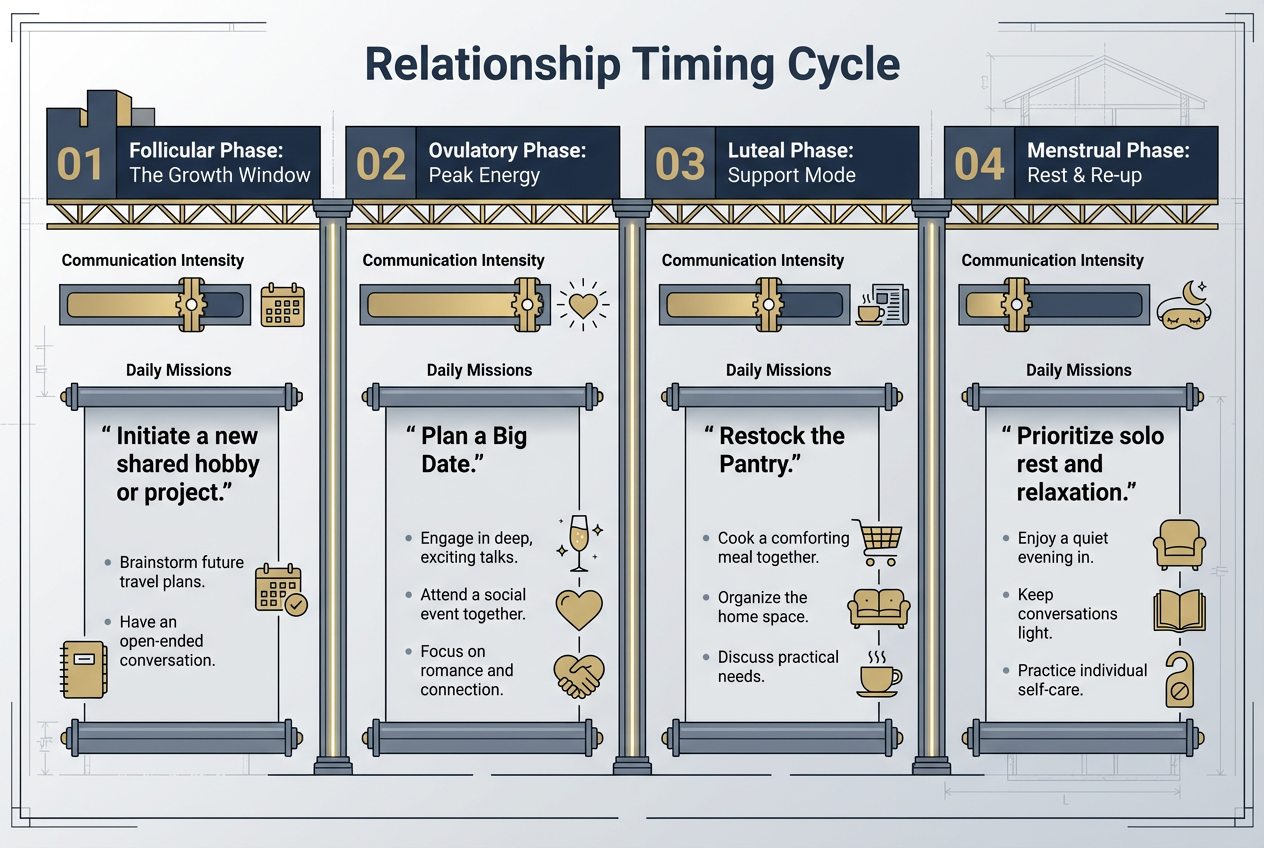 VibeCheck translates biological data into tactical daily missions, allowing partners to align their efforts with their partner's natural energy levels and needs.
The game-changer is realizing these phases aren't random. They happen in the same order, every month, with predictable effects. Once you can see the pattern, relationship conflicts stop feeling like random landmines and start feeling like weather patterns you can prepare for.
This is why many men who use VibeCheck as their partner cycle guide report a dramatic decrease in relationship arguments. They're not having fewer conflicts because they're avoiding topics - they're having fewer conflicts because they're choosing better timing.
VibeCheck vs. The Competition: Finding Your Best Fit
Bottom Line: VibeCheck wins for men who want actionable daily coaching and AI personalization. DuoSync wins for privacy-focused users who want local data storage. Flo wins for medical accuracy if your partner already uses it. Choose based on your primary concern: action, privacy, or integration.
The "period tracker for men" category has exploded in the past two years, but each app takes a different philosophical approach. Here's the honest breakdown:
The Winner's Circle
| App | Best For | Key Strength | Main Limitation |
|---|---|---|---|
| VibeCheck | Daily action-takers | AI-powered personalized missions | iOS only (Android coming); premium pricing |
| DuoSync | Privacy-conscious users | 100% local data storage | Less sophisticated AI coaching |
| Flo for Partners | Medical accuracy | 380M+ user base; clinical precision | Built for women first; secondary male experience |
| Paired | Couples engagement | Fun quizzes and games | Requires both partners to actively use it |
| Clue Connect | Science-focused users | Research-backed tracking | Clinical interface; minimal actionable guidance |
VibeCheck: The Actionable Coach
VibeCheck's core philosophy is simple: most men don't need more information - they need clearer instructions. The app's daily missions remove decision fatigue. You open it while drinking your morning coffee, get a 20-second brief on where her cycle is today, and receive 2-3 specific suggestions tailored to this moment in her cycle.
The AI learning system is where VibeCheck separates itself from everything else on the market. After you complete missions (or skip them), the app adjusts future suggestions based on what actually works for your relationship. If your partner loves quality time during her follicular phase but prefers solo space during her luteal phase, VibeCheck figures that out and adjusts accordingly.
The downside? Price and platform. At $8.99/month or $69.99/year, VibeCheck is more expensive than competitors. And if you're on Android, you're currently waiting for the "coming soon" version, which loses them about half their potential market.
DuoSync: The Privacy Hardliner
DuoSync's entire value proposition is privacy. Every piece of data stays on your phone - no cloud sync, no AI analysis happening on remote servers, no third-party data sharing. For men who worry about the ethics of tracking or who have partners concerned about data privacy, DuoSync offers peace of mind.
The app was "built by a guy for guys," and the UX reflects that - simple, straightforward, no medical jargon. It tracks cycles, predicts phases, and gives basic guidance on each phase. What it doesn't do is learn from your behavior or provide sophisticated personalized coaching.
If your priority is "respectful and private" over "AI-powered and predictive," DuoSync wins.
Flo for Partners: The Data Giant
Flo has 380 million users, making it the largest period tracking platform in the world. If your partner already uses Flo, the "Flo for Partners" feature lets you connect to her account and see what she's chosen to share with you.
The strength here is medical accuracy and trust. Flo has years of data science behind its predictions. The weakness is that the male partner experience feels like an afterthought - you're basically getting a limited view of an app designed for women. The interface is clinical, the advice is generic, and there's no real coaching layer.
Flo also carries baggage from past privacy controversies and lawsuits around data sharing, which makes some users uncomfortable.
The Verdict
Choose VibeCheck if you want the most advanced AI coaching and you're willing to pay premium prices for it. Choose DuoSync if privacy is your top concern and you want a simpler, local-first approach. Choose Flo if your partner already uses it and you want seamless integration with her existing data.
But if your goal is to become a more proactive, less reactive partner - to stop playing relationship roulette and start playing relationship chess - VibeCheck is the clear winner.
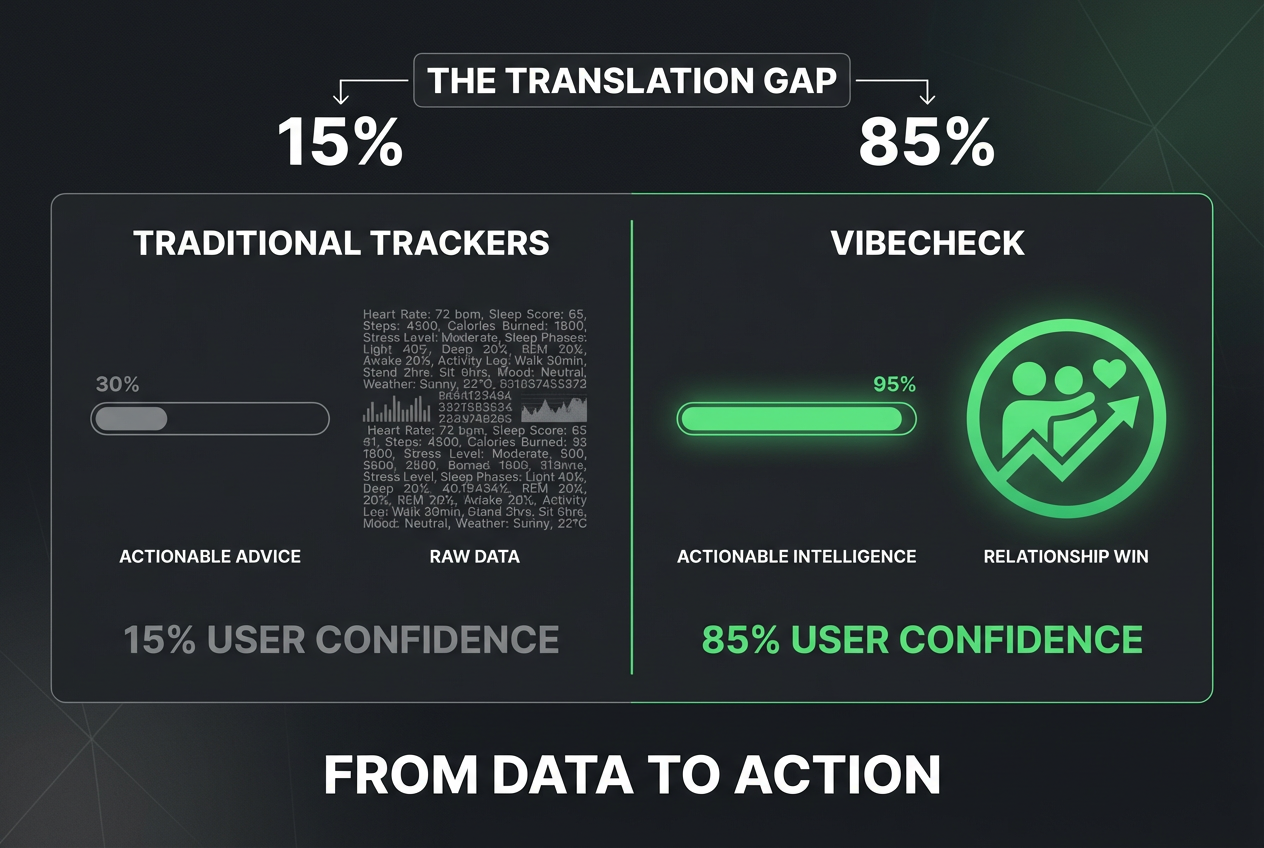 While legacy apps provide raw data, VibeCheck acts as a translation layer, turning cycle tracking into a proactive strategy for relationship harmony and success.
Feature Deep-Dive: The Tools That Actually Matter
Bottom Line: VibeCheck's Daily Missions and Stress Alerts are the two features that deliver the most relationship value. The AI Learning Loop ensures the advice improves monthly rather than staying static.
Let's talk about the specific tools that make VibeCheck more than just another calendar app.
Daily Missions: Your 60-Second Playbook
Every morning, VibeCheck gives you 2-3 missions calibrated to today's phase and your relationship history. These aren't vague suggestions like "be supportive." They're specific actions:
- "Restock her favorite snacks - energy is lower today"
- "Suggest a spontaneous date night - connection window is open"
- "Handle dinner tonight without asking - stress sensitivity is elevated"
- "Plan that weekend trip you've been talking about - energy and optimism are high"
The missions are short enough to complete without disrupting your day but specific enough to remove guesswork. You're not trying to interpret cycle data - you're just following a playbook designed for this exact moment.
As one user described it: "It's like having a relationship coach texting me every morning with today's game plan."
Stress Alerts: The Unforced Error Prevention System
This is the feature that saves relationships. VibeCheck sends you a heads-up when your partner is entering a high-sensitivity window (typically the late luteal phase, days 23-28). The alert doesn't just say "her period is coming" - it tells you what that means behaviorally.
The alert might say: "Stress sensitivity elevated for the next 4 days. Avoid bringing up finances, relationship concerns, or logistical conflicts. Focus on reducing friction, not creating conversations."
This simple warning prevents what one VibeCheck user calls "unforced errors" - the arguments that happen because you chose terrible timing, not because you said something wrong. That conversation about moving to a cheaper apartment? Still needs to happen. But waiting 5 days to have it might mean the difference between a productive discussion and a blowout fight.
AI Learning Loop: The System That Gets Smarter
Here's what makes VibeCheck genuinely different from every competitor: the app learns from your successes and failures.
After you complete a mission, you can rate how it went. Did bringing home chocolate work? Did suggesting a date night get shut down? The AI uses this feedback to refine future suggestions. Over time, your missions become increasingly personalized to your specific relationship dynamics.
This creates what VibeCheck calls a "custom playbook." After three to four months, the app knows:
- Which gestures resonate during which phases
- Your partner's unique cycle length and symptom patterns
- Which types of support she prefers when stressed
- What timing works best for important conversations
No generic app can do this. Flo gives everyone the same advice. DuoSync gives everyone the same phase descriptions. VibeCheck builds a playbook that's yours alone.
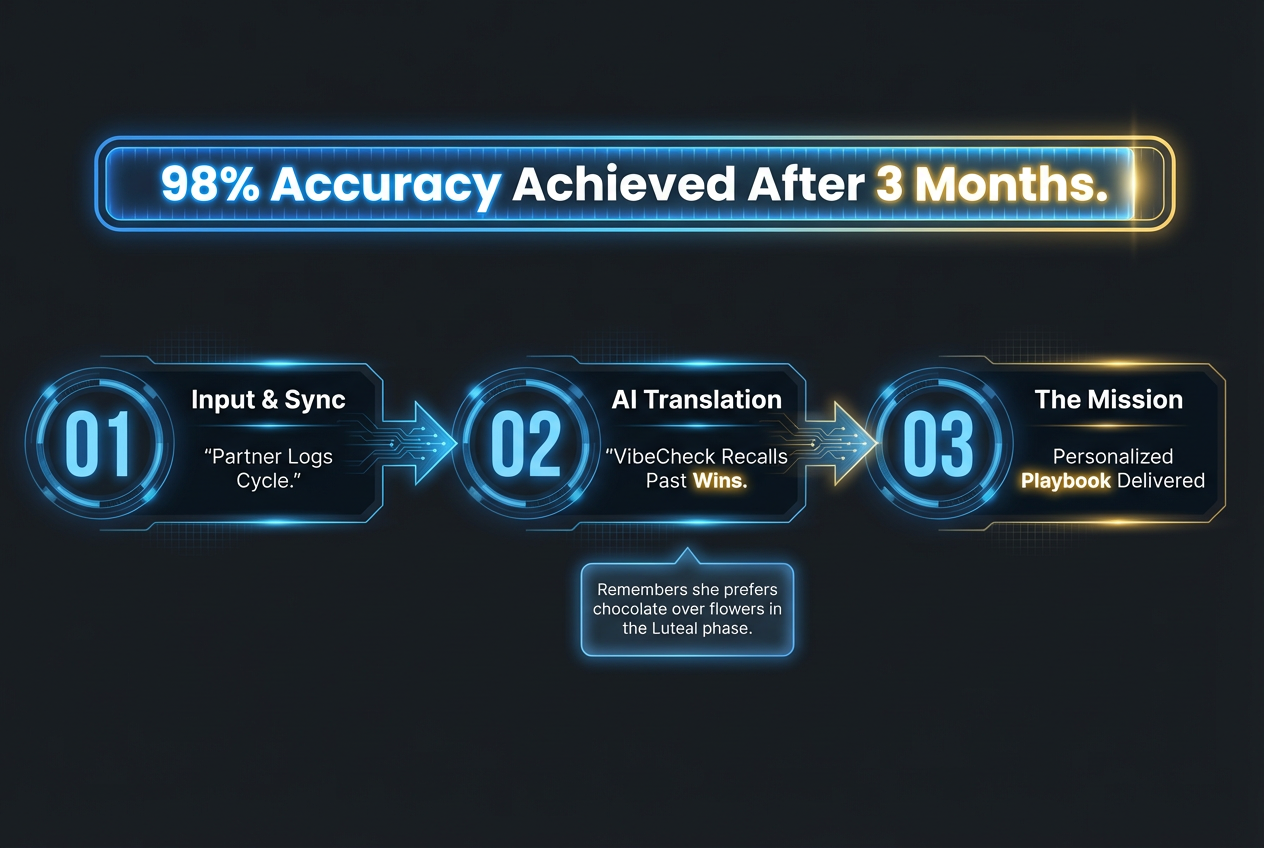 VibeCheck's unique AI doesn't just track dates; it learns what gestures work best for your specific relationship, creating a custom playbook that improves every month.
The Features That Don't Matter as Much
VibeCheck has other features - mood journals, symptom tracking, love language integration - but honestly, most men don't use them. The app succeeds or fails based on whether the Daily Missions are useful and whether the Stress Alerts prevent arguments. Everything else is secondary.
Focus on those two core features for the first month. If they work, you'll naturally explore the rest. If they don't, the other bells and whistles won't save the experience.
Setting Up VibeCheck the Right Way
Bottom Line: Have an explicit conversation about consent before downloading any tracking app. Frame it as a tool to support her better, not to monitor her. Let her control what data you see and respect her boundaries completely.
Here's the uncomfortable truth: done wrong, period tracking apps for men can feel invasive and creepy. Done right, they're a powerful tool for relationship support. The difference comes down to how you introduce the idea and set it up.
The Consent Conversation
Do not download VibeCheck and surprise your partner with "Hey, I'm tracking your cycle now." That's a terrible approach that will immediately create defensiveness and mistrust.
Instead, have an explicit conversation that sounds something like this:
"I've been thinking about how I can be a better partner, especially during times when you're stressed or dealing with physical discomfort. I found this app that's designed to help me understand your cycle better so I can support you without you having to ask. It's not about monitoring you - it's about me learning when to step up. Would you be open to helping me set it up?"
Notice the framing:
- You're asking permission, not announcing a decision
- You're positioning it as support, not surveillance
- You're acknowledging her autonomy by making it collaborative
Give her time to think about it. Some women will immediately see the value. Others will need reassurance that this isn't about control or using her biology against her in arguments.
Setup Options: Transparency Matters
VibeCheck offers two setup approaches:
Option 1: Linked Tracking - She shares her cycle data with you directly through the app. This gives the most accurate predictions and allows the AI to learn faster.
Option 2: Manual Entry - She tells you when her period starts each month, and you enter that date yourself. This gives her more privacy while still allowing you to use the app's coaching features.
Let her choose. If she's uncomfortable with linked tracking, manual entry still works. The important part is respecting her comfort level completely.
The Rules of Engagement
Set ground rules before you start:
- Never use cycle information as ammunition in arguments ("You're just saying that because you're about to get your period")
- Never share her cycle information with others, even as a joke
- Never make assumptions about her mood based solely on what the app says
- Always ask before trying to "help" during sensitive phases
The app is a guide, not a rulebook. If VibeCheck says it's a low-energy day but she wants to go rock climbing, you follow her lead, not the app. The goal is to support her reality, not impose a predicted reality onto her.
For more guidance on how boyfriends can use period trackers in a way that builds trust rather than eroding it, the key principle is always the same: consent first, support second, assumptions never.
Real-World Wins: What Success Looks Like
Bottom Line: VibeCheck's value shows up in prevented conflicts, proactive gestures that land perfectly, and a noticeable reduction in relationship tension over time. Success isn't dramatic - it's the absence of arguments that never happen.
The wins with VibeCheck aren't usually dramatic movie moments. They're quieter: the argument that didn't happen, the gesture that landed perfectly without you having to ask what she needed, the week where everything just felt easier.
The Chocolate Story
One user describes his first real win: "VibeCheck sent me an alert saying her period was starting the next day and stress was elevated. On my way home, I stopped and grabbed her favorite chocolate and a heating pad we didn't have. When I walked in, she hadn't even realized her period was coming yet, but 30 minutes later it started and she just looked at me like I'd read her mind. That's when she got it - this wasn't about tracking her, it was about me paying attention in a way I couldn't before."
That's a micro-win, but those micro-wins compound. When you consistently show up with the right support at the right time, it builds relationship equity.
The Avoided Argument
Another user's experience: "I was about to bring up the fact that we were spending too much on eating out. I'd been annoyed about it for a week and finally decided to address it. Checked VibeCheck first - late luteal phase, high stress sensitivity. The app basically said 'Do not have this conversation today.' I waited 5 days. Same conversation, completely different outcome. We actually problem-solved instead of fighting."
This is the "unforced error prevention" in action. The conversation still happened. The issue still got addressed. But the timing made all the difference between productive and destructive.
The Energy Match
A third user: "The follicular phase tips changed everything. I used to suggest date nights randomly and get shut down half the time, which made me stop suggesting them. Now I suggest them when her energy is naturally higher, and she almost always says yes. We're going out twice as much as we used to, and it doesn't feel forced."
This illustrates how understanding the cycle playbook lets you work with biology instead of against it. You're not changing what you want to do - you're changing when you suggest it.
What Failure Looks Like
Not every mission works. Sometimes you follow the app's advice and it still falls flat. That's normal - relationships aren't algorithms. The key is using those failures to help the AI learn.
One user describes attempting a date night during what should have been a high-energy phase, only to have his partner want to stay home instead. He marked the mission as unsuccessful, and VibeCheck adjusted future suggestions to account for the fact that his partner's follicular phase energy doesn't always translate to wanting social activities.
The app gets better the more honest feedback you give it. That's the difference between a static tracking app and an adaptive coaching system.
The Long Game
The real value of VibeCheck shows up over months, not days. Users consistently report:
- Fewer relationship arguments
- More successful date nights
- Better emotional connection
- Less walking on eggshells
- More appreciation from their partners
One user summarized it well: "We went from fighting about stupid stuff twice a week to fighting maybe twice a month, and when we do fight, it's about things that actually matter. That alone is worth the $9 monthly subscription."
Frequently Asked Questions
What is the VibeCheck app and how does it work?
VibeCheck is a relationship timing app for men that tracks your partner's menstrual cycle and translates it into daily actionable missions. Instead of just showing you a calendar, it gives you specific suggestions on what to do (or avoid) based on which hormonal phase she's in. The app uses AI to learn which gestures work best for your specific relationship and improves its recommendations over time.
Is using a period tracker for my partner creepy or invasive?
It depends entirely on how you approach it. Using VibeCheck without your partner's explicit consent is absolutely invasive. Using it after having an open conversation about wanting to support her better, and letting her control what information you see, is the opposite - it's respectful and proactive. The difference is consent and transparency. Always discuss it first, frame it as a support tool, and respect her boundaries completely.
How much does VibeCheck cost and is it worth it?
VibeCheck costs $8.99 per month or $69.99 per year (which works out to $5.83/month). Whether it's worth it depends on your relationship priorities. If you're currently experiencing regular conflicts due to timing issues, or if you want to be more proactive about supporting your partner, the cost is easily justified by the reduction in arguments and increase in relationship satisfaction. Compare it to the cost of couples therapy ($100-200 per session) and it becomes a relatively minor investment.
Can I use VibeCheck if my partner doesn't want to share her cycle data?
Yes. VibeCheck offers a manual entry option where your partner simply tells you when her period starts each month, and you enter that date yourself. This gives her complete privacy while still allowing you to use the app's phase-based coaching and daily missions. The AI won't learn as quickly compared to linked tracking, but the core functionality still works well.
What's the difference between VibeCheck and just using a regular period tracker?
Regular period trackers designed for women focus on medical data, symptom logging, and prediction accuracy for the person experiencing the cycle. VibeCheck focuses on translation - converting that biological information into specific actions a male partner should take. A regular tracker might tell you she's in the "luteal phase." VibeCheck tells you to handle dinner tonight, avoid bringing up stressful topics, and restock her favorite comfort snacks. It's the difference between information and instruction.
Does VibeCheck work for irregular cycles?
Yes, but with some limitations. VibeCheck's AI adapts to your partner's actual cycle length over time, so if she has a 35-day cycle instead of a 28-day cycle, the app learns that pattern. However, if cycles are highly irregular (varying by more than 7 days from month to month), prediction accuracy decreases and the daily missions become less precise. In those cases, combining VibeCheck with communication remains important - let the app be a general guide rather than a strict rulebook.
Is VibeCheck available for Android?
Currently, VibeCheck is iOS-only, but an Android version has been announced as "coming soon." This is VibeCheck's biggest competitive weakness, as it locks out roughly half the smartphone market. If you're on Android and don't want to wait, alternatives like DuoSync and Flo for Partners work on both platforms, though they lack VibeCheck's advanced AI coaching features.
What if the app's suggestions don't match what my partner actually needs?
Trust your partner over the app, always. VibeCheck is a guide based on general hormonal patterns and learned behavior, but it can't read minds or account for external factors like work stress, health issues, or just having an off day. If the app suggests a date night but she wants to stay in, follow her lead. Use the rating system to tell VibeCheck the mission didn't work, and the AI will adjust future suggestions. The app works best when combined with actual communication and attention, not as a replacement for them.
Tags

Related Articles
Continue reading to deepen your understanding

Why Your Girlfriend Wants Different Kinds of Affection at Different Times in Her Cycle
Ever feel like your girlfriend’s needs change every week? It’s not random. Understand how the four phases of her cycle drive her desire for intimacy so you can support her better.

How to Plan Romantic Gestures by Cycle Timing: The Partner’s Tactical Guide
Stop guessing why your date night plans fell flat. This guide explains how to synchronize your romantic efforts with her biological cycle for better intimacy and connection.

How to Tell When Your Girlfriend Is Ovulating: Reading the Biological Signals Your Partner Sends
Understanding your partner’s cycle helps you anticipate her needs and time important conversations. Learn the behavioral signs of ovulation to improve your relationship and connection.

Understanding Your Girlfriend’s Words of Affirmation Cycle: A Partner’s Guide
Ever feel like your compliments land wrong? Her need for words of affirmation isn’t random—it follows a biological rhythm. Learn how to match your support to her internal hormonal seasons.

The Partner’s Guide to the Luteal Phase: What It Is and How to Support Her
Stop walking on eggshells. Understand the biological changes of the luteal phase so you can support your partner through mood shifts and fatigue with empathy.

How to Plan Valentine’s Day Around Your Girlfriend’s Cycle
Does your romantic plan clash with her biological rhythm? Learn how to adjust your date night to her specific cycle phase so she feels comfortable and truly cared for this year.

The Strategic Partner’s Guide to Planning an Engagement Around Her Cycle
Don’t leave your proposal to chance. Learn how her biological rhythm impacts emotional receptivity and how to align your big question with the phase where she feels her best.

How to Plan Weekend Trips Around Your Girlfriend’s Cycle: A Tactical Guide
Stop booking trips that end in friction. Learn how to map weekend travel to her biological phases to reduce friction by 41% and maximize your time together.