Why Your Girlfriend Wants Different Kinds of Affection at Different Times in Her Cycle

Ever feel like your girlfriend’s needs change every week? It’s not random. Understand how the four phases of her cycle drive her desire for intimacy so you can support her better.
Why Your Girlfriend Wants Different Kinds of Affection at Different Times in Her Cycle
Your girlfriend seems to want different things each week, and you're wondering if you're reading the situation wrong. One week she's planning activities and seeking out physical touch. The next, she's withdrawn and needs space. A few days later, she wants constant reassurance. Then she's irritable and asking you to handle everything without being asked.
You're not imagining it. Her need for affection follows a biological pattern driven by hormonal changes during the menstrual cycle. Understanding this pattern doesn't mean treating her like a stereotype or reducing her to hormones - it means recognizing a real physiological rhythm that affects energy, mood, and social appetite, then adjusting your approach accordingly.
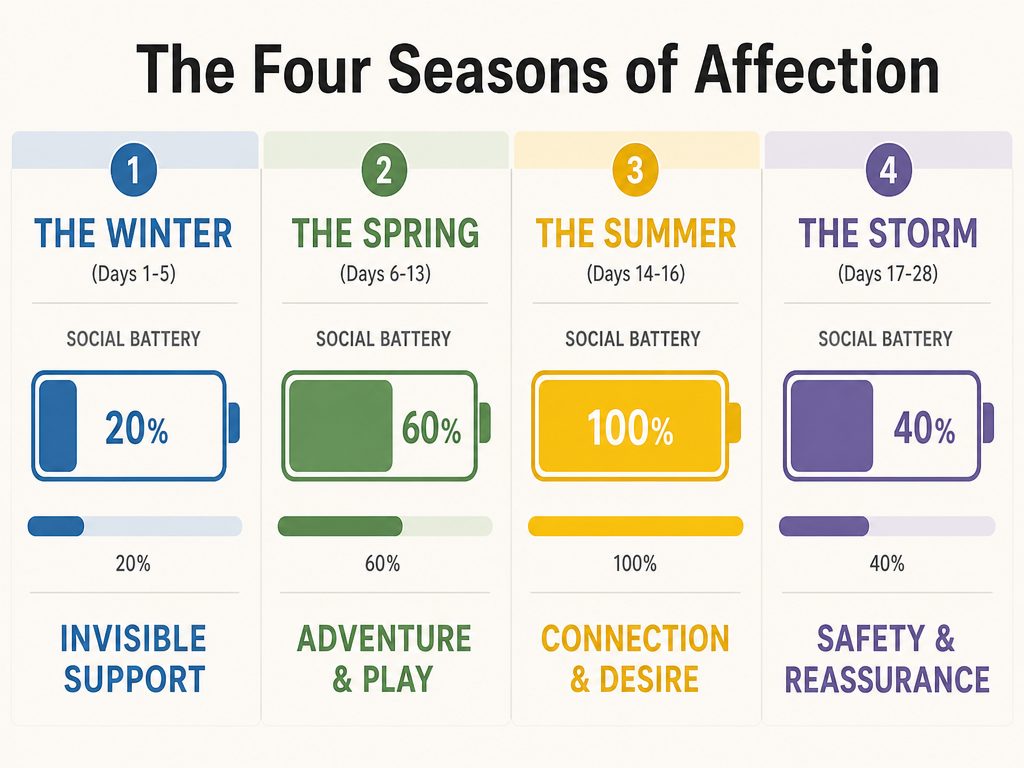 Understanding these four phases helps you decode when to lead with physical intimacy and when to prioritize 'invisible support' like chores and space.
Table of Contents
- What Drives These Shifting Affection Needs
- Phase 1: Menstruation (Days 1-5) - "Winter"
- Phase 2: Follicular (Days 6-13) - "Spring"
- Phase 3: Ovulation (Days 14-16) - "Summer"
- Phase 4: Luteal (Days 17-28) - "Storm"
- Reading Her Signals Without Tracking Her Cycle
- What About Women Who Don't Experience These Patterns
- The Mission Ready Period Kit
- Frequently Asked Questions
What Drives These Shifting Affection Needs
The menstrual cycle has four distinct phases: menstrual (bleeding, roughly days 1-5), follicular (day 1 through ovulation, with estrogen rising), ovulation (around day 14 in a 28-day cycle, triggered by a surge in luteinizing hormone), and luteal (after ovulation to the next period, with progesterone rising then falling).
Each phase brings different hormone levels, and those hormones don't just affect her reproductive system - they affect brain function, energy levels, and the ability to focus. Estrogen rises sharply in the days leading up to ovulation, which tends to boost energy and social drive. After ovulation, progesterone rises to prepare the uterine lining for a possible pregnancy. If pregnancy doesn't happen, both progesterone and estrogen drop before the next period, and that hormonal crash is linked to PMS-like symptoms such as mood shifts, fatigue, and appetite changes.
Her need for different kinds of affection across the month isn't random or a test - it's her body adapting to these biological shifts. Here's what each phase looks like and how to adjust your support accordingly.
Phase 1: Menstruation (Days 1-5) - "Winter"
What's Happening Biologically
Her period marks the beginning of the cycle. Hormone levels are at their lowest, and she's shedding the uterine lining built up during the previous cycle. Many women experience physical discomfort - cramps, bloating, fatigue, and sometimes nausea. Energy is typically low, and her social battery is depleted.
VibeCheck App
Download Free on iOS →What Kind of Affection She Wants
During this phase, she wants comfort without expectation. Physical closeness is welcome, but it should be gentle and non-demanding. Think cuddling on the couch rather than initiating sex. She wants to feel cared for, not like she needs to perform or entertain.
This is the phase where "invisible support" matters most - handling tasks without being asked, making decisions so she doesn't have to, and creating a low-stress environment where she can rest.
Tactical Scripts
- "I've got the dishes tonight. You just rest."
- "Do you want me to grab you anything while I'm out?"
- "Let's stay in and watch something easy."
Avoid: "Are you okay?" asked repeatedly, or treating her like she's fragile. She's not broken - she's managing a physical process. Also avoid pressuring her for energy she doesn't have, like suggesting high-intensity plans or expecting her to be social.
Phase 2: Follicular (Days 6-13) - "Spring"
What's Happening Biologically
During the follicular phase, estrogen rises as an egg-containing follicle develops in the ovary. This rising estrogen thickens the uterine lining and boosts energy, focus, and mood. Her social battery is recharging, and she's more likely to feel motivated and adventurous.
What Kind of Affection She Wants
This is the "Yes" phase. She wants adventure and playfulness. She's open to spontaneous plans, high-energy activities, and initiating physical touch. This is when she's most likely to suggest a new restaurant, agree to a road trip, or be receptive to you planning something unexpected.
She wants you to match her energy - be engaged, suggest activities, and show enthusiasm for spending time together. Physical affection during this phase is welcome and often reciprocated eagerly.
Tactical Scripts
- "Let's check out that new spot you mentioned."
- "What do you think about doing [activity] this weekend?"
- "I've been wanting to try [thing] with you."
Avoid: Low-effort plans or treating this phase as "normal" and missing the window. If you want to have an important conversation or plan something significant, this is your best opportunity.
Phase 3: Ovulation (Days 14-16) - "Summer"
What's Happening Biologically
Ovulation is when a surge in luteinizing hormone (LH) causes the ovary to release an egg, typically around day 14 of a 28-day cycle. Estrogen and testosterone levels peak during this phase, which usually correlates with the highest libido. Around ovulation, many women notice increased sex drive, mild pelvic or abdominal pain, tender breasts, bloating, and mood changes - though these vary significantly person to person.
What Kind of Affection She Wants
This is her peak phase for connection and validation. She wants quality time and specific, meaningful compliments. Physical intimacy is likely to be at its highest interest during this window. She wants to feel desired, not just wanted for sex - so focus on what makes her unique, not generic praise.
This is also when she's most receptive to deep conversations and emotional connection. If you've been putting off a serious talk or want to strengthen the relationship, this is the biological window where she's most emotionally available.
Tactical Scripts
- "You look incredible tonight, and I love how you handled that situation today."
- "I've been thinking about how much I appreciate [specific thing she does]."
- "What's been on your mind lately? I want to hear what you're thinking."
Avoid: Taking this phase for granted or assuming she'll always feel this connected. This is a short window - usually just a few days - and missing it means waiting nearly a month for the next one.
If you're looking for more tactical support during this phase, check out our guide on how to support your girlfriend during ovulation mood changes.
Phase 4: Luteal (Days 17-28) - "Storm"
What's Happening Biologically
After ovulation, the luteal phase begins: progesterone rises to help prepare the uterine lining for a possible pregnancy. If pregnancy doesn't happen, both progesterone and estrogen drop before the next period. A drop in estrogen and progesterone triggers a drop in serotonin, the neurotransmitter that regulates mood.
This serotonin crash is the biological mechanism behind PMS. As many as 3 in 4 women report experiencing PMS symptoms at some point in their life, though severity varies widely. Symptoms - which can include mood swings, irritability, bloating, breast tenderness, fatigue, and appetite changes - typically show up one to two weeks before a period.
Roughly half of people who menstruate report having at least one PMS symptom, but only about 1 in 5 have symptoms severe enough to disrupt their daily life. That more disruptive tier is a meaningfully different experience than "typical" PMS.
What Kind of Affection She Wants
During this phase, she wants safety and reassurance. The kind of affection that worked during ovulation - high-energy dates, spontaneous plans, physical intensity - can feel overwhelming now. She wants "protective" affection: you handling logistics, validating her feelings without trying to fix the problem, and giving her space when she needs it.
Expect a desire for more alone time or "crying for no reason." This isn't a relationship problem - it's a serotonin problem. When a partner is struggling emotionally, responding with genuine empathy tends to help more than trying to fix the problem or offer silver linings. Feeling understood, not corrected, is what tends to defuse tension.
Tactical Scripts
- "That sounds really frustrating. I can see why you feel that way."
- "Do you want to talk about it, or do you just need me to listen?"
- "I'm here if you need me, but I can also give you space if that's better."
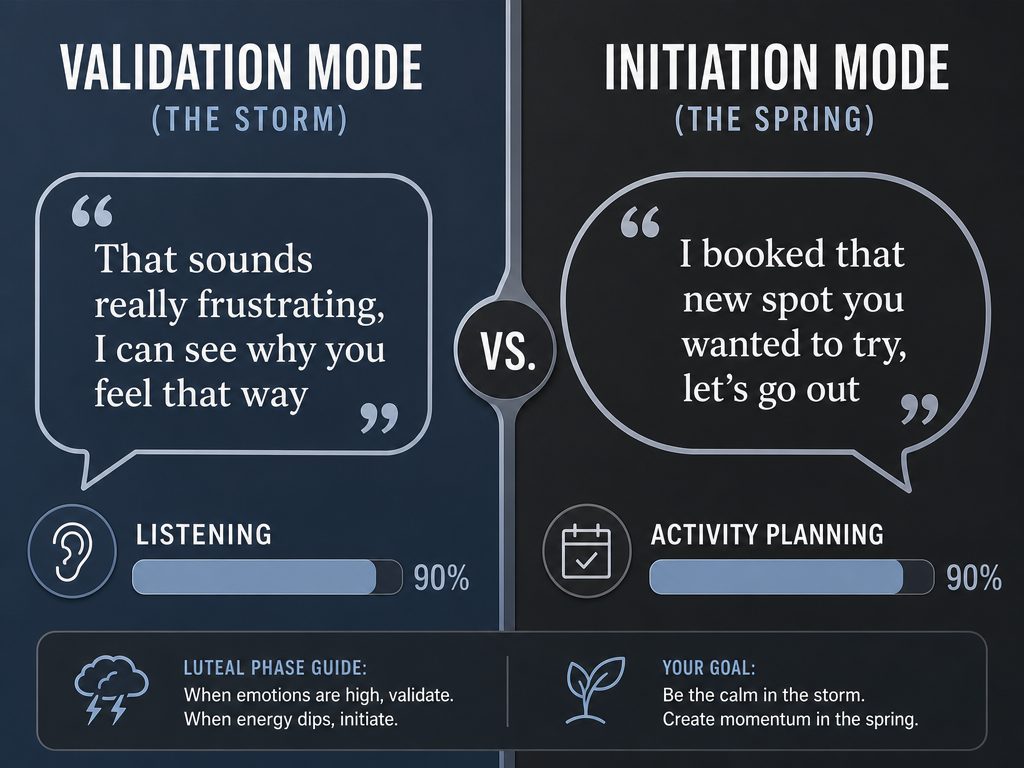 Switching from 'fixing' problems to 'validating' feelings is the most effective way to support a partner during the serotonin-depleted Luteal phase.
Avoid: "Is it your period?" or any variation of dismissing her feelings as hormonal. Also avoid trying to solve problems she didn't ask you to solve, planning high-stakes activities, or taking her irritability personally.
For more specific guidance on navigating this phase, read our tactical partner's guide to the luteal phase.
Reading Her Signals Without Tracking Her Cycle
Maybe you don't want to track her cycle, or maybe she doesn't want you to. You can still recognize patterns by observing behavioral signals:
Menstruation (Winter): She's less social, wants more rest, mentions physical discomfort, and prefers low-effort plans.
Follicular (Spring): She's initiating plans, suggesting new activities, more responsive to texts, and generally more upbeat.
Ovulation (Summer): She's dressing up more, seeking out physical closeness, asking deeper questions, and showing heightened interest in quality time.
Luteal (Storm): She's more irritable, withdrawing socially, craving specific foods, mentioning bloating or fatigue, and less tolerant of small annoyances.
Tracking these symptoms and mood changes across the cycle for a few months is a legitimate, medically endorsed way to identify real patterns and timing - rather than assuming based on stereotypes or a single cycle.
If you want help identifying which phase she's in without asking directly, our article on how to tell which cycle phase your girlfriend is in offers behavioral cues and timing frameworks.
What About Women Who Don't Experience These Patterns
Not every woman experiences dramatic shifts across her cycle. A "normal" cycle varies significantly between women - menstrual bleeding can start anywhere from every 24 to every 38 days and last up to 8 days. There is no single universal 28-day cycle, so exact day-by-day predictions for any specific woman should be treated as approximate.
Some women don't notice mood or energy changes at all. Others experience them but manage them internally. And for some, the changes are severe enough to significantly disrupt daily life - that's PMDD (premenstrual dysphoric disorder), a real, clinically recognized condition listed in the DSM-5 as a depressive disorder, not something people are "making up" or simply failing to cope with. It affects roughly 1 in 10 people who menstruate.
If your girlfriend doesn't seem to follow these patterns, that's normal. Ask her directly what she's noticed about her own cycle and what kind of support she finds helpful. The point isn't to impose a framework on her - it's to understand her specific experience.
For guidance on supporting a partner through severe cycle-related mood symptoms, read our article on how to help your girlfriend during period mood swings.
The Mission Ready Period Kit
Being prepared for the menstrual phase shows you understand the physical reality of her cycle and that you're willing to provide practical relief. Keep these items stocked:
- Ibuprofen or Naproxen: Better for cramps than acetaminophen (Tylenol) because they reduce inflammation, not just pain.
- Heating pad or hot water bottle: Heat reduces cramping by relaxing uterine muscles.
- 70%+ dark chocolate: Contains magnesium, which can reduce cramps and boost serotonin.
- Ginger tea: Reduces inflammation and nausea.
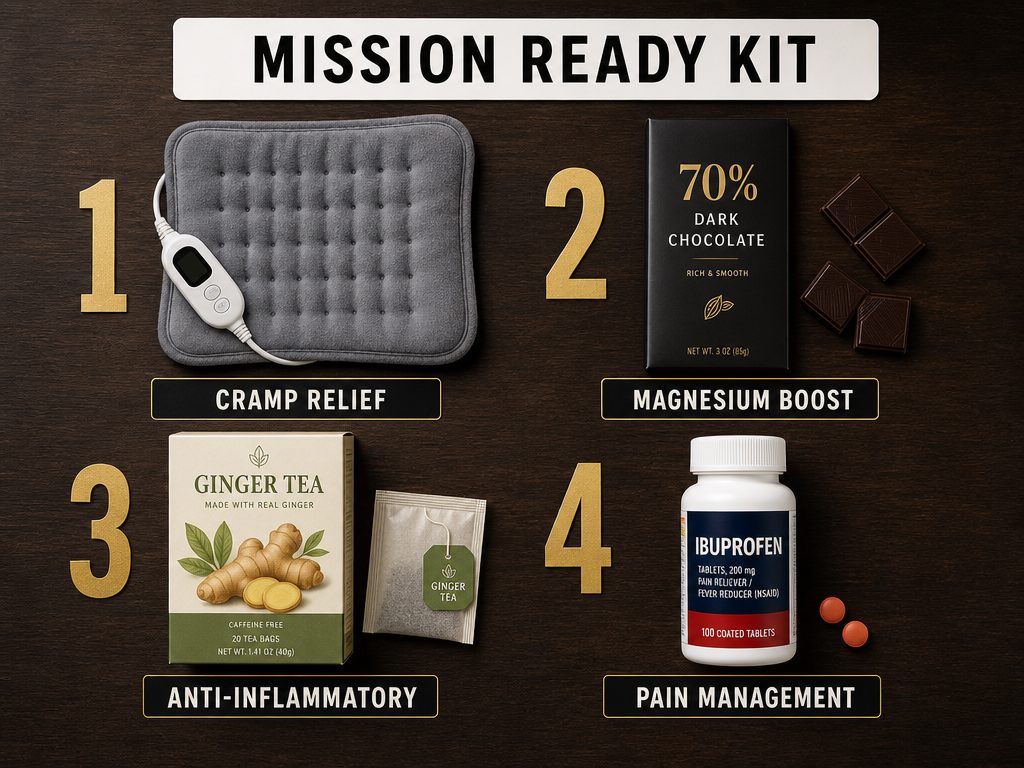 Being 'Mission Ready' with these four essentials demonstrates high emotional intelligence and provides practical relief when your partner needs it most.
Lifestyle approaches that can help ease PMS symptoms include regular aerobic exercise, smaller/more frequent meals, less salt/caffeine/alcohol, adequate sleep, and stress-reduction practices like deep breathing or yoga. A partner who understands these and is patient and supportive around them - rather than dismissive of symptoms - is aligning with medically recommended self-care, not indulging an excuse.
Frequently Asked Questions
How to handle horniness during menstrual cycle?
Libido shifts predictably across the cycle. It tends to be highest during ovulation (around day 14) when estrogen and testosterone peak, lower during menstruation when hormone levels are at their lowest, and variable during the luteal phase depending on individual PMS symptoms. If she's interested during her period, it's perfectly safe - use a towel, consider shower sex, or simply communicate about comfort levels. If she's not interested, respect that and wait for the follicular or ovulation phases when her libido naturally increases.
Are girls hornier before or after their period?
Most women experience peak libido during ovulation (around day 14) when estrogen and testosterone levels are highest, not immediately before or after the period. However, some women notice increased desire in the few days after their period ends, as they enter the follicular phase and estrogen begins rising again. The days immediately before the period (late luteal phase) are typically associated with lower libido due to PMS symptoms like bloating, fatigue, and irritability.
How to explain the luteal phase to a man?
The luteal phase is the two-week window after ovulation and before the next period. During this time, progesterone rises to prepare the body for a possible pregnancy. If pregnancy doesn't happen, both progesterone and estrogen drop sharply, which triggers a drop in serotonin - the brain chemical that regulates mood. This serotonin crash is why many women experience PMS symptoms like irritability, fatigue, and emotional sensitivity during the week or so before their period. It's not a personality flaw or overreaction - it's a real neurochemical event.
What phase of menstruation are you most emotional?
The late luteal phase (roughly days 21-28 of a 28-day cycle) is when emotional sensitivity tends to be highest. This is the week or so before the period starts, when both estrogen and progesterone drop sharply. That hormonal crash triggers a drop in serotonin, which can cause mood swings, irritability, tearfulness, and anxiety. Not everyone experiences this to the same degree, and severity can vary from cycle to cycle.
What is the happiest phase of a woman's cycle?
Many women report feeling their best during the follicular phase (days 6-13) and ovulation (days 14-16), when estrogen is rising or at its peak. Higher estrogen is associated with increased energy, better mood, higher confidence, and greater social motivation. These are the phases when she's most likely to feel upbeat, motivated, and engaged. However, this varies significantly between individuals, and not everyone experiences dramatic mood shifts across their cycle.
Can your menstrual cycle change if your partner is cheating?
No. The menstrual cycle is controlled by hormones released by the brain and ovaries, not by relationship stress or infidelity. However, high stress from any source - including relationship problems - can disrupt the cycle by affecting the hypothalamic-pituitary-ovarian axis, which regulates hormone production. Stress can delay ovulation, shorten or lengthen the cycle, or cause irregular bleeding. If you're noticing cycle irregularities, the cause is more likely stress, illness, weight changes, or other health factors, not cheating.
Do periods change attraction to partners?
Some older research suggested that women's attraction to masculine traits might shift across the cycle, but recent large-scale studies have found this effect to be inconsistent or non-existent. What does change across the cycle is libido and social energy, not fundamental attraction. During ovulation, when estrogen peaks, many women feel higher sexual desire and are more motivated to connect socially. During the luteal phase, especially late in that phase, lower energy and PMS symptoms can reduce interest in socializing or physical intimacy. This is about energy availability, not changing preferences.
What hormone triggers horniness?
Testosterone is the primary driver of libido in both men and women, though women produce much smaller amounts than men. In women, testosterone levels peak during ovulation (around day 14), which is why many women notice increased sexual desire mid-cycle. Estrogen also plays a supporting role by increasing blood flow and sensitivity, and it peaks during the same window. After ovulation, progesterone rises and tends to have a calming, sometimes libido-dampening effect for some women.
At what point in a woman's cycle is she most attractive?
Research on this question is mixed and often flawed. Some studies suggested that women might be perceived as more attractive during ovulation due to subtle changes in scent, facial symmetry, or behavior, but these findings have not been consistently replicated in larger, more rigorous studies. What's more reliable is that women often feel more confident and energetic during ovulation due to peak estrogen levels, and confidence is genuinely attractive. Focus less on objective "attractiveness" and more on understanding when she feels her best and matching your energy to hers.
Understanding how her cycle affects her need for affection doesn't mean reducing her to hormones or treating her like she's on autopilot. It means recognizing that she's managing a real, recurring biological process that affects energy, mood, and social appetite - and that being a good partner means adjusting your approach to match what she actually needs, not what you assume she should want.
If you want a tool that helps you track these phases and provides daily guidance on how to support her, consider trying VibeCheck - the relationship app built for men who want to stop guessing and start understanding.
Tags

Related Articles
Continue reading to deepen your understanding

How to Plan Romantic Gestures by Cycle Timing: The Partner’s Tactical Guide
Stop guessing why your date night plans fell flat. This guide explains how to synchronize your romantic efforts with her biological cycle for better intimacy and connection.

How to Tell When Your Girlfriend Is Ovulating: Reading the Biological Signals Your Partner Sends
Understanding your partner’s cycle helps you anticipate her needs and time important conversations. Learn the behavioral signs of ovulation to improve your relationship and connection.

Understanding Your Girlfriend’s Words of Affirmation Cycle: A Partner’s Guide
Ever feel like your compliments land wrong? Her need for words of affirmation isn’t random—it follows a biological rhythm. Learn how to match your support to her internal hormonal seasons.

The Partner’s Guide to the Luteal Phase: What It Is and How to Support Her
Stop walking on eggshells. Understand the biological changes of the luteal phase so you can support your partner through mood shifts and fatigue with empathy.

How to Plan Valentine’s Day Around Your Girlfriend’s Cycle
Does your romantic plan clash with her biological rhythm? Learn how to adjust your date night to her specific cycle phase so she feels comfortable and truly cared for this year.

The Strategic Partner’s Guide to Planning an Engagement Around Her Cycle
Don’t leave your proposal to chance. Learn how her biological rhythm impacts emotional receptivity and how to align your big question with the phase where she feels her best.

How to Plan Weekend Trips Around Your Girlfriend’s Cycle: A Tactical Guide
Stop booking trips that end in friction. Learn how to map weekend travel to her biological phases to reduce friction by 41% and maximize your time together.

How to Plan Engagement Around Girlfriend Cycle Timing
Master how to plan engagement around girlfriend cycle timing to leverage an 800% estrogen spike and ensure a joyous yes with our 4-phase tactical guide.