How to Respond When Your Girlfriend Needs Space During Her Period

If she’s suddenly sending one-word texts or pulling away, it’s likely not about you. Learn the science of the luteal phase and how to support her without feeling rejected.
How to Respond When Your Girlfriend Needs Space During Her Period
You were texting her paragraph-long messages about weekend plans yesterday. Now she's sending one-word replies and turned down your offer to come over. Your first thought: "Did I do something wrong?"
Your second thought: "Is she pulling away from me?"
Here's what's actually happening: her brain is experiencing a biological shift that makes social interaction feel exhausting. 75% to 85% of menstruating women experience uncomfortable physical or emotional symptoms during the premenstrual phase, and many of those symptoms include a genuine need for isolation and reduced social contact.
This isn't about you. It's about serotonin, progesterone, and a predictable pattern that happens every month. Understanding this pattern - and knowing how to respond to it - is what separates guys who walk on eggshells from partners who actually get it.
Table of Contents
- The "Space Window" Science: Why She Pulls Away Before Her Period
- Four Signs She Needs Space (Before She Has to Ask)
- The Response Blueprint: What to Actually Do
- Is It Her Cycle or a Relationship Problem?
- The Green Flag Talk: How to Bring Up Cycle Tracking
- Frequently Asked Questions
The "Space Window" Science: Why She Pulls Away Before Her Period
The luteal phase - roughly days 17-28 of her cycle - is biologically designed to make her want less social interaction. This isn't a personality flaw. It's a chemical shift.
Here's what happens in her brain during this phase:
VibeCheck App
Download Free on iOS →Serotonin transporter density in the brain increases shortly before menstruation, leading to a loss of synaptic serotonin and driving irritability and low mood. Think of it like her brain "cleaning out" the feel-good neurotransmitter that makes socializing rewarding. When serotonin drops, activities that normally feel enjoyable - texting you, making plans, having long conversations - start to feel like work.
At the same time, progesterone rises to prepare her body for a possible pregnancy. When pregnancy doesn't happen, both progesterone and estrogen drop before the next period. This hormonal crash creates what researchers call "increased stress vulnerability and decreased sociability" - the luteal phase is biologically associated with these shifts.
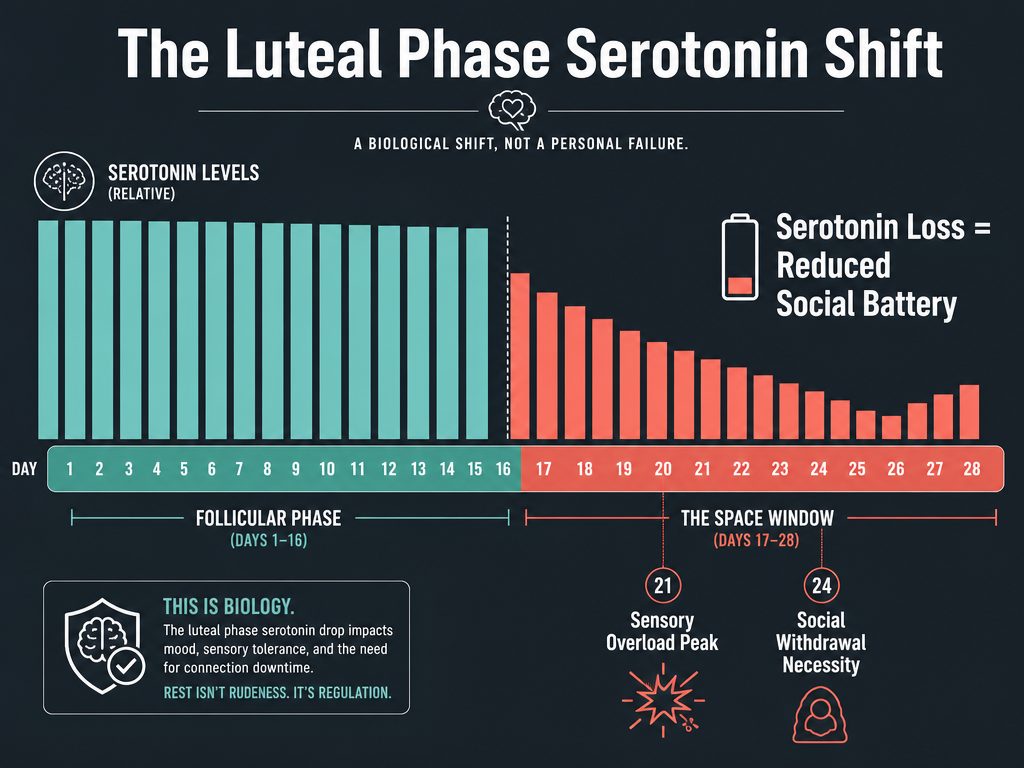
Translation: her brain is running low on the chemicals that make connection feel good. She's not mad at you. She's physiologically wired to conserve energy and reduce stimulation during this window.
This is a normal part of the menstrual cycle, which has four phases. Understanding which phase she's in helps you anticipate when the "space window" is coming and respond without panic.
Four Signs She Needs Space (Before She Has to Ask)
Most guys wait until she explicitly says "I need space" - and by that point, she's already frustrated that you didn't pick up the signals. Here's how to read the room earlier:
The Texting Taper
Her messages go from full paragraphs to short replies. "Yeah," "okay," "sounds good." She's not angry. She's in energy-conservation mode. Continuing to send long texts or ask open-ended questions ("How was your day? What are you thinking about dinner?") just adds to her mental load.
What to do: Match her energy. Send shorter messages. Don't ask questions that require a thoughtful response. If she's giving you one word, give her one sentence.
The Touch Ceiling
Physical affection that normally feels good - hugs, cuddling, even hand-holding - suddenly feels like too much. She might flinch, pull away, or just seem uncomfortable. This isn't rejection. It's sensory overload.
During the luteal phase, many women experience heightened sensitivity to physical stimuli. What feels soothing during other parts of her cycle can feel overwhelming when her nervous system is already on edge.
What to do: Don't take it personally. Offer affection but don't push it. A light touch on the shoulder is better than a full embrace. Let her initiate physical contact.
Decision Fatigue
Simple questions like "What do you want for dinner?" or "Should we go out this weekend?" trigger irritation. She snaps at you for asking. It's not the question itself - it's that her brain is already maxed out on decisions.
Progesterone's effects on mood include cognitive fog and reduced capacity for complex thinking. Every question you ask is another task her brain has to process.
What to do: Stop asking and start doing. Order her usual takeout without asking what she wants. Pick a low-key activity and tell her the plan instead of asking her to help decide.
Sensory Overload
She asks you to turn down the TV, turn off the lights, or stop chewing so loudly. Everything feels too loud, too bright, too much. This is a neurological response to the hormonal shift, not a personality quirk.
What to do: Create a low-stimulation environment. Dim the lights. Lower the volume. Give her quiet. Don't take it as criticism - treat it like you would if she had a headache.
The Response Blueprint: What to Actually Do
When you notice the signs above, here's your tactical framework:
Rule 1: No-Ask Acts of Service
Asking "How can I help?" or "What do you need?" feels supportive, but it's actually a burden during the luteal phase. Every question requires a decision, and decision-making is exactly what her brain is struggling with.
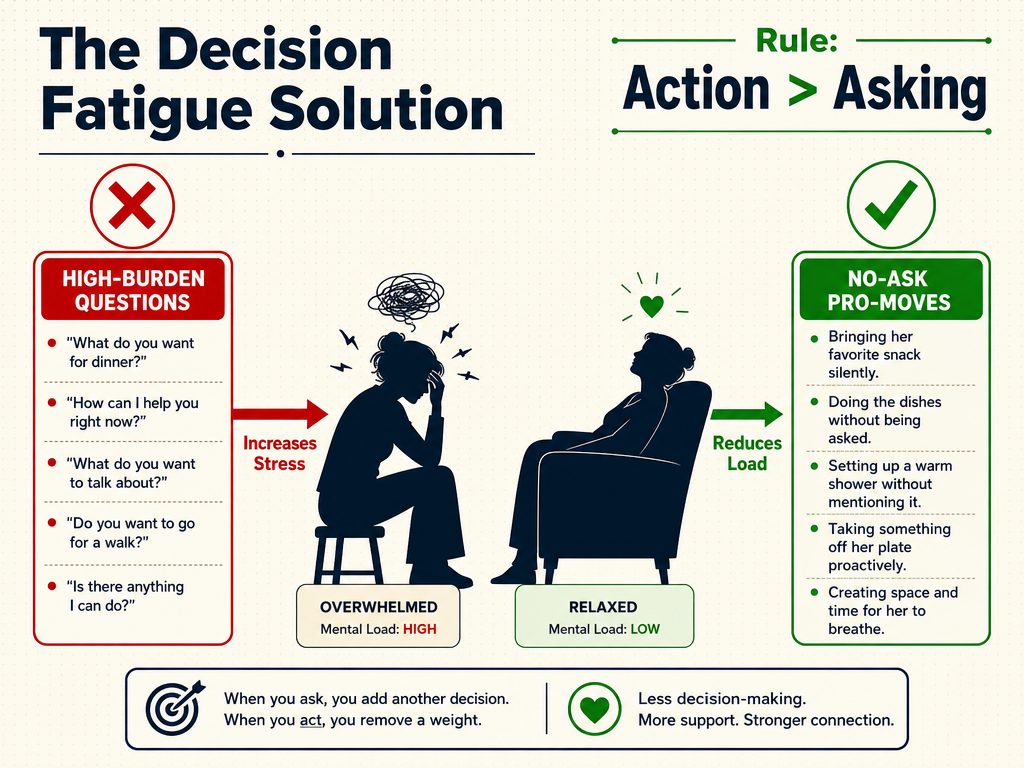
Instead, observe and act:
- If dishes are piling up, do them without mentioning it
- If she mentioned craving something last week, order it
- If laundry needs doing, handle it quietly
- If she usually takes a bath during this time, make sure the bathroom is clean and restocked
When a partner is struggling emotionally, responding with genuine empathy tends to help more than trying to "fix" the problem. Silent support beats interrogation every time.
Rule 2: Parallel Play
If you live together, you don't need to leave the house to give her space. You just need to stop demanding interaction.
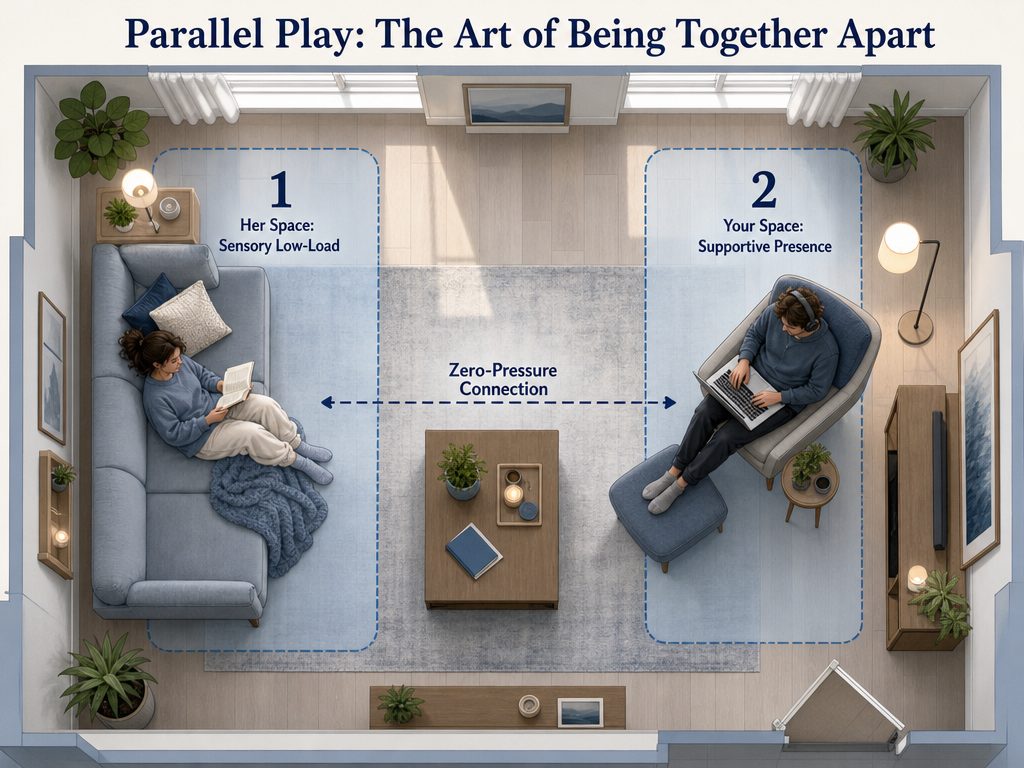
Sit in the same room but do separate activities. You read or play a game. She scrolls on her phone or watches TV. You're both there, but nobody has to talk. This provides the security of your presence without the social load of conversation.
Think of it like being roommates for a few days. Coexist without expecting engagement.
Rule 3: Validation Texts
If you don't live together and she's been distant, send a low-pressure message that validates her need for space without asking for a response.
Script 1: "I see you're maxed out today. I'm going to give you some quiet time and just be in the other room if you need me. No need to reply."
Script 2: "You seem like you're in battery-saver mode. Take all the time you need - I'll be here when you're recharged."
Script 3: "I know this week is rough. I'm not going anywhere. Text me if you want company or if you just need me to leave you alone."
These messages do three things: they acknowledge her state, remove pressure to respond, and reassure her you're not interpreting her distance as a relationship problem.
For more tactical text templates, check out our guide on how to comfort your girlfriend during PMS.
Is It Her Cycle or a Relationship Problem?
Here's how to tell the difference between a hormonal space window and a genuine relationship issue:
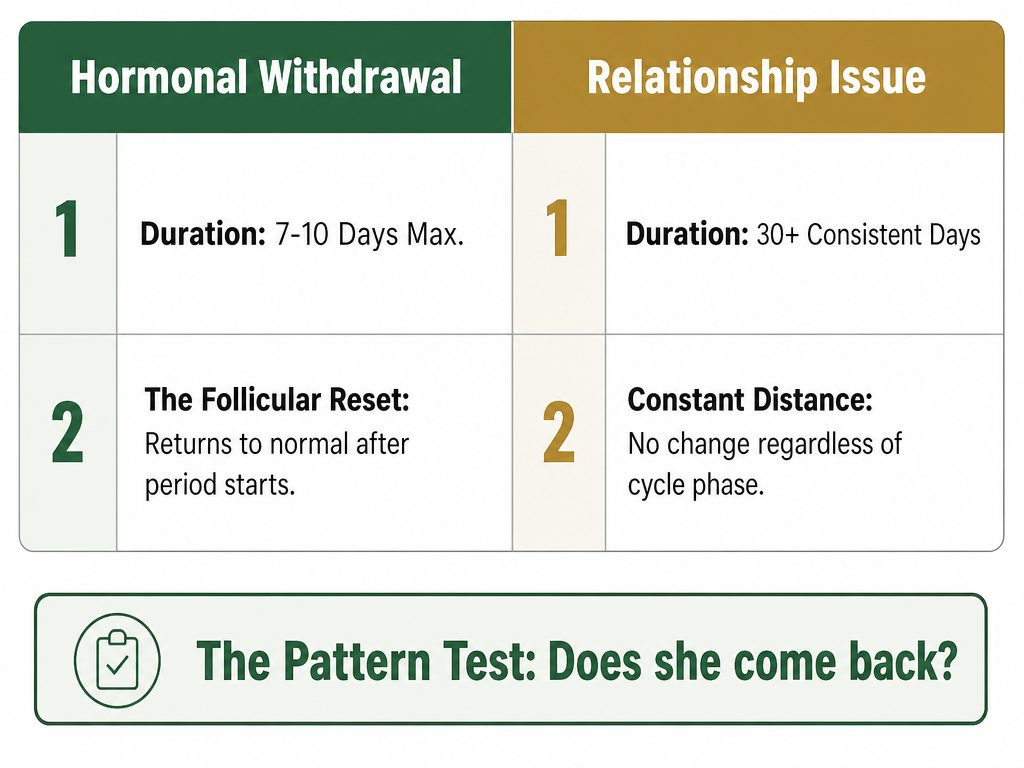
Duration
Hormonal withdrawal: Lasts 7-10 days, typically starting about a week before her period and resolving within a few days after bleeding begins.
Relationship issue: Persists for 30+ days with no "reset" or return to normal connection, regardless of where she is in her cycle.
Pattern
Hormonal withdrawal: Happens on a predictable schedule. If you track it over 2-3 months, you'll notice she pulls away at roughly the same point each cycle.
Relationship issue: Random timing with no correlation to her menstrual phase. She's distant during what should be her high-energy follicular phase or around ovulation.
Recovery
Hormonal withdrawal: She "comes back" to you naturally once her period starts or shortly after. Energy returns, texts get longer, physical affection feels good again. No difficult conversation required.
Relationship issue: Distance remains even after her cycle resets. She still seems checked out during the times when she should be feeling more connected.
If her withdrawal follows the 7-10 day pattern and resolves on its own every month, you're looking at biology, not a breakup. If it's constant or random, that's a sign you need to have a conversation about the relationship itself - but wait until she's in her follicular phase (days 6-14) when communication tends to be easier.
The Green Flag Talk: How to Bring Up Cycle Tracking
Suggesting that you track her cycle together can feel like walking into a minefield. Here's how to bring it up without sounding like you're reducing her to her hormones:
Timing matters. Don't bring this up during her luteal phase when she's already irritable. Wait until her follicular phase - roughly days 6-14 of her cycle - when energy tends to be higher and mood more stable.
Frame it as support, not diagnosis. Don't say: "I think you need to track your period so I know when you're going to be difficult." Instead, try: "I've noticed a pattern where you seem more stressed about a week before your period. I want to be better at supporting you during that time - would it help if I paid more attention to your cycle so I can be more proactive?"
Acknowledge uncertainty. A "normal" cycle varies a lot between women - bleeding can start anywhere from every 24 to every 38 days. Don't assume her cycle matches the textbook 28-day model. Ask if she'd be comfortable sharing when her period usually starts so you can learn her specific pattern.
Offer tools, don't demand compliance. You can mention period tracker apps designed for partners like VibeCheck or apps with partner-sharing features, but make it clear this is optional. Some women are comfortable sharing cycle data; others aren't. Respect her boundary either way.
Tracking symptoms and mood changes across the cycle for a few months is a legitimate, medically endorsed way to identify real patterns rather than relying on stereotypes. If she's open to it, this data helps you both understand when the space window is coming and plan around it.
Frequently Asked Questions
How to respond when your girlfriend is on her period?
Give her space without asking permission. Reduce sensory input (noise, light, questions). Handle logistics quietly (food, chores, plans). Use short, low-pressure texts if you're apart. Don't take her withdrawal personally - it's a biological shift, not a reflection of how she feels about you. For more specific tactics, see our guide on what to do when your girlfriend is on her period.
How to deal with a girlfriend needing space?
Respect the request immediately without demanding an explanation. Don't bombard her with "Are you okay?" messages. Create distance but remain available - let her know you're there if she needs you, then actually give her room to breathe. Use the time to focus on your own activities instead of obsessing over whether she's pulling away permanently. Space is temporary maintenance, not a breakup preview.
How to comfort gf in period over text?
Send validation texts that don't require a response. Avoid asking questions. Examples: "I know you're dealing with a lot today. I'm here if you need me, zero pressure to reply." or "Sending you good vibes. Take all the time you need." Don't ask how she's feeling - assume she's overwhelmed and offer support that doesn't add to her mental load. Our article on supportive text ideas has more specific scripts.
Does needing space mean break up?
Not if it follows a predictable monthly pattern and resolves on its own after her period starts. Cyclical withdrawal tied to her luteal phase (days 17-28) is biology, not relationship dissatisfaction. A breakup signal is persistent distance that lasts 30+ days with no recovery, happens randomly across all cycle phases, or comes with explicit statements that she's reconsidering the relationship. If she "resets" every month and comes back to normal connection during her follicular phase, you're fine.
What is the difference between PMDD and PMS?
PMS is very common: as many as 3 in 4 women report experiencing PMS symptoms at some point in their life, though severity varies widely. PMDD is a more severe, sometimes disabling extension of PMS. Both happen on a similar timeline (about 7-10 days before a period) and can share physical symptoms like bloating and fatigue, but PMDD specifically involves extreme mood symptoms - such as marked irritability, anxiety, or hopelessness - intense enough to disrupt daily life and strain relationships. PMDD affects approximately 3% to 8% of women of reproductive age and is listed in the DSM-5 as a depressive disorder. If her symptoms are severe enough to make her cancel work, avoid social contact entirely, or express hopelessness, she should talk to a healthcare provider about PMDD.
What are five important things to avoid during your period?
From a partner's perspective, here are five things to avoid doing to her during this phase: (1) Don't ask a lot of questions - every question is a decision she has to make when her brain is already maxed out. (2) Don't initiate serious relationship conversations - timing matters, and the luteal phase is the worst window for conflict resolution. (3) Don't push physical affection if she's pulling away - sensory sensitivity is real, and forced touch will backfire. (4) Don't take her irritability personally - it's a serotonin crash, not a character assessment of you. (5) Don't mention her period in the moment unless she brings it up first - "Are you on your period?" is the fastest way to escalate tension.
Do serotonin levels drop during the luteal phase?
Yes. Serotonin transporter density in the brain increases shortly before menstruation, leading to a loss of synaptic serotonin and driving irritability and low mood. This isn't a vague mood shift - it's a measurable neurochemical change. When serotonin drops, activities that normally feel rewarding (socializing, making plans, even texting) start to feel exhausting. This is why she goes from planning weekend trips to barely responding to your messages. Her brain is literally running low on the chemical that makes interaction feel good.
What hormones drop in your luteal phase?
Both estrogen and progesterone rise and then drop during the luteal phase. After ovulation, progesterone rises to help prepare the uterine lining for a possible pregnancy. If pregnancy doesn't happen, both progesterone and estrogen drop before the next period. This crash - not the rise - is what drives the mood and energy symptoms most partners notice. The sudden withdrawal of hormones her body has been running on for two weeks creates the irritability, fatigue, and social withdrawal that define the pre-period space window.
The bottom line: When your girlfriend needs space during her period, the best response is no response at all. Give her room without making her ask for it, handle logistics quietly, and trust that she'll come back when her biology allows it. This is a monthly reset, not a relationship crisis. Learn the pattern, respect the space window, and you'll stop walking on eggshells every time her cycle shifts.
Tags

Related Articles
Continue reading to deepen your understanding

Understanding Why Your Girlfriend’s Communication Style Shifts Weekly
Ever wonder why your partner’s moods and energy levels shift so much? Understanding the four phases of her menstrual cycle helps you become a more supportive and proactive partner.

When Do Your Girlfriend’s Energy Levels Change During Her Cycle?
Your girlfriend’s mood and stamina follow a biological rhythm. Learn how her energy peaks and crashes throughout the month so you can plan better dates and provide better support.

Why Your Girlfriend Needs Different Attention Each Week: The Four Seasons Framework
Stop walking on eggshells and start understanding her cycle. This framework shows you exactly how to support your girlfriend through all four biological phases every month.

Why Your Girlfriend Wants Space the Week Before Her Period
Does your girlfriend suddenly pull away every month? Discover the biological reasons behind the pre-period space window and how to navigate this phase together.

Why Your Girlfriend Wants Different Kinds of Affection at Different Times in Her Cycle
Ever feel like your girlfriend’s needs change every week? It’s not random. Understand how the four phases of her cycle drive her desire for intimacy so you can support her better.

How to Plan Romantic Gestures by Cycle Timing: The Partner’s Tactical Guide
Stop guessing why your date night plans fell flat. This guide explains how to synchronize your romantic efforts with her biological cycle for better intimacy and connection.

How to Tell When Your Girlfriend Is Ovulating: Reading the Biological Signals Your Partner Sends
Understanding your partner’s cycle helps you anticipate her needs and time important conversations. Learn the behavioral signs of ovulation to improve your relationship and connection.

Understanding Your Girlfriend’s Words of Affirmation Cycle: A Partner’s Guide
Ever feel like your compliments land wrong? Her need for words of affirmation isn’t random—it follows a biological rhythm. Learn how to match your support to her internal hormonal seasons.