Understanding Why Your Girlfriend’s Communication Style Shifts Weekly

Ever wonder why your partner’s moods and energy levels shift so much? Understanding the four phases of her menstrual cycle helps you become a more supportive and proactive partner.
Why Your Girlfriend's Communication Style Changes Each Week of Her Cycle
You're not imagining it. One week she's planning road trips and deep conversations about the future; the next, she needs you to handle dinner without asking. The week after that, she's confident and flirty; then suddenly, she's irritable over things that didn't bother her before.
It's not inconsistency. It's biology.
Your girlfriend's communication style follows a predictable 28-day pattern driven by four distinct hormonal phases. Understanding this cycle transforms you from a partner who's constantly guessing into one who anticipates her needs before she has to ask.
Table of Contents
- The Four Phases: Your Field Manual
- Week 1: The Menstrual Phase (The Reset Week)
- Week 2: The Follicular Phase (The Power Week)
- Week 3: Ovulation (The Radiance Window)
- Week 4: The Luteal Phase (The Sensitivity Week)
- How to Track Her Cycle (With Permission)
- Strategic Timing: When to Have Important Conversations
- Frequently Asked Questions
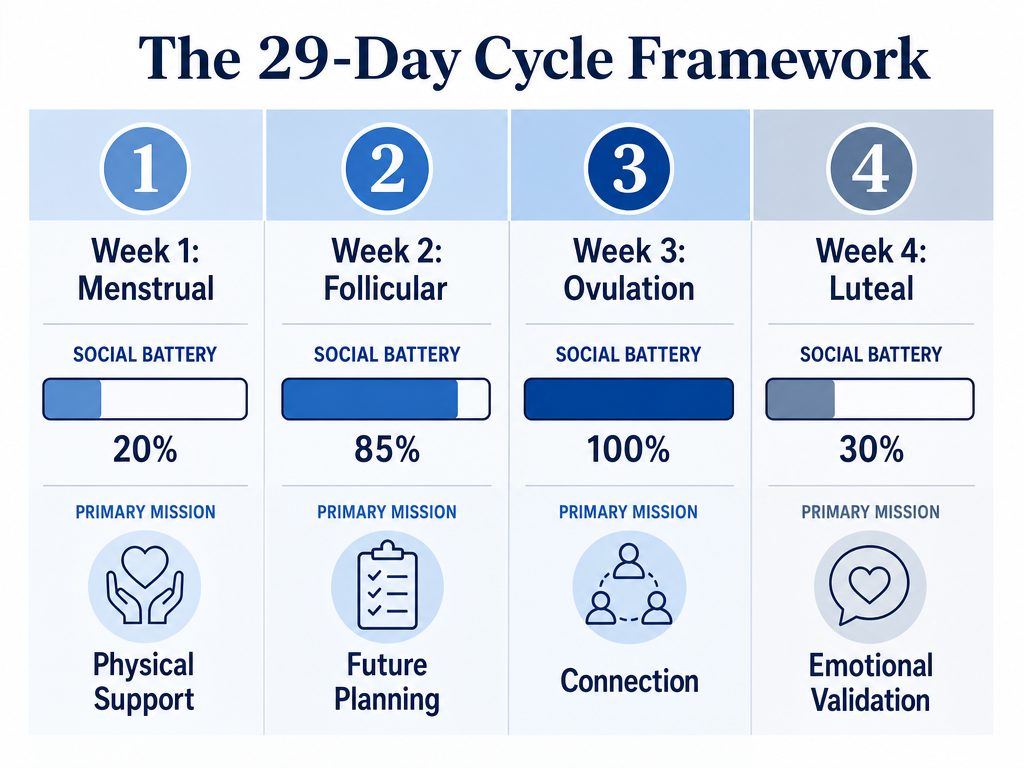 Understanding the 29-day cycle as a four-phase framework allows partners to anticipate shifts in energy and social battery rather than reacting to them.
The Four Phases: Your Field Manual
The menstrual cycle has four phases: menstrual (bleeding, roughly days 1-5), follicular (day 1 through ovulation, estrogen rising), ovulation (around day 14 in a 28-day cycle, triggered by a surge in luteinizing hormone), and luteal (after ovulation to the next period, progesterone rising then falling). The follicular and menstrual phases overlap.
Here's what matters for you: each phase changes how her brain processes stress, manages social energy, and responds to conflict. The median menstrual cycle length is 29 days, though 23-35 days is considered clinically regular. That means the "weekly" breakdown below is a template, not a rigid schedule. Her personal cycle might compress or stretch these windows.
Think of the cycle as four seasons. Winter is rest. Spring is growth. Summer is peak performance. Fall is preparation and vulnerability. Your job isn't to fix the weather; it's to dress appropriately and plan accordingly.
VibeCheck App
Download Free on iOS →Week 1: The Menstrual Phase (The Reset Week)
What's Happening Biologically:
Estrogen and progesterone are at rock bottom. Prostaglandins (the chemicals that trigger uterine contractions) cause physical discomfort. Her body is shedding the uterine lining, and energy is diverted to managing pain and inflammation. Approximately 88% of women experience physical discomfort or symptoms during their cycle.
How She Communicates:
Direct, quiet, low social battery. She may seem withdrawn or experience "brain fog" from fatigue. Small talk feels exhausting. She prefers texts over phone calls, shorter sentences over long explanations. She's not avoiding you; she's conserving energy.
What She Needs:
Physical comfort and practical help. Handle logistics without being asked. Stock the "period pantry" (chocolate, heating pads, ibuprofen, comfort food). Don't wait for her to delegate tasks; just do the dishes, order dinner, or take over evening routines.
The Script:
"I've got everything tonight. You just rest."
What Not to Do:
Don't schedule intense activities. Don't ask her to make decisions about weekend plans or handle mentally taxing projects. Don't take her quietness personally.
Hero Move:
Pre-emptively clear your schedule to absorb household responsibilities. She shouldn't have to ask you to take out the trash or cook dinner. Understanding how to support your partner during her period means showing up before she asks.
Week 2: The Follicular Phase (The Power Week)
What's Happening Biologically:
During the follicular phase, estrogen rises as an egg-containing follicle develops in the ovary; this rising estrogen also thickens the uterine lining. Near the end of this phase, high estrogen triggers a surge in luteinizing hormone (LH), which sets off ovulation. Rising estrogen boosts serotonin and dopamine, the brain chemicals responsible for mood stability and motivation.
How She Communicates:
Sociable, optimistic, creative, high verbal fluency. She's the version of herself you fell for: spontaneous, eager to connect, open to new ideas. She initiates plans, asks thoughtful questions, and has mental bandwidth for complex conversations.
What She Needs:
Intellectual stimulation and adventure. This is the window for "big talks" about the future: finances, marriage, major life decisions. She has the emotional margin to process difficult topics without feeling overwhelmed.
The Script:
"I've been thinking about our vacation plans. Want to look at flights tonight?"
What Not to Do:
Don't waste this high-energy phase on passive activities. Netflix binges and lazy weekends squander her peak performance window. Don't avoid hard conversations; this is when her brain is most equipped to handle them.
Hero Move:
Plan something ambitious. Book the rock climbing date she mentioned. Propose the weekend road trip. Have the budget conversation you've been putting off. Her follicular phase symptoms include high energy and optimism; use it.
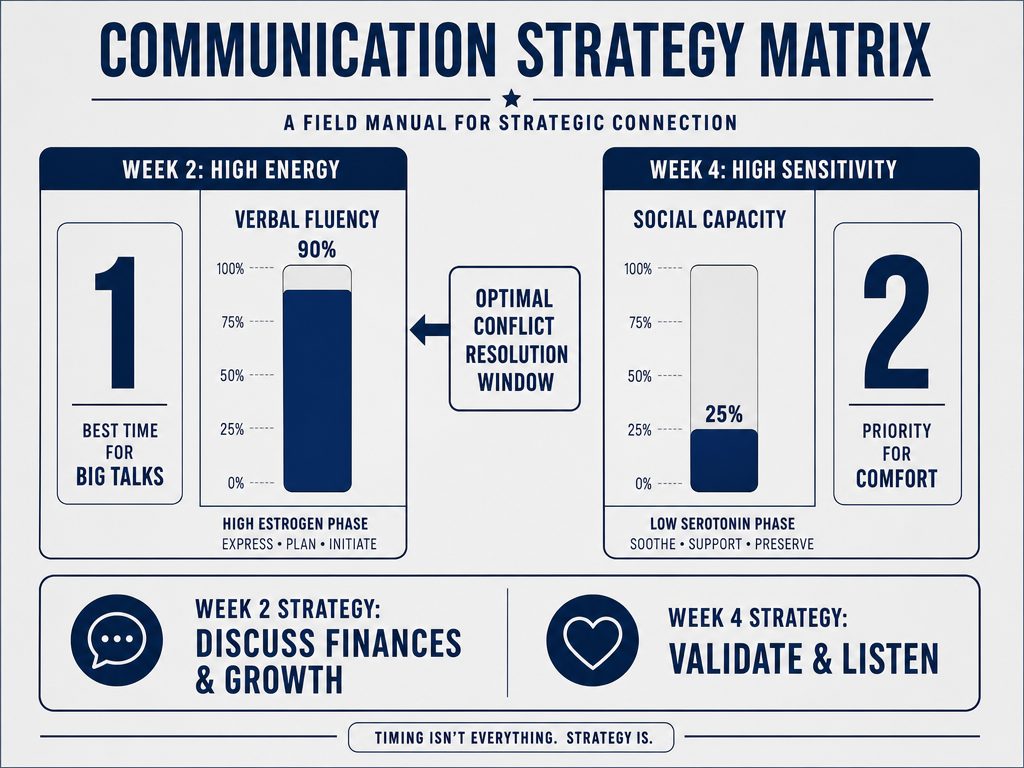 Timing is everything in a relationship; use the Follicular phase for big life decisions and the Luteal phase for supportive listening and validation.
Week 3: Ovulation (The Radiance Window)
What's Happening Biologically:
Ovulation is when a surge in luteinizing hormone (LH) causes the ovary to release an egg, typically around day 14 of a 28-day cycle. In the days just before ovulation, cervical mucus becomes clear and slippery, which is the most fertile window of the cycle. Estrogen peaks. Testosterone gets a slight bump. The "fertile window" is approximately 6-7 days long because sperm can survive inside the body for up to 5-6 days.
How She Communicates:
Flirty, confident, seeks connection. She's more expressive with compliments, more interested in physical affection, and more likely to initiate intimacy. Around ovulation, many women notice symptoms such as increased sex drive, mild pelvic or abdominal pain, tender breasts, bloating, and mood changes - though these vary a lot person to person, and not everyone notices them.
What She Needs:
Validation and visibility. She wants to feel seen, admired, and desired. Compliments land harder during this phase because her confidence is already elevated. Plan dates that get you out of the house: the new restaurant she mentioned, the live music venue, the art exhibit.
The Script:
"You look incredible today. Let's go to that new place you mentioned."
What Not to Do:
Don't coast. She's putting effort into how she looks and feels; match that energy. Don't assume the physical attraction takes care of itself. And don't treat ovulation like a purely biological event; she's emotionally invested in feeling desired, not just useful.
Hero Move:
Heavy compliments and intentional date planning. Notice details: her outfit, her energy, her ideas. This is the week to plan something memorable. Understanding your girlfriend's ovulation signs helps you recognize when she's in this peak connection window.
Week 4: The Luteal Phase (The Sensitivity Week)
What's Happening Biologically:
After ovulation, the luteal phase begins: progesterone rises to help prepare the uterine lining for a possible pregnancy. If pregnancy doesn't happen, both progesterone and estrogen drop before the next period. Many women notice PMS-like symptoms in this phase - mood shifts, breast tenderness, bloating, acne, and appetite changes - though not everyone does.
The hormone crash is real: when estrogen drops, serotonin (the mood-stabilizing neurotransmitter) drops with it. PMS (premenstrual syndrome) is very common: as many as 3 in 4 women report experiencing PMS symptoms at some point in their life, though severity varies widely.
How She Communicates:
Sensitive to criticism, irritable, anxious, easily overwhelmed. She's not trying to pick fights; her brain is literally more reactive to stress. Small annoyances feel bigger. Ambiguous comments get interpreted negatively. She needs validation over logic.
What She Needs:
Emotional validation and low-stakes support. "Comfort first" is the rule. Stock the period pantry early. Clear your schedule to absorb evening chores. Offer to handle dinner plans. Don't challenge her feelings or try to "fix" her mood; just listen.
The Script:
"That sounds really frustrating. I'm here if you want to vent."
What Not to Do:
Don't argue. Don't offer solutions unless she explicitly asks. Don't downplay her symptoms or imply she's overreacting. Don't schedule high-pressure activities or expect her to make big decisions. Learning how to help your girlfriend during period mood swings starts here, in the luteal phase.
Hero Move:
Be invisible support. Do the dishes without announcing it. Order her favorite takeout. Ask if she wants the heating pad before she mentions cramping. Roughly half of people who menstruate report having at least one PMS symptom, but only about 1 in 5 have symptoms severe enough to disrupt their daily life. Your girlfriend might fall into either category; don't assume.
How to Track Her Cycle (With Permission)
Tracking her cycle isn't creepy if you ask first. The conversation should sound like this:
"I want to be a better partner by understanding your rhythm. Mind if I track your cycle to know when to step up?"
Most women will say yes because you're framing it as support, not surveillance. Tracking your own (or a partner's, with her participation) symptoms and mood changes across the cycle for a few months is a legitimate, medically endorsed way to identify real patterns and timing - rather than assuming based on stereotypes or a single cycle.
Tools to Use:
- Period tracking apps with partner mode: Apps like VibeCheck, Clue, or Flo let you track her cycle and receive notifications about phase changes.
- Shared calendar: Mark the first day of her period in a shared Google Calendar. Count forward to estimate each phase.
- Symptom journal: Track patterns for three months before drawing conclusions. What you think is a luteal-phase mood swing might actually be a work-stress pattern.
The key is permission and transparency. Don't secretly track her cycle and then act on assumptions. Share what you notice: "I've been paying attention, and it seems like you have more energy mid-month. Does that feel accurate to you?"
Strategic Timing: When to Have Important Conversations
Best time for "big talks" (finances, future planning, major decisions):
Follicular phase (Week 2). She has the mental bandwidth, optimism, and emotional margin to process complex topics without feeling attacked.
Best time for "heart-to-hearts" (emotional check-ins, relationship health):
Ovulation (Week 3). She's confident and open to connection. She'll feel safe being vulnerable because her brain chemistry supports emotional intimacy.
Worst time for conflict or criticism:
Luteal phase (Week 4). Her brain is hyper-sensitive to perceived rejection or criticism. If you need to address a problem, wait until the follicular phase when her serotonin levels stabilize.
Best time for apologies:
Immediately after a fight, not days later. When a partner is struggling emotionally, responding with genuine empathy - listening without judgment, focusing on their feelings rather than debating facts, and validating that their reaction makes sense - tends to help more than trying to "fix" the problem or offer silver linings. Feeling understood, not corrected, is what tends to defuse tension.
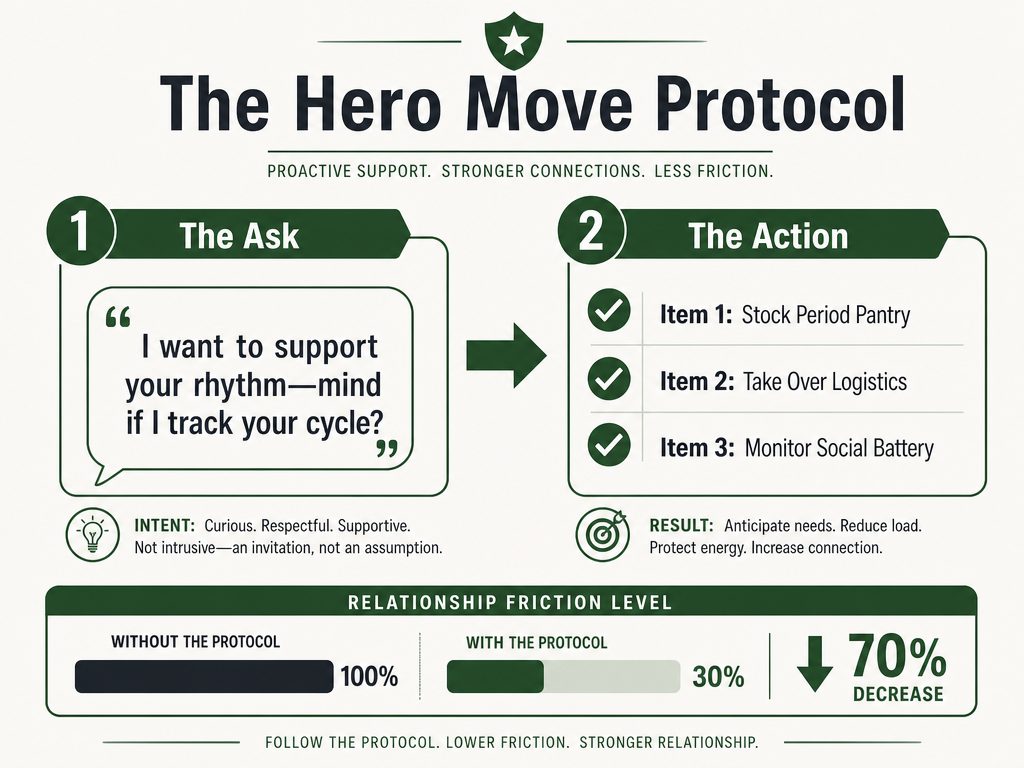 Transitioning from reactive conflict to proactive support starts with permission-based tracking and executing 'Hero Moves' before your partner even has to ask.
Frequently Asked Questions
How does the menstrual cycle affect mental health?
The menstrual cycle directly impacts brain chemistry. Estrogen affects many body systems, including brain function and the ability to focus, and levels are highest in the days leading up to ovulation. When estrogen and progesterone drop in the luteal phase, serotonin drops with them, which can trigger anxiety, irritability, or sadness. This isn't a personality flaw; it's a predictable neurochemical event.
For some women, the impact is minor. For others, it's severe. PMDD (premenstrual dysphoric disorder) is a real, clinically recognized condition - it's listed in the DSM-5 as a depressive disorder, not something people are "making up" or simply failing to cope with. It affects roughly 1 in 10 people who menstruate. PMDD is a more severe, sometimes disabling extension of PMS. Both happen on a similar timeline (about 7-10 days before a period) and can share physical symptoms like bloating and fatigue, but PMDD specifically involves extreme mood symptoms - such as marked irritability, anxiety, or hopelessness - intense enough to disrupt daily life and strain relationships.
If her mood symptoms seem unusually severe or debilitating, encourage her to talk to a healthcare provider. Don't dismiss it as "just PMS."
How to explain PMS to a man?
PMS isn't "being moody." It's a neurochemical shift caused by dropping hormone levels in the week or two before a period. When estrogen and progesterone crash, serotonin (the brain's mood stabilizer) crashes with them. Imagine going from caffeinated alertness to caffeine withdrawal in 48 hours - that's closer to what her brain experiences.
The key thing to understand: her intelligence doesn't change. Her cognitive skills remain constant. What changes is her capacity for social friction and stress tolerance. She's not less capable; she's operating with a lower emotional buffer.
As a partner, your job isn't to debate whether her feelings are "rational." Your job is to reduce unnecessary stress during a biologically vulnerable window. Lifestyle approaches that can help ease PMS symptoms include regular aerobic exercise, smaller/more frequent meals, less salt/caffeine/alcohol, adequate sleep, and stress-reduction practices like deep breathing or yoga. A partner who understands these and is patient/supportive around them (rather than dismissive of symptoms) is aligning with medically recommended self-care, not indulging an excuse.
What does it mean if my period cycle is less than 21 days?
A cycle shorter than 21 days falls outside the typical range. A "normal" cycle varies a lot between women - menstrual bleeding can start anywhere from every 24 to every 38 days and last up to 8 days. There is no single universal 28-day cycle, so exact day-by-day predictions for any specific woman should be treated as approximate.
If her cycle is consistently shorter than 21 days, she should talk to a healthcare provider. It could indicate a hormonal imbalance, thyroid issue, or other condition that needs medical evaluation. As her partner, you can encourage her to track symptoms and seek professional guidance without diagnosing or minimizing the issue.
Does brown still count as a period day?
Yes. Brown discharge is old blood that took longer to leave the uterus. It's still part of the menstrual phase, typically at the beginning or end of bleeding. Don't treat "light days" as a sign that her period is over or that she's back to full energy. The physical and hormonal shifts continue throughout the entire menstrual phase, which can last up to 8 days.
If she's experiencing brown discharge mid-cycle (between periods), it could be ovulation spotting, which is normal for some women. Spotting a week before period can also happen and is usually not a concern, but if it's new or persistent, she should check with a doctor.
What medications can be used to stop menstrual bleeding?
This isn't your call to make, and it's not a question you should be researching without her explicit request. Medications that stop or reduce menstrual bleeding include hormonal birth control (pills, IUDs, implants), tranexamic acid, or NSAIDs like ibuprofen for heavy flow - but these are medical decisions that require a healthcare provider's guidance.
If she's experiencing unusually heavy bleeding (soaking through a pad or tampon every hour for several hours, passing large clots, or bleeding for more than 8 days), encourage her to see a doctor. Don't suggest medications or treatments yourself. Your role is to support her in seeking professional care, not to diagnose or prescribe.
How to stop heavy bleeding during periods with home remedies?
Home remedies can help manage symptoms but won't "stop" heavy bleeding if the underlying cause is medical. That said, some supportive measures include:
- Iron-rich foods: Spinach, red meat, lentils to counteract anemia from blood loss.
- Hydration: Drinking water helps maintain blood volume.
- Heat therapy: A heating pad can reduce cramping, though it won't reduce flow.
- Ginger or cinnamon tea: Some women report these help with heavy flow, though clinical evidence is limited.
If her bleeding is severe enough that she's considering home remedies, she needs medical evaluation. Heavy menstrual bleeding can signal fibroids, endometriosis, clotting disorders, or hormonal imbalances. Your role is to encourage her to see a healthcare provider and support her through the process, not to troubleshoot medical symptoms yourself.
The Bottom Line:
Your girlfriend isn't inconsistent. She's operating on a biological rhythm that changes her energy, mood, and communication style on a predictable loop. Stop reacting and start anticipating. Understand the four phases. Track her cycle with permission. Time your support to match her needs.
The result? Less conflict, deeper connection, and a relationship where you're not walking on eggshells - you're walking in step with her biology.
Tags

Related Articles
Continue reading to deepen your understanding

When Do Your Girlfriend’s Energy Levels Change During Her Cycle?
Your girlfriend’s mood and stamina follow a biological rhythm. Learn how her energy peaks and crashes throughout the month so you can plan better dates and provide better support.

Why Your Girlfriend Needs Different Attention Each Week: The Four Seasons Framework
Stop walking on eggshells and start understanding her cycle. This framework shows you exactly how to support your girlfriend through all four biological phases every month.

Why Your Girlfriend Wants Space the Week Before Her Period
Does your girlfriend suddenly pull away every month? Discover the biological reasons behind the pre-period space window and how to navigate this phase together.

Why Your Girlfriend Wants Different Kinds of Affection at Different Times in Her Cycle
Ever feel like your girlfriend’s needs change every week? It’s not random. Understand how the four phases of her cycle drive her desire for intimacy so you can support her better.

How to Plan Romantic Gestures by Cycle Timing: The Partner’s Tactical Guide
Stop guessing why your date night plans fell flat. This guide explains how to synchronize your romantic efforts with her biological cycle for better intimacy and connection.

How to Tell When Your Girlfriend Is Ovulating: Reading the Biological Signals Your Partner Sends
Understanding your partner’s cycle helps you anticipate her needs and time important conversations. Learn the behavioral signs of ovulation to improve your relationship and connection.

Understanding Your Girlfriend’s Words of Affirmation Cycle: A Partner’s Guide
Ever feel like your compliments land wrong? Her need for words of affirmation isn’t random—it follows a biological rhythm. Learn how to match your support to her internal hormonal seasons.

The Partner’s Guide to the Luteal Phase: What It Is and How to Support Her
Stop walking on eggshells. Understand the biological changes of the luteal phase so you can support your partner through mood shifts and fatigue with empathy.