Why Your Girlfriend Wants Space the Week Before Her Period

Does your girlfriend suddenly pull away every month? Discover the biological reasons behind the pre-period space window and how to navigate this phase together.
Why Your Girlfriend Wants Space the Week Before Her Period (And What Actually Helps)
You've been here before: one week she's planning a weekend trip, and the next she barely responds to texts. Same woman, same relationship, but suddenly she needs space. If this pattern repeats every month around the same time, you're not imagining it - and you're definitely not the problem.
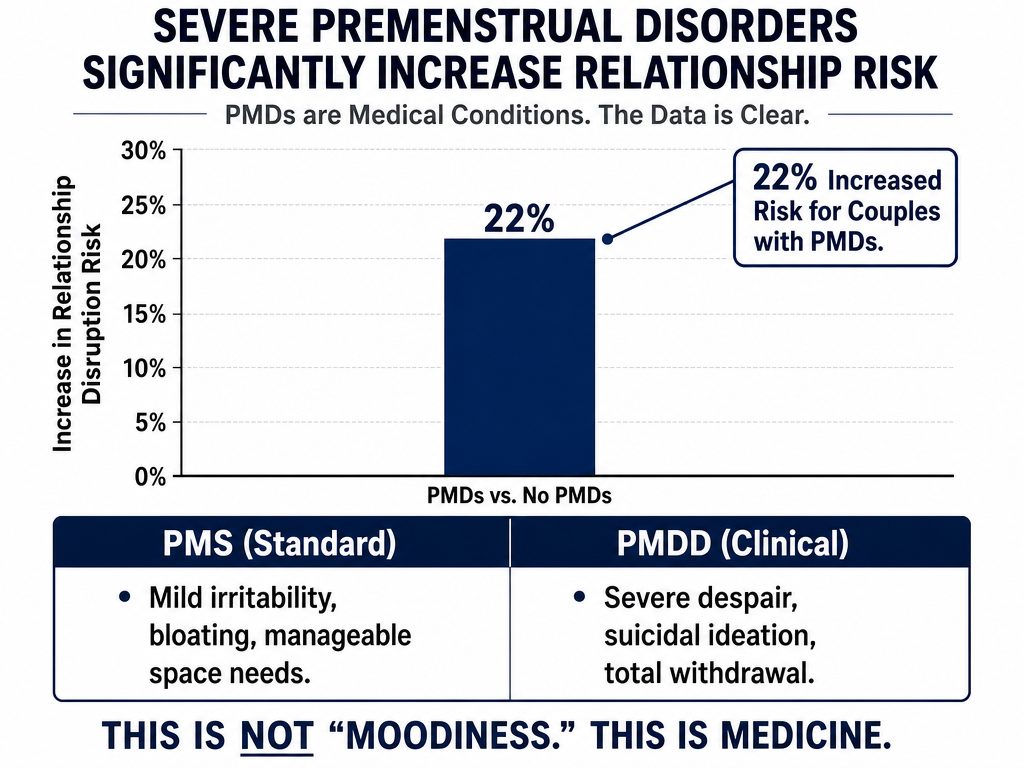
The week before her period triggers a biological shift so significant that married or cohabiting women with severe premenstrual disorders have a 21% to 22% increased risk of relationship disruption. This isn't about communication styles or compatibility. It's about understanding a predictable hormonal crash that affects her nervous system, sensory processing, and social capacity.
This guide explains the biological mechanism behind the "Space Window," shows you how to distinguish between a cycle issue and a relationship issue, and gives you tactical strategies that reduce friction instead of making it worse.
Table of Contents
- The Progesterone Crash: Understanding the Space Window
- Why Space Isn't About You
- The Relationship Diagnostic: Is This PMS or Something Else?
- What Happens to Girls a Week Before Their Period?
- Tactical Pro-Moves: How to Support Without Crowding
- Communication Scripts That Actually Work
- When to Seek Help: PMS vs. PMDD
- Frequently Asked Questions
The Progesterone Crash: Understanding the Space Window
The week before her period - roughly days 21 to 28 of a cycle that can vary anywhere from 24 to 38 days - is called the late luteal phase. After ovulation, progesterone rises to prepare the uterine lining for a possible pregnancy. When pregnancy doesn't happen, both progesterone and estrogen drop sharply before the next period.
This isn't a subtle shift. Progesterone helps regulate mood-stabilizing brain chemicals like GABA and serotonin. When it plummets, her nervous system loses its chemical cushion. What used to feel manageable - your presence, social plans, even the TV volume - now registers as sensory overload.
Many women notice PMS-like symptoms in this phase, including mood shifts, breast tenderness, bloating, acne, and appetite changes. But the most misunderstood symptom is the need for space. It's not emotional withdrawal from you specifically. It's a biological requirement to reduce sensory input and decision fatigue when her brain is running on fumes.
VibeCheck App
Download Free on iOS →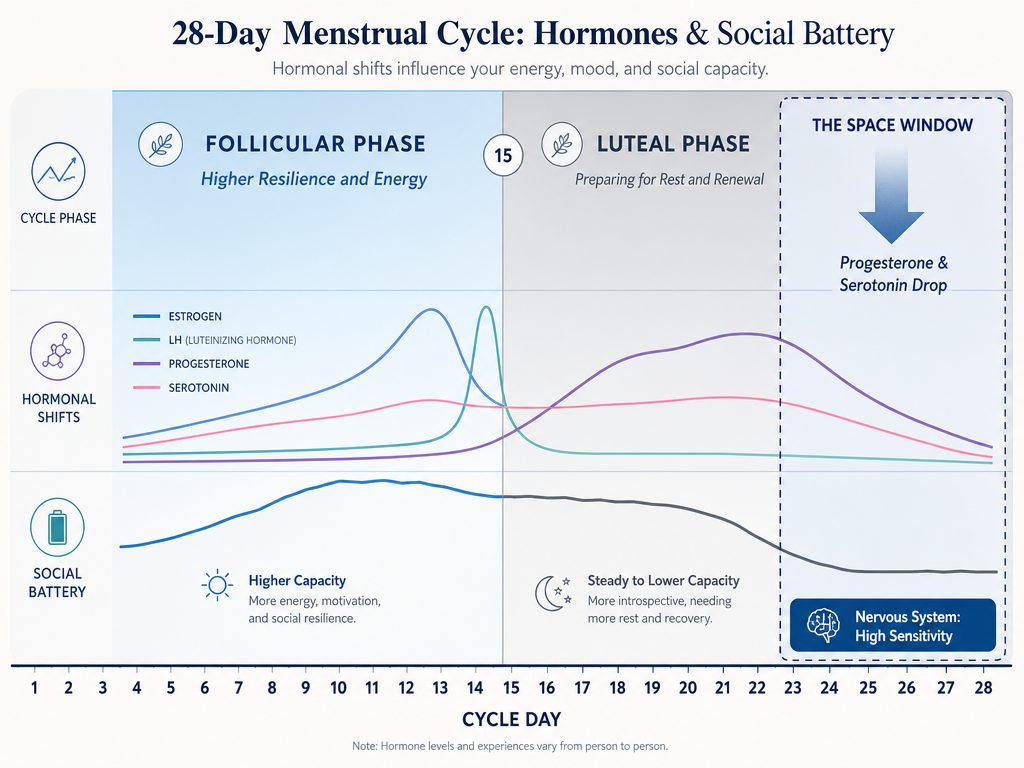
The Nervous System Hijack
During the luteal crash, her amygdala - the brain's threat-detection center - becomes hyper-reactive. Small decisions feel like cognitive mountains. The question "What do you want for dinner?" isn't just annoying; it's an unwanted demand on a nervous system already in survival mode.
She's not choosing to be distant. Her body is prioritizing basic regulation over social performance. Understanding this distinction is the first step toward responding effectively instead of taking it personally.
Why Space Isn't About You
Here's the hardest truth to internalize: when she says she needs space during this window, she's not evaluating your relationship. She's managing a biological event.
Estrogen affects many body systems, including brain function and the ability to focus. When both estrogen and progesterone drop together, the result is a double hit to mood regulation and cognitive capacity. Your proximity - no matter how well-intentioned - can feel like another thing to process when she has zero bandwidth left.
Think of it this way: if she had the flu, you wouldn't take it personally when she canceled plans. The luteal crash is less visible but just as real. Her social battery isn't broken; it's operating on reserve power.
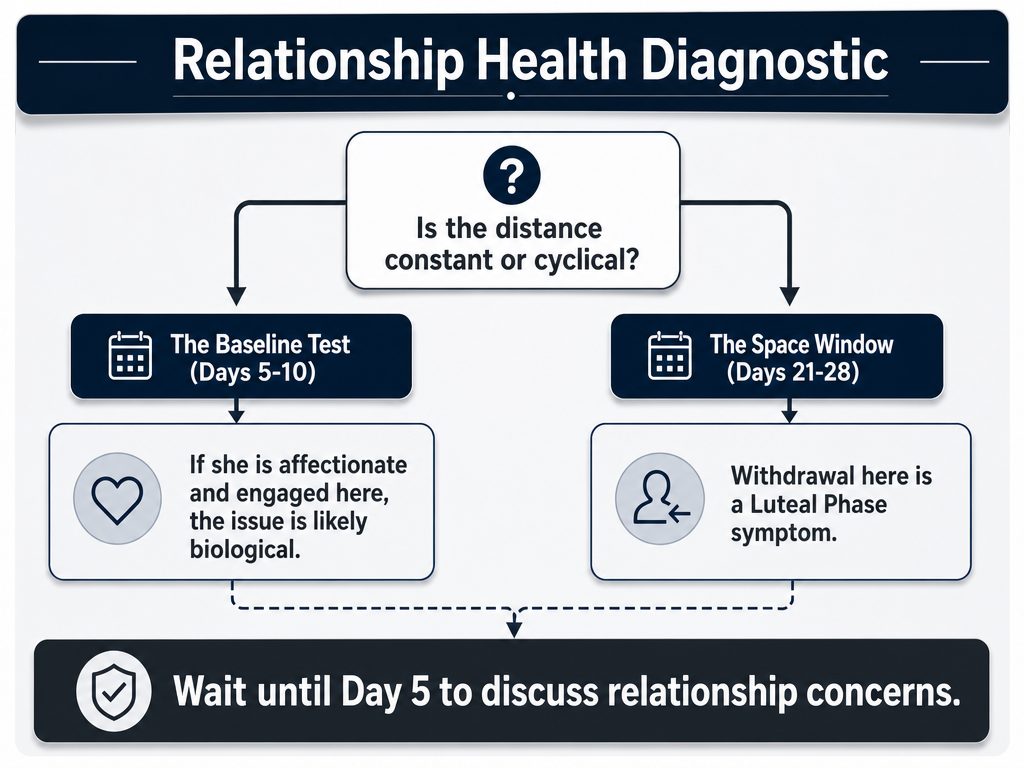
The pattern matters more than the moment. If she's only distant during the same week every month and returns to baseline afterward, it's a cycle issue. If she's been distant for 30 straight days, that's a different conversation entirely.
The Relationship Diagnostic: Is This PMS or Something Else?
Not every relationship issue is hormonal, and not every hormonal issue requires medical intervention. Use this framework to evaluate what you're actually dealing with.
The 28-Day Pattern Test
Track her mood and energy for three full cycles. Note when she pulls away, when she's most engaged, and when she's somewhere in between. If the withdrawal happens during the same 7-10 day window before her period and resolves within a few days after it starts, you're looking at a predictable biological pattern.
If there's no consistent timing - or if the distance persists across multiple weeks with no relief - the issue isn't cycle-related. It's time to talk about the relationship itself, not her hormones.
The Baseline Test
The follicular phase - roughly days 5 to 14 of her cycle - is when estrogen rises as an egg-containing follicle develops. This is her most resilient window. If you have concerns about the relationship, wait until this phase to bring them up. If the problems you noticed during her luteal phase disappear entirely when her hormones stabilize, they were cycle-driven.
If the same conflicts persist even during her follicular phase, they're not about PMS. They're about unresolved relationship dynamics that need attention regardless of timing.
For more on how to identify which phase she's in, see our guide on how to tell which cycle phase your girlfriend is in.
What Happens to Girls a Week Before Their Period?
The week before menstruation isn't just about mood swings. It's a full-system shift that affects energy, sensory tolerance, and social capacity.
Physical Symptoms
PMS is very common: as many as 3 in 4 women report experiencing PMS symptoms at some point in their life, though severity varies widely. Physical symptoms can include:
- Bloating and water retention
- Breast tenderness
- Headaches or migraines
- Fatigue and low energy
- Food cravings (especially salt and carbohydrates)
- Sleep disruption
These aren't minor inconveniences. They compound the hormonal impact on mood and make everyday interactions feel more draining.
Sensory Overload
Her threshold for noise, light, and touch drops sharply. The same TV volume that was fine last week now feels aggressive. Physical affection that she usually welcomes might feel suffocating. This isn't rejection - it's sensory gating failure.
Her nervous system is working overtime to regulate itself. Additional stimuli - even positive ones - require processing capacity she doesn't have.
Decision Fatigue
Even small choices require cognitive energy she's conserving. Asking "Should we go out or stay in?" forces her to evaluate options when her brain is already maxed out. The result: irritability, withdrawal, or what looks like indecision but is actually decision paralysis.
Tactical Pro-Moves: How to Support Without Crowding
The goal isn't to fix her experience. It's to provide support that reduces friction instead of adding to it.
Parallel Play: Presence Without Demand
Leaving the house entirely can trigger rejection sensitivity during an already vulnerable window. But hovering with constant check-ins adds unwanted social labor. The solution: parallel play.
Parallel play means being in the same space without requiring active engagement. You're reading while she's scrolling. You're gaming while she's watching a show. She gets the security of your presence without the demand for conversation or eye contact.
This works because it eliminates the "Am I being ignored?" anxiety that comes from total absence while respecting her need to regulate without performance.
The No-Ask Act of Service
Never ask "How can I help?" during this window. That question requires her to evaluate her needs, articulate them clearly, and manage your emotional response to the answer. It's three cognitive tasks disguised as support.
Instead, just do. Take out the trash. Order her usual takeout. Handle the dishes. Do the laundry. The key is picking tasks that don't require her input or decision-making. Silent, invisible support that removes friction without requiring gratitude or acknowledgment.
For more on timing supportive actions, read our guide on how to help your girlfriend during period mood swings.
Reduce Stimuli
Turn the TV down. Dim the lights. Speak quietly. Create an environment that requires less sensory processing. You're not walking on eggshells - you're reducing the baseline load on her nervous system so she can regulate more easily.
If she's irritable, don't interpret it as a personal attack. Her sensory filters are offline. What registers as a minor annoyance for you feels magnified for her.
Communication Scripts That Actually Work
What you say matters less than how you say it. During the luteal phase, avoid questions that require decision-making or justification.
What to Say
- "I'm going to make dinner. Let me know if you need anything."
- "I see you're overwhelmed. I'm handling [specific task]."
- "Take your time. I'll be here when you're ready."
These scripts validate her experience without demanding a response. They communicate support without requiring reciprocation.
What Not to Say
- "Are you on your period?" (Even if true, this reads as dismissive.)
- "You're being so moody." (Labels her experience instead of acknowledging it.)
- "What's wrong?" (Requires her to diagnose herself when she's barely coping.)
The Follicular Window for Big Conversations
If you need to discuss relationship issues, wait until days 8 to 14 of her cycle - her follicular phase. This is when estrogen rises and energy builds toward ovulation, giving her the emotional resilience to process complex topics without the added weight of hormonal depletion.
Talking about the cycle itself also works best during this window. Bringing it up mid-crash will feel like you're blaming her hormones instead of understanding them.
When to Seek Help: PMS vs. PMDD
Not all premenstrual symptoms are created equal. Roughly half of people who menstruate report having at least one PMS symptom, but only about 1 in 5 have symptoms severe enough to disrupt their daily life.
PMDD (premenstrual dysphoric disorder) is a real, clinically recognized condition - it's listed in the DSM-5 as a depressive disorder. The 12-month prevalence of PMDD ranges from 1.8% to 5.8% among women who menstruate.
PMS vs. PMDD: What's the Difference?
If her symptoms include:
- Suicidal thoughts or self-harm ideation
- Inability to function at work or in social settings
- Rage episodes that feel out of control
- Panic attacks or debilitating anxiety
…she needs professional support, not just a more understanding partner. Women with PMDD are 70% more likely to experience suicidal ideation than those without the condition.
Self-Care Strategies That Help
A partner who understands these strategies and supports them - rather than dismissing symptoms as an excuse - is aligning with medically recommended self-care.
Tracking as a Diagnostic Tool
Tracking symptoms and mood changes across the cycle for a few months is a legitimate, medically endorsed way to identify real patterns and timing. Apps designed for partners can help you both see the pattern without feeling like you're monitoring her.
For a comparison of tracking tools, see our guide to the best period tracker apps for boyfriends.
Frequently Asked Questions
Why do I want to leave my partner before my period?
If you're the one experiencing this, it's likely a hormonal shift during the luteal phase. When progesterone and estrogen drop, serotonin - a mood-stabilizing neurotransmitter - drops with them. This can make even secure relationships feel suffocating. The urge to leave typically resolves once your period starts and hormones stabilize.
If the feeling persists beyond this window, it's worth exploring whether the relationship itself is causing distress independent of your cycle.
Is it normal to not like your partner during the luteal phase?
Yes, within limits. The luteal phase can make even small irritations feel magnified. Your partner's habits that don't bother you during the rest of the month might suddenly feel unbearable. This is a sensory and emotional regulation issue, not a relationship compatibility issue.
However, if you genuinely dislike your partner for weeks at a time, that's not a cycle problem - it's a relationship problem that needs attention regardless of hormones.
What happens mentally in the luteal phase?
The sharp drop in progesterone and estrogen affects brain chemistry. Serotonin, which regulates mood and anxiety, becomes less available. Your amygdala - the brain's threat-detection center - becomes more reactive, meaning minor stressors feel like major threats. Decision-making requires more cognitive effort, and sensory input feels harder to process.
The result: irritability, overwhelm, withdrawal, and a reduced capacity for social performance. These symptoms typically resolve within a few days after menstruation begins.
How does PMS affect emotional regulation?
PMS disrupts the brain's ability to modulate emotional responses. Small frustrations feel bigger. Sadness feels deeper. Anxiety feels more urgent. This isn't a character flaw or a lack of coping skills - it's a neurochemical shift caused by fluctuating hormones.
The good news: it's temporary. Once hormones stabilize in the follicular phase, emotional regulation returns to baseline.
Do serotonin levels drop in the luteal phase?
Medical sources describe serotonin function as affected during the luteal phase, though exact mechanisms vary by individual. The drop in estrogen influences serotonin receptors and transporter activity, which can reduce the availability of this mood-regulating neurotransmitter.
This is why the luteal phase often brings mood symptoms similar to mild depression: low energy, reduced motivation, and difficulty experiencing pleasure.
Is PMDD a form of bipolar?
No. PMDD is listed in the DSM-5 as a depressive disorder, not a mood disorder like bipolar. The key difference: PMDD symptoms are tied to the menstrual cycle and resolve after menstruation begins. Bipolar disorder involves mood episodes that aren't linked to hormonal fluctuations and require different treatment approaches.
If you're unsure whether symptoms are cycle-related or something else, tracking mood across three full cycles can help clarify the pattern.
Understanding why your girlfriend wants space the week before her period isn't about excusing bad behavior or walking on eggshells. It's about recognizing a predictable biological event and responding with support that reduces friction instead of adding to it.
The luteal phase is temporary. Her need for space during this window isn't a referendum on your relationship - it's her nervous system asking for breathing room. Parallel play, no-ask acts of service, and saving big conversations for her follicular phase are tactical strategies that align with her biology instead of fighting it.
If symptoms are severe enough to disrupt daily life, encourage professional consultation for PMDD. But for the majority of women experiencing standard PMS, the most valuable thing you can offer is presence without demand, support without expectation, and the patience to wait out the storm without taking it personally.
For more tactical support strategies, explore our partner's guide to the menstrual cycle or try the VibeCheck app to track her cycle and get daily insights on how to show up when it matters most.
Tags

Related Articles
Continue reading to deepen your understanding

Why Your Girlfriend Wants Different Kinds of Affection at Different Times in Her Cycle
Ever feel like your girlfriend’s needs change every week? It’s not random. Understand how the four phases of her cycle drive her desire for intimacy so you can support her better.

How to Plan Romantic Gestures by Cycle Timing: The Partner’s Tactical Guide
Stop guessing why your date night plans fell flat. This guide explains how to synchronize your romantic efforts with her biological cycle for better intimacy and connection.

How to Tell When Your Girlfriend Is Ovulating: Reading the Biological Signals Your Partner Sends
Understanding your partner’s cycle helps you anticipate her needs and time important conversations. Learn the behavioral signs of ovulation to improve your relationship and connection.

Understanding Your Girlfriend’s Words of Affirmation Cycle: A Partner’s Guide
Ever feel like your compliments land wrong? Her need for words of affirmation isn’t random—it follows a biological rhythm. Learn how to match your support to her internal hormonal seasons.

The Partner’s Guide to the Luteal Phase: What It Is and How to Support Her
Stop walking on eggshells. Understand the biological changes of the luteal phase so you can support your partner through mood shifts and fatigue with empathy.

How to Plan Valentine’s Day Around Your Girlfriend’s Cycle
Does your romantic plan clash with her biological rhythm? Learn how to adjust your date night to her specific cycle phase so she feels comfortable and truly cared for this year.

The Strategic Partner’s Guide to Planning an Engagement Around Her Cycle
Don’t leave your proposal to chance. Learn how her biological rhythm impacts emotional receptivity and how to align your big question with the phase where she feels her best.

How to Plan Weekend Trips Around Your Girlfriend’s Cycle: A Tactical Guide
Stop booking trips that end in friction. Learn how to map weekend travel to her biological phases to reduce friction by 41% and maximize your time together.