Why Your Girlfriend Needs Different Communication Styles During Her Cycle

Stop wondering why your conversations feel like a minefield one week and a breeze the next. Use biology to understand her changing needs and adapt your style.
Why Your Girlfriend Needs Different Communication Styles During Her Cycle
Have you noticed that certain conversations go smoothly one week, then blow up the next - even when you're saying basically the same thing? You're not imagining it. Your girlfriend's brain processes emotional information differently depending on where she is in her menstrual cycle, and that affects how she hears you, how quickly she responds to conflict, and what kind of support she actually needs from you.
This isn't about her being "difficult" or you walking on eggshells. It's about understanding a biological pattern so you can time your words better, reduce friction, and show up as a more effective partner. This guide breaks down the science behind her changing communication needs and gives you a concrete framework for adjusting your approach throughout the month.
Table of Contents
- The Bandwidth Framework: Why Her Processing Changes
- The Neurobiology: How Progesterone Changes Threat Detection
- Phase-Specific Communication Protocols
- The Pause Protocol: Your Tactical De-escalation Script
- Data-Driven Empathy: Why Patience Is a Strategy, Not Just Kindness
- Frequently Asked Questions
The Bandwidth Framework: Why Her Processing Changes
Here's the core concept: your partner's personality doesn't change throughout her cycle, but her available "bandwidth" for processing stress, conflict, and complex conversations does. Think of it like your phone running too many apps at once - the device is the same, but performance lags when resources are maxed out.
The menstrual cycle has four distinct phases: menstrual (bleeding, roughly day 1-5), follicular (day 1 through ovulation, when estrogen is rising), ovulation (around day 14 in a typical 28-day cycle, triggered by a surge in luteinizing hormone), and luteal (after ovulation to the next period, when progesterone rises then falls). Each phase creates different hormonal conditions that affect energy, mood, and emotional reactivity.
During the follicular phase and ovulation, estrogen rises sharply and affects brain function, including the ability to focus and process information. Many women report feeling energized, socially confident, and mentally sharp during this window. This is when her bandwidth is highest - she can handle difficult conversations, process competing priorities, and stay emotionally regulated under pressure.
But after ovulation, the luteal phase begins. Progesterone rises to prepare the uterine lining, and if pregnancy doesn't happen, both progesterone and estrogen drop sharply before the next period. This hormonal crash is when many women notice PMS-like symptoms: mood shifts, irritability, bloating, breast tenderness, and fatigue. Research shows that progesterone selectively increases amygdala reactivity, turning up the brain's "threat detector" and making her more sensitive to negative stimuli.
VibeCheck App
Download Free on iOS →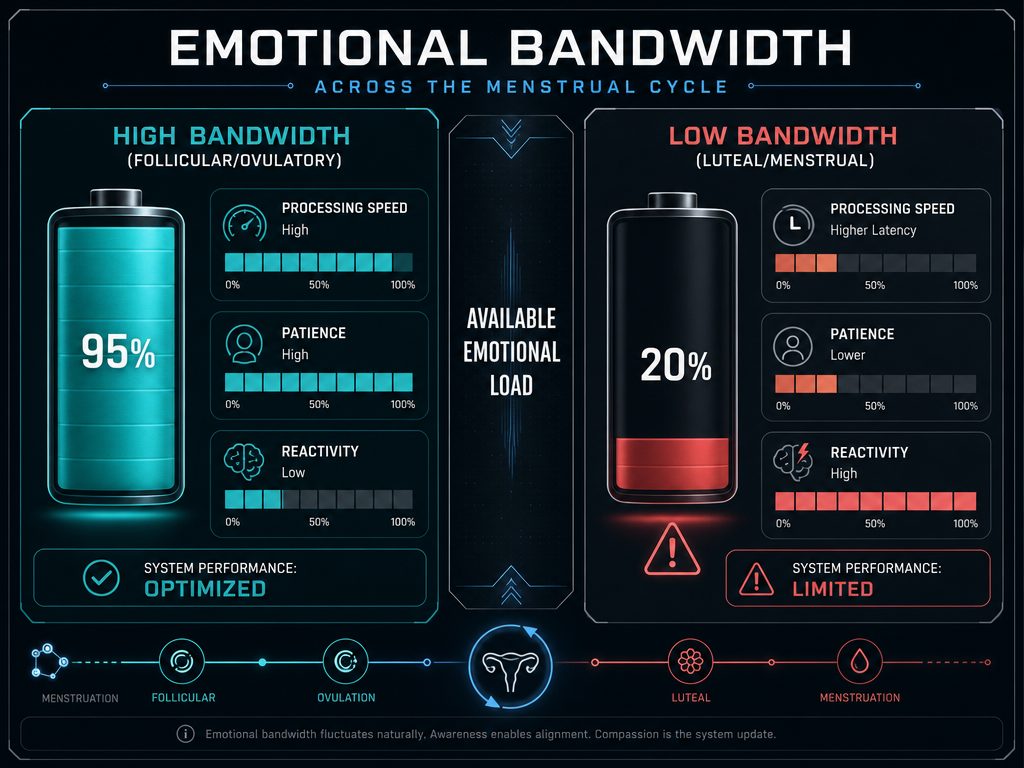 Understanding her 'bandwidth' helps shift the perspective from personality changes to biological capacity, allowing for more strategic and empathetic communication during high-stress phases.
So when you say "Did you forget the milk?" during the follicular phase, her brain processes it as a neutral logistical question. When you say the exact same thing during the luteal phase, her amygdala might flag it as "Why are you so forgetful and lazy?" It's not that she's being oversensitive - it's that her brain is temporarily wired to detect threats more aggressively.
This bandwidth shift applies to conflict resolution, too. A study published in the journal Social Cognitive and Affective Neuroscience found a significant increase (p = 0.001) in the mean reaction time for resolving emotional conflict from the follicular to the luteal phase. Translation: it literally takes her brain longer to process and resolve emotional tension when progesterone is elevated. Patience isn't just "being nice" - it's accounting for a biological processing delay.
The Neurobiology: How Progesterone Changes Threat Detection
Let's talk about the amygdala - a small, almond-shaped structure in the brain that acts as your emotional early-warning system. It scans incoming information for potential threats and triggers your fight-or-flight response. During the luteal phase, progesterone selectively increases amygdala reactivity, making it more sensitive to negative stimuli.
This isn't a flaw or a weakness. From an evolutionary perspective, heightened threat detection during the luteal phase may have helped protect a potentially pregnant body from danger. But in a modern relationship, it means a neutral comment can land like criticism, and a minor disagreement can feel like a referendum on the entire relationship.
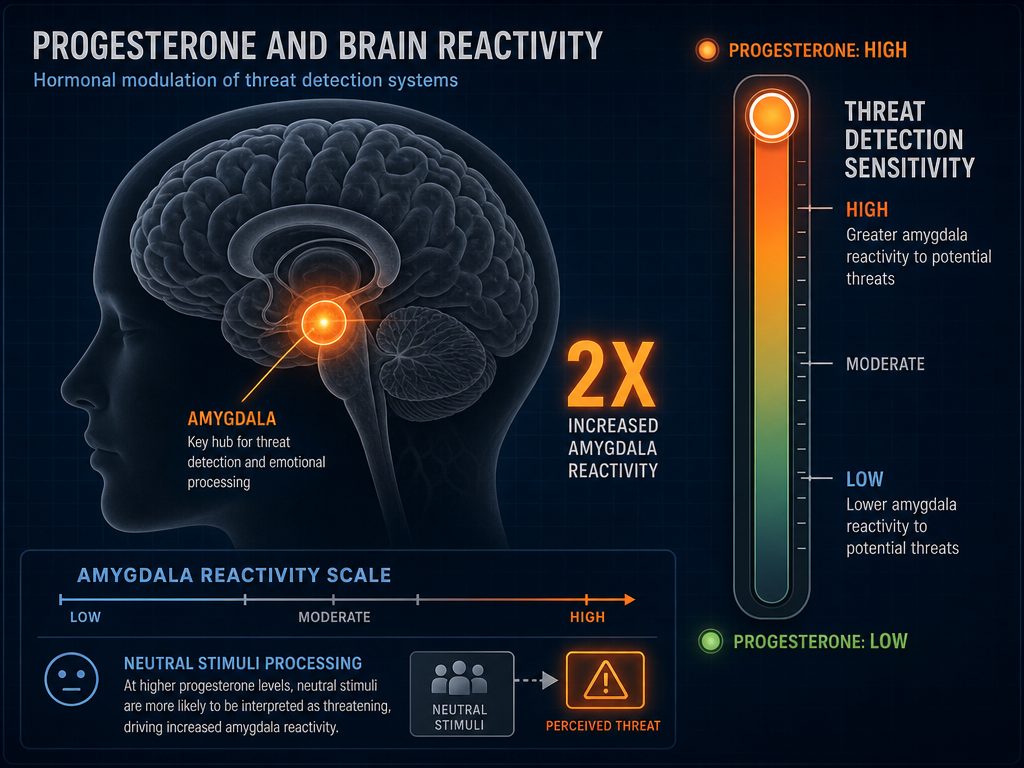 When progesterone rises during the luteal phase, the amygdala becomes more sensitive, causing the brain to perceive neutral statements as potential threats or attacks.
Here's what that looks like in practice:
Follicular Phase (High Bandwidth):
You: "Hey, can we talk about our budget this weekend?"
Her brain: "Sure, sounds productive."
Luteal Phase (Low Bandwidth):
You: "Hey, can we talk about our budget this weekend?"
Her brain: "He thinks I'm bad with money. He's probably been stewing about this for weeks. This is going to be a fight."
The words are identical. The emotional processing is not. This is why timing difficult conversations matters so much - not because she can't handle hard topics, but because her brain needs more recovery time and emotional reassurance when progesterone is elevated.
Phase-Specific Communication Protocols
Here's your tactical playbook, broken down by biological phase. Use this table as a reference when planning conversations, date nights, or conflict resolution.
| Phase | Primary Hormones | Her Bandwidth | Communication Style | Timing for Big Talks? |
|---|---|---|---|---|
| Menstrual | Low estrogen, low progesterone | Low physical/emotional energy | Soft tone, logistical support, minimal "deep dives" | Wait. She's recovering. |
| Follicular | Rising estrogen | High bandwidth, high mental clarity | Collaborative, high-energy, proactive | Best time. Schedule tough conversations here. |
| Ovulatory | Peak estrogen, LH surge | High social energy, confidence | Active listening, flirtatious, connection-focused | Good. She's socially engaged. |
| Luteal | Rising then falling progesterone | Lower bandwidth, higher reactivity | Validation-first, lower demand, "Pause Protocol" | Wait. Latency is higher; reactivity is up. |
Menstrual Phase: Recovery Mode
During her period, menstrual bleeding can last up to 8 days and varies widely person to person. Many women experience fatigue, cramps, and low energy. Her body is literally shedding and rebuilding tissue, which is metabolically expensive.
What she needs: Practical support without emotional demands. Offer to handle dinner, pick up supplies, or take over a chore without asking if she needs help. When a partner is struggling emotionally, responding with genuine empathy - listening without judgment, focusing on their feelings rather than debating facts - tends to help more than trying to "fix" the problem.
Communication style: Keep tone soft. Avoid scheduling intense conversations. If you need to discuss something logistical, frame it neutrally: "When you're feeling up to it, let's figure out our weekend plans" instead of "We need to talk about this weekend."
For more on how to support your partner during this phase, see how to help your girlfriend during period mood swings.
Follicular Phase: Your Green-Light Window
This is the phase when estrogen rises as an egg-containing follicle develops. Many women report feeling energized, optimistic, and mentally clear during this window. Her bandwidth is high, her mood is stable, and her brain processes conflict more efficiently.
What she needs: Collaborative planning. Big-picture conversations. Strategic thinking. This is when you bring up finances, travel plans, relationship goals, or anything that requires sustained focus and emotional regulation.
Communication style: Direct and proactive. "I'd love to talk through our vacation budget - does Saturday morning work?" She's more likely to engage without defensiveness, and you'll both get better outcomes.
This is also a great time for cycle-synced date planning - her energy is up, so plan activities that involve movement, socializing, or trying something new.
Ovulatory Phase: Peak Connection
Ovulation is when a surge in luteinizing hormone (LH) causes the ovary to release an egg, typically around day 14 of a 28-day cycle. Many women notice symptoms such as increased sex drive, mild pelvic or abdominal pain, tender breasts, bloating, and mood changes - though these vary significantly person to person.
What she needs: Emotional connection, affection, and social activity. Her brain is primed for bonding, so this is a strong window for intimacy, meaningful conversations, and quality time.
Communication style: Active listening. Flirtatious engagement. Focus on connection rather than logistics. This isn't the time to bring up a conflict you've been sitting on, but it is the time to reinforce your bond and show appreciation.
For more on recognizing ovulation signs, see our comprehensive guide.
Luteal Phase: Validation-First Mode
After ovulation, progesterone rises to help prepare the uterine lining for a possible pregnancy. If pregnancy doesn't happen, both progesterone and estrogen drop sharply. Research shows that anger and irritability typically peak peri-menstrually - the window just before and during the start of the period.
This is the luteal phase, and it's where most relationship friction happens. As many as 3 in 4 women report experiencing PMS symptoms at some point in their life, though severity varies widely. Symptoms typically show up one to two weeks before a period and resolve within a few days after it starts.
What she needs: Validation before solutions. Lower social demands. Space to rest without feeling abandoned. If she's irritable or withdrawn, it's not because she's mad at you - it's because her serotonin levels are crashing along with her hormones, and her nervous system is on high alert.
Communication style: Lead with empathy. "I can see you're exhausted - what can I take off your plate?" is better than "Are you okay?" (which can feel interrogative). Avoid bringing up new problems or scheduling high-stakes conversations. If conflict arises, deploy the Pause Protocol (see next section).
For a detailed breakdown of this phase, read the partner's guide to the luteal phase.
The Pause Protocol: Your Tactical De-escalation Script
Here's your emergency brake for when a conversation starts to escalate during the luteal phase. The Pause Protocol is a pre-agreed framework that lets both of you step back without abandoning the issue or making things worse.
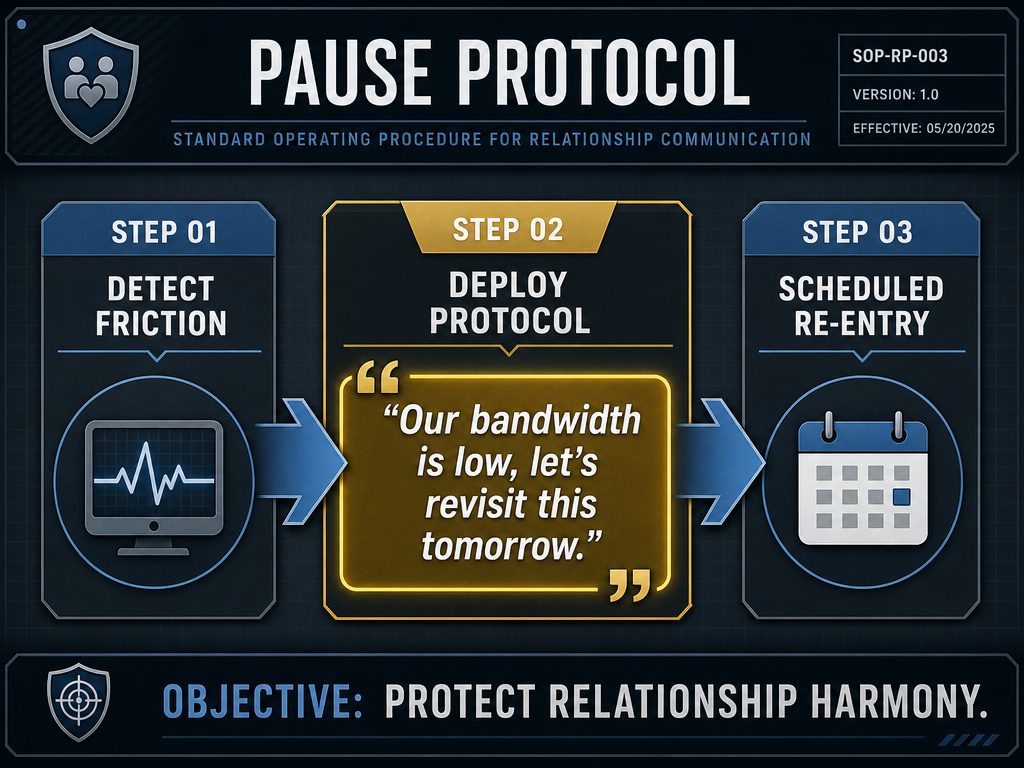 The Pause Protocol provides a logical framework for de-escalating conflict by identifying low-bandwidth moments and scheduling a time to revisit the topic when processing power is higher.
How It Works
Recognize the pattern. If you notice her tone sharpening, her body language closing off, or a small issue suddenly feeling like a referendum on the relationship, you're likely in the red zone. Her amygdala is flagging threats faster than her prefrontal cortex can regulate them.
Deploy the script. Use a pre-agreed phrase: "I want to give this the attention it deserves, but I think our bandwidth is low right now. Let's pause and revisit this tomorrow morning." The key word is "our" - you're framing it as a shared capacity issue, not "you're too emotional right now."
Schedule the follow-up. Don't just kick the can down the road. Propose a specific time to resume the conversation: "How about Saturday morning after coffee?" This signals that you're not avoiding the issue - you're optimizing the conditions for resolution.
Never say "Is it your period?" This is the nuclear option of invalidation. Even if you're right about the timing, framing her reaction as purely hormonal dismisses her perspective and makes the fight worse. Use "bandwidth" or "energy" instead.
Why It Works
Research shows a significant increase in the mean reaction time for resolving emotional conflict from the follicular to the luteal phase. This means her brain literally needs more time to process emotional information when progesterone is elevated. By pausing, you're not giving up - you're letting her nervous system reset so the conversation can happen on better neurological footing.
The Pause Protocol also respects her autonomy. You're not telling her she's overreacting; you're acknowledging that the current conditions aren't ideal for either of you. That distinction matters.
For more on timing difficult conversations, see our guide on how to apologize after a fight.
Data-Driven Empathy: Why Patience Is a Strategy, Not Just Kindness
Let's bring this full circle with the research. A 2013 study published in Social Cognitive and Affective Neuroscience tracked women's ability to resolve emotional conflict across the menstrual cycle. The researchers found a significant increase (p = 0.001) in the mean reaction time for resolving emotional conflict from the follicular to the luteal phase.
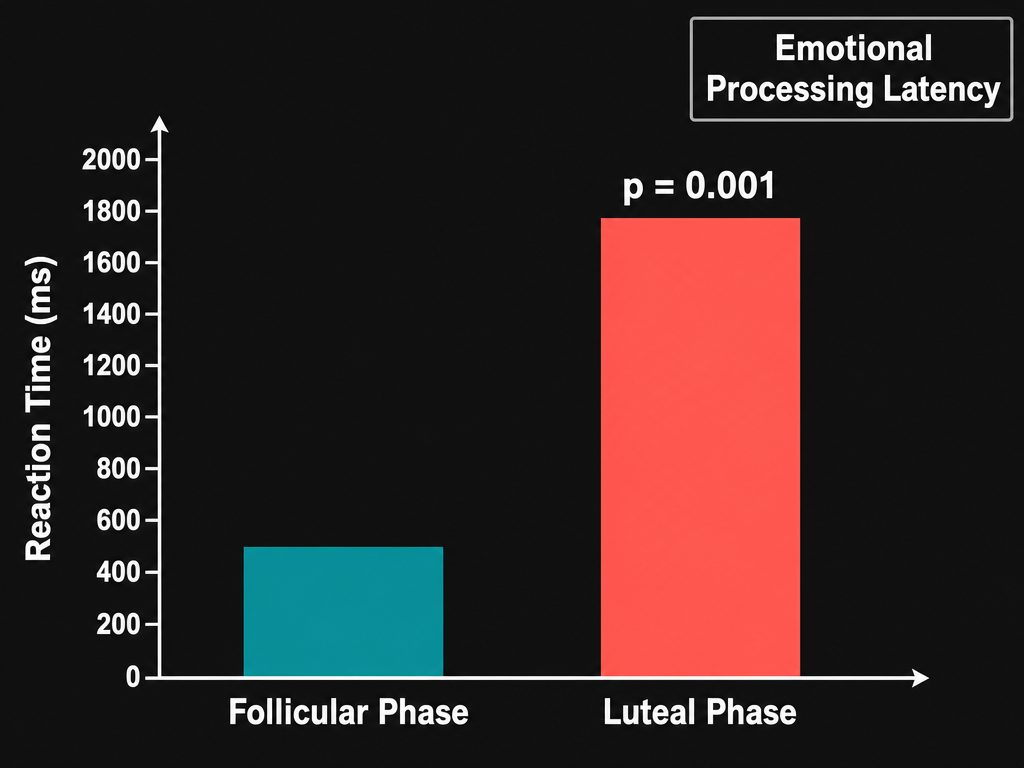 Research shows a significant increase in the time it takes for the brain to resolve emotional conflict during the luteal phase, requiring extra patience.
Translation: it takes longer for her brain to work through emotional tension when progesterone is elevated. This isn't about intelligence or maturity - it's about neurobiology. Her prefrontal cortex (the part of the brain responsible for rational thought and emotional regulation) has to work harder to override signals from an overactive amygdala.
This is why lifestyle approaches that can help ease PMS symptoms - regular aerobic exercise, smaller/more frequent meals, less salt/caffeine/alcohol, adequate sleep, and stress-reduction practices like deep breathing or yoga - are medically recommended. A partner who understands these factors and is patient and supportive (rather than dismissive) is aligning with evidence-based self-care, not indulging an excuse.
Patience isn't just being nice. It's a tactical response to a known biological pattern. When you give her brain the extra time it needs to process conflict, you're not coddling her - you're optimizing for a better outcome.
Frequently Asked Questions
What stage of the menstrual cycle is a woman most emotional?
Anger and irritability typically peak peri-menstrually - the window just before and during the start of the period. This is when progesterone and estrogen levels drop sharply, taking serotonin (a mood-stabilizing neurotransmitter) with them. Many women notice PMS-like symptoms in the luteal phase - mood shifts, breast tenderness, bloating, acne, and appetite changes - though not everyone does.
It's worth noting that "emotional" doesn't mean "irrational." Her cognition (logical thinking) remains stable throughout the cycle. What shifts is her emotional reactivity - how quickly her brain flags something as a threat and how long it takes to resolve that tension.
What is the difference between PMDD and PMS?
PMDD (premenstrual dysphoric disorder) is a more severe, sometimes disabling extension of PMS. Both happen on a similar timeline (about 7-10 days before a period) and can share physical symptoms like bloating and fatigue, but PMDD specifically involves extreme mood symptoms - such as marked irritability, anxiety, or hopelessness - intense enough to disrupt daily life and strain relationships.
PMDD is a real, clinically recognized condition - it's listed in the DSM-5 as a depressive disorder, not something people are "making up" or simply failing to cope with. It affects roughly 1 in 10 people who menstruate. If your partner's symptoms are severe enough to disrupt work, relationships, or daily functioning, she should talk to a healthcare provider. PMDD is treatable with therapy, lifestyle changes, and sometimes medication.
How does the menstrual cycle affect mood?
The menstrual cycle affects mood primarily through shifts in estrogen, progesterone, and serotonin. Estrogen affects many body systems, including brain function and the ability to focus, and levels are highest in the days leading up to ovulation. When estrogen is elevated, many women report feeling energized, confident, and mentally sharp.
After ovulation, progesterone rises. Progesterone selectively increases amygdala reactivity, making the brain's "threat detector" more sensitive to negative stimuli. If pregnancy doesn't happen, both progesterone and estrogen crash before the next period, taking serotonin with them. Serotonin is a neurotransmitter that stabilizes mood, so when it drops, irritability, anxiety, and sadness can increase.
This isn't a universal experience - roughly half of people who menstruate report having at least one PMS symptom, but only about 1 in 5 have symptoms severe enough to disrupt their daily life. The key point for partners is that mood shifts follow a predictable biological pattern, not random personality changes.
Can stress cause a period to come early?
Yes, stress can disrupt the menstrual cycle and cause a period to come early - or late. A "normal" cycle varies a lot between women - menstrual bleeding can start anywhere from every 24 to every 38 days, so exact day-by-day predictions for any specific woman should be treated as approximate.
Stress affects the hypothalamic-pituitary-adrenal (HPA) axis, which regulates hormone production. When cortisol (the stress hormone) is chronically elevated, it can interfere with the signals that trigger ovulation and menstruation. This can make cycles shorter, longer, or more irregular.
As a supportive partner, understand that if she's under significant stress - work deadlines, family issues, major life changes - her cycle timing may shift. Tracking your own (or a partner's, with her participation) symptoms and mood changes across the cycle for a few months is a legitimate, medically endorsed way to identify real patterns and timing - rather than assuming based on stereotypes or a single cycle. For tools to help with this, check out the best period tracker apps for men.
How do I bring this up with my girlfriend without it sounding condescending?
Lead with curiosity, not diagnosis. Instead of "I've been reading about your hormones," try "I've noticed we have smoother conversations some weeks than others - have you noticed that too?" Frame it as something you want to understand together, not something you're managing for her.
If she's open to the conversation, share what you've learned: "I read that the luteal phase can make it harder to process conflict because of how progesterone affects the brain. I don't want to bring up tough topics when your bandwidth is low. Would it help if we scheduled important conversations for earlier in your cycle?"
The key is positioning this as a tool for both of you, not a judgment on her. You're not saying she's irrational - you're saying you want to time your support better.
What if she doesn't have a regular cycle?
Normal menstrual cycles can range from 21 to 35 days; a "28-day average" is only a teaching tool and not a rule for individuals. If her cycle is irregular, the phase-by-phase framework still applies - you'll just need to track actual patterns rather than relying on calendar math.
Tracking symptoms and mood changes across the cycle for a few months is a medically endorsed way to identify real patterns. You can use a period tracker app with partner mode (we review the best options here) to log her energy, mood, and physical symptoms. Over time, you'll see the biological rhythm even if the calendar dates shift.
What if she says she doesn't notice these patterns?
That's valid. Not everyone experiences dramatic hormonal shifts, and some women have very mild PMS symptoms or none at all. The research describes population-level trends, not universal rules.
If she doesn't notice major changes, don't force the framework. But if you've observed patterns - recurring conflicts before her period, energy crashes mid-cycle, social withdrawal in the luteal phase - share your observations gently: "I've noticed you seem more tired the week before your period. Is that something you've noticed too?" She may not have connected the dots, or she may prefer not to frame her moods through a biological lens. Respect her perspective.
How do I know if her symptoms are severe enough to see a doctor?
Roughly half of people who menstruate report having at least one PMS symptom, but only about 1 in 5 have symptoms severe enough to disrupt their daily life. If her symptoms - physical or emotional - are interfering with work, relationships, or daily functioning, she should talk to a healthcare provider.
Red flags include: extreme mood swings that feel out of proportion to the situation, persistent hopelessness or thoughts of self-harm, physical pain that interferes with daily activities, or symptoms that don't improve after her period starts. PMDD affects roughly 1 in 10 people who menstruate and is a clinically recognized condition that responds well to treatment.
Your role as a partner isn't to diagnose, but to encourage her to seek support if she's struggling. "I've noticed you're really suffering the week before your period - have you talked to your doctor about it?" is a caring prompt, not an overstep.
Understanding your girlfriend's changing communication needs throughout her cycle isn't about excusing bad behavior or walking on eggshells. It's about recognizing a biological pattern so you can time your words better, reduce unnecessary friction, and show up as a more effective partner. Her personality doesn't change - her bandwidth does. When you adjust your approach to match her biology, you're not indulging her moods; you're optimizing for connection.
For more tactical guidance on cycle-aware support, see the partner's guide to understanding her cycle or explore how to be a better boyfriend using science-backed strategies.
Tags

Related Articles
Continue reading to deepen your understanding

When Your Girlfriend Gets Withdrawn Before Her Period
If she suddenly pulls away, it is usually biology, not you. Learn why your girlfriend gets distant before her period and use these tactical scripts to help her during the luteal phase.

How to Respond When Your Girlfriend Needs Space During Her Period
If she’s suddenly sending one-word texts or pulling away, it’s likely not about you. Learn the science of the luteal phase and how to support her without feeling rejected.

Understanding Why Your Girlfriend’s Communication Style Shifts Weekly
Ever wonder why your partner’s moods and energy levels shift so much? Understanding the four phases of her menstrual cycle helps you become a more supportive and proactive partner.

When Do Your Girlfriend’s Energy Levels Change During Her Cycle?
Your girlfriend’s mood and stamina follow a biological rhythm. Learn how her energy peaks and crashes throughout the month so you can plan better dates and provide better support.

Why Your Girlfriend Needs Different Attention Each Week: The Four Seasons Framework
Stop walking on eggshells and start understanding her cycle. This framework shows you exactly how to support your girlfriend through all four biological phases every month.

Why Your Girlfriend Wants Space the Week Before Her Period
Does your girlfriend suddenly pull away every month? Discover the biological reasons behind the pre-period space window and how to navigate this phase together.

Why Your Girlfriend Wants Different Kinds of Affection at Different Times in Her Cycle
Ever feel like your girlfriend’s needs change every week? It’s not random. Understand how the four phases of her cycle drive her desire for intimacy so you can support her better.

How to Plan Romantic Gestures by Cycle Timing: The Partner’s Tactical Guide
Stop guessing why your date night plans fell flat. This guide explains how to synchronize your romantic efforts with her biological cycle for better intimacy and connection.