Why Your Girlfriend Needs Different Attention Each Week: The Four Seasons Framework

Stop walking on eggshells and start understanding her cycle. This framework shows you exactly how to support your girlfriend through all four biological phases every month.
Why Your Girlfriend Needs Different Attention Each Week: The Four Seasons Framework
Your girlfriend's energy, mood, and needs change throughout the month - and it's not random. Understanding her 28-day biological cycle transforms you from a guy walking on eggshells into a strategic partner who knows exactly what she needs, when she needs it. Here's how to stop guessing and start supporting her through every phase.
Table of Contents
- What Is the Menstrual Cycle and Why Does It Matter for Your Relationship?
- The Four Seasons Framework: Understanding Each Cycle Phase
- Winter (Menstrual Phase): Acts of Service
- Spring (Follicular Phase): Quality Time and New Ideas
- Summer (Ovulation): Peak Energy and Big Conversations
- Autumn (Luteal Phase): Patience and Safe Harbor
- The Three Non-Negotiable Rules for Every Phase
- How to Track Her Cycle Without Being Weird About It
- What Is the 7-2-1 Rule for Menstruation?
- Frequently Asked Questions
What Is the Menstrual Cycle and Why Does It Matter for Your Relationship?
The menstrual cycle has four phases: menstrual (bleeding, roughly days 1-5), follicular (day 1 through ovulation, estrogen rising), ovulation (around day 14 in a 28-day cycle, triggered by a surge in luteinizing hormone), and luteal (after ovulation to the next period, progesterone rising then falling). The follicular and menstrual phases overlap.
Here's what most guys don't realize: a "normal" cycle varies significantly between women - menstrual bleeding can start anywhere from every 24 to every 38 days and last up to 8 days. There's no single universal 28-day cycle, so exact day-by-day predictions for any specific woman should be treated as approximate.
Your girlfriend's shifting needs aren't unpredictable mood swings. They're biological shifts in estrogen and progesterone that affect her energy, focus, social drive, and emotional state. When you understand these patterns, you can anticipate her needs instead of reacting to them.
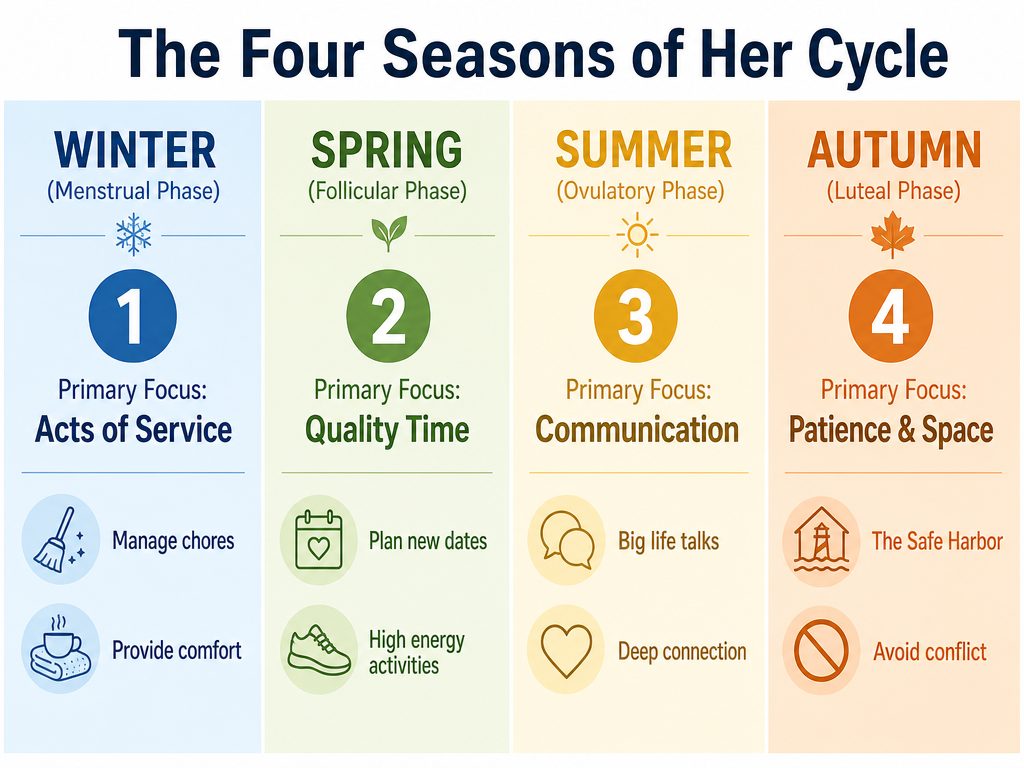 Understanding the Four Seasons framework helps you adapt your support style from acts of service in 'Winter' to patient space-holding during the 'Autumn' luteal phase.
The Four Seasons Framework: Understanding Each Cycle Phase
The "Four Seasons" analogy maps each biological phase to a season with distinct energy patterns and relationship needs. This framework helps you match your support style to what she's actually experiencing, not what you think she needs.
Winter = Menstrual Phase (Days 1-5)
Low energy, inward focus, physical discomfort.
VibeCheck App
Download Free on iOS →Spring = Follicular Phase (Days 6-14)
Rising energy, openness to new ideas, social momentum.
Summer = Ovulation (Days 14-16)
Peak energy, confidence, and clarity - but watch for the crash.
Autumn = Luteal Phase (Days 17-28)
Declining energy, rising sensitivity, the need for predictability and rest.
Each season requires a different kind of support. Here's how to navigate them.
Winter (Menstrual Phase): Acts of Service
What's Happening Biologically
During menstruation, both estrogen and progesterone are at their lowest. She's bleeding, which causes fatigue, cramping, and a general sense of being physically drained. Her body is working hard even when she's sitting still.
What She Needs From You
Winter is about reducing her load. She doesn't need big romantic gestures or deep conversations. She needs you to handle the "life admin" without being asked.
Specific Actions:
- Take over dinner planning and cooking for 3-5 days.
- Handle grocery runs, dish duty, and any household tasks she normally manages.
- Offer a heating pad, pain relief, or her favorite comfort food - but don't make her tell you what she needs. Just stock it ahead of time.
- Cancel plans if she's not feeling up to them. Don't pressure her to "push through."
What Not to Do:
- Don't ask "What can I do?" She's tired. Just do it.
- Don't suggest she's overreacting to pain. Period cramps range from mild to debilitating, and you're not qualified to judge.
- Don't expect sex unless she initiates. For some women, period sex relieves cramps. For others, it's the last thing they want.
The Red Flag: When to Encourage Her to See a Doctor
The 7-2-1 rule is a medical screening for heavy bleeding: 7+ days of flow, pad change every 2 hours, or 1-inch clots. If her periods consistently meet any of these criteria, she may have heavy menstrual bleeding, which is a treatable medical condition. Gently encourage her to talk to a doctor.
Spring (Follicular Phase): Quality Time and New Ideas
What's Happening Biologically
During the follicular phase, estrogen rises as an egg-containing follicle develops in the ovary; this rising estrogen also thickens the uterine lining. Near the end of this phase, high estrogen triggers a surge in luteinizing hormone (LH), which sets off ovulation.
Rising estrogen typically brings more energy, better mood, and increased openness to trying new things. She's rebuilding after Winter.
What She Needs From You
Spring is your window for quality time and trying new activities together. She's more likely to say yes to spontaneous plans, new restaurants, or weekend trips.
Specific Actions:
- Suggest activities you've been wanting to try together.
- Plan dates, but keep them flexible. Her energy is building, not stable.
- This is a good time to reconnect after she's been more withdrawn during her period.
- Listen to her new ideas and plans without shutting them down.
What Not to Do:
- Don't assume she's "back to normal" and suddenly load her schedule. Her energy is rising, not infinite.
- Don't bring up serious relationship problems yet. Save heavy conversations for Summer.
Why This Phase Matters
Spring is when many couples feel closest. Companionship in early relationships grows by approximately 1.19 hours per week, peaking at the 2.70-year mark. Taking advantage of her rising energy during the follicular phase helps you both invest in that shared time when she's most receptive to it.
Summer (Ovulation): Peak Energy and Big Conversations
What's Happening Biologically
Ovulation is when a surge in luteinizing hormone (LH) causes the ovary to release an egg, typically around day 14 of a 28-day cycle. In the days just before ovulation, cervical mucus becomes clear and slippery, which is the most fertile window of the cycle.
Around ovulation, many women notice symptoms such as increased sex drive, mild pelvic or abdominal pain, tender breasts, bloating, and mood changes - but these vary significantly person to person, and not everyone notices them.
What She Needs From You
Summer is the time for big conversations and relationship maintenance. Her confidence and clarity are at their peak. If you need to have a serious talk about your future, money, or moving in together, this is your window.
Specific Actions:
- Schedule important conversations during this phase. She's more likely to be receptive and clear-headed.
- Match her high energy with activity. She wants to do things, not sit on the couch.
- This is often when her sex drive peaks. Initiate, but don't expect it to last past ovulation.
What Not to Do:
- Don't assume she's always going to feel this good. Ovulation lasts 24-48 hours.
- Don't miss the window. If you wait until the luteal phase to bring up something important, you're fighting biology.
The Ovulation Paradox
Here's where it gets counterintuitive. Pop culture often paints ovulation as the "perfect" relationship phase, but research tells a different story. Increases in estradiol (ovulation phase) negatively affected women's relationship evaluations, which men were able to perceive.
Translation: she may feel "too good" or "too independent" during ovulation. She's at peak energy and confidence, which can make her more critical of the relationship or less needy of your attention. Don't take it personally. It's a hormonal spike, not a referendum on your partnership.
Autumn (Luteal Phase): Patience and Safe Harbor
What's Happening Biologically
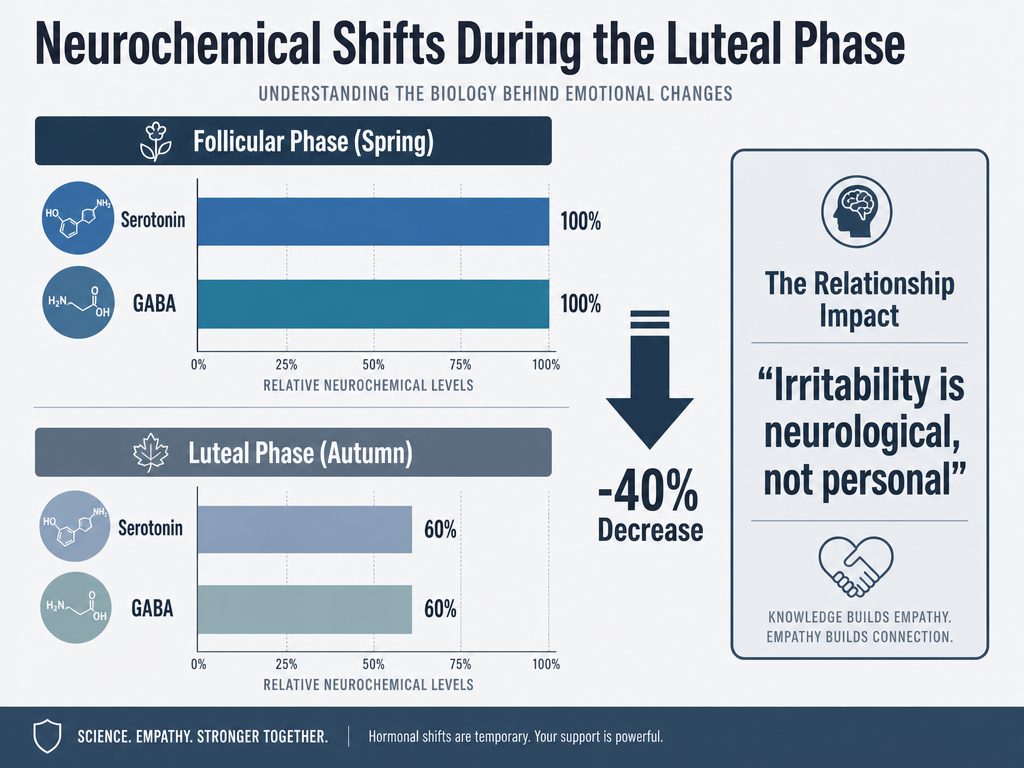 Biological shifts in GABA and Serotonin during the luteal phase can cause sudden mood changes. Recognizing this as a neurological shift helps prevent taking irritability personally.
After ovulation, the luteal phase begins: progesterone rises to help prepare the uterine lining for a possible pregnancy. If pregnancy doesn't happen, both progesterone and estrogen drop before the next period. Many women notice PMS-like symptoms in this phase - mood shifts, breast tenderness, bloating, acne, and appetite changes - though not everyone does.
This isn't just "moods" - it's a neurological shift. When estrogen and progesterone drop sharply in the days before her period, so do serotonin and GABA, the brain chemicals that regulate mood and stress. Her body is experiencing something closer to a chemical withdrawal than a personality flaw.
What She Needs From You
Autumn is about being the safe harbor in the storm. She doesn't need you to fix anything. She needs you to not make things worse.
Specific Actions:
- Take over dinner without being asked. Cooking feels like a huge task during this phase.
- Lower the stakes on everything. Cancel stressful plans. Suggest takeout and a movie instead of going out.
- Give her space if she asks for it. She's not pulling away from you - she's conserving energy.
- Validate her feelings without offering solutions. "That sounds really hard" beats "Have you tried...?"
What Not to Do:
- Never, ever say "Is it that time of the month?" You just made it worse.
- Don't match her irritability. If she's snappy, stay calm. Escalating turns a small friction point into a full fight.
- Don't push for sex or intimacy if she's not initiating. Progesterone drops libido for many women.
PMS vs. PMDD: When It's More Than Mood Swings
PMS (premenstrual syndrome) is very common: as many as 3 in 4 women report experiencing PMS symptoms at some point in their life, though severity varies widely. Symptoms - which can include mood swings, irritability, bloating, breast tenderness, and fatigue - typically show up one to two weeks before a period and resolve within a few days after it starts.
But here's the critical distinction: roughly half of people who menstruate report having at least one PMS symptom, but only about 1 in 5 have symptoms severe enough to disrupt their daily life. That more disruptive tier is a meaningfully different experience than "typical" PMS.
PMDD (premenstrual dysphoric disorder) is a real, clinically recognized condition - it's listed in the DSM-5 as a depressive disorder, not something people are "making up" or simply failing to cope with. It affects roughly 1 in 10 people who menstruate.
PMDD is a more severe, sometimes disabling extension of PMS. Both happen on a similar timeline (about 7-10 days before a period) and can share physical symptoms like bloating and fatigue, but PMDD specifically involves extreme mood symptoms - such as marked irritability, anxiety, or hopelessness - intense enough to disrupt daily life and strain relationships.
People with PMDD report frequent conflict, emotional withdrawal, and fear of abandonment during the luteal phase. If her symptoms are consistently severe - if she's missing work, canceling plans every month, or having thoughts of self-harm - gently encourage her to talk to a healthcare provider. PMDD is treatable, but it requires professional help.
The Three Non-Negotiable Rules for Every Phase
No matter which phase she's in, these three rules apply:
1. Never Say "Is It That Time of the Month?"
This phrase dismisses her feelings and reduces her to her biology. Even if you're right about the timing, saying it out loud makes you the problem. If you're wondering whether her cycle is affecting her mood, track it silently and adjust your behavior accordingly.
2. Take Over Dinner During the Luteal Phase Without Being Asked
Cooking requires planning, decision-making, and physical effort - all of which feel monumentally harder during the luteal phase. Keep her favorite comfort foods stocked. Order takeout without waiting for her to suggest it. This single act prevents more fights than almost anything else you can do.
3. Be the Safe Harbor, Not the Storm
When she's irritable, your job is to stay calm. Matching her energy or getting defensive escalates tension. When a partner is struggling emotionally, responding with genuine empathy - listening without judgment, focusing on their feelings rather than debating facts, and validating that their reaction makes sense - tends to help more than trying to "fix" the problem or offer silver linings.
How to Track Her Cycle Without Being Weird About It
Tracking your partner's cycle can feel invasive if done wrong, but it's one of the most supportive things you can do when framed correctly. Here's how to approach it:
Get Her Consent First
Don't secretly track her period. That's creepy. Instead, frame it as a way to support her better: "I've been reading about how the menstrual cycle affects energy and mood, and I want to understand what you're going through so I can be more supportive. Would you be comfortable sharing your cycle with me?"
Use an App Designed for Partners
Several apps now include partner features:
- Flo for Partners lets her share cycle data with you through the app.
- Clue Partner Connect offers a similar shared tracking system.
- VibeCheck goes further by turning cycle data into daily guidance - it tells you what phase she's in and suggests specific actions you can take.
If you're comparing options, check out our comparison of the best period tracker apps for men.
Track Patterns, Not Days
Tracking your own (or a partner's, with her participation) symptoms and mood changes across the cycle for a few months is a legitimate, medically endorsed way to identify real patterns and timing - rather than assuming based on stereotypes or a single cycle.
Watch for patterns: Does she get a headache three days before her period? Is she more withdrawn during the luteal phase? Use this information to anticipate her needs, not to predict her behavior in a way that feels patronizing.
What Is the 7-2-1 Rule for Menstruation?
If you've seen the "7-2-1 rule" mentioned online, you need to know what it actually means - because it's not relationship advice.
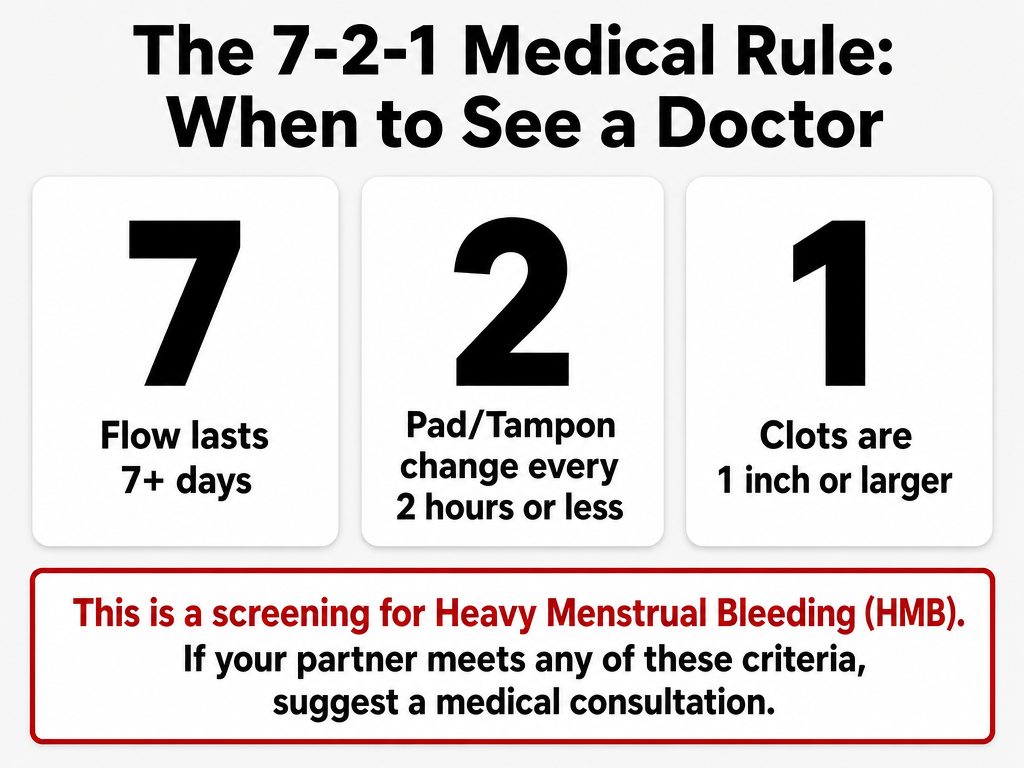 The 7-2-1 rule is a vital medical screening tool. If your partner experiences these symptoms, her 'bad periods' may actually be a treatable medical condition.
The 7-2-1 rule is a medical screening for heavy bleeding: 7+ days of flow, pad change every 2 hours, or 1-inch clots. This isn't a relationship tip. It's a diagnostic tool to identify heavy menstrual bleeding, which is a real medical condition that requires treatment.
If your girlfriend consistently experiences any of these symptoms, her "bad periods" aren't just something she needs to tough out. Gently encourage her to see a doctor. Heavy menstrual bleeding can be caused by hormonal imbalances, fibroids, or other treatable conditions.
Frequently Asked Questions
Can your period sync with your partner?
No. The idea that women who live together or spend a lot of time together will eventually sync their cycles is a persistent myth, but it's not supported by research. Your girlfriend's cycle is driven by her own hormonal patterns, not by proximity to you or anyone else.
How to support a partner during the luteal phase?
The luteal phase is when progesterone rises and then crashes, bringing with it mood swings, fatigue, and irritability. Lifestyle approaches that can help ease PMS symptoms include regular aerobic exercise, smaller/more frequent meals, less salt/caffeine/alcohol, adequate sleep, and stress-reduction practices like deep breathing or yoga.
As her partner, your job is to reduce her load: take over household tasks, keep comfort food stocked, cancel stressful plans, and offer emotional validation without trying to fix her feelings. For a detailed tactical guide, read our partner's guide to the luteal phase.
What is mittelschmerz?
Mittelschmerz - one-sided lower abdominal pain around the time of ovulation - is a real, documented phenomenon, not something imagined. It's generally harmless, usually lasts minutes to a couple of days, and typically doesn't require medical treatment.
How often mittelschmerz happens varies considerably: some women get it almost every cycle, others only occasionally or never. It may be somewhat more common in women in their teens through mid-20s, though there's no clearly established risk factor.
If your partner mentions pain around ovulation, validate it. Offer a heating pad and pain relief, and give her space to rest if she needs it.
Does "cycle syncing" actually work?
The idea of "cycle syncing" - adjusting your diet, workouts, and activities to match each phase of the menstrual cycle - has become popular online. Here's what's actually established by research:
There is general research support for hormone-linked differences in mood and energy across the cycle - energy tends to be lower during the period and can build through the follicular phase toward ovulation, with PMS-type symptoms more likely in the luteal phase. Specific "cycle syncing" lifestyle programs built on this idea have not themselves been tested in clinical research, so prescriptive claims (exact workouts/foods for exact cycle days) go beyond what's established.
Translation: the general principle - that her energy and needs shift across the month - is real. The highly specific "do X workout on day 12 and eat Y food on day 19" advice is not backed by clinical studies.
How can I tell which phase she's in without asking?
You can learn to read behavioral and physical cues. During the follicular phase, she's more social, energetic, and open to new plans. Around ovulation, she may have a subtle spike in confidence and sex drive. During the luteal phase, watch for withdrawal, irritability, and fatigue. During menstruation, she's likely to be more inward-focused and physically uncomfortable.
That said, the most accurate way to know is to track her cycle with her consent using an app like VibeCheck, which translates cycle data into daily guidance.
What if my girlfriend says she doesn't want me tracking her cycle?
Respect that. Some women feel uncomfortable with the idea, and that's valid. You can still apply the Four Seasons framework by paying attention to patterns over time without formal tracking. Notice when she tends to be more energetic, when she's more withdrawn, and when she's dealing with physical symptoms. Adjust your support accordingly.
The goal isn't to control or predict her - it's to be more attuned to what she's experiencing so you can show up in the way she actually needs.
Are these patterns the same for everyone?
No. While the hormonal framework is universal, how individual women experience each phase varies widely. Some women have minimal PMS symptoms. Others have PMDD that requires medical treatment. Some women experience a libido surge during ovulation. Others don't notice any change.
Use this guide as a starting point, but pay attention to her specific patterns. Track them over a few months. Ask her what she's noticed about her own cycle. The goal is to understand her experience, not to impose a one-size-fits-all model.
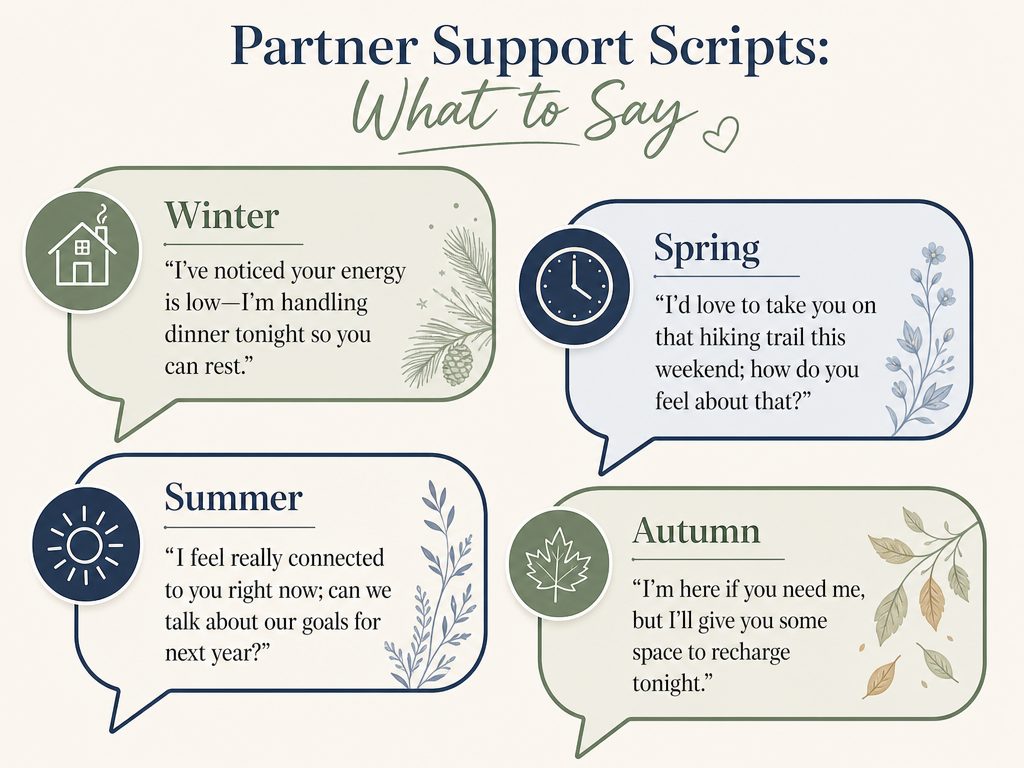 Using 'Soft Start' scripts allows you to offer support and initiate important conversations without being patronizing or making her cycle feel like an excuse.
Understanding why your girlfriend needs different attention each week isn't about reducing her to biology. It's about recognizing that her 28-day cycle is a real, measurable pattern that affects her energy, mood, and needs. When you align your support with her biological rhythm, you stop walking on eggshells and start showing up as the partner she actually needs.
Stop guessing. Start tracking. And become the guy who just gets it.
If you're ready to turn this framework into daily action, try VibeCheck - the relationship app that tells you exactly what to do based on where she is in her cycle.
Tags

Related Articles
Continue reading to deepen your understanding

Why Your Girlfriend Wants Space the Week Before Her Period
Does your girlfriend suddenly pull away every month? Discover the biological reasons behind the pre-period space window and how to navigate this phase together.

Why Your Girlfriend Wants Different Kinds of Affection at Different Times in Her Cycle
Ever feel like your girlfriend’s needs change every week? It’s not random. Understand how the four phases of her cycle drive her desire for intimacy so you can support her better.

How to Plan Romantic Gestures by Cycle Timing: The Partner’s Tactical Guide
Stop guessing why your date night plans fell flat. This guide explains how to synchronize your romantic efforts with her biological cycle for better intimacy and connection.

How to Tell When Your Girlfriend Is Ovulating: Reading the Biological Signals Your Partner Sends
Understanding your partner’s cycle helps you anticipate her needs and time important conversations. Learn the behavioral signs of ovulation to improve your relationship and connection.

Understanding Your Girlfriend’s Words of Affirmation Cycle: A Partner’s Guide
Ever feel like your compliments land wrong? Her need for words of affirmation isn’t random—it follows a biological rhythm. Learn how to match your support to her internal hormonal seasons.

The Partner’s Guide to the Luteal Phase: What It Is and How to Support Her
Stop walking on eggshells. Understand the biological changes of the luteal phase so you can support your partner through mood shifts and fatigue with empathy.

How to Plan Valentine’s Day Around Your Girlfriend’s Cycle
Does your romantic plan clash with her biological rhythm? Learn how to adjust your date night to her specific cycle phase so she feels comfortable and truly cared for this year.

The Strategic Partner’s Guide to Planning an Engagement Around Her Cycle
Don’t leave your proposal to chance. Learn how her biological rhythm impacts emotional receptivity and how to align your big question with the phase where she feels her best.