When to Give Your Girlfriend Space: Reading Her Hormonal Cues

Is she pulling away or just recharging? Understand how the menstrual cycle affects her social battery and learn when to lean in versus when to back off.
When to Give Your Girlfriend Space: Reading Her Hormonal Cues
You're not imagining it. She went from making weekend plans and texting all day to giving one-word replies and shutting down conversations. Your first instinct is to ask what's wrong or try to fix it. But if this shift happens on a predictable loop every few weeks, the answer isn't in your messages - it's in her biology.
Social energy peaks during ovulation and drops significantly during the luteal phase. Understanding when she genuinely needs solitude versus when she's pulling away for other reasons is one of the most practical relationship skills you can develop. This guide explains the biological "why" behind her need for space and gives you a tactical playbook for when to lean in and when to back off.
Table of Contents
- What Drives the Need for Alone Time?
- The Four Phases: When Space Needs Shift
- The 7 Behavioral Tells She Needs Space
- Biology of Overload: The Touch Ceiling
- The Partner Playbook: How to Give Space
- Red Flags: When It's Not the Cycle
- Frequently Asked Questions
What Drives the Need for Alone Time?
Her need for solitude is tied to predictable hormonal shifts, not personal rejection.
The menstrual cycle has four phases: menstrual (bleeding, roughly day 1-5), follicular (day 1 through ovulation, with rising estrogen), ovulation (around day 14 in a 28-day cycle, triggered by a surge in luteinizing hormone), and luteal (after ovulation to the next period, with progesterone rising then falling). Each phase affects her brain chemistry, sensory threshold, and social bandwidth differently.
During the luteal phase - the 10-14 days before her period - progesterone rises to prepare the uterine lining for a possible pregnancy. If pregnancy doesn't occur, both progesterone and estrogen drop sharply in the final days before menstruation. Progesterone's metabolites (like allopregnanolone) interact with GABA receptors, which can lead to increased sedation or mental sluggishness during the luteal phase. This neurochemical shift can make even light social interaction feel draining.
Think of it like a phone battery. In the follicular and ovulation phases, she's operating at 80-100% charge. During the luteal phase, that drops to 30-50%. Suddenly, answering "How was your day?" or deciding where to eat dinner feels like opening too many browser tabs on a dying laptop.
VibeCheck App
Download Free on iOS →A "normal" cycle varies considerably - menstrual bleeding can start anywhere from every 24 to every 38 days and last up to 8 days. There is no universal 28-day standard, so her specific patterns matter more than any textbook timeline.
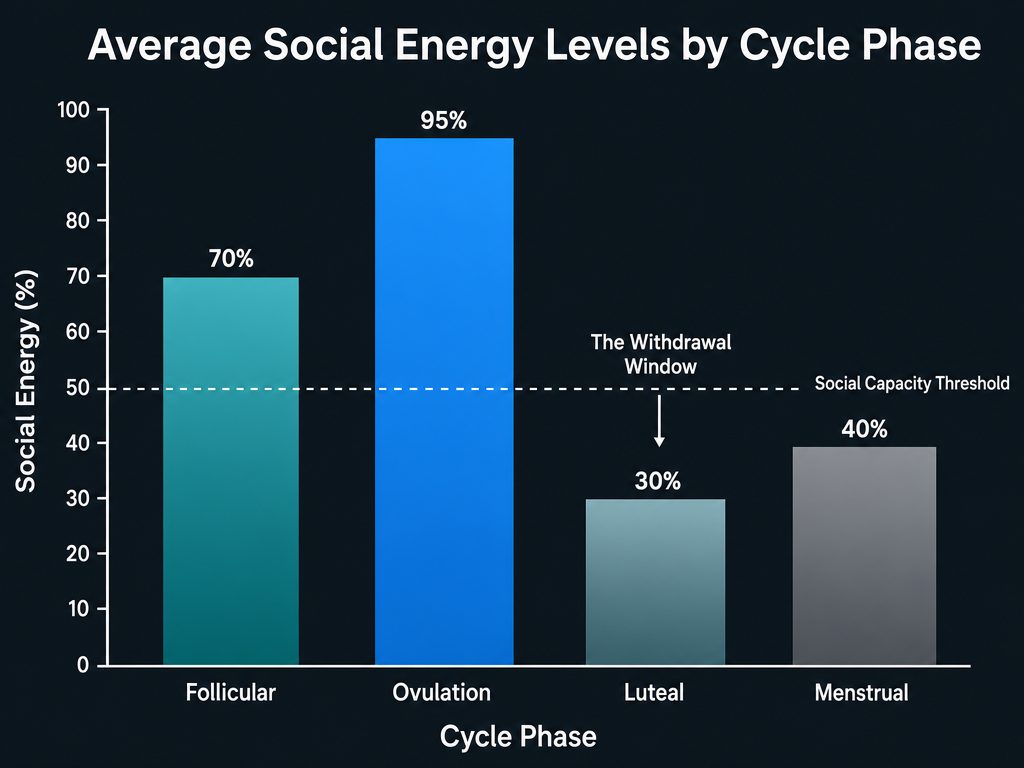 Understanding the biological fluctuations in social energy helps partners anticipate the Luteal Phase, where the need for solitude naturally increases due to shifting hormones.
The Four Phases: When Space Needs Shift
Not all phases are equal. Here's how her social battery typically fluctuates:
Menstrual Phase (Day 1-5): Physical Recovery
During menstruation, she's managing cramps, fatigue, and bleeding. Her need for space here is less about emotional withdrawal and more about physical exhaustion. She may prefer low-effort company - being in the same room while you both do separate things - rather than complete isolation. This is different from the luteal phase irritability; think "recovery mode" instead of "sensory overload."
Follicular Phase (Day 1-14): Rising Energy
During the follicular phase, estrogen rises as an egg-containing follicle develops in the ovary. This rising estrogen also thickens the uterine lining and, near the end of the phase, triggers a surge in luteinizing hormone (LH) that sets off ovulation. Estrogen affects many body systems, including brain function and the ability to focus, and levels are highest in the days leading up to ovulation.
She's usually more social, energized, and open to connection during this phase. Her texts are longer. She initiates plans. She doesn't flinch when you put your arm around her. If she's asking for space during this window, it's less likely to be hormonal and more likely a relational issue worth addressing directly.
Ovulation (Around Day 14): Peak Social Mode
Around ovulation, many women notice symptoms such as increased sex drive, mild pelvic or abdominal pain, tender breasts, bloating, and mood changes - but these vary considerably person to person, and not everyone notices them. This is generally her most outgoing, high-energy phase. She's planning trips, suggesting dinner with friends, and initiating physical affection.
If she's consistently withdrawing during ovulation, that's a signal something else is going on. This phase is biologically wired for connection, not isolation.
Luteal Phase (Day 15-28): The Danger Zone
This is where most hormonal withdrawal happens. Progesterone rises after ovulation, preparing the body for a possible pregnancy. If no pregnancy occurs, both progesterone and estrogen crash in the final week before her period. Many women notice PMS-like symptoms in this phase - mood shifts, breast tenderness, bloating, acne, and appetite changes - though not everyone does.
As many as 3 in 4 women report experiencing PMS symptoms at some point in their life, though severity varies widely. Symptoms - which can include mood swings, irritability, bloating, breast tenderness, and fatigue - typically show up one to two weeks before a period and resolve within a few days after it starts.
Her need for space peaks here. She's not mad at you. She's managing a biochemical shift that makes normal stimuli feel overwhelming.
The 7 Behavioral Tells She Needs Space
Learn to recognize these patterns before you misread them as disinterest:
1. The Texting Taper
Her messages go from paragraphs to one-word replies. She's not ghosting you - she's in decision-fatigue mode. Texting requires micro-decisions (what emoji, how much detail, whether to explain her mood), and her brain is rationing that energy.
2. The Touch Ceiling
She pulls away when you reach for her hand or shifts position when you sit close. This isn't rejection. When progesterone drops, her nervous system becomes more sensitive to stimuli. Light touch can feel irritating rather than comforting. If she normally loves physical affection but suddenly seems to flinch, she's likely in the luteal phase.
3. Task Burial
She throws herself into household chores, work projects, or organizing drawers. This is a coping mechanism - doing concrete, solitary tasks helps her feel in control when her internal state feels chaotic. Don't interrupt this with conversation. It's her way of managing overwhelm.
4. Social Calendar Pruning
She cancels plans with friends, skips group dinners, or suggests staying home instead of going out. Her social battery is genuinely depleted. Pushing her to "just go and you'll feel better" usually backfires.
5. The One-Room Retreat
She's home but stays in a separate room. She's reading, watching TV alone, or scrolling on her phone. She's not avoiding you specifically - she's avoiding all interaction. This is a sign her sensory threshold is maxed out.
6. Shortened Conversations
You ask how her day was, and she gives a three-word answer. You try to discuss weekend plans, and she says "I don't know, whatever." She's not being dismissive - she's genuinely out of bandwidth for extended conversation.
7. Headphone Armor
She puts in earbuds or headphones even when she's not actively listening to anything. This is a nonverbal "do not disturb" sign. Respect it.
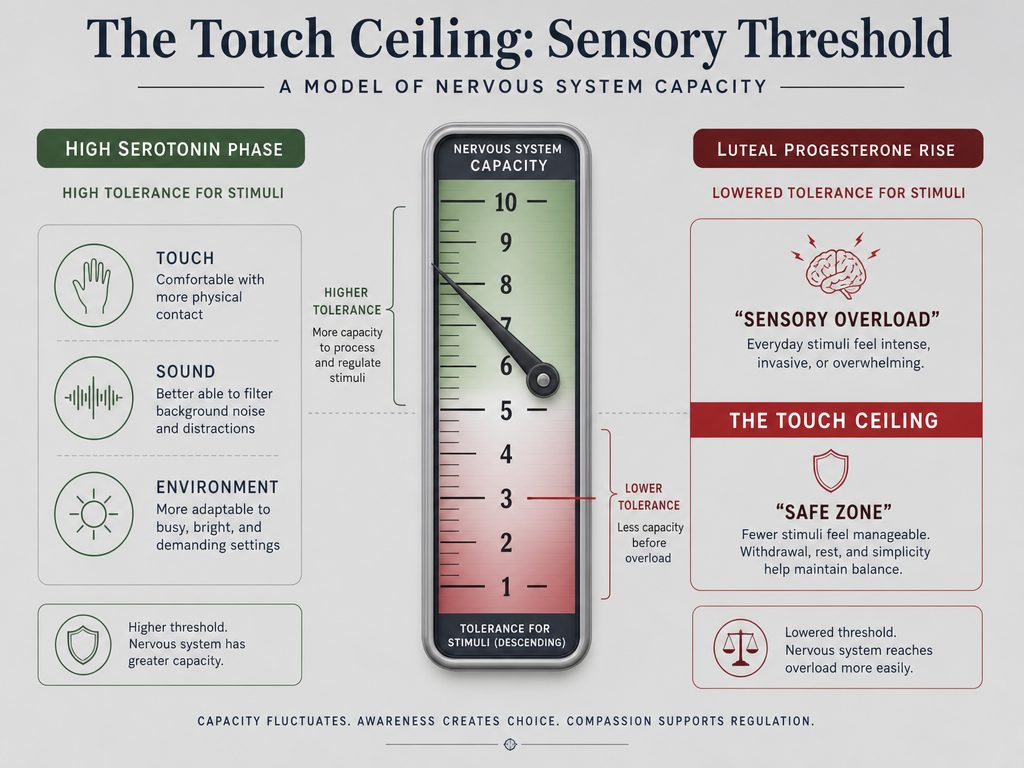 When progesterone rises and serotonin drops, the nervous system's 'Touch Ceiling' lowers, making even well-intentioned physical contact feel overwhelming rather than comforting.
Biology of Overload: The Touch Ceiling
Why does she suddenly not want to be touched?
When progesterone surges and then crashes in the luteal phase, it affects the brain's GABA system - the same neurotransmitter targeted by anxiety medications. Progesterone's metabolites interact with GABA receptors, which can lead to increased sedation or mental sluggishness. This creates a paradox: she might feel both mentally foggy and hyper-sensitive to external stimuli.
Her sensory threshold lowers. A hug that felt comforting last week now feels like too much input. Conversation that was enjoyable becomes exhausting. Even the sound of chewing or tapping can trigger irritation. This isn't about you - her nervous system is genuinely overloaded.
Reframe it: she doesn't dislike your touch. She dislikes all touch right now, because her brain is processing sensation differently. Knowing this helps you not take it personally.
The Partner Playbook: How to Give Space
Giving space doesn't mean disappearing. It means adjusting your presence to match her capacity.
Strategy 1: Parallel Play
Be in the same room but do different things. She's reading; you're on your laptop. She's watching TV; you're working on a project. No interaction required. This gives her the comfort of your presence without the demand of engagement.
Why it works: She feels less alone without feeling obligated to perform social interaction.
Strategy 2: No-Ask Service
Do the dishes, take out the trash, or handle dinner without asking "What can I do?" or "What do you need?" During the luteal phase, even answering simple questions adds to her decision fatigue. Instead, identify recurring friction points (meal planning, laundry, grocery runs) and handle them silently.
Example script (internal): "It's day 22 of her cycle. I'll order dinner, clean the kitchen, and not ask her to make any choices tonight."
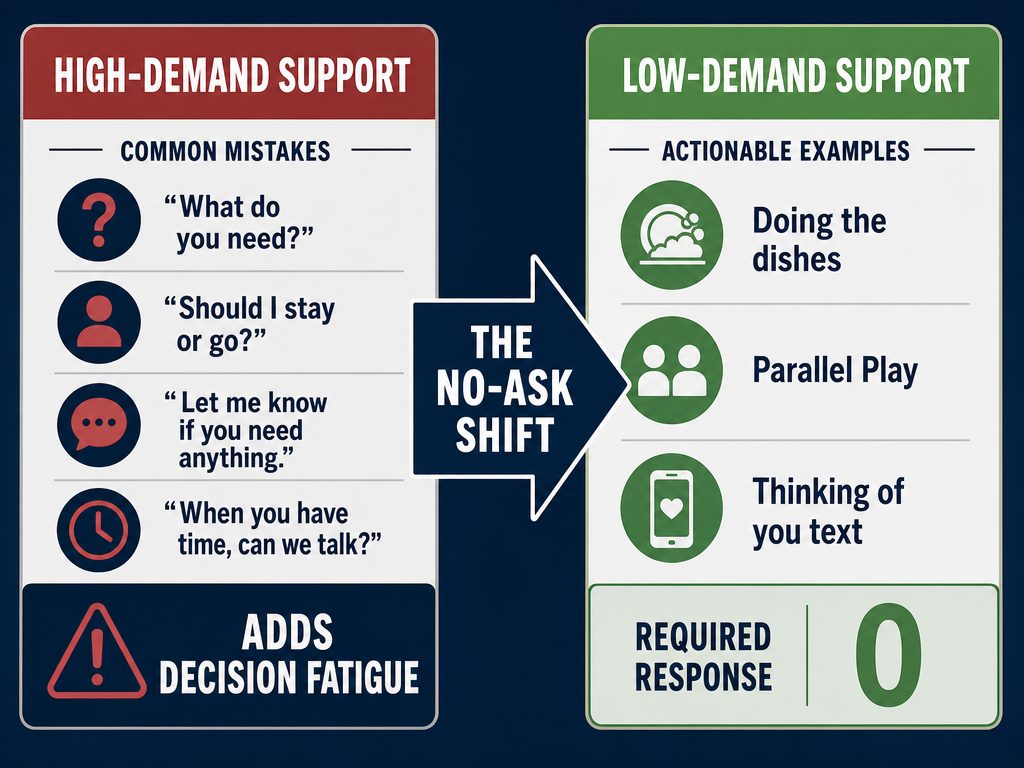 Effective support during hormonal withdrawal means moving from high-demand questions to low-demand actions that reduce her mental load without requiring a verbal response.
Strategy 3: The Safety Net Text
Send one low-pressure message per day if she's been withdrawn. Make it clear she doesn't need to respond.
Examples:
- "Thinking of you. No need to reply."
- "I picked up your favorite snack. It's in the fridge when you want it."
- "Taking care of dinner tonight. You just rest."
Why it works: It reassures her you're present and supportive without adding to her to-do list.
Strategy 4: The Validation Script
If she does open up about feeling overwhelmed, respond with validation, not solutions.
The script: "I can see your battery is low. I'm going to give you some quiet time, but I'm in the next room if you need me."
This acknowledges her state without making her explain or justify it. When a partner is struggling emotionally, responding with genuine empathy - listening without judgment, focusing on their feelings rather than debating facts, and validating that their reaction makes sense - tends to help more than trying to "fix" the problem or offer silver linings.
Strategy 5: Track, Don't Guess
Tracking your own (or a partner's, with her participation) symptoms and mood changes across the cycle for a few months is a legitimate, medically endorsed way to identify real patterns and timing - rather than assuming based on stereotypes or a single cycle. Use a period tracker app or simply note patterns in your phone. After three months, you'll start seeing when she reliably needs more space.
Pattern recognition beats reactive scrambling. If you know days 21-26 are her withdrawal window, you can proactively adjust plans, skip suggesting high-energy activities, and build in recovery time.
Red Flags: When It's Not the Cycle
How do you know if withdrawal is relational instead of hormonal?
Hormonal withdrawal has a predictable pattern. Relational withdrawal doesn't. Here are signs the issue isn't her cycle:
1. It Lasts Longer Than 14 Days
The luteal phase is the longest stretch where hormonal withdrawal happens, typically 10-14 days before her period. If she's been distant for three weeks straight with no relief, it's not PMS.
2. It Happens Across All Phases
If she withdraws during ovulation (her biologically social phase) and the follicular phase (her rising-energy phase), the pattern isn't hormonal. Something else is affecting the relationship.
3. She Explicitly Says She Needs Space "From You"
Hormonal withdrawal is generalized - she pulls back from friends, family, and social events. If she's specifically withdrawing from you but maintaining other connections, that's a relational red flag worth addressing directly.
4. Other Behaviors Change
She stops making future plans, avoids discussing the relationship, or becomes evasive about her schedule. These are signs of emotional distance, not temporary hormonal shifts.
5. She's Withdrawn Since a Specific Conflict
If the distance started after an unresolved fight or major disagreement and hasn't cycled back to normal, she's likely processing relational hurt - not managing PMS.
If you see these patterns, have a direct conversation. Don't use her cycle as an excuse to avoid addressing real issues.
Frequently Asked Questions
Is needing alone time normal in a relationship?
Yes. Needing periodic solitude is normal in any healthy relationship, and hormonal cycles can amplify that need on a predictable schedule. Roughly half of people who menstruate report having at least one PMS symptom, but only about 1 in 5 have symptoms severe enough to disrupt their daily life. If her withdrawal follows a monthly pattern and resolves after her period starts, it's likely cycle-related and not a relationship red flag.
The key distinction: healthy space needs are temporary, predictable, and don't come with resentment or evasiveness. If she consistently needs space "from you" specifically - but not from friends or other social connections - that's worth addressing.
What happens to women's hormones during the luteal phase?
During the luteal phase (the 10-14 days after ovulation and before the next period), progesterone rises sharply to prepare the uterine lining for a possible pregnancy. If pregnancy doesn't happen, both progesterone and estrogen drop in the final days before menstruation. Many women notice PMS-like symptoms in this phase - mood shifts, breast tenderness, bloating, acne, and appetite changes - though not everyone does.
The drop in estrogen can affect mood and focus, because estrogen influences brain function and the ability to concentrate. Meanwhile, progesterone's metabolites interact with GABA receptors, which can lead to increased sedation or mental sluggishness. Together, these shifts create the biological conditions for social withdrawal, irritability, and lower energy.
Is it normal to feel anger at my partner during the luteal phase?
Yes, irritability and mood swings are common during the luteal phase due to the hormonal shifts described above. However, there's a meaningful difference between "I'm easily annoyed" and "I'm experiencing disabling anger." PMDD (premenstrual dysphoric disorder) is a real, clinically recognized condition - it's listed in the DSM-5 as a depressive disorder, not something people are "making up" or simply failing to cope with. It affects roughly 1 in 10 people who menstruate.
If her luteal-phase anger is affecting her ability to work, maintain friendships, or function day-to-day - or if it's causing significant relationship damage - she should talk to a healthcare provider about PMDD.
How long should I give her space?
The luteal phase typically lasts 10-14 days, so her peak need for space usually resolves once her period starts. That said, every woman's cycle is different. A "normal" cycle can range from 24 to 38 days, and menstrual bleeding can last up to 8 days. The best approach is to track her individual patterns over a few months rather than rely on a generic timeline.
If she's asking for space outside of her luteal phase, or if the withdrawal lasts longer than two weeks with no relief, it's worth a direct conversation. Space needs that extend indefinitely or happen across all cycle phases are usually relational, not hormonal.
What are the 5 symptoms of PMDD?
PMDD involves extreme mood symptoms - such as marked irritability, anxiety, or hopelessness - intense enough to disrupt daily life and strain relationships. The DSM-5 criteria include at least five symptoms during most menstrual cycles in the past year, with at least one being a core mood symptom:
Core mood symptoms (at least one required):
- Marked mood swings (sudden sadness or tearfulness)
- Marked irritability or anger, or increased interpersonal conflicts
- Depressed mood, feelings of hopelessness, or self-deprecating thoughts
- Marked anxiety, tension, or feeling "on edge"
Additional symptoms:
- Decreased interest in usual activities
- Difficulty concentrating
- Lethargy, easy fatigability, or marked lack of energy
- Marked change in appetite, overeating, or specific food cravings
- Hypersomnia or insomnia
- Feeling overwhelmed or out of control
- Physical symptoms like breast tenderness, bloating, joint or muscle pain, or weight gain
Importantly, an estimated 40% of women seeking treatment for PMDD actually have a premenstrual exacerbation of an underlying mood disorder. If her symptoms are severe or don't resolve after her period starts, she should see a healthcare provider for proper evaluation.
The bottom line: Her need for space isn't a rejection - it's a biological signal. Learn the pattern, adjust your presence, and stop walking on eggshells. When you understand the rhythm, you become the partner who gives her exactly what she needs before she has to ask for it.
For more on navigating her cycle phases, see our complete partner's guide to the menstrual cycle or try our period calculator to start tracking patterns.
Tags

Related Articles
Continue reading to deepen your understanding

How to Understand Your Girlfriend’s Social Battery and Hormones
Does your girlfriend suddenly cancel plans or seem withdrawn? This guide explains how her cycle impacts her energy so you can support her like a pro.

How Your Girlfriend’s Emotional Needs Change During Her Cycle
Does your girlfriend’s mood seem unpredictable? Learn how her emotional needs shift on a biological loop and how to support her through every phase of her cycle.

What to Buy When Your Girlfriend Has Hormone Cravings: A Support Guide
Stop wondering what to pick up at the store. This guide explains the science behind cycle cravings and provides a specific list of foods and comfort items she needs.

Your Girlfriend’s Mood Shifts Throughout the Month, Explained
Ever wonder why her energy and moods change so drastically each week? Understand the four hormonal phases and how to be the partner she needs during every stage of her cycle.

How to Support Your Girlfriend When She’s Crying Because of Hormones
Watching her cry when hormones hit can feel overwhelming. Learn the biological why behind the tears and use these proven scripts to provide the support she actually needs right now.

How to Help Your Girlfriend with Hormonal Mood Swings Without Arguing
Understand her cycle and learn tactical scripts to handle tension. This guide shows you how to support her through hormonal shifts without getting into unnecessary fights.

When to Feed Your Girlfriend: Understanding Hangry Hormones
Does your girlfriend get irritable when she hasn’t eaten? It’s not just in her head. Learn why hormones cause hanger and the specific times her body needs more fuel.

The Boyfriend’s Guide to Supporting Your Partner Through PMS
If your partner is suddenly irritable and exhausted, it’s biology, not you. Learn about the luteal phase and how to provide meaningful support without walking on eggshells.