How to Plan a Date Night When Your Girlfriend Has PMS: The Partner’s Tactical Guide

Navigate the luteal phase by evaluating which date templates match her energy. Use our triage framework to decide between active dates or low-sensory sanctuary time.
How to Plan a Date Night When Your Girlfriend Has PMS: The Partner's Tactical Guide
You've been planning this date for weeks. Reservations are confirmed, you picked out the perfect spot, and you're ready to be thoughtful. Then she texts: "I don't know if I'm feeling it tonight."
Your first instinct might be frustration, or worse, assuming she's making an excuse. But if the timing lines up with the week before her period, you're not dealing with flakiness - you're dealing with a progesterone crash that affects roughly 20% to 32% of premenopausal women in a clinically significant way. Understanding how to plan a date night when your girlfriend has PMS isn't about lowering your standards or walking on eggshells. It's about working with her biology instead of against it.
This guide gives you the framework to turn "storm week" into a time when you're her anchor, not her adversary.
Table of Contents
- The Neurochemical Why: What's Actually Happening in Her Brain
- The Pre-Date Check-In: Your Triage Framework
- The Sensory Sanctuary: Date Templates for Low-Friction Connection
- Strategic Activity Pivots: When the Plan Needs to Change
- The Red Zone Survival Guide: Rules for Peak-Storm Moments
- The 7-2-1 Rule: Your Partner Self-Care Framework
- What foods help PMS mood swings?
- How to support your girlfriend in her luteal phase?
- What are lowkey date ideas?
- Frequently Asked Questions
The Neurochemical Why: What's Actually Happening in Her Brain
She isn't choosing to be irritable. Her brain's anxiety regulators are genuinely under-fueled during the progesterone crash that happens in the luteal phase - the stretch between ovulation and her next period. After ovulation, progesterone rises to help prepare the uterine lining for a possible pregnancy. If pregnancy doesn't happen, both progesterone and estrogen drop sharply before her period starts.
That progesterone drop matters because progesterone modulates GABA-A receptors in the brain - the same receptors that help regulate anxiety, sleep, and emotional stability. When progesterone plummets, those receptors become less effective, creating a state that can feel like mild withdrawal. It's not melodrama; it's measurable brain chemistry.
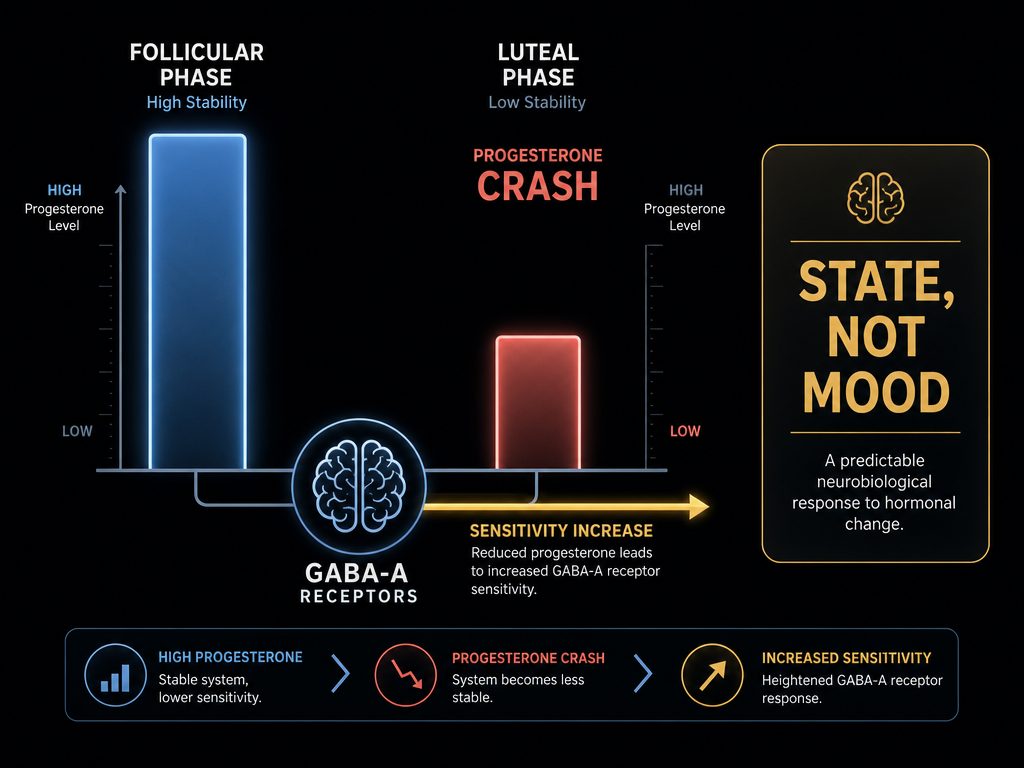 Understanding the biological shift: When progesterone levels crash, GABA-A receptors become less effective, making the luteal phase a neurological state rather than a simple mood choice.
Understanding this distinction changes everything. When you recognize that her reaction to bright lights, sudden plans, or your well-intentioned enthusiasm isn't personal, you stop taking friction as rejection. You treat it as biological context.
VibeCheck App
Download Free on iOS →The Pre-Date Check-In: Your Triage Framework
Before you suggest dinner reservations or tickets to anything, run the triage question: "Do you want me to listen, give you space, or help find a solution?"
This single question - borrowed from relationship research on empathy - does three critical things:
- It acknowledges she might need something different than your original plan.
- It gives her permission to name her actual state without guilt.
- It prevents you from offering the wrong type of support.
If she says "listen," your job is validation, not problem-solving. If she says "space," you're offering low-guilt solitude, not abandonment. If she says "solution," then you're helping her troubleshoot logistics or discomfort without minimizing her experience.
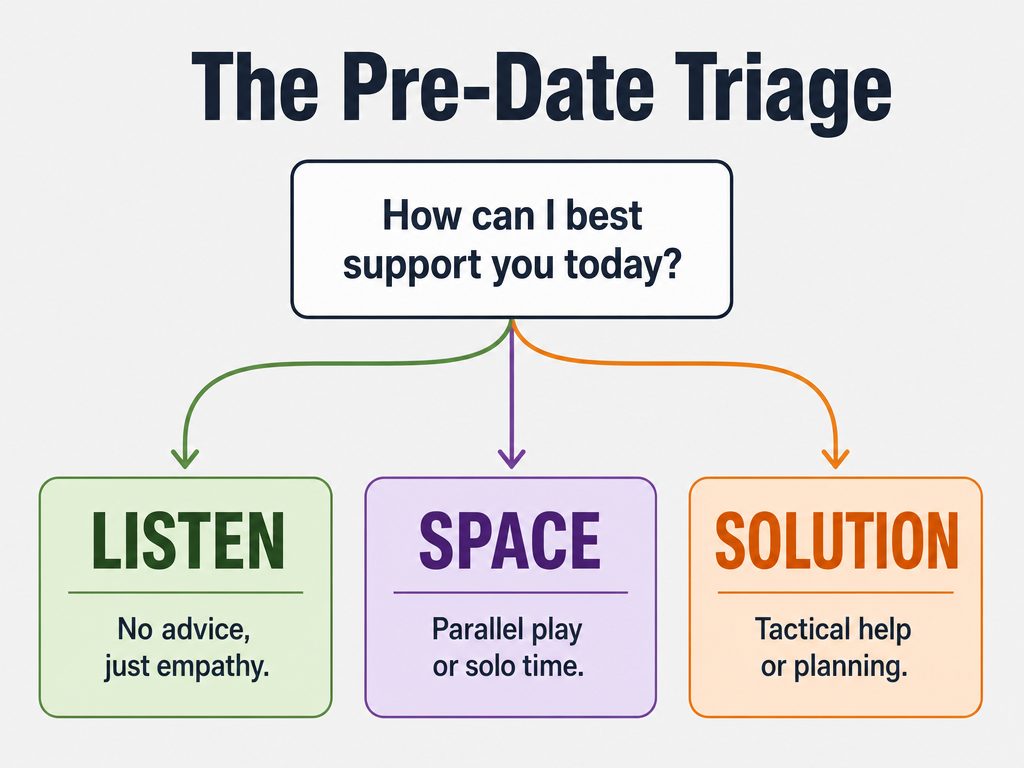 Use this triage framework before suggesting any activities. Identifying whether your partner needs empathy, quiet company, or active help prevents friction before the date begins.
This framework prevents the classic error: booking a high-energy social event when she needs a low-sensory sanctuary, or offering quiet solitude when she actually wants connection. Ask first, plan second.
The Sensory Sanctuary: Date Templates for Low-Friction Connection
The luteal phase is a time of heightened sensory sensitivity for many women. Bright lights feel sharper, background noise feels louder, and crowded spaces can feel overwhelming in a way they didn't the week before. Your date-night strategy should account for this.
The Sanctuary Checklist
- Lighting: Dim, warm lamps instead of overhead fluorescents or bright restaurant lighting.
- Sound: Lower volume than usual. If you're streaming something, use subtitles and keep the volume at conversational level. Avoid venues with live music or loud kitchens.
- Menu: High omega-3 foods like salmon or walnuts, dark chocolate, and meals that don't leave her bloated. Skip high-sodium takeout that amplifies water retention.
- Activity Intensity: Low-stakes creativity wins. Think parallel play - reading side by side, assembling a puzzle, or an at-home pottery kit - rather than competitive games or high-coordination activities.
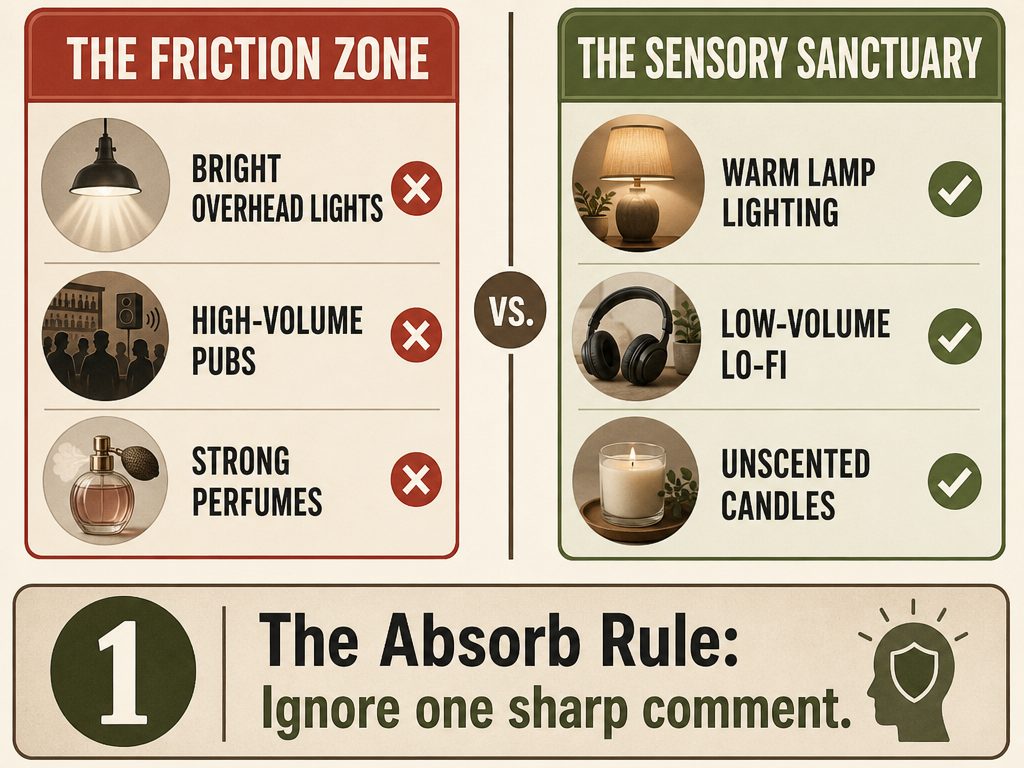 Small environmental changes make a huge difference. Swapping bright lights and loud music for a low-sensory sanctuary reduces cortisol and helps maintain a calm connection.
These aren't elaborate gestures. They're environmental tweaks that reduce the sensory load on her nervous system, creating space for actual connection instead of friction management.
Strategic Activity Pivots: When the Plan Needs to Change
Even with perfect planning, she might text an hour before and say she's not feeling it. This isn't flakiness - it's biological honesty. Your pivot strategy determines whether the night ends in resentment or relief.
The Low-Guilt Cancellation Offer
Don't make her fight for permission to cancel. Offer it proactively: "If you'd rather reschedule, we can move this to next week. No guilt, no explanation needed."
This does two things: it shows you're treating her state as legitimate, and it removes the emotional labor of convincing you she's not just being difficult. Most of the time, she'll appreciate the option even if she doesn't take it.
The Home-Base Pivot
If she's on the fence, suggest the home version of your original plan. Reservations at the new Italian place become homemade pasta with a bottle of wine and dim lighting. The concert becomes a playlist and a living-room dance session she can bail on without embarrassment if she's overstimulated.
The Parallel-Play Option
When she wants your company but not your attention, suggest a "pillow fort and low-stakes video game" setup. Games like Animal Crossing, Stardew Valley, or any cozy simulation game let her zone out without needing to perform enthusiasm. You're present, you're available, but you're not demanding interaction she doesn't have the bandwidth for.
If you're looking for more ways to support your girlfriend during different cycle phases, this kind of flexible planning becomes second nature once you map her patterns.
The Red Zone Survival Guide: Rules for Peak-Storm Moments
Some weeks are worse than others. Roughly 1 in 10 people who menstruate experience PMDD (premenstrual dysphoric disorder), a clinically recognized condition that involves extreme mood symptoms intense enough to disrupt daily life. Even if she doesn't have PMDD, the luteal phase can include sharp irritability, anxiety, or what some call "the breakup urge" - an intense, temporary feeling that the relationship isn't working.
Your survival rules:
The "No Forever Language" Rule
Do not make major life decisions during peak luteal. No "where is this relationship going?" talks, no house-hunting, no conversations about long-term plans. Her brain is running on a neurochemical deficit that makes everything feel more intense and less optimistic than it actually is. Reassure her that "we're okay, we'll talk in four days" and then drop it.
The "Absorb One Hit" Rule
Give yourself permission to ignore one sharp comment without defensive retaliation. She might snap at you for something minor - you left a dish in the sink, you suggested the wrong restaurant, you breathed too loud. Your job isn't to internalize it or to correct her perception. Your job is to absorb it, let it pass, and not escalate.
This doesn't mean tolerating abuse. It means recognizing that a single irritable comment during a progesterone crash isn't a reflection of how she feels about you when her neurochemistry stabilizes.
The Exit Strategy
If the friction is building and you can feel yourself getting defensive, use a circuit breaker: "I'm going to take a quick walk so I can be present without reacting. I'll be back in 20 minutes."
This isn't stonewalling. It's tactical de-escalation. You're removing yourself before the conversation becomes a fight, giving both of you space to reset. When you come back, you're calmer, and she's had time to regulate without an audience.
Understanding how to comfort your girlfriend during PMS means knowing when to stay and when to step back.
The 7-2-1 Rule: Your Partner Self-Care Framework
You can't be a stable anchor if you're running on empty. The 7-2-1 rule is your personal maintenance checklist during her luteal phase:
- 7 hours of sleep for you. You're navigating heightened friction, and sleep deprivation makes you reactive. Prioritize rest.
- 2 gestures for her. Two specific, low-pressure acts of service or connection per day. Examples: making her coffee without being asked, sending a single affirming text ("Thinking of you, no response needed"), or handling a chore she usually does.
- 1 moment of absorbed friction. One instance per day where you let a sharp comment or mood swing pass without reacting. Not indefinitely - just once, as a deliberate act of emotional generosity.
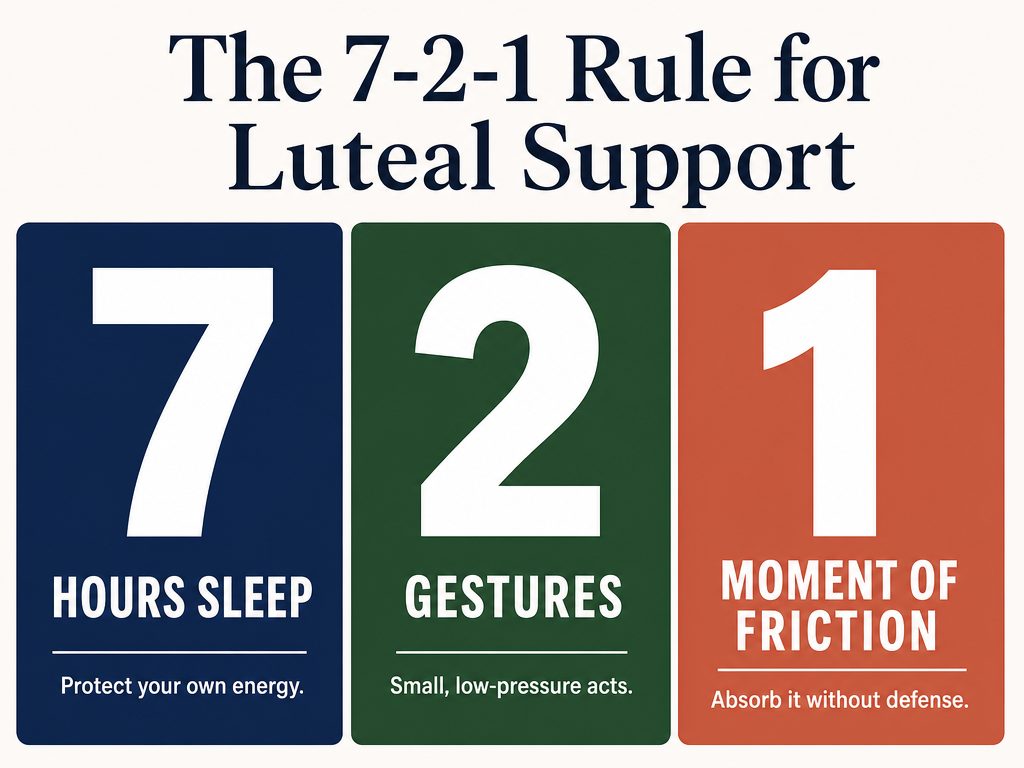 The 7-2-1 Rule: Prioritize your own rest, provide two low-pressure gestures, and commit to absorbing one moment of friction without retaliating to keep the peace.
This framework prevents burnout. You're not endlessly accommodating; you're strategically supporting while maintaining your own baseline.
What foods help PMS mood swings?
Foods that help stabilize blood sugar and support neurotransmitter production can make a measurable difference. Think high omega-3s (salmon, walnuts, flaxseeds), complex carbs (sweet potatoes, oats), magnesium-rich options (dark chocolate, spinach, almonds), and lean proteins that don't spike insulin.
Avoid high-sodium processed foods that worsen bloating and water retention, and limit caffeine if she's already anxious. Lifestyle approaches that can help ease PMS symptoms include regular aerobic exercise, smaller/more frequent meals, less salt/caffeine/alcohol, adequate sleep, and stress-reduction practices.
If you're planning a meal together, ask her what sounds good rather than surprising her with something heavy or unfamiliar. Her appetite might be unpredictable, and giving her control over the menu removes one source of friction.
How to support your girlfriend in her luteal phase?
Supporting her in the luteal phase means treating her symptoms as legitimate, not dismissible. This is the phase where progesterone rises and then crashes, and many women experience mood shifts, breast tenderness, bloating, acne, and appetite changes.
Your support strategy:
- Anticipate her needs without being asked. If you know she usually feels bloated and tired during this phase, stock the fridge with her preferred comfort foods and don't suggest high-energy activities.
- Validate her experience. When she says she's exhausted or irritable, respond with empathy, not solutions. "That sounds really hard" beats "Have you tried going for a run?"
- Track the pattern with her permission. Tracking symptoms and mood changes across the cycle for a few months is a medically endorsed way to identify real patterns. Use a shared tracker or app so you both see the data.
Understanding how to support your girlfriend in her luteal phase turns guesswork into strategy.
What are lowkey date ideas?
Lowkey date ideas are activities that require minimal social performance and allow for easy exit if she's overwhelmed. Examples:
- At-home movie marathon with a curated list she picks. Let her control the remote and the pacing. If she falls asleep halfway through, that's success, not failure.
- Cooking a simple meal together. Pick a recipe with five ingredients or fewer, something that doesn't require precision or stress.
- Puzzle or board game that doesn't involve competition. Cooperative games like Pandemic or a 500-piece puzzle let you work together without one person winning.
- Stargazing in the backyard or a quiet park. Minimal sensory load, easy conversation, no crowds.
- At-home spa setup. Face masks, foot soaks, dim lighting, and a playlist she chooses. You're providing the environment, not the performance.
The key is removing pressure. She doesn't need to dress up, show up, or be "on." You're creating space for connection that feels effortless, not obligatory.
For more ideas on planning dates around her cycle, understanding her energy patterns turns every week into an opportunity instead of a minefield.
Frequently Asked Questions
How do I know if she has PMS or PMDD?
PMS is common: as many as 3 in 4 women report experiencing PMS symptoms at some point in their life, though severity varies widely. Symptoms typically show up one to two weeks before a period and resolve within a few days after it starts.
PMDD is different. PMDD affects roughly 1 in 10 people who menstruate and involves extreme mood symptoms - such as marked irritability, anxiety, or hopelessness - intense enough to disrupt daily life and strain relationships. If her symptoms are severe enough that she can't work, socialize, or function normally during the luteal phase, she should talk to a healthcare provider about PMDD.
Can I suggest she track her cycle without sounding controlling?
Yes, if you frame it as a shared tool for understanding patterns, not a way to predict or control her behavior. Try: "I've been reading about how hormones affect mood and energy. Would it help if we tracked your cycle together so I can be more supportive?" If she says no, drop it. If she's open, use an app that lets her control the data and choose what she shares with you.
What if the same strategies don't work every month?
Hormone levels aren't perfectly predictable. A "normal" cycle varies a lot between women - menstrual bleeding can start anywhere from every 24 to every 38 days and last up to 8 days. Stress, sleep, diet, and other factors influence how intensely she experiences each phase. The goal isn't perfect prediction; it's pattern recognition. If something worked last month and doesn't this month, ask her what she needs instead of assuming the playbook is broken.
Should I bring up PMS during an argument?
No. Telling her she's "just being hormonal" during a fight is dismissive and will escalate the situation. If you need to de-escalate, use the circuit breaker: "I'm going to take a break so I can listen without reacting. I'll be back in 20 minutes." Address the hormonal context later, when neither of you is activated, and frame it as something you want to understand together - not something you're using to invalidate her feelings.
How do I handle the "breakup urge" if she brings it up?
The breakup urge - an intense, temporary feeling that the relationship isn't working - is a real phenomenon during the luteal phase, driven by the same neurochemical crash that fuels irritability and anxiety. If she brings it up, don't panic and don't engage in a "where are we going?" conversation in the moment.
Instead, try: "I hear you. Let's revisit this in a few days when we're both in a better headspace. If you still feel this way after your period, we'll talk it through." This acknowledges her feelings without treating them as permanent, and it prevents you from making decisions based on a temporary neurochemical state.
What if my girlfriend doesn't want help or support during PMS?
Some women prefer to manage PMS independently and don't want their partner involved. If she tells you she'd rather handle it alone, respect that boundary. Your job isn't to force support she doesn't want; it's to stay available and non-reactive if she changes her mind.
You can still apply the 7-2-1 rule for your own maintenance, and you can still avoid scheduling high-intensity plans during her luteal phase if you've noticed that's when friction tends to spike. But don't perform support she hasn't asked for - that creates pressure, not connection.
Planning a date night during PMS week isn't about lowering your expectations or walking on eggshells. It's about recognizing that her brain is operating on a different neurochemical baseline during the luteal phase, and adjusting your approach to work with that biology instead of against it. The triage framework, sensory sanctuary checklist, and 7-2-1 rule give you concrete tools to become the anchor she needs without draining yourself in the process.
This is the difference between hoping she'll be in a good mood and strategically supporting the conditions that make connection possible. When you stop treating her cycle as unpredictable weather and start treating it as a biological rhythm you can learn, you become a partner who shows up with intention instead of guesswork.
Tags

Related Articles
Continue reading to deepen your understanding

Your Girlfriend’s Mood Shifts Throughout the Month, Explained
Ever wonder why her energy and moods change so drastically each week? Understand the four hormonal phases and how to be the partner she needs during every stage of her cycle.

How to Support Your Girlfriend When She’s Crying Because of Hormones
Watching her cry when hormones hit can feel overwhelming. Learn the biological why behind the tears and use these proven scripts to provide the support she actually needs right now.

How to Help Your Girlfriend with Hormonal Mood Swings Without Arguing
Understand her cycle and learn tactical scripts to handle tension. This guide shows you how to support her through hormonal shifts without getting into unnecessary fights.

When to Feed Your Girlfriend: Understanding Hangry Hormones
Does your girlfriend get irritable when she hasn’t eaten? It’s not just in her head. Learn why hormones cause hanger and the specific times her body needs more fuel.

The Boyfriend’s Guide to Supporting Your Partner Through PMS
If your partner is suddenly irritable and exhausted, it’s biology, not you. Learn about the luteal phase and how to provide meaningful support without walking on eggshells.

Why Your Girlfriend Wants Different Things Each Week: The Biological Roadmap
Does your partner seem like a different person every seven days? Understand how her 28-day biological cycle impacts her energy and mood so you can provide the support she actually needs.

How to Help Your Girlfriend When She’s Irritable Before Her Period: The Partner’s Playbook
Is your partner snapping at small things right before her cycle? It’s not you—it’s biology. Learn how to navigate the serotonin crash and provide the support she actually needs.

How to Tell Your Girlfriend Is Overwhelmed by Hormones
Is she snapping or withdrawing for no reason? Identify the behavioral tells of hormonal overwhelm and learn how to support her during the luteal phase without triggering a fight.