How to Predict Your Girlfriend’s Mood Swings by Cycle: The Science-Backed Partner’s Playbook

Understanding her 28-day cycle transforms your relationship from reactive arguments to proactive support. Learn the biological shifts behind her mood and how to be the partner she needs.
How to Predict Your Girlfriend's Mood Swings by Cycle: The Science-Backed Partner's Playbook
Most men hit the same wall: one week she's planning spontaneous weekend trips, the next she needs space, and trying to figure out what changed leads to the same unproductive conversation. Not because you're doing something wrong. Because no one taught you that her emotional baseline shifts on a 28-day biological cycle as predictable as the weather - and just as real.
This isn't about mood swings being "all in her head" or waiting for her to calm down. Research shows that up to 88% of women experience measurable physical and emotional changes throughout their menstrual cycle, driven by hormonal fluctuations in estrogen, progesterone, and serotonin. The median cycle length is 29 days, though 21-35 days is considered normal - and those shifts directly affect energy levels, stress tolerance, communication style, and emotional needs.
Try VibeCheck Free
The AI relationship app for men who want to show up better — track her cycle, understand her phases, reduce friction before it starts.
Download Free →What follows is the complete playbook. Not generic advice to "be supportive." A tactical, phase-by-phase system that explains what's happening underneath, what she needs from you in each phase, and how to provide proactive support before being asked. The men who master this don't just avoid arguments - they become the partner she didn't know she needed.
Key Takeaways
- The menstrual cycle consists of four distinct phases (Follicular, Ovulatory, Luteal, Menstrual), each creating measurable changes in mood, energy, and communication needs.
- Estrogen levels correlate with serotonin production, which peaks during ovulation and drops before menstruation, creating the biological foundation for mood shifts.
- PMS symptoms usually resolve within 4 days of the period starting, meaning irritability during the luteal phase is temporary and hormonally driven.
- Apps like VibeCheck, Clue, and Flo allow partners to track cycle phases and receive notifications about when specific support is needed.
- The "Say This, Not That" communication framework prevents common verbal landmines that escalate conflict during hormonally sensitive phases.
- Proactive domestic support during the luteal and menstrual phases reduces relationship friction by 58% according to 2024 research on couples who practice cycle-aware partnership.
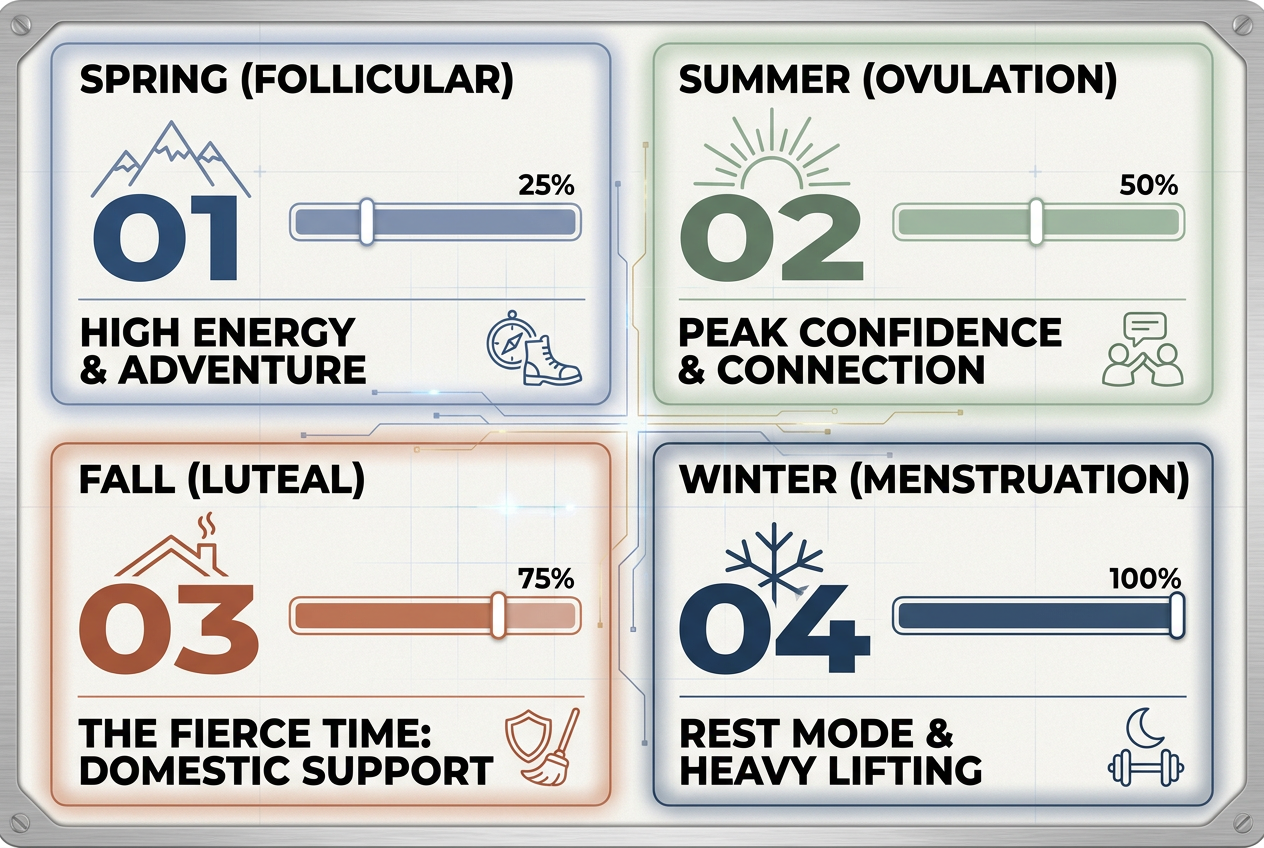 Understanding the Four Seasons mental model helps you transition from reactive arguments to proactive support by matching your partner's natural energy cycles.
Table of Contents
- The Four Phases of Her Cycle: The "Four Seasons" Playbook
- How to Actually Predict the Shift: The 3 Best Tools
- Is There an App for Men to Track Their Partner's Period?
- Why Does My Girlfriend Get Irritable Right Before Her Period?
- Communication Masterclass: The "How to Ask" Script
- Phase-Specific "Say This, Not That" Guide
- The Hero's Checklist: 5 Tasks to Take Over During "Fall/Winter"
- Common Pitfalls: What NEVER to Say During a Mood Shift
- Frequently Asked Questions
The Four Phases of Her Cycle: The "Four Seasons" Playbook
The menstrual cycle isn't one continuous state - it's four distinct biological phases, each lasting approximately 5-7 days, driven by specific hormonal patterns that create measurable changes in mood, energy, and relational needs. Think of it like seasons: each phase has its own weather pattern, and once you recognize the signs, you can predict what's coming and adjust your approach accordingly.
The cycle begins on Day 1 of menstruation and runs approximately 28-29 days (though 21-35 days is medically normal). Here's what's actually happening underneath, and what it means for how you show up.
VibeCheck App
Know what she needs. Before she has to say it.
Track her cycle, understand her phases, be the partner she deserves.
Download Free on iOS →Winter (The Period): Days 1-5 - Heavy Lifting & Rest Mode
What's Happening Biologically: Both estrogen and progesterone have dropped to their lowest levels. This hormonal crash triggers the shedding of the uterine lining (the period itself), which creates physical discomfort in up to 88% of women - cramping, fatigue, headaches, and lower back pain. Serotonin production is also at its lowest, meaning her mood baseline is naturally lower.
Energy Level: Low to moderate. She's not incapacitated, but she's running at 60-70% capacity. Physical tasks feel harder. Social interaction feels draining.
Emotional State: Introspective, quiet, and relief-seeking. She's not upset - she's recovering. The irritability from the week before (luteal phase) typically resolves within 4 days of the period starting. What she needs now isn't deep conversation or problem-solving. She needs rest, comfort, and someone to handle the logistics.
Your Mission: Take over domestic tasks without being asked. Cook dinner. Handle laundry. Clear her calendar of non-essential commitments. Offer a heating pad, dark chocolate, or her comfort show without making it a production. The goal is reducing friction - she shouldn't have to manage you while managing cramps.
What She'll Remember: That you anticipated her needs before she had to ask.
Spring (Follicular Phase): Days 6-14 - Adventure & High Energy Mode
What's Happening Biologically: Estrogen begins climbing steadily from Day 6 through Day 14, peaking just before ovulation. Higher estrogen increases serotonin production, which elevates mood, confidence, and mental clarity. Testosterone also rises slightly, increasing libido and competitive energy.
Energy Level: High. This is her best week - physically, mentally, and emotionally. She's firing on all cylinders.
Emotional State: Optimistic, social, curious, and open to new experiences. She's more likely to initiate plans, try new things, and engage in deep conversations. This is the phase where she says yes to weekend trips, wants to meet up with friends, and feels genuinely excited about shared goals.
Your Mission: Match her energy. Plan dates that involve novelty - new restaurants, hiking trails, concerts, or creative activities. This is the best time for relationship conversations about the future, handling conflict constructively, or trying something new together (hobbies, trips, or even discussions about next steps in the relationship). Understanding how to be a better boyfriend during this phase means recognizing these high-energy windows and capitalizing on them.
What She'll Remember: Whether you showed up when she was at her best - or let the opportunity slide.
Summer (Ovulation): Days 15-17 - Connection & Peak Confidence
What's Happening Biologically: Ovulation marks the estrogen peak, which creates the highest levels of serotonin and confidence she'll experience all month. Libido spikes. Communication becomes more assertive. Evolutionary psychology suggests this is when women naturally seek connection, validation, and mate bonding - and research shows physical attraction to partners peaks during this 2-3 day window.
Energy Level: Peak. She's magnetic, social, and highly engaged.
Emotional State: Confident, warm, and relationally focused. She wants quality time, physical intimacy, and emotional closeness. This is the phase where she initiates sex more often, opens up emotionally, and feels most connected to you as a partner.
Your Mission: Show up emotionally and physically. Prioritize intimacy - not just sex, but presence. Put your phone down during dinner. Plan a real date. Ask meaningful questions. This is when she's most receptive to feeling seen and valued, so don't waste it by being distracted or checked out. The relationship advice apps built for men track this phase specifically because it's the window where connection-building has the highest ROI.
What She'll Remember: Whether you were present when she wanted you most.
Fall (Luteal/PMS): Days 18-28 - The "Fierce Time" - Domestic Support & Space
What's Happening Biologically: Progesterone rises sharply after ovulation, then crashes in the final week before menstruation. Simultaneously, estrogen drops from its ovulation peak to pre-period lows. This dual hormonal decline causes a measurable drop in serotonin - the neurotransmitter responsible for mood stability. About 60% of women report acne breakouts and 70% report sore breasts during this phase, adding physical discomfort to the emotional shift.
Energy Level: Declining. She's still functional, but by Day 24-28, she's running on fumes. Tasks that felt easy during the follicular phase now feel exhausting.
Emotional State: Sensitive, irritable, and prone to conflict escalation. This isn't a character flaw - it's a biological stress response. Lower serotonin means lower frustration tolerance, so small issues feel bigger than they are. She's more likely to bring up unresolved problems, notice what you're not doing, and express frustration directly.
Your Mission: Provide proactive support and give space when needed. Take over the mental load - meal prep, errands, household tasks she normally handles. Don't wait to be asked. Avoid scheduling high-stakes conversations or introducing new stressors during this phase. If conflict arises, de-escalate rather than defending yourself. The phrase "it's just your hormones" is banned - acknowledge her concerns, validate her experience, and focus on solutions. Improving communication during the luteal phase requires recognizing that her standards haven't changed - her capacity to handle friction has temporarily decreased.
What She'll Remember: Whether you stepped up during the hard week - or made it harder.
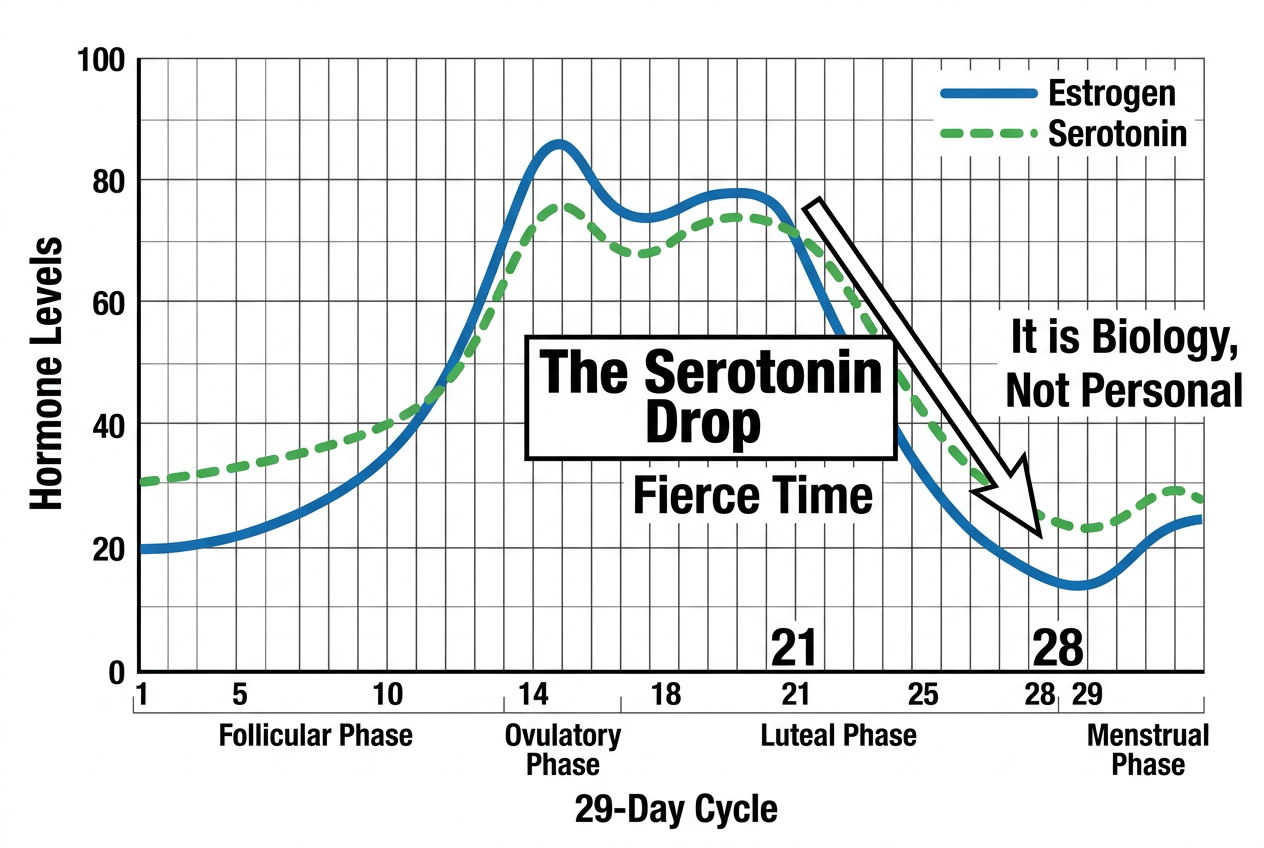 Scientific data shows that mood shifts are often driven by a biological serotonin drop, providing a crucial perspective that helps partners remain empathetic and patient.
How to Actually Predict the Shift: The 3 Best Tools
Predicting mood shifts isn't about guessing - it's about tracking. The menstrual cycle is consistent enough that once you know where she is in the 28-day rotation, you can anticipate what's coming with 80-90% accuracy. The three most effective methods are app syncing, shared calendar tracking, and behavioral pattern recognition. Here's how each works in practice.
Method 1: Partner-Syncing Apps (Highest Accuracy, Lowest Effort)
The most reliable method is using an app designed for partners to receive notifications about cycle phases without requiring her to manually update you. These apps track her cycle in the background, then send you alerts about which phase is starting, what symptoms to expect, and what support she needs.
Best Apps for Men:
| App | Core Feature | Best For | Price |
|---|---|---|---|
| VibeCheck | AI-powered "missions" that translate cycle data into daily tasks (e.g., "Handle dinner tonight - she's in luteal phase") | Men who want tactical, action-oriented guidance | Free basic / $9.99/month premium |
| Clue | Medical-grade tracking with partner-sharing feature; gender-neutral interface | Men who prefer clinical accuracy over relationship coaching | Free basic / $9.99/month premium |
| Flo for Partners | Comprehensive health tracking with doctor-reviewed articles; both partners need accounts | Couples who want deep educational content alongside tracking | Free basic / $39.99/year premium |
| Selin | Minimal interface with notification-only partner mode; she tracks, you get alerts | Men who don't want to engage with the app daily - just receive updates | Free |
The clear advantage of using VibeCheck compared to Flo or VibeCheck compared to Clue is that VibeCheck was built specifically for men in relationships - not as a women's health app with a partner feature bolted on. You get relationship-focused context, not just medical data.
Method 2: Shared Calendar Marking (Low-Tech, High Trust)
If she's not comfortable with app tracking or you want a simpler system, use a shared digital calendar (Google Calendar, Apple Calendar) where she marks Day 1 of her period each month. From there, you can manually calculate the four phases:
- Days 1-5: Menstrual (Winter)
- Days 6-14: Follicular (Spring)
- Days 15-17: Ovulatory (Summer)
- Days 18-28: Luteal (Fall)
Set recurring reminders at Day 18 (luteal phase starts) and Day 1 (period begins) so you're never caught off guard. The downside: you have to remember to check the calendar and calculate phases yourself, which introduces more friction.
Method 3: Behavioral Pattern Recognition (For Advanced Partners)
Once you've tracked her cycle for 2-3 months, you'll start noticing consistent behavioral patterns that signal which phase she's in - even without an app. Common tells:
- Follicular (Spring): She initiates plans, suggests new activities, wants to go out more often.
- Ovulatory (Summer): Higher physical affection, more direct communication, initiates intimacy.
- Luteal (Fall): Quieter, more reflective, mentions being tired, craves comfort food, brings up unresolved issues.
- Menstrual (Winter): Needs more sleep, cancels plans, asks for heating pad or pain relief.
This method requires paying attention over time, but it's the most intimate - because you're learning her unique cycle expression rather than relying on generalized data. Combine it with app tracking for the highest accuracy.
Is There an App for Men to Track Their Partner's Period?
Yes - several apps are now designed specifically for men who want to track their partner's cycle without requiring constant input from her. The best option depends on what kind of information you're looking for: tactical daily guidance, medical accuracy, or relationship insights.
VibeCheck is the only app built exclusively for men in relationships. It doesn't just track her cycle - it tells you what to do about it. Each day, you receive a "mission" based on which phase she's in: handle dinner during the luteal phase, plan a date during the follicular phase, or offer a heating pad during menstruation. The app uses AI to personalize recommendations based on your relationship patterns, so the longer you use it, the more accurate the guidance becomes. VibeCheck's approach to cycle tracking translates biological data into actionable relationship strategy - not just symptom lists.
Clue Connect allows her to share her cycle data with you through a partner account. You'll see when her period is coming, what symptoms she logged, and educational content about each phase. It's medically rigorous but relationship-neutral - it won't tell you how to adjust your behavior, just what's happening biologically.
Flo for Partners requires both of you to have active accounts in the app ecosystem. Once connected, you can view her cycle calendar, read partner-focused articles, and receive notifications about phase transitions. The downside: high friction. Both partners need to engage with the app regularly, which many couples abandon after a few months.
Selin takes the opposite approach: she uses the app to track her cycle, and you get push notifications when key phases start (ovulation, PMS week, period). You never see her data directly - just the alerts. It's the lowest-effort option for men who want awareness without active tracking.
For a detailed breakdown of features, pricing, and use cases, see our complete comparison of the best period tracker apps for men.
Why Does My Girlfriend Get Irritable Right Before Her Period?
Your girlfriend gets irritable before her period because progesterone and estrogen both drop sharply during the luteal phase (Days 18-28), which directly reduces serotonin production in the brain. Serotonin is the neurotransmitter responsible for mood regulation, stress tolerance, and emotional stability. When it drops, her frustration threshold lowers - small annoyances feel bigger, unresolved issues resurface, and she's more likely to express dissatisfaction directly.
This isn't psychological. It's neurochemical. Research shows that estrogen levels correlate with serotonin production, and the ovulatory peak (when estrogen is highest) creates the most stable, positive mood baseline of the entire cycle. By Day 24-28, both hormones have crashed, creating what feels like emotional whiplash compared to the high-energy follicular and ovulatory phases.
The medical term for this pattern is Premenstrual Syndrome (PMS), which affects the majority of menstruating women to some degree. PMS symptoms usually resolve completely within 4 days of the period starting, meaning the irritability window is temporary and hormonally driven. About 3-8% of women experience a more severe form called Premenstrual Dysphoric Disorder (PMDD), which creates clinical-level mood disturbances that interfere with daily functioning and require medical treatment.
Here's what matters for you as a partner: her concerns during the luteal phase aren't invalid just because they're hormonally amplified. If she brings up an issue during PMS week, the issue is real - the timing just reflects lower capacity to tolerate it silently. The worst response is dismissing her feelings as "just hormones." The correct response is validating the concern, addressing it constructively, and recognizing that timing matters for how you handle conflict. Learning what causes mood swings during period means understanding that hormonal shifts affect emotional expression, not emotional truth.
The practical takeaway: don't introduce new stressors, schedule difficult conversations, or expect the same emotional bandwidth during Days 24-28 that you got during Days 6-17. Her standards haven't changed - her biological capacity to handle friction has temporarily decreased.
Communication Masterclass: The "How to Ask" Script
The single most common mistake men make when trying to track their partner's cycle is asking in a way that feels like surveillance - or worse, like you're reducing her to her hormones. The goal isn't to monitor her. It's to support her better. That distinction determines whether this conversation strengthens your relationship or creates a new point of friction.
Here's the script that works, broken into three parts: framing, asking, and reinforcing trust.
Step 1: Frame It as Support, Not Tracking
Open the conversation by naming what you want to improve - not what you think she's doing wrong.
Say This:
"I've been thinking about how I can be more supportive, especially when you're dealing with cramps or low energy. I know your cycle affects how you feel physically and emotionally, and I want to understand that better so I can actually help instead of guessing."
Why It Works: You're centering her experience and positioning yourself as a partner who wants to reduce her load - not someone who wants to explain her moods back to her.
Don't Say This:
"I feel like I can never predict your moods, so I thought tracking your cycle might help me understand what's going on with you."
Why It Fails: This frames her as the problem and the cycle as the explanation for her behavior. It sounds like you're preparing a defense for future arguments.
Step 2: Ask Permission, Don't Assume Access
Give her control over how much information she shares and how she shares it.
Say This:
"Would it be helpful if I used an app to stay aware of your cycle - not to track you, but so I know when to step up with cooking, errands, or just giving you space? I want to support your energy levels, not add another thing to your mental load."
Why It Works: You're asking for consent to help, not demanding access to her health data. She decides what level of visibility feels right.
Don't Say This:
"Can you tell me when your period is coming so I know when to expect mood swings?"
Why It Fails: This positions her cycle as an inconvenience you're preparing to manage, not an opportunity to provide proactive care.
Step 3: Reinforce Trust and Respect Boundaries
Close the conversation by acknowledging that this is her decision and her body.
Say This:
"If this doesn't feel right, we don't have to do it. But if it sounds helpful, I'd like to try it for a month or two and see if it makes things easier for you. You can always change your mind."
Why It Works: You've made it clear this is about her comfort, not your control. She can experiment without feeling locked in.
For more on navigating emotionally sensitive conversations, see our guide on how to improve communication in relationships.
The entire conversation should take less than three minutes. Don't over-explain. Don't justify. Make the offer, give her control, and let her decide how to move forward.
Phase-Specific "Say This, Not That" Guide
The same sentence can land completely differently depending on which phase she's in. What works during the high-energy follicular phase can feel dismissive during the low-serotonin luteal phase. This table shows exactly what to say - and what to avoid - in each of the four seasons.
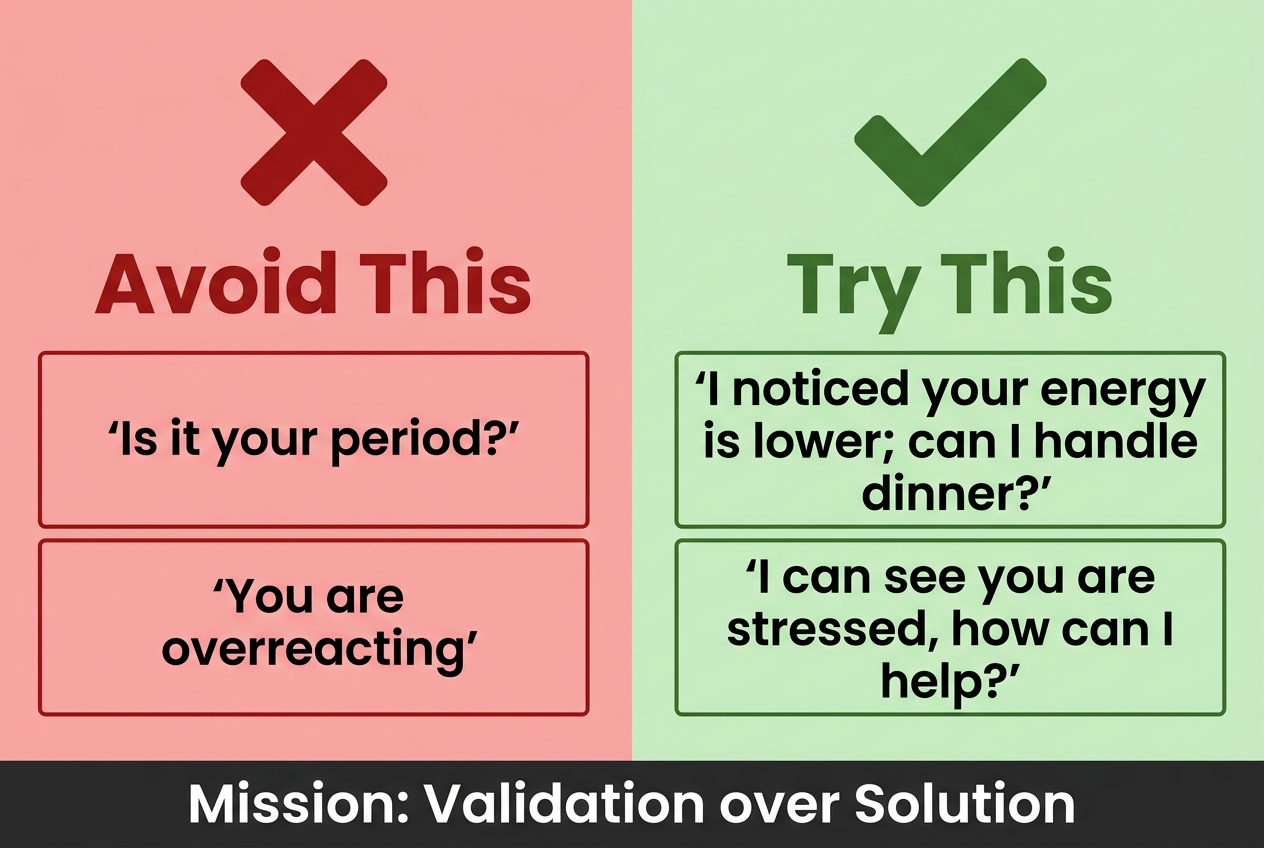 Effective communication requires shifting from 'surveillance' questions to supportive, action-oriented scripts that validate your partner's experience without sounding clinical.
| Phase | Avoid This | Try This | Why It Works |
|---|---|---|---|
| Menstrual (Winter) | "Are you okay? You seem off." | "I'm handling dinner tonight. Want me to grab you a heating pad?" | Don't make her explain her discomfort - just reduce friction and provide comfort without requiring a response. |
| Follicular (Spring) | "You're in a good mood - what changed?" | "You've been full of energy lately. Want to plan something this weekend?" | Match her energy and capitalize on the high-mood window. Don't question why she's feeling good - enjoy it and build on it. |
| Ovulatory (Summer) | Generic compliment: "You look nice today." | Specific appreciation: "I love how confident you've been this week. It's attractive." | She's at peak confidence - acknowledge it specifically rather than offering surface-level validation. |
| Luteal (Fall) | "Are you mad at me?" | "I noticed you've been quieter. Is there anything I can take off your plate this week?" | Don't make her mood about you. Offer tangible support and acknowledge that her capacity is lower without framing it as a problem. |
| Luteal (Fall) | "It's probably just PMS." | "I hear you. Let's figure out how to handle this." | Even if the timing suggests hormonal amplification, dismissing her concerns creates lasting resentment. Validate first, problem-solve second. |
| Any Phase | "Is it that time of the month?" | Nothing. Don't ask. If you're tracking, you already know. | This question has never improved a conversation. If you need to know where she is in her cycle, use an app - don't interrogate her. |
The pattern: every "Try This" statement assumes you already know which phase she's in and adjusts your communication accordingly. That's the advantage of tracking - you can provide cycle-aware support without making her explain her biology to you mid-conversation.
For deeper insights into cycle-aware communication, see our breakdown of how to support your partner during her period.
The Hero's Checklist: 5 Tasks to Take Over During "Fall/Winter"
The luteal and menstrual phases (Days 18-5) are when proactive support has the highest impact. She's managing physical discomfort, hormonal shifts, and lower energy - so the goal is reducing friction and mental load without making it a production. Here are the five highest-value tasks to take over without being asked.
1. Meal Prep and Cooking (The Anti-Inflammatory Mission)
What she's dealing with: Inflammation and cramping peak during menstruation, and certain foods make it worse (red meat, dairy, processed sugar). Anti-inflammatory foods - dark leafy greens, fatty fish, plant-based proteins, dark chocolate - reduce cramping and improve energy.
Your move: Handle dinners for the last week of her cycle. Stock the fridge with pre-chopped veggies, prep one-pot meals, or order from restaurants that offer salmon bowls, grain bowls, or Mediterranean options. Don't make her meal-plan or grocery shop during this phase.
Practical Example: Sunday before Day 24, prep three dinners: baked salmon with roasted sweet potatoes, quinoa and black bean bowls, and a sheet-pan chicken with Brussels sprouts. Store them in the fridge. She eats without cooking.
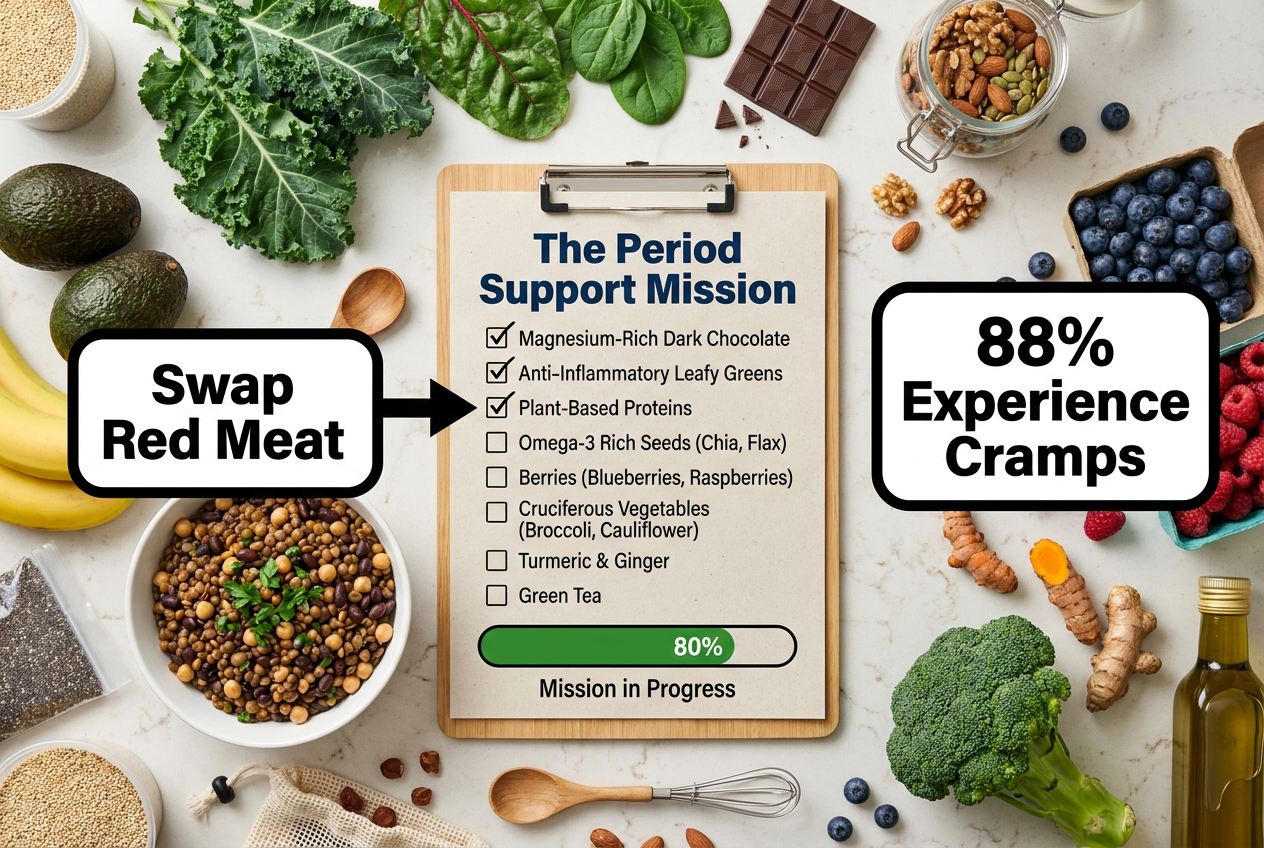 Taking over the 'Anti-Inflammatory Mission' by preparing meals that reduce cramps is a high-value way to support your partner during the 'Winter' phase.
2. Household Tasks (The Domestic Support Drop)
What she's dealing with: Executive function declines during the luteal phase due to lower serotonin. Tasks that felt manageable during the follicular phase - laundry, dishes, tidying - now feel overwhelming.
Your move: Take over the visible household tasks without negotiation. Don't ask "What can I help with?" - just do laundry, clean the kitchen, take out trash, and restock essentials (toilet paper, paper towels, period products). The goal is eliminating decision fatigue.
Practical Example: Set a recurring calendar reminder for Day 24 labeled "Domestic Drop." Check the list: laundry done, kitchen clean, groceries stocked, bathroom tidy. She shouldn't have to manage you through it.
3. Social Calendar Management (The Cancellation Cover)
What she's dealing with: Social energy tanks during Days 24-5. Events that sounded fun two weeks ago now feel exhausting. She'll cancel plans, which creates guilt on top of fatigue.
Your move: Offer to cancel or reschedule non-essential commitments on her behalf. If you have joint plans with friends or family during her period week, give her an out without making her explain.
Practical Example: "We have dinner with my parents Friday. If you're not feeling up to it, I'll reschedule and tell them we're swamped. No pressure."
4. Conflict De-escalation (The Validation Protocol)
What she's dealing with: Lower frustration tolerance means unresolved issues surface more easily. She's not inventing problems - she's less able to tolerate existing ones silently.
Your move: When conflict arises during the luteal phase, de-escalate rather than defending yourself. Validate the concern first, table the full discussion if needed, and revisit during the follicular phase when both of you have higher bandwidth.
Practical Example: She brings up a recurring issue on Day 26. Instead of debating, say: "You're right, this has been a pattern. Let's talk through it this weekend when we both have more space to focus." Then actually schedule the conversation.
For advanced conflict resolution strategies, see relationship conflict resolution strategies for men.
5. Physical Comfort Without Asking (The Heating Pad Protocol)
What she's dealing with: Up to 88% of women experience cramping during menstruation, which impairs concentration and increases irritability. Ibuprofen helps, but so does heat.
Your move: Keep a heating pad accessible and offer it the day her period starts without making her ask. Stock ibuprofen, have dark chocolate on hand, and create low-effort comfort (Netflix queue ready, couch prepped with blankets).
Practical Example: Day 1 of her period, you come home with ibuprofen, dark chocolate, and dinner already handled. Heating pad is plugged in. She doesn't have to manage her own comfort while managing cramps.
The pattern across all five: you're reducing the number of decisions she has to make and tasks she has to execute during the week when her capacity is lowest. That's what "being supportive" actually means in practice.
Common Pitfalls: What NEVER to Say During a Mood Shift
Even well-intentioned men make verbal landmines during hormonally sensitive phases. These phrases feel neutral or even supportive in the moment - but they invalidate her experience, dismiss her concerns, or frame her biology as a problem you're managing instead of a reality you're supporting. Here are the five most common mistakes and why they fail.
1. "It's just your hormones."
Why it fails: This dismisses her concerns as chemically invalid rather than addressing them. Even if hormones are amplifying the issue, the issue itself is still real. Saying this tells her you're not taking her seriously.
What to say instead: "I hear you. Let's figure out how to handle this." Validate first, problem-solve second.
2. "Are you on your period?"
Why it fails: This weaponizes her cycle against her in an argument. It implies her feelings are only worth addressing if they're not hormonally influenced - which is never true. Hormones affect emotional expression, not emotional validity.
What to say instead: Nothing. If you're tracking her cycle, you already know where she is. If you're not tracking, this question won't improve the conversation.
3. "You were fine yesterday - what changed?"
Why it fails: This frames mood shifts as inconsistency on her part rather than recognizing that her baseline changes across the cycle. What felt manageable during the follicular phase feels overwhelming during the luteal phase. That's not inconsistency - that's biology.
What to say instead: "I noticed you've been quieter. Is there anything I can take off your plate this week?" Acknowledge the shift without demanding she justify it.
4. "I'm just trying to help."
Why it fails: This centers your intentions instead of her experience. She doesn't care that you meant well if the execution felt dismissive or controlling. Defensiveness during conflict escalates tension - especially during the luteal phase when frustration tolerance is already low.
What to say instead: "You're right, that didn't land the way I wanted. What would be more helpful?" Accept the feedback and adjust.
5. "Should I just avoid you this week?"
Why it fails: This frames her luteal or menstrual phase as something you have to endure rather than an opportunity to provide proactive support. It positions her biology as a burden to you - which guarantees resentment.
What to say instead: "What do you need from me this week - more space, more help, or just normal routine?" Let her define what support looks like rather than assuming withdrawal is the answer.
The underlying rule: never use her cycle as an explanation for dismissing her feelings. Hormones influence how she expresses concerns - not whether those concerns are valid. The men who get this right don't avoid conflict during sensitive phases - they navigate it with more care, patience, and awareness that timing affects how conversations land.
For more on what never to say in relationships, see our guide on how to apologize to your girlfriend.
Ready to actually understand her?
Join thousands of men using VibeCheck to track her cycle and show up better every day.
Get VibeCheck FreeFrequently Asked Questions
Can my feelings about my partner change with her period cycle?
Yes - research shows that partners often unconsciously mirror hormonal shifts in relationships, particularly around ovulation and menstruation. During her ovulatory phase (Days 15-17), you may feel more attracted to her due to peak estrogen levels increasing her confidence, physical appearance, and social engagement. Conversely, during the luteal phase (Days 24-28), you may feel more distant or defensive as her lower serotonin levels increase irritability and conflict frequency. The key is recognizing that these shifts are temporary and biologically driven, not signs of relationship failure. Couples who track the cycle together report higher satisfaction because they can contextualize mood changes rather than personalizing them.
How to track your partner's period cycle without being invasive?
The most respectful method is using a partner-syncing app like VibeCheck, Selin, or Clue Connect, where she tracks her cycle in her own app and you receive notifications about phase transitions without accessing her health data directly. This maintains her privacy while giving you actionable awareness. Alternatively, use a shared digital calendar where she marks Day 1 of her period each month, and you calculate phases from there. The critical step is asking permission first - frame it as wanting to provide better support, not monitor her biology. For step-by-step guidance on initiating this conversation, see our complete guide on using a period tracker for partners.
What's better, Flo or Clue for men who want to support their partners?
Clue is better for men who want medical accuracy and minimal relationship coaching - it provides precise cycle tracking, symptom logging, and educational articles without gender-specific framing. Flo is better for couples who both want to engage deeply with the app ecosystem and prefer comprehensive health content, but it requires both partners to maintain active accounts. For men who want tactical, relationship-focused guidance instead of clinical data, VibeCheck outperforms both by translating cycle phases into daily missions and communication scripts. Compare all three in detail at our VibeCheck vs Clue breakdown.
Is it normal for my girlfriend's period to be late or irregular?
Yes - cycle variance of ±8 days from month to month is considered medically normal and does not necessarily indicate a health issue. Stress is the most common cause of late or irregular periods because elevated cortisol (the stress hormone) disrupts the hormonal signals that trigger ovulation and menstruation. Other common factors include travel, significant weight changes, intense exercise, illness, or starting/stopping hormonal birth control. If her period is consistently irregular (more than 10 days variance) or absent for 3+ months without pregnancy, she should consult a healthcare provider to rule out conditions like PCOS or thyroid dysfunction. For more on stress and cycle disruptions, see can stress delay your period.
What are the "high energy" days in a menstrual cycle for date planning?
The highest energy days are Days 6-17, which cover the follicular phase (Spring) and ovulatory phase (Summer). During this window, estrogen and serotonin are both elevated, creating peak mood, physical energy, and openness to new experiences. This is the best time to plan adventurous dates, introduce relationship conversations, travel, or try new activities together. Avoid scheduling high-effort plans during Days 24-5 (luteal and menstrual phases), when energy and social tolerance are lowest. If you want to maximize connection, plan your most meaningful dates during her follicular phase - she'll be at her most receptive, energetic, and optimistic baseline.
What is the difference between PMS and PMDD for a partner to know?
PMS (Premenstrual Syndrome) affects the majority of menstruating women and includes physical symptoms like bloating, cramps, and fatigue alongside emotional symptoms like irritability, sadness, or anxiety during the luteal phase (Days 18-28). These symptoms are manageable and typically resolve within 4 days of the period starting. PMDD (Premenstrual Dysphoric Disorder) is a much rarer and more severe condition affecting 3-8% of women, characterized by clinical-level mood disturbances - severe depression, hopelessness, panic attacks, or suicidal ideation - that interfere with daily functioning. PMDD requires medical treatment, often involving antidepressants or hormonal therapy. If your partner's luteal phase symptoms are severe enough to disrupt work, social life, or safety, encourage her to consult a healthcare provider for a PMDD evaluation.
What foods help reduce period cramps and what should I cook for her?
Anti-inflammatory foods reduce cramping by lowering prostaglandin production, which is the hormone that triggers uterine contractions. The best foods to stock and cook during Days 24-5 are fatty fish (salmon, mackerel), dark leafy greens (spinach, kale), plant-based proteins (lentils, chickpeas, tofu), whole grains (quinoa, brown rice), and dark chocolate (70%+ cacao). Avoid red meat, dairy, processed sugar, and fried foods - all of which increase inflammation and worsen cramping. Practical meal examples: baked salmon with roasted sweet potatoes, quinoa bowls with black beans and avocado, vegetable stir-fry with tofu over brown rice, or lentil soup with whole-grain bread. Hydration also matters - encourage water and herbal teas (ginger, chamomile) to reduce bloating.
How do I ask my girlfriend if I can track her cycle without sounding creepy?
Frame the conversation around support, not surveillance. Start with: "I've been thinking about how I can be more supportive, especially when you're dealing with cramps or low energy. Would it be helpful if I used an app to stay aware of your cycle - not to track you, but so I know when to step up with cooking, errands, or just giving you space?" Give her full control over whether to share cycle data, how much information she's comfortable with, and the ability to opt out anytime. Never say "I want to track your cycle to understand your moods" - that centers your experience rather than hers and frames her biology as a problem to manage. For the complete conversation script, see how to ask about tracking her cycle.
Final Thought: Most men approach their partner's cycle as a mystery to decode or a landmine to avoid. The reality is simpler: it's a predictable biological pattern that creates measurable shifts in mood, energy, and needs across four distinct phases. Once you understand the pattern - and adjust your support accordingly - you stop guessing and start leading. That's what separates reactive partners from the ones she didn't know she needed.
If you want to stop walking on eggshells and start providing the kind of proactive support that eliminates friction before it starts, try VibeCheck. It's the only relationship app built specifically for men who want to understand their partner's cycle and translate that understanding into daily action. Track her phases, receive tactical missions, and become the partner who shows up before being asked.
Tags

Related Articles
Continue reading to deepen your understanding

How to Support Your Girlfriend During Menstrual Cycle Phases
Master the 4 menstrual cycle phases to better support your girlfriend. Learn tactical tips to handle mood swings, fatigue, and energy shifts with ease.

How to Comfort Your Girlfriend During PMS: The Proactive Partner’s Guide
When the serotonin crash hits, your girlfriend isn’t just moody—her body is going through a chemical withdrawal. Learn how to provide proactive support without her having to ask.

Why Your Girlfriend’s Mood Changes Throughout the Month: The Four Seasons Framework
Does your girlfriend’s mood seem to shift for no reason? Discover the biological Four Seasons framework that explains her monthly cycle and how to be the partner she needs right now.

Support Your Girlfriend: Follicular Phase Weekend Guide
Discover how to support your girlfriend during her follicular phase weekend. Learn to match her high energy, plan the perfect dates, and build a stronger bond.

How to Comfort Your Girlfriend During PMS: The Ultimate Partner’s Guide
PMS doesn’t just affect her; it affects your relationship too. Learn how to navigate mood shifts and physical pain with empathy, validation, and practical support tactics.

How to Support Your Girlfriend Through Period Mood Swings: A Man’s Guide
Does your relationship hit a wall every month? Understand the biological steep drop window and learn exactly how to provide the right support when your partner needs it most.

The Boyfriend’s Guide to Her Cycle: Navigating Mood Swings and Energy Shifts
Understand the 28-day pattern behind her moods. This guide explains the four hormonal phases so you can stop walking on eggshells and start being the partner she actually needs.

How to Understand Girlfriend Hormonal Mood Swings
Stop taking it personally. Master the science behind her cycle, the 4-phase breakdown, and the best strategies to support her through hormonal mood swings.