How to Support Your Girlfriend Through Luteal Phase Fatigue

Is your partner suddenly exhausted and irritable before her period? Understand the biology behind her fatigue and learn tactical ways to provide real support during the luteal phase.
When Your Girlfriend Is Exhausted Before Her Period: The Partner's Tactical Support Guide
Is your girlfriend suddenly drained and irritable in the days leading up to her period? It's not in her head, and it's not about you. After ovulation, the luteal phase begins: progesterone rises to help prepare the uterine lining for a possible pregnancy. If pregnancy doesn't happen, both progesterone and estrogen drop before the next period. Many women notice PMS-like symptoms in this phase - mood shifts, breast tenderness, bloating, acne, and appetite changes. This biological window explains the pre-period energy crash you're witnessing every month.
This guide will show you what's actually happening in her body, why she's running out of fuel faster than usual, and what you can do to support her without making things worse.
Table of Contents
- The Science: Why She's Exhausted During the Luteal Phase
- The Metabolic Reality: Why She Needs More Food
- The Tactical Support Playbook
- Communication Strategy: What to Say and When
- What NOT to Do
- How to Deal With a Spouse With PMDD
- How Long Can Period Fatigue Last
- Frequently Asked Questions
The Science: Why She's Exhausted During the Luteal Phase
The luteal phase is the biological window between ovulation and the start of her next period. For most women, this spans roughly 10 to 14 days. During the follicular phase, estrogen rises as an egg-containing follicle develops in the ovary; this rising estrogen also thickens the uterine lining. Near the end of this phase, high estrogen triggers a surge in luteinizing hormone (LH), which sets off ovulation. After that surge, ovulation is when a surge in luteinizing hormone (LH) causes the ovary to release an egg, typically around day 14 of a 28-day cycle.
Once ovulation happens, progesterone takes over. This hormone prepares the body for potential pregnancy by thickening the uterine lining and shifting the entire system into a higher metabolic state. When pregnancy doesn't occur, both progesterone and estrogen crash in the final days before her period. That crash is what triggers the fatigue, irritability, and mood swings you're seeing.
Estrogen affects many body systems, including brain function and the ability to focus, and levels are highest in the days leading up to ovulation. When estrogen drops sharply after ovulation, serotonin - the brain's "feel-good" neurotransmitter - drops with it. This isn't a personality flaw or a sign she needs to "just relax." It's a measurable chemical change that affects her sleep quality, stress tolerance, and overall energy levels.
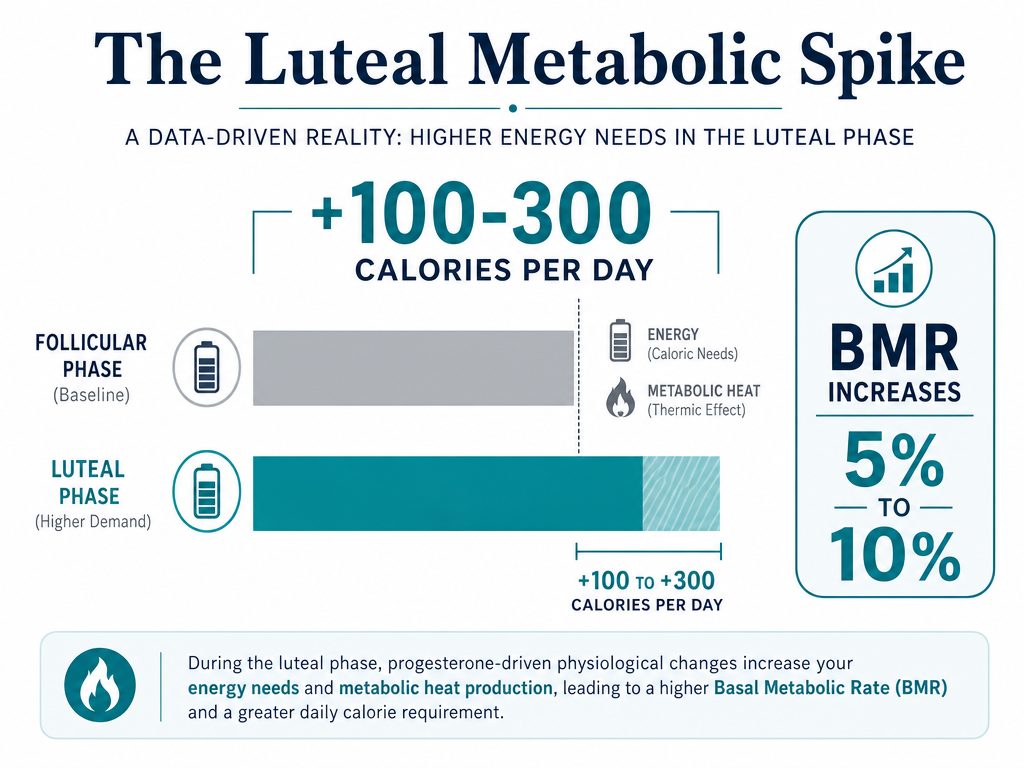
Understanding that your partner's body is literally burning more fuel during this phase helps frame her fatigue and hunger as a biological reality rather than a choice.
VibeCheck App
Download Free on iOS →The Metabolic Reality: Why She Needs More Food
Here's what most guys don't realize: Basal Metabolic Rate (BMR) can increase by 5% to 10% during the luteal phase, burning an extra 100-300 calories per day. Her body is running hotter. She's not "giving in" to cravings - she's compensating for an actual increase in energy expenditure.
Energy intake (calories consumed) is significantly greater in the luteal phase compared to the follicular phase, with one meta-analysis citing an average increase of 260 kcal/day. That's not a character flaw. It's biology.
Think of it this way: her engine is burning fuel at a higher rate, but her fuel tank capacity hasn't changed. If she doesn't eat more, she runs out of gas faster. The result? Fatigue, brain fog, irritability, and low frustration tolerance.
When you understand this, her behavior makes more sense. She's not being difficult when she asks for a snack at 10 PM or seems annoyed that dinner was late. Her blood sugar regulation is more volatile, and she's genuinely running on fumes.
The Tactical Support Playbook
Now that you understand the biology, here's what you can actually do.
The 7-2-1 Rule
This is a simple framework for staying proactive during her luteal phase:
- 7 hours of sleep for you so you don't snap back when she's irritable.
- 2 small chores she usually does - take them off her plate without being asked.
- 1 low-pressure evening - cancel the double date or the crowded event. Give her space to rest.
This isn't about doing everything for her. It's about reducing the small friction points that compound when her stress tolerance is already low.
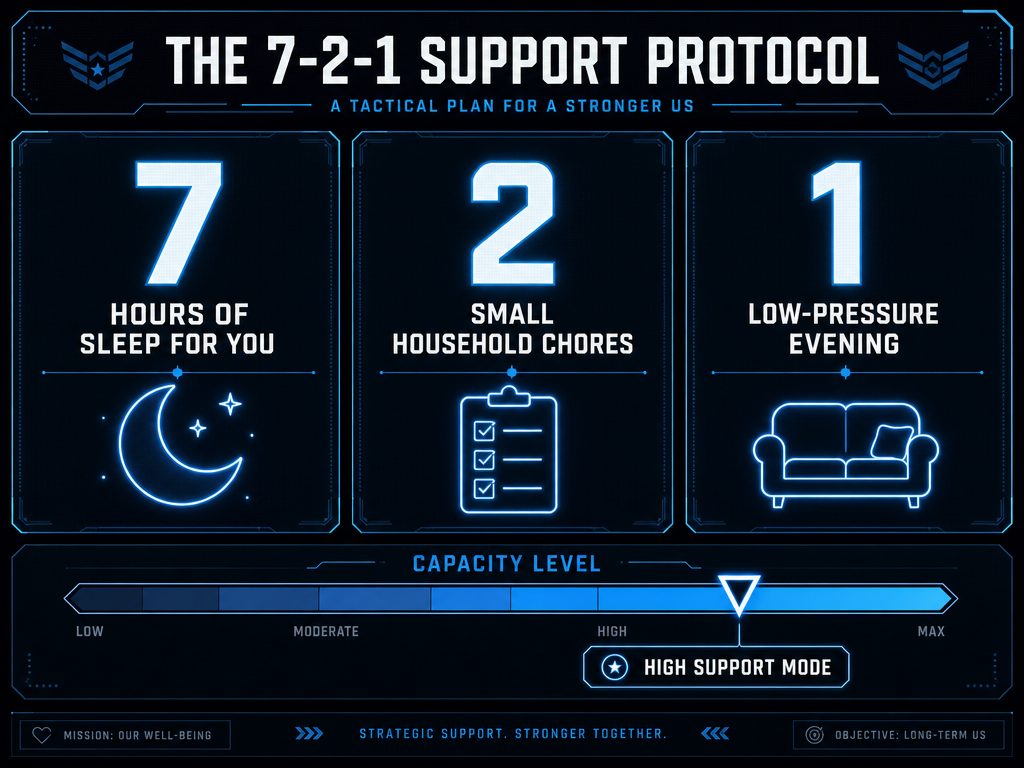
The 7-2-1 Rule provides a concrete framework for partners to maintain their own energy while proactively reducing their partner's mental and physical load.
Meal Prep and Food Support
Lifestyle approaches that can help ease PMS symptoms include regular aerobic exercise, smaller/more frequent meals, less salt/caffeine/alcohol, adequate sleep, and stress-reduction practices like deep breathing or yoga. You can't control her hormones, but you can remove decision fatigue around meals.
Stock the fridge with foods that stabilize blood sugar:
- Complex carbs (oats, sweet potatoes, whole grains)
- Lean proteins (chicken, fish, eggs, Greek yogurt)
- Healthy fats (avocado, nuts, olive oil)
- Dark chocolate (yes, really - it helps with serotonin)
Avoid asking "What do you want for dinner?" when she's already depleted. Instead, say: "I'm handling dinner tonight. I'll make pasta and a salad so you can rest."
The Invisible Helper Strategy
Don't ask "What can I do?" That question adds mental load. She has to think about what needs doing, communicate it to you, and then follow up to make sure it's done. That's three tasks, not zero.
Instead, pick something from her usual routine and just do it. Dishes. Laundry. Tidying the living room. Grocery pickup. She'll notice, and you won't have made her manage you in the process.
Communication Strategy: What to Say and When
The Baseline Test
Don't bring up major relationship issues during her luteal phase. A "normal" cycle varies a lot between women - menstrual bleeding can start anywhere from every 24 to every 38 days and last up to 8 days. Once you know her pattern, aim for days 5-10 of her cycle - the early to mid-follicular phase - for serious conversations. That's when her serotonin and estrogen levels are rising, giving her more capacity for problem-solving and emotional resilience.
The Safe-Word Framework
When an argument escalates during the luteal phase, you need a circuit breaker. Introduce a neutral word - something like "Lighthouse" - that either of you can say to signal: "We're both flooded. Let's take 20 minutes and come back."
This isn't avoidance. It's recognition that when her progesterone levels are crashing, her nervous system is more reactive. A short break lets her brain chemistry settle so you can actually resolve the issue instead of making it worse.

Utilizing a safe-word framework like 'Lighthouse' allows couples to pause arguments when biological capacity is low, deferring heavy conversations to more stable windows.
Low Capacity Language
Learn to recognize statements like "I don't have the bandwidth for this" or "I can't deal with that right now" as biological statements, not personal rejections. She's not saying you're unimportant. She's saying her nervous system is maxed out and she can't process another demand.
The right response: "Got it. We'll table it until you're ready."
What NOT to Do
These are the conversational landmines that will make things worse:
- Never say: "Is it that time of the month?" Even if you're genuinely trying to understand, this phrase feels dismissive and reductive.
- Never say: "You're just being emotional." Her emotions are real, and they're caused by measurable chemical changes.
- Don't try to fix her fatigue with logic. Suggestions like "Maybe if you drank more coffee" or "Have you tried working out?" ignore the fact that her body is in a different metabolic state. She doesn't need optimization tips. She needs rest.
- Don't take her irritability personally. She's not angry at you. She's dealing with a serotonin crash that makes everything feel more overwhelming.
How to Deal With a Spouse With PMDD
Research shows that PMDD affects an estimated 4%-8% of women of reproductive age. If your partner is experiencing severe depressive episodes, panic attacks, or suicidal thoughts in the week before her period, this isn't standard PMS. She needs clinical evaluation.
PMDD requires medical intervention. Encourage her to see a healthcare provider who specializes in reproductive mental health. Treatment options include SSRIs, hormonal birth control, or cognitive behavioral therapy designed for PMDD.
Your role as a partner:
- Take her symptoms seriously and validate that they're real.
- Help track her cycle so patterns become clear.
- Support her in seeking professional help.
- Learn the difference between "normal" luteal phase irritability and PMDD-level crisis.
- Have a safety plan if she experiences suicidal ideation.
If you're unsure whether her symptoms cross into PMDD territory, encourage her to track symptoms for two full cycles. If the severe mood symptoms consistently show up in the week before her period and resolve within a few days after it starts, that's the pattern doctors look for.
How Long Can Period Fatigue Last
Period fatigue typically spans two distinct windows:
The luteal phase crash (7-10 days before her period): This is when progesterone is high and then crashes. Fatigue during this window is often accompanied by bloating, breast tenderness, irritability, and food cravings.
The menstrual phase (bleeding days, usually 3-7 days): The menstrual cycle has four phases - menstrual (bleeding, ~day 1-5), follicular (day 1 through ovulation, estrogen rising), ovulation (around day 14 in a 28-day cycle, triggered by a surge in luteinizing hormone), and luteal (after ovulation to the next period, progesterone rising then falling). During bleeding, her body is shedding the uterine lining, which is physically taxing. Low iron levels can compound fatigue if her bleeding is heavy.
So in total, period-related fatigue can last anywhere from 10 to 17 days per cycle when you combine the luteal phase and the menstrual phase. That's more than half the month.
For most women, energy starts to return in the early follicular phase (days 5-10), when estrogen begins rising again. By ovulation, many women report feeling their best - higher energy, better mood, and increased motivation.
If her fatigue is severe, unrelenting, or accompanied by other symptoms like dizziness or shortness of breath, she should get her iron and thyroid levels checked. Those are common culprits when fatigue extends beyond the expected windows.
Frequently Asked Questions
How to help your wife during the luteal phase?
Focus on reducing her cognitive and physical load. Don't ask what she needs - just handle a few tasks she normally does. Stock high-protein snacks. Create quiet, low-pressure evenings where she can rest. Avoid scheduling demanding social events during this window. Use the 7-2-1 Rule: get 7 hours of sleep yourself, take on 2 of her usual chores, and plan 1 low-key evening.
How to feel better emotionally on your period?
Tracking your own (or a partner's, with her participation) symptoms and mood changes across the cycle for a few months is a legitimate, medically endorsed way to identify real patterns and timing - rather than assuming based on stereotypes or a single cycle. Once you know when symptoms typically start, you can plan ahead. Prioritize sleep, reduce caffeine and alcohol, eat smaller/more frequent meals with complex carbs and protein, and build in time for gentle movement like yoga or walking. If you're supporting a partner, encourage these habits without being preachy.
What's the difference between normal PMS and something more serious?
PMS (premenstrual syndrome) is very common: as many as 3 in 4 women report experiencing PMS symptoms at some point in their life, though severity varies widely. Roughly half of people who menstruate report having at least one PMS symptom, but only about 1 in 5 have symptoms severe enough to disrupt their daily life. If her symptoms prevent her from going to work, maintaining relationships, or functioning day-to-day, that's not typical PMS. Encourage her to track symptoms and see a healthcare provider.
Can I track her cycle without being creepy?
Yes, but only with her consent and participation. Tracking your own (or a partner's, with her participation) symptoms and mood changes across the cycle for a few months is a legitimate, medically endorsed way to identify real patterns and timing. The goal is to use that information to adjust your own behavior - planning low-key dates during her luteal phase, avoiding big conversations when her serotonin is low, stocking her favorite snacks. It's not about policing her or treating her like a science experiment. It's about becoming a more attuned partner.
Why does she keep wanting to break up with me during this week?
The luteal phase amplifies existing relationship concerns. If there's an unresolved issue, it'll feel more urgent and unbearable when her serotonin is low. That doesn't mean the concern is invalid - it means her capacity to tolerate ambiguity or discomfort is reduced. Wait until her follicular phase (days 5-10) to revisit the conversation. If the same concerns come up then, they're probably real and need addressing. If they evaporate, they were likely magnified by the hormone crash.
Understanding your girlfriend's luteal phase fatigue isn't about excusing bad behavior or walking on eggshells forever. It's about recognizing that her body goes through a predictable biological loop every month, and you can either work with that loop or fight it. When you understand the science, you stop taking her moods personally. You become the partner who knows when to step up, when to give space, and when to simply keep the fridge stocked and the house quiet.
For more tactical support strategies, check out our guide on how to support your girlfriend during the luteal phase and learn how to tell which cycle phase your girlfriend is in using behavioral cues. If you want to understand the full 28-day pattern, read our boyfriend's guide to the menstrual cycle phases. And if you're looking for tools that turn cycle data into daily actionable guidance, explore our period tracker for men to stop guessing and start supporting with precision.
Tags

Related Articles
Continue reading to deepen your understanding

When Your Girlfriend Needs Attention During the Follicular Phase: A Tactical Guide for Partners
If your girlfriend is seeking more connection lately, it isn’t a problem—it is biological. Discover how her follicular phase affects her social drive and exactly when she needs your presence.

Your Girlfriend Is Withdrawn During Ovulation? What It Actually Means and How to Respond
Is your girlfriend suddenly distant mid-cycle? This guide covers the biological causes of ovulation withdrawal and how to support her with an invisible framework.

When Your Girlfriend Is Sensitive to Criticism During the Luteal Phase: The Partner’s Science-Based Action Guide
Does your partner react intensely to feedback right before her period? Understand the biology behind luteal phase rejection sensitivity and learn how to communicate effectively.

How to Give Your Girlfriend Reassurance During the Follicular Phase: A Partner’s Tactical Guide
Is your girlfriend feeling vulnerable after her period? Learn why the early follicular phase causes emotional lows and how you can provide the specific reassurance she needs to feel secure.

Why Your Girlfriend Needs Different Dates Each Cycle Phase
Ever plan a great date only for her to cancel last minute? Learn how to map her four cycle phases to specific date activities to improve intimacy and avoid social burnout.

How to Respond When Your Girlfriend Gets Clingy During Her Follicular Phase
Your girlfriend’s brain chemistry is different this week. Rising estrogen levels cause social drive to peak. Here is how to respond to her need for connection effectively.

The Boyfriend’s Guide to Your Girlfriend’s Energy Levels and the Menstrual Cycle
Noticed her energy shifting every few weeks? Stop guessing and start supporting. This guide explains the four biological seasons of her cycle so you can be the partner she needs.

Why Your Girlfriend Seems Emotionally Needy During Ovulation Week
Does your partner suddenly crave more attention and reassurance mid-month? It is not insecurity—it is biology. Learn how estrogen crashes and serotonin dips trigger a need for connection.