When Your Girlfriend Needs Attention During the Follicular Phase: A Tactical Guide for Partners

If your girlfriend is seeking more connection lately, it isn’t a problem—it is biological. Discover how her follicular phase affects her social drive and exactly when she needs your presence.
When Your Girlfriend Needs Attention During the Follicular Phase: A Partner's Tactical Guide
She wants your attention more than usual, but it's not because anything's wrong. If you've noticed your girlfriend seeking connection, asking for reassurance, or craving your company during certain weeks, you're probably witnessing the follicular phase at work. This isn't a problem to fix - it's a biological window to understand.
The follicular phase is the stretch between the first day of her period and ovulation, typically lasting about 14 days in a 28-day cycle. During this time, estrogen rises from its lowest point to its peak, driving significant shifts in mood, energy, and social drive. What looks like neediness is often her body preparing for peak connection and collaboration.
This guide will help you understand exactly when and how to give attention during each stage of the follicular phase, so you can stop guessing and start supporting her with intention.
Table of Contents
- Understanding the Follicular Phase: Biology for Boyfriends
- The 3 Stages of Follicular Attention
- Why She Needs More Attention Now: The Biological Whys
- The "When to Give" Cheat Sheet
- How This Is Different From the Luteal Phase
- The Repair Framework: Using the Follicular Phase to Heal Past Conflicts
- Frequently Asked Questions
Understanding the Follicular Phase: Biology for Boyfriends
The follicular phase begins on the first day of menstruation and continues until ovulation, when a surge in luteinizing hormone triggers the release of an egg. Most health content presents this as the "happy phase" or the "high-energy phase," but that oversimplifies a complex biological transition.
Estrogen levels start at their absolute floor on day 1, which means the beginning of the follicular phase often overlaps with physical exhaustion, emotional vulnerability, and sometimes lingering tension from the previous week's premenstrual symptoms. The "high energy" reputation comes from the later half of this phase, as estrogen climbs and the body prepares for ovulation.
What matters for you as a partner is this: her need for attention isn't constant across these 14 days. It shifts dramatically based on where she is in the biological arc.
VibeCheck App
Download Free on iOS →The 3 Stages of Follicular Attention
Breaking the follicular phase into three distinct windows helps you understand when she needs safety, when she needs reconnection, and when she's ready for adventure.
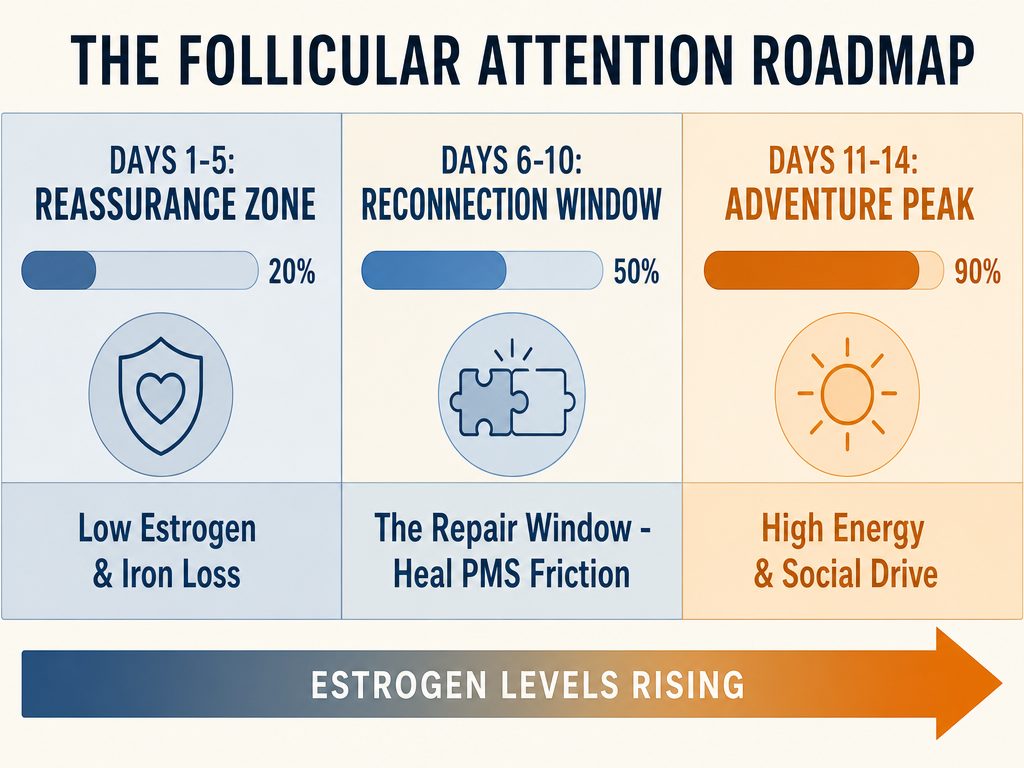 This roadmap helps partners identify the specific emotional and social needs of their girlfriend as she transitions from menstruation to peak ovulation energy.
Stage 1: The Reassurance Zone (Days 1-5)
This is when her period starts. Estrogen is at rock bottom, and if she experienced PMS or mood disruption the week before, she's still recovering from that hormonal crash.
What she needs: Safety and stability. Her nervous system is on edge, her energy is depleted, and she might feel physically vulnerable. This isn't the time for grand gestures or surprises - it's the time for quiet, reliable presence.
What attention looks like:
- Handle logistics without being asked (dinner, errands, tidying up)
- Offer verbal reassurance: "I'm not going anywhere" or "We're good"
- Provide physical comfort like a heating pad, her favorite snacks, or just sitting close while she rests
- Don't take it personally if she seems withdrawn - her body is recovering
The iron factor: Approximately 35% of women of reproductive age in the U.S. have low iron stores, which worsens during menstruation as blood loss depletes iron further. Low iron isn't just physical fatigue - correcting iron deficiency can significantly reduce symptoms of anxiety and depression. Offering iron-rich foods (red meat, dark leafy greens, fortified cereals) or simply understanding that her exhaustion has a biological basis shows you're paying attention without needing to fix everything.
Stage 2: The Reconnection Window (Days 6-10)
Her period has likely ended or is ending. Estrogen is rising steadily, and with it, her mood and energy begin to stabilize. This phase is often called the "repair window" because rising estrogen supports better mood regulation and cognitive function, making it the optimal time to address unresolved tension.
What she needs: Reconnection and emotional repair. If there were fights, misunderstandings, or tension during her luteal phase (the week before her period), now is when her brain chemistry supports forgiveness and constructive conversation.
What attention looks like:
- Initiate low-pressure quality time - a walk, cooking together, or watching something she enjoys
- Apologize for conflicts that happened during her PMS window (you'll learn more about this in The Repair Framework)
- Ask open-ended questions: "How are you feeling this week?" or "What's been on your mind?"
- Plan simple dates that prioritize conversation over intensity
Why timing matters: You might have tried to talk through a problem last week and hit a wall. That's because PMS symptoms, which can include mood swings and irritability, affect as many as 3 in 4 women at some point in their life. During the luteal phase, her serotonin and energy reserves are depleted. Now, in the reconnection window, her brain is biologically more equipped to process emotion and rebuild trust.
Stage 3: The Adventure Peak (Days 11-14)
This is the final stretch before ovulation. Estrogen levels reach their highest point, and many women experience a noticeable surge in energy, confidence, and social drive. Ovulation symptoms can include increased sex drive, mood changes, and a general sense of vitality, though these vary widely.
What she needs: Matching energy and social validation. She's not just seeking attention - she wants to share her peak energy with you. This is when she's most likely to suggest plans, initiate physical intimacy, or want to be seen and admired.
What attention looks like:
- Plan high-effort dates: new restaurants, concerts, outdoor adventures, or social events
- Match her enthusiasm - don't dismiss her ideas as "too much"
- Offer compliments and verbal affirmation (she's more receptive to praise during this window)
- Prioritize physical intimacy if that's part of your relationship language
- Be present and engaged when she wants to talk or share ideas
The social drive distinction: She's not "clingy" during this phase - she's experiencing a biological peak in prosocial behavior. Her brain is wired for connection, collaboration, and seeking out stimulating experiences. If you interpret this as neediness, you'll miss the opportunity to connect during her most energized window.
Why She Needs More Attention Now: The Biological Whys
The follicular phase is a transition from the lowest hormonal point in her cycle to the highest. Understanding the "why" behind her shifting needs helps you respond with empathy instead of defensiveness.
The Estrogen Floor (Days 1-5): When estrogen drops to its baseline, so does serotonin - the neurotransmitter that stabilizes mood. This is why she might seem fragile, anxious, or emotionally raw at the start of her period. Her nervous system is more sensitive to perceived threats, including relationship uncertainty. Reassurance isn't indulging insecurity; it's addressing a real biological vulnerability.
The Iron Gap (Days 1-5): Blood loss during menstruation depletes iron stores, which directly affects energy levels and emotional regulation. Correcting iron deficiency can significantly reduce symptoms of anxiety and depression. Offering her iron-rich foods or simply acknowledging that her fatigue is real (not laziness) shows you understand the biology at play.
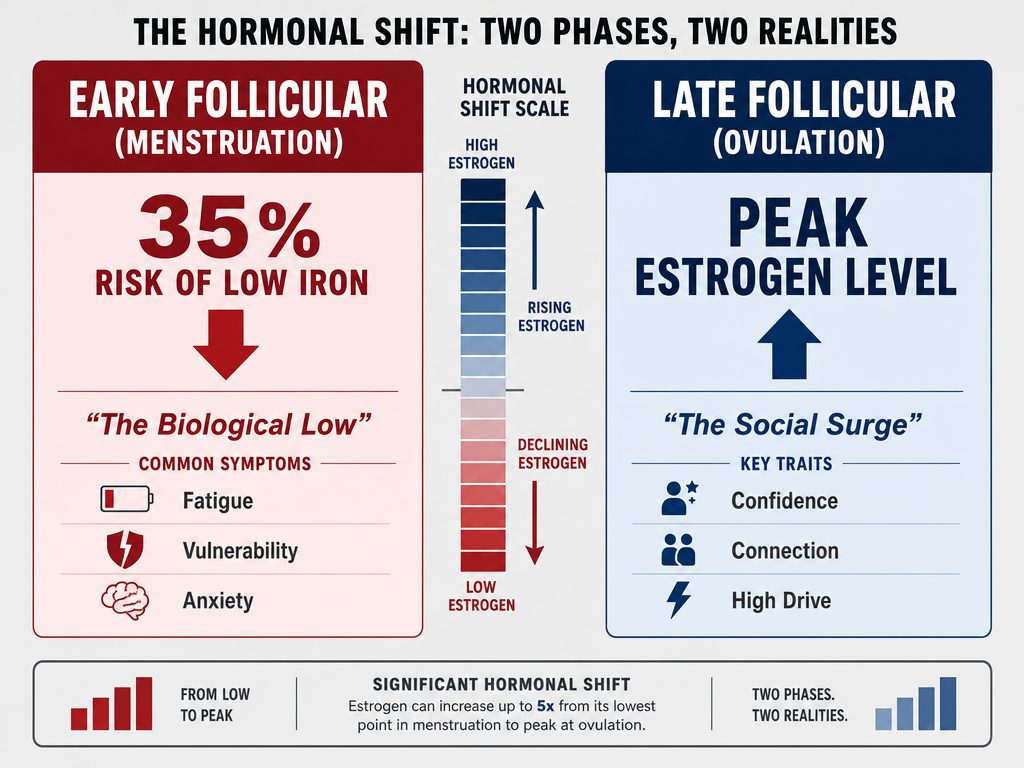 Comparing the early biological low to the late social surge provides partners with the 'why' behind shifting needs for reassurance versus adventure.
The Repair Chemistry (Days 6-10): As estrogen rises, it supports better executive function, emotional regulation, and stress resilience. This is why conversations that felt impossible last week suddenly feel productive. Her brain chemistry is literally supporting connection and problem-solving.
The Social Surge (Days 11-14): Peak estrogen doesn't just affect mood - it drives social behavior. Research suggests that women may experience heightened confidence and social engagement near ovulation. If she suddenly wants to spend more time with you, make plans with friends, or try new things, it's not random - it's biology optimizing for connection and collaboration.
The "When to Give" Cheat Sheet
Knowing the general pattern is helpful, but what do you actually do when she's standing in front of you? Here's a tactical breakdown.
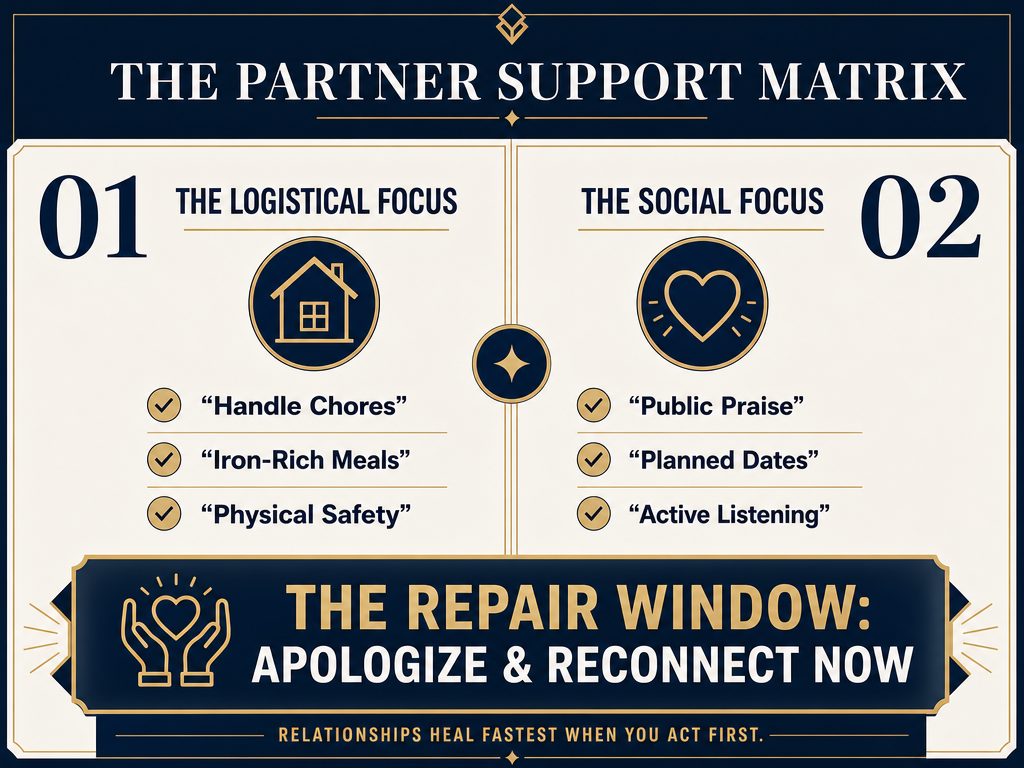 Use this matrix to determine whether your partner needs logistical support to ease physical fatigue or social validation to match her rising energy levels.
Give Proactively If She:
- Asks indirect questions like "Are we okay?" or "Do you still think I'm...?"
- Seems withdrawn or quieter than usual during Days 1-5
- Initiates plans or suggests activities during Days 11-14
- Mentions feeling tired, crampy, or physically uncomfortable
Give Physical Touch (Non-Sexual) If:
- She's in Days 1-5 and her body language suggests discomfort
- She leans into you, sits close, or initiates casual touch
- She's stressed or anxious (touch can ground the nervous system)
Important: Don't assume physical touch is always welcome. Some women experience breast tenderness, bloating, or pelvic discomfort around ovulation, so check in before assuming she wants to be held.
Give Social Validation If:
- She's in Days 11-14 and wants to make plans or go out
- She's talking more than usual or sharing ideas enthusiastically
- She's dressing up, putting effort into her appearance, or initiating intimacy
- She suggests trying something new or stepping outside her routine
Give Space (But Stay Available) If:
- She explicitly asks for alone time
- She's processing something heavy and hasn't asked for input
- She's in the early follicular phase and seems to need quiet recovery time
Key principle: Attention during the follicular phase isn't about smothering her with affection. It's about being present, responsive, and matching your energy to hers as it shifts.
How This Is Different From the Luteal Phase
If you've been confused by the difference between "she needs attention" during the follicular phase and "leave me alone" during the luteal phase, you're not imagining it. The attention she needs during each phase serves a completely different biological purpose.
Follicular Phase (Days 1-14):
- Estrogen rising
- Mood and energy improving
- Social drive increasing
- Attention serves connection, repair, and shared experience
Luteal Phase (Days 15-28):
- Progesterone rising, then both progesterone and estrogen dropping
- Mood and energy declining
- Social battery draining
- Attention may feel overwhelming; she needs space to manage discomfort
As many as 3 in 4 women report experiencing PMS symptoms at some point in their life, and those symptoms - mood swings, irritability, bloating, fatigue - tend to cluster in the week or two before her period. If you gave her the exact same level of attention during her luteal phase that you give during the follicular phase, it would likely backfire.
The partner who understands this distinction doesn't take her withdrawal personally. He recognizes that her need for space isn't rejection - it's her body conserving energy during a biological low. For more on navigating that phase, see our guide on how to support your girlfriend during the luteal phase.
The Repair Framework: Using the Follicular Phase to Heal Past Conflicts
One of the most overlooked benefits of understanding the follicular phase is the opportunity it provides for relationship repair. If you fought during her PMS window or left tension unresolved during the luteal phase, the follicular phase - especially Days 6-10 - is your best chance to rebuild trust.
Why Repair Works Better Now
Rising estrogen supports better emotional regulation and cognitive flexibility, which means her brain is more equipped to process apologies, see your perspective, and engage in constructive problem-solving. This doesn't mean she'll forget what happened - it means she has more emotional capacity to work through it.
During the luteal phase, her serotonin reserves are depleted, which makes her more reactive to stress and less able to extend benefit of the doubt. An apology that lands well on Day 8 of her cycle might have triggered defensiveness on Day 24. Timing matters.
How to Use the Reconnection Window
Step 1: Acknowledge what happened. Don't pretend the fight didn't happen or wait for her to bring it up. A simple "I've been thinking about what happened last week, and I want to talk it through" shows you're taking responsibility.
Step 2: Validate her experience. When a partner is struggling emotionally, responding with genuine empathy tends to help more than trying to "fix" the problem. Say something like "I can see why you felt hurt" or "That makes sense - I wasn't hearing you." Don't debate who was right.
Step 3: Offer a specific change. General apologies like "I'm sorry I upset you" don't rebuild trust. Instead, say "Next time, I'll check in before making plans" or "I'll give you space when you ask for it instead of pushing."
Step 4: Follow through. The repair isn't complete until you demonstrate the change in action. If you promised to communicate better, show it the next time tension arises.
For more on timing apologies to maximize their effectiveness, see our guide on how to apologize to your girlfriend after a fight.
Frequently Asked Questions
What are the four stages of the menstrual cycle and what are their symptoms?
The menstrual cycle has four phases: menstrual (bleeding, roughly days 1-5), follicular (day 1 through ovulation, with estrogen rising), ovulation (around day 14 in a 28-day cycle, triggered by a surge in luteinizing hormone), and luteal (after ovulation to the next period, with progesterone rising then falling). The follicular and menstrual phases overlap, which is why Days 1-5 can feel like a biological low even though the follicular phase is technically underway.
Symptoms during the menstrual phase include bleeding, cramping, fatigue, and sometimes mood sensitivity. During the follicular phase, energy and mood typically improve as estrogen rises. At ovulation, many women notice increased sex drive, mild pelvic pain, tender breasts, bloating, and mood changes, though these vary widely. During the luteal phase, many women experience PMS symptoms like mood shifts, breast tenderness, bloating, acne, and appetite changes, though not everyone does.
For a complete breakdown, see our menstrual cycle guide for boyfriends.
How to love your luteal phase?
If you're asking this as a partner trying to support someone through the luteal phase, the answer is understanding and accommodation. The luteal phase is when progesterone rises to prepare the uterine lining for pregnancy, and when pregnancy doesn't occur, both progesterone and estrogen drop sharply. This hormonal crash depletes serotonin and can cause significant mood and energy shifts.
"Loving" the luteal phase as a partner means:
- Giving her space when she asks for it without taking it personally
- Handling more of the household logistics so she can rest
- Not picking fights or initiating heavy conversations during the final week of her cycle
- Supporting lifestyle habits that can ease PMS symptoms, like regular exercise, smaller meals, less caffeine, adequate sleep, and stress-reduction practices
For more tactical guidance, see our article on how to support your girlfriend during the luteal phase.
What are the changes in women's behavior during ovulation?
Around ovulation, many women notice symptoms such as increased sex drive, mild pelvic or abdominal pain, tender breasts, bloating, and mood changes, though these vary widely from person to person. Behaviorally, peak estrogen levels can support heightened confidence, social engagement, and energy.
For partners, this might look like:
- She initiates plans or suggests trying new things
- She's more talkative, enthusiastic, or socially active
- She's more interested in physical intimacy
- She seems more confident in her appearance and wants to be noticed
These changes aren't universal - some women don't notice any behavioral shift during ovulation, and others experience discomfort (like mittelschmerz, one-sided pelvic pain) that overshadows the energy boost. The key is observing her specific patterns over several cycles rather than assuming based on general trends.
For more on supporting her during this phase, see our guide on how to support your girlfriend during ovulation.
Which menstrual phase is worst for pregnancy?
This question usually reflects confusion about fertility windows, so let's clarify: the menstrual phase (when she's actively bleeding) is the least fertile time in her cycle because there's no viable egg present. However, "worst for pregnancy" might also mean "most difficult to navigate as a couple."
If you're asking which phase is hardest on a relationship, that's often the luteal phase - specifically the final 7-10 days before her period starts. This is when PMS symptoms like mood swings, irritability, bloating, and fatigue are most likely to appear, and when relationship friction tends to spike.
Roughly half of people who menstruate report having at least one PMS symptom, but only about 1 in 5 have symptoms severe enough to disrupt their daily life. If her symptoms are consistently disabling, it's worth encouraging her to talk to a healthcare provider about PMDD (premenstrual dysphoric disorder), a more severe form of PMS that affects roughly 1 in 10 people who menstruate.
For strategies on navigating the luteal phase, see our guide on what to do when your girlfriend has PMS.
Understanding when your girlfriend needs attention during the follicular phase isn't about memorizing a checklist - it's about recognizing the biological pattern and responding with intention. The reassurance she needs on Day 3 is fundamentally different from the adventure she craves on Day 13. When you match your support to her shifting energy, you stop walking on eggshells and start building the kind of partnership that feels effortless instead of exhausting.
For daily insights tailored to your partner's specific cycle, consider trying VibeCheck - the relationship app built for men who want to stop guessing and start supporting with precision.
Tags

Related Articles
Continue reading to deepen your understanding

Your Girlfriend Is Withdrawn During Ovulation? What It Actually Means and How to Respond
Is your girlfriend suddenly distant mid-cycle? This guide covers the biological causes of ovulation withdrawal and how to support her with an invisible framework.

When Your Girlfriend Is Sensitive to Criticism During the Luteal Phase: The Partner’s Science-Based Action Guide
Does your partner react intensely to feedback right before her period? Understand the biology behind luteal phase rejection sensitivity and learn how to communicate effectively.

How to Give Your Girlfriend Reassurance During the Follicular Phase: A Partner’s Tactical Guide
Is your girlfriend feeling vulnerable after her period? Learn why the early follicular phase causes emotional lows and how you can provide the specific reassurance she needs to feel secure.

Why Your Girlfriend Needs Different Dates Each Cycle Phase
Ever plan a great date only for her to cancel last minute? Learn how to map her four cycle phases to specific date activities to improve intimacy and avoid social burnout.

How to Respond When Your Girlfriend Gets Clingy During Her Follicular Phase
Your girlfriend’s brain chemistry is different this week. Rising estrogen levels cause social drive to peak. Here is how to respond to her need for connection effectively.

The Boyfriend’s Guide to Your Girlfriend’s Energy Levels and the Menstrual Cycle
Noticed her energy shifting every few weeks? Stop guessing and start supporting. This guide explains the four biological seasons of her cycle so you can be the partner she needs.

Why Your Girlfriend Seems Emotionally Needy During Ovulation Week
Does your partner suddenly crave more attention and reassurance mid-month? It is not insecurity—it is biology. Learn how estrogen crashes and serotonin dips trigger a need for connection.

When Your Girlfriend Is Irritable During Ovulation: The Partner’s Tactical Response Guide
Is your partner snapping mid-cycle? Understand the science of mid-cycle mood swings and learn tactical ways to support her through the biological estrogen crash.