How to Comfort Your Girlfriend During Hormonal Sadness Naturally: A Partner’s Science-Backed Guide

Is your girlfriend feeling withdrawn or tearful before her period? Understand the science of the luteal dip and learn how to provide natural, empathetic support when she needs it most.
How to Comfort Your Girlfriend During Hormonal Sadness Naturally: A Partner's Science-Backed Guide
You've noticed a pattern. About a week before her period starts, your girlfriend becomes withdrawn, tearful, or irritable - seemingly without cause. Plans get cancelled. Small issues turn into arguments. You feel helpless, maybe even rejected.
You're not imagining it, and she's not overreacting. What you're witnessing is a neurobiological shift as real as hunger or fatigue. Approximately 47.8% of reproductive-age women worldwide are affected by PMS, and more than 64% of women experience premenstrual mood swings and anxiety. The sadness you're seeing has a biological trigger: a hormone crash that affects her brain chemistry directly.
This guide explains what's happening in her body, what she actually needs from you, and how to provide natural support that doesn't involve dismissing her emotions or patronizing her with generic "be nice" advice. You'll learn the difference between PMS and PMDD, how to recognize the phases of her cycle, and - most importantly - what to say, what to do, and what to avoid when the hormonal sadness hits.
Table of Contents
- Understanding the Luteal Dip: Why Hormonal Sadness Happens
- PMS vs. PMDD: Recognizing the Difference
- The Tactical Empathy Framework: Validation Before Solutions
- The Natural Support Kit: Evidence-Backed Remedies
- The Follicular Strategy: Planning During the Good Week
- What Never to Say (and What to Say Instead)
- Frequently Asked Questions
Understanding the Luteal Dip: Why Hormonal Sadness Happens
The menstrual cycle isn't just about the period. It's a four-phase biological process that loops every 24 to 38 days (there's no universal 28-day standard). The phase that triggers most hormonal sadness is the luteal phase - the 7 to 14 days before her period starts.
Here's what happens: after ovulation, the luteal phase begins as progesterone rises to prepare the uterine lining for a possible pregnancy. If pregnancy doesn't occur, both progesterone and estrogen drop sharply in the days before menstruation. This double hormone crash is what causes the emotional shift.
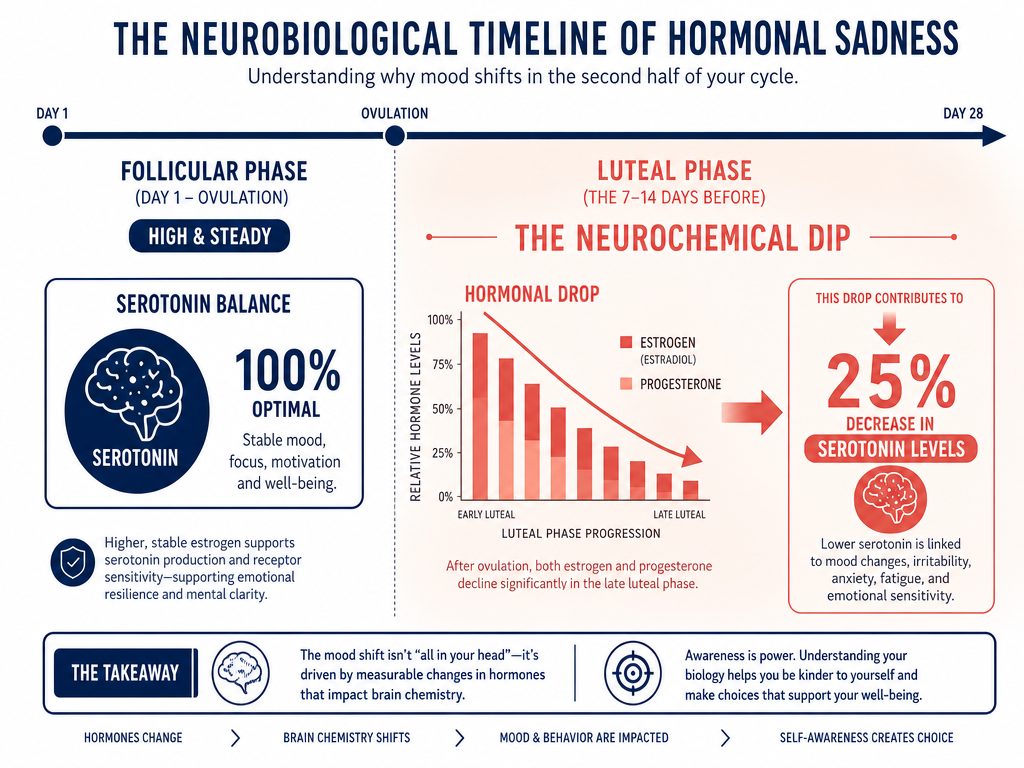
The 'Luteal Dip' is a biological reality where dropping hormone levels cause a significant decrease in serotonin, leading to feelings of sadness that are neurochemical, not personal.
VibeCheck App
Download Free on iOS →Estrogen affects many body systems, including brain function, and when it falls, neurotransmitter systems - particularly serotonin - are disrupted. Think of it as a chemical withdrawal. Her sadness, anxiety, or irritability aren't about you or about her being unable to cope. Her brain chemistry has temporarily shifted, and she's feeling the effects.
This isn't abstract theory. It's why she might cry at a commercial one week and laugh it off the next. It's why the same conversation lands differently depending on when you have it. Biology is dictating her emotional baseline, and understanding this is the first step toward being genuinely helpful.
If you want to better understand how her energy and mood shift throughout the entire month, check out our menstrual cycle guide for boyfriends.
PMS vs. PMDD: Recognizing the Difference
Not all hormonal sadness is created equal. Most women experience some degree of premenstrual symptoms, but there's a meaningful difference between standard PMS and PMDD (premenstrual dysphoric disorder).
PMS (Premenstrual Syndrome) is very common: as many as 3 in 4 women report experiencing PMS symptoms at some point in their life, though severity varies widely. Symptoms typically show up one to two weeks before a period and can include mood swings, irritability, bloating, breast tenderness, and fatigue. Roughly half of people who menstruate report having at least one PMS symptom, but only about 1 in 5 have symptoms severe enough to disrupt their daily life.
PMDD is more severe. It's a real, clinically recognized condition listed in the DSM-5 as a depressive disorder, affecting roughly 1 in 10 people who menstruate. PMDD involves extreme mood symptoms - such as marked irritability, anxiety, or hopelessness - intense enough to disrupt daily life and strain relationships. Up to 5% of women of childbearing age suffer from PMDD.
The distinction matters because the support strategies differ slightly. If she's experiencing severe, debilitating symptoms that consistently interfere with work, relationships, or basic functioning, professional medical help should be on the table alongside natural remedies. A study of 15,606 women found that married or cohabiting women with PMDD had a 21% increased risk of relationship disruption, which underscores how serious this condition can be for couples.
If you suspect PMDD, encourage her to talk to a healthcare provider. Natural support is valuable, but it's not a substitute for medical treatment when the condition is severe.
The Tactical Empathy Framework: Validation Before Solutions
When your girlfriend is in the grip of hormonal sadness, your instinct might be to fix it. You want to offer solutions, point out the positives, or remind her that "it'll pass in a few days." These responses, though well-intentioned, often backfire.
Why? Because when a partner is struggling emotionally, responding with genuine empathy - listening without judgment, focusing on their feelings rather than debating facts, and validating that their reaction makes sense - tends to help more than trying to "fix" the problem or offer silver linings. What she needs most is to feel understood, not corrected.
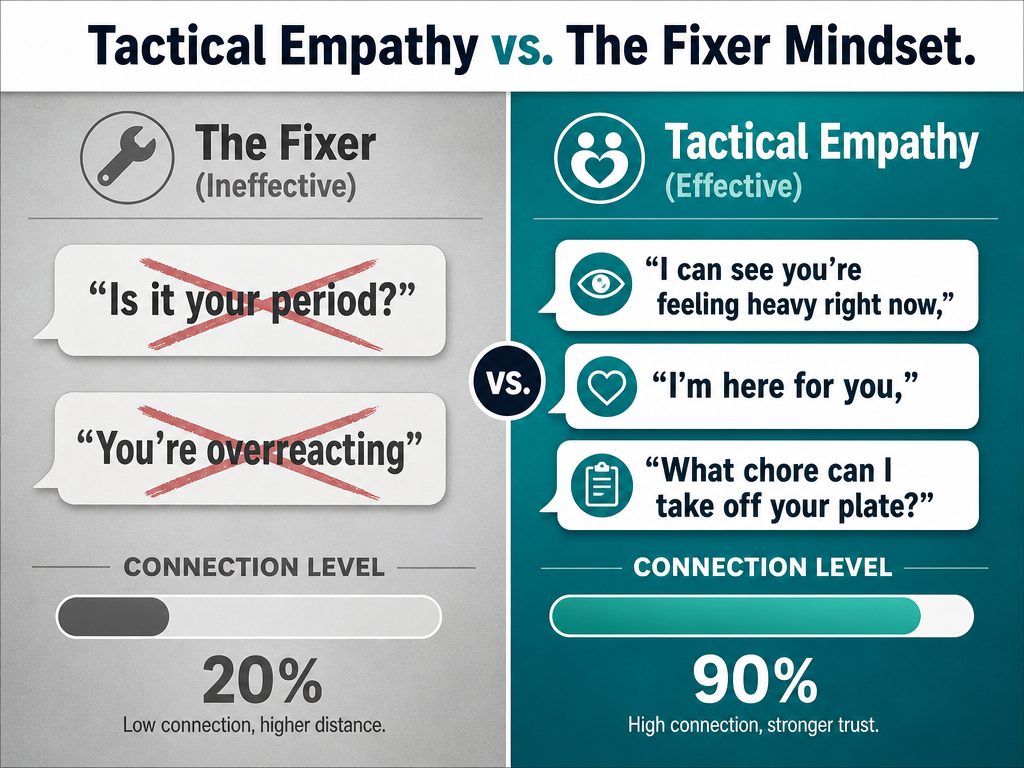
Shifting your response from 'fixing' the problem to validating her feelings and offering practical load-reduction is the most effective way to provide natural support.
Here's the framework:
- Acknowledge the feeling without judgment. "I can see you're feeling heavy right now" or "This sounds really overwhelming."
- Ask what would help, don't assume. "What can I take off your plate today?" or "Do you want company or some quiet time?"
- Offer concrete, low-lift support. Handle dinner, run an errand, cancel plans if she's too drained to go out.
- Don't take it personally. If she snaps or withdraws, it's the neurochemical crash talking, not an indictment of you or the relationship.
This approach isn't about coddling or treating her like she's fragile. It's about recognizing that her emotional bandwidth is temporarily reduced and adjusting your expectations accordingly. The goal is to reduce friction, not to make her feel like a burden.
For more on navigating mood shifts throughout her cycle, see our guide on how to support your girlfriend's luteal phase.
The Natural Support Kit: Evidence-Backed Remedies
Natural support for hormonal sadness isn't about replacing medical treatment - it's about complementing her body's needs with evidence-backed approaches that can meaningfully reduce symptoms.
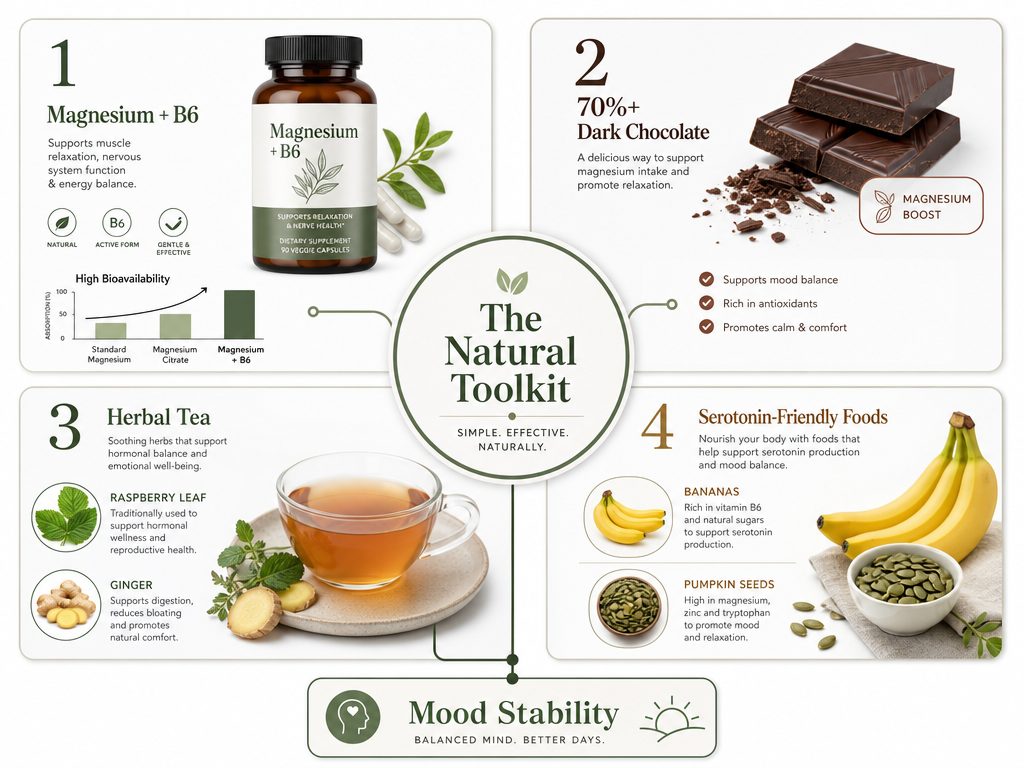
Science-backed natural remedies like Magnesium Glycinate and Vitamin B6, combined with specific nutrient-dense foods, help stabilize mood by supporting the body's natural chemistry.
Supplements with Research Support
A combination of Magnesium and Vitamin B6 is significantly more effective at reducing PMS mood symptoms than magnesium alone or a placebo. Here's what that looks like in practice:
Magnesium Glycinate: Supports relaxation, helps with sleep quality, and may reduce anxiety. Look for chelated forms like glycinate, which are better absorbed and less likely to cause digestive upset. A typical dose is 200-400mg daily, but she should start lower and adjust based on how her body responds.
Vitamin B6: Plays a role in serotonin production. The research-backed dose for PMS is typically 50-100mg daily. Higher doses (above 200mg) can cause nerve issues over time, so don't assume more is better.
Both of these can be found over-the-counter. If she's not already taking them, suggest she start a few days before the luteal phase begins (typically around day 14-16 of her cycle, though normal cycles vary considerably).
Important disclaimer: These are not a cure, and they're not appropriate for everyone. If she's on birth control or other medications, she should check with a healthcare provider before adding supplements. Herbal options like Vitex (Chasteberry) have anecdotal support but can interfere with hormonal birth control and lack strong clinical evidence - tread carefully there.
Foods That Help
You can support her body's serotonin and magnesium levels naturally through diet. Nutrient-dense foods that may help include:
- Dark chocolate: Provides magnesium and can genuinely lift mood. Not a "cure," but a pleasant addition.
- Bananas: Rich in vitamin B6 and easily digestible.
- Pumpkin and sunflower seeds: Nutrient-dense options that can be helpful.
- Leafy greens: Spinach, kale, and Swiss chard are nutrient-rich choices.
- Complex carbs: Whole grains can help stabilize blood sugar and support serotonin production.
Notice what's missing: there's no magic "PMS diet." The goal is nutrient density, not restriction.
Herbal Teas
Herbal teas won't fix a serotonin crash, but they can provide comfort and mild relief:
- Chamomile: Known for its calming effects, may help with anxiety and sleep.
- Ginger: Can ease nausea and digestive discomfort, which sometimes accompany PMS.
- Raspberry leaf: Traditionally used for menstrual cramps, though clinical evidence is limited.
The ritual of making and drinking tea can be as valuable as the tea itself - it's a moment of quiet care in a low-energy phase.
Lifestyle Support
Lifestyle approaches that can help ease PMS symptoms include regular aerobic exercise, smaller/more frequent meals, less salt/caffeine/alcohol, adequate sleep, and stress-reduction practices like deep breathing or yoga. As her partner, you can support these by:
- Suggesting a walk together instead of a high-intensity workout if she's feeling drained
- Keeping easy-to-prepare, nutrient-dense snacks in the house
- Taking on extra chores so she has time to rest
- Not pushing alcohol-heavy social plans during her luteal phase
These aren't grand gestures. They're tactical adjustments that reduce her cognitive and physical load.
For more on when her energy naturally peaks and dips, read our guide on understanding your partner's cycle.
The Follicular Strategy: Planning During the Good Week
The most effective way to handle the "bad week" is to plan for it during the "good week."
The follicular phase - the days after her period ends and leading up to ovulation - is when estrogen rises as an egg-containing follicle develops in the ovary. This is her biological summer: energy is higher, mood tends to be more stable, and she's more receptive to planning and conversation.
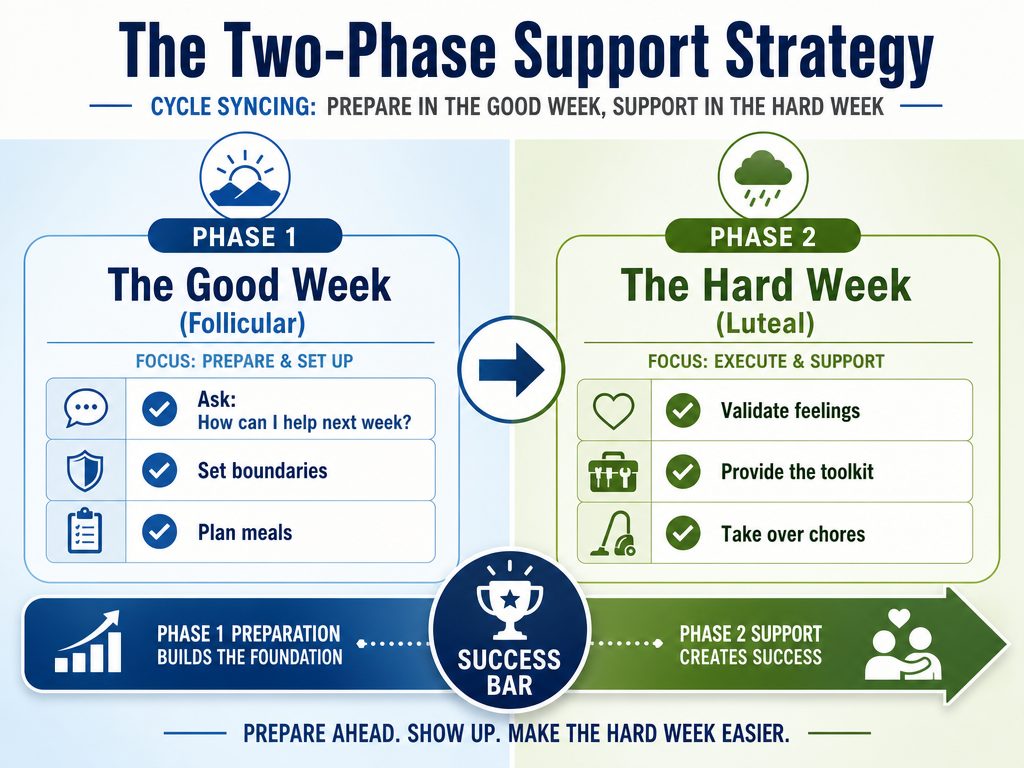
The most successful way to handle the 'bad week' is to create a support plan during the 'good week' when communication and energy are at their highest.
Use this window to have a low-pressure conversation about what she needs. Frame it collaboratively, not prescriptively:
- "I've noticed you tend to feel drained in the week before your period. What can I do to help when that happens?"
- "Would you prefer I check in more often, or give you space? I want to match what you actually need."
- "Are there specific things that make the luteal phase harder - like social plans, or work stress piling up? How can I help reduce that?"
Some women want more closeness and reassurance during PMS. Others need solitude and low stimulation. There's no universal script, which is why asking during a high-clarity phase matters.
You can also use this time to prep logistics:
- Stock magnesium supplements, herbal tea, and easy-to-prepare meals
- Look ahead at her cycle dates and avoid scheduling high-stakes conversations or demanding social events during the luteal phase
- Agree on a simple signal she can use when she's hitting a wall - something like "I'm in the red zone today" - so you know to dial back expectations without her having to explain herself repeatedly
Tracking symptoms and mood changes across the cycle for a few months is a legitimate, medically endorsed way to identify real patterns, rather than assuming based on stereotypes. You might suggest using a cycle-tracking app together (with her consent and input, obviously). Tools like VibeCheck or period calculators can help both of you anticipate the rough days and plan accordingly.
Planning ahead doesn't mean you're "managing" her or treating her emotions like a project. It means you're recognizing a predictable biological pattern and adjusting your approach to reduce unnecessary friction.
For more on how to use cycle awareness in your relationship, see our article on how to tell which cycle phase your girlfriend is in.
What Never to Say (and What to Say Instead)
Even with the best intentions, certain phrases will make things worse. Here's what to avoid and what to say instead:
Never Say:
- "Is it your period?" or "Are you on your period?" This dismisses her feelings as illegitimate and reduces her to a biological function. Even if you're right about the timing, leading with this shuts down conversation.
- "You're overreacting." She's not. Her neurochemistry has shifted, and what feels overwhelming to her right now is a real experience.
- "Just think positive" or "It could be worse." Toxic positivity doesn't fix serotonin. It just makes her feel unheard.
- "Why are you so emotional?" Because progesterone and estrogen have crashed and her serotonin levels are lower. That's the answer. But phrasing it as an accusation won't help.
- "Calm down." Has this ever worked? For anyone? In any situation?
Say Instead:
- "I can see you're feeling heavy right now. I'm here. What chore can I take off your plate today?" This validates her experience, offers presence without pressure, and provides concrete help.
- "You're not overreacting. This sounds really hard." Validation matters more than solutions in the moment.
- "Do you need to talk, or do you need quiet? I'm good with either." Gives her agency without forcing her to explain herself.
- "I know this week is rough. What can I do to make it easier?" Acknowledges the pattern without reducing her to it.
- "I'm not going anywhere. Let me know what you need when you're ready." Reassures her that you're a stable presence, even when she's struggling.
The key difference: these responses center her experience, not your discomfort with her emotions. They make space for what she's feeling without trying to argue her out of it or minimize it.
If you're looking for more communication strategies, our guide on how to comfort your girlfriend during PMS offers additional scripts and tactics.
Frequently Asked Questions
How can I best support my partner who has PMDD?
PMDD is more severe than standard PMS and often requires medical intervention. Natural remedies like magnesium and B6 can still help, but they shouldn't be the only approach. Encourage her to see a healthcare provider who can discuss options like SSRIs, hormonal treatments, or therapy specifically for PMDD. As a partner, your role is to validate that PMDD is a real, serious condition (not something she's "making up"), reduce her load during symptomatic weeks, and support whatever treatment plan she and her doctor decide on. Be patient - PMDD can strain relationships, but a study of 15,606 women found that married or cohabiting women with PMDD had a 21% increased risk of relationship disruption, which means support and understanding are especially important.
Can the luteal phase cause feelings of sadness?
Yes. After ovulation, the luteal phase begins as progesterone rises, and if pregnancy doesn't happen, both progesterone and estrogen drop before the next period. This hormone crash disrupts serotonin and other neurotransmitter systems, which is why many women experience sadness, irritability, or anxiety in the days leading up to menstruation. It's not "all in her head" - it's a neurobiological response to hormonal shifts.
How to tell if mood swings are hormonal?
Tracking symptoms and mood changes across the cycle for a few months is a legitimate way to identify real patterns. If the mood swings consistently happen in the same 7-10 day window before her period (the luteal phase) and then improve after menstruation starts, that's a strong indicator they're hormone-related. Cycle-tracking apps can help visualize this pattern. If mood swings are constant across the entire month, or if they're severe enough to disrupt daily life, encourage her to speak with a healthcare provider to rule out other conditions like anxiety, depression, or PMDD.
What vitamins help with PMS mood swings?
A combination of Magnesium and Vitamin B6 is significantly more effective at reducing PMS mood symptoms than magnesium alone or a placebo. Magnesium (especially chelated forms like glycinate) supports relaxation and sleep, while B6 plays a role in serotonin production. Typical doses are 200-400mg of magnesium and 50-100mg of B6 daily. She should start supplementation a few days before the luteal phase and continue through menstruation. Always check with a healthcare provider before adding supplements, especially if she's on other medications.
How to deal with hormonal depression?
Hormonal depression - whether linked to PMS, PMDD, or other hormonal shifts - should be taken seriously. Natural approaches like magnesium, B6, regular exercise, adequate sleep, and stress reduction can help mild to moderate symptoms. However, if the depression is severe, persistent, or interfering with her ability to function, professional help is essential. A healthcare provider can assess whether medication (like SSRIs), therapy, or hormonal treatments are appropriate. As a partner, your role is to validate that what she's experiencing is real, support her in seeking help, and reduce her burden during difficult phases. You can't fix hormonal depression, but you can be a stabilizing presence.
Is it normal to not like your partner during the luteal phase?
Many women report feeling less connected to their partner during the luteal phase, and research shows that hormonal shifts can affect mood and social preferences. When progesterone and estrogen drop, serotonin drops with them, which can make everything feel heavier - including relationship dynamics. This doesn't mean she doesn't love you; it means her neurochemistry is temporarily altered and her capacity for closeness or social engagement is lower. The best response is to give her space without taking it personally, reduce demands on her time and energy, and wait for the phase to pass. If the feeling of disconnection persists throughout the entire cycle, that's worth discussing during a high-clarity phase (like the follicular phase) or with a couples therapist.
Hormonal sadness isn't a character flaw, a sign of weakness, or something your girlfriend should just "get over." It's a predictable, biologically driven shift that affects nearly half of all women to some degree. Understanding the luteal dip, recognizing the difference between PMS and PMDD, and providing natural, evidence-backed support can meaningfully reduce her discomfort - and your stress.
The most powerful thing you can do is treat her cycle as information, not inconvenience. Plan ahead during the follicular phase. Validate her feelings during the luteal phase. Stock magnesium and dark chocolate. Take the laundry off her plate. Don't ask if it's her period.
You can't fix her hormones, but you can be the kind of partner who doesn't need to. The one who shows up, pays attention, and makes the hard weeks a little easier.
If you want a tool that helps you anticipate her needs and sync your support to her cycle, check out VibeCheck - a relationship app designed specifically for men who want to stop guessing and start understanding.
Tags

Related Articles
Continue reading to deepen your understanding

How to Understand Your Girlfriend’s Social Battery and Hormones
Does your girlfriend suddenly cancel plans or seem withdrawn? This guide explains how her cycle impacts her energy so you can support her like a pro.

How Your Girlfriend’s Emotional Needs Change During Her Cycle
Does your girlfriend’s mood seem unpredictable? Learn how her emotional needs shift on a biological loop and how to support her through every phase of her cycle.

What to Buy When Your Girlfriend Has Hormone Cravings: A Support Guide
Stop wondering what to pick up at the store. This guide explains the science behind cycle cravings and provides a specific list of foods and comfort items she needs.

Your Girlfriend’s Mood Shifts Throughout the Month, Explained
Ever wonder why her energy and moods change so drastically each week? Understand the four hormonal phases and how to be the partner she needs during every stage of her cycle.

How to Support Your Girlfriend When She’s Crying Because of Hormones
Watching her cry when hormones hit can feel overwhelming. Learn the biological why behind the tears and use these proven scripts to provide the support she actually needs right now.

How to Help Your Girlfriend with Hormonal Mood Swings Without Arguing
Understand her cycle and learn tactical scripts to handle tension. This guide shows you how to support her through hormonal shifts without getting into unnecessary fights.

When to Feed Your Girlfriend: Understanding Hangry Hormones
Does your girlfriend get irritable when she hasn’t eaten? It’s not just in her head. Learn why hormones cause hanger and the specific times her body needs more fuel.

The Boyfriend’s Guide to Supporting Your Partner Through PMS
If your partner is suddenly irritable and exhausted, it’s biology, not you. Learn about the luteal phase and how to provide meaningful support without walking on eggshells.