How to Know When Your Girlfriend Needs Affection by Reading Her Hormonal Signals

Your girlfriend’s need for closeness follows a biological pattern. Learn to read these signals to stop guessing and start responding to her actual needs before she ever has to ask.
How to Know When Your Girlfriend Needs Affection: Reading Her Hormonal Signals
Your girlfriend's need for affection isn't random. It follows a biological pattern shaped by her 28-day hormone cycle, and understanding this pattern transforms you from a reactive partner into a proactive one. When you learn to read these signals, you stop guessing and start responding to her actual needs before she has to ask.
Table of Contents
- What Hormones Control Affection Needs?
- The Four Season Translation Matrix
- The Oxytocin Gap: Why She Needs More Reassurance Some Weeks
- Non-Verbal Signs She Needs Affection
- Interactive Element: Sign Checker
- When to Increase Physical Touch vs. Emotional Support
- The Hormone Trap: What Never to Say
- Frequently Asked Questions
What Hormones Control Affection Needs?
Three hormones drive your girlfriend's shifting need for closeness: estrogen, progesterone, and oxytocin.
Estrogen affects many body systems, including brain function and the ability to focus, and levels are highest in the days leading up to ovulation. When estrogen climbs, she feels confident, social, and energized. She's more likely to initiate plans and reach out first.
Progesterone rises after ovulation, helping prepare the uterine lining for a possible pregnancy. If pregnancy doesn't happen, both progesterone and estrogen drop before the next period. Many women notice PMS-like symptoms in this phase - mood shifts, breast tenderness, bloating, acne, and appetite changes - though not everyone does.
Oxytocin is the "bonding" hormone. Research shows that oxytocin concentrations significantly increase from the early follicular phase to ovulation, then oxytocin levels significantly decrease from ovulation to the mid-luteal phase. This drop creates what partners experience as "the reassurance gap" - she suddenly feels less attached, even though nothing between you has changed.
Understanding these shifts means you can anticipate her needs instead of reacting after she's already frustrated.
VibeCheck App
Download Free on iOS →The Four Season Translation Matrix
The menstrual cycle has four phases - menstrual (bleeding, roughly day 1-5), follicular (day 1 through ovulation, estrogen rising), ovulation (around day 14 in a 28-day cycle, triggered by a surge in luteinizing hormone), and luteal (after ovulation to the next period, progesterone rising then falling). The follicular and menstrual phases overlap. Think of these as four seasons, each requiring different types of support.
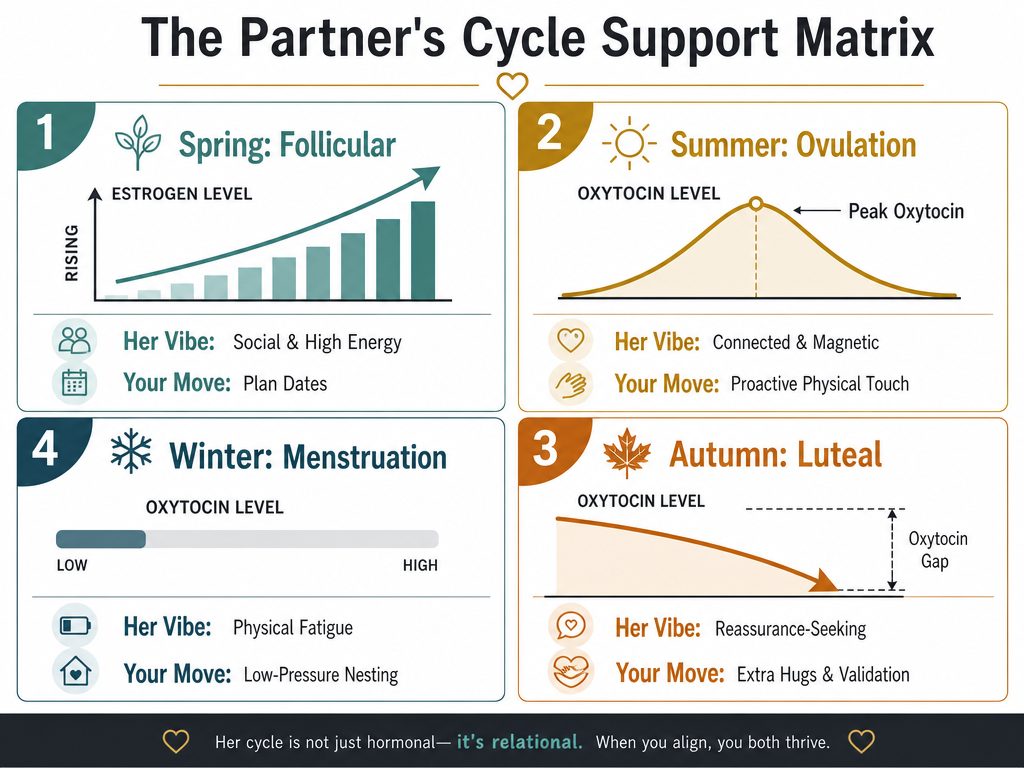
Spring (Follicular Phase, Days 6-13)
During the follicular phase, estrogen rises as an egg-containing follicle develops in the ovary; this rising estrogen also thickens the uterine lining. Near the end of this phase, high estrogen triggers a surge in luteinizing hormone (LH), which sets off ovulation.
What you'll notice: She's more talkative, initiates plans, and seems genuinely excited about social activities. Her energy builds day by day.
Support strategy: Match her momentum. She wants a partner who can keep up, not one who anchors her down. Plan dates with movement and social interaction - concerts, hikes, group dinners. She'll likely take the lead on affection during this phase, so follow her cues and mirror her energy.
Summer (Ovulation, Days 14-15)
Ovulation is when a surge in luteinizing hormone (LH) causes the ovary to release an egg, typically around day 14 of a 28-day cycle. Around ovulation, many women notice symptoms such as increased sex drive, mild pelvic or abdominal pain, tender breasts, bloating, and mood changes - but these vary person to person, and not everyone notices them.
What you'll notice: Peak confidence and physical energy. She may dress differently, feel more attractive, and show more interest in physical intimacy. Estrogen and testosterone levels peak just before ovulation, typically around day 14.
Support strategy: Be proactive with physical touch. Oxytocin is at its highest, so hugs, hand-holding, and affection land well. This is her biological summer - she's primed for connection. Take initiative but read her signals; not every woman experiences a libido spike at ovulation.
Autumn (Luteal Phase, Days 16-28)
This is where most partners get confused. After ovulation, progesterone rises while estrogen and oxytocin drop. The biological shift creates what feels like emotional distance, but it's not personal - it's chemical.
What you'll notice: She withdraws from large groups but may seek more one-on-one time with you. Small irritations become bigger deals. She needs verbal reassurance more than usual. Her social battery drains faster.
Support strategy: Increase non-sexual touch and verbal affirmation. Long hugs, holding her hand while watching TV, telling her you're proud of her - these release oxytocin and buffer the drop she's experiencing. Don't take her need for alone time as rejection; she's managing sensory overload, not pulling away from you specifically. Offer to handle household tasks without being asked. The lifestyle approaches that can help ease PMS symptoms include regular aerobic exercise, smaller/more frequent meals, less salt/caffeine/alcohol, adequate sleep, and stress-reduction practices - supporting these isn't indulging her, it's aligning with what her body actually needs.
Winter (Menstruation, Days 1-5)
Low hormone levels across the board mean low physical energy. Her body is shedding the uterine lining, which can cause cramping, fatigue, and general discomfort.
What you'll notice: She wants comfort over intensity. "Nesting" behaviors - oversized clothes, blankets, staying home. She may cancel plans or need more sleep.
Support strategy: Low-pressure affection. Think presence, not performance. Bring her heating pad without being asked. Watch a show together without expectations. Take over meal prep. She doesn't need you to fix her mood; she needs you to make the practical parts of life easier so she can rest. Don't ask "What can I do?" - just do the visible tasks.
The Oxytocin Gap: Why She Needs More Reassurance Some Weeks
The luteal phase creates what partners describe as "walking on eggshells," but it's not a personality shift - it's an oxytocin crash.
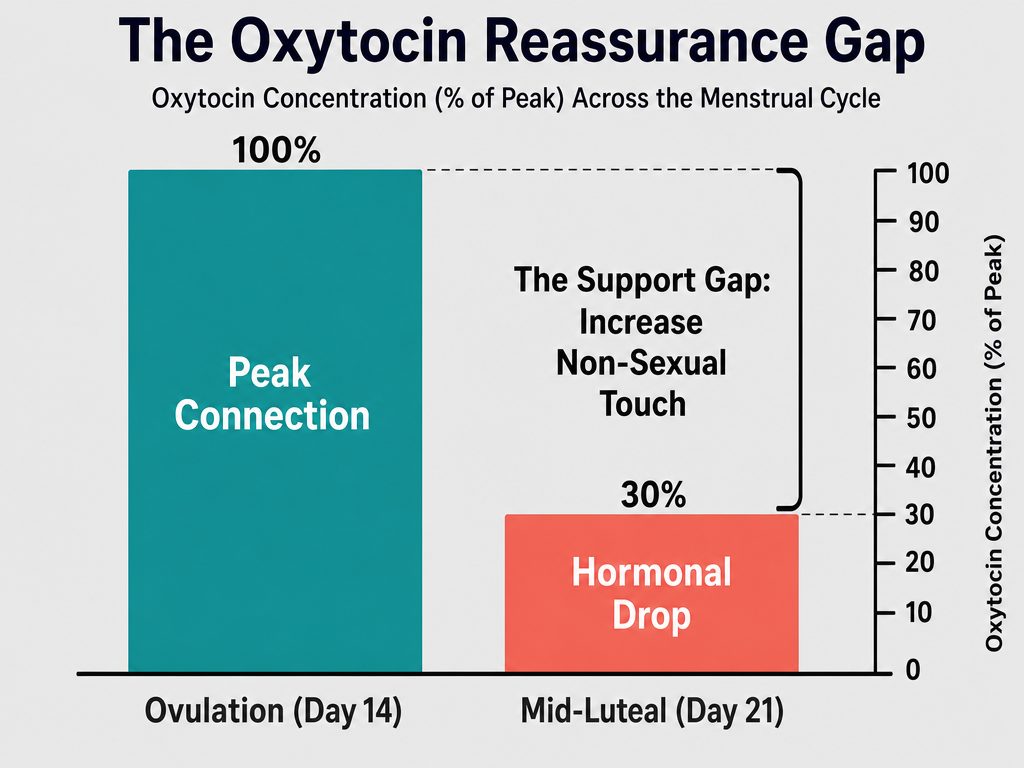
Research shows oxytocin drops significantly after ovulation. Oxytocin is what makes us feel bonded and secure, so when it falls, she can feel disconnected even when you haven't done anything differently. Small comments land harder. Silence feels like rejection. She questions things that felt secure a week ago.
This is where touch becomes a biological tool, not just a romantic gesture. Hugging, hand-holding, and other forms of non-sexual physical contact trigger oxytocin release. You're literally helping her body replace what the hormone drop took away.
The key is to increase these behaviors without pointing out her cycle. Never say "Are you on your period?" or "Is this a hormone thing?" Use your knowledge as a silent guide for your own behavior, not as a diagnosis for hers.
Non-Verbal Signs She Needs Affection
She won't always say "I need a hug" or "I'm feeling disconnected." Here's what to watch for instead:
Physical withdrawal that isn't about you: She's scrolling on her phone next to you instead of talking, or she's physically present but emotionally checked out. This often happens in the luteal phase when her social battery is drained but she still wants your company. The solution isn't conversation - it's low-key physical presence like sitting close or putting your hand on her leg.
Increased sensitivity to tone: If she's reacting strongly to how you said something rather than what you said, her progesterone sensitivity is likely heightened. This is a sign to soften your delivery and add verbal reassurance. "I'm not upset with you" or "We're good" can defuse tension before it builds.
"Nesting" behaviors: Baggy clothes, declining social plans, asking to stay in - these signal she needs comfort more than stimulation. Offer to order food, set up a movie, or run errands so she doesn't have to leave the house.
Texting less or delayed responses: A drop in her usual communication rhythm during the late luteal phase isn't disinterest - it's mental bandwidth running low. Don't push for more contact. Send supportive, no-pressure texts instead of asking questions that require decisions.
Seeking physical closeness without initiating conversation: She sits closer, leans on you, or wants to hold your hand but isn't chatty. This is a request for touch-based reassurance, not a signal that something's wrong. Just be there.
Interactive Element: Sign Checker

| If you see her... | She is likely... | Try this... |
|---|---|---|
| Extra social, planning activities, initiating texts | Peak estrogen (Week 2) | Plan a night out; high-energy dates; let her lead affection |
| Confident, physically affectionate, suggesting intimacy | Ovulation (Day 14-15) | Be proactive with touch; mirror her energy; go with her plans |
| Easily hurt by small comments, withdrawing from groups but seeking you | Dropping oxytocin (Week 3-4) | Extra verbal reassurance; long hugs; take over household tasks |
| Withdrawing into "comfy" clothes, canceling plans, low energy | Menstruation (Day 1-5) | Low-pressure presence; bring food/heating pad; handle logistics |
| Texting less, seeming "distant" but still wanting to be near you | Luteal phase mental fatigue | Send supportive texts; don't ask decision questions; just be there |
Use this as a reference, not a script. Individual variation matters - a "normal" cycle varies between women; menstrual bleeding can start anywhere from every 24 to every 38 days and last up to 8 days. There is no single universal 28-day cycle, so exact day-by-day predictions for any specific woman should be treated as approximate. Tracking symptoms and mood changes across the cycle for a few months is a legitimate, medically endorsed way to identify real patterns and timing for your specific partner.
When to Increase Physical Touch vs. Emotional Support
Increase physical touch when:
- She's in her follicular phase or at ovulation and her energy is high
- She's sitting close but not talking much (luteal phase comfort-seeking)
- You notice her shoulders are tense or she seems physically uncomfortable
- She initiates small touches like holding your hand or leaning on you
Increase emotional support when:
- She's questioning decisions or second-guessing herself (luteal phase reassurance gap)
- She's withdrawn from friends but still engaging with you
- Small frustrations are snowballing into bigger reactions
- She's expressing self-doubt or asking for validation
Combine both when:
- She's in the first few days of her period and dealing with physical discomfort plus low mood
- She's mentioned feeling "off" or "disconnected" but can't explain why
- You've had a disagreement and she's still in the late luteal phase
The tactical approach: when a partner is struggling emotionally, responding with genuine empathy - listening without judgment, focusing on their feelings rather than debating facts, and validating that their reaction makes sense - tends to help more than trying to "fix" the problem or offer silver linings. Combine that validation with physical presence and you're addressing both the chemical drop and the emotional need it creates.
The Hormone Trap: What Never to Say
Your biological knowledge is a framework for your own behavior, not a weapon to diagnose hers. Never say:
- "Are you on your period?"
- "Is this a hormone thing?"
- "You're being irrational."
- "You'll feel better in a few days."
- "This is just PMS talking."
These phrases tell her you're dismissing her feelings as chemical rather than valid. Even if hormones are amplifying her reaction, the underlying issue is still real to her.
Instead, respond to what she's expressing: "I hear you" or "That makes sense" or "What do you need right me?" If you've been tracking her cycle privately and you know she's in the luteal phase, adjust your approach - softer tone, more patience, proactive support - without announcing why.
PMS is very common: as many as 3 in 4 women report experiencing PMS symptoms at some point in their life, though severity varies widely. Symptoms - which can include mood swings, irritability, bloating, breast tenderness, and fatigue - typically show up one to two weeks before a period and resolve within a few days after it starts. But roughly half of people who menstruate report having at least one PMS symptom, and only about 1 in 5 have symptoms severe enough to disrupt their daily life. That more disruptive tier is a meaningfully different experience than "typical" PMS. If her symptoms are consistently severe, PMDD (premenstrual dysphoric disorder) is a real, clinically recognized condition - it's listed in the DSM-5 as a depressive disorder and affects roughly 1 in 10 people who menstruate. Severe symptoms warrant a medical conversation, not just better partnership tactics.
Frequently Asked Questions
How to support girlfriend during menstrual cycle?
Track her patterns across all four phases and adjust your support style to match her energy level. During the follicular phase, match her rising energy with active plans. At ovulation, be proactive with physical affection. In the luteal phase, increase verbal reassurance and take over practical tasks without being asked. During menstruation, prioritize her physical comfort and reduce logistical demands.
Is it normal to feel extremely emotional before my period?
Yes. Many women notice PMS-like symptoms in the luteal phase - mood shifts, breast tenderness, bloating, acne, and appetite changes - though not everyone does. The progesterone drop combined with falling oxytocin creates heightened emotional sensitivity. If the intensity disrupts daily life or strains relationships consistently, that may be PMDD rather than typical PMS, and a medical evaluation is appropriate.
How to deal with a spouse with PMDD?
PMDD is a more severe, sometimes disabling extension of PMS. Both happen on a similar timeline (about 7-10 days before a period) and can share physical symptoms like bloating and fatigue, but PMDD specifically involves extreme mood symptoms - such as marked irritability, anxiety, or hopelessness - intense enough to disrupt daily life and strain relationships. Treatment often requires medical intervention, not just lifestyle adjustments. Support her in seeing a healthcare provider who understands PMDD, and recognize that managing it is a clinical issue, not a relationship failure.
What could be causing irritability during my period?
Hormone levels are at their lowest during menstruation, which affects neurotransmitter production and pain tolerance. Physical discomfort from cramping and fatigue compounds the mood impact. Irritability can also carry over from the late luteal phase if PMS symptoms started before bleeding began. If irritability during the period itself is consistently severe, it may signal an underlying condition worth discussing with a healthcare provider.
When do females release oxytocin?
Oxytocin is released in response to physical touch, social bonding, orgasm, and breastfeeding. But oxytocin levels also fluctuate naturally across the menstrual cycle - oxytocin concentrations significantly increase from the early follicular phase to ovulation, then oxytocin levels significantly decrease from ovulation to the mid-luteal phase. This natural drop is why many women feel less bonded or more emotionally vulnerable in the week or two before their period, even when external relationship factors haven't changed.
Do you feel better in luteal or follicular phase?
Most women report feeling better during the follicular phase, when estrogen is rising and energy builds toward ovulation. The luteal phase brings progesterone dominance, which can cause fatigue, mood shifts, and physical discomfort as the body prepares for either pregnancy or menstruation. However, individual experiences vary - some women feel steadier in the luteal phase and more anxious during the estrogen spike. The key is identifying your partner's specific pattern rather than assuming a universal experience.
Want to stop guessing and start supporting? VibeCheck tracks her cycle and sends you a daily mission tailored to her current phase - so you always know when she needs affection, space, or practical help. Built for men who want to be proactive partners, not reactive ones.
Tags

Related Articles
Continue reading to deepen your understanding

How to Understand Your Girlfriend’s Social Battery and Hormones
Does your girlfriend suddenly cancel plans or seem withdrawn? This guide explains how her cycle impacts her energy so you can support her like a pro.

How Your Girlfriend’s Emotional Needs Change During Her Cycle
Does your girlfriend’s mood seem unpredictable? Learn how her emotional needs shift on a biological loop and how to support her through every phase of her cycle.

What to Buy When Your Girlfriend Has Hormone Cravings: A Support Guide
Stop wondering what to pick up at the store. This guide explains the science behind cycle cravings and provides a specific list of foods and comfort items she needs.

Your Girlfriend’s Mood Shifts Throughout the Month, Explained
Ever wonder why her energy and moods change so drastically each week? Understand the four hormonal phases and how to be the partner she needs during every stage of her cycle.

How to Support Your Girlfriend When She’s Crying Because of Hormones
Watching her cry when hormones hit can feel overwhelming. Learn the biological why behind the tears and use these proven scripts to provide the support she actually needs right now.

How to Help Your Girlfriend with Hormonal Mood Swings Without Arguing
Understand her cycle and learn tactical scripts to handle tension. This guide shows you how to support her through hormonal shifts without getting into unnecessary fights.

When to Feed Your Girlfriend: Understanding Hangry Hormones
Does your girlfriend get irritable when she hasn’t eaten? It’s not just in her head. Learn why hormones cause hanger and the specific times her body needs more fuel.

The Boyfriend’s Guide to Supporting Your Partner Through PMS
If your partner is suddenly irritable and exhausted, it’s biology, not you. Learn about the luteal phase and how to provide meaningful support without walking on eggshells.