How to Know Your Girlfriend’s Hormone Phase Without Asking

Stop walking on eggshells and start understanding her biological patterns. Decode behavior across all four phases so you can provide the support she actually needs right now.
How to Know Your Girlfriend's Hormone Phase Without Asking
You're sitting across from her at dinner. Three days ago, she was planning your next trip together. Now she's barely making eye contact and you're walking on eggshells, trying to figure out what changed.
Spoiler: probably nothing you did.
Her body runs on a 28-day hormonal cycle that shifts her energy, mood, and stress tolerance in predictable patterns. Learning to read those patterns doesn't require asking invasive questions or tracking an app together. It requires paying attention to subtle behavioral and physical cues that her biology broadcasts naturally.
This guide will teach you how to recognize which phase she's in without a single awkward conversation, so you can stop guessing and start supporting her in ways that actually land.
Table of Contents
- Why You Can't Just Ask
- The Four Biological Phases Explained
- Phase 1: Menstruation (Days 1-5) - The Reset
- Phase 2: Follicular (Days 6-13) - The Yes Window
- Phase 3: Ovulation (Days 14-16) - Peak Energy
- Phase 4: Luteal (Days 17-28) - The Storm
- The Observable Tells: What to Look For
- The Hormonal Birth Control Wildcard
- The Decision Matrix: When to Bring Up Hard Topics
- Frequently Asked Questions
Why You Can't Just Ask
"Is it that time of the month?"
If you've ever said those words, you already know why direct questions don't work. Even well-intentioned inquiries about her cycle can feel like you're reducing her emotions to biology, dismissing her legitimate concerns, or treating her body like a science experiment you're monitoring.
VibeCheck App
Download Free on iOS →The discomfort is compounded by decades of cultural baggage. Women have heard their feelings invalidated with PMS jokes their entire lives. When you ask directly, she might hear "You're being irrational because of your hormones," even if that's not what you meant.
But here's the biological reality: as many as 3 in 4 women report experiencing PMS symptoms at some point in their life, and 88% of women experience physical symptoms like cramps every cycle. Her hormones genuinely do affect her stress tolerance, social battery, and emotional reactivity in measurable ways. You're not imagining the pattern - you're just learning to read it.
The solution isn't to ignore her cycle. It's to become fluent in the behavioral language her body already speaks.
The Four Biological Phases Explained
The menstrual cycle has four phases: menstrual (bleeding, around day 1-5), follicular (day 1 through ovulation, estrogen rising), ovulation (around day 14 in a 28-day cycle, triggered by a surge in luteinizing hormone), and luteal (after ovulation to the next period, progesterone rising then falling). The follicular and menstrual phases overlap.
Here's the catch: while 28 days is the cited average, a "normal" cycle varies between women - menstrual bleeding can start anywhere from every 24 to every 38 days and last up to 8 days. There is no single universal 28-day cycle, so exact day-by-day predictions for any specific woman should be treated as approximate. You're looking for patterns, not a rigid calendar.
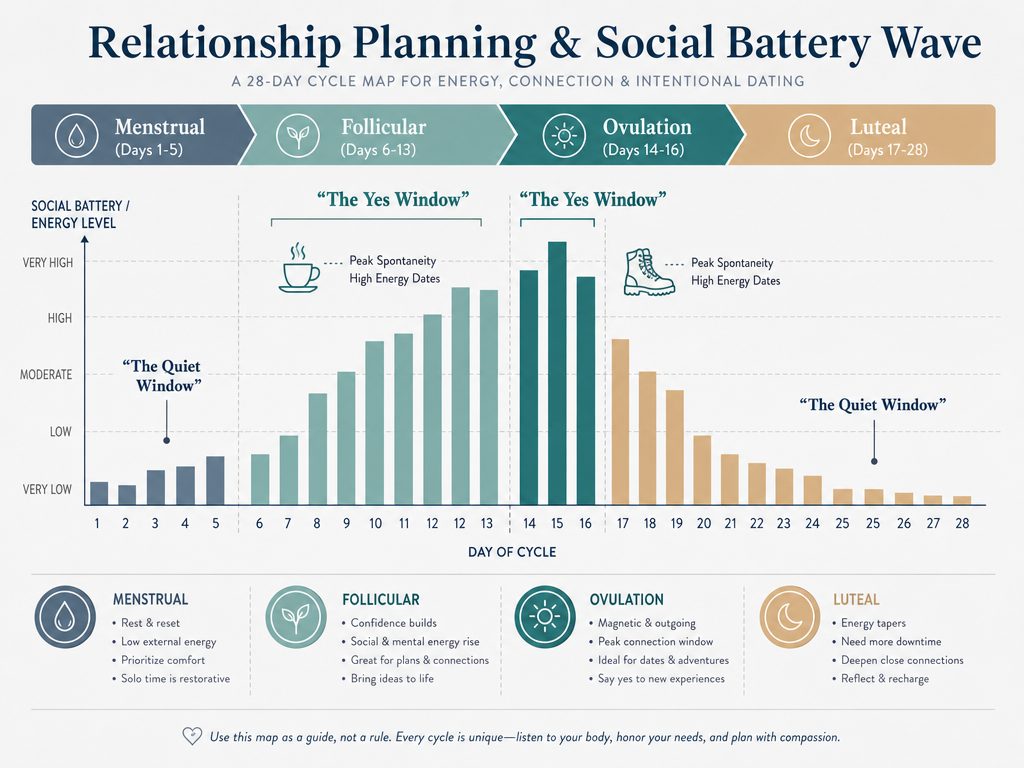 Understanding her 'Social Battery' across the month helps you identify the best times for high-energy dates and spontaneous plans without needing to ask for a calendar update.
Think of her cycle like climate versus weather. The climate is the long-term pattern; the weather is what's happening today. Understanding the climate helps you prepare for the weather without being blindsided by it.
Phase 1: Menstruation (Days 1-5) - The Reset
Primary hormones: All hormones are at their lowest point.
Observable tells:
- She cancels or rescales social plans
- She wears looser clothing or reaches for heating pads
- She has lower tolerance for noise, crowds, or chaos
- She prioritizes comfort food and familiar routines
- She might move more slowly or show less enthusiasm for high-energy activities
Roughly half of people who menstruate report having at least one PMS symptom, but only about 1 in 5 have symptoms severe enough to disrupt their daily life. That more disruptive tier is a meaningfully different experience than "typical" PMS. If you notice her symptoms are consistently intense enough to interfere with work or daily routines, that's worth encouraging her to talk to a doctor about - conditions like PMDD (premenstrual dysphoric disorder) are real, clinically recognized, and treatable.
Your move: The "Low-Stakes Weekend." Don't ask if she needs anything - bring the comfort to her. Order her favorite takeout without prompting. Suggest a quiet night in instead of the party you were considering. Offer to handle the grocery run or walk the dog. If she's dealing with physical symptoms like cramps, don't minimize them or suggest she "power through." Acknowledge that they're real and offer practical support.
This is not the week to propose a furniture-moving project, book a high-intensity weekend trip, or schedule a difficult relationship talk. Her body is literally shedding its uterine lining - energy is at a premium.
Phase 2: Follicular (Days 6-13) - The Yes Window
Primary hormones: During the follicular phase, estrogen rises as an egg-containing follicle develops in the ovary; this rising estrogen also thickens the uterine lining. Near the end of this phase, high estrogen triggers a surge in luteinizing hormone (LH), which sets off ovulation.
Observable tells:
- She initiates plans or says yes to activities she'd normally hesitate on
- Her energy visibly builds each day
- She shows more interest in trying new restaurants, classes, or experiences
- She seems more patient with annoyances that would normally frustrate her
- She engages more deeply in conversations and asks more questions
Estrogen affects many body systems, including brain function and the ability to focus, and levels are highest in the days leading up to ovulation. Medical sources describe this brain effect in general terms; they do not specify an exact mechanism for how estrogen affects day-to-day mood. What you'll observe, though, is an upward trajectory - Monday she's receptive, by Thursday she's actively planning, and by the weekend she's the one suggesting spontaneous road trips.
Your move: The "Big Talk" window. This is your biological green light for difficult conversations. Need to discuss holiday travel plans with the in-laws? Want to revisit the budget? Bring it up now. Her serotonin is stable, her stress tolerance is high, and her capacity for nuanced problem-solving is at its peak.
This is also when being emotionally available pays the highest dividends. She's primed for connection, not conflict. Schedule the weekend getaway, book the concert tickets, or plan the surprise date you've been thinking about. Her "social battery" is fully charged and she genuinely wants to say yes.
Phase 3: Ovulation (Days 14-16) - Peak Energy
Primary hormones: Ovulation is when a surge in luteinizing hormone (LH) causes the ovary to release an egg, typically around day 14 of a 28-day cycle. In the days just before ovulation, cervical mucus becomes clear and slippery, which is the most fertile window of the cycle.
Observable tells:
- The "glow": skin appears clearer, makeup looks more polished
- Voices of naturally cycling women have a higher minimum pitch in the late follicular phase, which can make her sound slightly brighter or more animated
- She puts more effort into grooming (styled hair, coordinated outfits, intentional jewelry)
- She's more socially confident - she starts conversations, holds eye contact longer, laughs more easily
- She seems unusually interested in spontaneous plans or adventures
This is her biological summer. Estrogen spikes up to 800% above baseline during the 24-48 hour ovulation window, which translates to peak physical and social energy. Around ovulation, many women notice symptoms such as increased sex drive, mild pelvic or abdominal pain, tender breasts, bloating, and mood changes - but these vary a lot person to person, and not everyone notices them.
Some women experience mittelschmerz - one-sided lower abdominal pain around the time of ovulation. It's a real, documented phenomenon, generally harmless, and usually lasts minutes to a couple of days. If she mentions a sharp twinge on one side of her lower abdomen mid-cycle, that's likely what it is.
Your move: The "Adventure" window. This is when you book the surprise weekend trip, suggest the high-energy concert, or plan the hiking date. She has the bandwidth for novelty, stimulation, and crowds. Her stress tolerance is at its highest, and her capacity for enjoying surprise is maxed out.
This is also a strategic time to show appreciation without it feeling performative. Compliments land harder, spontaneous gestures feel more romantic, and she's more receptive to physical affection. If you've been waiting for the "right moment" to express something meaningful, this is it.
Phase 4: Luteal (Days 17-28) - The Storm
Primary hormones: After ovulation, the luteal phase begins: progesterone rises to help prepare the uterine lining for a possible pregnancy. If pregnancy doesn't happen, both progesterone and estrogen drop before the next period. Many women notice PMS-like symptoms in this phase - mood shifts, breast tenderness, bloating, acne, and appetite changes - though not everyone does.
Observable tells:
- Jawline breakouts or skin dullness (progesterone thickens sebum)
- She becomes unusually sensitive to your tone - a neutral comment sounds critical
- She gravitates toward familiar routines instead of novelty
- She shows less patience for minor annoyances (dishes in the sink, traffic, loud chewing)
- She expresses a preference for staying in over going out
- She craves specific foods (carbs, chocolate, salt) and has less tolerance for hunger
This is the phase where 75% of women report some level of emotional or physical PMS. The biological driver is a serotonin crash triggered by plummeting estrogen and progesterone. She's not being unreasonable - her brain is literally in a state of chemical withdrawal. PMS symptoms typically show up one to two weeks before a period and resolve within a few days after it starts.
The amygdala (the brain's threat-detection center) becomes more active during the luteal phase, which means she genuinely perceives neutral tones as harsher than she would during the follicular phase. This isn't something she's choosing to do - it's a neurochemical shift.
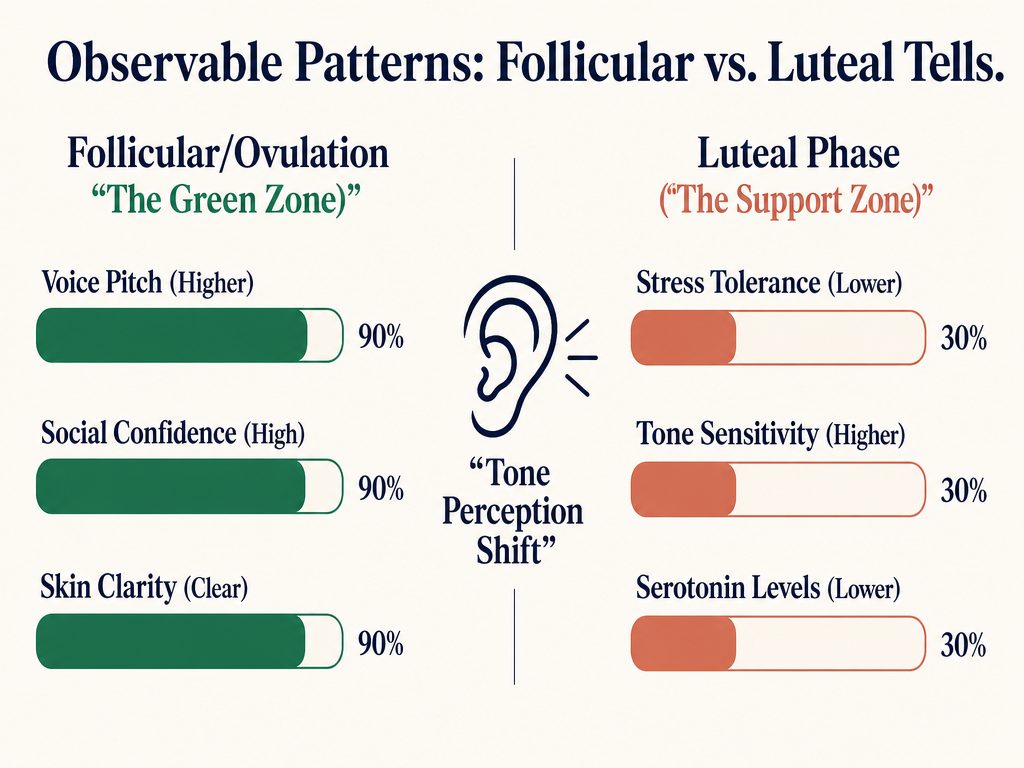 By observing subtle shifts in her stress tolerance and social energy, you can identify her current hormone phase and adjust your support style accordingly.
Your move: The "Validation First" rule. Don't fix, just listen. When a partner is struggling emotionally, responding with genuine empathy tends to help more than trying to "fix" the problem. Feeling understood, not corrected, is what tends to defuse tension.
If she's upset about a situation, resist the urge to offer solutions until she explicitly asks for them. Acknowledge her feelings first: "That sounds really frustrating" or "I can see why that would stress you out." Skip the silver linings ("At least it's not worse") and avoid dismissive language ("You're overthinking this").
This is also when lifestyle approaches that can help ease PMS symptoms become relevant - regular aerobic exercise, smaller/more frequent meals, less salt/caffeine/alcohol, adequate sleep, and stress-reduction practices like deep breathing or yoga. A partner who understands these and is patient around them (rather than dismissive of symptoms) is aligning with medically recommended self-care.
Avoid scheduling high-stakes relationship talks, surprise social events with new people, or activities that require sustained patience. She's not "being difficult" - she's navigating a biological phase where her nervous system is primed for threat detection instead of exploration.
The Observable Tells: What to Look For
You don't need to track an app to identify patterns. You need to pay attention to repeated behaviors that cluster together.
Social battery cues:
- Follicular/Ovulation: She initiates hangouts, accepts invitations enthusiastically, stays out later
- Luteal/Menstrual: She rescales plans, suggests smaller gatherings, leaves events earlier
Grooming effort:
- Follicular/Ovulation: Styled hair, coordinated outfits, makeup that looks intentional
- Luteal/Menstrual: Functional clothing, minimal makeup, preference for comfort over appearance
Tone sensitivity:
- Follicular/Ovulation: Neutral comments are received neutrally; she gives you the benefit of the doubt
- Luteal/Menstrual: The same neutral comment sounds critical; she interprets ambiguity negatively
Decision-making speed:
- Follicular/Ovulation: Quick yeses, less deliberation, more openness to spontaneity
- Luteal/Menstrual: More hesitation, preference for known quantities, need for mental space before committing
Physical comfort:
- Follicular/Ovulation: Fewer mentions of being tired, cold, or uncomfortable
- Luteal/Menstrual: More frequent mentions of needing warmth, rest, or specific foods
The key is consistency. One data point isn't a pattern. Three cycles of the same behavioral cluster around the same timeframe is a pattern worth noting.
The Hormonal Birth Control Wildcard
If she's on hormonal birth control (the pill, patch, ring, or hormonal IUD), these cues may be nearly invisible or reversed.
Hormonal contraceptives work by suppressing ovulation and flattening the natural hormone curve. Instead of the dramatic estrogen spike and progesterone crash, she gets a steady synthetic dose. For many women, this means fewer observable mood and energy shifts - which is exactly why many choose it.
But it also means the "four seasons" framework becomes less predictive. She might not have a "yes window" or a "storm week" because her hormone levels don't fluctuate in the same way. Some women on hormonal birth control experience mood shifts tied to the placebo week (when synthetic hormones drop), but the pattern is less consistent than natural cycling.
If you've been tracking patterns and nothing seems to line up, ask her (in a neutral moment, not during a conflict) whether she's on hormonal birth control and if she's noticed any changes in her mood or energy that feel tied to it. Frame it as curiosity about how you can support her better, not as an accusation that her birth control is "making her moody."
For women not on hormonal contraceptives, tracking symptoms and mood changes across the cycle for a few months is a legitimate, medically endorsed way to identify real patterns rather than assuming based on stereotypes or a single cycle. If you want to move from "noticing" to actively tracking together, apps like Flo for Partners or VibeCheck offer partner modes designed for this exact use case.
The Decision Matrix: When to Bring Up Hard Topics
Not all relationship conversations are created equal. Timing a difficult talk to her cycle phase can reduce conflict substantially.
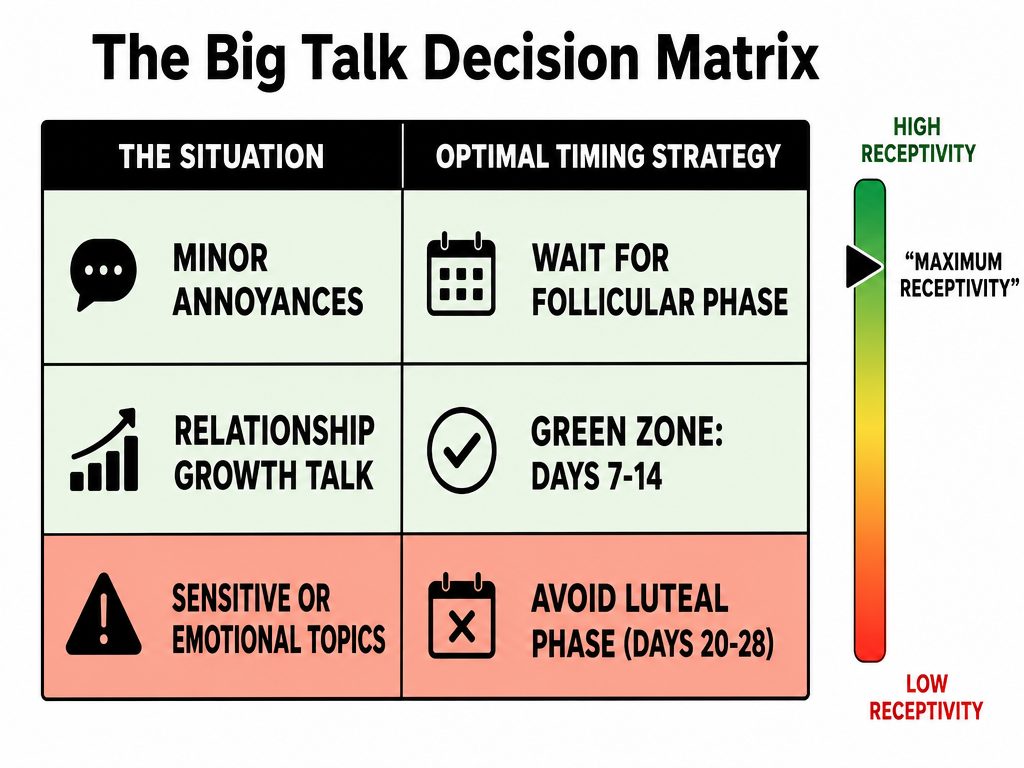 Timing is everything in relationship communication. This matrix helps you determine if a difficult conversation is best handled today or delayed for a high-receptivity window.
| Conversation Type | Green Zone (Follicular/Ovulation) | Caution Zone (Luteal/Menstrual) |
|---|---|---|
| Big life decisions (moving, career changes, engagement) | High receptivity to new ideas; strong problem-solving capacity | Lower tolerance for uncertainty; preference for stability |
| Relationship concerns (recurring friction, unmet needs) | Better emotional regulation; more bandwidth for nuanced discussion | Higher amygdala activation; neutral tones sound harsh |
| Family conflict (in-laws, holiday planning) | More patience for compromise; higher social tolerance | Lower patience for external demands; protective of personal space |
| Financial planning (budgets, big purchases) | More openness to risk and change | Preference for conservative, familiar choices |
| Minor annoyances (chores, habits) | Can be addressed without escalation | May trigger disproportionate frustration |
The rule: if it can wait, wait for the green zone. If it can't wait, adjust your delivery. In the luteal phase, lead with validation, avoid accusatory language, and give her space to process before expecting a resolution.
Frequently Asked Questions
How do you know if a girl is on her period without asking?
You'll notice a cluster of behavioral and physical cues: she rescales or cancels social plans, reaches for heating pads or pain relief, wears looser clothing, has lower tolerance for noise or chaos, and prioritizes comfort over appearance. 88% of women experience physical symptoms like cramps every cycle, so some combination of these tells is usually visible. The key is to observe patterns across multiple cycles rather than making assumptions based on a single instance.
If she seems unusually withdrawn or uncomfortable, don't ask "Are you on your period?" Instead, offer practical support: "You seem like you could use a quiet night in - want me to grab takeout and handle dinner?" This shows you're paying attention without making her menstrual cycle the explicit subject.
How to know if girlfriend is in luteal phase?
The luteal phase is characterized by rising progesterone followed by a sharp drop in both progesterone and estrogen before her period. Observable tells include: increased sensitivity to tone (neutral comments sound critical), preference for familiar routines over novelty, jawline breakouts or skin changes, lower patience for minor annoyances, and gravitating toward carb-heavy or salty foods.
75% of women report some level of emotional or physical PMS, and these symptoms typically appear one to two weeks before her period. If you notice a consistent pattern of mood shifts or physical symptoms that resolve within a few days after her period starts, you're likely observing the luteal phase.
For a detailed breakdown, read our tactical partner's guide to the luteal phase.
Do you feel prettier in follicular or luteal phase?
Many women report feeling more confident and attractive during the follicular and ovulation phases, when estrogen is rising or at its peak. Estrogen affects skin clarity, collagen production, and even voice pitch, which can contribute to the "glow" people notice around ovulation. During this time, women are also more likely to put effort into grooming and styling, which reinforces the perception of looking and feeling their best.
In the luteal phase, progesterone can cause skin to retain more oil, leading to breakouts, and the hormonal crash often brings bloating and fatigue. This doesn't mean she looks objectively worse - but she may feel less confident or less inclined to invest energy in her appearance.
How do I know if I'm in my luteal or follicular phase?
If you're asking this as a partner trying to understand your girlfriend's cycle, the distinction is this: the follicular phase (including ovulation) is the "green zone" - high energy, rising estrogen, openness to new experiences, and strong stress tolerance. The luteal phase is the "caution zone" - progesterone dominance followed by a sharp hormone drop, lower energy, preference for routine, and heightened sensitivity.
If you're asking as someone tracking your own cycle, the follicular phase runs from the first day of your period through ovulation (roughly days 1-14 in a 28-day cycle), and the luteal phase runs from ovulation to the day before your next period (roughly days 15-28). Physical markers like cervical mucus changes and basal body temperature shifts can help pinpoint ovulation, but behavioral and mood patterns are often the easiest tells. For more on this, check out what is the follicular phase.
How to track your partner's period?
Start with observation, not apps. Notice when she rescales plans, mentions fatigue or discomfort, gravitates toward specific foods, or shows lower patience for minor annoyances. Track these patterns mentally or in a private note for 2-3 cycles to see if they cluster around the same timeframe.
If you want to move to active tracking, use an app designed for partners. Flo for Partners, VibeCheck, or Clue Partner Connect all offer modes where she can share her cycle data with you. The key is that she consents to sharing and controls what you see.
Never track her cycle without her knowledge. That crosses from supportive to invasive. Frame it as a collaborative tool for reducing friction and improving timing, not as surveillance. For a deeper dive, read our partner's guide to period tracking.
Do women's voices change when ovulating?
Yes, subtly. Research shows that voices of naturally cycling women have a higher minimum pitch in the late follicular phase, which corresponds to the days leading up to ovulation. The shift is small - most people won't consciously register it - but it's measurable and tied to peak estrogen levels.
This doesn't mean you should use voice pitch as a primary tracking method. It's one observable tell among many, and it's more useful as a pattern to notice in hindsight than as a predictive tool.
When are you prettiest in your cycle?
This is subjective, but biological markers suggest that many women feel and appear their most vibrant during the late follicular and ovulation phases (roughly days 10-16 in a 28-day cycle). Estrogen is at its peak around ovulation, which improves skin clarity, increases collagen production, and can make hair and nails appear healthier.
Women also tend to put more effort into grooming during this time - styled hair, coordinated outfits, intentional makeup - which reinforces the perception of looking their best. In the luteal phase, progesterone can cause skin to retain more oil and water, leading to bloating and breakouts, which may make her feel less confident even if the objective difference is minimal.
The key takeaway: if she mentions feeling "off" or less attractive, don't dismiss it as vanity. Hormonal shifts genuinely affect skin, energy, and self-perception. A well-timed compliment during the luteal phase can mean more than one during ovulation.
The average woman will have roughly 450 periods over her lifetime. That's 450 opportunities for you to either walk on eggshells or become fluent in the patterns that make your relationship easier for both of you.
You don't need to track an app or ask invasive questions. You just need to pay attention, recognize the tells, and adjust your approach to match her biology instead of fighting it. The men who master this don't just reduce conflict - they become the partner she feels genuinely understood by, which is the foundation of every strong relationship.
For more tactical guidance, explore our complete guide to supporting your girlfriend through every cycle phase or take our Better Boyfriend Quiz to discover your relationship strengths and blind spots.
Tags

Related Articles
Continue reading to deepen your understanding

Your Girlfriend’s Mood Shifts Throughout the Month, Explained
Ever wonder why her energy and moods change so drastically each week? Understand the four hormonal phases and how to be the partner she needs during every stage of her cycle.

How to Support Your Girlfriend When She’s Crying Because of Hormones
Watching her cry when hormones hit can feel overwhelming. Learn the biological why behind the tears and use these proven scripts to provide the support she actually needs right now.

How to Help Your Girlfriend with Hormonal Mood Swings Without Arguing
Understand her cycle and learn tactical scripts to handle tension. This guide shows you how to support her through hormonal shifts without getting into unnecessary fights.

When to Feed Your Girlfriend: Understanding Hangry Hormones
Does your girlfriend get irritable when she hasn’t eaten? It’s not just in her head. Learn why hormones cause hanger and the specific times her body needs more fuel.

The Boyfriend’s Guide to Supporting Your Partner Through PMS
If your partner is suddenly irritable and exhausted, it’s biology, not you. Learn about the luteal phase and how to provide meaningful support without walking on eggshells.

Why Your Girlfriend Wants Different Things Each Week: The Biological Roadmap
Does your partner seem like a different person every seven days? Understand how her 28-day biological cycle impacts her energy and mood so you can provide the support she actually needs.

How to Help Your Girlfriend When She’s Irritable Before Her Period: The Partner’s Playbook
Is your partner snapping at small things right before her cycle? It’s not you—it’s biology. Learn how to navigate the serotonin crash and provide the support she actually needs.

How to Tell Your Girlfriend Is Overwhelmed by Hormones
Is she snapping or withdrawing for no reason? Identify the behavioral tells of hormonal overwhelm and learn how to support her during the luteal phase without triggering a fight.