How to Support Your Girlfriend During Ovulation Energy Changes

Notice her energy shifting from high-performance to a total crash? It’s likely ovulation. Here is how you can understand her cycle and be the supportive partner she needs right now.
How to Support Your Girlfriend During Ovulation Energy Changes
You've probably noticed it: one week she's planning weekend trips and crushing her workouts, the next she's exhausted and can barely make it through dinner. It's not random, and it's not in her head. It's ovulation - and the energy shift that follows is as real as the biological process driving it.
Estrogen levels spike just before ovulation, which can increase energy and libido, before plummeting immediately after. That drop can leave her feeling like she has the flu, even though nothing's actually wrong. Understanding this pattern isn't just about being a better boyfriend - it's about showing up when it actually matters.
Table of Contents
- What Actually Happens During Ovulation
- The Energy Spike: Days Leading Up to Ovulation
- The Post-Ovulation Crash: What You Need to Know
- What Is "Ovulation Flu"?
- Mittelschmerz: Understanding Ovulation Pain
- How to Support Her During the High-Energy Phase
- How to Support Her During the Energy Crash
- What Not to Do: Communication Mistakes That Make It Worse
- Frequently Asked Questions
What Actually Happens During Ovulation
Ovulation is when a surge in luteinizing hormone (LH) causes the ovary to release an egg, typically around day 14 of a 28-day cycle. But here's what matters for you: a "regular" cycle is 21 to 35 days long, with ovulation typically occurring 14 days before the next period starts. That means if she has a 30-day cycle, ovulation happens around day 16, not day 14.
The days leading up to ovulation are driven by rising estrogen. During the follicular phase, estrogen rises as an egg-containing follicle develops in the ovary; this rising estrogen also thickens the uterine lining. When estrogen peaks, it triggers the LH surge that releases the egg. In the days just before ovulation, cervical mucus becomes clear and slippery, which is the most fertile window of the cycle.
The "fertile window" is approximately 6-7 days long because sperm can survive inside the body for up to 5 days. This is biology's way of maximizing the chance of conception, but it also explains why her energy and libido tend to peak during this window.
After ovulation, the luteal phase begins: progesterone rises to help prepare the uterine lining for a possible pregnancy. Progesterone is the "calm down" hormone - it promotes rest and recovery. When estrogen drops sharply and progesterone takes over, that's when the energy crash happens.
VibeCheck App
Download Free on iOS →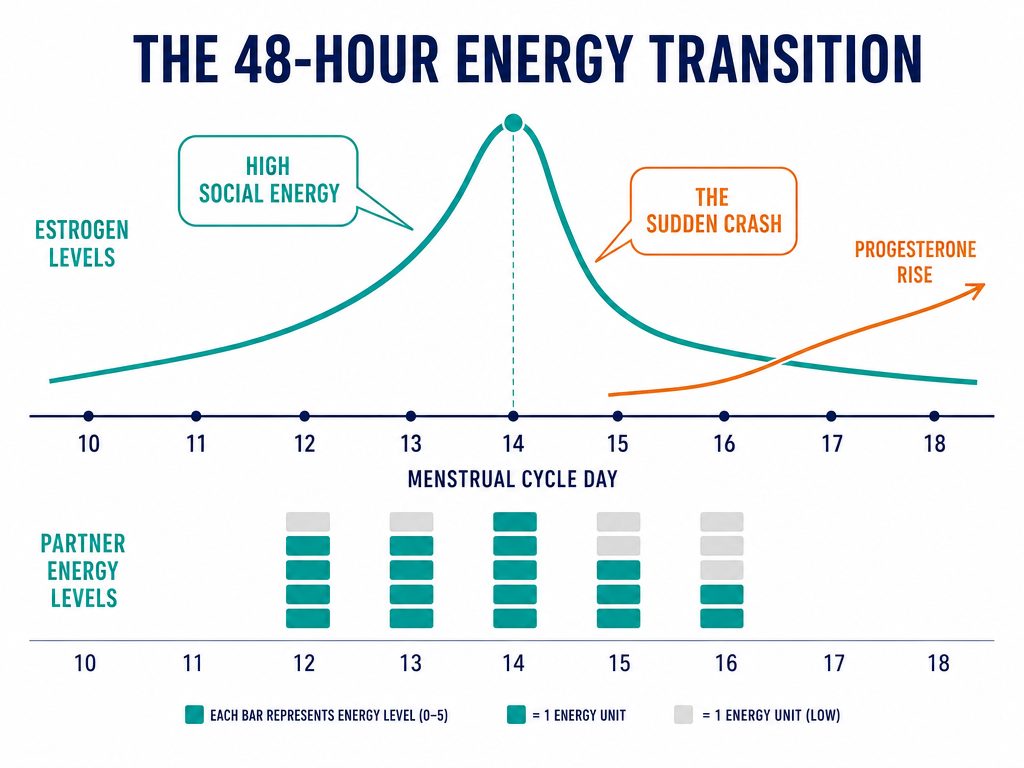 Understanding the hormonal shift from high-energy estrogen peaks to the post-ovulation crash helps you anticipate your partner's needs before the change occurs.
The Energy Spike: Days Leading Up to Ovulation
In the days before ovulation, estrogen reaches its monthly peak. Estrogen affects many body systems, including brain function and the ability to focus, and levels are highest in the days leading up to ovulation. This isn't just "feeling good" - it's a measurable shift in energy, confidence, and sociability.
What you might observe:
- She's initiating plans, suggesting new activities, or wanting to go out more than usual
- Her libido is noticeably higher - she's more interested in physical intimacy
- She has more energy for workouts, social events, or tackling difficult tasks
- She's more talkative, upbeat, or confident in conversations
This is her body's biological summer. It's the best time of the month for activities that require energy, focus, or social engagement. If you've been planning a challenging hike, a dinner party with friends, or a weekend trip, this is when she's most likely to enjoy it.
The Post-Ovulation Crash: What You Need to Know
After ovulation, estrogen drops sharply, and progesterone takes over. That transition - usually happening within 24 to 48 hours - can feel jarring. Mental fatigue has been shown to increase during the luteal phase (the phase immediately following ovulation).
What happens biologically:
- Estrogen plummets from its peak
- Progesterone rises, promoting rest and slowing metabolism
- Serotonin (a mood-regulating neurotransmitter influenced by estrogen) drops
- Body temperature rises slightly, which can contribute to fatigue
What you might notice:
- She cancels plans she was excited about earlier in the week
- She's less interested in physical intimacy or social activities
- She seems quieter, more withdrawn, or less responsive
- She complains about feeling tired, achy, or "off" without a clear reason
This isn't laziness or her being flaky. It's a biological shift. There is general research support for hormone-linked differences in mood and energy across the cycle - energy tends to be lower during the period and can build through the follicular phase toward ovulation, with PMS-type symptoms more likely in the luteal phase.
What Is "Ovulation Flu"?
Some women describe post-ovulation symptoms that mimic a cold or flu: fatigue, headaches, body aches, brain fog, and low-grade nausea. There's no official medical diagnosis for "ovulation flu," but the symptom cluster is real and hormone-driven.
Why it happens:
- The estrogen crash after ovulation can trigger headaches (estrogen withdrawal headaches are a documented phenomenon)
- Rising progesterone can cause fatigue and body temperature changes
- Immune system fluctuations tied to the menstrual cycle may make her more susceptible to inflammation or minor illness
What it looks like:
- She wakes up feeling drained, even after a full night's sleep
- She has a headache that won't respond to typical remedies
- She feels vaguely unwell but can't pinpoint what's wrong
- She wants to cancel plans and stay home
If she mentions feeling "like she's getting sick" around mid-cycle, don't dismiss it. It's not imaginary. She's not exaggerating. Her body is responding to a hormonal shift that's as real as any cold.
For more on how to support her through these luteal phase symptoms, check out our tactical partner's guide to the luteal phase.
Mittelschmerz: Understanding Ovulation Pain
Approximately 20% of women experience Mittelschmerz (ovulation pain), which typically lasts from a few minutes to 48 hours. The name comes from German: "middle" (mittel) and "pain" (schmerz).
What it feels like:
- Sharp, sudden pain on one side of the lower abdomen
- Dull ache or cramping in the pelvic area
- Pain that switches sides from month to month (depending on which ovary releases an egg)
- Sometimes accompanied by light spotting or nausea
What you can do:
- Don't minimize her pain. Some women describe mittelschmerz as debilitating, not just a "twinge"
- Offer a heating pad or hot water bottle for her lower abdomen
- Suggest ibuprofen or another anti-inflammatory if she doesn't already have it
- Be ready to change plans if she's in significant discomfort
If you're trying to understand what this pain feels like from a male perspective, imagine a sharp cramp deep in your lower abdomen that comes out of nowhere and lasts for hours. It's not "just cramps" - it's a distinct, localized pain.
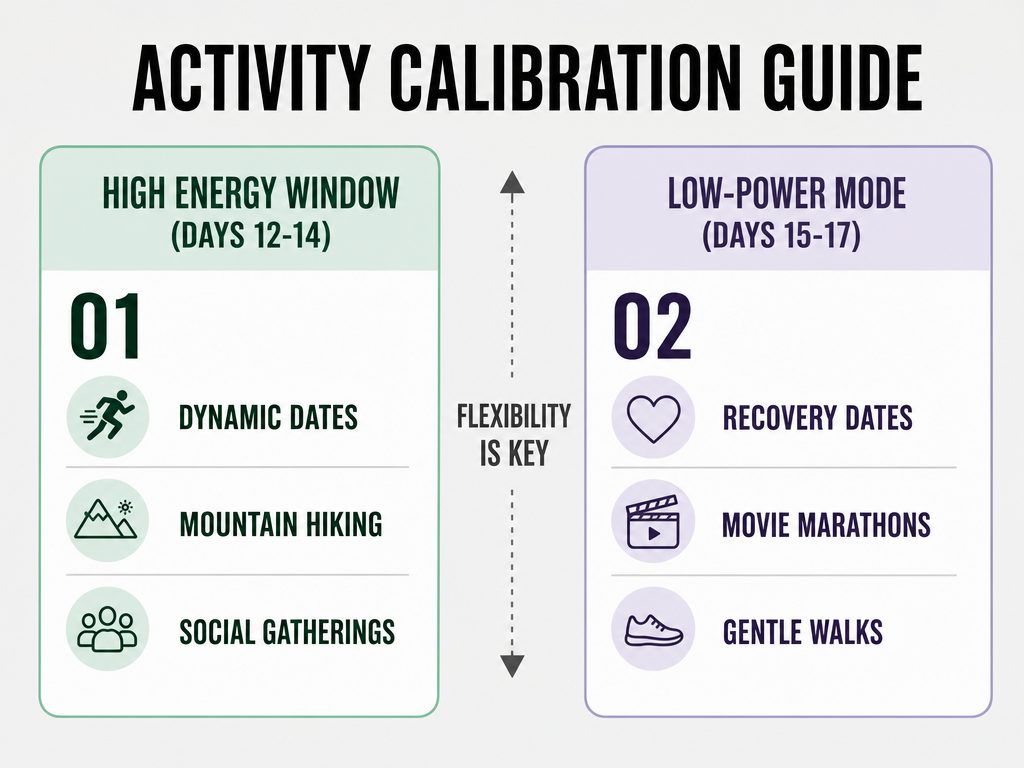 Timing your activities to match her hormonal energy levels reduces friction and ensures both of you enjoy your time together, whether active or restful.
How to Support Her During the High-Energy Phase
When estrogen is high, she's operating at peak capacity. This is the time to plan activities that match that energy.
Match Her Energy Level
- Suggest the challenging hike, the long bike ride, or the workout class you've both been talking about
- Plan social activities: dinner with friends, parties, or group outings
- Tackle projects that require focus and collaboration, like planning a trip or organizing your apartment
- Be receptive to her initiating plans - she's not being demanding, she's leveraging her natural energy window
Acknowledge Her Libido Spike Without Making It Transactional
Her sex drive is genuinely higher during this phase. That's biology, not a favor she's doing you. Respond to her cues, but don't treat it like a "window of opportunity" you need to maximize before it closes. She'll notice if you're suddenly more attentive only when she's ovulating.
Instead:
- Be present and responsive when she initiates
- Match her energy without pressuring her
- Remember that this heightened interest is tied to her cycle - it's not a baseline you can expect every week
Be Her Partner in Planning
She's probably thinking ahead, making plans, and tackling to-do lists. This is when she's most receptive to:
- Discussing future trips or goals
- Making decisions about big purchases or changes
- Having serious conversations that require mental clarity
Don't waste this window by being passive. If you've been putting off a conversation or a decision, this is the time to bring it up.
How to Support Her During the Energy Crash
When progesterone takes over and estrogen drops, her needs shift dramatically. What worked last week won't work now.
Offer the Pivot
If you had plans for an active Saturday and she seems drained, be the one to suggest changing gears. Don't wait for her to cancel - proactively offer a lower-energy alternative.
Instead of saying: "Are you still up for hiking today?"
Try: "I noticed you've seemed a bit tired this week. Want to swap the hike for a movie and takeout? We can hit the trail next weekend."
This shows you're paying attention without making her feel guilty for changing plans.
Stock the Mid-Cycle Stash
Most guides tell you to buy pads and tampons. That's a start, but it's not enough. The real support happens mid-cycle, when she's dealing with post-ovulation fatigue, headaches, and Mittelschmerz pain.
Keep these on hand:
- Magnesium supplements (magnesium can help with headaches and muscle tension, though specific clinical trials for "ovulation flu" relief are limited)
- Dark chocolate (a natural source of magnesium and a mood booster)
- Electrolyte packets or hydration drinks (hormonal shifts can affect hydration and trigger headaches)
- Ibuprofen or another anti-inflammatory for pain relief
- A heating pad for abdominal cramping
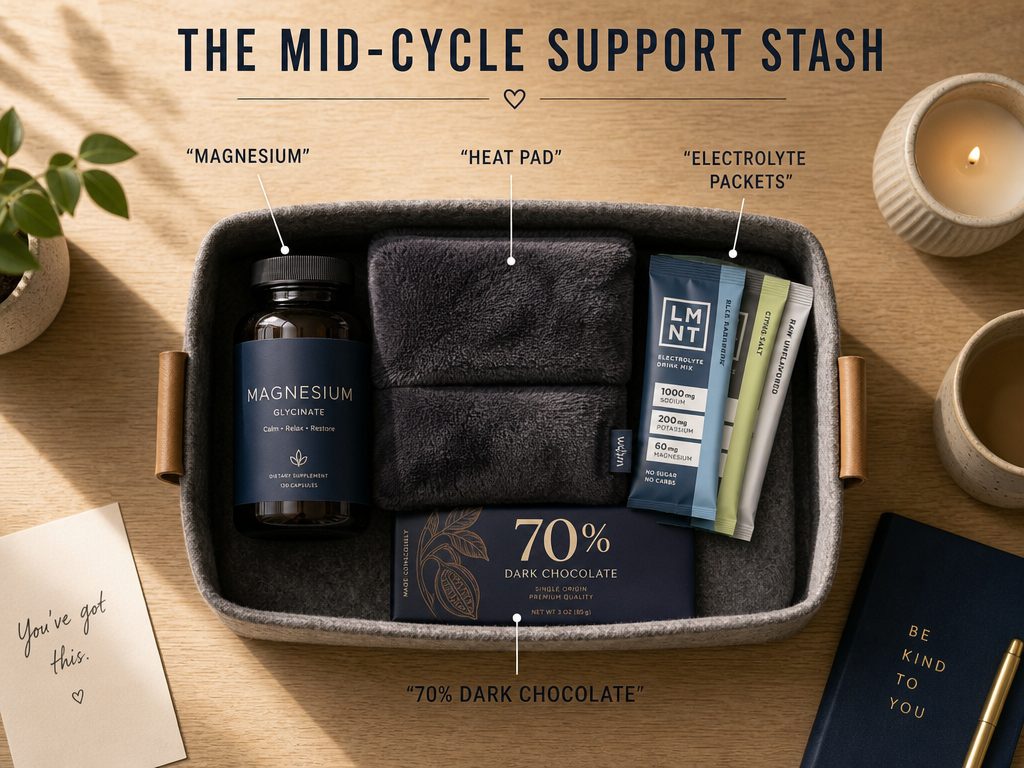 Being prepared with a 'Mid-Cycle Stash' shows proactive support, providing physical relief for the 'ovulation flu' or Mittelschmerz pain without her having to ask.
Validate Her Experience
If she says she feels exhausted or unwell:
Don't say: "You were fine yesterday. Maybe you just need more sleep."
Instead: "That sounds rough. What can I take off your plate today?"
Don't try to solve it. Just acknowledge it.
Adjust Your Expectations
This is not the time for:
- Intense workouts or physically demanding activities
- Big social events or gatherings that require her to be "on"
- Conversations that require heavy decision-making or emotional bandwidth
This is the time for:
- Quiet nights in
- Low-key activities like watching a show, cooking together, or going for an easy walk
- Giving her space if she needs it without taking it personally
Understanding when to give her space without making it feel like abandonment is a relationship skill. Learn more in our guide on signs your girlfriend needs space.
What Not to Do: Communication Mistakes That Make It Worse
Don't "Cycle-Splain" Her Mood
Even if you're right about where she is in her cycle, don't say: "You're just acting this way because you're ovulating."
That's dismissive. It makes her feel reduced to her biology and implies her feelings aren't valid.
Instead, keep your observations to yourself and respond to what she's telling you she needs.
Don't Assume You Know Better Than She Does
She's lived with this body her entire adult life. If she says she needs rest, she needs rest. If she says she's in pain, she's in pain. Don't downplay it or suggest she's overreacting.
Don't Make It About You
If she cancels plans, don't guilt her: "But you said you wanted to go out."
She did. And then her hormones shifted. That's not her changing her mind to mess with you - it's her body changing the conditions.
Don't Track Her Cycle to Predict When She'll Want Sex
This is a common mistake. Men think: "If I know when she's ovulating, I can plan around it." That's transactional and creepy. Her libido is hers to navigate. Your job is to be responsive, not strategic.
For a deeper understanding of how her mood shifts throughout the month, read our guide on how to tell which cycle phase your girlfriend is in.
Frequently Asked Questions
Are you more energetic when ovulating?
Yes. Estrogen levels spike just before ovulation, which can increase energy and libido. Many women report feeling more social, confident, and physically capable in the days leading up to ovulation. This is the peak energy window of the cycle.
Why am I so fatigued when I ovulate?
If fatigue hits right after ovulation, it's likely due to the estrogen drop and the rise in progesterone. Mental fatigue has been shown to increase during the luteal phase (the phase immediately following ovulation). This isn't the same as fatigue during ovulation itself - it's the crash that follows.
How do you describe ovulation pain to a man?
Mittelschmerz feels like a sharp, sudden cramp on one side of the lower abdomen. It's not diffuse like period cramps - it's localized and can range from a dull ache to a stabbing sensation. Some women describe it as feeling like something is "pulling" or "popping" internally. Approximately 20% of women experience this pain, which typically lasts from a few minutes to 48 hours.
What helps with ovulation flu?
There's no official medical treatment for "ovulation flu" because it's not a diagnosable condition, but the symptoms - fatigue, headaches, body aches - are real. What can help:
- Rest and reduced activity
- Hydration and electrolytes
- Anti-inflammatory medication like ibuprofen for headaches or body aches
- A heating pad for discomfort
- Magnesium-rich foods or supplements (though clinical evidence for this specific use is limited)
Lifestyle approaches that can help ease PMS symptoms include regular aerobic exercise, smaller/more frequent meals, less salt/caffeine/alcohol, adequate sleep, and stress-reduction practices like deep breathing or yoga. These same strategies can help with post-ovulation symptoms.
Do I have less energy in the luteal phase?
Yes. The luteal phase - the time after ovulation until the next period - is when progesterone rises and estrogen drops. Many women notice PMS-like symptoms in this phase - mood shifts, breast tenderness, bloating, acne, and appetite changes. Fatigue is one of the most common complaints during this window.
How long does post-ovulation fatigue last?
Post-ovulation fatigue typically begins a day or two after ovulation and can last anywhere from a few days to a full week, depending on the individual. Some women feel it most intensely in the first few days of the luteal phase and then adjust as progesterone stabilizes. Others experience waves of fatigue throughout the entire luteal phase until their period starts.
Can ovulation cause irritability?
The irritability most people associate with the menstrual cycle is usually tied to PMS, which happens in the luteal phase - after ovulation. However, the sharp drop in estrogen immediately following ovulation can trigger mood changes in some women. Estrogen influences serotonin production, so when it drops, mood regulation can take a hit.
Supporting your girlfriend through ovulation energy changes isn't about memorizing her cycle or treating her like a science experiment. It's about recognizing that her energy and mood shifts are real, predictable, and tied to biology - and responding with empathy instead of confusion.
You don't need to become an expert on hormones. You just need to notice the patterns, adjust your expectations, and show up with the kind of support that actually helps.
If you want to understand the full 28-day cycle and how to navigate each phase, check out our boyfriend's guide to the menstrual cycle. And if you're ready to stop guessing and start tracking, our period calculator tool can help you anticipate her needs before the energy shift hits.
Tags

Related Articles
Continue reading to deepen your understanding

Supporting Your Girlfriend Through the Luteal Phase
When hormone levels crash before her period, your partner’s brain enters a high-alert state. Learn how to provide the security she needs with tactical scripts and empathy.

How to Give Your Girlfriend Reassurance During Ovulation Week
Is your girlfriend suddenly questioning everything during her cycle? Understand the estrogen crash and learn how to provide the tactical support she needs to feel secure and loved.

When to Give Her Space vs. When to Stay Close: Your Phase-by-Phase Guide
Your girlfriend’s need for closeness isn’t random. Understanding how her 28-day biological rhythm affects her energy helps you time your support perfectly across all four phases.

Your Girlfriend’s 28-Day Relationship Manual: How to Support Her Through Every Phase
Understanding her menstrual cycle transforms you from a guy walking on eggshells into a strategic partner who knows exactly what support to offer and when.

When Your Girlfriend Goes Distant During the Luteal Phase: The Partner’s Tactical Guide
Does your girlfriend pull away or go quiet right before her period? Understand the biological reason for her withdrawal and how you can support her without making it worse.

The Strategic Partner’s Guide to Ovulation Energy Surge Date Ideas
Is your girlfriend suddenly full of energy and ready for adventure? It’s likely her ovulation surge. Use this guide to plan dates that match her peak confidence and social drive.

How to Plan a Surprise for Your Girlfriend During Her Follicular Phase
Stop fighting her hormones and start working with them. Use this guide to time your surprises perfectly with her biological clock for better reactions and maximum joy.

How to Comfort Your Girlfriend During Ovulation Mood Swings: The Partner’s Tactical Guide
Is your partner suddenly irritable mid-cycle? It is likely an estrogen crash. Use these tactical tips to navigate her ovulation mood swings with empathy.