How to Plan Romantic Gestures by Cycle Timing: The Partner’s Tactical Guide

Stop guessing why your date night plans fell flat. This guide explains how to synchronize your romantic efforts with her biological cycle for better intimacy and connection.
How to Plan Romantic Gestures by Cycle Timing: The Partner's Tactical Guide
Your girlfriend went from excited about your date night plans to barely interested. You planned a weekend hiking trip, and she canceled at the last minute. You suggested a big conversation about moving in together, and she shut down completely.
The problem isn't your effort. It's your timing.
Her energy, mood, and social capacity aren't random - they follow a predictable 28-day biological pattern. Understanding this rhythm transforms you from a partner who's constantly guessing into one who knows exactly when to suggest adventure, when to plan a quiet night in, and when a conversation about the future will actually land well.
Men who ignore their partner's hormonal cycle report significantly lower relationship satisfaction. 60% of women say their partner's limited understanding of reproductive health affects their relationship dynamics.
This isn't about memorizing biology. It's about becoming the kind of partner who stops fighting her natural rhythm and starts working with it.
Table of Contents
- The Four Seasons Framework: Your Biological Blueprint
- Menstrual Phase: Winter (Days 1-7)
- Follicular Phase: Spring (Days 8-13)
- Ovulation Phase: Summer (Days 14-17)
- Luteal Phase: Autumn (Days 18-28)
- The Permission Script: How to Start Tracking
- The Period Pantry: Essential Support Items
- Tactical Execution: Phase-by-Phase Action Plans
- When Traditional Cycle Planning Doesn't Work
- Frequently Asked Questions
The Four Seasons Framework: Your Biological Blueprint
The menstrual cycle has four distinct phases: menstrual (bleeding, roughly days 1-5), follicular (day 1 through ovulation as estrogen rises), ovulation (around day 14 in a 28-day cycle, triggered by a surge in luteinizing hormone), and luteal (after ovulation to the next period, as progesterone rises then falls). The follicular and menstrual phases overlap.
VibeCheck App
Download Free on iOS →Think of these phases as seasons. Each one brings different energy levels, social capacity, and emotional needs. Your job isn't to change the weather - it's to dress appropriately for it.
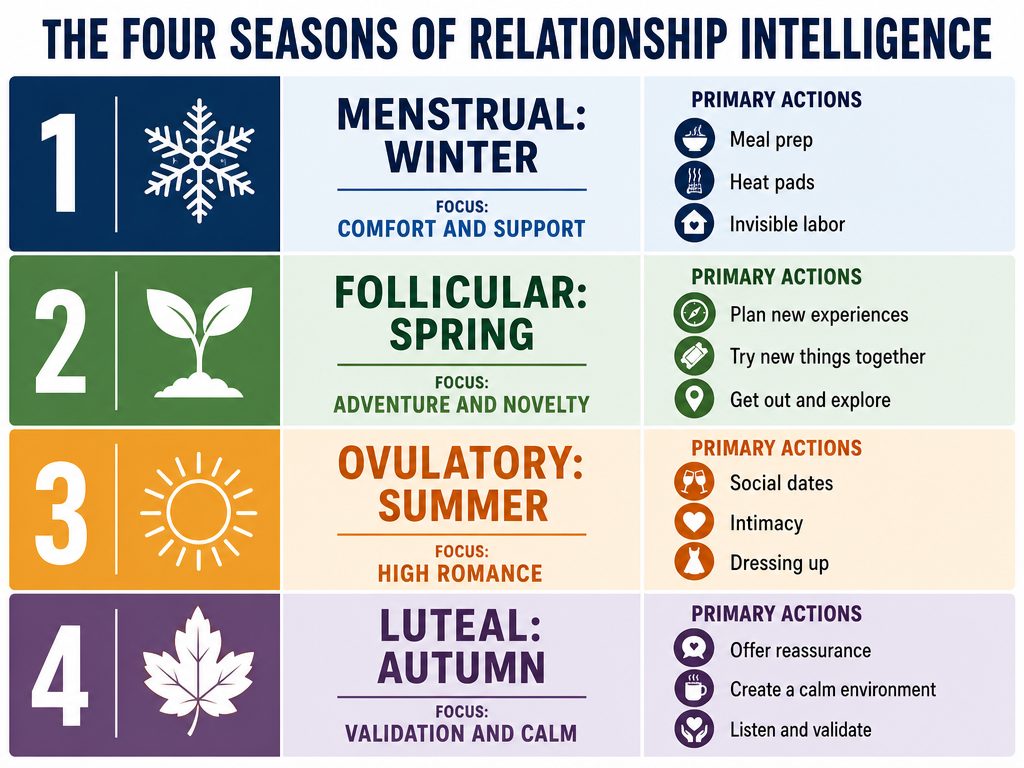 Mapping your romantic efforts to her biological cycle ensures your gestures align with her energy levels, moving from comfort in 'Winter' to adventure in 'Summer.'
Here's what matters: a "normal" cycle varies considerably between women - menstrual bleeding can start anywhere from every 24 to every 38 days and last up to 8 days. There is no single universal 28-day cycle, so exact day-by-day predictions for any specific woman should be treated as approximate. Track her patterns for at least three cycles before you rely on timing.
Menstrual Phase: Winter (Days 1-7)
This is the rest phase. 88% of women experience cramps, bloating, or fatigue during the menstrual phase. Her body is shedding the uterine lining, and her energy is at its lowest point of the month.
What's happening biologically: Both estrogen and progesterone are at their lowest levels. Blood loss and cramping create physical discomfort that drains her social and cognitive bandwidth.
What she actually needs: Comfort. Support. Reduced decision-making. This is where "Invisible Labor" becomes your greatest romantic gesture.
Invisible Labor means:
- Making dinner without asking what she wants
- Handling the dishes without being reminded
- Running errands so she doesn't have to leave the house
- Keeping the space quiet and low-stimulation
The worst timing mistakes:
- Planning high-energy dates (hiking, concerts, group dinners)
- Scheduling "big" relationship conversations
- Expecting her to make decisions about weekend plans
- Suggesting spontaneous adventures
What actually works:
- A heating pad left by her side of the bed
- Her favorite takeout ordered without prompting
- Handling tasks she normally manages (laundry, groceries, pet care)
- Suggesting a movie night at home with her comfort queue ready
One partner described this phase perfectly: "I used to plan elaborate date nights during her period, then get frustrated when she wasn't excited. Now I plan those dates for two weeks later, and during her period, I just handle everything at home. She says it's the most romantic thing I've ever done."
Follicular Phase: Spring (Days 8-13)
This is the power phase. During the follicular phase, estrogen rises as an egg-containing follicle develops in the ovary; this rising estrogen also thickens the uterine lining and triggers increased energy and mental clarity.
What's happening biologically: Estrogen is climbing steadily. Estrogen affects many body systems, including brain function and the ability to focus, and levels are highest in the days leading up to ovulation. She has more physical energy, better mood stability, and increased openness to new experiences.
What she actually wants: Adventure. Novelty. Ambitious plans. This is your window for "big" dates and important conversations.
The best timing opportunities:
- Planning weekend trips or day adventures
- Trying new restaurants or activities
- Having serious relationship conversations (moving in, engagement, future planning)
- Suggesting social events with friends or family
What actually works:
- Booking tickets to that concert she mentioned
- Planning a hike or outdoor activity
- Suggesting a weekend road trip
- Bringing up the "where is this relationship going" conversation
The tactical advantage: This phase gives you the highest probability of an enthusiastic "yes" to ambitious plans. Use it strategically. If you've been waiting for the right time to suggest meeting her parents or planning a big trip, this is it.
Ovulation Phase: Summer (Days 14-17)
This is the radiance phase. Ovulation is when a surge in luteinizing hormone causes the ovary to release an egg, typically around day 14 of a 28-day cycle. Around ovulation, many women notice symptoms such as increased sex drive, mild pelvic or abdominal pain, tender breasts, bloating, and mood changes - but these vary considerably person to person, and not everyone notices them.
What's happening biologically: Estrogen peaks just before ovulation, then drops sharply afterward. This creates a brief window of peak confidence, social energy, and physical desire - followed by a noticeable energy crash.
What she actually wants: High romance. Social connection. Physical intimacy. This is the phase when she's most likely to want to dress up, be seen, and feel desired.
The best timing opportunities:
- Planning formal date nights (nice restaurants, theater, events where she can dress up)
- Organizing group dates or double dates
- Initiating physical intimacy
- Taking photos together (she'll feel most confident about how she looks)
What actually works:
- Making reservations at that upscale restaurant
- Suggesting she wear that dress you love
- Planning a date with another couple
- Complimenting her appearance genuinely and specifically
The tactical warning: The energy crash after ovulation can be sudden and disorienting. If she was enthusiastic about plans on Tuesday and withdrawn by Friday, it's likely the post-ovulation dip. Don't take it personally - it's biochemical, not relational.
Learn more about how to support your girlfriend during ovulation mood changes.
Luteal Phase: Autumn (Days 18-28)
This is the sensitivity phase. After ovulation, the luteal phase begins: progesterone rises to help prepare the uterine lining for a possible pregnancy. If pregnancy doesn't happen, both progesterone and estrogen drop before the next period. This hormonal withdrawal is what drives PMS.
What's happening biologically: Serotonin levels can drop by approximately 40% in the final week before a period. This isn't a metaphor - it's a chemical withdrawal that affects mood regulation, sleep quality, and stress tolerance.
PMS (premenstrual syndrome) is very common: as many as 3 in 4 women report experiencing PMS symptoms at some point in their life, though severity varies widely. Symptoms - which can include mood swings, irritability, bloating, breast tenderness, and fatigue - typically show up one to two weeks before a period and resolve within a few days after it starts.
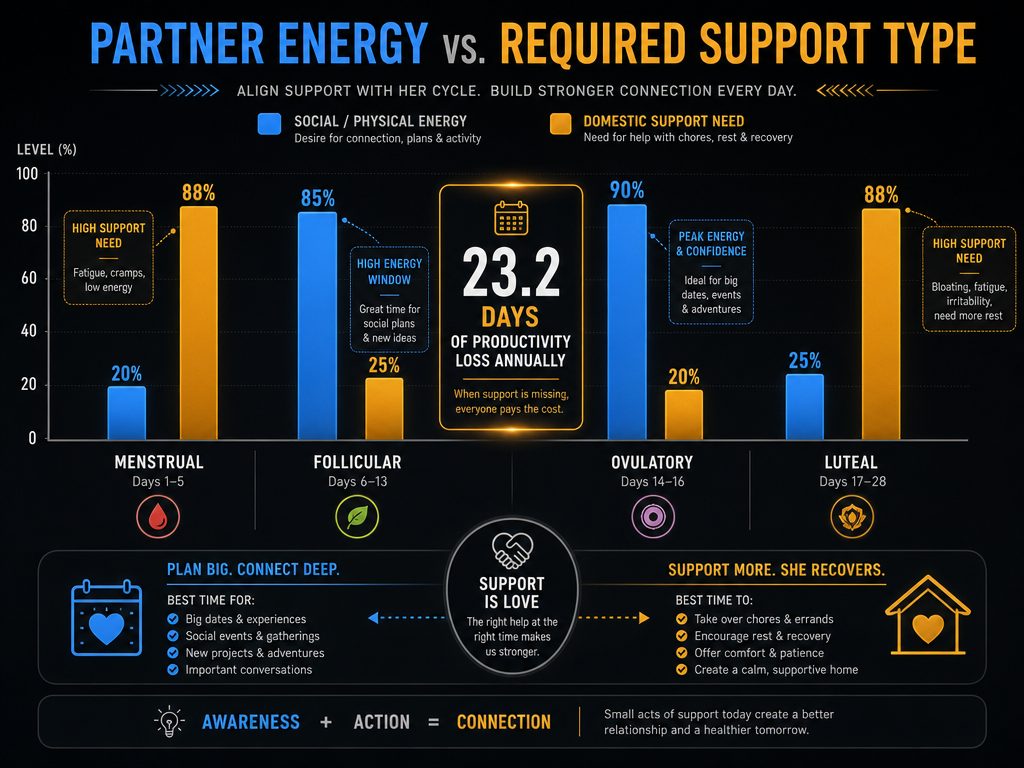 Understanding the inverse relationship between her energy and her need for support helps you pivot from planning dates to reducing her cognitive load at home.
What she actually needs: Validation. Low-stakes comfort. Reduced friction. This is not the time for ambitious plans or difficult conversations.
The worst timing mistakes:
- Planning high-energy social events
- Initiating serious or critical conversations
- Expecting enthusiasm for spontaneous plans
- Dismissing her mood as "just PMS"
What actually works:
- Suggesting cozy nights in instead of going out
- Having her favorite snacks already in the house
- Using validation scripts when she's stressed
- Offering to handle decisions she'd normally make
The Luteal Script (your tactical communication tool):
When she's visibly stressed or irritable:
"I can see you're having a hard time. Instead of [the plan we made], how about I [lower-effort alternative] while you rest?"
Example: "I can see you're stressed. Instead of the dinner reservation tonight, how about I order Thai food and handle the dishes while you take a bath?"
This script does three things: it acknowledges her state without making her defend it, it removes a decision from her plate, and it offers tangible relief instead of empty reassurance.
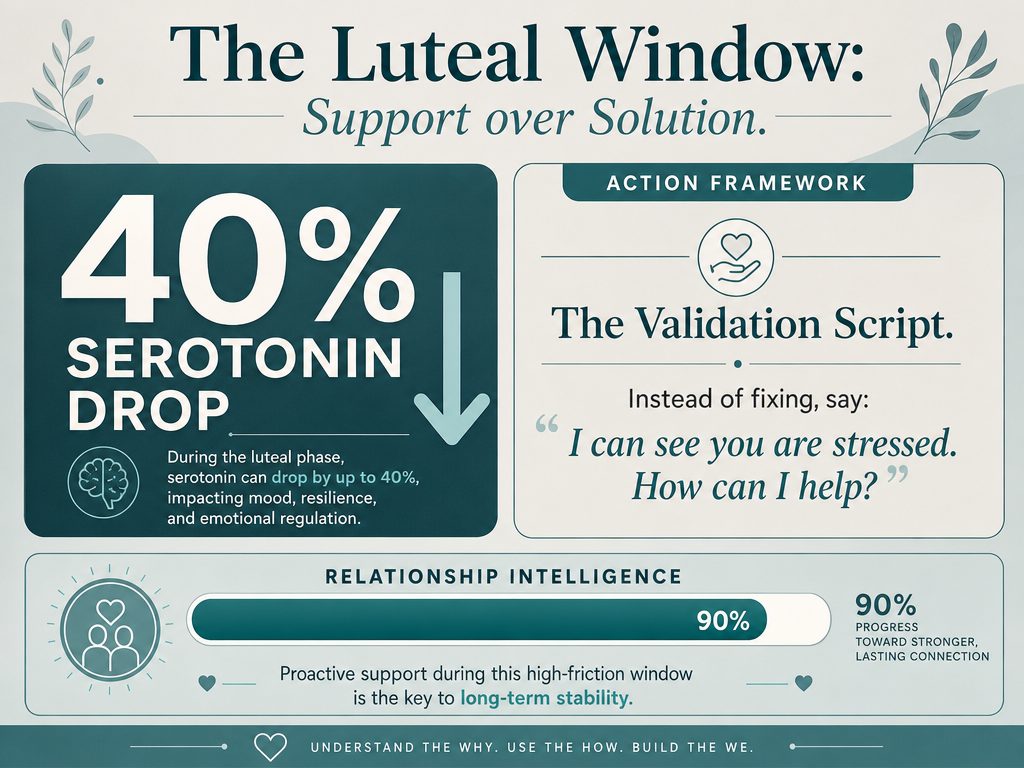 During the Luteal phase, biological shifts like a 40% serotonin drop make validation and low-stakes comfort more effective than high-energy romantic gestures.
When a partner is struggling emotionally, responding with genuine empathy - listening without judgment, focusing on their feelings rather than debating facts, and validating that their reaction makes sense - tends to help more than trying to "fix" the problem or offer silver linings. Feeling understood, not corrected, is what tends to defuse tension.
For more tactical support during this phase, read our guide on how to support your girlfriend during luteal phase mood changes.
The Permission Script: How to Start Tracking
Most men want to track their partner's cycle but don't know how to bring it up without sounding creepy or controlling. Here's the 30-second script that actually works:
"I realized I don't really understand how your cycle affects your energy and mood. I want to plan dates and conversations when you actually feel good, not when you're exhausted. Would you be open to sharing your tracker with me - or just giving me a heads-up about which phase you're in - so I can support you better?"
Why this works:
- You're framing it as support, not surveillance
- You're acknowledging your own knowledge gap
- You're asking for permission, not demanding access
- You're focused on improving her experience, not controlling her
If she's hesitant, suggest a trial period: "How about we try it for one cycle and see if it actually helps?"
Most women appreciate a partner who wants to understand their biology instead of dismissing it. 60% of women say their partner's limited understanding of reproductive health affects their relationship dynamics.
The Period Pantry: Essential Support Items
The best romantic gesture isn't flowers during her period - it's having the right supplies already in the house so she doesn't have to ask for them.
Stock these items before you need them:
Comfort essentials:
- A rechargeable heating pad (not the disposable kind)
- Epsom salts for baths
- A dedicated "cozy blanket" she associates with rest
- Unscented lotion (scent sensitivity increases during menstruation)
Cravings (personalized to her patterns):
- Dark chocolate (it contains magnesium, which may help with cramps)
- Salty snacks she specifically requests when she's premenstrual
- Her preferred comfort foods (ice cream, chips, takeout menus from her favorites)
Logistics:
- Backup supply of her specific preferred menstrual products (tampons, pads, or cups - ask her brand and absorbency level)
- Ibuprofen or her preferred pain reliever
- Ginger tea or peppermint tea (both ease nausea)
Media:
- A "comfort queue" of movies or shows she loves that require zero cognitive load
- A playlist she associates with relaxation
- Books or magazines she can read without concentration
The goal isn't to turn your home into a pharmacy. It's to remove the cognitive load of asking for what she needs. When she's already depleted, having to explain what would help is an additional burden.
Tactical Execution: Phase-by-Phase Action Plans
Here's the reference table you can screenshot and review weekly:
| Phase | Days | Energy Signature | Optimal Romantic Focus | Gesture Playbook | Red Flags (Avoid) |
|---|---|---|---|---|---|
| Menstrual | 1-7 | Winter (Rest) | Comfort & Support | Heating pads, meal prep, handle chores, quiet nights in | High-energy dates, big conversations, spontaneous plans |
| Follicular | 8-13 | Spring (Power) | Adventure & Novelty | New restaurants, hiking, weekend trips, serious talks | Passive dates, staying home when she wants to go out |
| Ovulatory | 14-17 | Summer (Radiance) | High Romance | Dressing up, social events, physical intimacy, photos | Low-effort dates, criticizing her appearance |
| Luteal | 18-28 | Autumn (Sensitivity) | Validation & Calm | Listening scripts, cozy nights, snacks, reduced decisions | Conflict, criticism, high-pressure social events |
The resource allocation question: When should you spend money on a "big" date versus focus on invisible labor?
Follicular and ovulation phases: This is when high-investment dates (nice restaurants, tickets to events, weekend trips) have the highest return. Her energy is up, her openness to experience is high, and she'll actually enjoy ambitious plans.
Menstrual and luteal phases: This is when low-cost, high-care gestures (handling chores, ordering her favorite takeout, running errands) matter more than expensive plans. She doesn't want to be entertained - she wants to be relieved of burden.
One partner explained it this way: "I used to spend two hundred dollars on a fancy dinner during her period, and she'd be miserable the whole time. Now I spend twenty dollars on Thai food and do all the dishes, and she says it's the most thoughtful thing I do all month."
For more tactical guidance, see our complete boyfriend's guide to menstrual cycle phases.
When Traditional Cycle Planning Doesn't Work
Not every woman has a predictable 28-day cycle. Some cycles are shorter, some are longer, and some are irregular. A "normal" cycle varies considerably between women - menstrual bleeding can start anywhere from every 24 to every 38 days and last up to 8 days.
If her cycle is irregular:
- Focus on behavioral cues instead of calendar counting (is she withdrawing socially? Craving specific foods? Needing more sleep?)
- Track patterns over three months instead of one
- Ask her to flag "high-energy weeks" and "low-energy weeks" without worrying about specific phase names
If she has PMDD (Premenstrual Dysphoric Disorder):
PMDD is a real, clinically recognized condition - it's listed in the DSM-5 as a depressive disorder, not something people are "making up" or simply failing to cope with. It affects roughly 1 in 10 people who menstruate.
PMDD is a more severe, sometimes disabling extension of PMS. Both happen on a similar timeline (about 7-10 days before a period) and can share physical symptoms like bloating and fatigue, but PMDD specifically involves extreme mood symptoms - such as marked irritability, anxiety, or hopelessness - intense enough to disrupt daily life and strain relationships.
If you suspect PMDD:
- Encourage her to track symptoms for two cycles and share them with her doctor
- Understand that this is a medical condition requiring treatment, not a character flaw
- Adjust your expectations during the symptomatic window (she's managing a depressive episode, not "being difficult")
If she's on hormonal birth control:
Some forms of hormonal contraception suppress ovulation entirely, which flattens the hormonal curve. If she's on the pill, an IUD, or an implant, she may not experience the same energy fluctuations described here.
Ask her: "Do you notice energy or mood shifts throughout the month, or does everything feel pretty consistent?"
If she says it's consistent, then traditional cycle syncing won't apply. Focus instead on other stress factors (work deadlines, sleep quality, external life events).
There is general research support for hormone-linked differences in mood and energy across the cycle - energy tends to be lower during the period and can build through the follicular phase toward ovulation, with PMS-type symptoms more likely in the luteal phase. Specific "cycle syncing" lifestyle programs built on this idea have not themselves been tested in clinical research, so prescriptive claims (exact workouts or foods for exact cycle days) go beyond what's established.
Frequently Asked Questions
How should a guy treat his girlfriend when she's on her period?
Treat her like she's recovering from a physically and emotionally draining event - because she is. 88% of women experience cramps, bloating, or fatigue during the menstrual phase. Focus on reducing her cognitive and physical load: handle chores without being asked, offer comfort items (heating pad, favorite foods), and don't expect her to be enthusiastic about high-energy plans. The goal is invisible support, not grand gestures.
For a complete playbook, read what to do when your girlfriend is on her period.
How to explain the luteal phase to a man?
The luteal phase is the 10-14 days before her period when progesterone rises and then crashes along with estrogen. Serotonin levels can drop by approximately 40% in the final week before a period, which is why mood, sleep, and stress tolerance all take a hit. It's not "being moody" - it's a biochemical withdrawal that feels like low-grade depression or anxiety. The tactical takeaway: this is when she needs validation and reduced friction, not ambitious plans or difficult conversations.
What should boyfriends do during the luteal phase?
Lower your expectations for social energy and enthusiasm. Offer low-stakes comfort (cozy nights in, favorite snacks, handling decisions she'd normally make) instead of pushing for adventure. Use validation scripts when she's stressed: "I can see you're having a hard time. Instead of going out tonight, how about I order takeout and handle the dishes while you rest?" This phase is about reducing her burden, not entertaining her.
Learn the complete tactical approach in our luteal phase support guide.
Is it normal to not like your partner during the luteal phase?
Yes, and it's biochemical, not relational. Serotonin levels can drop by approximately 40% in the final week before a period, which affects emotional regulation and stress tolerance. Small annoyances feel magnified, and the emotional bandwidth for patience shrinks. If irritability shows up predictably in the same window every month and resolves after her period starts, it's likely hormonal. Tracking symptoms and mood changes across the cycle for a few months is a legitimate, medically endorsed way to identify real patterns and timing - rather than assuming based on stereotypes or a single cycle.
How do I bring up cycle tracking without sounding controlling?
Use the Permission Script: "I realized I don't really understand how your cycle affects your energy and mood. I want to plan dates and conversations when you actually feel good, not when you're exhausted. Would you be open to sharing your tracker with me - or just giving me a heads-up about which phase you're in - so I can support you better?"
Frame it as improving her experience, not monitoring her biology. Offer a trial period: "How about we try it for one cycle and see if it helps?" Most women appreciate a partner who wants to understand instead of dismiss.
When is the best time for big relationship conversations?
The follicular phase (days 8-13) is your highest-probability window. During the follicular phase, estrogen rises, which supports increased energy, mental clarity, and openness to future-oriented thinking. This is when "where is this relationship going" conversations, discussions about moving in together, or talks about engagement are most likely to land well. Avoid the luteal phase (days 18-28) for high-stakes conversations - her stress tolerance is lower, and she's managing a biochemical withdrawal.
What are the best apps for men to track their partner's cycle?
Look for apps with partner-mode features that give you actionable guidance, not just raw data. Clue offers a "Connect" feature, Flo has a partner mode, and apps like VibeCheck are specifically built for men who want daily insights on how to support their partner. The key is choosing an app that translates cycle data into "what do I do today" instead of making you interpret hormone charts yourself.
Compare your options in our guide to the best period tracker apps for men.
What is mittelschmerz and how do I support my girlfriend through it?
Mittelschmerz - one-sided lower abdominal pain around the time of ovulation - is a real, documented phenomenon, not something imagined. It's generally harmless, usually lasts minutes to a couple of days, and typically doesn't require medical treatment. How often mittelschmerz happens varies considerably: some women get it almost every cycle, others only occasionally or never.
If she experiences it, offer the same comfort you would during menstrual cramps: heating pad, ibuprofen, and reduced physical demands. Don't suggest high-intensity activities on days when she's feeling mid-cycle pain.
The bottom line: Your girlfriend's energy, mood, and social capacity follow a predictable biological rhythm. Men who track this pattern and adjust their plans accordingly report better relationship satisfaction, fewer rejected date nights, and less conflict over "bad timing."
Stop treating her cycle as an obstacle and start treating it as a strategic advantage. When you understand the Four Seasons framework, you know exactly when to suggest adventure, when to plan romance, and when to just handle the dishes and order takeout.
Ready to stop guessing and start supporting? Download VibeCheck to get daily insights on her cycle phase and personalized guidance on what she actually needs - so you can be the partner who always knows the right move.
Tags

Related Articles
Continue reading to deepen your understanding

Why Your Girlfriend Needs Different Communication Styles During Her Cycle
Stop wondering why your conversations feel like a minefield one week and a breeze the next. Use biology to understand her changing needs and adapt your style.

When Your Girlfriend Gets Withdrawn Before Her Period
If she suddenly pulls away, it is usually biology, not you. Learn why your girlfriend gets distant before her period and use these tactical scripts to help her during the luteal phase.

How to Respond When Your Girlfriend Needs Space During Her Period
If she’s suddenly sending one-word texts or pulling away, it’s likely not about you. Learn the science of the luteal phase and how to support her without feeling rejected.

Understanding Why Your Girlfriend’s Communication Style Shifts Weekly
Ever wonder why your partner’s moods and energy levels shift so much? Understanding the four phases of her menstrual cycle helps you become a more supportive and proactive partner.

When Do Your Girlfriend’s Energy Levels Change During Her Cycle?
Your girlfriend’s mood and stamina follow a biological rhythm. Learn how her energy peaks and crashes throughout the month so you can plan better dates and provide better support.

Why Your Girlfriend Needs Different Attention Each Week: The Four Seasons Framework
Stop walking on eggshells and start understanding her cycle. This framework shows you exactly how to support your girlfriend through all four biological phases every month.

Why Your Girlfriend Wants Space the Week Before Her Period
Does your girlfriend suddenly pull away every month? Discover the biological reasons behind the pre-period space window and how to navigate this phase together.

Why Your Girlfriend Wants Different Kinds of Affection at Different Times in Her Cycle
Ever feel like your girlfriend’s needs change every week? It’s not random. Understand how the four phases of her cycle drive her desire for intimacy so you can support her better.