Understanding Your Girlfriend’s Words of Affirmation Cycle: A Partner’s Guide

Ever feel like your compliments land wrong? Her need for words of affirmation isn’t random—it follows a biological rhythm. Learn how to match your support to her internal hormonal seasons.
Understanding Your Girlfriend's Words of Affirmation Cycle: A Partner's Guide
Has your girlfriend ever shut down after you gave her a compliment that landed totally wrong? Or asked "Do you even notice me anymore?" during a week when you thought everything was fine?
You're not imagining the disconnect. Her need for words of affirmation isn't random - it follows a biological rhythm you can learn to read.
This guide explains how the menstrual cycle's four phases create predictable shifts in her emotional needs, and gives you the exact scripts to match your support to her internal season. You'll learn when celebratory praise hits hardest, when quiet reassurance matters most, and how to avoid the most common mistimed-compliment mistakes that cause friction.
Table of Contents
- What the Words of Affirmation Cycle Actually Means
- The Serotonin Link: Why Hormones Matter
- The Four Seasons Framework
- The 7-2-1 Rule and Decision Tree
- How to Start the Conversation Without Being Weird
- Frequently Asked Questions
What the Words of Affirmation Cycle Actually Means
Words of affirmation - verbal reassurance, praise, acknowledgment - are one of the five love languages. But here's what most relationship advice misses: your girlfriend's receptivity to different types of affirmation changes across her 28-day hormonal cycle.
During some phases, she needs celebratory recognition of her achievements and energy. During others, she needs anchoring reassurance that she's loved even when she feels low. Timing matters as much as the words themselves.
The cycle includes four distinct phases:
VibeCheck App
Download Free on iOS →- Menstrual phase (bleeding, roughly days 1-5): lowest energy, highest need for unconditional acceptance
- Follicular phase (day 1 through ovulation, estrogen rising): building energy, responsive to encouragement for new ideas
- Ovulatory phase (around day 14, peak estrogen): highest confidence, wants romantic and physical affirmation
- Luteal phase (after ovulation to next period, progesterone rising then falling): reality-validating reassurance becomes critical
These aren't arbitrary mood swings. They're biological shifts with measurable hormonal causes. Estrogen affects brain function and the ability to focus, with levels highest in the days leading up to ovulation.
 Understanding the four biological seasons helps you match your words of affirmation to her internal rhythm, ensuring your support feels relevant and deeply felt.
The Serotonin Link: Why Hormones Matter
Why does the type of affirmation that works shift so dramatically? Because estrogen isn't just about reproduction - it directly influences mood regulation.
Research shows estrogen stimulates serotonin and dopamine receptors, influencing mood and motivation. When estrogen rises during the follicular phase, her brain's "feel-good" chemistry rises with it. When it crashes after ovulation and again before menstruation, serotonin availability drops.
This creates a biological vacuum that words of affirmation help fill - but only if they're the right words. Generic praise ("You're amazing!") might land during high-estrogen phases when her confidence is already elevated. During low-estrogen phases, she needs reassurance that addresses the specific emotional gap she's experiencing: "You don't have to perform right now. I love you exactly as you are."
After ovulation, the luteal phase begins: progesterone rises to help prepare the uterine lining for a possible pregnancy. If pregnancy doesn't happen, both progesterone and estrogen drop before the next period. Many women notice PMS-like symptoms in this phase - mood shifts, breast tenderness, bloating, acne, and appetite changes.
This progesterone crash is why "Storm Week" (the 7-10 days before her period) often brings the highest emotional sensitivity. She's not being difficult - her brain chemistry is literally withdrawing from hormones it had adapted to.
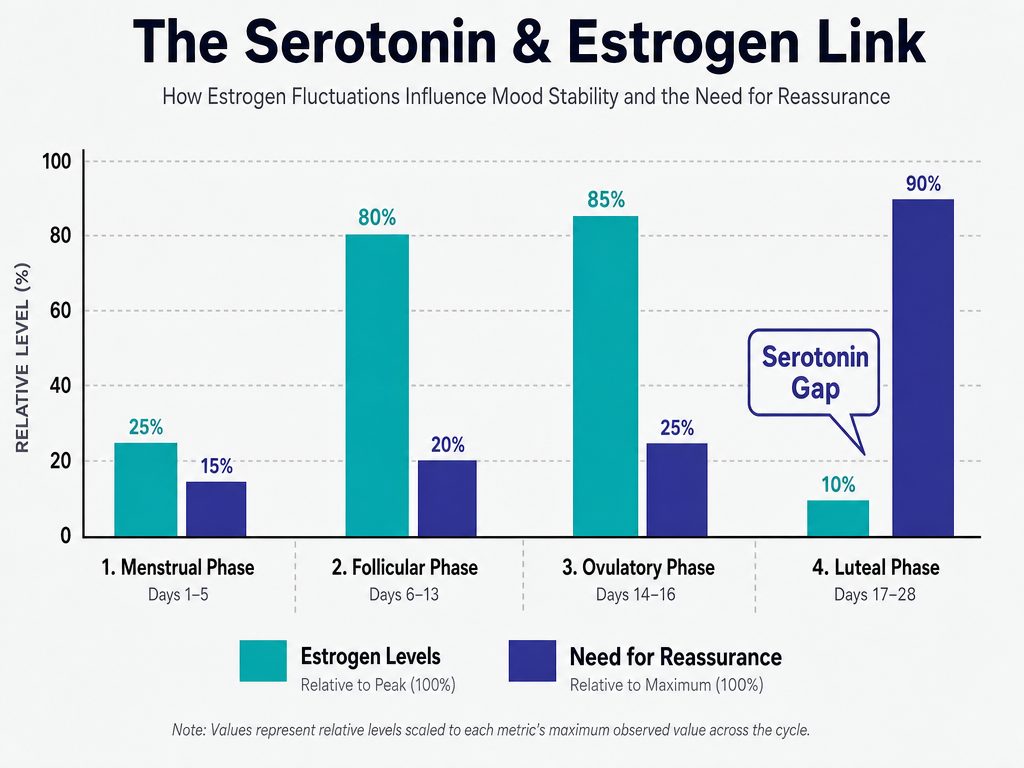 When her estrogen levels drop, her brain's natural serotonin follows. Your words of affirmation act as a chemical bridge to help stabilize her mood during this gap.
The Four Seasons Framework
The most effective way to understand cycle-based affirmation needs is the Four Seasons model. Each phase has a distinct energy signature and corresponding support requirement.
Winter: The Menstrual Phase (Days 1-5)
What's happening biologically: Both estrogen and progesterone are at their lowest. Energy is at minimum. Roughly 88% of women report experiencing menstrual cramps every cycle, and many deal with bloating, fatigue, and feeling physically "off."
What she needs emotionally: Unconditional reassurance that she doesn't have to be productive, social, or "on" right now. She may feel unsexy, unlovable, or invisible. Your job is to counter that narrative with zero performance pressure.
The scripts that work:
- "I love taking care of you. You don't have to 'be' anyone today - just rest."
- "You're not a burden. I'm here because I want to be."
- "I see how hard this is. You're handling it better than you think."
What to avoid:
- Trying to "fix" her discomfort with solutions she didn't ask for
- Downplaying her pain ("It's just cramps, right?")
- Making plans that require high social energy
The relationship move: Shift from verbal affirmation to physical acts of service. Make her favorite comfort food. Handle the errands she mentioned. Create a quiet, low-demand environment. When a partner is struggling emotionally, responding with genuine empathy tends to help more than trying to "fix" the problem.
Need tactical guidance for this phase? See our guide on how to help your girlfriend during period mood swings.
Spring: The Follicular Phase (Days 6-13)
What's happening biologically: During the follicular phase, estrogen rises as an egg-containing follicle develops in the ovary. This rising estrogen also thickens the uterine lining and triggers noticeable shifts in energy, mood, and motivation. This is her biological spring - energy is building, confidence is returning, and she's often more open to new ideas or social plans.
What she needs emotionally: Encouragement for forward momentum. She's likely planning, starting projects, or feeling more social. Your affirmations should celebrate her initiative and reinforce her capability.
The scripts that work:
- "I'm so impressed by how you handled [specific task]. Your energy is contagious right now."
- "That idea you mentioned sounds really promising. What's your next step?"
- "You've been crushing it this week. Want to celebrate?"
What to avoid:
- Passive recognition ("Oh, that's nice") when she shares an accomplishment
- Treating her rising energy as "hyper" or dismissing it
- Staying in "caretaker mode" when she's clearly back to full capacity
The relationship move: Match her energy. If she wants to go out, say yes. If she's excited about a new hobby or project, ask follow-up questions. This is the phase where big conversations about future plans tend to go well because her optimism and problem-solving ability are naturally elevated.
For a deeper dive into this phase, check out the follicular phase symptoms guide.
Summer: The Ovulatory Phase (Days 14-17)
What's happening biologically: Ovulation is when a surge in luteinizing hormone (LH) causes the ovary to release an egg, typically around day 14 of a 28-day cycle. Estrogen peaks just before ovulation. This is her biological summer - highest confidence, strongest sex drive, peak social charisma. Many women notice symptoms such as increased sex drive, mild pelvic or abdominal pain, tender breasts, bloating, and mood changes around ovulation.
What she needs emotionally: Romantic and physical affirmation. She wants to be seen as attractive, desirable, and exciting. This is the phase where she's most receptive to compliments about her appearance and most interested in feeling connected to you as a partner, not just a roommate.
The scripts that work:
- "You look incredible tonight. I love being out with you."
- "I can't stop thinking about you today."
- "I'm so lucky you're mine."
What to avoid:
- Being distracted or half-present during quality time
- Defaulting to "you look nice" when she's clearly dressed up
- Treating intimacy as routine or obligatory
The relationship move: Prioritize date nights, physical touch, and making her feel chosen. This is the week to plan something romantic, not the week to suggest she hang out with her friends while you game. If you've been considering a big gesture (flowers, a surprise date, an overdue "I'm proud of you"), now is when it will land hardest.
Learn more about supporting her during this phase with our girlfriend ovulation signs guide.
Autumn: The Luteal Phase (Days 18-28)
What's happening biologically: This is the longest and most emotionally variable phase. After ovulation, progesterone rises to help prepare the uterine lining for a possible pregnancy. If pregnancy doesn't happen, both progesterone and estrogen drop before the next period. This hormonal crash triggers the PMS symptoms most people associate with the menstrual cycle - mood swings, irritability, fatigue, bloating, and heightened emotional sensitivity.
As many as 3 in 4 women report experiencing PMS symptoms at some point in their life, though severity varies widely. Symptoms typically show up one to two weeks before a period and resolve within a few days after it starts.
What she needs emotionally: Reality-validating reassurance. She's not looking for you to tell her everything is fine when it doesn't feel fine. She needs you to acknowledge that things feel heavy right now and that her feelings make sense - that she's not "overreacting" or "being crazy."
The scripts that work:
- "I know things feel heavy right now. I'm right here with you. It's okay to feel this way."
- "You're not too much. What you're feeling is real, and I see it."
- "I'm not going anywhere. We'll get through this together."
What to avoid:
- Telling her she's overreacting or being too sensitive
- Offering solutions when she's venting
- Using "logical" arguments to dismiss her emotional reality
- Making jokes about PMS or hormones
The relationship move: Lower expectations for social energy, give her space when she asks for it, and be patient with mood shifts. This is not the week to have a hard conversation about your future or to spring surprise plans on her. Default to quiet, low-pressure quality time. Lifestyle approaches that can help ease PMS symptoms include regular aerobic exercise, smaller/more frequent meals, less salt/caffeine/alcohol, adequate sleep, and stress-reduction practices.
If you need more tactical help for this phase, see our complete luteal phase support guide.
The 7-2-1 Rule and Decision Tree
There's one critical red line where "words of affirmation" stops being the priority and medical awareness takes over: abnormally heavy bleeding.
If any of these apply, your support strategy should shift immediately from emotional validation to physical care and medical follow-up. Heavy bleeding can indicate conditions like fibroids, polyps, or bleeding disorders that require professional evaluation.
The decision tree:
- Is she experiencing 7-2-1 symptoms? → Encourage her to contact her healthcare provider and focus on rest, hydration, and symptom tracking.
- Is she in the luteal or menstrual phase with normal symptoms? → Use anchoring affirmations and reduce social/performance demands.
- Is she in the follicular or ovulatory phase? → Use celebratory affirmations and match her energy.
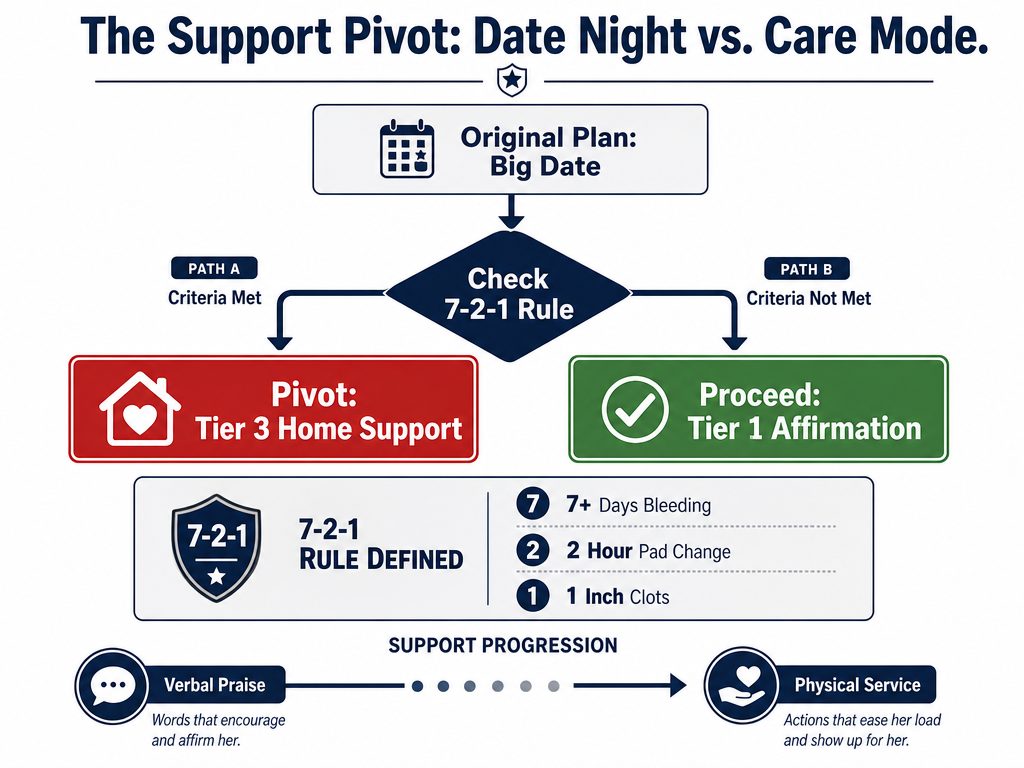 The 7-2-1 rule provides a clear medical signal to stop focusing on social plans and shift your energy toward providing physical comfort and medical support.
How to Start the Conversation Without Being Weird
Bringing up cycle tracking with your girlfriend can feel awkward. Here's a non-judgmental script:
"I want to match my energy to yours this week. I've been reading about how hormones affect mood and energy throughout the month, and I want to support you better. Would you be comfortable sharing roughly where you are in your cycle so I know whether you need me to plan something fun or just give you space?"
Key principles:
- Frame it as your desire to support, not to monitor or control
- Acknowledge you're learning and might get it wrong sometimes
- Ask her how she experiences each phase rather than assuming
- Respect her privacy - not every woman wants to share this level of detail
If she's hesitant, suggest cycle-tracking apps with partner modes. These allow her to share high-level phase information (follicular, ovulatory, luteal, menstrual) without disclosing exact dates or symptoms. Tracking symptoms and mood changes across the cycle for a few months is a legitimate, medically endorsed way to identify real patterns.
Apps like VibeCheck are specifically built for this use case - she retains full control of her data, and you receive actionable daily guidance tailored to her current phase. See our boyfriend guide to the menstrual cycle for a complete overview.
Frequently Asked Questions
What phase of a woman's cycle is she most emotional?
The luteal phase (days 18-28) typically brings the highest emotional sensitivity due to the progesterone crash. Both estrogen and progesterone drop sharply in the final week before menstruation, which reduces serotonin availability and can trigger mood swings, irritability, anxiety, and tearfulness.
However, "most emotional" doesn't mean "most irrational." Her feelings during this phase are a legitimate response to neurochemical changes. Roughly half of people who menstruate report having at least one PMS symptom, but only about 1 in 5 have symptoms severe enough to disrupt their daily life.
If her symptoms are consistently severe - causing her to miss work, damage relationships, or feel hopeless - that may indicate PMDD (premenstrual dysphoric disorder), not typical PMS. PMDD is a real, clinically recognized condition listed in the DSM-5 as a depressive disorder, affecting roughly 1 in 10 people who menstruate. Encourage her to talk to a healthcare provider if this sounds familiar.
What to do when your partner's love language is words of affirmation?
First, understand that words of affirmation isn't about constant praise or empty flattery. It's about verbal recognition that she's seen, valued, and loved.
If words of affirmation is her primary love language, she needs you to be intentional about saying what you notice and appreciate. This includes:
- Specific compliments ("I love how patient you were with that situation" beats "You're great")
- Verbal gratitude for everyday things ("Thanks for handling that - it really helped")
- Reassurance during stress ("I believe in you. You've got this.")
- Unprompted "I love you" moments, not just responses
Cycle awareness makes this more effective because you can tailor the type of affirmation to her current phase. During her follicular phase, celebrate her energy and ideas. During her luteal phase, validate her reality without trying to "fix" her feelings. For a deeper dive, see our guide on how to be a better boyfriend.
How do you feel in luteal vs follicular phase?
Most women report feeling higher energy, motivation, and optimism during the follicular phase (days 1-13), when estrogen is rising. Social plans feel easier, new projects feel exciting, and problem-solving feels sharper.
The luteal phase (days 18-28) typically brings lower energy, heightened emotional sensitivity, and a preference for familiar routines over novelty. Many women feel more introverted, need more sleep, and are more easily overwhelmed by social demands.
That said, individual variation is significant. A "normal" cycle varies a lot between women - menstrual bleeding can start anywhere from every 24 to every 38 days and last up to 8 days. Some women barely notice the shift, others find it profoundly disruptive.
The best way to understand her experience is to ask and track patterns over several cycles rather than assuming based on general descriptions.
What is considered a dangerously heavy period?
Use the 7-2-1 rule as your baseline: bleeding lasting more than 7 days, needing to change a pad or tampon in less than 2 hours, or passing clots larger than 1 inch all warrant a conversation with a healthcare provider.
Additional warning signs include:
- Bleeding that soaks through protection onto clothes or bedding
- Severe fatigue or dizziness (possible anemia from blood loss)
- Bleeding between periods or after sex
These symptoms can indicate treatable conditions like uterine fibroids, polyps, adenomyosis, or blood clotting disorders. Don't wait for a crisis - encourage her to get evaluated if any of these apply.
How does progesterone influence the menstrual cycle?
Progesterone is the dominant hormone of the luteal phase. After ovulation, the empty follicle becomes the corpus luteum, which produces progesterone to prepare the uterine lining for a potential pregnancy.
If pregnancy doesn't occur, progesterone production stops, triggering menstruation. This sharp drop in progesterone is what causes many classic PMS symptoms - mood swings, bloating, breast tenderness, and fatigue.
Progesterone has a sedating effect on the brain (it's chemically similar to some anti-anxiety medications), so when it drops suddenly, many women experience anxiety, irritability, or insomnia as a rebound effect. This is why the final week before her period is often the most emotionally challenging - her body is withdrawing from a hormone it had adapted to.
Are my emotional needs being met?
This is a question only you can answer - but cycle awareness can help you separate biological timing from relationship health.
If you consistently feel like you're walking on eggshells or getting rejected during her luteal phase, that's a timing problem, not a compatibility problem. If your needs feel unmet across all phases, that's worth a direct conversation.
Red flags that go beyond normal cycle fluctuations:
- She dismisses your feelings or needs even during high-energy phases
- You feel like you're always the "supporter" and never the "supported"
- Affection or connection only happens on her terms, never yours
- She refuses to acknowledge how her cycle affects her behavior or your relationship
A healthy relationship includes reciprocal support. Understanding her cycle should make you a more attuned partner - but it shouldn't require you to become invisible. For more on this balance, see what women want in relationships.
The menstrual cycle isn't an obstacle to your relationship - it's a roadmap. When you understand how her hormonal seasons shape her needs, you stop guessing and start providing the exact support she's looking for.
Want daily, personalized guidance on when to speak up and when to give space? VibeCheck translates her cycle into a tactical playbook so you can stop walking on eggshells and start being the partner she needs.
Tags

Related Articles
Continue reading to deepen your understanding

Why Your Girlfriend Needs Different Communication Styles During Her Cycle
Stop wondering why your conversations feel like a minefield one week and a breeze the next. Use biology to understand her changing needs and adapt your style.

When Your Girlfriend Gets Withdrawn Before Her Period
If she suddenly pulls away, it is usually biology, not you. Learn why your girlfriend gets distant before her period and use these tactical scripts to help her during the luteal phase.

How to Respond When Your Girlfriend Needs Space During Her Period
If she’s suddenly sending one-word texts or pulling away, it’s likely not about you. Learn the science of the luteal phase and how to support her without feeling rejected.

Understanding Why Your Girlfriend’s Communication Style Shifts Weekly
Ever wonder why your partner’s moods and energy levels shift so much? Understanding the four phases of her menstrual cycle helps you become a more supportive and proactive partner.

When Do Your Girlfriend’s Energy Levels Change During Her Cycle?
Your girlfriend’s mood and stamina follow a biological rhythm. Learn how her energy peaks and crashes throughout the month so you can plan better dates and provide better support.

Why Your Girlfriend Needs Different Attention Each Week: The Four Seasons Framework
Stop walking on eggshells and start understanding her cycle. This framework shows you exactly how to support your girlfriend through all four biological phases every month.

Why Your Girlfriend Wants Space the Week Before Her Period
Does your girlfriend suddenly pull away every month? Discover the biological reasons behind the pre-period space window and how to navigate this phase together.

Why Your Girlfriend Wants Different Kinds of Affection at Different Times in Her Cycle
Ever feel like your girlfriend’s needs change every week? It’s not random. Understand how the four phases of her cycle drive her desire for intimacy so you can support her better.