How to Comfort Your Girlfriend During Hormonal Irritability

Her mood swings aren’t a personality flaw—they’re a biological event. Master the invisible support framework and science-backed tactics to comfort her without adding to her stress.
How to Comfort Your Girlfriend During Hormonal Irritability: The Science-Based Partner's Guide
When your girlfriend snaps over something small or seems unreasonably frustrated, your first instinct might be to take it personally or ask "what's wrong?" Neither helps. Her irritability isn't random - it's a biological event you can learn to navigate.
This guide explains the neurological mechanism behind hormonal irritability, provides tactical "invisible support" strategies that reduce her decision load, and offers natural remedies with clinical backing. You'll learn when normal PMS crosses into PMDD territory and how to time conversations without making things worse.
Table of Contents
- The Science of the Serotonin Vacuum
- The Invisible Support Framework
- Natural Remedy Toolkit
- Communication Scripts: The "Don't Fix, Just Validate" Method
- Red Flag: Identifying PMDD
- Frequently Asked Questions
The Science of the Serotonin Vacuum
Her irritability isn't a personality flaw. It's a neurochemical withdrawal.
Recent research from the Max Planck Institute shows that shortly before menstrual onset, the brain produces substantially more serotonin transporters (SERT). These transporters act like a vacuum, pulling serotonin out of the synaptic space where it regulates mood. When serotonin is removed this way, emotional regulation becomes physically harder.
Think of it this way: her prefrontal cortex - the part of the brain that manages impulse control and rational decision-making - is running on a depleted fuel tank. Meanwhile, her amygdala (the emotional alarm system) is more reactive. Studies published in PLOS ONE document measurable structural and functional changes in these brain networks across the menstrual cycle.
This pattern typically happens during the luteal phase - the roughly two weeks between ovulation and her period. After ovulation, the luteal phase begins: progesterone rises to help prepare the uterine lining for a possible pregnancy. If pregnancy doesn't happen, both progesterone and estrogen drop before the next period. Many women notice PMS-like symptoms in this phase - mood shifts, breast tenderness, bloating, acne, and appetite changes - though not everyone does.
VibeCheck App
Download Free on iOS →As many as 3 in 4 women report experiencing PMS symptoms at some point in their life, though severity varies widely. Symptoms - which can include mood swings, irritability, bloating, breast tenderness, and fatigue - typically show up one to two weeks before a period and resolve within a few days after it starts.
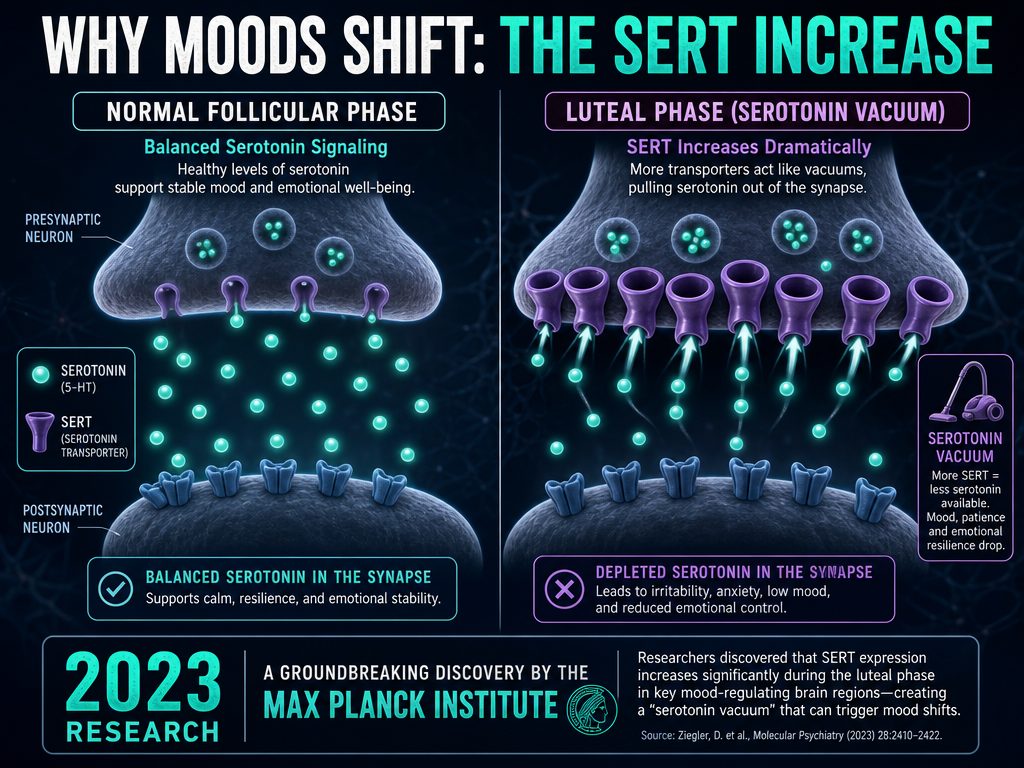
Understanding the 'Serotonin Vacuum': New research shows that a spike in transporters physically removes serotonin from the brain, leading to increased irritability and emotional sensitivity.
The key insight: she's not choosing to be irritable. She's managing a brain that's chemically different this week than it was last week.
The Invisible Support Framework
Here's what makes most men fail during this window: they ask questions.
"What's wrong?" "How can I help?" "Do you need anything?"
Each question requires her to make a decision. And right now, making decisions is physically exhausting because her prefrontal cortex is already struggling to regulate emotions.
The solution is invisible support - proactive actions that remove decision load without requiring her input.
Reactive Support vs. Proactive Support
| Reactive (Adds Load) | Proactive (Removes Load) |
|---|---|
| "What do you want for dinner?" | Start cooking her favorite comfort meal |
| "Should I do the dishes?" | Just do them without asking |
| "Do you need space?" | Give her space without announcing it |
| "Are you okay?" | Sit quietly nearby, available but not demanding |
| "How can I help?" | Handle the household task you know stresses her |
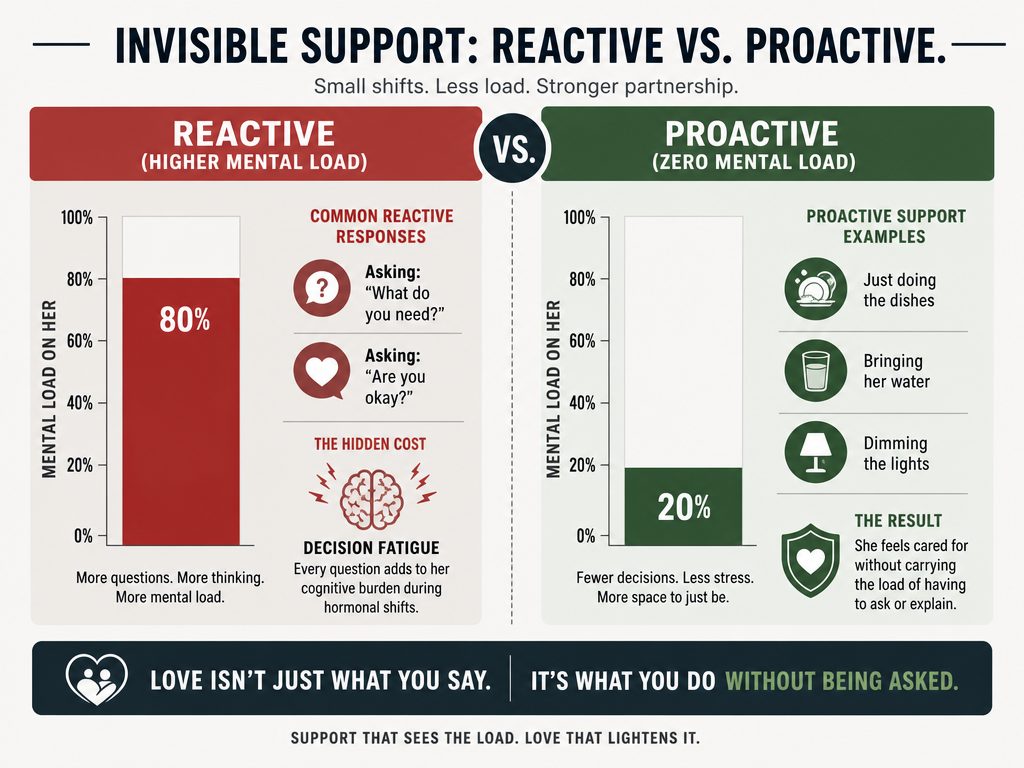
The 'Invisible Support' framework: Shifting from reactive questions to proactive actions reduces her decision fatigue when her prefrontal cortex is already struggling to regulate emotions.
The pattern here is simple: notice what typically needs doing, then do it without making it her responsibility to direct you. Your goal is to reduce the number of times she has to think, decide, or explain.
When you see signs she's in the luteal phase - understanding your girlfriend's cycle phases makes this easier - shift into proactive mode automatically.
Natural Remedy Toolkit
Not every solution requires a prescription. Several natural interventions have clinical backing for reducing irritability and mood symptoms tied to the menstrual cycle.
Nutritional Support
Dark Chocolate (high-quality cacao)
High-quality dark chocolate contains magnesium, which many women run low on during the luteal phase. It also triggers a mild endorphin release. Keep a bar on hand - not as a joke about "period cravings," but as a legitimate mineral supplement.
Complex Carbohydrates
Whole grains, sweet potatoes, and oats help stabilize blood sugar and support serotonin production. Her body is already struggling to maintain serotonin; don't make it worse with blood sugar crashes from processed foods.
Omega-3 Fatty Acids
Found in salmon, walnuts, and flaxseed, omega-3s reduce systemic inflammation that can worsen PMS symptoms. If she's not a fish eater, consider suggesting a quality fish oil supplement.
The "Big Three" Supplements
Clinical research consistently points to three supplements with the strongest evidence base for reducing PMS irritability:
Calcium (1200mg daily)
Multiple studies show calcium supplementation can reduce the severity of mood symptoms, bloating, and food cravings.
Magnesium (200-400mg daily)
Magnesium glycinate is the most bioavailable form. It helps with muscle relaxation, sleep quality, and mood regulation.
Vitamin B6 (50-100mg daily)
B vitamins play a role in neurotransmitter synthesis. Research suggests adequate B-vitamin intake may reduce the incidence of PMS significantly.
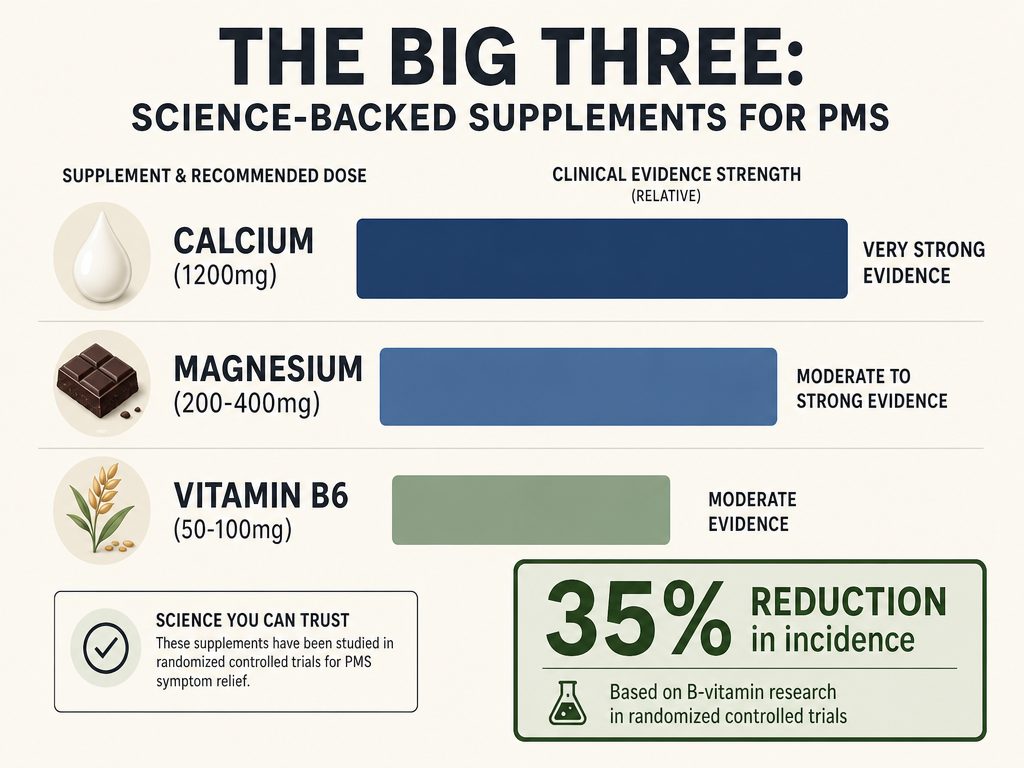
The 'Big Three' Supplements: Clinical research identifies Calcium, Magnesium, and Vitamin B6 as the most effective natural interventions for reducing hormonal irritability and mood swings.
Before she starts any supplement, encourage her to talk with her doctor - especially if she's on other medications.
Environmental Adjustments
Hormonal shifts can increase sensitivity to light and noise. During the luteal phase, consider:
- Dimming overhead lights in the evening
- Reducing background noise (TV, music) when she's home
- Keeping the bedroom cooler - progesterone raises body temperature slightly
- Using blackout curtains if she's having trouble sleeping
These aren't grand gestures. They're subtle environmental tweaks that acknowledge her physical reality without making a production of it.
Communication Scripts: The "Don't Fix, Just Validate" Method
What you say matters less than when you say it and how you frame it.
When a partner is struggling emotionally, responding with genuine empathy - listening without judgment, focusing on their feelings rather than debating facts, and validating that their reaction makes sense - tends to help more than trying to "fix" the problem or offer silver linings. Feeling understood, not corrected, is what tends to defuse tension.
If She Snaps at You
Don't say: "Calm down." "You're overreacting." "Is it your period?"
Try this: "I hear you're frustrated. I'm going to take the trash out and get started on dinner so you don't have to worry about it."
You're acknowledging her emotion without debating whether it's "justified," and you're removing a task from her plate.
If She's Crying or Withdrawn
Don't say: "What's wrong?" "Why are you crying?" "You were fine yesterday."
Try this: "It's okay. You don't have to explain. I'm just going to sit here with you."
Silence is often more comforting than interrogation. Your presence - calm, non-demanding - signals safety.
If She Apologizes for Being "Difficult"
Don't say: "It's fine." (This dismisses her experience.)
Try this: "You're not difficult. Your body's doing something intense right now, and I'm here for it."
This validates the biological reality without treating her like a victim of her hormones. She's still herself - just managing extra neurological load.
The Timing Rule
Never bring up relationship issues, future plans, or criticism during the late luteal phase (roughly days 21-28 of her cycle if she has a typical 28-day cycle - though menstrual bleeding can start anywhere from every 24 to every 38 days, so timing varies person to person).
If you need to have a serious conversation, wait for the follicular phase - the first half of her cycle when estrogen is rising. Her emotional regulation and stress tolerance are naturally higher then.
Red Flag: Identifying PMDD
There's a line between normal PMS irritability and a clinical condition that requires medical intervention.
PMDD (premenstrual dysphoric disorder) is a real, clinically recognized condition - it's listed in the DSM-5 as a depressive disorder, not something people are "making up" or simply failing to cope with. It affects roughly 1 in 10 people who menstruate.
Signs That Suggest PMDD (Not Typical PMS)
- Severe mood swings or crying episodes that feel out of her control
- Intense anger or rage that leads to conflict in multiple relationships
- Feelings of hopelessness, worthlessness, or thoughts of self-harm
- Panic attacks or severe anxiety that appear only in the luteal phase
- Inability to function at work, school, or in social settings
If you're seeing these patterns consistently - not just one bad month - she needs to talk to a healthcare provider. Tracking symptoms and mood changes across the cycle for a few months is a legitimate, medically endorsed way to identify real patterns and timing - rather than assuming based on stereotypes or a single cycle.
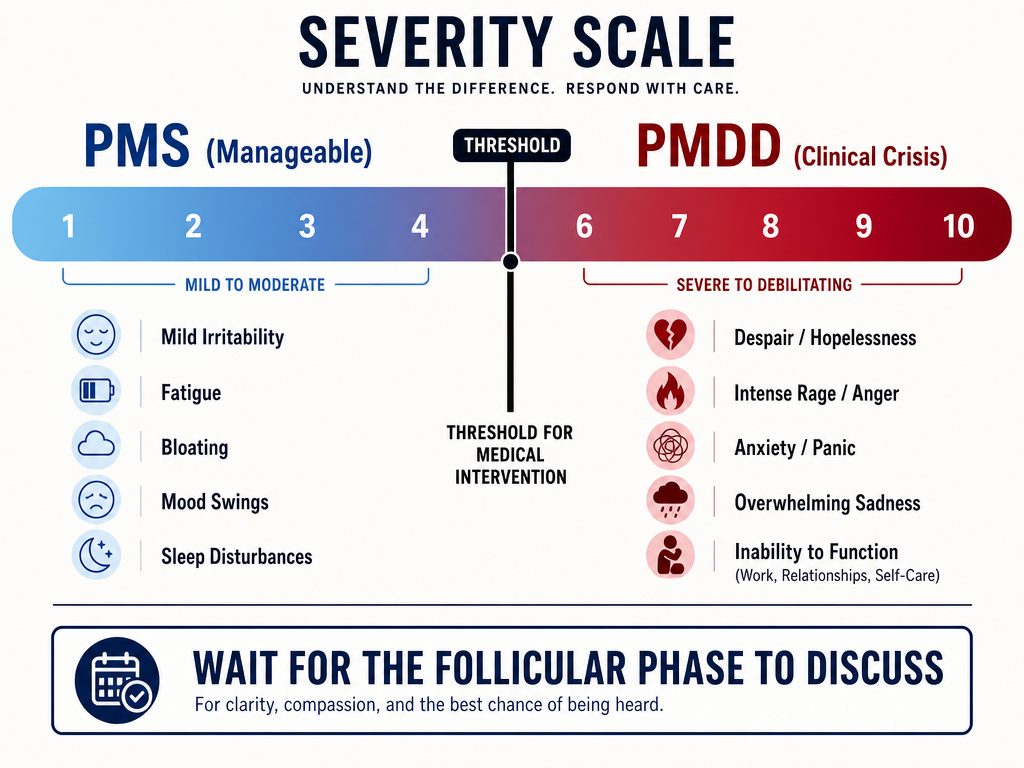
Distinguishing PMS from PMDD: While irritability is common, signs of despair or intense rage may indicate PMDD, requiring a medical consultation during the follicular phase.
Critical timing note: If you're going to suggest she talk to a doctor about PMDD, do it during the follicular phase (after her period starts), never during the crisis window when she's symptomatic. Bringing it up mid-crisis will feel like an attack.
Frequently Asked Questions
How to calm PMS rage?
Don't try to "calm" her - that implies she's out of control and you're the rational one. Instead, remove environmental stressors (noise, clutter, decision demands), validate her feelings without debate, and give her physical space if she needs it. The serotonin vacuum makes emotional regulation harder; your job is to reduce additional friction, not to "fix" her mood.
My girlfriend is experiencing mood swings during her period. Is this normal?
Yes. Roughly half of people who menstruate report having at least one PMS symptom, but only about 1 in 5 have symptoms severe enough to disrupt their daily life. Mood swings, irritability, and emotional sensitivity are common during the luteal phase and the first few days of bleeding. If her symptoms are intense enough to disrupt work, relationships, or daily function - or if she experiences despair or suicidal thoughts - that may indicate PMDD, which requires medical evaluation.
What supplements help with PMS irritability?
The supplements with the strongest clinical evidence are Calcium (1200mg daily), Magnesium (200-400mg daily, preferably glycinate form), and Vitamin B6 (50-100mg daily). These support neurotransmitter function, reduce muscle tension, and help regulate mood. She should talk to her doctor before starting any supplement regimen, especially if she's on other medications.
Do serotonin levels drop during PMS?
Not exactly. The serotonin itself doesn't necessarily "drop" - instead, the brain produces more serotonin transporters (SERT) that pull serotonin out of the synaptic space where it's active. This "serotonin vacuum" effect leads to reduced serotonin availability for mood regulation, which manifests as irritability, sadness, or anxiety. This mechanism is most pronounced in the late luteal phase, shortly before menstruation begins.
How can I best support my partner who has PMDD?
PMDD is a medical condition, not a character flaw. She needs professional treatment - often a combination of therapy and medication (SSRIs are commonly prescribed, sometimes only during the luteal phase). Your role is to validate her experience, help her track symptoms so she can show patterns to her doctor, reduce decision load during symptomatic weeks, and never suggest she's "overreacting." Learning to tell which cycle phase your girlfriend is in helps you anticipate high-risk windows.
Is it normal to feel anger at my partner during the luteal phase?
Yes, if the anger is linked to the hormonal window and resolves after her period starts. The neurological changes during the luteal phase make emotional regulation harder and increase sensitivity to perceived slights or stress. However, if the anger is constant, escalates to verbal or physical aggression, or doesn't follow the cycle pattern, that's a relationship issue separate from hormones and may require couples counseling.
How much B6 for PMDD?
Clinical studies typically use 50-100mg of Vitamin B6 daily for PMS and PMDD symptom reduction. Higher doses (above 200mg daily) can cause nerve damage over time, so more is not better. If she's considering B6 for PMDD, she should work with her doctor to determine the right dose and monitor for side effects, especially if she's taking other supplements or medications.
Can I take vitex and vitamin B6 together?
Vitex (chasteberry) and Vitamin B6 target different mechanisms - vitex influences prolactin and progesterone, while B6 supports neurotransmitter synthesis. There's no known contraindication for taking them together, but both can affect hormone levels, so she should consult her doctor before combining them. Some people are sensitive to vitex (it can worsen symptoms in certain cases), so professional guidance is important.
Who should avoid chasteberry?
Chasteberry (vitex) can interfere with hormonal birth control, dopamine agonist medications, and may worsen symptoms in people with certain hormone-sensitive conditions. It's also not recommended during pregnancy or breastfeeding. Anyone considering chasteberry should talk to their doctor first - especially if they have a history of depression, as it can affect dopamine pathways.
What matters most: her irritability isn't personal, it's biological. Lifestyle approaches that can help ease PMS symptoms include regular aerobic exercise, smaller/more frequent meals, less salt/caffeine/alcohol, adequate sleep, and stress-reduction practices like deep breathing or yoga. A partner who understands these and is patient/supportive around them - rather than dismissive of symptoms - is aligning with medically recommended self-care.
Stop asking what she needs. Start noticing what removes friction. That's how you become a better boyfriend during the hardest biological week of the month.
Tags

Related Articles
Continue reading to deepen your understanding

How to Understand Your Girlfriend’s Social Battery and Hormones
Does your girlfriend suddenly cancel plans or seem withdrawn? This guide explains how her cycle impacts her energy so you can support her like a pro.

How Your Girlfriend’s Emotional Needs Change During Her Cycle
Does your girlfriend’s mood seem unpredictable? Learn how her emotional needs shift on a biological loop and how to support her through every phase of her cycle.

What to Buy When Your Girlfriend Has Hormone Cravings: A Support Guide
Stop wondering what to pick up at the store. This guide explains the science behind cycle cravings and provides a specific list of foods and comfort items she needs.

Your Girlfriend’s Mood Shifts Throughout the Month, Explained
Ever wonder why her energy and moods change so drastically each week? Understand the four hormonal phases and how to be the partner she needs during every stage of her cycle.

How to Support Your Girlfriend When She’s Crying Because of Hormones
Watching her cry when hormones hit can feel overwhelming. Learn the biological why behind the tears and use these proven scripts to provide the support she actually needs right now.

How to Help Your Girlfriend with Hormonal Mood Swings Without Arguing
Understand her cycle and learn tactical scripts to handle tension. This guide shows you how to support her through hormonal shifts without getting into unnecessary fights.

When to Feed Your Girlfriend: Understanding Hangry Hormones
Does your girlfriend get irritable when she hasn’t eaten? It’s not just in her head. Learn why hormones cause hanger and the specific times her body needs more fuel.

The Boyfriend’s Guide to Supporting Your Partner Through PMS
If your partner is suddenly irritable and exhausted, it’s biology, not you. Learn about the luteal phase and how to provide meaningful support without walking on eggshells.