How to Help Your Girlfriend When She’s Irritable Before Her Period: The Partner’s Playbook

Is your partner snapping at small things right before her cycle? It’s not you—it’s biology. Learn how to navigate the serotonin crash and provide the support she actually needs.
How to Help Your Girlfriend When She's Irritable Before Her Period: The Partner's Playbook
Your girlfriend was laughing at your jokes two days ago. Now she snaps at you for leaving a glass in the sink. You didn't change - but something in her brain chemistry did.
Roughly 3 in 4 women experience some level of PMS symptoms in the week or two before their period. For many, irritability is the most relationship-disruptive one. You're not imagining the pattern, and she's not choosing to be short-tempered. Her brain is literally running low on the neurochemical that regulates patience and emotional resilience.
This guide gives you the biology, the scripts, and the tactical support framework to navigate premenstrual irritability without making things worse. You'll learn when to step in, when to back off, and how to tell if what you're seeing crosses the line from normal PMS into something that needs medical attention.
Table of Contents
- Why Does She Get Irritable Before Her Period?
- The Serotonin Crash: What's Happening in Her Brain
- The Invisible Support Framework: Don't Ask, Just Act
- What to Say (and Never Say) When She's Irritable
- The PMS Care Kit: What Actually Helps
- When Irritability Crosses Into PMDD Territory
- Long-Term Strategy: Tracking and Prevention
- Frequently Asked Questions
Why Does She Get Irritable Before Her Period?
Her irritability follows a predictable biological pattern tied to the luteal phase of her menstrual cycle. This phase starts after ovulation and lasts until her next period begins - typically 10 to 14 days. During this window, both progesterone and estrogen rise initially, then drop sharply in the final week before menstruation.
That hormonal crash triggers a cascade of neurochemical changes. Research from the Max Planck Institute found that shortly before menstrual onset, the serotonin transporter in the brain increases, promoting a loss of serotonin at the synapses. Think of it like her brain suddenly opening more drains while producing the same amount of serotonin - the neurotransmitter responsible for mood regulation, patience, and impulse control gets "washed out" faster than usual.
Lower serotonin means:
- Reduced patience with minor annoyances
- Heightened sensitivity to perceived slights
- Difficulty regulating emotional reactions
- Increased decision fatigue
VibeCheck App
Download Free on iOS →She's not weak or failing to cope. She's navigating a temporary neurochemical deficit that would make anyone more reactive.
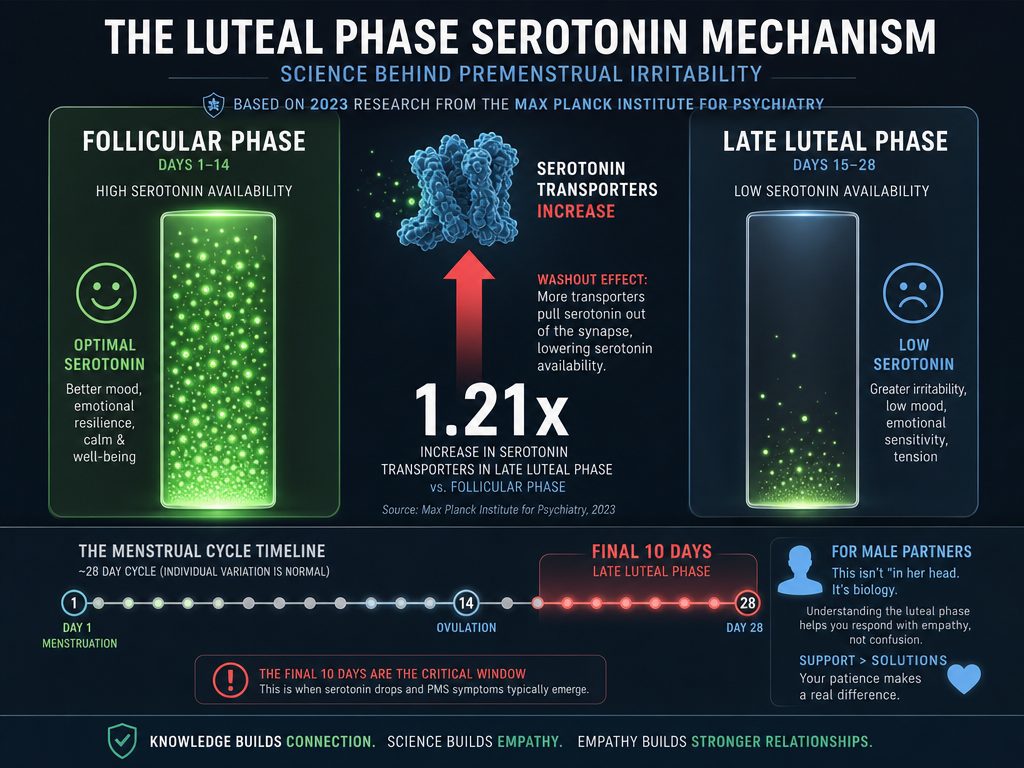 Understanding the 'Serotonin Washout' provides biological context for premenstrual mood shifts, moving the conversation from personal blame to hormonal management.
The Serotonin Crash: What's Happening in Her Brain
The luteal phase brings predictable shifts: progesterone rises to prepare the uterine lining for a possible pregnancy, and if pregnancy doesn't happen, both progesterone and estrogen plummet in the days before her period. Many women notice mood shifts, breast tenderness, bloating, and appetite changes during this phase.
But the serotonin mechanism is what drives irritability specifically. When serotonin transporters ramp up, the brain clears serotonin from synapses faster than it can be replenished. The result is a functional serotonin shortage that mirrors what happens during clinical depression - except it's temporary and predictable.
This explains why:
- Small things feel big (her emotional buffer is thinner)
- She wants to be left alone (social interaction requires more serotonin)
- Decisions feel overwhelming (executive function runs on serotonin)
- She's quicker to anger (impulse control depends on serotonin availability)
Understanding this biology changes the conversation. She's not overreacting to a dirty dish - she's reacting normally to a dirty dish while her brain is chemically compromised. Your job isn't to fix her mood; it's to reduce the friction she has to manage while her serotonin recovers.
The Invisible Support Framework: Don't Ask, Just Act
The worst question you can ask during the luteal phase: "What do you need?"
When serotonin is low, making decisions - even small ones like choosing what to eat or articulating what would help - feels exhausting. Asking her to tell you what she needs adds to her mental load instead of reducing it.
The Invisible Support Framework is built on a simple rule: anticipate and execute without requiring her input.
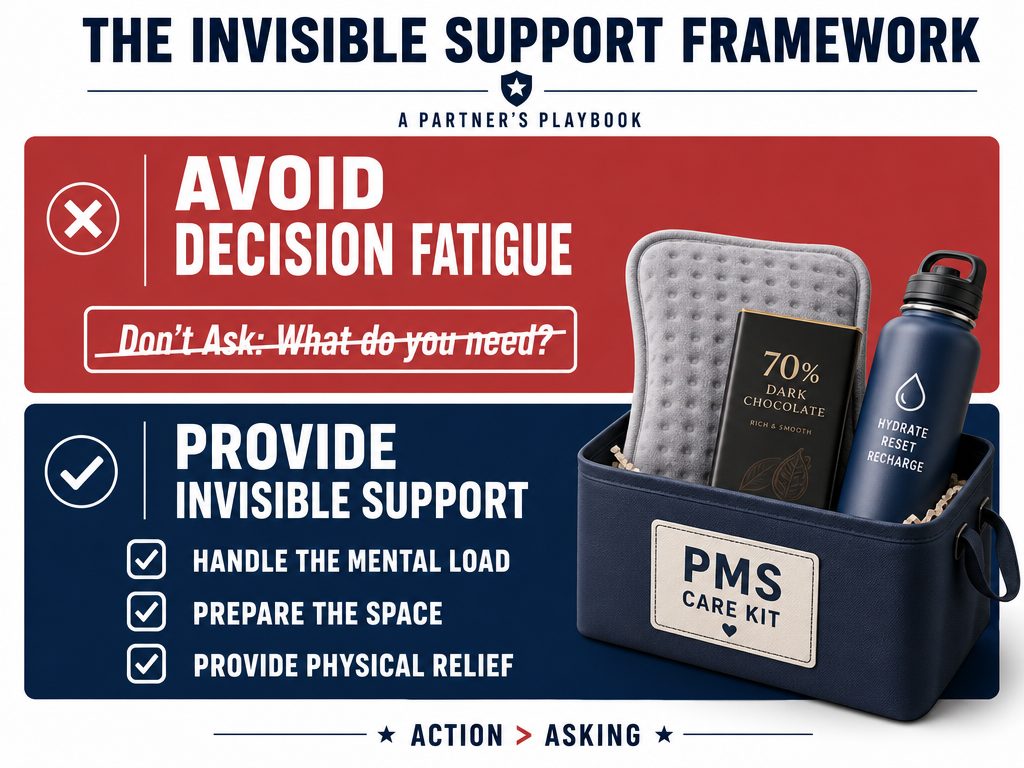 The 'Don't Ask, Just Act' approach reduces decision fatigue for your partner when her serotonin levels and patience are naturally lower.
Tactical Actions That Work
Handle the mental load:
- Take out the trash before she notices it's full
- Do the dishes without being asked
- Plan and execute dinner (or pick up takeout)
- Handle one recurring task she normally manages (grocery pickup, pet care, laundry)
The goal is to remove items from her to-do list before they become points of friction. Lifestyle approaches that can help ease PMS symptoms include reducing stress and maintaining routine - both of which you support by quietly handling logistics.
Create a low-demand environment:
- Cancel or reschedule non-essential social plans
- Reduce noise and visual clutter in shared spaces
- Don't initiate big conversations or decisions
- Give her physical and emotional space to decompress
Stock the care essentials:
- Keep a heating pad accessible (heat relaxes uterine muscles and reduces cramping)
- Have ibuprofen or naproxen on hand (NSAIDs block prostaglandins, which cause cramps and amplify pain sensitivity)
- Stock dark chocolate or magnesium-rich snacks (magnesium helps regulate mood and muscle tension)
- Maintain her preferred comfort items (favorite tea, cozy blanket, etc.)
For more on understanding how different cycle phases affect her needs, see our guide on how to support your girlfriend during the luteal phase.
What to Say (and Never Say) When She's Irritable
Words matter more when serotonin is low. What feels like casual conversation to you can land like criticism to someone with a thinner emotional buffer.
Never Say:
- "Is it your period?" (Dismisses her feelings as purely hormonal and implies she's not rational)
- "Calm down." (Tells her she's wrong to feel what she's feeling)
- "You're overreacting." (Invalidates her experience and puts you in opposition to her)
- "It's not that big of a deal." (Minimizes something that genuinely feels overwhelming to her right now)
These phrases do the opposite of what you want. They increase her emotional load by forcing her to defend her feelings on top of managing them.
The Empathetic Pivot:
Instead of challenging her reaction, validate her experience and offer concrete support. The Gottman Institute's research on emotional support emphasizes that responding with genuine empathy - listening without judgment and validating that her reaction makes sense - tends to help more than trying to fix the problem.
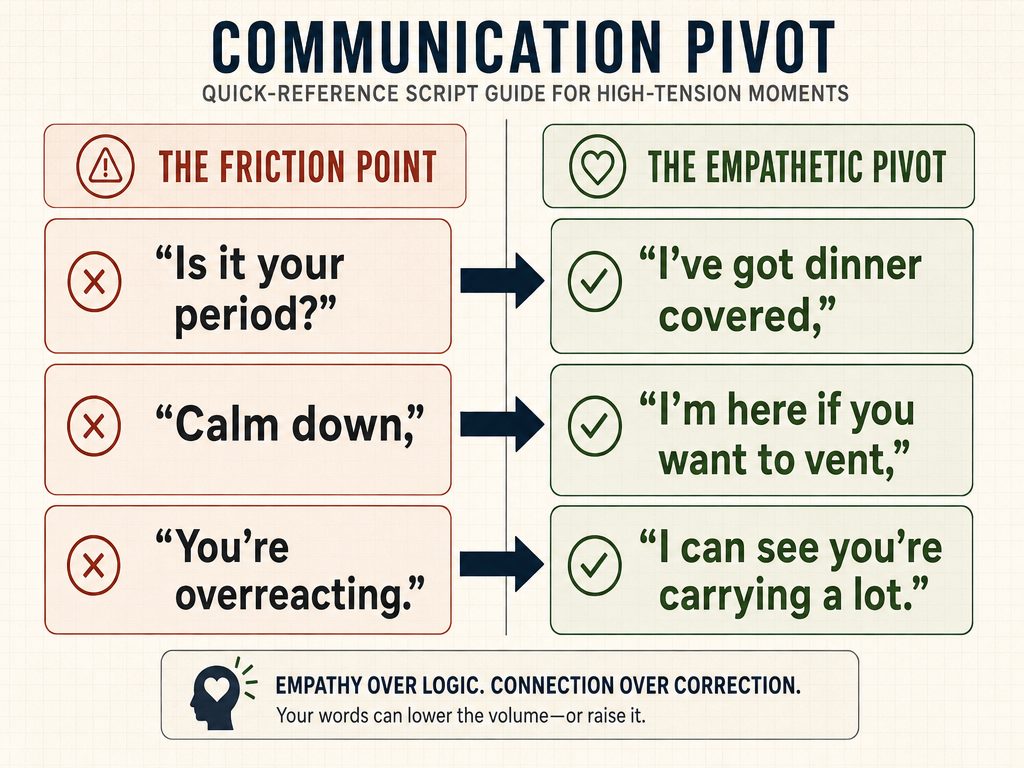 Swapping logical challenges for empathetic pivots can immediately de-escalate tension and make your partner feel supported rather than judged.
Script examples:
Instead of: "What's for dinner?"
Try: "I'm picking up Thai food and I've got the heating pad ready if you need it."
Instead of: "Why are you being so sensitive?"
Try: "I can see you're carrying a lot right now. Do you want to vent, or would you rather have some space?"
Instead of: "You didn't seem upset earlier."
Try: "I hear you. What can I take off your plate today?"
The pattern: acknowledge, offer support, don't debate. When you validate her experience instead of questioning it, you reduce the conflict and make space for her to feel understood.
For more on timing difficult conversations, read our guide on how to apologize to your girlfriend after a fight.
The PMS Care Kit: What Actually Helps
Build a standing toolkit of items that address the physical and neurochemical symptoms of PMS. Keep it stocked before the luteal phase starts so you're never scrambling.
For physical relief:
- Heating pad: Relaxes uterine muscles and reduces cramping intensity
- NSAIDs (ibuprofen, naproxen): Block prostaglandins, which cause both cramps and heightened pain sensitivity
- Comfortable clothing: Elastic waistbands, loose layers, soft fabrics
For mood support:
- Dark chocolate: Rich in magnesium, which helps regulate neurotransmitter function and muscle tension
- Herbal tea: Chamomile or peppermint can provide comfort and mild relaxation (note: claims about specific teas "curing" cramps lack strong evidence, but the ritual itself can be soothing)
- Comfort media: Queue up shows or movies she finds genuinely relaxing
For decision fatigue:
- Pre-planned meals: Remove the "what should we eat?" question entirely
- Cleared calendar: Protect her from non-essential obligations
- Low-effort entertainment: Don't suggest complex activities that require planning or energy
Clinical evidence highlights saffron's ability to improve both physical pain and mood symptoms in PMS, though it requires consistent use over time and isn't a quick fix for acute irritability. The PMS care kit is about immediate relief, not long-term supplementation.
For partners looking to track these patterns more systematically, check out our period tracker guide for men.
When Irritability Crosses Into PMDD Territory
PMS is very common - as many as 3 in 4 women experience symptoms at some point. But not all premenstrual symptoms are the same. Roughly half report at least one PMS symptom, but only about 1 in 5 have symptoms severe enough to disrupt daily life. That disruptive tier is PMDD - premenstrual dysphoric disorder.
PMDD is a real, clinically recognized condition listed in the DSM-5 as a depressive disorder, affecting roughly 3% to 8% of the menstruating population. It's not "bad PMS" or a failure to cope - it's a distinct diagnosis with distinct treatment needs.
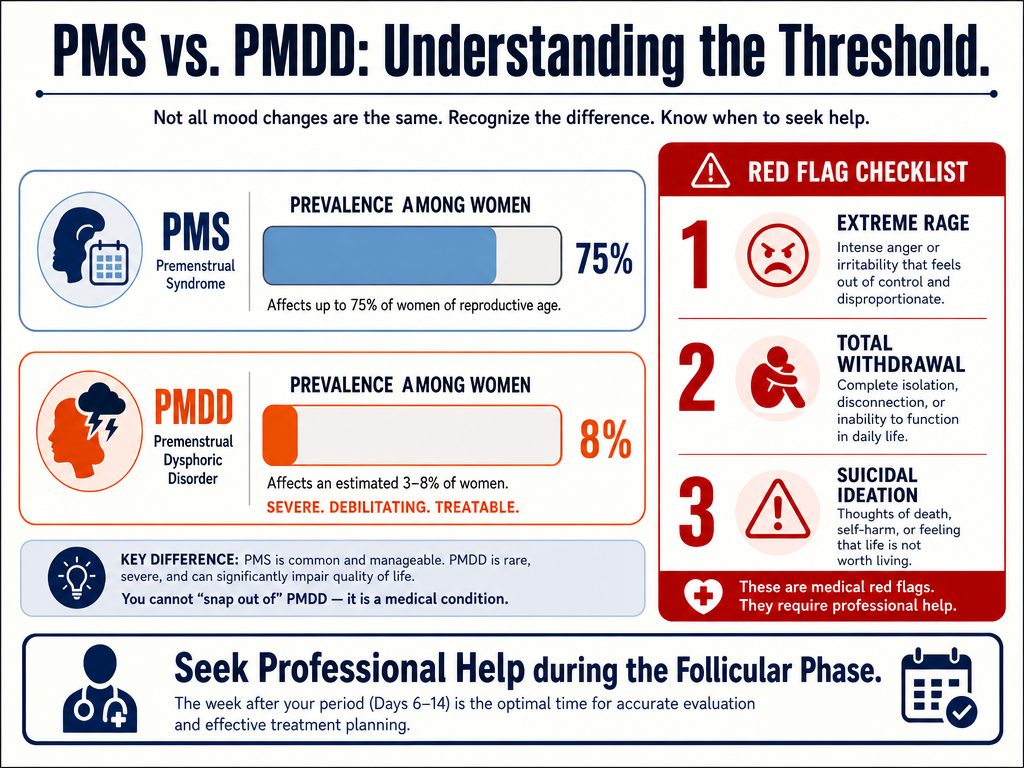 Distinguishing between standard PMS and PMDD is crucial for long-term relationship health and ensuring your partner receives the correct level of care.
Red Flags That Warrant Medical Attention
Watch for these patterns during the 7-10 days before her period:
Severe mood symptoms:
- Suicidal thoughts or self-harm ideation
- Rage that feels out of control or dangerous
- Panic attacks or extreme anxiety
- Feelings of hopelessness or despair
Functional impairment:
- Inability to work or complete basic tasks
- Total withdrawal from relationships
- Physical symptoms so severe they prevent daily activities
Relationship strain:
- Repeated conflicts that only occur during the luteal phase
- Pattern of threatening to leave or end the relationship
- Escalating verbal or emotional outbursts
PMDD is more severe and sometimes disabling compared to PMS. Both happen on a similar timeline and can share physical symptoms, but PMDD specifically involves extreme mood symptoms intense enough to disrupt daily life and strain relationships. Research shows that premenstrual disorders are associated with an incidence risk ratio of 1.21 for relationship disruption among cohabiting women, meaning the stakes are real.
How to Suggest She See a Doctor
Timing matters. Never bring up PMDD during the luteal phase when she's symptomatic - she'll hear it as dismissal. Wait until the follicular phase (the week after her period ends), when estrogen is rising and her mood is stable.
Script example:
"I've noticed a pattern over the last few months where you seem to struggle a lot in the week before your period - more than just typical PMS. I'm not trying to diagnose you, but I read that PMDD is a real medical condition that affects some women, and I think it might be worth talking to your doctor about. I want to support you in getting help if this is something more than just dealing with a rough week."
Offer to help her track symptoms. Tracking symptoms and mood changes across the cycle for a few months is a medically endorsed way to identify real patterns and provide useful data to a healthcare provider.
For more on supporting a partner through severe cycle-related challenges, see our guide on how to comfort your girlfriend during PMS.
Long-Term Strategy: Tracking and Prevention
If premenstrual irritability is a recurring issue, you need a system - not just reactive tactics. Tracking her cycle helps you anticipate patterns and provide proactive support before tension builds.
How to Ask About Tracking Her Cycle
Don't track without her knowledge - that's invasive and weird. Instead, frame it as a team effort to reduce friction.
Script example:
"I've noticed we tend to have more conflict around the same time each month, and I think it lines up with your cycle. Would you be open to us tracking it together so I can be more supportive and avoid scheduling stressful stuff during that window?"
If she's open to it, you have options:
- Use a shared calendar where she marks her period start date
- Ask her to use a cycle-tracking app with partner-sharing features (like period trackers with partner mode)
- Track it yourself based on her period start dates (most cycles are 24-38 days, though there's no universal 28-day cycle)
The 10-Day Support Window
Standard PMS symptoms typically show up one to two weeks before a period. That means your highest-alert window is roughly 10 days before her period starts through the first couple days of bleeding.
During this window:
- Reduce your own demands and expectations
- Front-load chores and decision-making
- Avoid initiating difficult conversations or major plans
- Watch for patterns in what helps vs. what makes things worse
This isn't about walking on eggshells forever - it's about being strategic with timing. The same conversation that sparks a fight on day 25 of her cycle might go smoothly on day 10. Learn to read the calendar and adjust accordingly.
For men looking to systematically understand cycle phases and optimize relationship timing, our boyfriend guide to the menstrual cycle breaks down all four phases and what each one means for your relationship.
Frequently Asked Questions
How do I help my girlfriend when she's PMSing?
Focus on reducing her mental and physical load without requiring her to articulate what she needs. Handle household tasks proactively, create a low-stress environment, stock physical relief items (heating pad, NSAIDs, comfort foods), and use empathetic language instead of dismissive phrases. The goal is invisible support - she should feel lighter, not managed.
What is the 7-2-1 rule for menstruation?
The "7-2-1 rule" is a social media trend, not a biological standard. It refers to a rough guideline some people use for tracking symptoms (7 days of PMS, 2 days of heaviest bleeding, 1 day of recovery), but medical sources don't recognize it as a formal framework. The actual support window varies by person - symptoms typically appear 1-2 weeks before a period and resolve within a few days after it starts. Don't treat it as a rigid rule.
How to calm PMS rage?
You can't "calm" someone else's neurochemical state, but you can avoid escalating it. Validate her feelings instead of challenging them, remove stressors from her environment, give her space if she needs it, and don't engage in debates or justifications. If rage is severe or uncontrollable, it may be PMDD, which requires medical intervention - not just better communication.
Does serotonin drop during the luteal phase of PMS?
Not exactly. Research shows that the serotonin transporter in the brain increases during the luteal phase, which means serotonin is cleared from synapses faster than usual - leading to lower available serotonin even if production stays the same. The effect is a functional serotonin shortage that impacts mood regulation, patience, and impulse control.
Is it normal to feel anger at my partner during the luteal phase of PMDD?
If you're the partner experiencing PMDD, yes - extreme irritability and anger toward loved ones is a recognized symptom. If you're asking as the partner on the receiving end: what you're experiencing is real, but it's not about you. PMDD involves extreme mood symptoms intense enough to disrupt daily life, including marked irritability and relationship strain. Encourage her to talk to a doctor during the follicular phase when symptoms are absent.
How to increase serotonin levels during the luteal phase?
Lifestyle measures that support serotonin function include regular aerobic exercise, adequate sleep, stress reduction (deep breathing, yoga), and balanced meals with complex carbohydrates and protein. Magnesium-rich foods (dark chocolate, leafy greens, nuts) may help regulate mood. Saffron shows clinical evidence for improving PMS mood symptoms, though it requires consistent use. For severe symptoms, some doctors prescribe SSRIs (selective serotonin reuptake inhibitors) specifically during the luteal phase - but that's a medical decision, not something you can manage with diet alone.
Can taking SSRIs during the luteal phase help with PMDD?
Yes, for some women with PMDD, doctors prescribe SSRIs to be taken only during the luteal phase (intermittent dosing) rather than daily. This approach targets the serotonin deficit during the symptomatic window. It's a legitimate medical treatment, but it requires a healthcare provider to diagnose PMDD and determine if this approach is appropriate. Don't suggest medication yourself - suggest she talk to her doctor about the pattern she's experiencing.
Tags

Related Articles
Continue reading to deepen your understanding

How to Understand Your Girlfriend’s Social Battery and Hormones
Does your girlfriend suddenly cancel plans or seem withdrawn? This guide explains how her cycle impacts her energy so you can support her like a pro.

How Your Girlfriend’s Emotional Needs Change During Her Cycle
Does your girlfriend’s mood seem unpredictable? Learn how her emotional needs shift on a biological loop and how to support her through every phase of her cycle.

What to Buy When Your Girlfriend Has Hormone Cravings: A Support Guide
Stop wondering what to pick up at the store. This guide explains the science behind cycle cravings and provides a specific list of foods and comfort items she needs.

Your Girlfriend’s Mood Shifts Throughout the Month, Explained
Ever wonder why her energy and moods change so drastically each week? Understand the four hormonal phases and how to be the partner she needs during every stage of her cycle.

How to Support Your Girlfriend When She’s Crying Because of Hormones
Watching her cry when hormones hit can feel overwhelming. Learn the biological why behind the tears and use these proven scripts to provide the support she actually needs right now.

How to Help Your Girlfriend with Hormonal Mood Swings Without Arguing
Understand her cycle and learn tactical scripts to handle tension. This guide shows you how to support her through hormonal shifts without getting into unnecessary fights.

When to Feed Your Girlfriend: Understanding Hangry Hormones
Does your girlfriend get irritable when she hasn’t eaten? It’s not just in her head. Learn why hormones cause hanger and the specific times her body needs more fuel.

The Boyfriend’s Guide to Supporting Your Partner Through PMS
If your partner is suddenly irritable and exhausted, it’s biology, not you. Learn about the luteal phase and how to provide meaningful support without walking on eggshells.